
Project Scheduling Network Optimization can be used as
Project Scheduling Network Optimization can be used as an aid in the scheduling of large complex projects that consist of many activities A project is divided into a collection of work activities (for planning and control purposes) that must all be completed to accomplish the project 1
Project Scheduling þ Identifying precedence relationships þ Sequencing activities þ Determining activity times & costs þ Estimating material and worker requirements þ Determining critical activities

Purposes of Project Scheduling 1. Shows the relationship of each activity to others and to the whole project 2. Identifies the precedence relationships among activities 3. Encourages the setting of realistic time and cost estimates for each activity 4. Helps make better use of people, money, and material resources by identifying critical bottlenecks in the project 3
Project Management Techniques þ Gantt chart þ Critical Path Method (CPM) þ Program Evaluation and Review Technique (PERT) 4
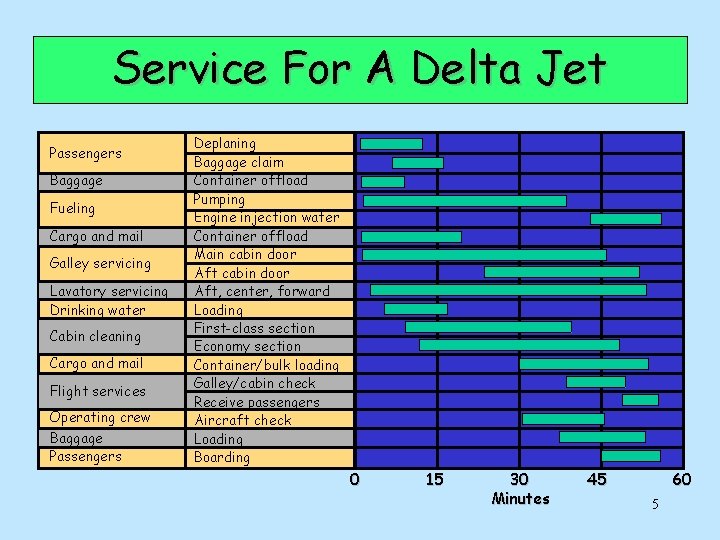
Service For A Delta Jet Passengers Baggage Fueling Cargo and mail Galley servicing Lavatory servicing Drinking water Cabin cleaning Cargo and mail Flight services Operating crew Baggage Passengers Deplaning Baggage claim Container offload Pumping Engine injection water Container offload Main cabin door Aft, center, forward Loading First-class section Economy section Container/bulk loading Galley/cabin check Receive passengers Aircraft check Loading Boarding 0 15 30 Minutes 45 60 5
CPM & PERT þ Network techniques þ Developed in 1950’s þ Consider precedence relationships and interdependencies þ Each uses a different estimate of activity times CPM: activity durations are known with certainty 6 PERT: not known with certainty
Steps CPM & PERT 1. Define the project and prepare the work breakdown structure 2. Develop relationships among the activities - decide which activities must precede and which must follow others 3. Draw the network connecting all of the activities 7
Six Steps CPM & PERT 4. Assign time and/or cost estimates to each activity 5. Compute the longest time path through the network – this is called the critical path 6. Use the network to help plan, schedule, monitor, and control the project 8
Questions CPM & PERT Can Answer 1. When will completed? the entire project be 2. What are the critical activities or tasks in the project? 3. Which are the noncritical activities? 4. Is the project on schedule, behind schedule, or ahead of schedule? (due date!) 9
Questions CPM & PERT Can Answer 5. Is the money spent equal to, less than, or greater than the budget? 6. Are there enough resources available to finish the project on time? 7. If the project must be finished in a shorter time, what is the way to accomplish this at least cost (crashing)? 10
Precedence Relationships and Networks Activity j is a predecessor of activity k if activity j must be completed before activity k can begin Project networks represent the precedence relationships between activities 11
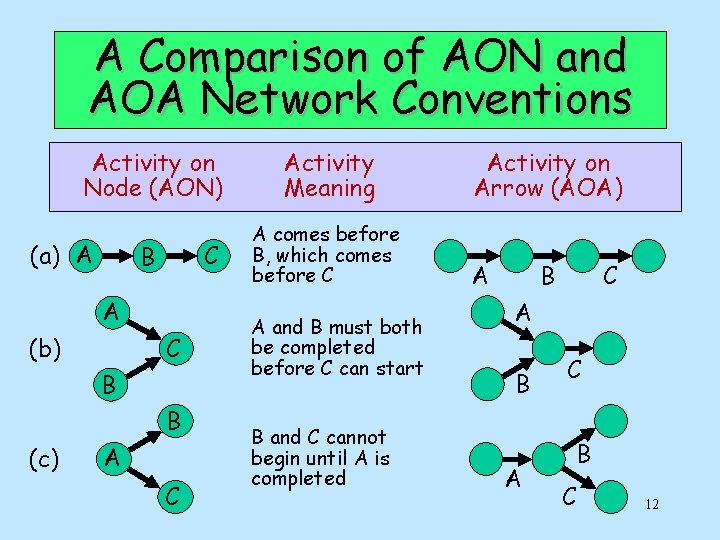
A Comparison of AON and AOA Network Conventions Activity on Node (AON) (a) A C B A (b) C B B (c) A C Activity Meaning A comes before B, which comes before C A and B must both be completed before C can start B and C cannot begin until A is completed Activity on Arrow (AOA) A B C A B A C B C 12
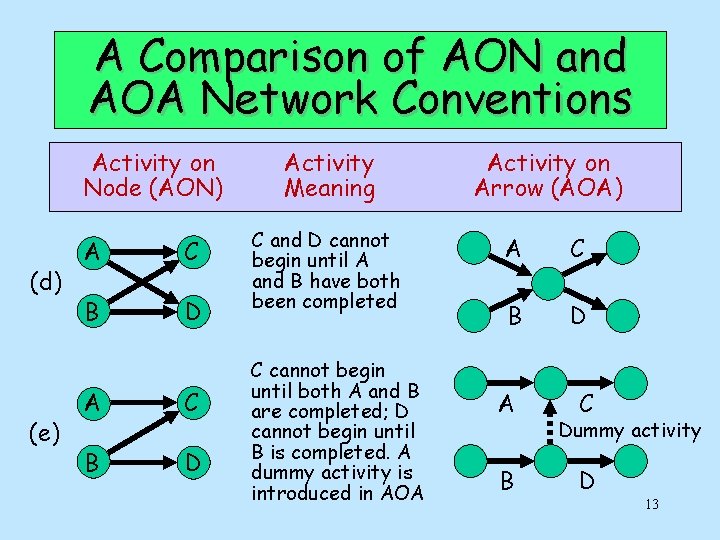
A Comparison of AON and AOA Network Conventions Activity on Node (AON) (d) (e) A C B D Activity Meaning C and D cannot begin until A and B have both been completed C cannot begin until both A and B are completed; D cannot begin until B is completed. A dummy activity is introduced in AOA Activity on Arrow (AOA) A C B Dummy activity D 13
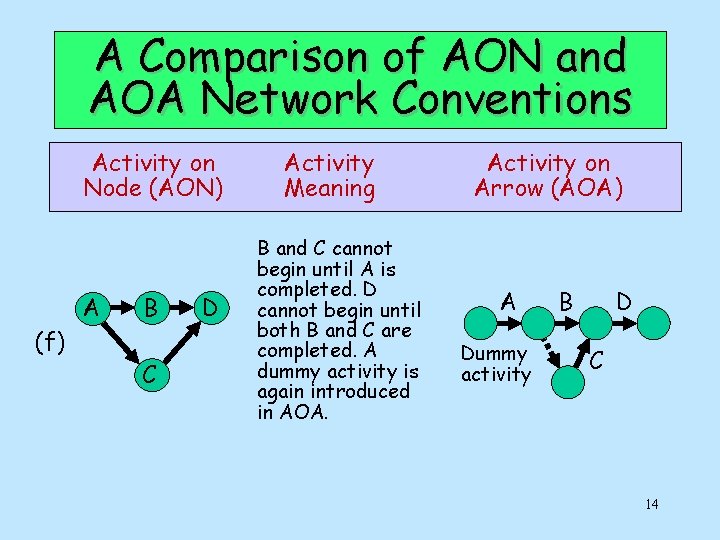
A Comparison of AON and AOA Network Conventions Activity on Node (AON) A B (f) C D Activity Meaning B and C cannot begin until A is completed. D cannot begin until both B and C are completed. A dummy activity is again introduced in AOA. Activity on Arrow (AOA) A Dummy activity D B C 14
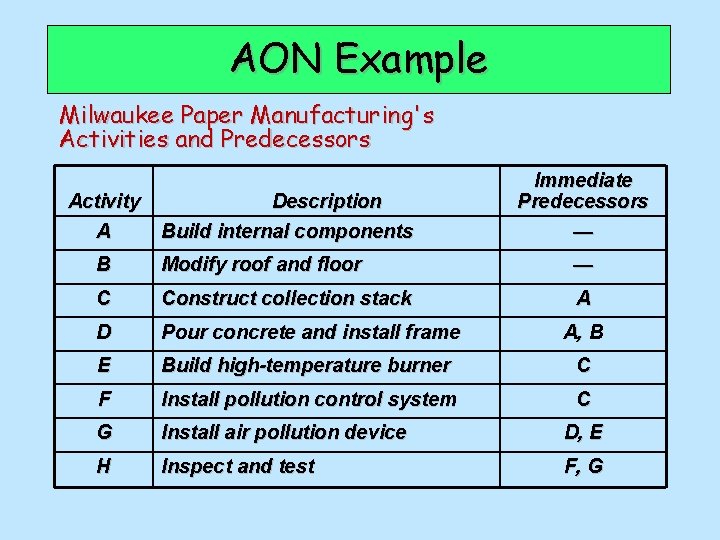
AON Example Milwaukee Paper Manufacturing's Activities and Predecessors Activity A Description Build internal components Immediate Predecessors — B Modify roof and floor — C Construct collection stack A D Pour concrete and install frame A, B E Build high-temperature burner C F Install pollution control system C G Install air pollution device D, E H Inspect and test F, G
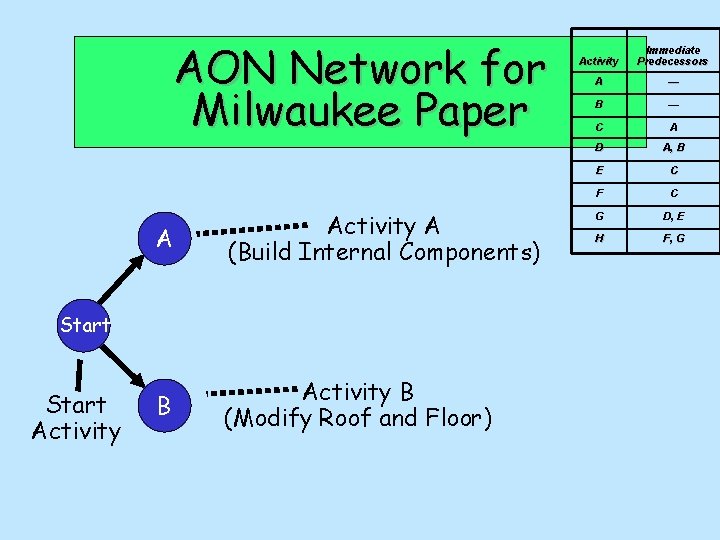
AON Network for Milwaukee Paper A Activity A (Build Internal Components) B Activity B (Modify Roof and Floor) Start Activity Immediate Predecessors A — B — C A D A, B E C F C G D, E H F, G
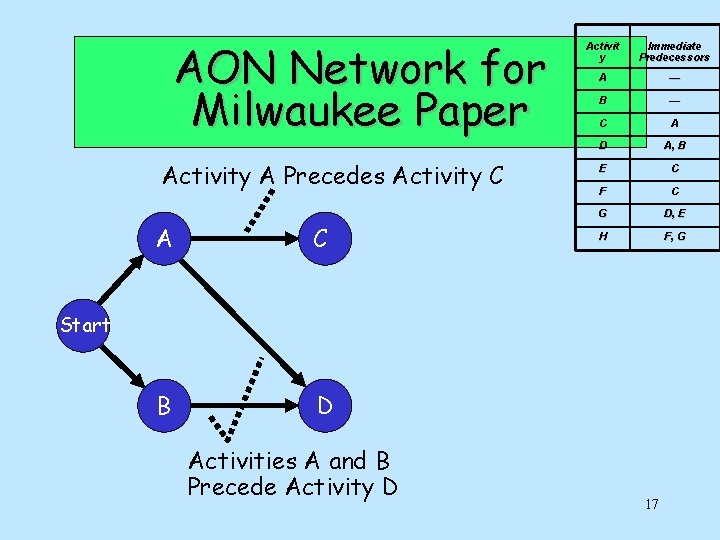
AON Network for Milwaukee Paper Activity A Precedes Activity C A C B D Activit y Immediate Predecessors A — B — C A D A, B E C F C G D, E H F, G Start Activities A and B Precede Activity D 17
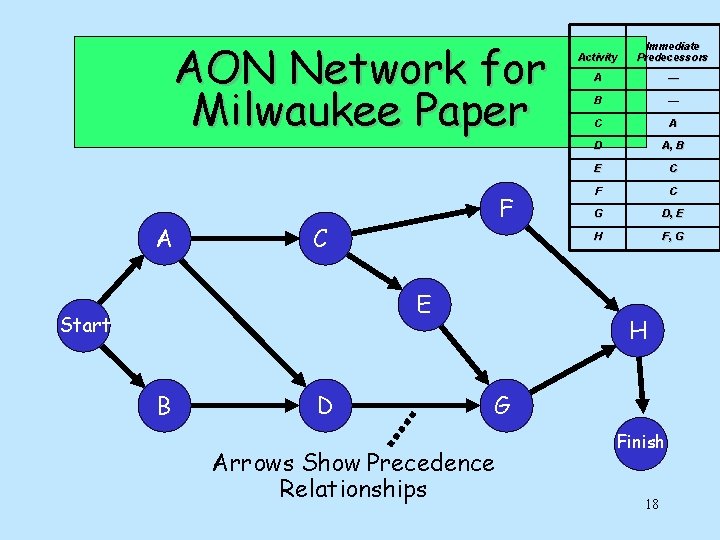
AON Network for Milwaukee Paper A F C E Start B D Activity Immediate Predecessors A — B — C A D A, B E C F C G D, E H F, G H G Arrows Show Precedence Relationships Finish 18
Determining the Project Schedule Perform a Critical Path Analysis þ The critical path is the longest path through the network þ The critical path is the shortest time in which the project can be completed þ Any delay in critical path activities delays the project þ Critical path activities have no slack time 19
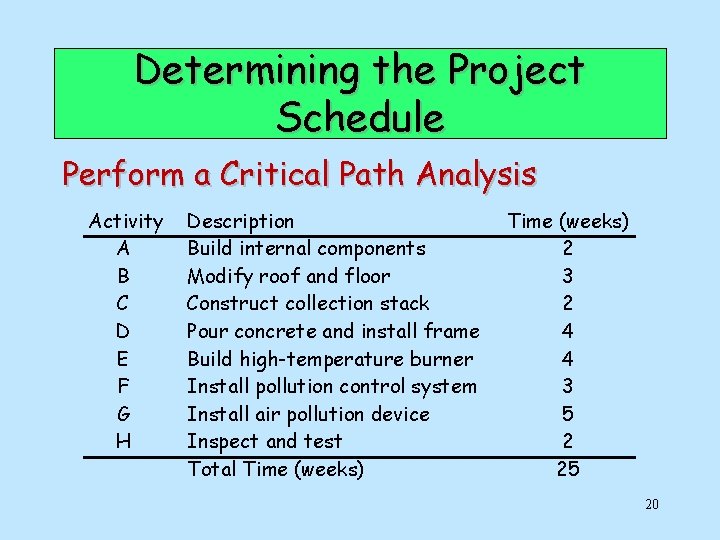
Determining the Project Schedule Perform a Critical Path Analysis Activity A B C D E F G H Description Build internal components Modify roof and floor Construct collection stack Pour concrete and install frame Build high-temperature burner Install pollution control system Install air pollution device Inspect and test Total Time (weeks) 2 3 2 4 4 3 5 2 25 20
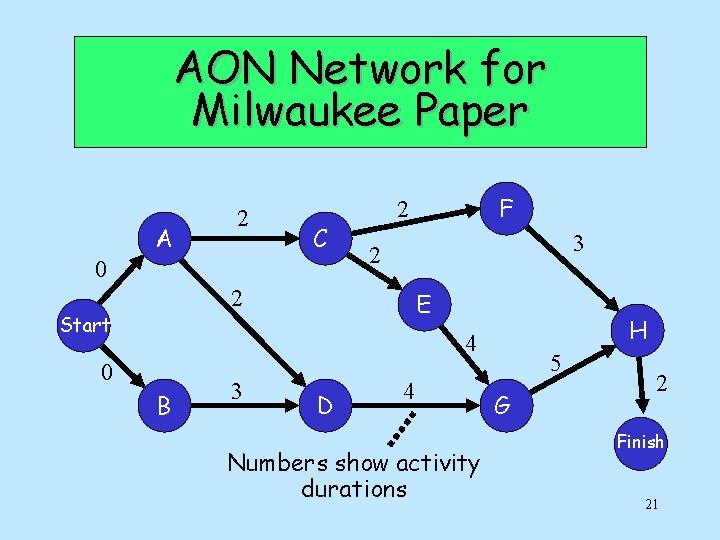
AON Network for Milwaukee Paper A 2 C 0 3 2 2 Start F 2 E H 4 0 B 3 D 4 Numbers show activity durations 5 G 2 Finish 21
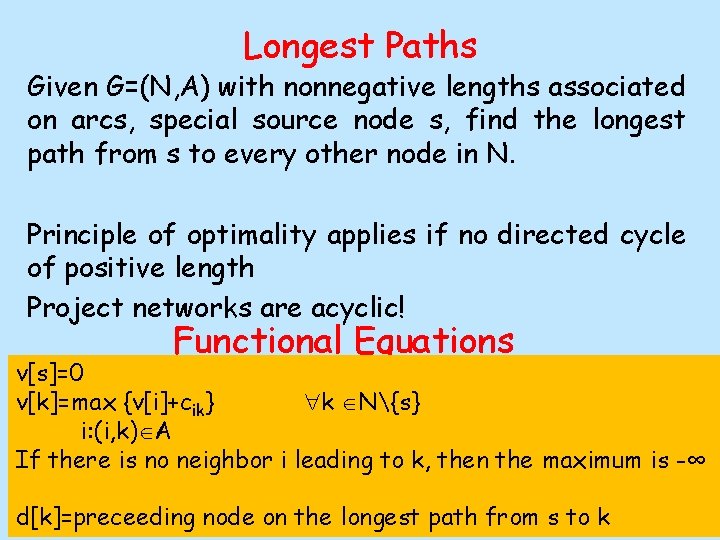
Longest Paths Given G=(N, A) with nonnegative lengths associated on arcs, special source node s, find the longest path from s to every other node in N. Principle of optimality applies if no directed cycle of positive length Project networks are acyclic! Functional Equations v[s]=0 v[k]=max {v[i]+cik} k N{s} i: (i, k) A If there is no neighbor i leading to k, then the maximum is -∞ d[k]=preceeding node on the longest path from s to k 22
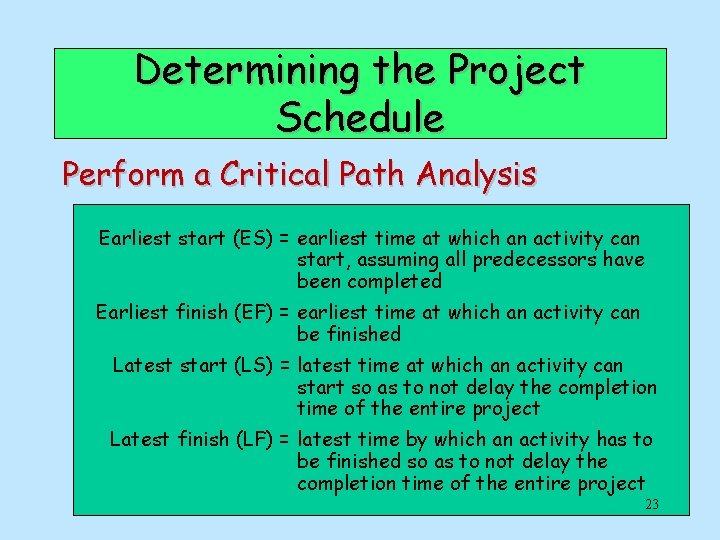
Determining the Project Schedule Perform a Critical Path Analysis Earliest start (ES) = earliest time at which an activity can Activity Description Timehave (weeks) start, assuming all predecessors A Build internal components 2 been completed Modify roof and floor 3 Earliest. Bfinish (EF) = earliest time at which an activity can be finished C Construct collection stack 2 Pour=concrete andat install 4 Latest. Dstart (LS) latest time whichframe an activity can start so as to not burner delay the completion E Build high-temperature 4 of the entiresystem project F Installtime pollution control 3 Latest. Gfinish (LF) = latest time bydevice which an activity has Install air pollution 5 to be finished so as to not delay the H Inspect and test 2 completion time of the entire project Table Total Time (weeks) 25 233. 2
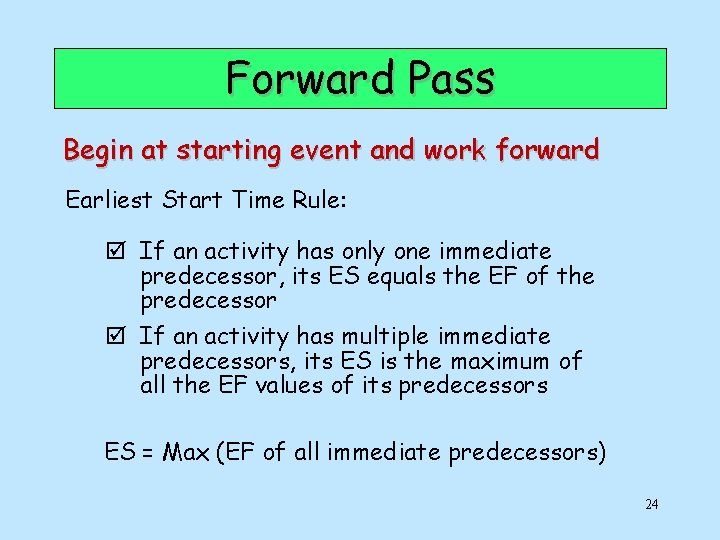
Forward Pass Begin at starting event and work forward Earliest Start Time Rule: þ If an activity has only one immediate predecessor, its ES equals the EF of the predecessor þ If an activity has multiple immediate predecessors, its ES is the maximum of all the EF values of its predecessors ES = Max (EF of all immediate predecessors) 24

Forward Pass Begin at starting event and work forward Earliest Finish Time Rule: þ The earliest finish time (EF) of an activity is the sum of its earliest start time (ES) and its activity time EF = ES + Activity time 25
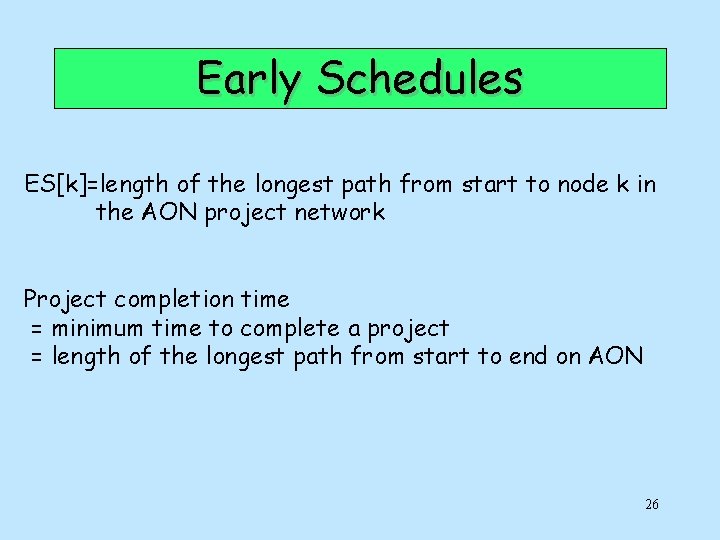
Early Schedules ES[k]=length of the longest path from start to node k in the AON project network Project completion time = minimum time to complete a project = length of the longest path from start to end on AON 26
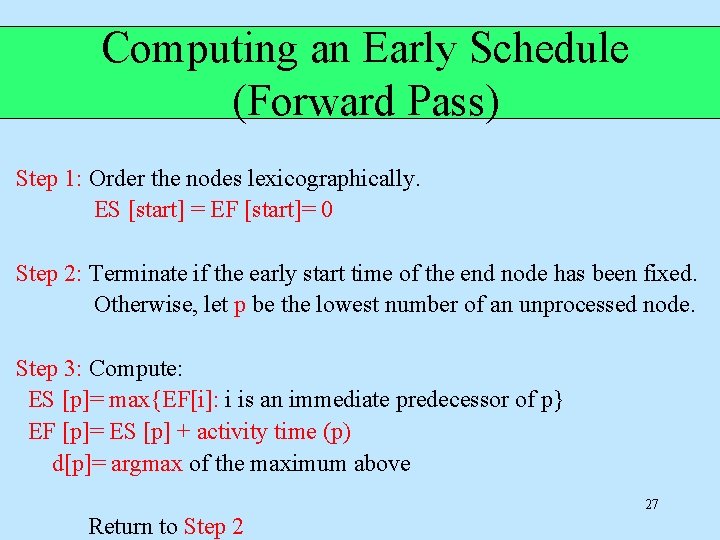
Computing an Early Schedule (Forward Pass) Step 1: Order the nodes lexicographically. ES [start] = EF [start]= 0 Step 2: Terminate if the early start time of the end node has been fixed. Otherwise, let p be the lowest number of an unprocessed node. Step 3: Compute: ES [p]= max{EF[i]: i is an immediate predecessor of p} EF [p]= ES [p] + activity time (p) d[p]= argmax of the maximum above 27 Return to Step 2
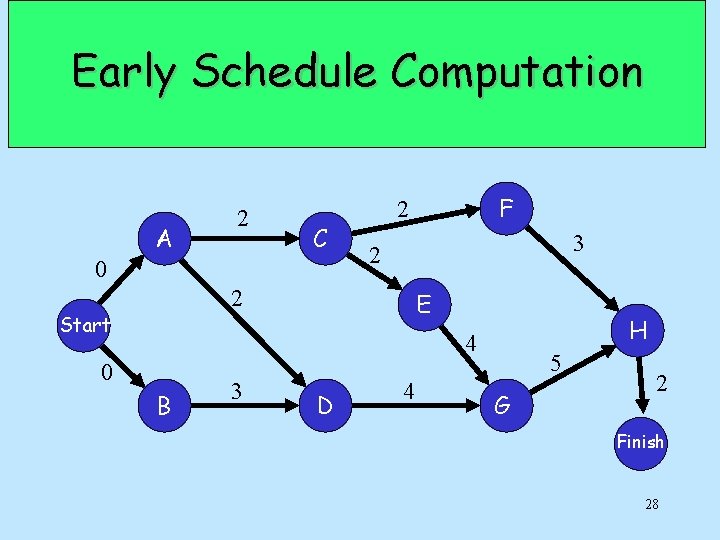
Early Schedule Computation A 2 C 0 3 2 2 Start F 2 E H 4 0 B 3 D 4 5 G 2 Finish 28
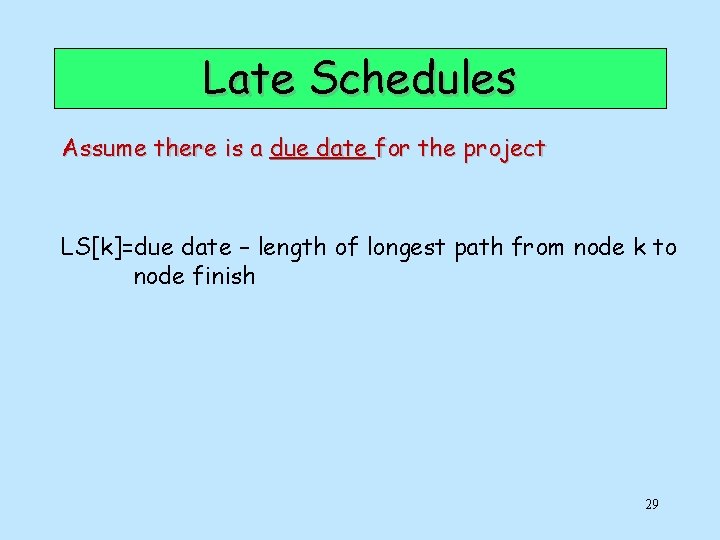
Late Schedules Assume there is a due date for the project LS[k]=due date – length of longest path from node k to node finish 29
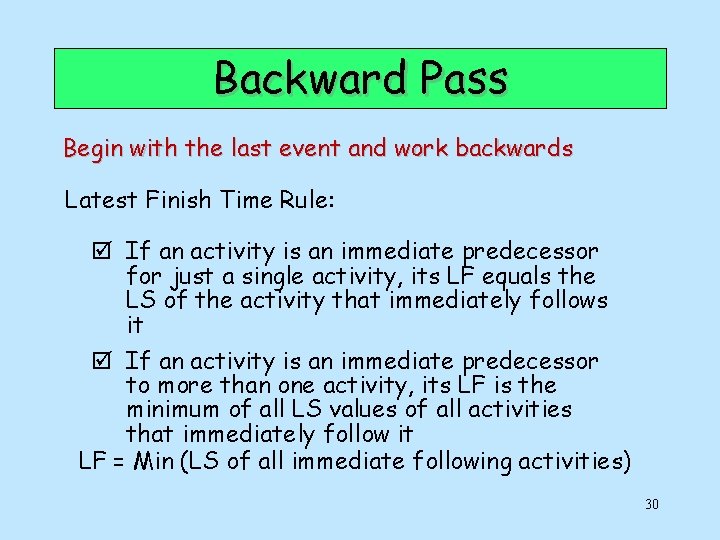
Backward Pass Begin with the last event and work backwards Latest Finish Time Rule: þ If an activity is an immediate predecessor for just a single activity, its LF equals the LS of the activity that immediately follows it þ If an activity is an immediate predecessor to more than one activity, its LF is the minimum of all LS values of all activities that immediately follow it LF = Min (LS of all immediate following activities) 30
Backward Pass Begin with the last event and work backwards Latest Start Time Rule: þ The latest start time (LS) of an activity is the difference of its latest finish time (LF) and its activity time LS = LF – Activity time 31
Computing a Late Schedule (Backward Pass) Step 1: Order the nodes lexicographically. LF [finish] = LS [finish]= due date Step 2: Terminate if the late start time of the start node has been fixed. Otherwise, let p be the highest number of an unprocessed node. Step 3: Compute: LF [p]= min{LS[i]: i is an immediate successor of p} LS [p]= LF [p] - activity time (p) d[p]= argmin of the minimum above Return to Step 2 32
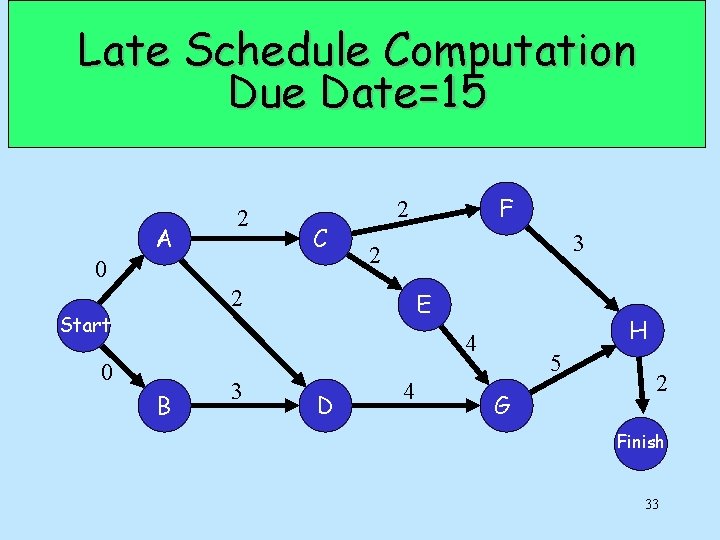
Late Schedule Computation Due Date=15 A 2 C 0 3 2 2 Start F 2 E H 4 0 B 3 D 4 5 G 2 Finish 33
Computing Slack Time After computing the ES, EF, LS, and LF times for all activities, compute the slack or free time for each activity þ Slack is the length of time an activity can be delayed without delaying the entire project Slack = LS – ES or Slack = LF – EF þ Critical Activities: Activities with Zero Slack 34

Computing Slack Time Earliest Start Finish Activity ES EF A B C D E F G H 0 0 2 3 4 4 8 13 2 3 4 7 8 7 13 15 Latest Start LS Latest Finish LF Slack LS – ES On Critical Path 0 1 2 4 4 10 8 13 2 4 4 8 8 13 13 15 0 1 0 6 0 0 Yes No Yes 35
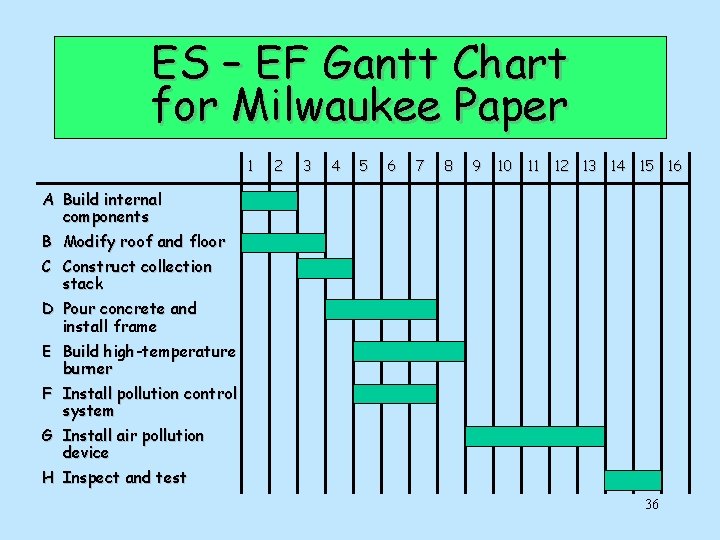
ES – EF Gantt Chart for Milwaukee Paper 1 2 3 4 5 6 7 8 9 10 11 12 13 14 15 16 A Build internal components B Modify roof and floor C Construct collection stack D Pour concrete and install frame E Build high-temperature burner F Install pollution control system G Install air pollution device H Inspect and test 36
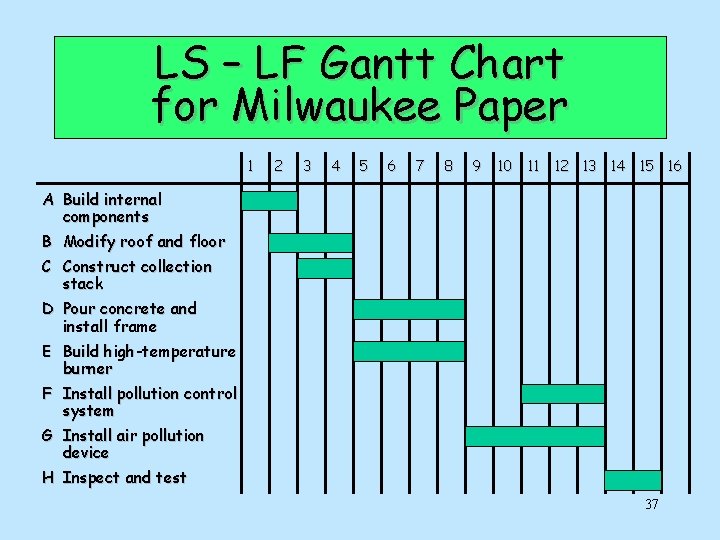
LS – LF Gantt Chart for Milwaukee Paper 1 2 3 4 5 6 7 8 9 10 11 12 13 14 15 16 A Build internal components B Modify roof and floor C Construct collection stack D Pour concrete and install frame E Build high-temperature burner F Install pollution control system G Install air pollution device H Inspect and test 37
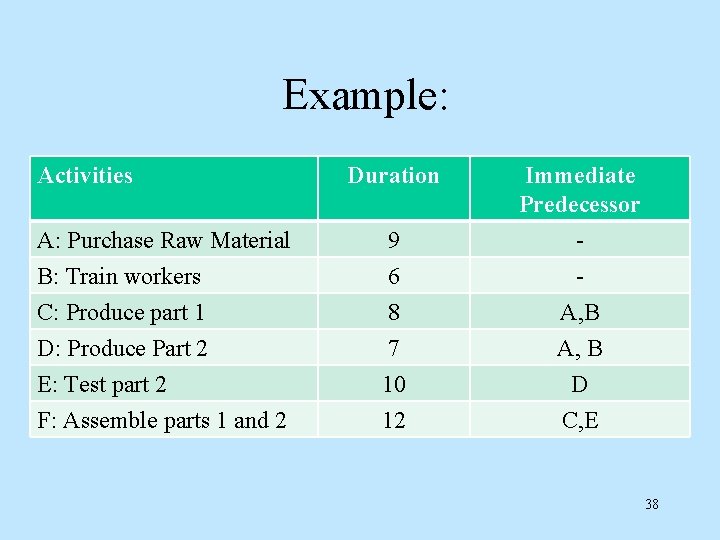
Example: Activities A: Purchase Raw Material B: Train workers C: Produce part 1 D: Produce Part 2 E: Test part 2 F: Assemble parts 1 and 2 Duration 9 6 8 7 10 12 Immediate Predecessor A, B D C, E 38

39
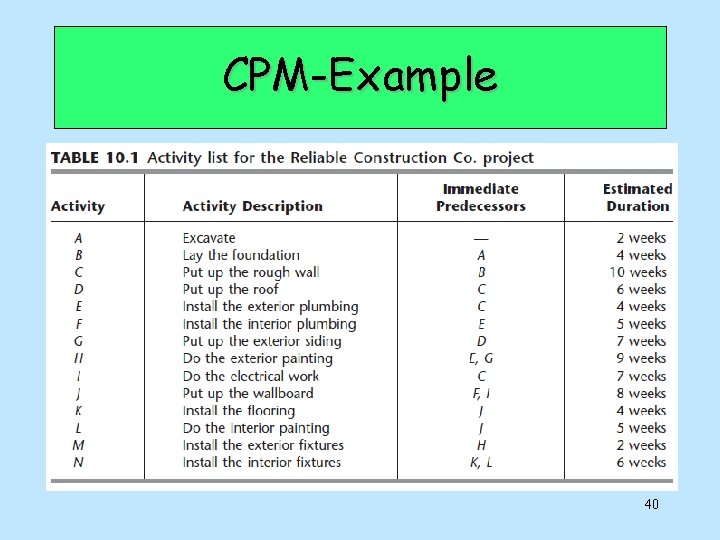
CPM-Example 40
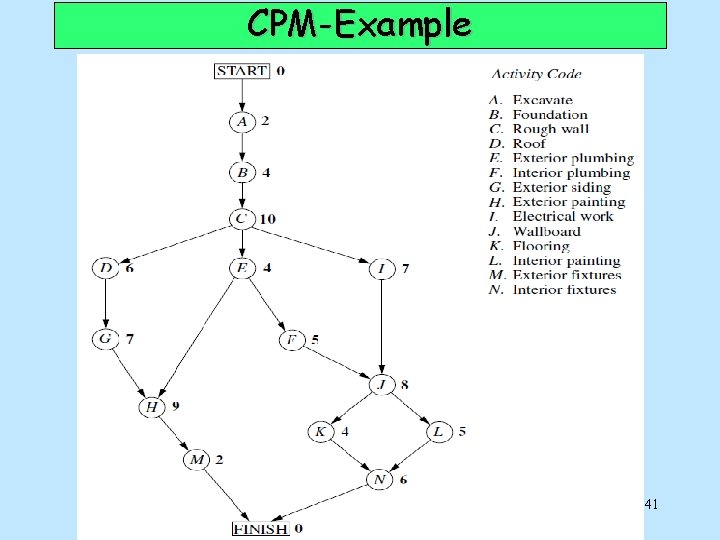
CPM-Example 41
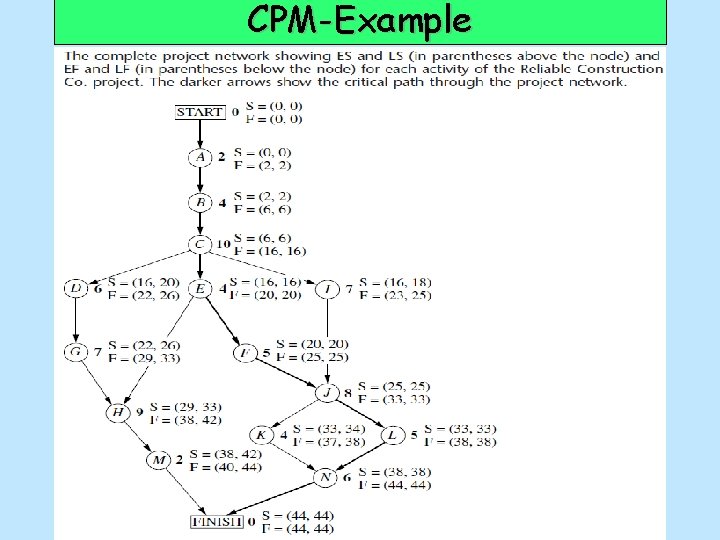
CPM-Example 42
PERT: Variability in Activity Times þ CPM assumes we know a fixed time estimate for each activity and there is no variability in activity times þ PERT uses a probability distribution for activity times to allow for variability
PERT: Variability in Activity Times þ Three time estimates are required þ Optimistic time (a) – if everything goes according to plan þ Pessimistic time (b) – assuming very unfavorable conditions þ Most likely time (m) – most realistic estimate
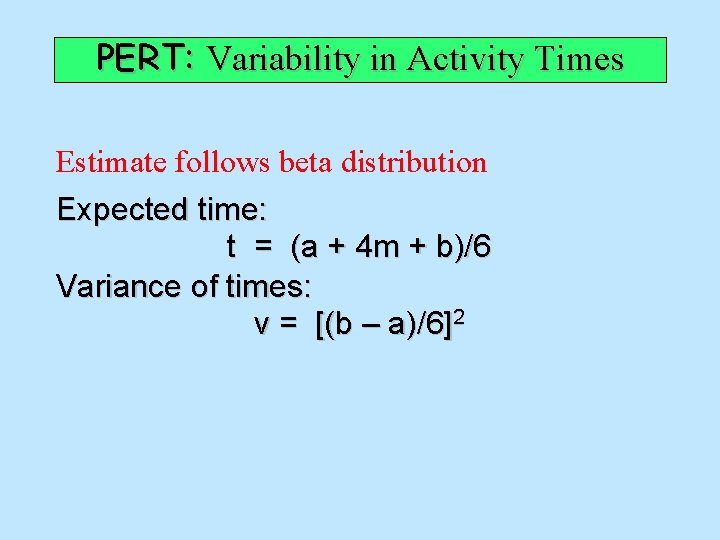
PERT: Variability in Activity Times Estimate follows beta distribution Expected time: t = (a + 4 m + b)/6 Variance of times: v = [(b – a)/6]2
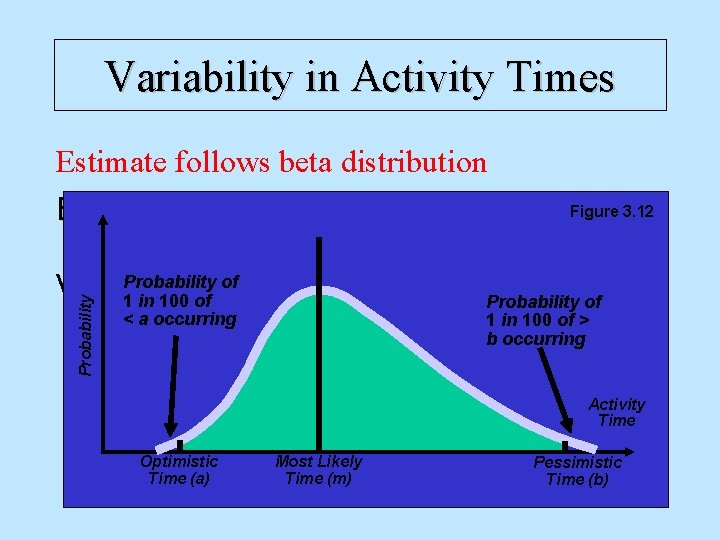
Variability in Activity Times Probability Estimate follows beta distribution Figure 3. 12 Expected time: t = (a + 4 m + b)/6 Probability of Variance of times: 1 in 100 of Probability of < a occurring v = [(b − a)/6]2 1 in 100 of > b occurring Activity Time Optimistic Time (a) Most Likely Time (m) Pessimistic Time (b)
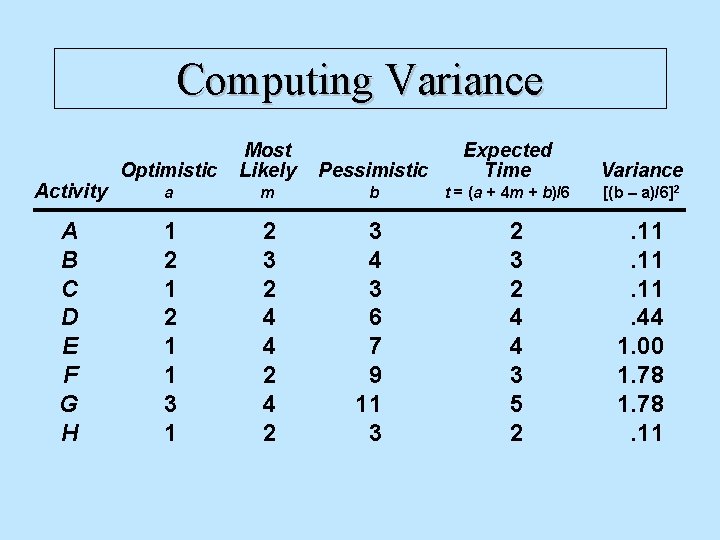
Computing Variance Activity A B C D E F G H Optimistic Most Likely Pessimistic Expected Time Variance a m b t = (a + 4 m + b)/6 [(b – a)/6]2 1 2 1 1 3 1 2 3 2 4 4 2 3 4 3 6 7 9 11 3 2 4 4 3 5 2 . 11. 11. 44 1. 00 1. 78. 11
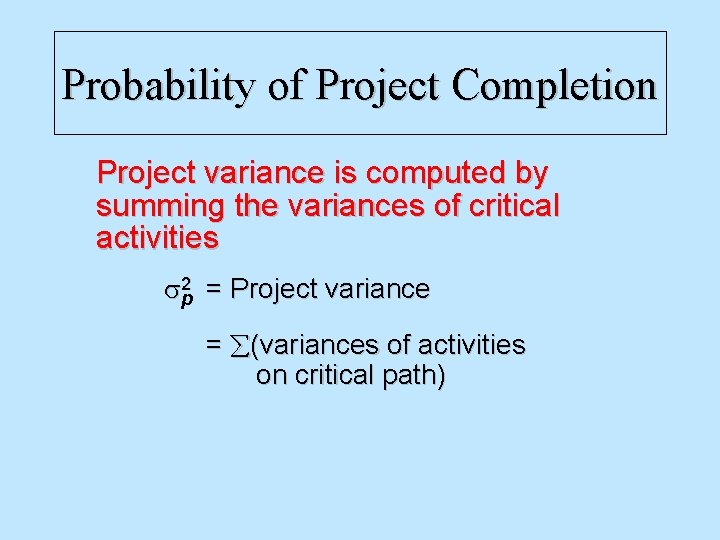
Probability of Project Completion Project variance is computed by summing the variances of critical activities sp 2 = Project variance = (variances of activities on critical path)
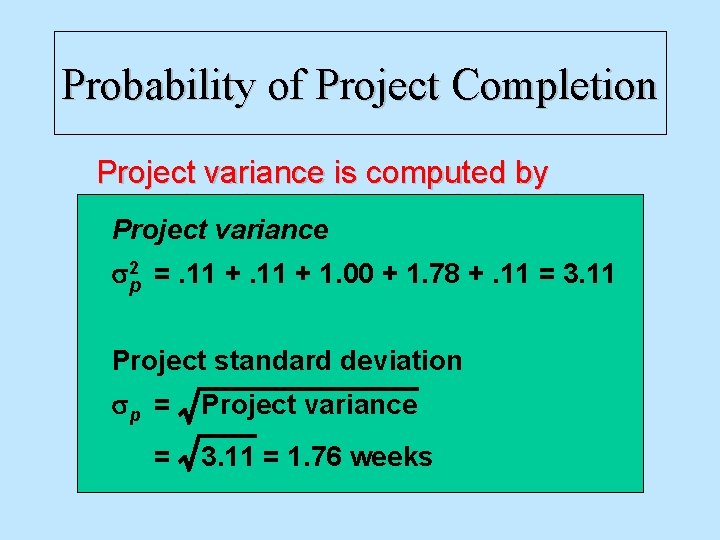
Probability of Project Completion Project variance is computed by summing the variances of critical Project variance activities s 2 p =. 11 + 1. 00 + 1. 78 +. 11 = 3. 11 Project standard deviation sp = = Project variance 3. 11 = 1. 76 weeks
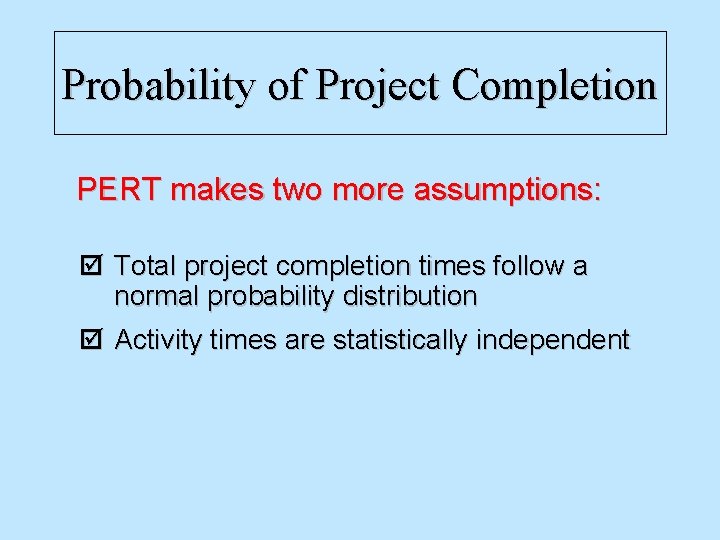
Probability of Project Completion PERT makes two more assumptions: þ Total project completion times follow a normal probability distribution þ Activity times are statistically independent
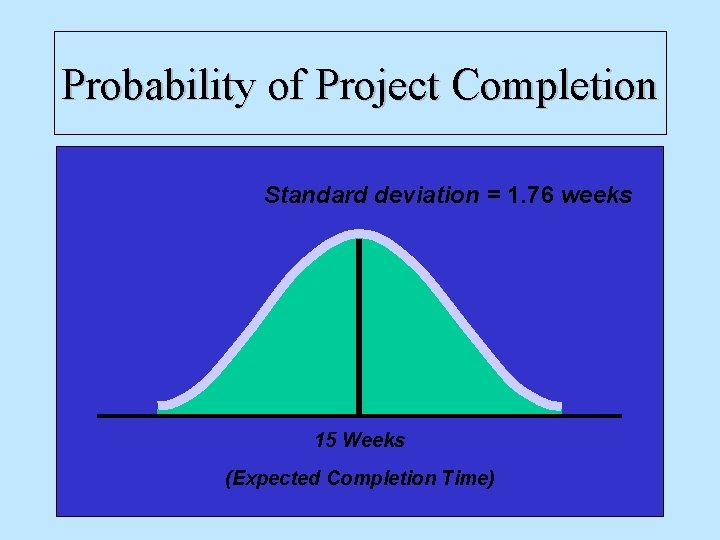
Probability of Project Completion Standard deviation = 1. 76 weeks 15 Weeks (Expected Completion Time)
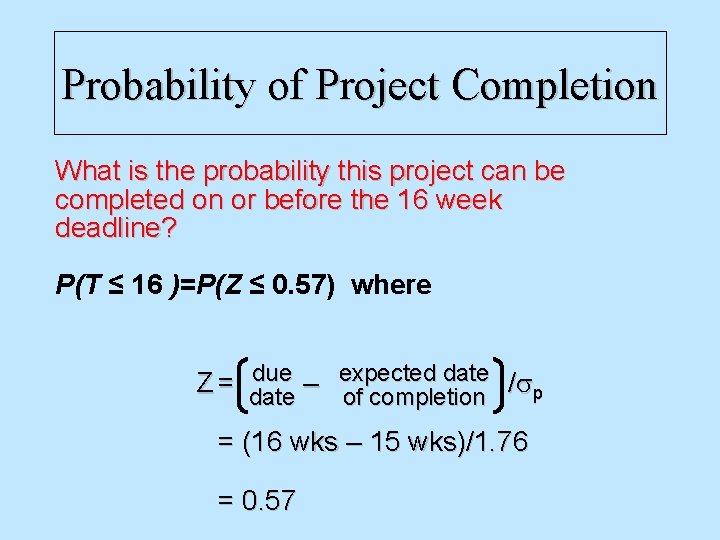
Probability of Project Completion What is the probability this project can be completed on or before the 16 week deadline? P(T ≤ 16 )=P(Z ≤ 0. 57) where due – expected date /s Z = date p of completion = (16 wks – 15 wks)/1. 76 = 0. 57

LP to find the project completion time G=(N, A): AON project network Parameters: Decision Variables: Model:
Crashing a Project What if due date < project completion time? Crashing the project: Reducing the project duration below its normal value by accomplishing some activities in a shorter time at a larger cost
Factors to Consider When Crashing A Project þ The amount by which an activity is crashed is, in fact, permissible þ Taken together, the shortened activity durations will enable us to finish the project by the due date þ The total cost of crashing is as small as possible
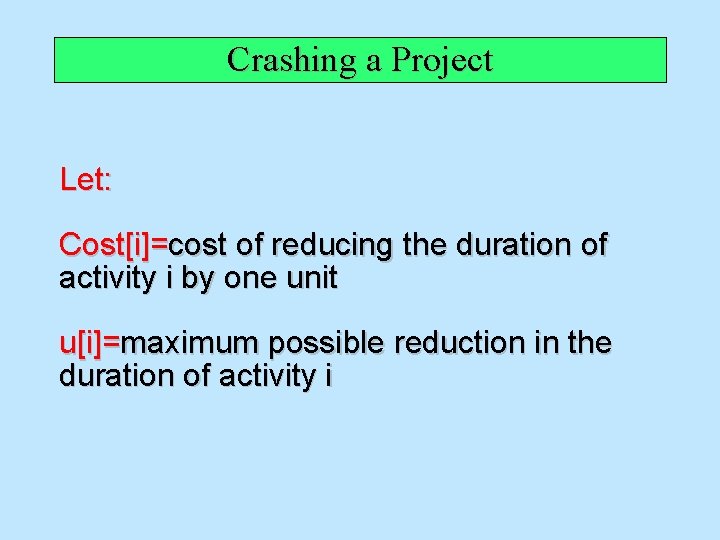
Crashing a Project Let: Cost[i]=cost of reducing the duration of activity i by one unit u[i]=maximum possible reduction in the duration of activity i
LP to find the min cost crashing Decision Variables: Model:
Least possible project duration with a budget of K units? Decision Variables: Model:

Advantages of PERT/CPM 1. Especially useful when scheduling and controlling large projects 2. Straightforward concept and not mathematically complex 3. Network depiction help highlight relationships among project activities 4. Critical path and slack time analyses help pinpoint activities that need to be closely watched
Advantages of PERT/CPM 5. Project documentation and graphics point out who is responsible for various activities 6. Applicable to a wide variety of projects 7. Useful in monitoring not only schedules but costs as well
Limitations of PERT/CPM 1. Project activities have to be clearly defined, independent, and stable in their relationships 2. Precedence relationships must be specified and networked together 3. Time estimates tend to be subjective and are subject to fudging by managers 4. There is an inherent danger of too much emphasis being placed on the longest, or critical, path
- Slides: 61