
PROJECT RISKS MEANING Risk is the possibility of

PROJECT RISKS
MEANING • Risk is the possibility of loss or injury. Project risk is an uncertain event or condition that, if it occurs, has an effect on at least one project objective. • Having the best people execute the plan does not guarantee success. There a host of external factors which may play a role in determining the outcome regarding whether a project has been successful or not. These are called Project risks. The formal definition of a risk is an event or occurrence that may negatively impact the project. • Risks can be mitigated and even prevented. However this requires a good amount of understanding of the risks and advance planning
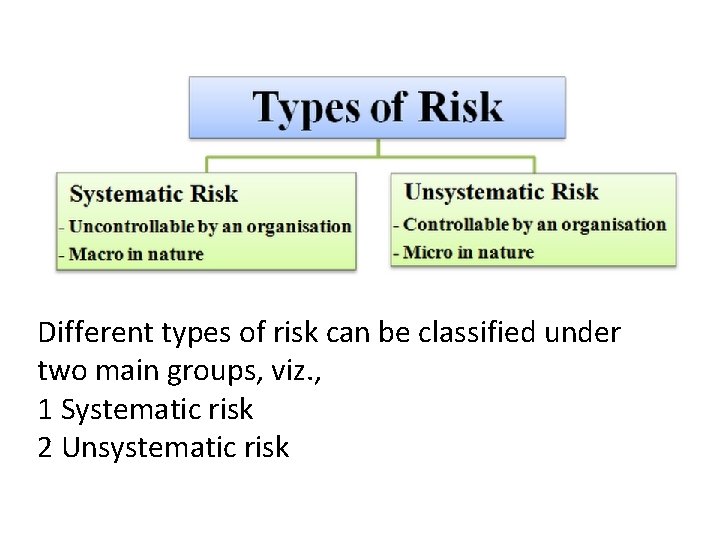
Different types of risk can be classified under two main groups, viz. , 1 Systematic risk 2 Unsystematic risk
A. Systematic Risk • Systematic risk is due to the influence of external factors on an organization. Such factors are normally uncontrollable from an organization's point of view. • It is a macro in nature as it affects a large number of organizations operating under a similar stream or same domain. It cannot be planned by the organization.
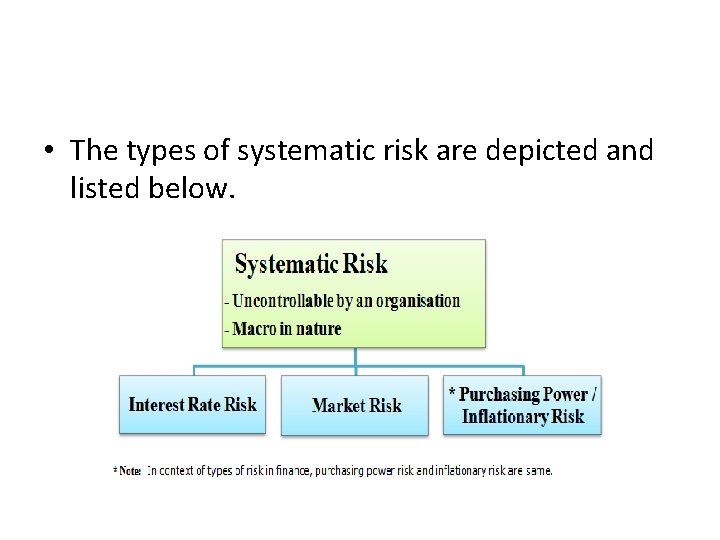
• The types of systematic risk are depicted and listed below.
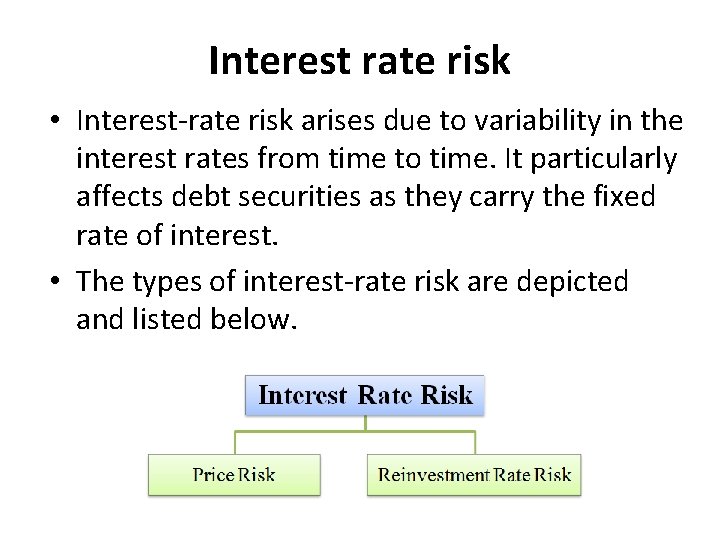
Interest rate risk • Interest-rate risk arises due to variability in the interest rates from time to time. It particularly affects debt securities as they carry the fixed rate of interest. • The types of interest-rate risk are depicted and listed below.
The meaning of price and reinvestment rate risk is as follows: • Price risk arises due to the possibility that the price of the shares, commodity, investment, etc. may decline or fall in the future. • Reinvestment rate risk results from fact that the interest or dividend earned from an investment can't be reinvested with the same rate of return as it was acquiring earlier.

Market risk • Market risk is associated with consistent fluctuations seen in the trading price of any particular shares or securities. That is, it arises due to rise or fall in the trading price of listed shares or securities in the stock market. • The types of market risk are depicted and listed below.
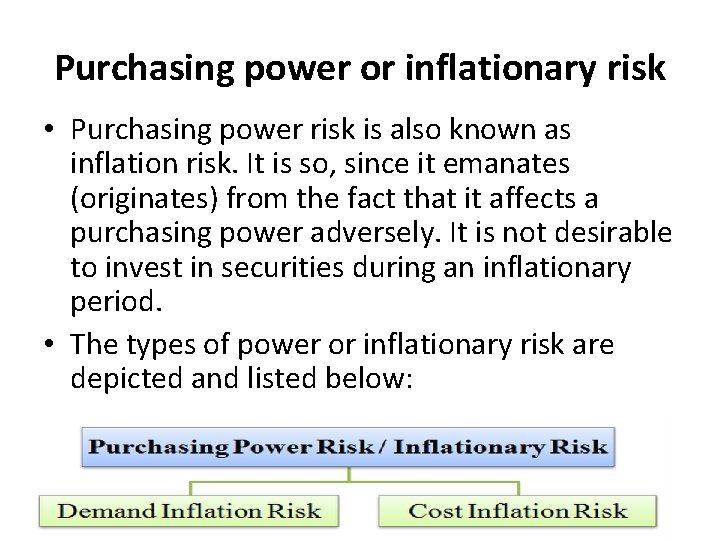
Purchasing power or inflationary risk • Purchasing power risk is also known as inflation risk. It is so, since it emanates (originates) from the fact that it affects a purchasing power adversely. It is not desirable to invest in securities during an inflationary period. • The types of power or inflationary risk are depicted and listed below:
The meaning of demand cost inflation risk is as follows: • Demand inflation risk arises due to increase in price, which result from an excess of demand over supply. It occurs when supply fails to cope with the demand hence cannot expand anymore. In other words, demand inflation occurs when production factors are under maximum utilization. • Cost inflation risk arises due to sustained increase in the prices of goods and services. It is actually caused by higher production cost. A high cost of production inflates the final price of finished goods consumed by people.
B. Unsystematic Risk • Unsystematic risk is due to the influence of internal factors prevailing within an organization. Such factors are normally controllable from an organization's point of view. • It is a micro in nature as it affects only a particular organization. It can be planned, so that necessary actions can be taken by the organization to mitigate (reduce the effect of) the risk.
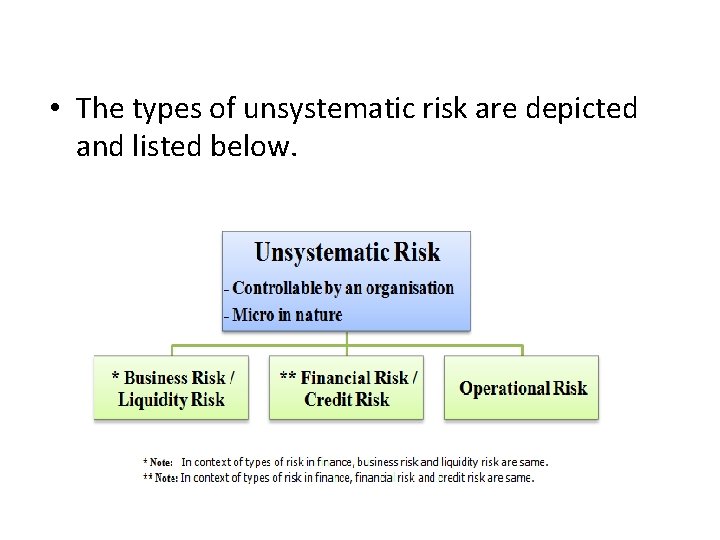
• The types of unsystematic risk are depicted and listed below.
1. Business or liquidity risk Business risk is also known as liquidity risk. It is so, since it emanates (originates) from the sale and purchase of securities affected by business cycles, technological changes, etc. 2. Financial or credit risk Financial risk is also known as credit risk. It arises due to change in the capital structure of the organization. The capital structure mainly comprises of three ways by which funds are sourced for the projects. These are as follows: • Owned funds. For e. g. share capital. • Borrowed funds. For e. g. loan funds. • Retained earnings. For e. g. reserve and surplus.
3. Operational risks are the business process risks failing due to human errors. This risk will change from industry to industry. It occurs due to breakdowns in the internal procedures, people, policies and systems.
Measurement of Risks 1. 2. 3. 4. Sensitivity Analysis Simulation Analysis Monte Carlo Analysis Decision Tree Analysis

Sensitivity Analysis • A sensitivity analysis determines how different values of an independent variable affect a particular dependent variable under a given set of assumptions. In other words, sensitivity analyses study how various sources of uncertainty in a mathematical model contribute to the model's overall uncertainty. • It is a way to predict the outcome of a decision given a certain range of variables. By creating a given set of variables, an analyst can determine how changes in one variable affect the outcome.
Benefits and Limitations of Sensitivity Analysis • Conducting sensitivity analysis provides a number of benefits for decision-makers. First, it acts as an indepth study of all the variables. Because it's more indepth, the predictions may be far more reliable. Secondly, It allows decision-makers to identify where they can make improvements in the future. Finally, it allows for the ability to make sound decisions about companies, the economy, or their investments. • But there are some disadvantages to using a model such as this. The outcomes are all based on assumptions because the variables are all based on historical data. This means it isn't exactly accurate, so there may be room for error when applying the analysis to future predictions.
Simulation Analysis • Simulation can be broadly defined as a technique for studying real-world dynamical systems by imitating their behavior using a mathematical model of the system implemented on a digital computer. • The Simulation Analysis is a method, wherein the infinite calculations are made to obtain the possible outcomes and probabilities for any choice of action. • It is also called what if analysis.
Advantages and Disadvantages Main advantages of simulation include: • Study the behavior of a system without building it. • Results are accurate in general, compared to analytical model. • Help to find un-expected phenomenon, behavior of the system. • Easy to perform ``What-If'' analysis. Main disadvantages of simulation include: • Expensive to build a simulation model. • Expensive to conduct simulation. • Sometimes it is difficult to interpret the simulation results.
Monte Carlo Analysis • Monte Carlo simulations are used to model the probability of different outcomes in a process that cannot easily be predicted due to the intervention of random variables. It is a technique used to understand the impact of risk and uncertainty in prediction and forecasting models. • Monte Carlo simulation is also referred to as multiple probability simulation. Monte Carlo simulations are named after the gambling hot spot in Monaco, since chance and random outcomes are central to the modeling technique, much as they are to games like roulette, dice, and slot machines. The technique was first develop
Benefits and Limitations of Monte Carlo analysis in project management Benefits: • Provides early identification of how likely you are to meet project milestones and deadlines. • Can be used to create a more realistic budget and schedule. • Predicts the likelihood of schedule and cost overruns. • Quantifies risks to assess impacts better. • Provides objective data for decision making.
Limitations: • You must provide three estimates for every activity or factor being analyzed. • The analysis is only as good as the estimates provided. • The Monte Carlo simulation shows you the overall probability for the entire project or a large subset of it (such as a phase). It can’t be used to analyze individual activities or risks.
Decision Tree Analysis • A decision tree analysis is a specific technique in which a diagram (in this case referred to as a decision tree) is used for the purposes of assisting the project leader and the project team in making a difficult decision. • The decision tree is a diagram that presents the decision under consideration and, along different branches, the implications that may arise from choosing one path or another. • The decision tree analysis is often conducted when a number of future outcomes of scenarios remains uncertain, and is a form of brainstorming which, when decision making, can help to assure all factors are given proper consideration. • The decision tree analysis takes into account a number of factors including probabilities, costs, and rewards of each event and decision to be made in the future.
Advantages And Disadvantages Of Decision Tree Analysis • • • Advantages: Compared to other algorithms decision trees requires less effort for data preparation during pre-processing. A decision tree does not require normalization of data. A decision tree does not require scaling of data as well. Missing values in the data also does NOT affect the process of building decision tree to any considerable extent. A Decision trees model is very intuitive and easy to explain to technical teams as well as stakeholders.
• • • Disadvantage: A small change in the data can cause a large change in the structure of the decision tree causing instability. For a Decision tree sometimes calculation can go far more complex compared to other algorithms. Decision tree often involves higher time to train the model. Decision tree training is relatively expensive as complexity and time taken is more. Decision Tree algorithm is inadequate for applying regression and predicting continuous values.
- Slides: 25