
Project Risk Management The Importance of Project Risk
- Slides: 45
Project Risk Management
The Importance of Project Risk Management �Project risk management is the art and science of identifying, analyzing, and responding to risk throughout the life of a project and in the best interests of meeting project objectives �Risk management is often overlooked in projects, but it can help improve project success by helping select good projects, determining project scope, and developing realistic estimates �It helps project stakeholders understand the nature of 2 the project, involves team members in defining strengths and weaknesses and helps to integrate other
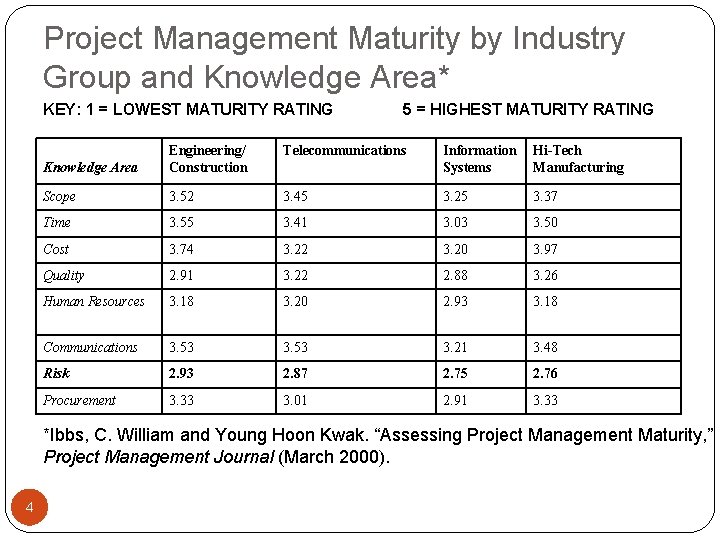
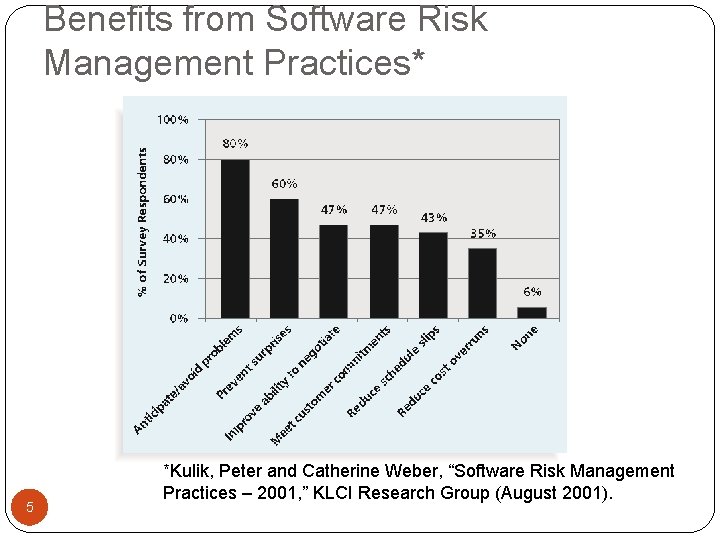
Research Shows Need to Improve Project Risk Management �Study by Ibbs and Kwak shows risk has the lowest maturity rating of all knowledge areas �A similar survey was completed with software development companies in South Africa in 2003, and risk management also had the lowest maturity �KLCI study shows the benefits of good software risk management practices 3
Project Management Maturity by Industry Group and Knowledge Area* KEY: 1 = LOWEST MATURITY RATING 5 = HIGHEST MATURITY RATING Telecommunications Knowledge Area Engineering/ Construction Information Systems Hi-Tech Manufacturing Scope 3. 52 3. 45 3. 25 3. 37 Time 3. 55 3. 41 3. 03 3. 50 Cost 3. 74 3. 22 3. 20 3. 97 Quality 2. 91 3. 22 2. 88 3. 26 Human Resources 3. 18 3. 20 2. 93 3. 18 Communications 3. 53 3. 21 3. 48 Risk 2. 93 2. 87 2. 75 2. 76 Procurement 3. 33 3. 01 2. 91 3. 33 *Ibbs, C. William and Young Hoon Kwak. “Assessing Project Management Maturity, ” Project Management Journal (March 2000). 4
Benefits from Software Risk Management Practices* 5 *Kulik, Peter and Catherine Weber, “Software Risk Management Practices – 2001, ” KLCI Research Group (August 2001).
Negative Risk �A dictionary definition of risk is “the possibility of loss or injury” �Negative risk involves understanding potential problems that might occur in the project and how they might impede project success �Negative risk management is like a form of insurance; it is an activity undertaken to lessen the impact of potentially adverse events on a project 6
Risk Can Be Positive �Positive risks are risks that result in good things happening; sometimes called opportunities �A general definition of project risk is an uncertainty that can have a negative or positive effect on meeting project objectives �The goal of project risk management is to minimize potential negative risks while maximizing potential positive risks 7
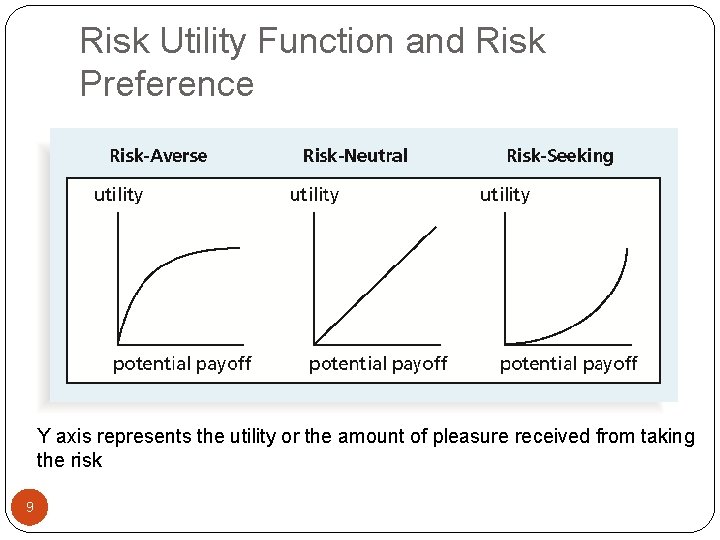
Risk Utility �Risk utility or risk tolerance is the amount of satisfaction or pleasure received from a potential payoff �Utility rises at a decreasing rate for people who are risk -averse; in other words when more payoff or money is at stake, a person or organization that is risk averse has lower tolerance for risk �Those who are risk-seeking have a higher tolerance for risk, and their satisfaction increases when more payoff is at stake �The risk-neutral approach achieves a balance between risk and payoff 8
Risk Utility Function and Risk Preference Y axis represents the utility or the amount of pleasure received from taking the risk 9
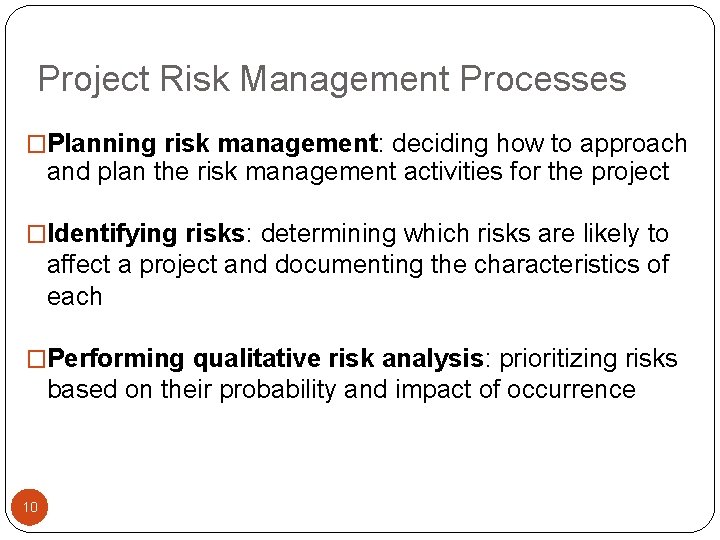
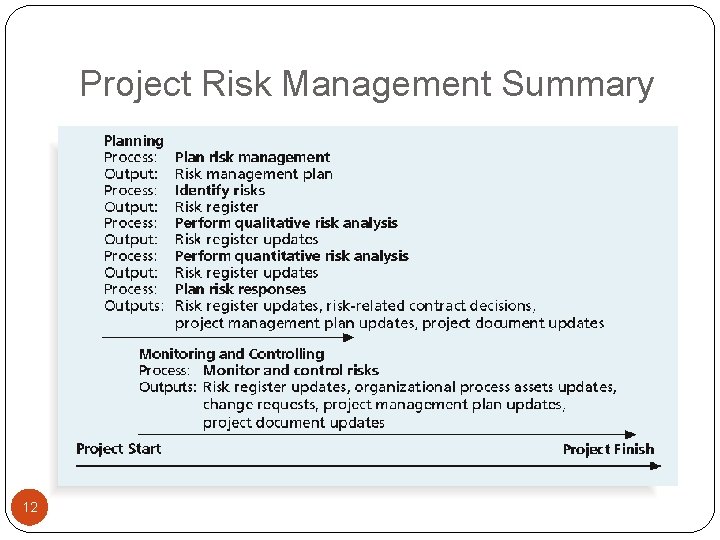
Project Risk Management Processes �Planning risk management: deciding how to approach and plan the risk management activities for the project �Identifying risks: determining which risks are likely to affect a project and documenting the characteristics of each �Performing qualitative risk analysis: prioritizing risks based on their probability and impact of occurrence 10
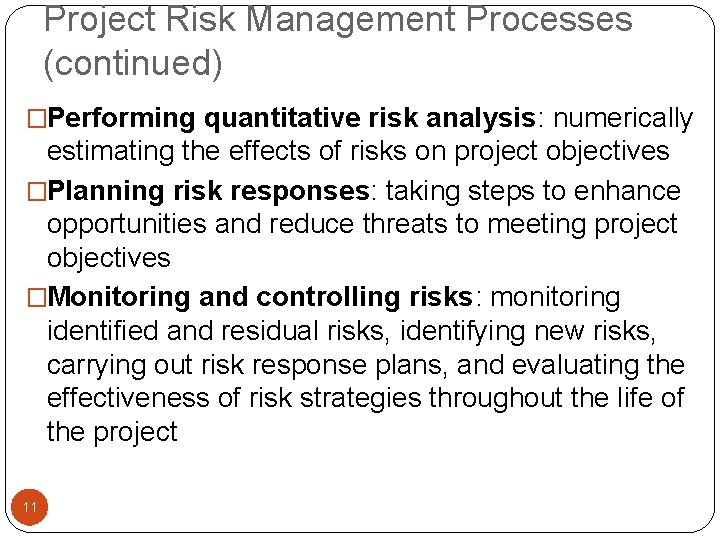
Project Risk Management Processes (continued) �Performing quantitative risk analysis: numerically estimating the effects of risks on project objectives �Planning risk responses: taking steps to enhance opportunities and reduce threats to meeting project objectives �Monitoring and controlling risks: monitoring identified and residual risks, identifying new risks, carrying out risk response plans, and evaluating the effectiveness of risk strategies throughout the life of the project 11
Project Risk Management Summary 12
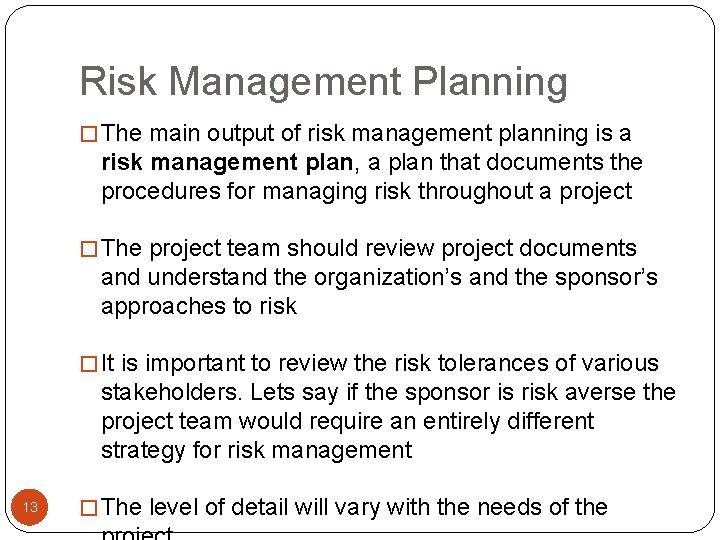
Risk Management Planning � The main output of risk management planning is a risk management plan, a plan that documents the procedures for managing risk throughout a project � The project team should review project documents and understand the organization’s and the sponsor’s approaches to risk � It is important to review the risk tolerances of various stakeholders. Lets say if the sponsor is risk averse the project team would require an entirely different strategy for risk management 13 � The level of detail will vary with the needs of the
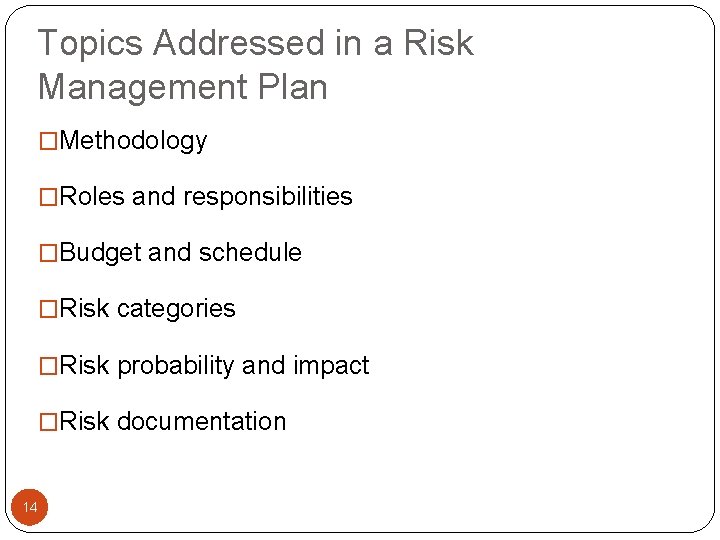
Topics Addressed in a Risk Management Plan �Methodology �Roles and responsibilities �Budget and schedule �Risk categories �Risk probability and impact �Risk documentation 14
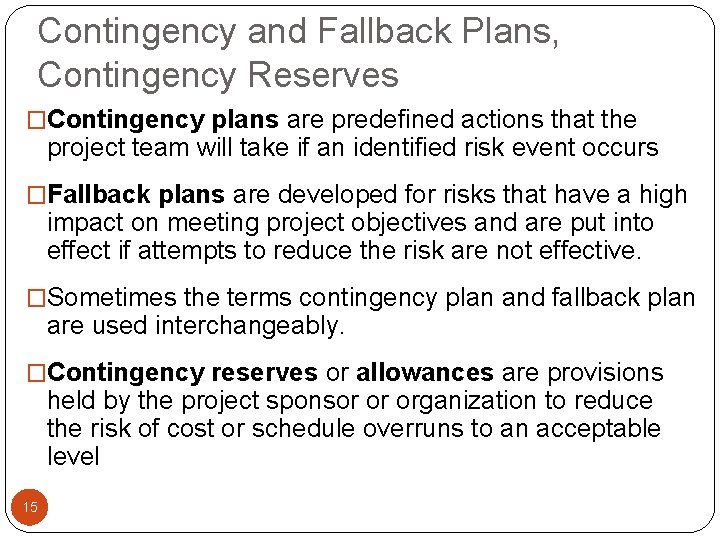
Contingency and Fallback Plans, Contingency Reserves �Contingency plans are predefined actions that the project team will take if an identified risk event occurs �Fallback plans are developed for risks that have a high impact on meeting project objectives and are put into effect if attempts to reduce the risk are not effective. �Sometimes the terms contingency plan and fallback plan are used interchangeably. �Contingency reserves or allowances are provisions held by the project sponsor or organization to reduce the risk of cost or schedule overruns to an acceptable level 15
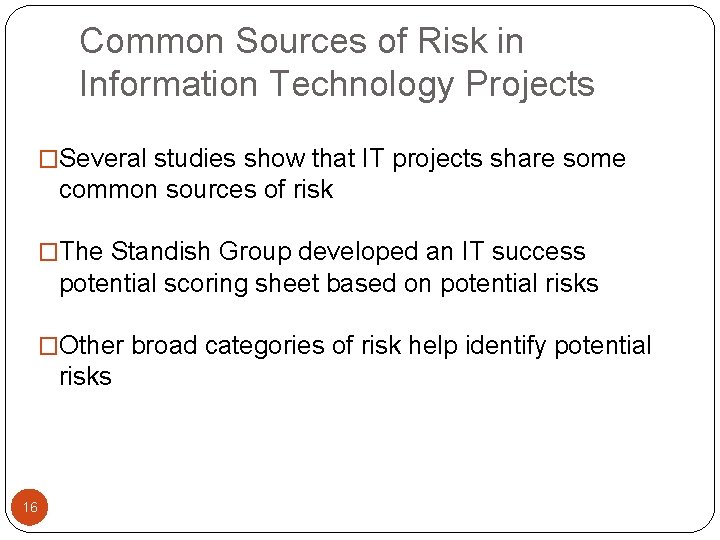
Common Sources of Risk in Information Technology Projects �Several studies show that IT projects share some common sources of risk �The Standish Group developed an IT success potential scoring sheet based on potential risks �Other broad categories of risk help identify potential risks 16
Information Technology Success Potential Scoring Sheet 17
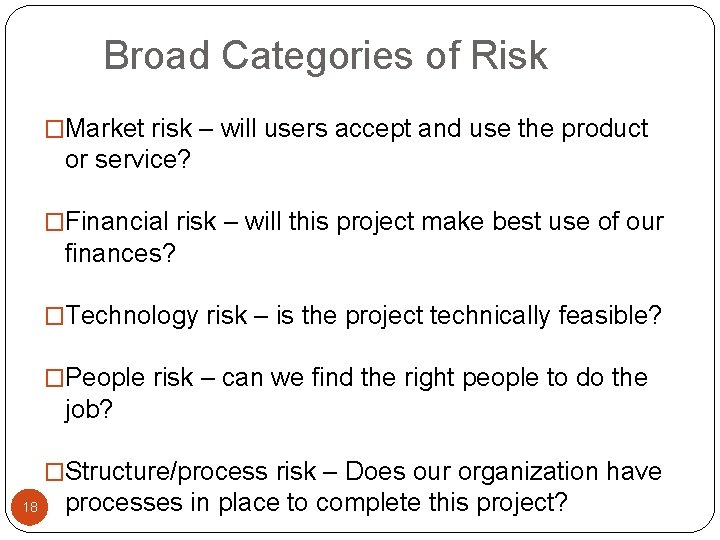
Broad Categories of Risk �Market risk – will users accept and use the product or service? �Financial risk – will this project make best use of our finances? �Technology risk – is the project technically feasible? �People risk – can we find the right people to do the job? �Structure/process risk – Does our organization have 18 processes in place to complete this project?
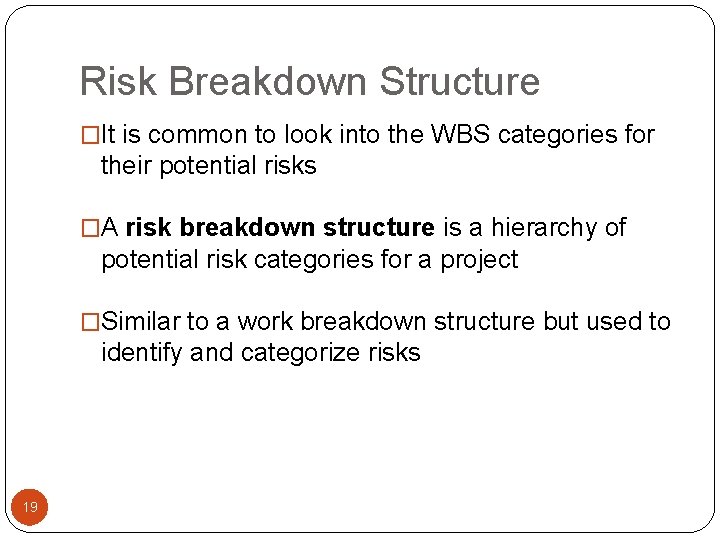
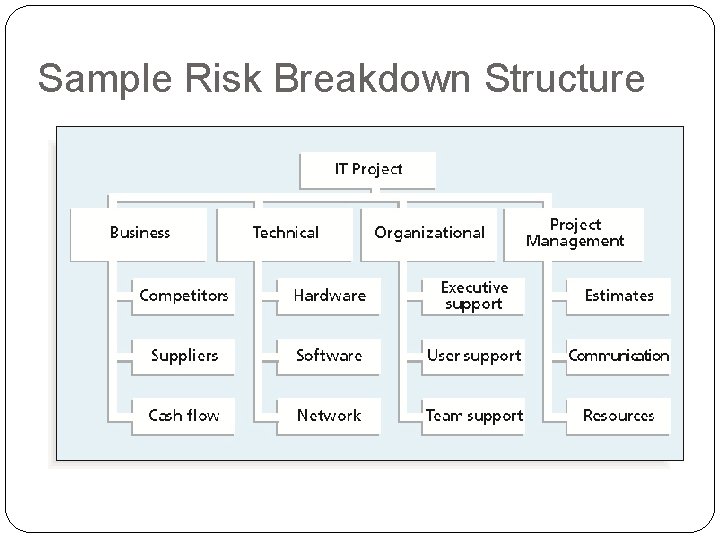
Risk Breakdown Structure �It is common to look into the WBS categories for their potential risks �A risk breakdown structure is a hierarchy of potential risk categories for a project �Similar to a work breakdown structure but used to identify and categorize risks 19
Sample Risk Breakdown Structure 2 0
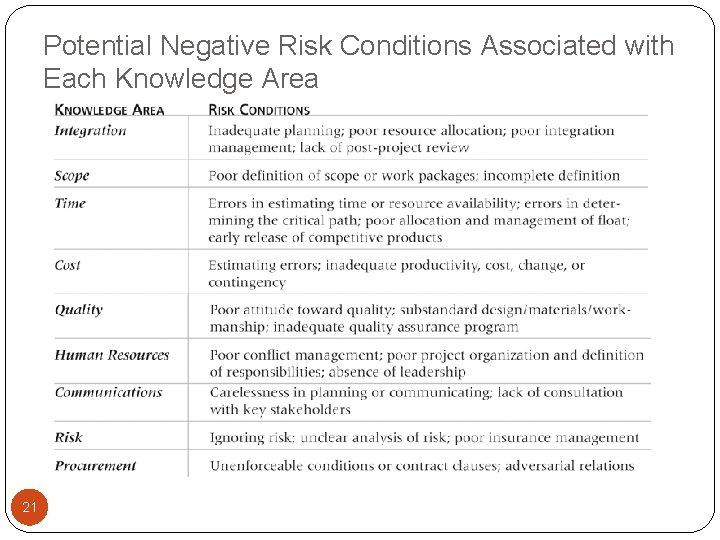
Potential Negative Risk Conditions Associated with Each Knowledge Area 21
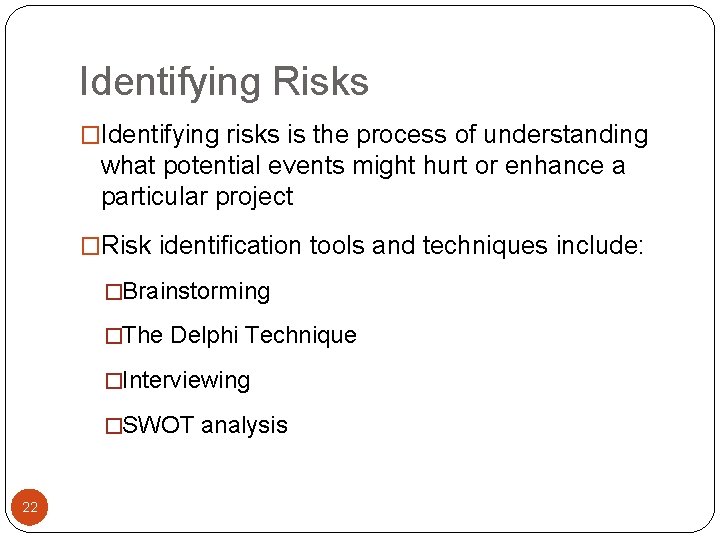
Identifying Risks �Identifying risks is the process of understanding what potential events might hurt or enhance a particular project �Risk identification tools and techniques include: �Brainstorming �The Delphi Technique �Interviewing �SWOT analysis 22
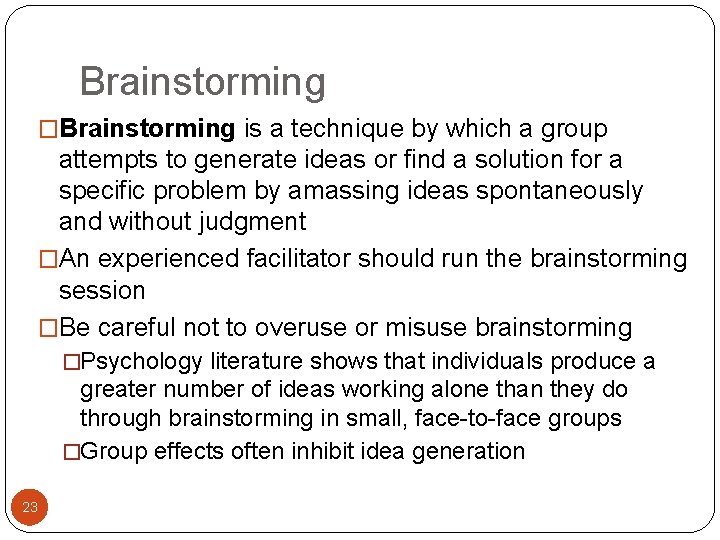
Brainstorming �Brainstorming is a technique by which a group attempts to generate ideas or find a solution for a specific problem by amassing ideas spontaneously and without judgment �An experienced facilitator should run the brainstorming session �Be careful not to overuse or misuse brainstorming �Psychology literature shows that individuals produce a greater number of ideas working alone than they do through brainstorming in small, face-to-face groups �Group effects often inhibit idea generation 23
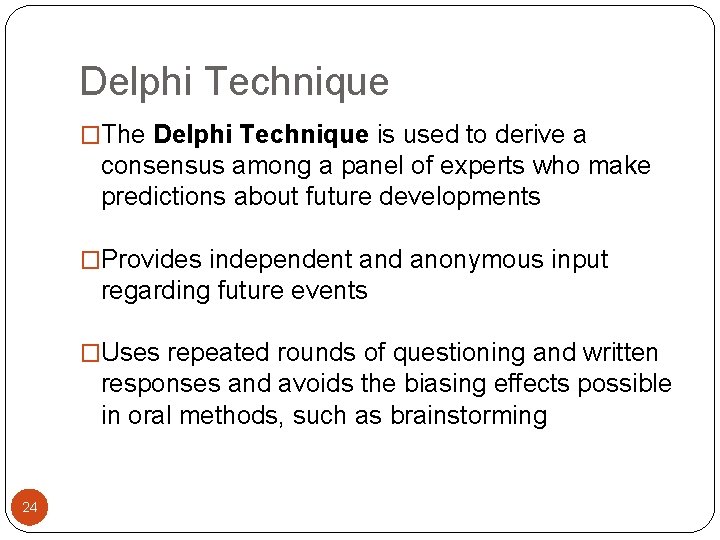
Delphi Technique �The Delphi Technique is used to derive a consensus among a panel of experts who make predictions about future developments �Provides independent and anonymous input regarding future events �Uses repeated rounds of questioning and written responses and avoids the biasing effects possible in oral methods, such as brainstorming 24
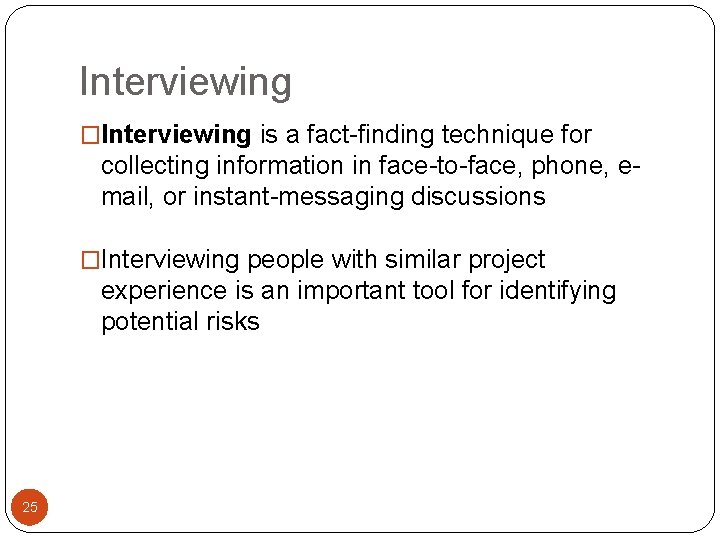
Interviewing �Interviewing is a fact-finding technique for collecting information in face-to-face, phone, email, or instant-messaging discussions �Interviewing people with similar project experience is an important tool for identifying potential risks 25
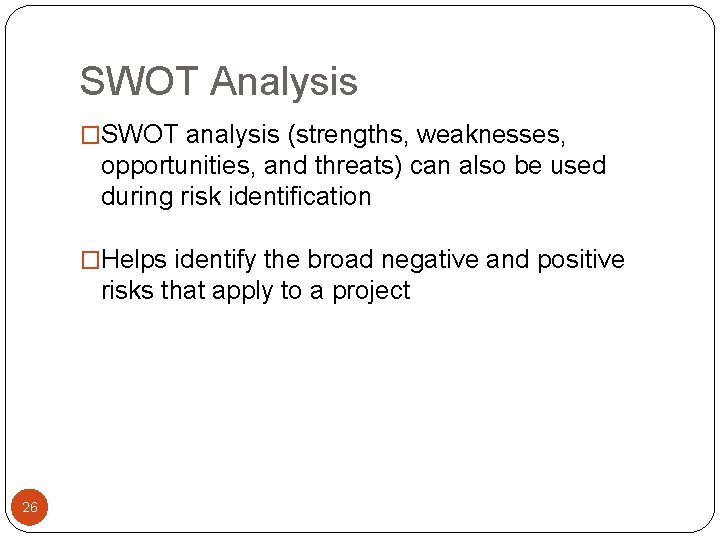
SWOT Analysis �SWOT analysis (strengths, weaknesses, opportunities, and threats) can also be used during risk identification �Helps identify the broad negative and positive risks that apply to a project 26
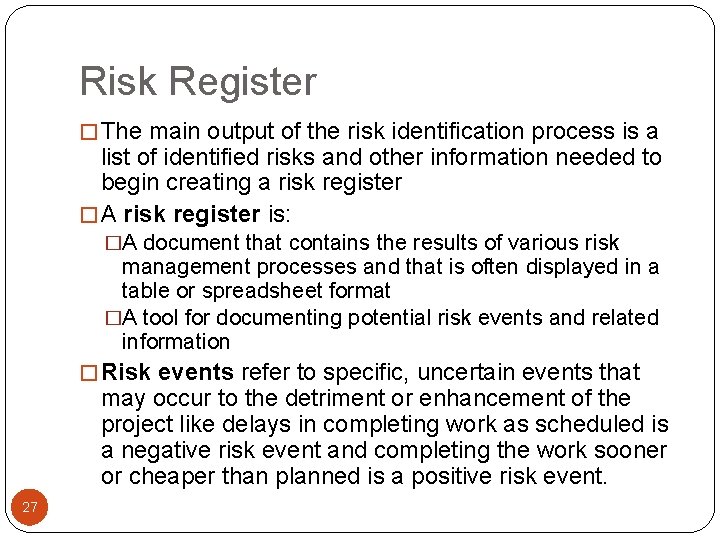
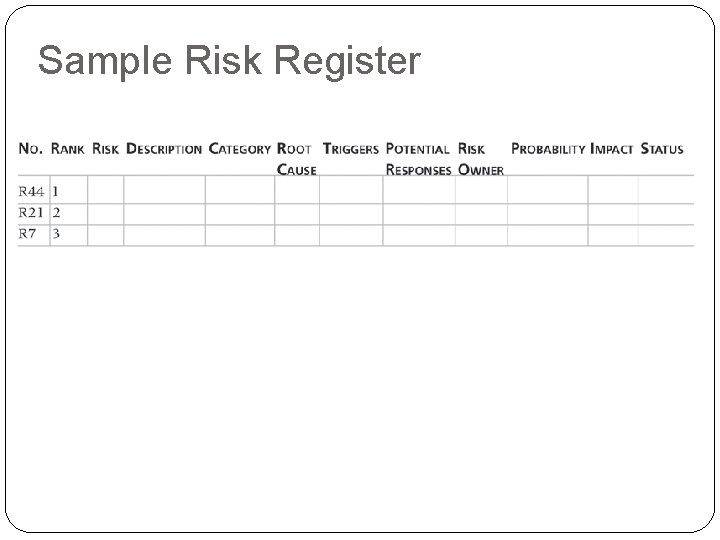
Risk Register � The main output of the risk identification process is a list of identified risks and other information needed to begin creating a risk register � A risk register is: �A document that contains the results of various risk management processes and that is often displayed in a table or spreadsheet format �A tool for documenting potential risk events and related information � Risk events refer to specific, uncertain events that may occur to the detriment or enhancement of the project like delays in completing work as scheduled is a negative risk event and completing the work sooner or cheaper than planned is a positive risk event. 27
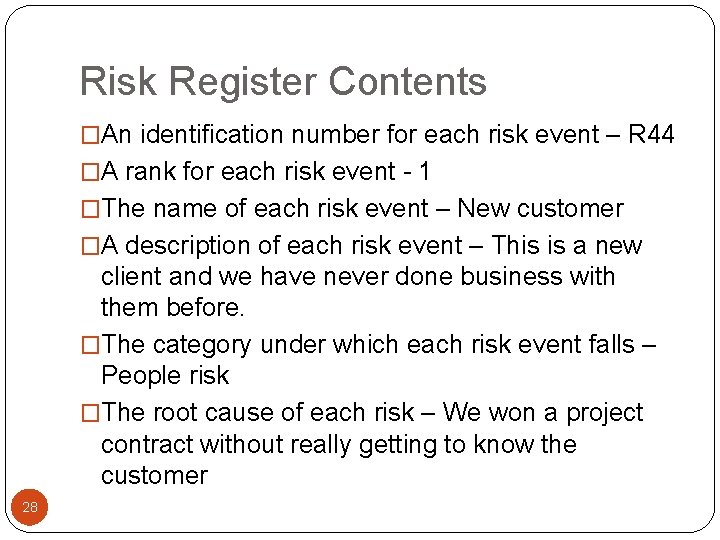
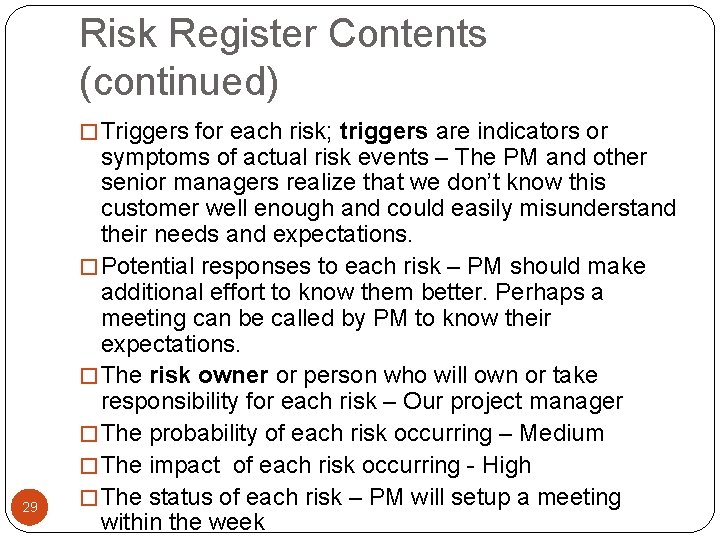
Risk Register Contents �An identification number for each risk event – R 44 �A rank for each risk event - 1 �The name of each risk event – New customer �A description of each risk event – This is a new client and we have never done business with them before. �The category under which each risk event falls – People risk �The root cause of each risk – We won a project contract without really getting to know the customer 28
Risk Register Contents (continued) � Triggers for each risk; triggers are indicators or 29 symptoms of actual risk events – The PM and other senior managers realize that we don’t know this customer well enough and could easily misunderstand their needs and expectations. � Potential responses to each risk – PM should make additional effort to know them better. Perhaps a meeting can be called by PM to know their expectations. � The risk owner or person who will own or take responsibility for each risk – Our project manager � The probability of each risk occurring – Medium � The impact of each risk occurring - High � The status of each risk – PM will setup a meeting within the week
Sample Risk Register 3 0
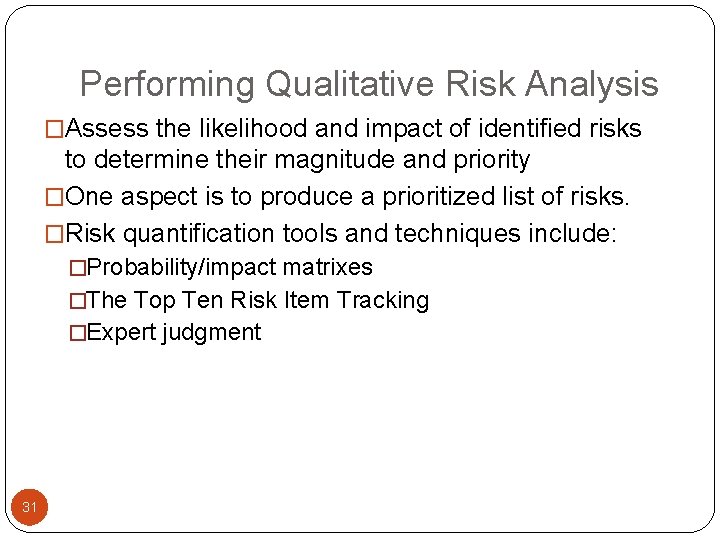
Performing Qualitative Risk Analysis �Assess the likelihood and impact of identified risks to determine their magnitude and priority �One aspect is to produce a prioritized list of risks. �Risk quantification tools and techniques include: �Probability/impact matrixes �The Top Ten Risk Item Tracking �Expert judgment 31
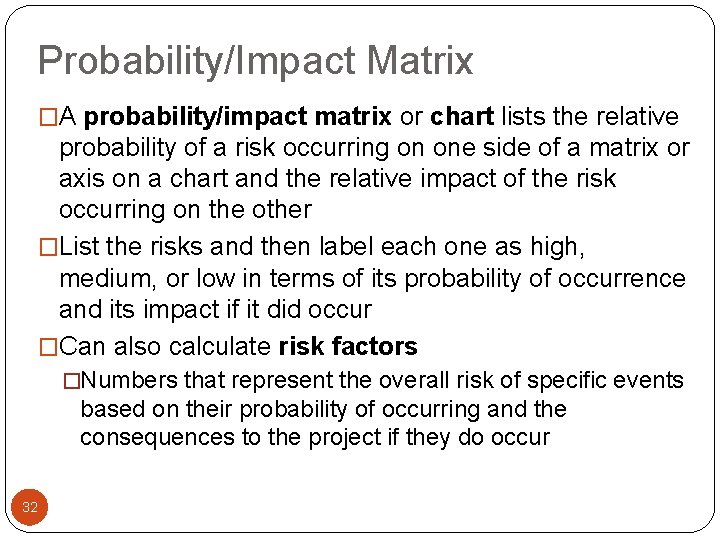
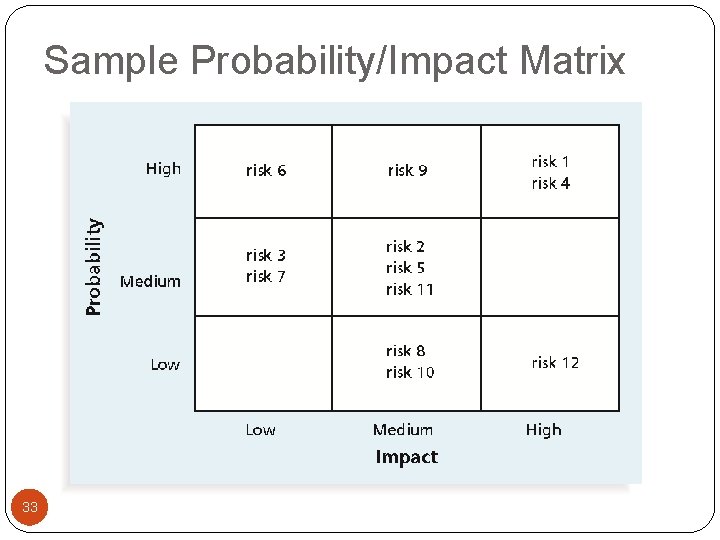
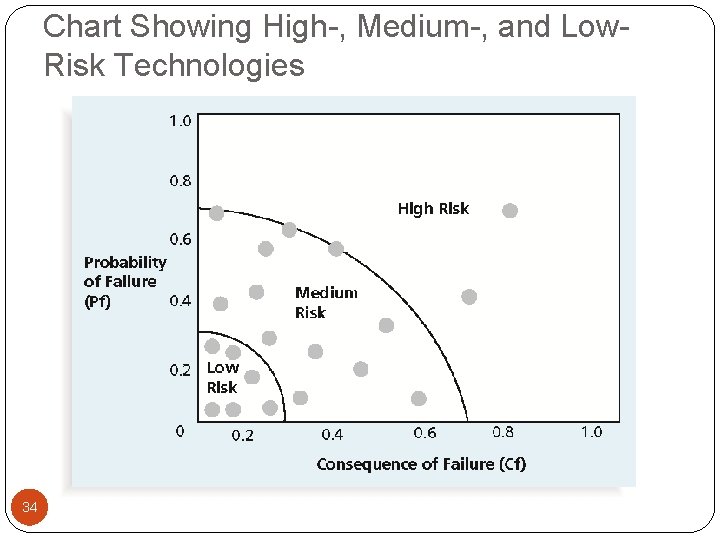
Probability/Impact Matrix �A probability/impact matrix or chart lists the relative probability of a risk occurring on one side of a matrix or axis on a chart and the relative impact of the risk occurring on the other �List the risks and then label each one as high, medium, or low in terms of its probability of occurrence and its impact if it did occur �Can also calculate risk factors �Numbers that represent the overall risk of specific events based on their probability of occurring and the consequences to the project if they do occur 32
Sample Probability/Impact Matrix 33
Chart Showing High-, Medium-, and Low. Risk Technologies 34
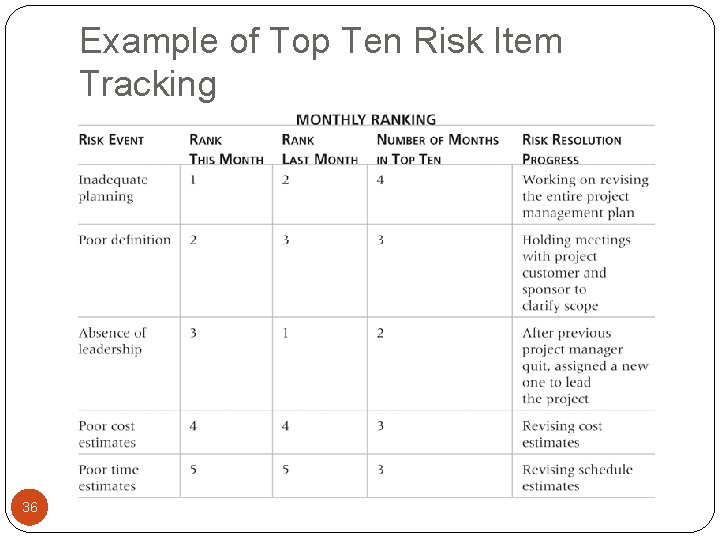
Top Ten Risk Item Tracking � Top Ten Risk Item Tracking is a qualitative risk analysis tool that helps to identify risks and maintain an awareness of risks throughout the life of a project � Establish a periodic review of the top ten project risk items � List the current ranking, previous ranking, number of times the risk appears on the list over a period of time, and a summary of progress made in resolving the risk item � A risk management review accomplishes several objectives. �First it keeps management and the customer aware of the 35 major influences that could prevent or enhance the project’s success �Second, by involving the customer, the project team may be able to consider alternate strategies for addressing a risk. �Third, it is a means of promoting confidence in the project team by demonstrating to management and the customer
Example of Top Ten Risk Item Tracking 36
Watch list �The main output of the Qualitative risk analysis is updating the risk register. �A watch list is a list of risks that are low priority but are still identified as potential risks �Qualitative analysis can also identify risks that should be evaluated on a quantitative basis 37
Performing Quantitative Risk Analysis �Often follows qualitative risk analysis, but both can be done together �Large, complex projects involving leading edge technologies often require extensive quantitative risk analysis �Main techniques include: �Decision tree analysis �Monte Carlo Simulation �Sensitivity analysis Assignment # 3: 38 Make groups of six people and study the Quantitative Risk Analysis techniques. Apply the three techniques on a business case involving IT. You will have to present your work next week that is 24 -Dec-2013
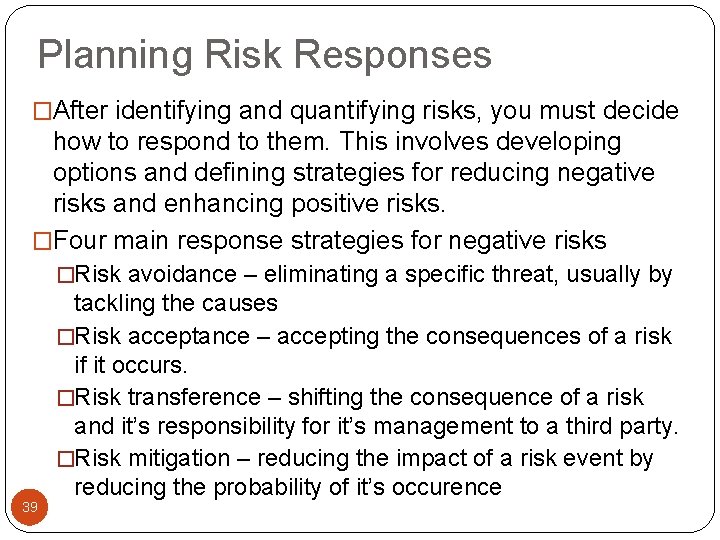
Planning Risk Responses �After identifying and quantifying risks, you must decide how to respond to them. This involves developing options and defining strategies for reducing negative risks and enhancing positive risks. �Four main response strategies for negative risks �Risk avoidance – eliminating a specific threat, usually by 39 tackling the causes �Risk acceptance – accepting the consequences of a risk if it occurs. �Risk transference – shifting the consequence of a risk and it’s responsibility for it’s management to a third party. �Risk mitigation – reducing the impact of a risk event by reducing the probability of it’s occurence
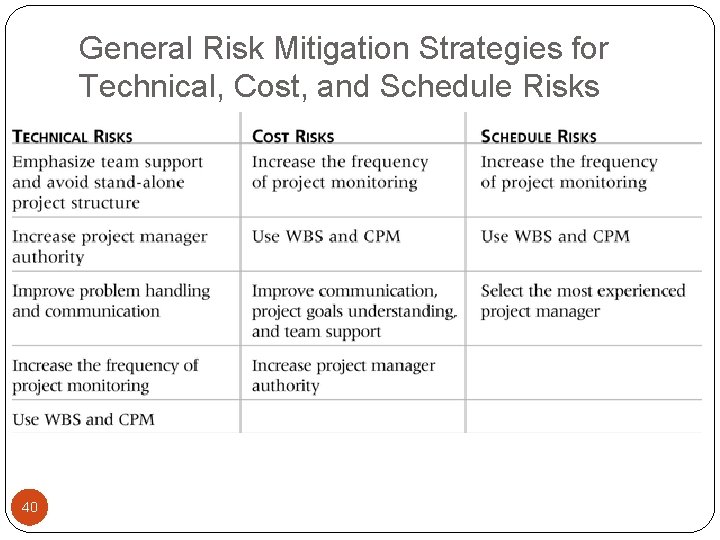
General Risk Mitigation Strategies for Technical, Cost, and Schedule Risks 40
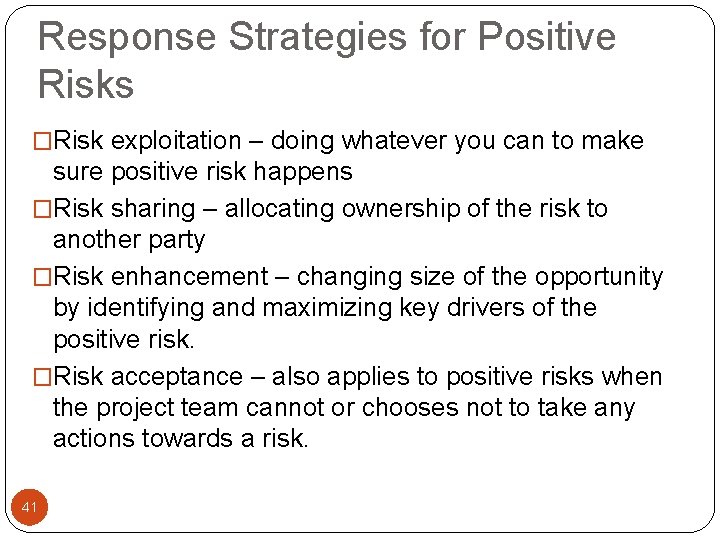
Response Strategies for Positive Risks �Risk exploitation – doing whatever you can to make sure positive risk happens �Risk sharing – allocating ownership of the risk to another party �Risk enhancement – changing size of the opportunity by identifying and maximizing key drivers of the positive risk. �Risk acceptance – also applies to positive risks when the project team cannot or chooses not to take any actions towards a risk. 41
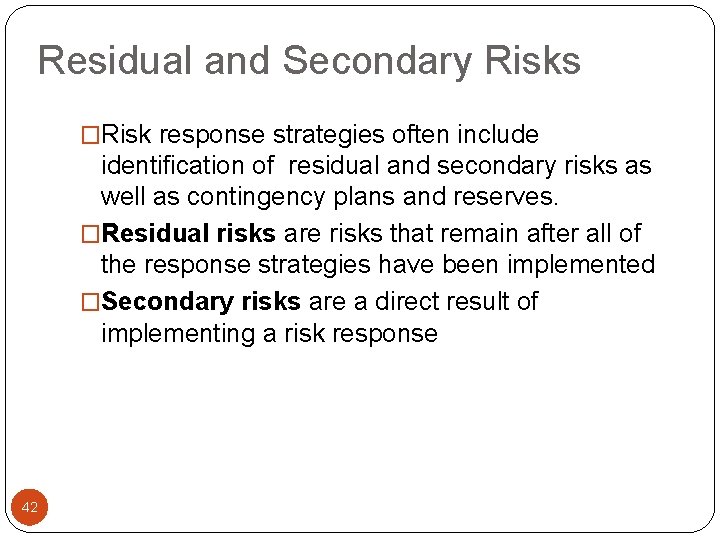
Residual and Secondary Risks �Risk response strategies often include identification of residual and secondary risks as well as contingency plans and reserves. �Residual risks are risks that remain after all of the response strategies have been implemented �Secondary risks are a direct result of implementing a risk response 42
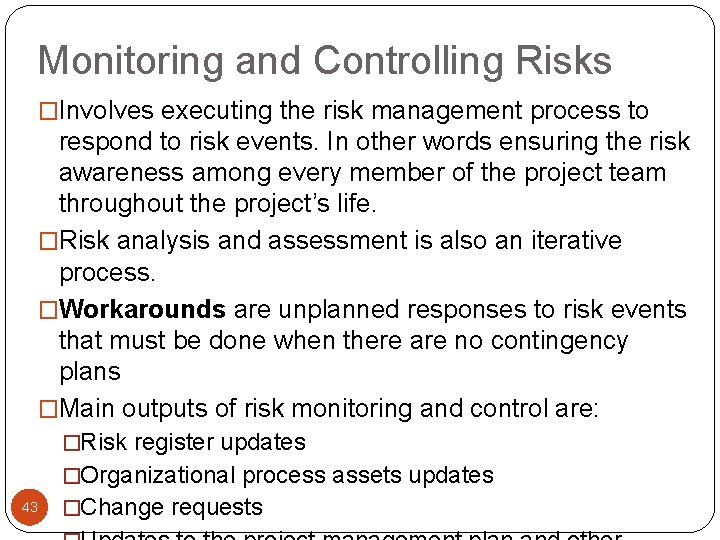
Monitoring and Controlling Risks �Involves executing the risk management process to respond to risk events. In other words ensuring the risk awareness among every member of the project team throughout the project’s life. �Risk analysis and assessment is also an iterative process. �Workarounds are unplanned responses to risk events that must be done when there are no contingency plans �Main outputs of risk monitoring and control are: �Risk register updates �Organizational process assets updates 43 �Change requests
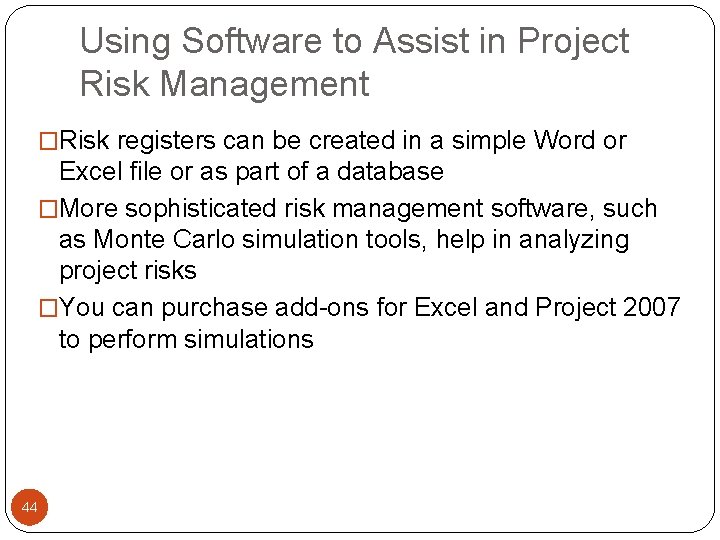
Using Software to Assist in Project Risk Management �Risk registers can be created in a simple Word or Excel file or as part of a database �More sophisticated risk management software, such as Monte Carlo simulation tools, help in analyzing project risks �You can purchase add-ons for Excel and Project 2007 to perform simulations 44
Chapter Summary �Project risk management is the art and science of identifying, analyzing, and responding to risk throughout the life of a project and in the best interests of meeting project objectives �Main processes include: �Plan risk management �Identify risks �Perform qualitative risk analysis �Perform quantitative risk analysis �Plan risk responses �Monitor and control risks 45