
Project Proposal Effectiveness of a Structured Mentoring Programme


- Slides: 17
Project Proposal: Effectiveness of a Structured Mentoring Programme on Autonomous Self-Regulation of Beginning Teachers
2011 JANUARY SENIOR TEACHERS PROG PROJECT GROUP MEMBERS: • MRS PEARL THAM POH CHEONG (CATHOLIC HIGH SECONDARY SCHOOL) • MDM TOH GIM HOON (NANYANG GIRLS’ HIGH SCHOOL) • MRS SANDY TAN (NANYANG GIRLS’ HIGH SCHOOL)
RATIONALE OF PROJECT: Based on past Literature Review on Mentoring Beginning Teachers and Needs Analysis, there is a need for an effective SMP in developing Beginning Teachers. OBJECTIVES OF PROJECT: --To develop greater autonomy in BT through Questioning Techniques in Pre and Post lesson conference and regular contact logs. -Set up a structure and process for SMP to include a system of needs assessment, lesson observation cycle, contact log -Proper documentation to monitor the Professional Development of Mentees -
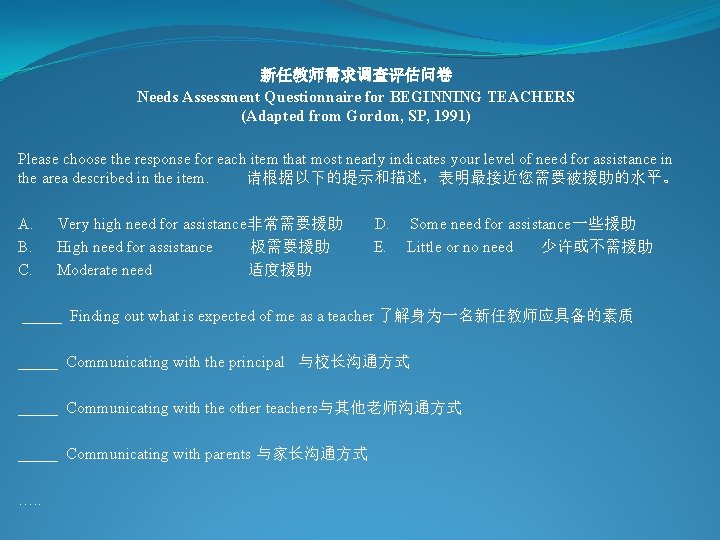
新任教师需求调查评估问卷 Needs Assessment Questionnaire for BEGINNING TEACHERS (Adapted from Gordon, SP, 1991) Please choose the response for each item that most nearly indicates your level of need for assistance in the area described in the item. 请根据以下的提示和描述,表明最接近您需要被援助的水平。 A. B. C. Very high need for assistance非常需要援助 High need for assistance 极需要援助 Moderate need 适度援助 D. E. Some need for assistance一些援助 Little or no need 少许或不需援助 _____ Finding out what is expected of me as a teacher 了解身为一名新任教师应具备的素质 _____ Communicating with the principal 与校长沟通方式 _____ Communicating with the other teachers与其他老师沟通方式 _____ Communicating with parents 与家长沟通方式 …. .
Selected Areas of Learning: Module 4 ‘Mentoring and Coaching the adult learner ‘ by Dr Moo Swee Ngoh. (Main module) Module 2 ‘Becoming a Teacher Innovator – Leading learning’. Dr Caroline Koh on Models of Thinking and Critical Thinking. Module 3 ‘Enlarging your people hinterland – Leading Teams’. Dr Liu Woon Chia on Learner Motivation
Modules 2 and 3 are used to craft pre-test and post-test surveys to measure the autonomous self-regulation level of Beginning Teacher before and after interventions.
Methodology
Intervention Strategies: Structure : • Needs Survey and Questionnaires • Pre lesson planning, lesson observation and post lesson conference (Through use of Questioning) • Contact logs • Post Intervention Reflection
NATURE AND SIZE OF SAMPLE: Proposed sample size – Total of 6 Beginning Teachers from Catholic High School and Nanyang Girls’ High School Profile - Less than 2 years teaching experience
INSTRUMENTS (i) Quantitative measures - survey conducted on Beginning Teachers (ii) Qualitative measures – interviews, contact logs and reflections of Beginning Teachers.
(i) Quantitative survey conducted on Beginning Teachers: (Pre and Post tests – using statistical test to compare subscale mean) http: //www. psych. rochester. edu/SDT/links. php http: //merl. nie. edu. sg/res_tools. html This project adapted 12 items from SRQ –L to measure the level of self-autonomous regulation in Beginning Teachers before and after the structured mentoring programme.
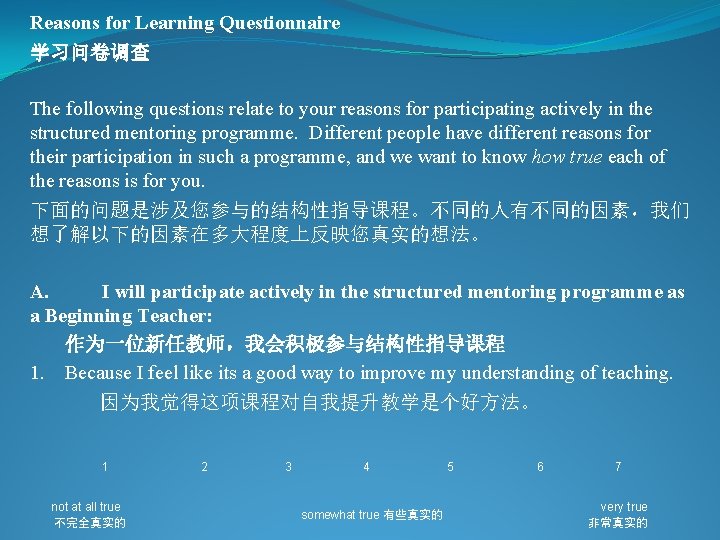
Reasons for Learning Questionnaire 学习问卷调查 The following questions relate to your reasons for participating actively in the structured mentoring programme. Different people have different reasons for their participation in such a programme, and we want to know how true each of the reasons is for you. 下面的问题是涉及您参与的结构性指导课程。不同的人有不同的因素,我们 想了解以下的因素在多大程度上反映您真实的想法。 A. I will participate actively in the structured mentoring programme as a Beginning Teacher: 作为一位新任教师,我会积极参与结构性指导课程 1. Because I feel like its a good way to improve my understanding of teaching. 因为我觉得这项课程对自我提升教学是个好方法。 1 not at all true 不完全真实的 2 3 4 somewhat true 有些真实的 5 6 7 very true 非常真实的
(ii) Qualitative analysis (thematic) – - Interviews (Pre and Post lesson conferences) - ‘Mentor - Mentee contact log’ - Post intervention reflections
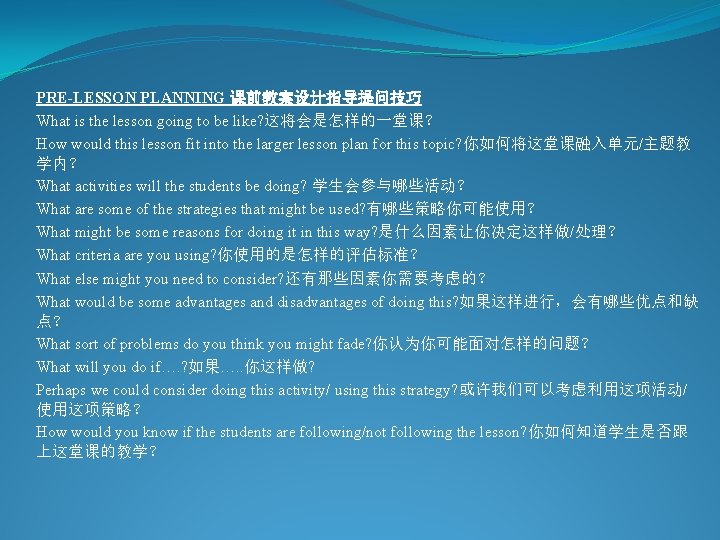
PRE-LESSON PLANNING 课前教案设计指导提问技巧 What is the lesson going to be like? 这将会是怎样的一堂课? How would this lesson fit into the larger lesson plan for this topic? 你如何将这堂课融入单元/主题教 学内? What activities will the students be doing? 学生会参与哪些活动? What are some of the strategies that might be used? 有哪些策略你可能使用? What might be some reasons for doing it in this way? 是什么因素让你决定这样做/处理? What criteria are you using? 你使用的是怎样的评估标准? What else might you need to consider? 还有那些因素你需要考虑的? What would be some advantages and disadvantages of doing this? 如果这样进行,会有哪些优点和缺 点? What sort of problems do you think you might fade? 你认为你可能面对怎样的问题? What will you do if…. ? 如果…. . 你这样做? Perhaps we could consider doing this activity/ using this strategy? 或许我们可以考虑利用这项活动/ 使用这项策略? How would you know if the students are following/not following the lesson? 你如何知道学生是否跟 上这堂课的教学?
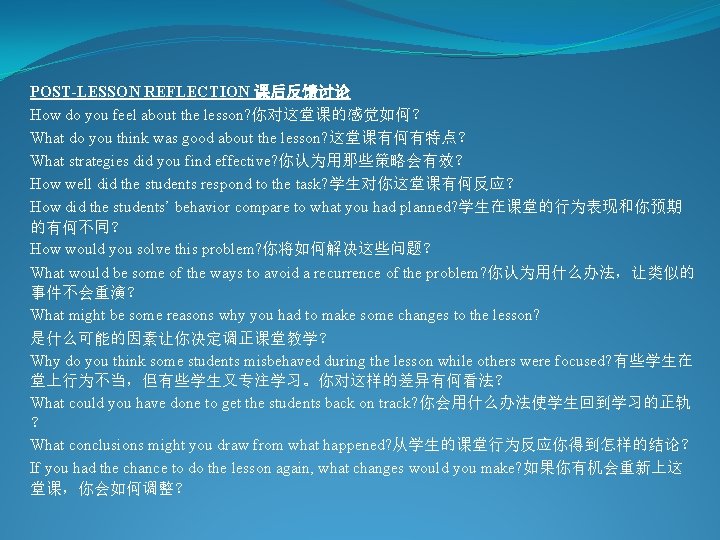
POST-LESSON REFLECTION 课后反馈讨论 How do you feel about the lesson? 你对这堂课的感觉如何? What do you think was good about the lesson? 这堂课有何有特点? What strategies did you find effective? 你认为用那些策略会有效? How well did the students respond to the task? 学生对你这堂课有何反应? How did the students’ behavior compare to what you had planned? 学生在课堂的行为表现和你预期 的有何不同? How would you solve this problem? 你将如何解决这些问题? What would be some of the ways to avoid a recurrence of the problem? 你认为用什么办法,让类似的 事件不会重演? What might be some reasons why you had to make some changes to the lesson? 是什么可能的因素让你决定调正课堂教学? Why do you think some students misbehaved during the lesson while others were focused? 有些学生在 堂上行为不当,但有些学生又专注学习。你对这样的差异有何看法? What could you have done to get the students back on track? 你会用什么办法使学生回到学习的正轨 ? What conclusions might you draw from what happened? 从学生的课堂行为反应你得到怎样的结论? If you had the chance to do the lesson again, what changes would you make? 如果你有机会重新上这 堂课,你会如何调整?
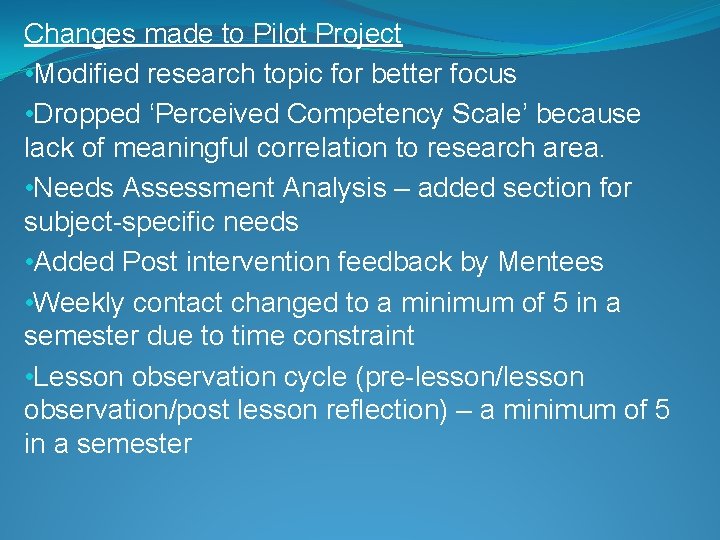
Changes made to Pilot Project • Modified research topic for better focus • Dropped ‘Perceived Competency Scale’ because lack of meaningful correlation to research area. • Needs Assessment Analysis – added section for subject-specific needs • Added Post intervention feedback by Mentees • Weekly contact changed to a minimum of 5 in a semester due to time constraint • Lesson observation cycle (pre-lesson/lesson observation/post lesson reflection) – a minimum of 5 in a semester
Big thank you to Miss Chua Bee Leng and our esteemed colleagues for their invaluable feedback during the Pilot Project Presentation. THE END