
Project overview Progress report Milestones and Schedule Infrastructure
- Slides: 42
• Project overview • Progress report • Milestones and Schedule • Infrastructure needs • Personnel & HQP • Outlook SNOLAB WORKSHOP OCT. 4 2008 V. Zacek Université de Montréal
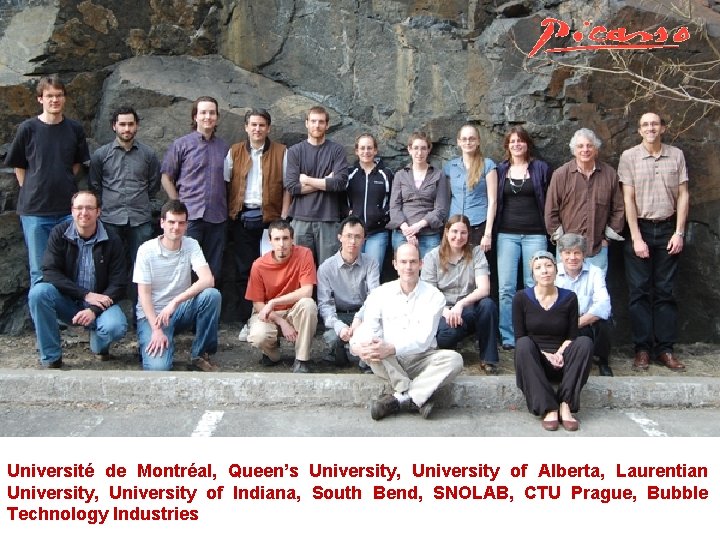
Université de Montréal, Queen’s University, University of Alberta, Laurentian University, University of Indiana, South Bend, SNOLAB, CTU Prague, Bubble Technology Industries
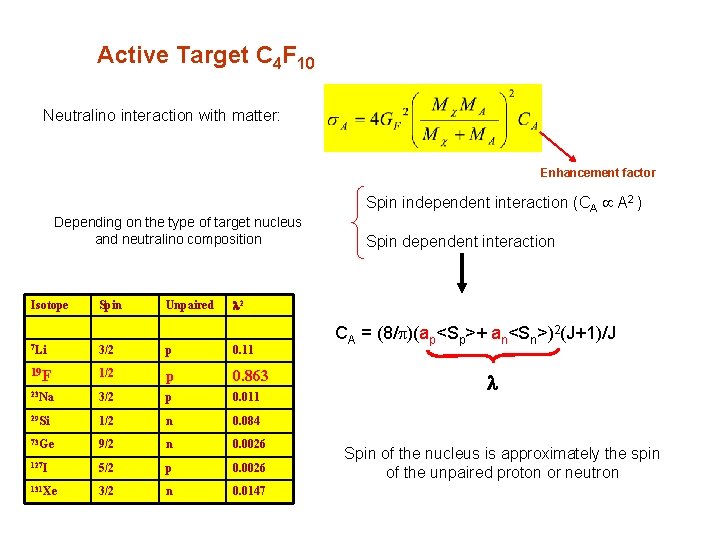
Active Target C 4 F 10 Neutralino interaction with matter: Enhancement factor Spin independent interaction (CA A 2 ) Depending on the type of target nucleus and neutralino composition Isotope Spin Unpaired Spin dependent interaction 2 7 Li 3/2 p 0. 11 19 F 1/2 p 0. 863 23 Na 3/2 p 0. 011 29 Si 1/2 n 0. 084 73 Ge 9/2 n 0. 0026 127 I 5/2 p 0. 0026 131 Xe 3/2 n 0. 0147 CA = (8/ )(ap<Sp>+ an<Sn>)2(J+1)/J Spin of the nucleus is approximately the spin of the unpaired proton or neutron
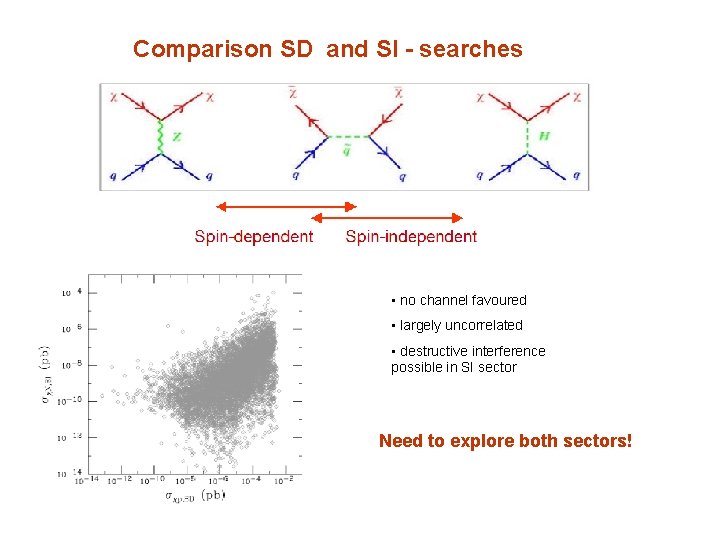
Comparison SD and SI - searches • no channel favoured • largely uncorrelated • destructive interference possible in SI sector Need to explore both sectors!
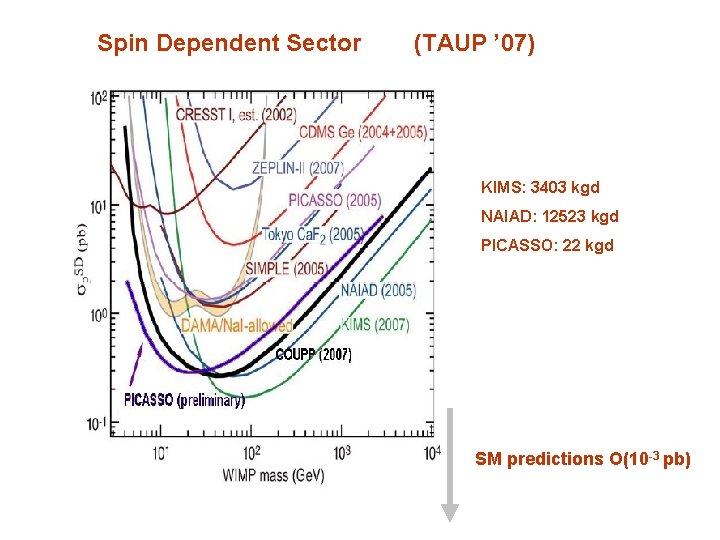
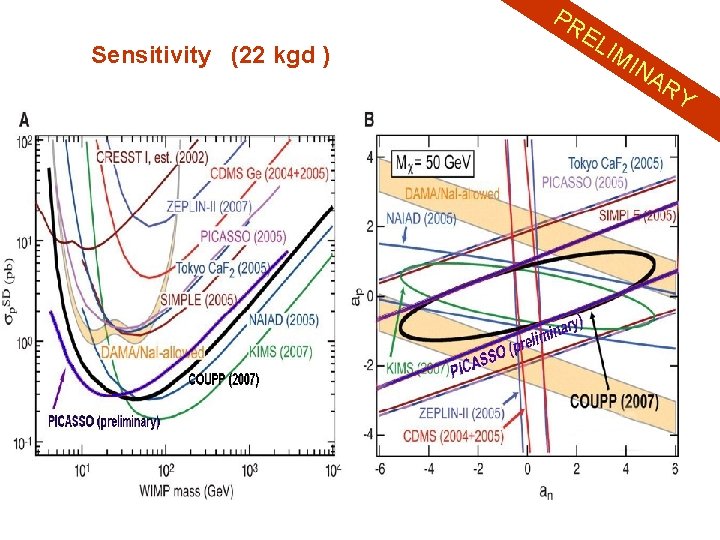
Spin Dependent Sector (TAUP ’ 07) KIMS: 3403 kgd NAIAD: 12523 kgd PICASSO: 22 kgd SM predictions O(10 -3 pb)
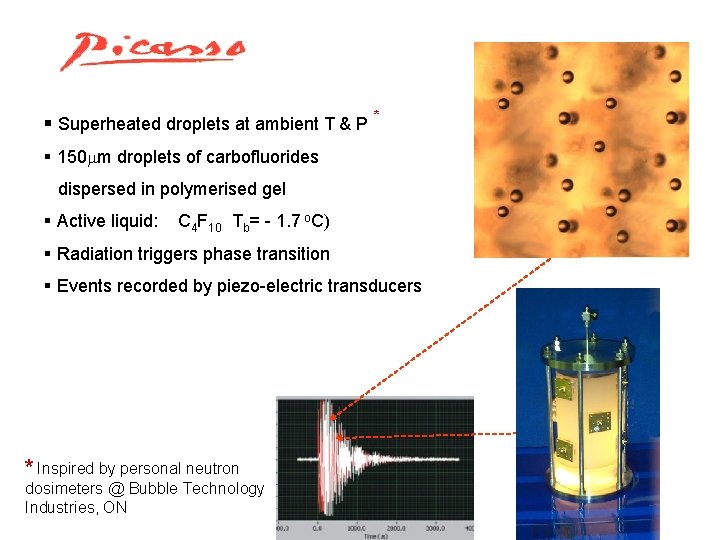
§ Superheated droplets at ambient T & P * § 150 m droplets of carbofluorides dispersed in polymerised gel § Active liquid: C 4 F 10 Tb= - 1. 7 o. C) § Radiation triggers phase transition § Events recorded by piezo-electric transducers * Inspired by personal neutron dosimeters @ Bubble Technology Industries, ON
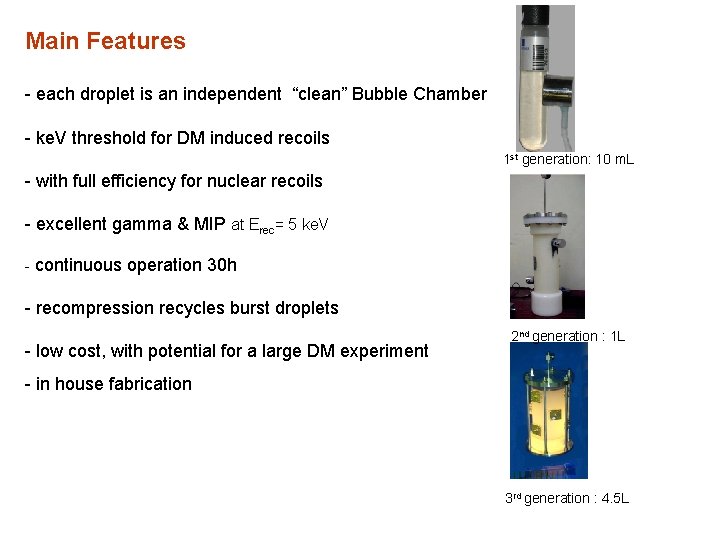
Main Features - each droplet is an independent “clean” Bubble Chamber - ke. V threshold for DM induced recoils 1 st generation: 10 m. L - with full efficiency for nuclear recoils - excellent gamma & MIP at Erec= 5 ke. V - continuous operation 30 h - recompression recycles burst droplets - low cost, with potential for a large DM experiment 2 nd generation : 1 L - in house fabrication 3 rd generation : 4. 5 L
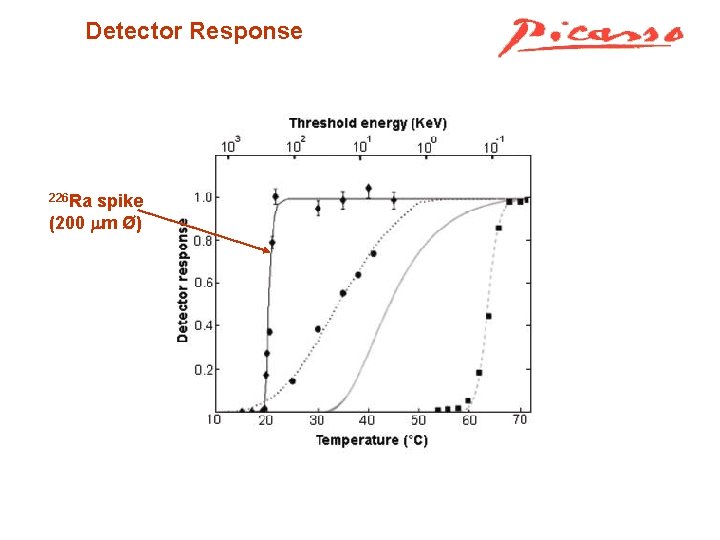
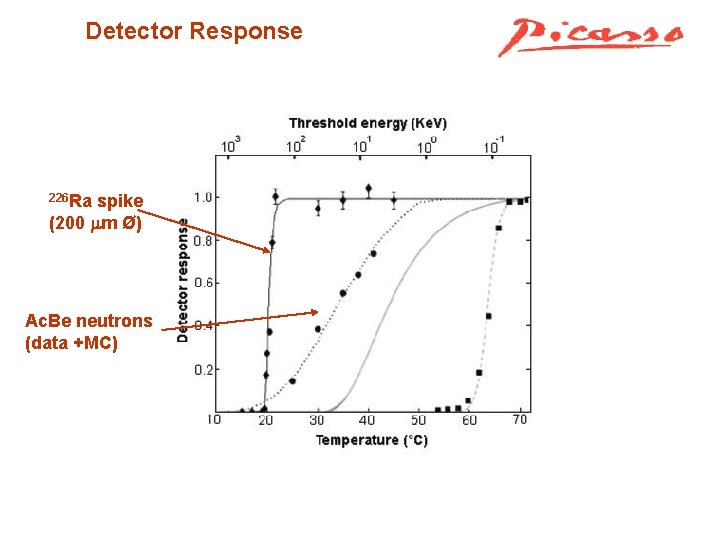
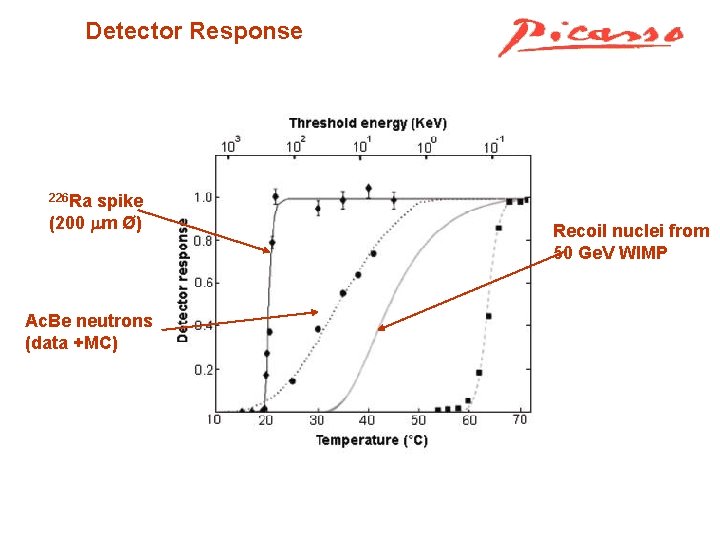
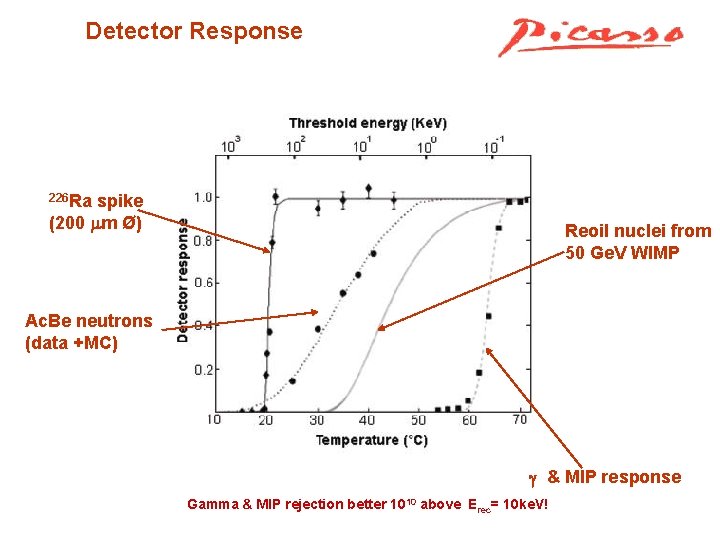
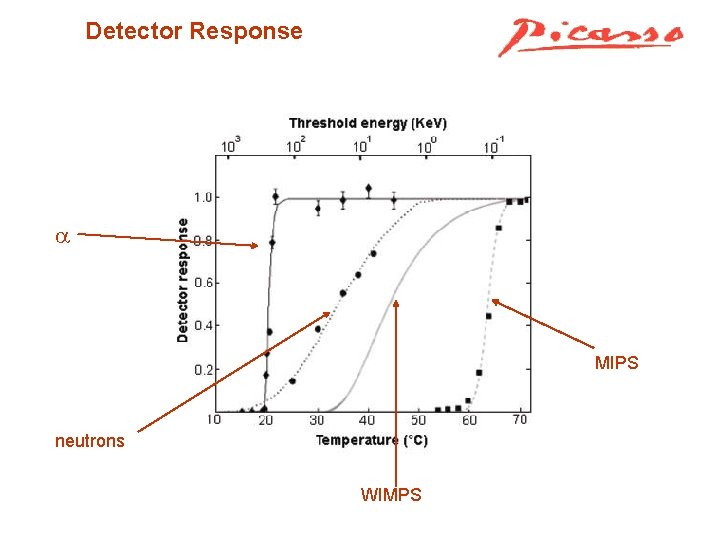
Detector Response 226 Ra spike (200 m Ø)
Detector Response 226 Ra spike (200 m Ø) Ac. Be neutrons (data +MC)
Detector Response 226 Ra spike (200 m Ø) Ac. Be neutrons (data +MC) Recoil nuclei from 50 Ge. V WIMP
Detector Response 226 Ra spike (200 m Ø) Reoil nuclei from 50 Ge. V WIMP Ac. Be neutrons (data +MC) & MIP response Gamma & MIP rejection better 1010 above Erec= 10 ke. V!
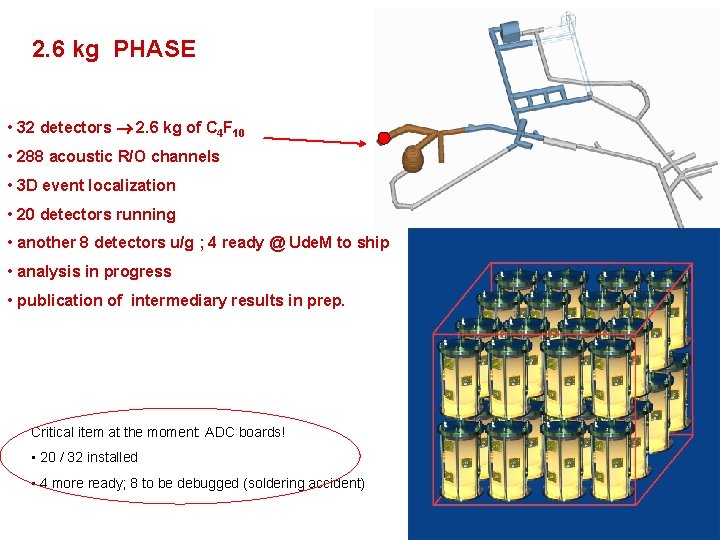
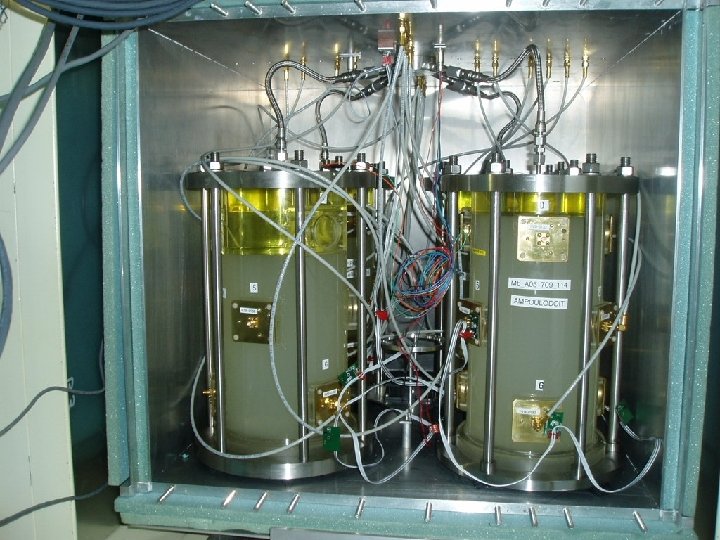
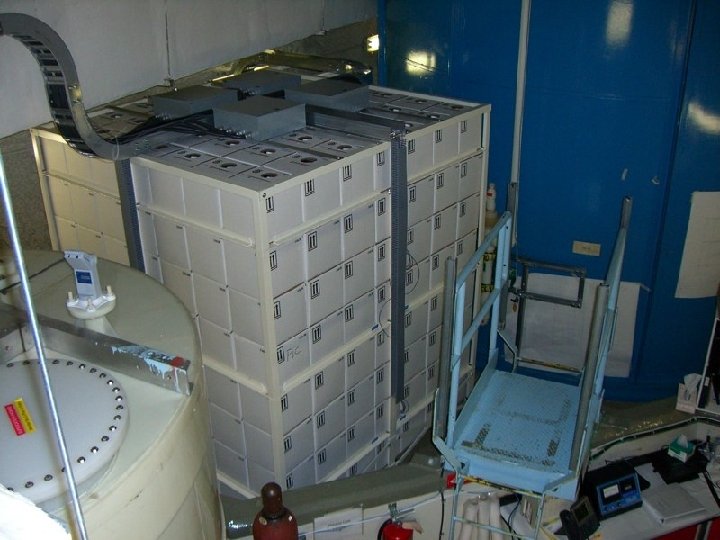
2. 6 kg PHASE • 32 detectors 2. 6 kg of C 4 F 10 • 288 acoustic R/O channels • 3 D event localization • 20 detectors running • another 8 detectors u/g ; 4 ready @ Ude. M to ship • analysis in progress • publication of intermediary results in prep. Critical item at the moment: ADC boards! • 20 / 32 installed • 4 more ready; 8 to be debugged (soldering accident)
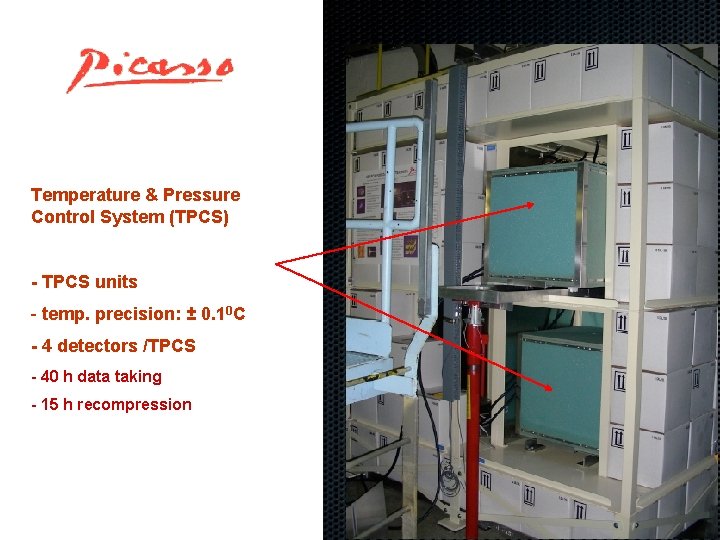
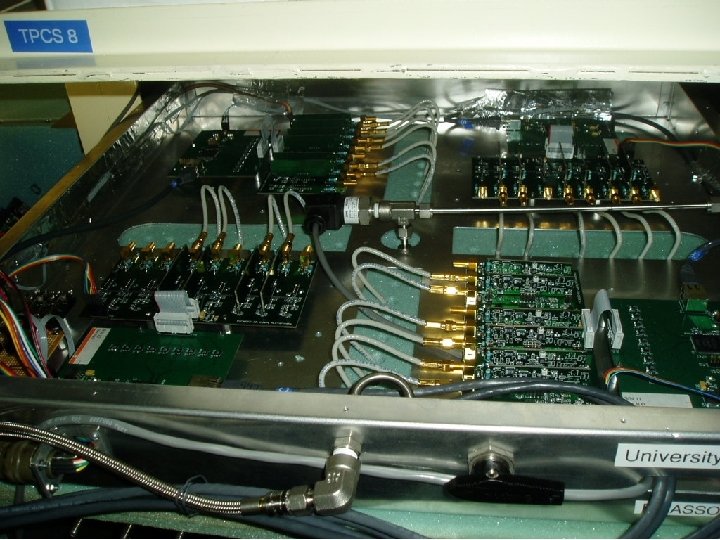
Temperature & Pressure Control System (TPCS) - TPCS units - temp. precision: ± 0. 10 C - 4 detectors /TPCS - 40 h data taking - 15 h recompression
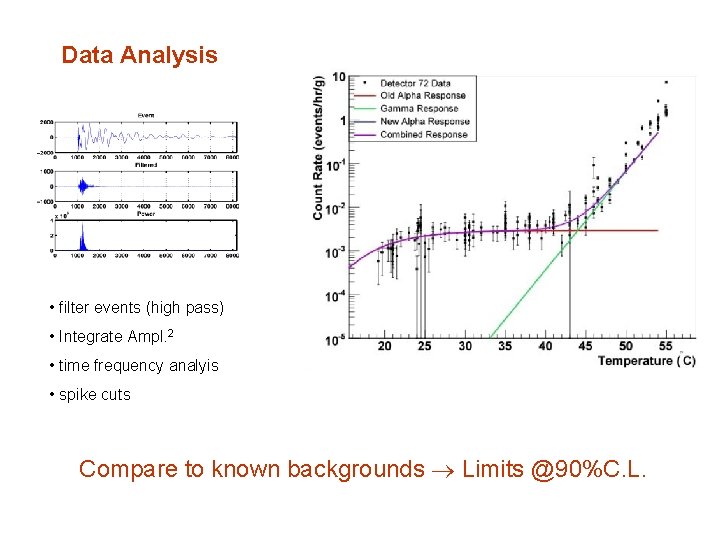
Data Analysis • filter events (high pass) • Integrate Ampl. 2 • time frequency analyis • spike cuts Compare to known backgrounds Limits @90%C. L.
PR Sensitivity (22 kgd ) EL IM IN A RY
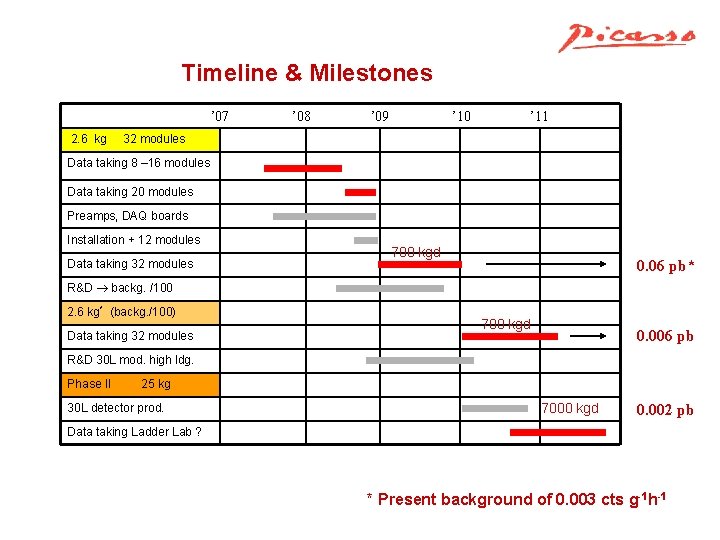
Timeline & Milestones ’ 07 2. 6 kg ’ 08 ’ 09 ’ 10 ’ 11 32 modules Data taking 8 – 16 modules Data taking 20 modules Preamps, DAQ boards Installation + 12 modules Data taking 32 modules 700 kgd 0. 06 pb* R&D backg. /100 2. 6 kg* (backg. /100) Data taking 32 modules 700 kgd 0. 006 pb R&D 30 L mod. high ldg. Phase II 25 kg 30 L detector prod. 7000 kgd 0. 002 pb Data taking Ladder Lab ? * Present background of 0. 003 cts g-1 h-1
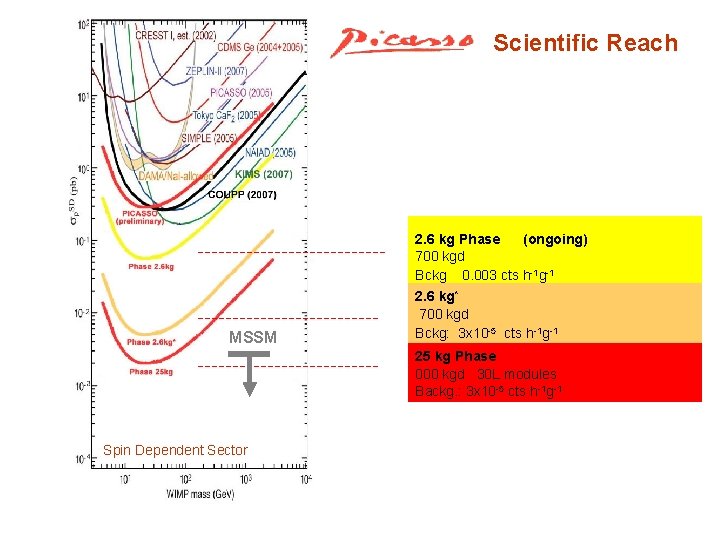
Scientific Reach MSSM 2. 6 kg Phase (ongoing) 700 kgd Bckg 0. 003 cts h-1 g-1 2. 6 kg* 700 kgd Bckg: 3 x 10 -5 cts h-1 g-1 25 kg Phase 000 kgd 30 L modules Backg. : 3 x 10 -5 cts h-1 g-1 Spin Dependent Sector
Infrastructure needs • On site support extremely helpful (I. Lawson) short interventions, change electronics, assistance before/ after power outages • Access @ measuring time at HP(Ge) regular assays of samples || to detector fabrication • Office space / cubicles with full installation c. o. g. shifting to SNOLAB • Radiochemistry and low background expertise SNOLAB (Laurentian) radio chemistry lab for spike work • Electronics maintenance support from technician (Reg, Noël) • Computing support for on-line servers and network • Clean lab space for sample preparation
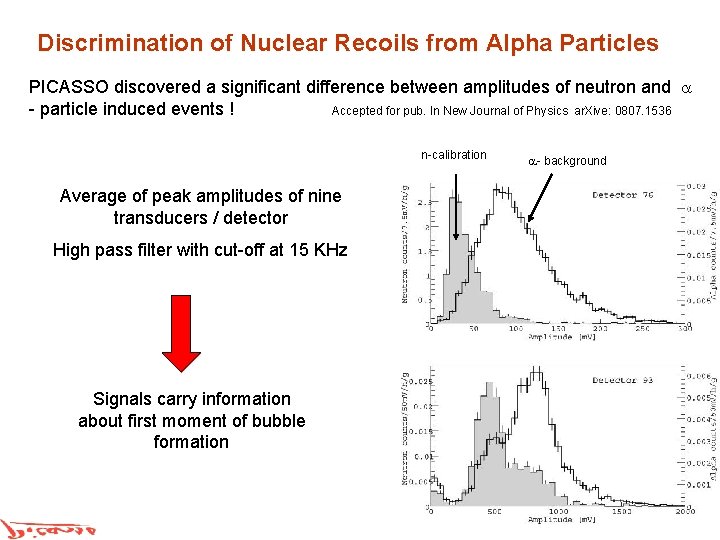
Discrimination of Nuclear Recoils from Alpha Particles PICASSO discovered a significant difference between amplitudes of neutron and - particle induced events ! Accepted for pub. In New Journal of Physics ar. Xive: 0807. 1536 n-calibration Average of peak amplitudes of nine transducers / detector High pass filter with cut-off at 15 KHz Signals carry information about first moment of bubble formation - background
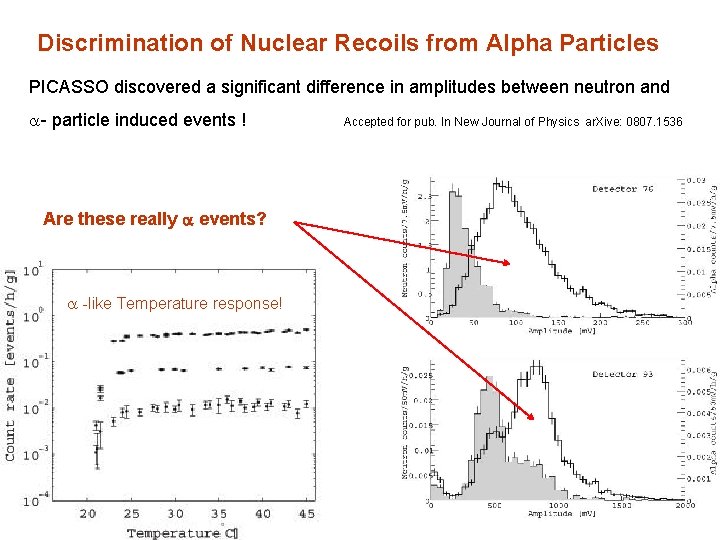
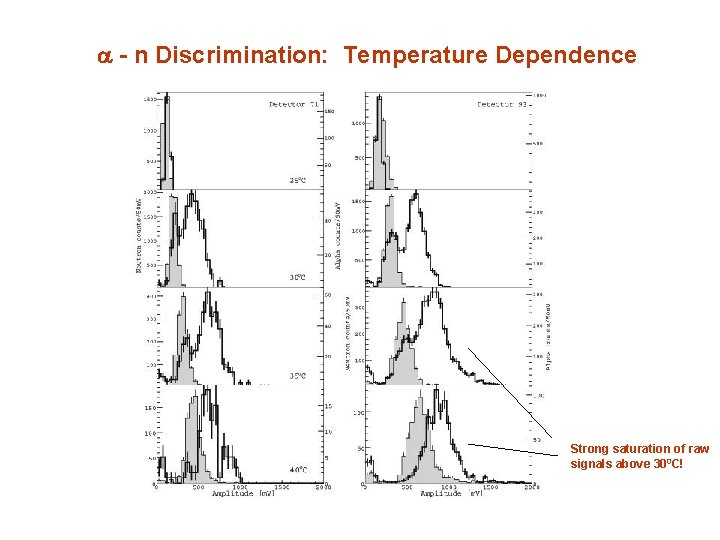
Discrimination of Nuclear Recoils from Alpha Particles PICASSO discovered a significant difference in amplitudes between neutron and - particle induced events ! Are these really events? -like Temperature response! Signals carry information about first moment of bubble formation Accepted for pub. In New Journal of Physics ar. Xive: 0807. 1536
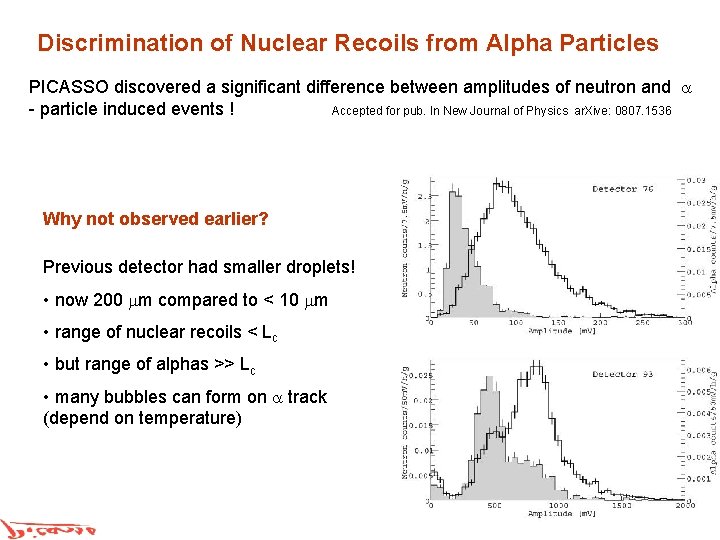
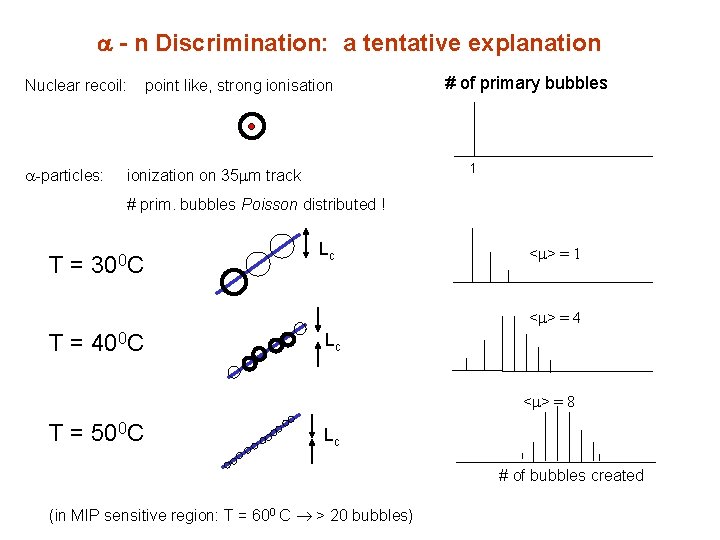
Discrimination of Nuclear Recoils from Alpha Particles PICASSO discovered a significant difference between amplitudes of neutron and - particle induced events ! Accepted for pub. In New Journal of Physics ar. Xive: 0807. 1536 Why not observed earlier? Previous detector had smaller droplets! • now 200 m compared to < 10 m • range of nuclear recoils < Lc • but range of alphas >> Lc • many bubbles can form on track (depend on temperature)
- n Discrimination: a tentative explanation Nuclear recoil: -particles: point like, strong ionisation # of primary bubbles 1 ionization on 35 m track # prim. bubbles Poisson distributed ! T= 300 C Lc < > = 1 < > = 4 T = 400 C Lc < > = 8 T = 500 C Lc # of bubbles created (in MIP sensitive region: T = 600 C > 20 bubbles)
- n Discrimination: Temperature Dependence Strong saturation of raw signals above 300 C!
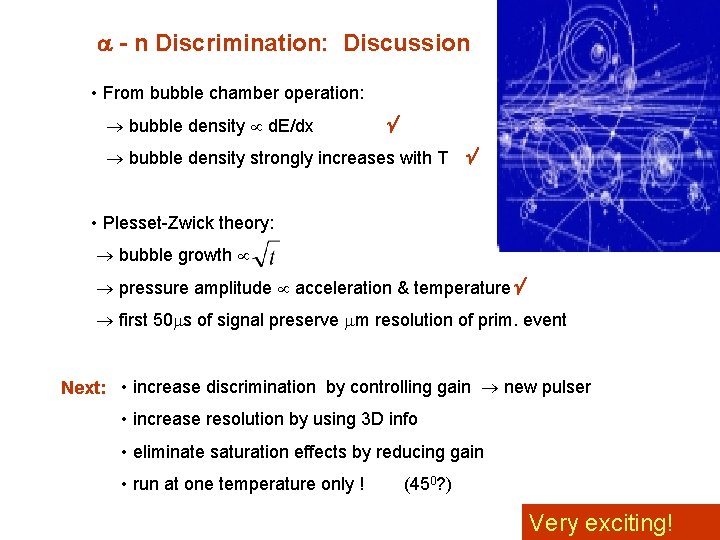
- n Discrimination: Discussion • From bubble chamber operation: bubble density d. E/dx bubble density strongly increases with T • Plesset-Zwick theory: bubble growth pressure amplitude acceleration & temperature first 50 s of signal preserve m resolution of prim. event Next: • increase discrimination by controlling gain new pulser • increase resolution by using 3 D info • eliminate saturation effects by reducing gain • run at one temperature only ! (450? ) Very exciting!
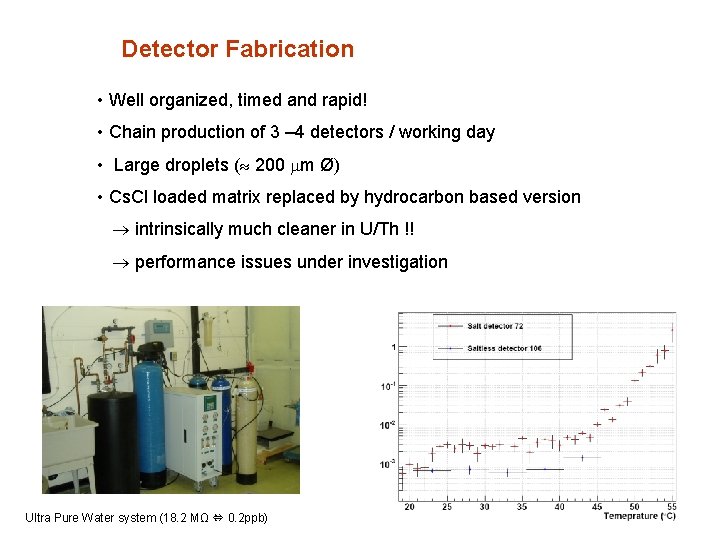
Detector Fabrication • Well organized, timed and rapid! • Chain production of 3 – 4 detectors / working day • Large droplets ( 200 m Ø) • Cs. Cl loaded matrix replaced by hydrocarbon based version intrinsically much cleaner in U/Th !! performance issues under investigation Ultra Pure Water system (18. 2 MΩ ⇔ 0. 2 ppb)
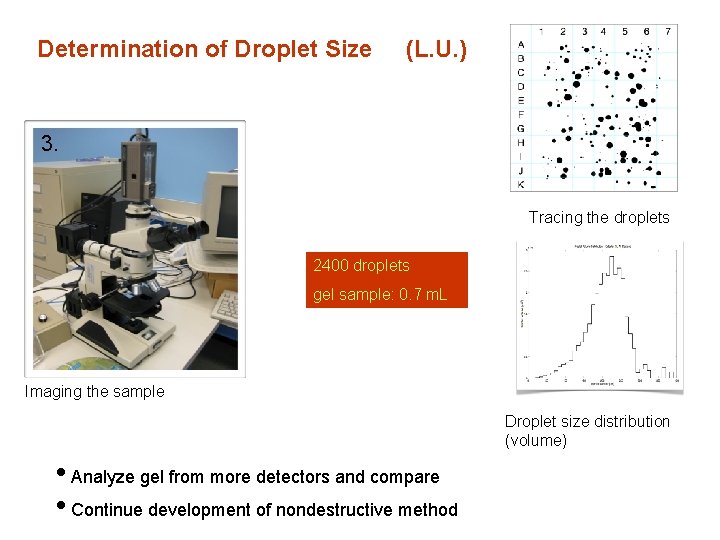
Determination of Droplet Size (L. U. ) 3. Tracing the droplets 2400 droplets gel sample: 0. 7 m. L Imaging the sample Droplet size distribution (volume) • Analyze gel from more detectors and compare • Continue development of nondestructive method
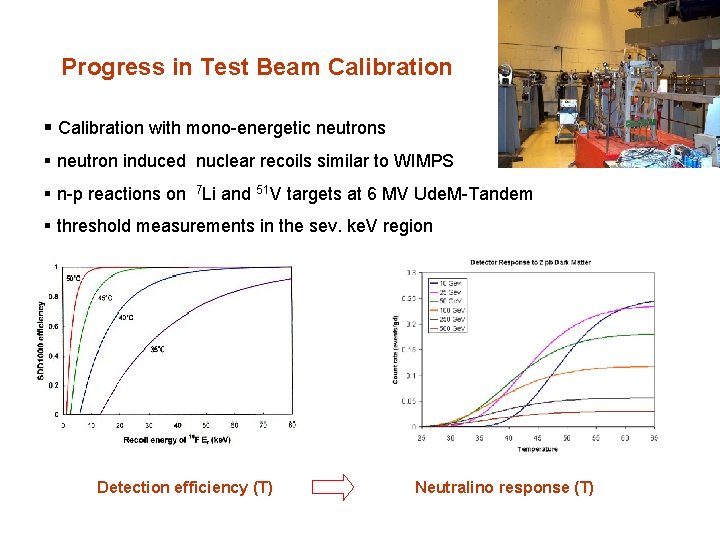
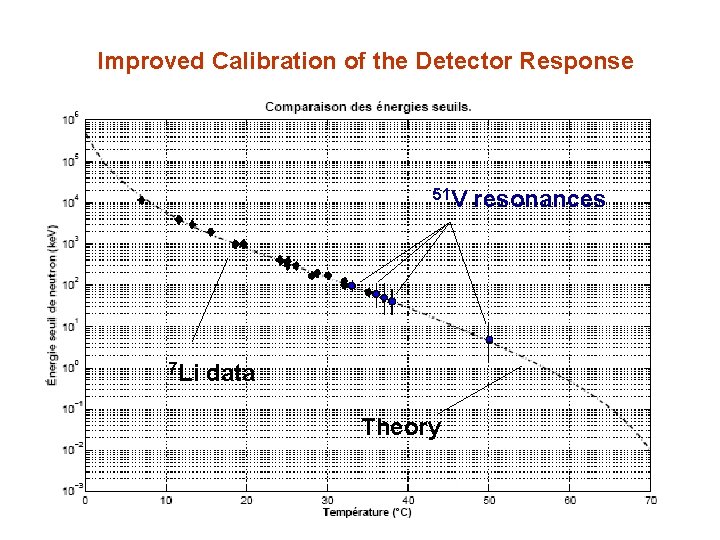
Progress in Test Beam Calibration § Calibration with mono-energetic neutrons § neutron induced nuclear recoils similar to WIMPS § n-p reactions on 7 Li and 51 V targets at 6 MV Ude. M-Tandem § threshold measurements in the sev. ke. V region Detection efficiency (T) Neutralino response (T)
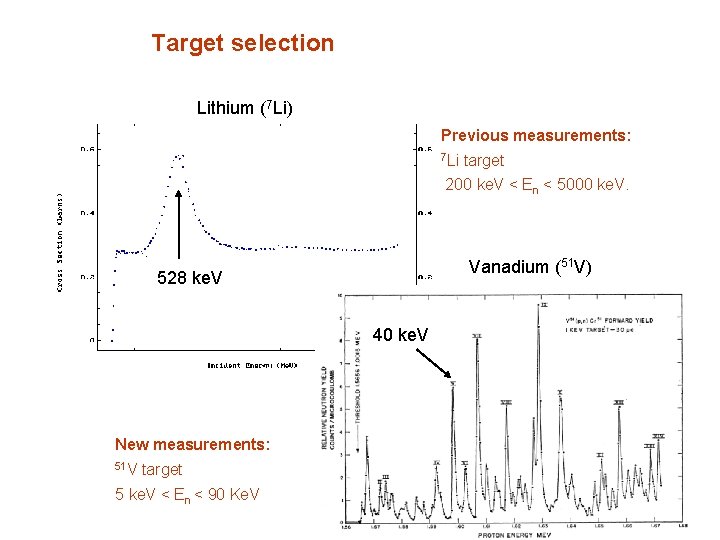
Target selection Lithium (7 Li) Previous measurements: 7 Li target 200 ke. V < En < 5000 ke. V. Vanadium (51 V) 528 ke. V 40 ke. V New measurements: 51 V target 5 ke. V < En < 90 Ke. V
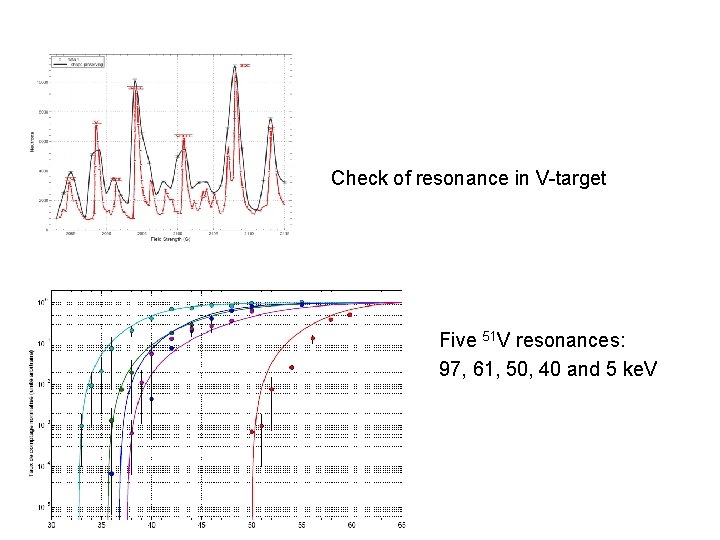
Check of resonance in V-target Five 51 V resonances: 97, 61, 50, 40 and 5 ke. V
Improved Calibration of the Detector Response 51 V 7 Li data Theory resonances
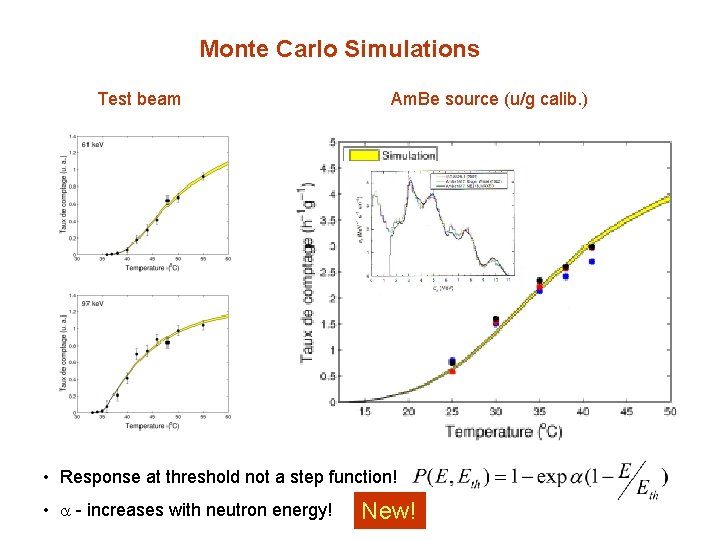
Monte Carlo Simulations Test beam Am. Be source (u/g calib. ) • Response at threshold not a step function! • - increases with neutron energy! New!
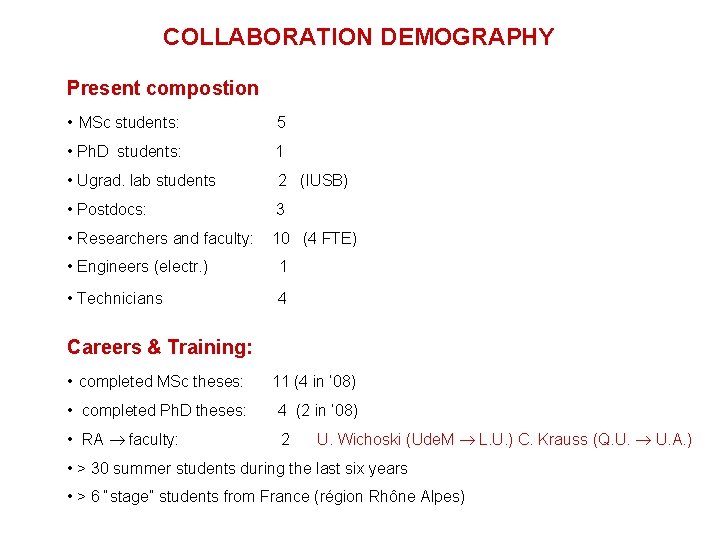
COLLABORATION DEMOGRAPHY Present compostion • MSc students: 5 • Ph. D students: 1 • Ugrad. lab students 2 (IUSB) • Postdocs: 3 • Researchers and faculty: 10 (4 FTE) • Engineers (electr. ) 1 • Technicians 4 Careers & Training: • completed MSc theses: 11 (4 in ’ 08) • completed Ph. D theses: 4 (2 in ’ 08) • RA faculty: 2 U. Wichoski (Ude. M L. U. ) C. Krauss (Q. U. A. ) • > 30 summer students during the last six years • > 6 “stage” students from France (région Rhône Alpes)
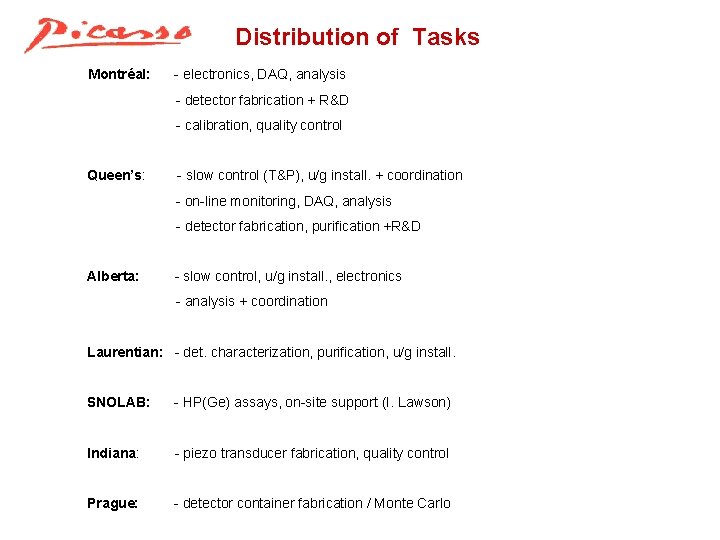
Distribution of Tasks Montréal: - electronics, DAQ, analysis - detector fabrication + R&D - calibration, quality control Queen’s: - slow control (T&P), u/g install. + coordination - on-line monitoring, DAQ, analysis - detector fabrication, purification +R&D Alberta: - slow control, u/g install. , electronics - analysis + coordination Laurentian: - det. characterization, purification, u/g install. SNOLAB: - HP(Ge) assays, on-site support (I. Lawson) Indiana: - piezo transducer fabrication, quality control Prague: - detector container fabrication / Monte Carlo
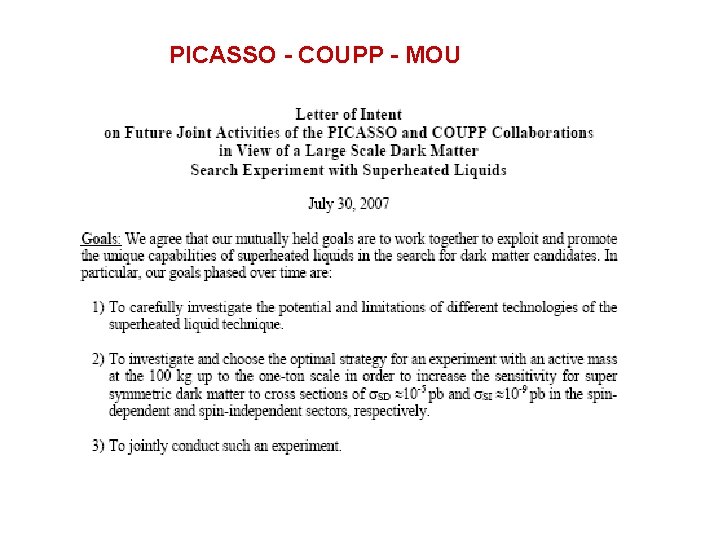
PICASSO - COUPP - MOU
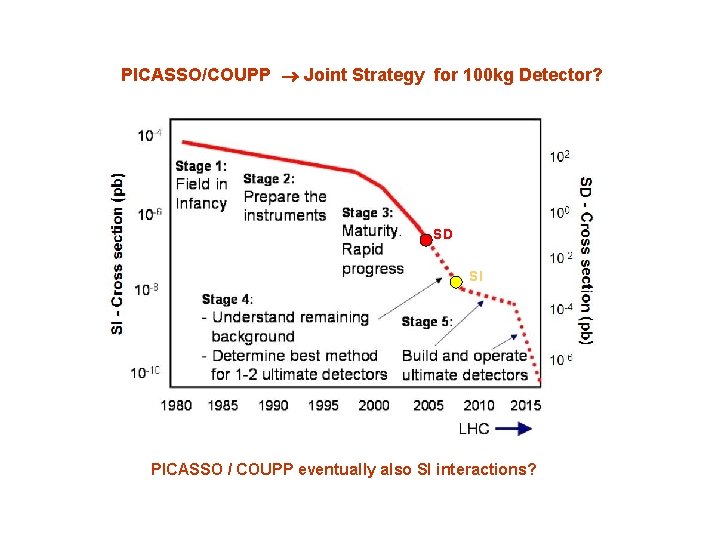
PICASSO/COUPP Joint Strategy for 100 kg Detector? SD SI PICASSO / COUPP eventually also SI interactions?
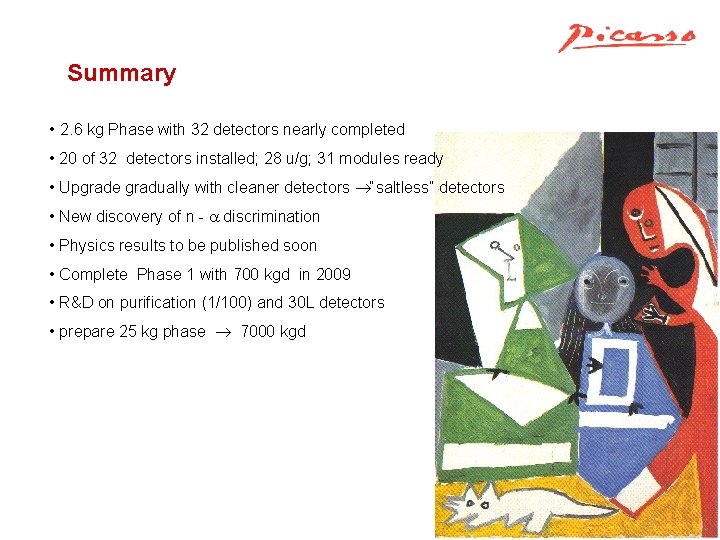
Summary • 2. 6 kg Phase with 32 detectors nearly completed • 20 of 32 detectors installed; 28 u/g; 31 modules ready • Upgrade gradually with cleaner detectors “saltless” detectors • New discovery of n - discrimination • Physics results to be published soon • Complete Phase 1 with 700 kgd in 2009 • R&D on purification (1/100) and 30 L detectors • prepare 25 kg phase 7000 kgd
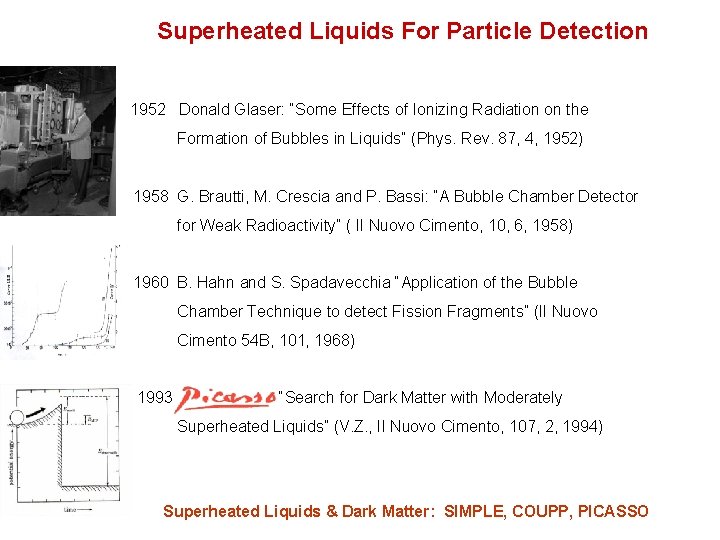
Superheated Liquids For Particle Detection 1952 Donald Glaser: “Some Effects of Ionizing Radiation on the Formation of Bubbles in Liquids” (Phys. Rev. 87, 4, 1952) 1958 G. Brautti, M. Crescia and P. Bassi: “A Bubble Chamber Detector for Weak Radioactivity” ( Il Nuovo Cimento, 10, 6, 1958) 1960 B. Hahn and S. Spadavecchia “Application of the Bubble Chamber Technique to detect Fission Fragments” (Il Nuovo Cimento 54 B, 101, 1968) 1993 “Search for Dark Matter with Moderately Superheated Liquids” (V. Z. , Il Nuovo Cimento, 107, 2, 1994) Superheated Liquids & Dark Matter: SIMPLE, COUPP, PICASSO
Detector Response MIPS neutrons WIMPS
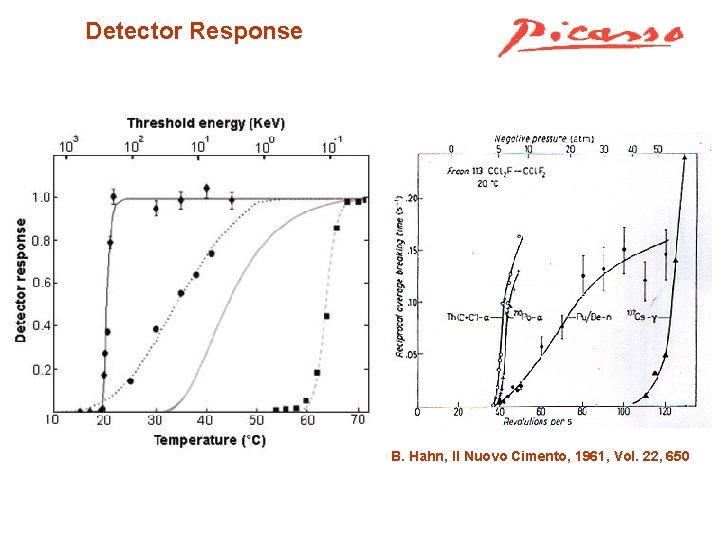
Detector Response B. Hahn, Il Nuovo Cimento, 1961, Vol. 22, 650