
Project overview November 2019 Advancing Common Business Operations

Project overview November 2019
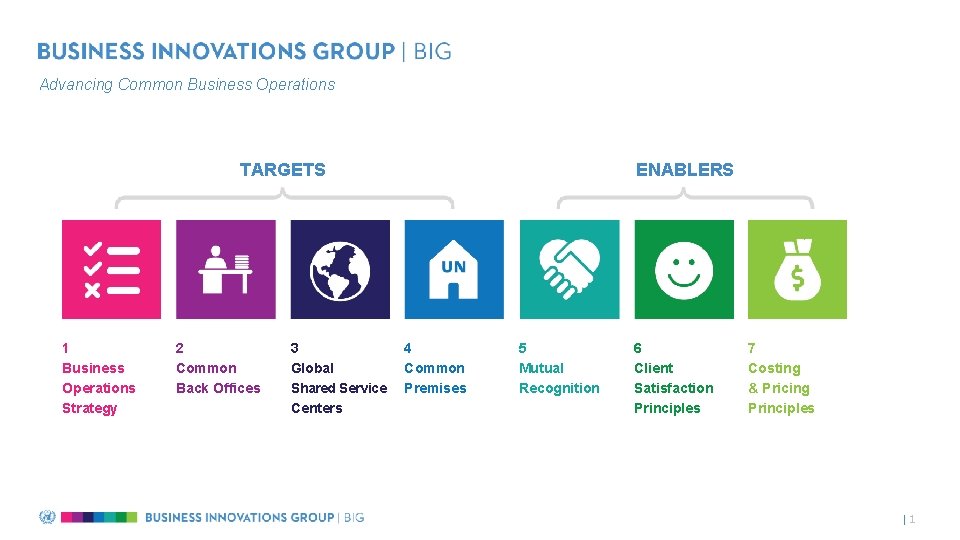
Advancing Common Business Operations TARGETS 1 Business Operations Strategy 2 Common Back Offices 3 Global Shared Service Centers ENABLERS 4 Common Premises 5 Mutual Recognition 6 Client Satisfaction Principles 7 Costing & Pricing Principles |1

1. Business Operations Strategy (BOS) Adopt improved Business Operations Strategy by all UN country teams by 2021 Current progress: What’s next? • BOS 2. 0 guidance launched in 1. Finalize online platform. October. 2. Global rollout activities led by Development • conducted. • Coordination Office (DCO): BOS online tool user acceptance test > - create core capacity with BOS experts, Next steps for the rollout plan defined, starting in Nov 2019; including country prioritization, capacity development and support Training of Trainers in region workshops to - Practitioner training for general group of staff in 2020; structure. - Webinars and video tutorials. |2
4. Common Premises Increase the proportion of UN common premises to 50 per cent by 2021 Current progress: What’s next? • 1. Propose revised resource Requires a culture shift to co-locating as the new norm, and a whole-country approach to review both capital and requirement. subnational offices. • 2. Create new end-to-end In March 2019, an Investment Request was presented. As no resources were forthcoming, a scaled down “consolidating planning” pilot was taken in 6 countries 1 to test tools/approach. • 3 pilots completed: results suggest that the consolidation planning will require external support to the UNCTs/OMTs, and that a self-review without central support may not be > consolidation planning guidelines / tools by Q 1 2020. 3. Complete three more pilots. 4. Support DCO/TTCP+FS to develop a UN-wide premise database. achievable. 1. Kosovo 1, Bolivia, Burundi, Colombia, Pakistan and Sri Lanka. References to Kosovo on this website shall be understood to be in the context of Security Council Resolution 1244 (1999). |3
Three “Enablers”: Mutual Recognition – Client Satisfaction – Costing & Pricing 5. Mutual Recognition Statement Operate with the mutual recognition of best practices regarding policies and procedures • 16 entities signed to date, most recently, FAO and UNRWA joining the UN Secretariat, ILO, IOM, ITU, UN Women, UNAIDS, UNDP, UNESCO, UNFPA, UNHCR, UNICEF, UNOPS, WFP, and WHO • BIG project team is facilitating entity-level and inter-agency level discussion on operationalization. 6. Client Satisfaction Principles Measure client satisfaction with regard to all backoffice services • Principles reviewed and finalized. • Shared with member entities for signature in September and first signed 7. Costing and Pricing Principles Agree on pricing principles to ensure fairness and transparency in service provision by UNHCR & WFP. • Process facilitated by DCO. |4
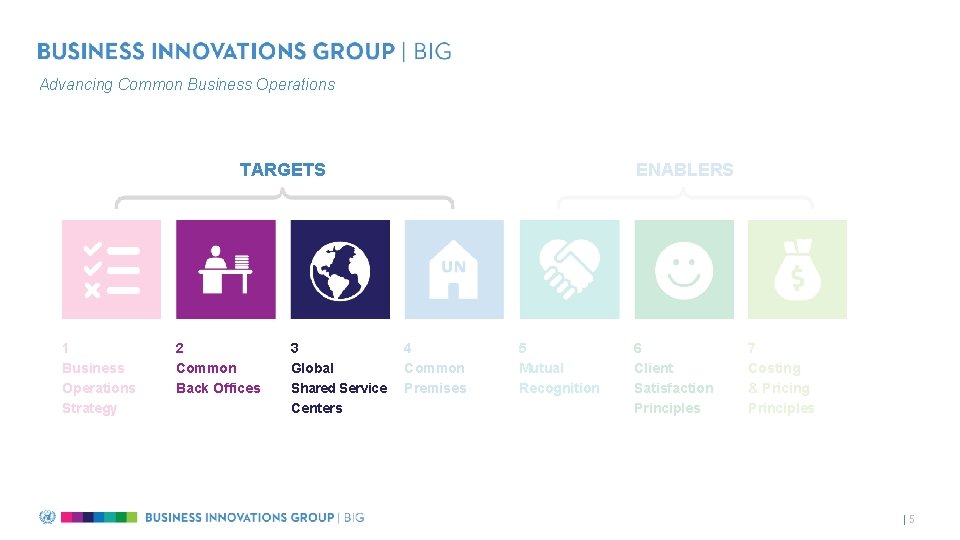
Advancing Common Business Operations TARGETS 1 Business Operations Strategy 2 Common Back Offices 3 Global Shared Service Centers ENABLERS 4 Common Premises 5 Mutual Recognition 6 Client Satisfaction Principles 7 Costing & Pricing Principles |5
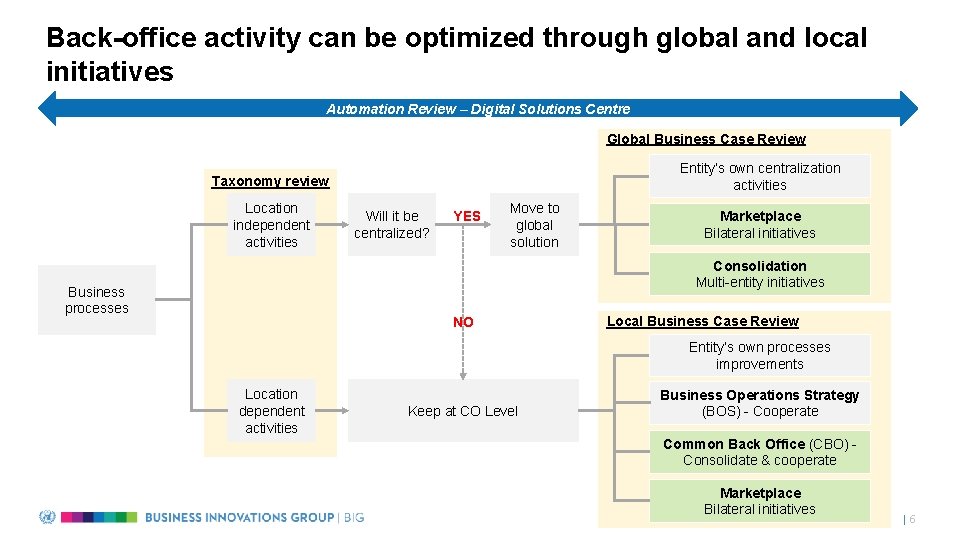
Back-office activity can be optimized through global and local initiatives Automation Review – Digital Solutions Centre Global Business Case Review Entity’s own centralization activities Taxonomy review Location independent activities Will it be centralized? YES Move to global solution Marketplace Bilateral initiatives Consolidation Multi-entity initiatives Business processes NO Local Business Case Review Entity’s own processes improvements Location dependent activities Keep at CO Level Business Operations Strategy (BOS) - Cooperate Common Back Office (CBO) Consolidate & cooperate Marketplace Bilateral initiatives |6
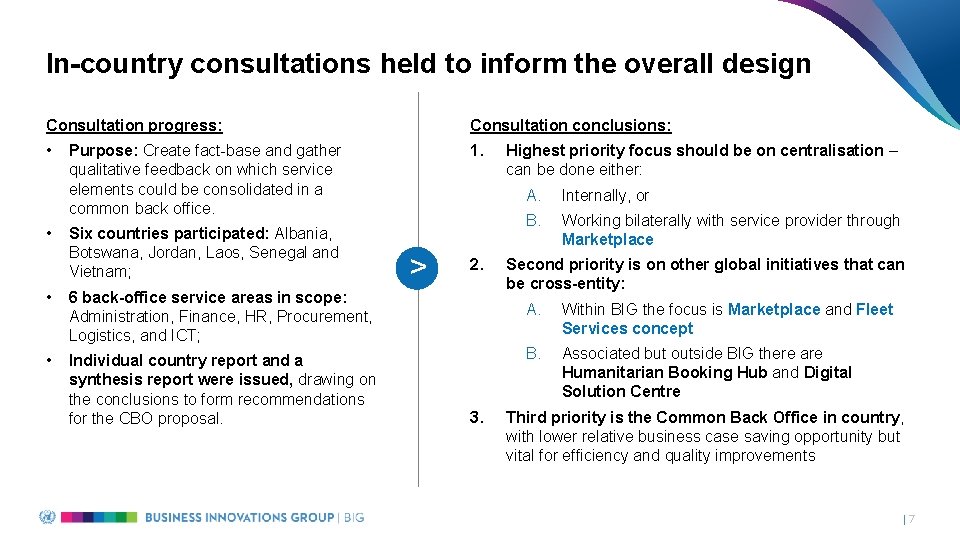
In-country consultations held to inform the overall design Consultation progress: Consultation conclusions: • 1. • Purpose: Create fact-base and gather qualitative feedback on which service elements could be consolidated in a common back office. Six countries participated: Albania, Botswana, Jordan, Laos, Senegal and Vietnam; • 6 back-office service areas in scope: Administration, Finance, HR, Procurement, Logistics, and ICT; • Individual country report and a synthesis report were issued, drawing on the conclusions to form recommendations for the CBO proposal. > 2. 3. Highest priority focus should be on centralisation – can be done either: A. Internally, or B. Working bilaterally with service provider through Marketplace Second priority is on other global initiatives that can be cross-entity: A. Within BIG the focus is Marketplace and Fleet Services concept B. Associated but outside BIG there are Humanitarian Booking Hub and Digital Solution Centre Third priority is the Common Back Office in country, with lower relative business case saving opportunity but vital for efficiency and quality improvements |7
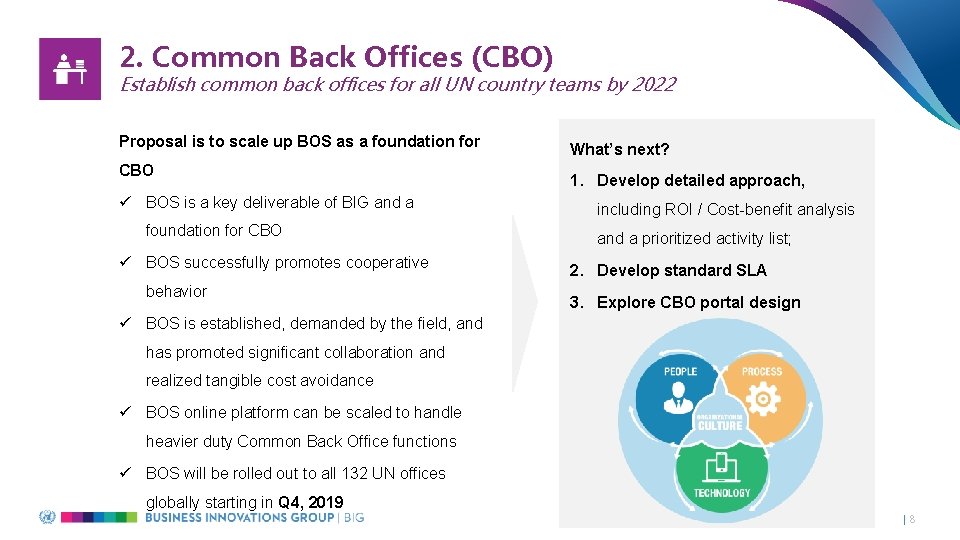
2. Common Back Offices (CBO) Establish common back offices for all UN country teams by 2022 Proposal is to scale up BOS as a foundation for CBO ü BOS is a key deliverable of BIG and a foundation for CBO ü BOS successfully promotes cooperative behavior What’s next? 1. Develop detailed approach, including ROI / Cost-benefit analysis and a prioritized activity list; 2. Develop standard SLA 3. Explore CBO portal design ü BOS is established, demanded by the field, and has promoted significant collaboration and realized tangible cost avoidance ü BOS online platform can be scaled to handle heavier duty Common Back Office functions ü BOS will be rolled out to all 132 UN offices globally starting in Q 4, 2019 |8
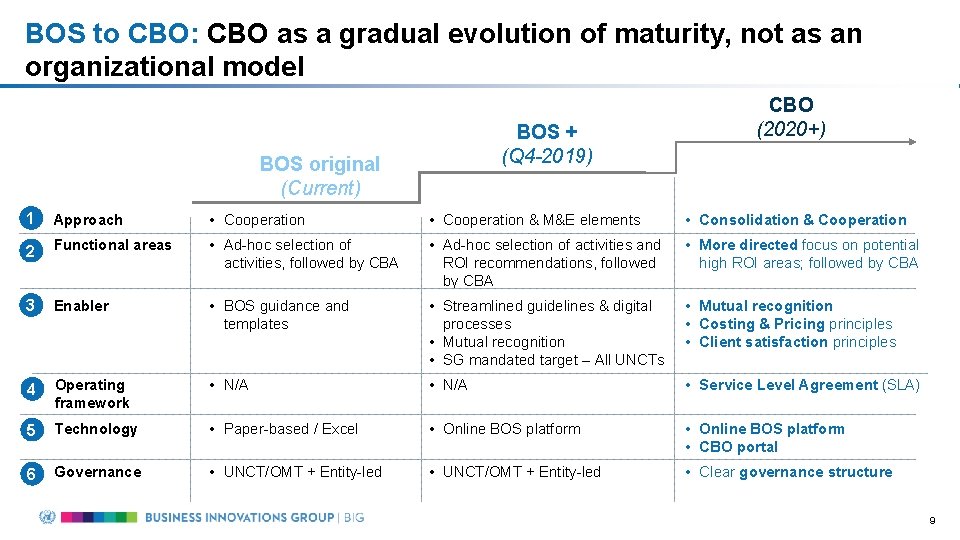
BOS to CBO: CBO as a gradual evolution of maturity, not as an organizational model BOS + (Q 4 -2019) BOS original (Current) CBO (2020+) 1 1. Approach • Cooperation & M&E elements • Consolidation & Cooperation 2. Functional areas 2 • Ad-hoc selection of activities, followed by CBA • Ad-hoc selection of activities and ROI recommendations, followed by CBA • More directed focus on potential high ROI areas; followed by CBA 3 3. Enabler • BOS guidance and templates • Streamlined guidelines & digital processes • Mutual recognition • SG mandated target – All UNCTs • Mutual recognition • Costing & Pricing principles • Client satisfaction principles 4 Operating framework • N/A • Service Level Agreement (SLA) 5 Technology • Paper-based / Excel • Online BOS platform • CBO portal 6 Governance • UNCT/OMT + Entity-led • Clear governance structure 9
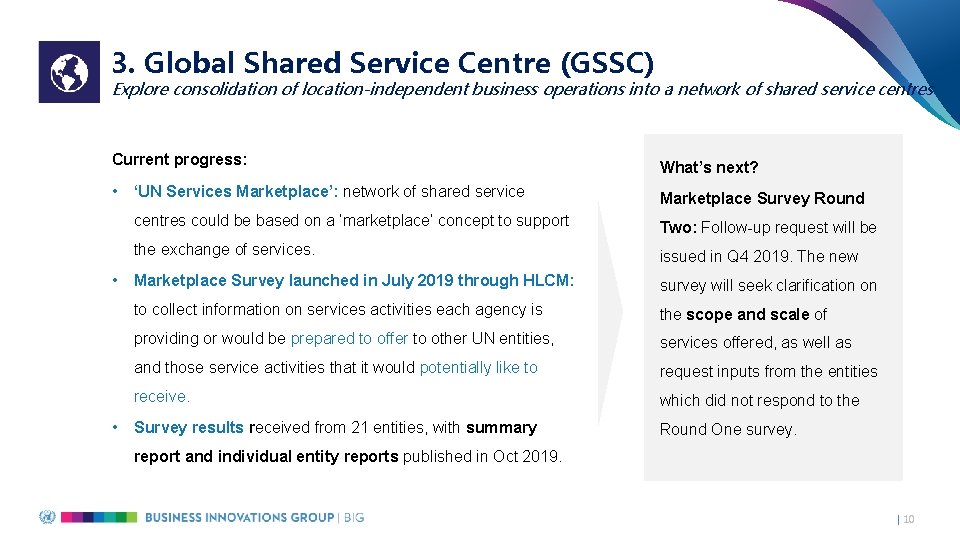
3. Global Shared Service Centre (GSSC) Explore consolidation of location-independent business operations into a network of shared service centres Current progress: What’s next? • ‘UN Services Marketplace’: network of shared service Marketplace Survey Round centres could be based on a ‘marketplace’ concept to support Two: Follow-up request will be the exchange of services. issued in Q 4 2019. The new Marketplace Survey launched in July 2019 through HLCM: survey will seek clarification on to collect information on services activities each agency is the scope and scale of providing or would be prepared to offer to other UN entities, services offered, as well as and those service activities that it would potentially like to request inputs from the entities receive. which did not respond to the Survey results received from 21 entities, with summary Round One survey. • • report and individual entity reports published in Oct 2019. | 10
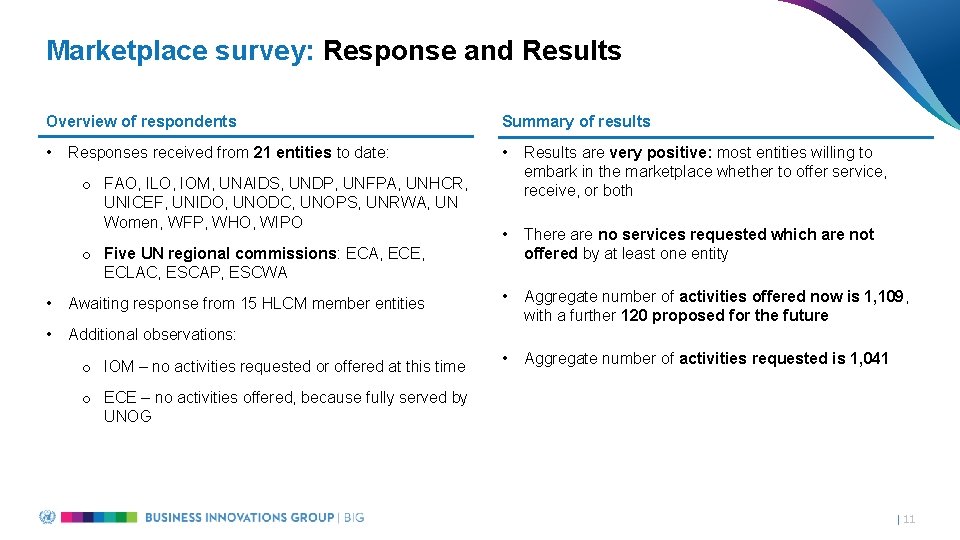
Marketplace survey: Response and Results Overview of respondents Summary of results • • Results are very positive: most entities willing to embark in the marketplace whether to offer service, receive, or both • There are no services requested which are not offered by at least one entity • Aggregate number of activities offered now is 1, 109, with a further 120 proposed for the future • Aggregate number of activities requested is 1, 041 Responses received from 21 entities to date: o FAO, ILO, IOM, UNAIDS, UNDP, UNFPA, UNHCR, UNICEF, UNIDO, UNODC, UNOPS, UNRWA, UN Women, WFP, WHO, WIPO o Five UN regional commissions: ECA, ECE, ECLAC, ESCAP, ESCWA • Awaiting response from 15 HLCM member entities • Additional observations: o IOM – no activities requested or offered at this time o ECE – no activities offered, because fully served by UNOG | 11
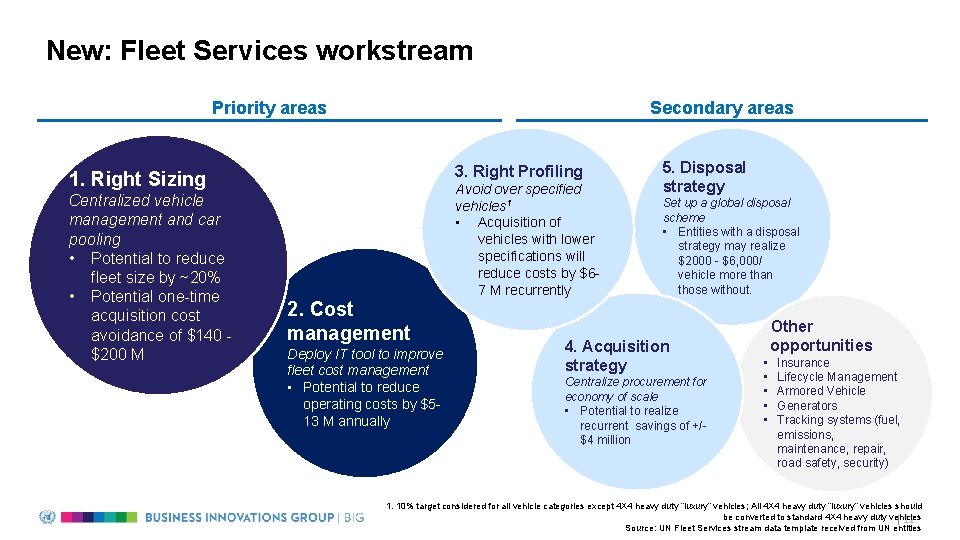
New: Fleet Services workstream Priority areas Secondary areas 3. Right Profiling 1. Right Sizing Centralized vehicle management and car pooling • Potential to reduce fleet size by ~20% • Potential one-time acquisition cost avoidance of $140 $200 M Avoid over specified vehicles 1 • Acquisition of vehicles with lower specifications will reduce costs by $67 M recurrently 2. Cost management Deploy IT tool to improve fleet cost management • Potential to reduce operating costs by $513 M annually 5. Disposal strategy Set up a global disposal scheme • Entities with a disposal strategy may realize $2000 - $6, 000/ vehicle more than those without. 4. Acquisition strategy Centralize procurement for economy of scale • Potential to realize recurrent savings of +/$4 million Other opportunities • • • Insurance Lifecycle Management Armored Vehicle Generators Tracking systems (fuel, emissions, maintenance, repair, road safety, security) 1. 10% target considered for all vehicle categories except 4 X 4 heavy duty “luxury” vehicles; All 4 X 4 heavy duty “luxury” vehicles should be converted to standard 4 X 4 heavy duty vehicles | 12 Source: UN Fleet Services stream data template received from UN entities
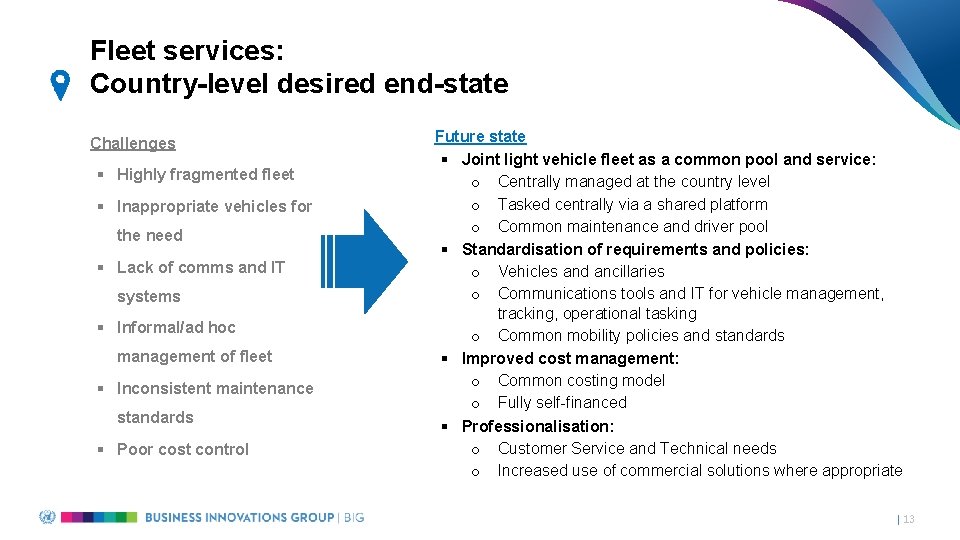
Fleet services: Country-level desired end-state Challenges § Highly fragmented fleet § Inappropriate vehicles for the need § Lack of comms and IT systems § Informal/ad hoc management of fleet § Inconsistent maintenance standards § Poor cost control Future state § Joint light vehicle fleet as a common pool and service: o Centrally managed at the country level o Tasked centrally via a shared platform o Common maintenance and driver pool § Standardisation of requirements and policies: o Vehicles and ancillaries o Communications tools and IT for vehicle management, tracking, operational tasking o Common mobility policies and standards § Improved cost management: o Common costing model o Fully self-financed § Professionalisation: o Customer Service and Technical needs o Increased use of commercial solutions where appropriate | 13
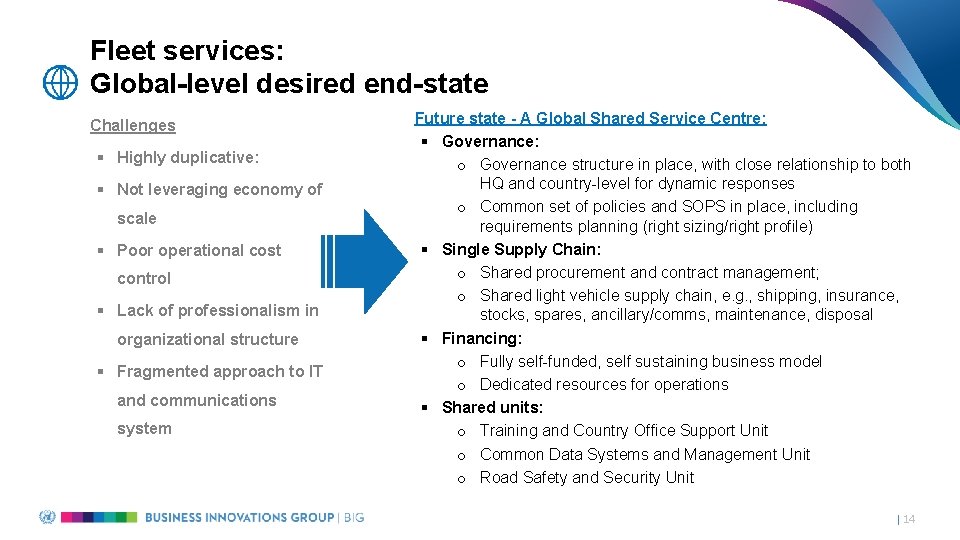
Fleet services: Global-level desired end-state Challenges § Highly duplicative: § Not leveraging economy of scale § Poor operational cost control § Lack of professionalism in organizational structure § Fragmented approach to IT and communications system Future state - A Global Shared Service Centre: § Governance: o Governance structure in place, with close relationship to both HQ and country-level for dynamic responses o Common set of policies and SOPS in place, including requirements planning (right sizing/right profile) § Single Supply Chain: o Shared procurement and contract management; o Shared light vehicle supply chain, e. g. , shipping, insurance, stocks, spares, ancillary/comms, maintenance, disposal § Financing: o Fully self-funded, self sustaining business model o Dedicated resources for operations § Shared units: o Training and Country Office Support Unit o Common Data Systems and Management Unit o Road Safety and Security Unit | 14
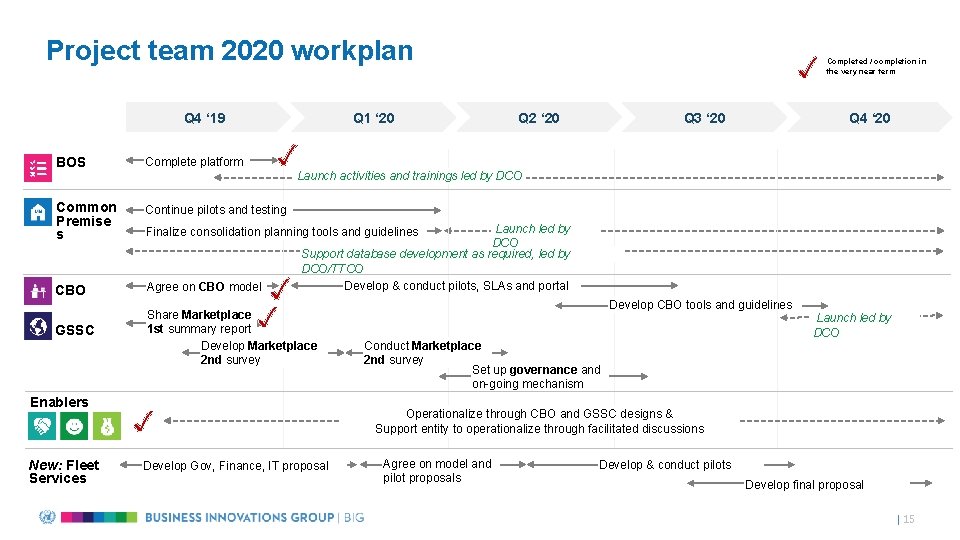
Project team 2020 workplan Q 4 ‘ 19 BOS Complete platform Common Premise s Continue pilots and testing CBO Agree on CBO model GSSC Q 1 ‘ 20 Q 2 ‘ 20 Q 3 ‘ 20 Q 4 ‘ 20 Launch activities and trainings led by DCO Launch led by DCO Support database development as required, led by DCO/TTCO Develop & conduct pilots, SLAs and portal Finalize consolidation planning tools and guidelines Share Marketplace 1 st summary report Develop Marketplace 2 nd survey Enablers New: Fleet Services Completed / completion in the very near term Develop CBO tools and guidelines Conduct Marketplace 2 nd survey Set up governance and on-going mechanism Launch led by DCO Operationalize through CBO and GSSC designs & Support entity to operationalize through facilitated discussions Develop Gov, Finance, IT proposal Agree on model and pilot proposals Develop & conduct pilots Develop final proposal | 15
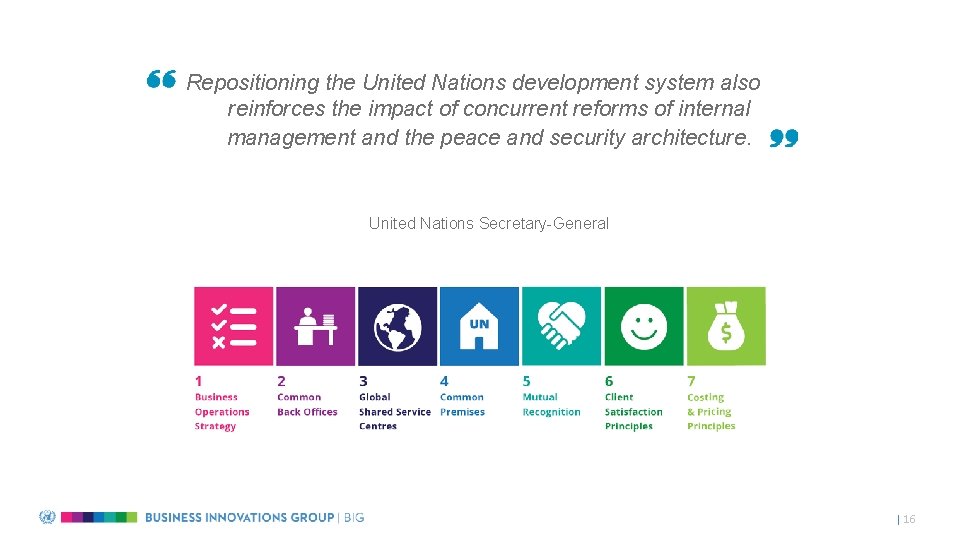
Repositioning the United Nations development system also reinforces the impact of concurrent reforms of internal management and the peace and security architecture. United Nations Secretary-General | 16
- Slides: 17