
Project Overview Introduction Product Analysis Drawing communication Sensing

- Slides: 11
Project Overview § § § § § Introduction & Product Analysis Drawing & communication Sensing abilities in robots Programming Robots Mechanisms and Systems Designing new products & Packaging Presentation and Rendering Biomimicry Concept Modelling Concept presentations
LESSON 02
LESSON 2 STARTER Learning objective: Learn how to draw and annotate observational sketches of existing products. Sketch and draw moving products to develop communication skills. METHODS OF DRAWING & SKETCHING Drawing and sketching is a fun way to be creative. Everyone can draw and sketch. And with practice, you can start to draw things you see around you and recreate them on paper with surprising accuracy. If you are confident, you can then move on to drawing designs for things you can’t see, but are new ideas you have had yourself. This is how designers start every project, with quick sketches on paper to show others (clients and fellow designers) before committing any valuable time to making models or bringing the ideas to life on the computer (CAD). Today you will start by sketching 2 D features and profiles of Hexbugs, then move onto 3 D sketching aspects of them. Once you have mastered these steps, you can then move onto sketching your own ideas… New words: client, CAD.
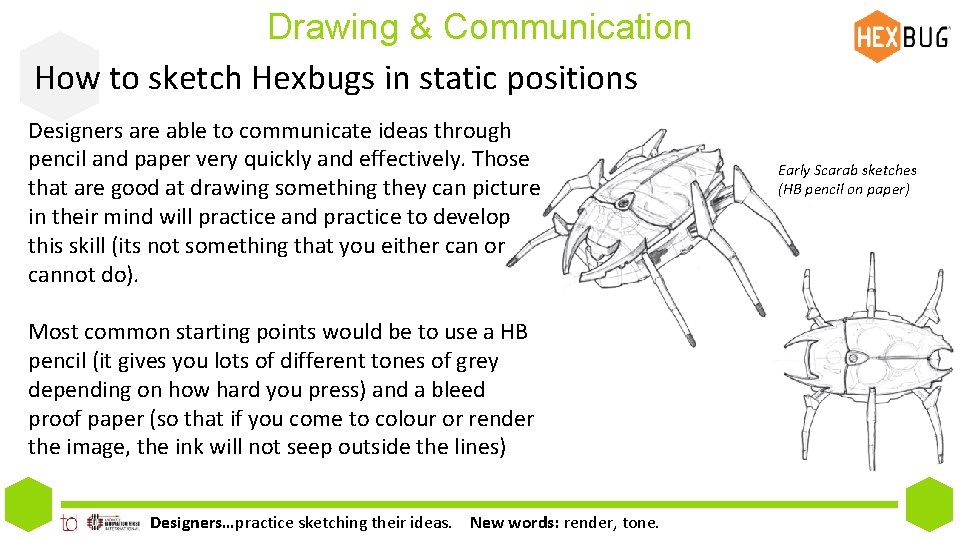
Drawing & Communication How to sketch Hexbugs in static positions Designers are able to communicate ideas through pencil and paper very quickly and effectively. Those that are good at drawing something they can picture in their mind will practice and practice to develop this skill (its not something that you either can or cannot do). Most common starting points would be to use a HB pencil (it gives you lots of different tones of grey depending on how hard you press) and a bleed proof paper (so that if you come to colour or render the image, the ink will not seep outside the lines) Designers…practice sketching their ideas. New words: render, tone. Early Scarab sketches (HB pencil on paper)
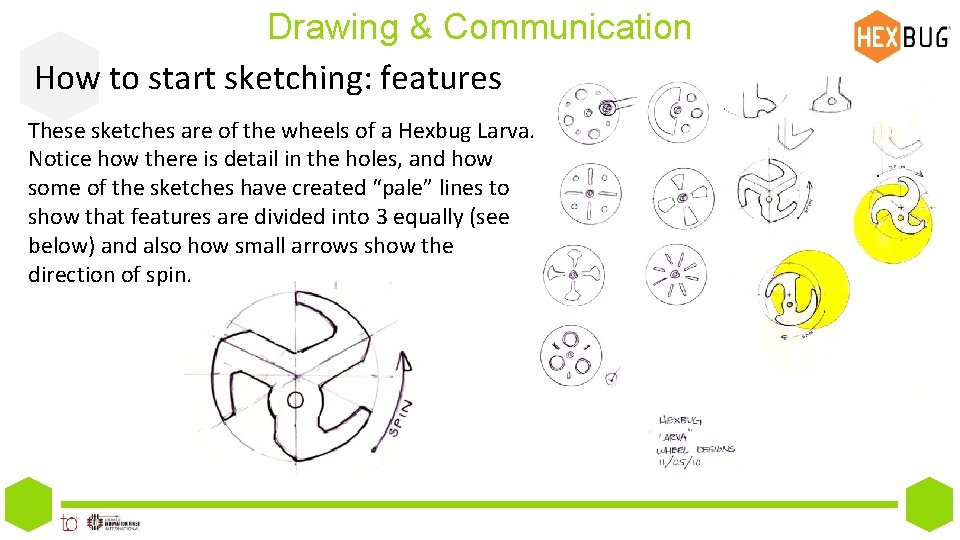
Drawing & Communication How to start sketching: features These sketches are of the wheels of a Hexbug Larva. Notice how there is detail in the holes, and how some of the sketches have created “pale” lines to show that features are divided into 3 equally (see below) and also how small arrows show the direction of spin.
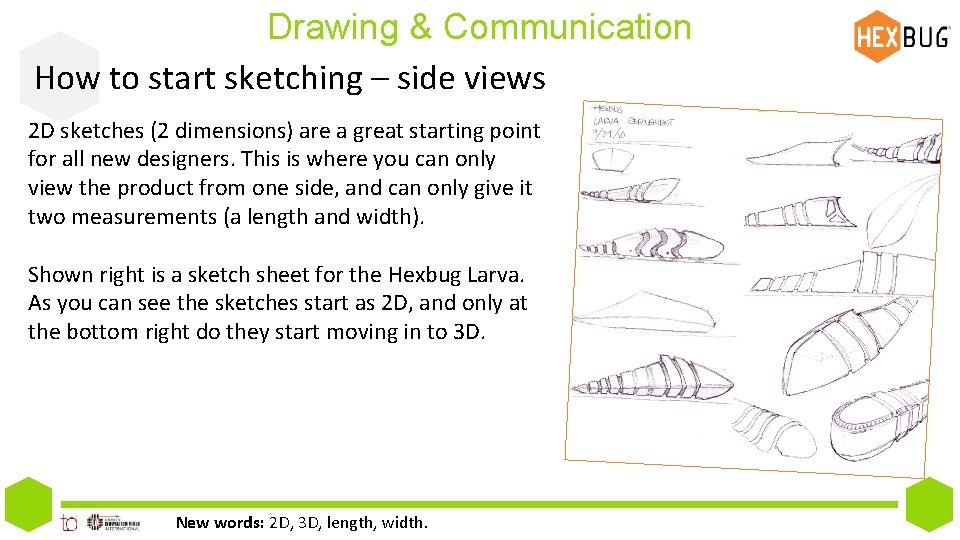
Drawing & Communication How to start sketching – side views 2 D sketches (2 dimensions) are a great starting point for all new designers. This is where you can only view the product from one side, and can only give it two measurements (a length and width). Shown right is a sketch sheet for the Hexbug Larva. As you can see the sketches start as 2 D, and only at the bottom right do they start moving in to 3 D. New words: 2 D, 3 D, length, width.
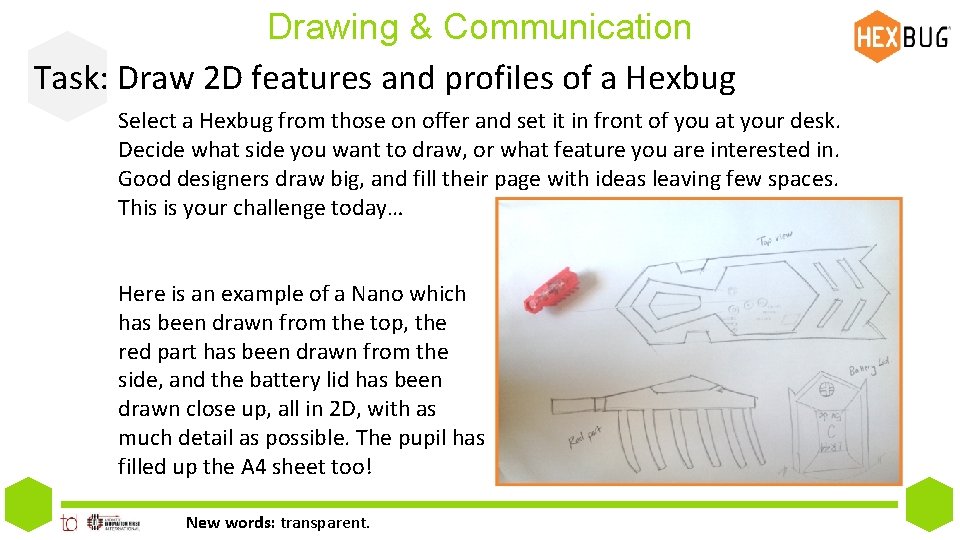
Drawing & Communication Task: Draw 2 D features and profiles of a Hexbug Select a Hexbug from those on offer and set it in front of you at your desk. Decide what side you want to draw, or what feature you are interested in. Good designers draw big, and fill their page with ideas leaving few spaces. This is your challenge today… Here is an example of a Nano which has been drawn from the top, the red part has been drawn from the side, and the battery lid has been drawn close up, all in 2 D, with as much detail as possible. The pupil has filled up the A 4 sheet too! New words: transparent.
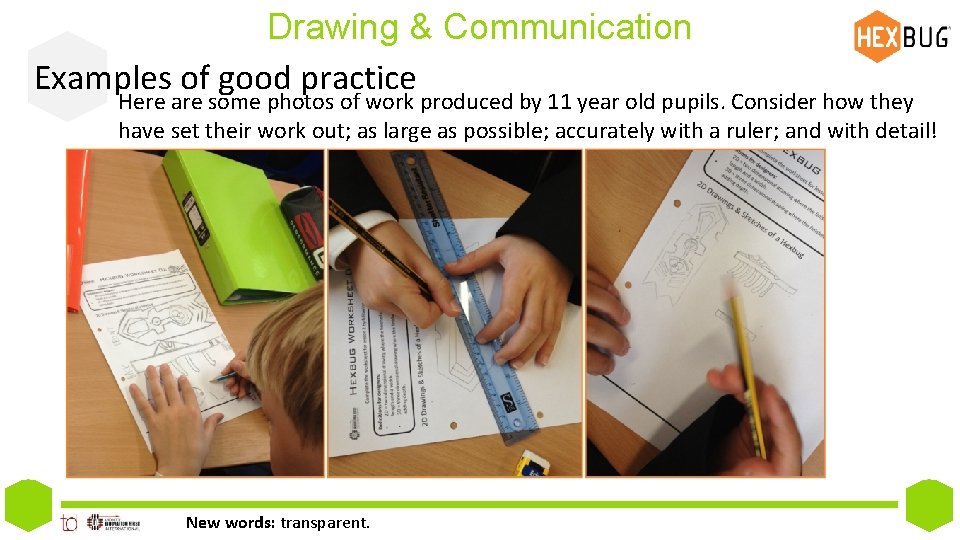
Drawing & Communication Examples of good practice Here are some photos of work produced by 11 year old pupils. Consider how they have set their work out; as large as possible; accurately with a ruler; and with detail! New words: transparent.
LESSON 2 PLENARY As a class, let us consider the following questions? A. How do designers build up their sketches? B. Why do designer sketch in detail? C. What do designers use rulers for? D. Why do we have the saying “a picture paints a thousand words”?
Summary Learning objective: Learn how to draw and annotate observational sketches of existing products. Sketch and draw moving products to develop communication skills. Today you have: § Learnt how to study and draw existing products in 2 D. § Developed knowledge of designers draw § Practiced drawing Hexbugs in detail to prepare for designing your own.