
Project Overview Introduction Product Analysis Drawing communication Sensing

- Slides: 9
Project Overview § § § § § Introduction & Product Analysis Drawing & communication Sensing abilities in robots Programming Robots Mechanisms and Systems Designing new products & Packaging Presentation and Rendering Biomimicry Concept Modelling Concept presentations
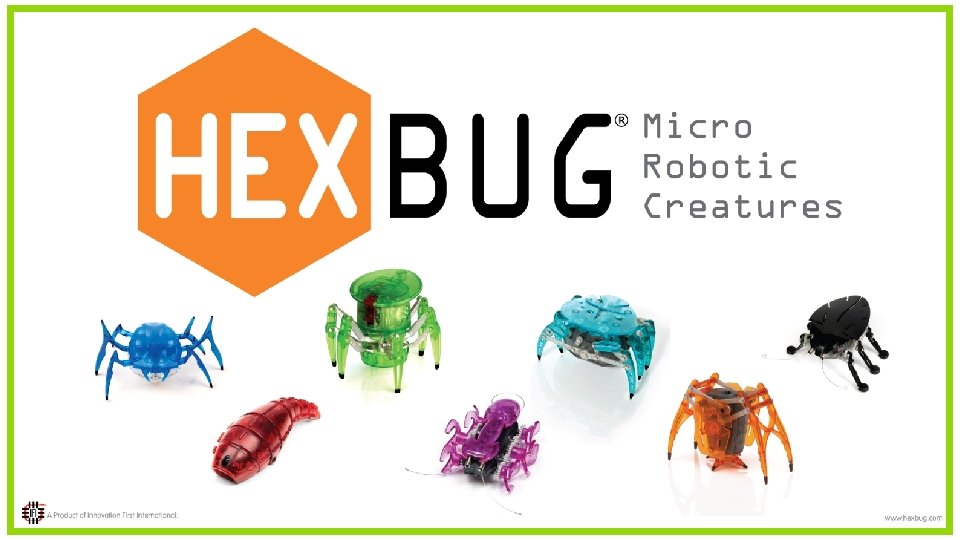
INTRODUCTION In this project you are going to learn design and technology related skills and knowledge relating to a range of cutting edge technology toy robots. They are called Hexbugs. You might have seen them in toy shops, but behind the fun exterior, there is fantastic design and engineering. Definition of a HEXBUG: • a micro robotic creature that reacts to its environment or that you control. • an innovative battery powered, high-tech toy. • Fun for all ages At each stage of this project, you will learn about the jobs people are doing to deliver this product to you the customer. These include concept designers, electrical engineers, robotics specialists and graphic artists, so you might just hear about a career you would like to do when you are older!
LESSON 01
LESSON 1 STARTER Learning objective: Learn how to analyse an existing product to understand how it has been made, how it works, and what features it has. WHAT IS PRODUCT ANALYSIS? The term product analysis means; studying how well a product does its job. • What is the function of the product? • What are the different parts of the product and how do they work together? • How has the product been shaped, coloured, textured and decorated? • What materials and components are used to make the product? • Which processes were used to make the product? • Who is the consumer of this product? • How well does the product do its job? • What is unique about the product? • In what environment might the product be used? New words: function, materials, components, processes, consumer, environment.
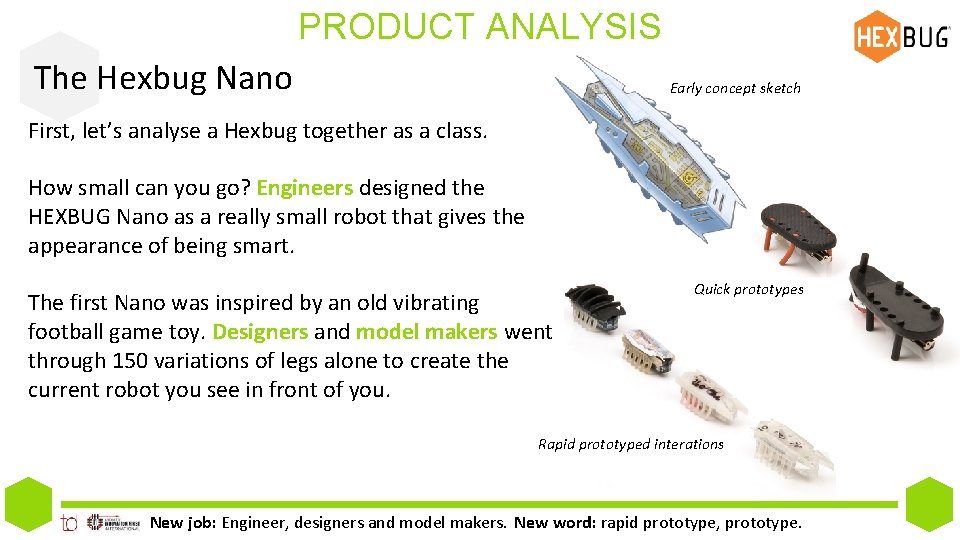
PRODUCT ANALYSIS The Hexbug Nano Early concept sketch First, let’s analyse a Hexbug together as a class. How small can you go? Engineers designed the HEXBUG Nano as a really small robot that gives the appearance of being smart. The first Nano was inspired by an old vibrating football game toy. Designers and model makers went through 150 variations of legs alone to create the current robot you see in front of you. Quick prototypes Rapid prototyped interations New job: Engineer, designers and model makers. New word: rapid prototype, prototype.
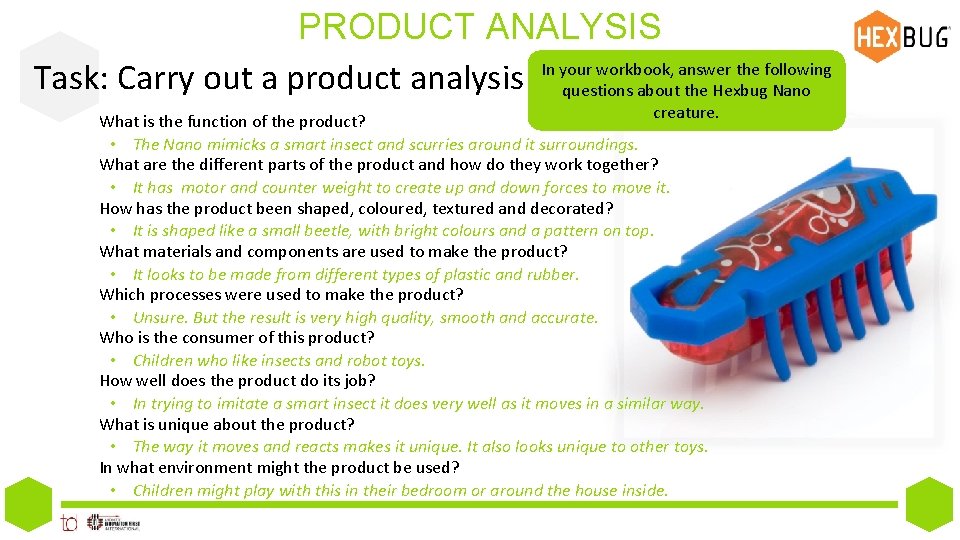
PRODUCT ANALYSIS In your workbook, answer the following Task: Carry out a product analysis questions about the Hexbug Nano creature. What is the function of the product? • The Nano mimicks a smart insect and scurries around it surroundings. What are the different parts of the product and how do they work together? • It has motor and counter weight to create up and down forces to move it. How has the product been shaped, coloured, textured and decorated? • It is shaped like a small beetle, with bright colours and a pattern on top. What materials and components are used to make the product? • It looks to be made from different types of plastic and rubber. Which processes were used to make the product? • Unsure. But the result is very high quality, smooth and accurate. Who is the consumer of this product? • Children who like insects and robot toys. How well does the product do its job? • In trying to imitate a smart insect it does very well as it moves in a similar way. What is unique about the product? • The way it moves and reacts makes it unique. It also looks unique to other toys. In what environment might the product be used? • Children might play with this in their bedroom or around the house inside.
LESSON 1 PLENARY As a class, let us consider the following questions? A. What makes robot toys move? B. What makes them act or react like a real insect? C. From our analysis, what question was hardest to answer without knowing more? D. What jobs are involved in the creation of a Hexbug that we know so far?
Summary Learning objective: Learn how to analyse an existing product to understand how it has been made, how it works, and what features it has. Today you have: § Learnt how to analyse an existing product by looking at a Hexbug Nano. § Analysed their features, characteristics and the qualities that make them smart. § Explored a new product with highly-technological features