
PROJECT ON INTEGRATED NATURAL RESOURCE MANAGEMENT IN THE
- Slides: 27
PROJECT ON INTEGRATED NATURAL RESOURCE MANAGEMENT IN THE BAIKAL BASIN TRANSBOUNDARY ECOSYSTEM TRANSBOUNDARY DIAGNOSTIC ANALYSIS AND STRATEGIC ACTION PROGRAMME FOR THE TRANSBOUNDARY BAIKAL BASIN Dr. Saskia Marijnissen TDA Consultant & SAG Leader saskiamarijnissen@me. com
TRANSBOUNDARY DIAGNOSTIC ANALYSIS LAKE BAIKAL BASIN PRESENTATION STRUCTURE 1. General overview of TDA-SAP process and linkages 2. Brief discussion of key issues relevant to the TDA 3. Overview of SAP process
TRANSBOUNDARY DIAGNOSTIC ANALYSIS LAKE BAIKAL BASIN 1. INTRODUCTION TDA – SAP APPROACH
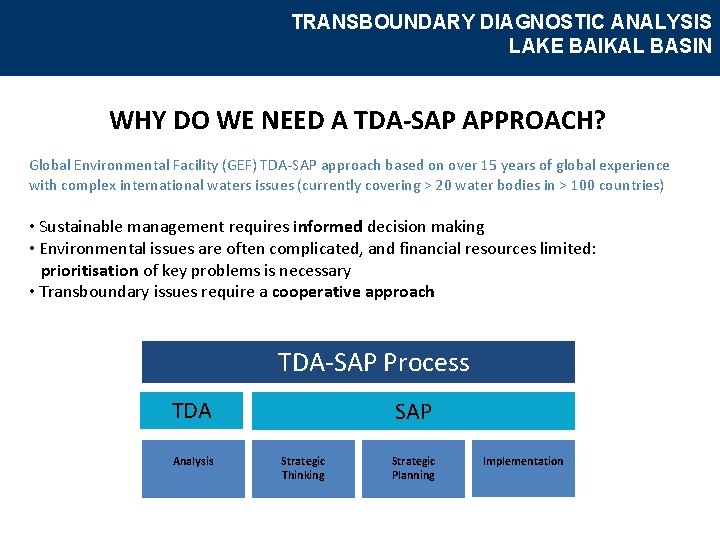
TRANSBOUNDARY DIAGNOSTIC ANALYSIS LAKE BAIKAL BASIN WHY DO WE NEED A TDA-SAP APPROACH? Global Environmental Facility (GEF) TDA-SAP approach based on over 15 years of global experience with complex international waters issues (currently covering > 20 water bodies in > 100 countries) • Sustainable management requires informed decision making • Environmental issues are often complicated, and financial resources limited: prioritisation of key problems is necessary • Transboundary issues require a cooperative approach TDA-SAP Process TDA Analysis SAP Strategic Thinking Strategic Planning Implementation
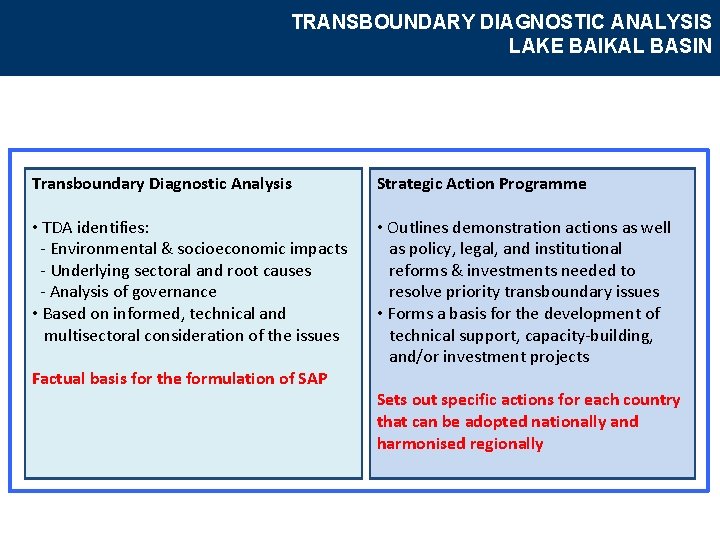
TRANSBOUNDARY DIAGNOSTIC ANALYSIS LAKE BAIKAL BASIN Transboundary Diagnostic Analysis Strategic Action Programme • TDA identifies: - Environmental & socioeconomic impacts - Underlying sectoral and root causes - Analysis of governance • Based on informed, technical and multisectoral consideration of the issues • Outlines demonstration actions as well as policy, legal, and institutional reforms & investments needed to resolve priority transboundary issues • Forms a basis for the development of technical support, capacity-building, and/or investment projects Factual basis for the formulation of SAP Sets out specific actions for each country that can be adopted nationally and harmonised regionally
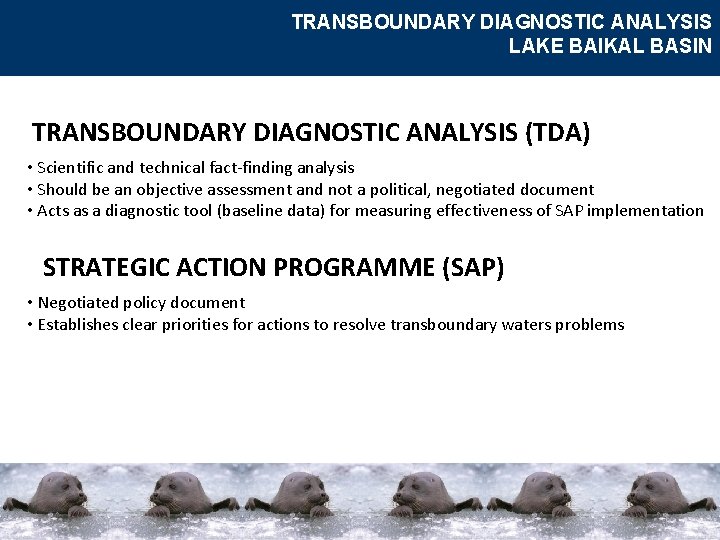
TRANSBOUNDARY DIAGNOSTIC ANALYSIS LAKE BAIKAL BASIN TRANSBOUNDARY DIAGNOSTIC ANALYSIS (TDA) • Scientific and technical fact-finding analysis • Should be an objective assessment and not a political, negotiated document • Acts as a diagnostic tool (baseline data) for measuring effectiveness of SAP implementation STRATEGIC ACTION PROGRAMME (SAP) • Negotiated policy document • Establishes clear priorities for actions to resolve transboundary waters problems
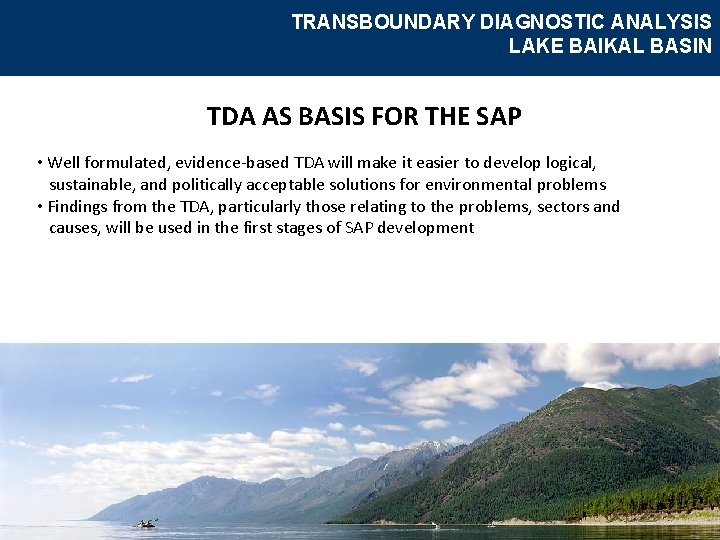
TRANSBOUNDARY DIAGNOSTIC ANALYSIS LAKE BAIKAL BASIN TDA AS BASIS FOR THE SAP • Well formulated, evidence-based TDA will make it easier to develop logical, sustainable, and politically acceptable solutions for environmental problems • Findings from the TDA, particularly those relating to the problems, sectors and causes, will be used in the first stages of SAP development
TRANSBOUNDARY DIAGNOSTIC ANALYSIS LAKE BAIKAL BASIN 2. UPDATED TDA
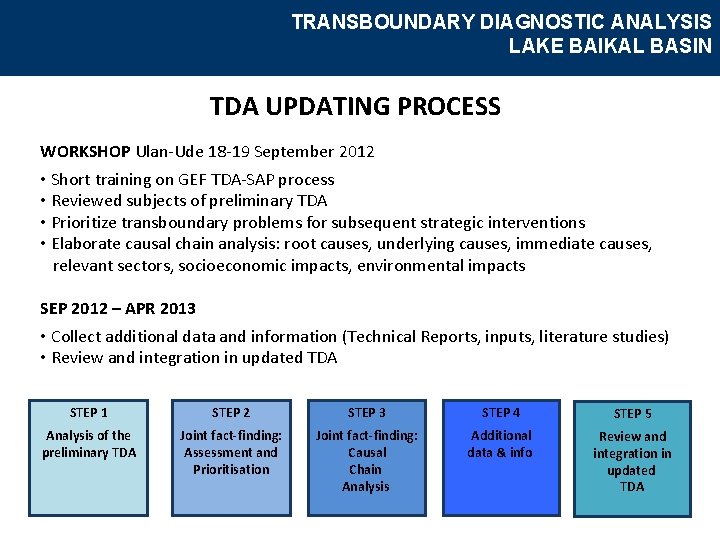
TRANSBOUNDARY DIAGNOSTIC ANALYSIS LAKE BAIKAL BASIN TDA UPDATING PROCESS WORKSHOP Ulan-Ude 18 -19 September 2012 • Short training on GEF TDA-SAP process • Reviewed subjects of preliminary TDA • Prioritize transboundary problems for subsequent strategic interventions • Elaborate causal chain analysis: root causes, underlying causes, immediate causes, relevant sectors, socioeconomic impacts, environmental impacts SEP 2012 – APR 2013 • Collect additional data and information (Technical Reports, inputs, literature studies) • Review and integration in updated TDA STEP 1 STEP 2 STEP 3 STEP 4 STEP 5 Analysis of the preliminary TDA Joint fact-finding: Assessment and Prioritisation Joint fact-finding: Causal Chain Analysis Additional data & info Review and integration in updated TDA
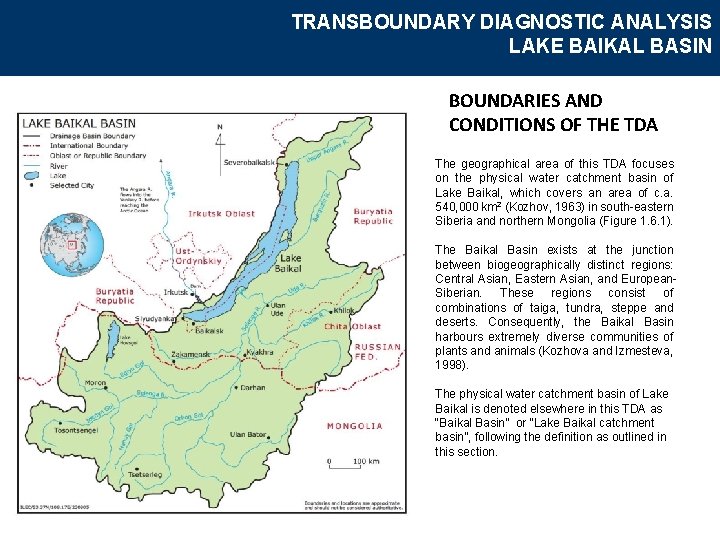
TRANSBOUNDARY DIAGNOSTIC ANALYSIS LAKE BAIKAL BASIN BOUNDARIES AND CONDITIONS OF THE TDA The geographical area of this TDA focuses on the physical water catchment basin of Lake Baikal, which covers an area of c. a. 540, 000 km 2 (Kozhov, 1963) in south-eastern Siberia and northern Mongolia (Figure 1. 6. 1). The Baikal Basin exists at the junction between biogeographically distinct regions: Central Asian, Eastern Asian, and European. Siberian. These regions consist of combinations of taiga, tundra, steppe and deserts. Consequently, the Baikal Basin harbours extremely diverse communities of plants and animals (Kozhova and Izmesteva, 1998). The physical water catchment basin of Lake Baikal is denoted elsewhere in this TDA as “Baikal Basin” or “Lake Baikal catchment basin”, following the definition as outlined in this section.
TRANSBOUNDARY DIAGNOSTIC ANALYSIS LAKE BAIKAL BASIN WHY PRIORITISE? • Environmental issues in transboundary water basins are often abundant and complex, while financial and human resources are limited • Prioritisation enables governments and other stakeholders to focus limited financial and human resources on key environmental issues and maximise impact
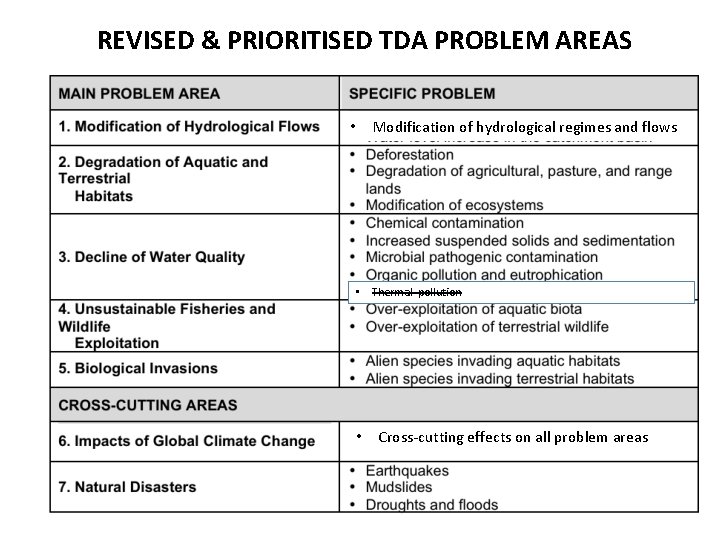
REVISED & PRIORITISED TDA PROBLEM AREAS • Modification of hydrological regimes and flows • Thermal pollution • Cross-cutting effects on all problem areas
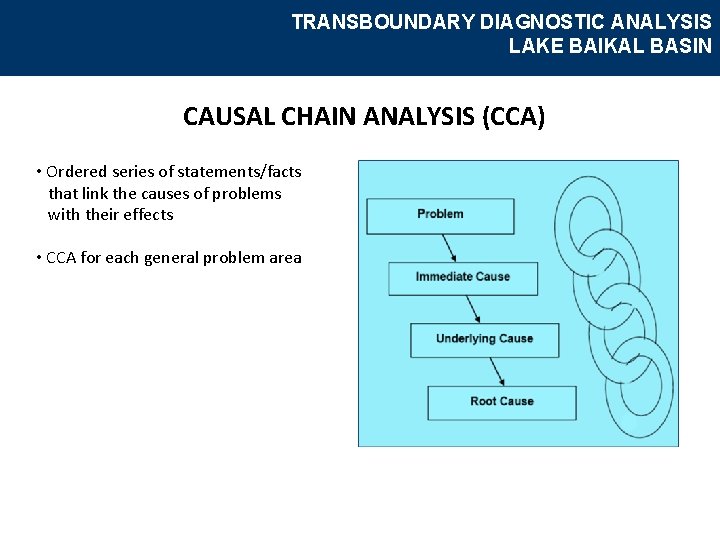
TRANSBOUNDARY DIAGNOSTIC ANALYSIS LAKE BAIKAL BASIN CAUSAL CHAIN ANALYSIS (CCA) • Ordered series of statements/facts that link the causes of problems with their effects • CCA for each general problem area
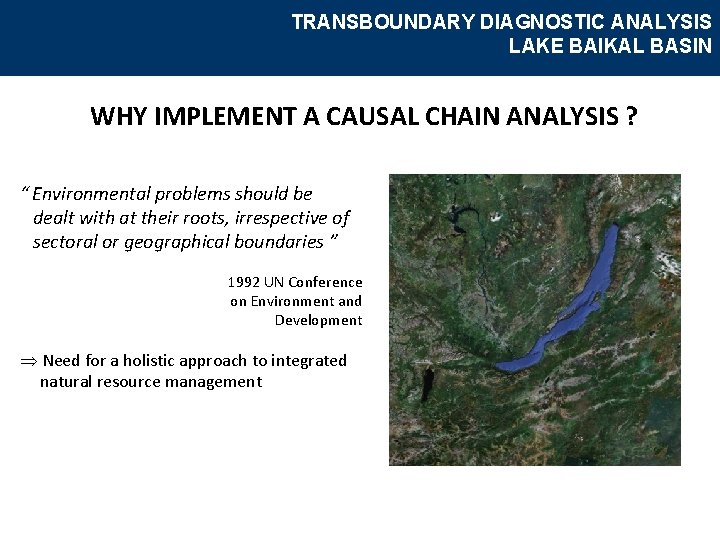
TRANSBOUNDARY DIAGNOSTIC ANALYSIS LAKE BAIKAL BASIN WHY IMPLEMENT A CAUSAL CHAIN ANALYSIS ? “ Environmental problems should be dealt with at their roots, irrespective of sectoral or geographical boundaries ” 1992 UN Conference on Environment and Development Need for a holistic approach to integrated natural resource management
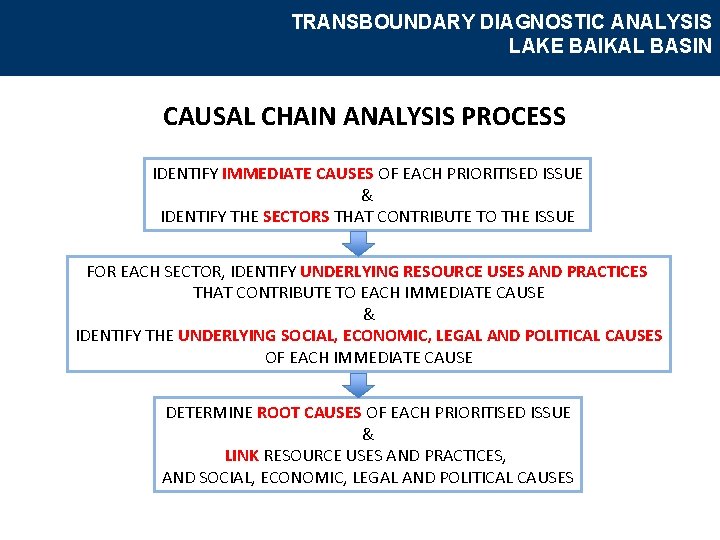
TRANSBOUNDARY DIAGNOSTIC ANALYSIS LAKE BAIKAL BASIN CAUSAL CHAIN ANALYSIS PROCESS IDENTIFY IMMEDIATE CAUSES OF EACH PRIORITISED ISSUE & IDENTIFY THE SECTORS THAT CONTRIBUTE TO THE ISSUE FOR EACH SECTOR, IDENTIFY UNDERLYING RESOURCE USES AND PRACTICES THAT CONTRIBUTE TO EACH IMMEDIATE CAUSE & IDENTIFY THE UNDERLYING SOCIAL, ECONOMIC, LEGAL AND POLITICAL CAUSES OF EACH IMMEDIATE CAUSE DETERMINE ROOT CAUSES OF EACH PRIORITISED ISSUE & LINK RESOURCE USES AND PRACTICES, AND SOCIAL, ECONOMIC, LEGAL AND POLITICAL CAUSES
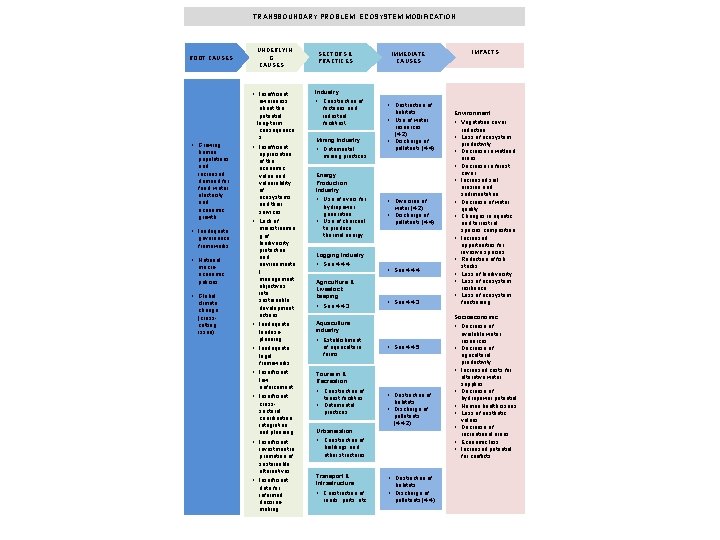
TRANSBOUNDARY PROBLEM: ECOSYSTEM MODIFICATION ROOT CAUSES UNDERLYIN G CAUSES • Insufficient • Growing human populations and increased demand for food, water, electricity, and economic growth • Inadequate governance frameworks • National macroeconomic policies • Global climate change (crosscutting issue) SECTORS & PRACTICES Industry awareness about the potential long-term consequence s • Construction of • Insufficient • Detrimental appreciation of the economic value and vulnerability of ecosystems and their services • Lack of mainstreamin g of biodiversity protection and environmenta l management objectives into sustainable development actions • Inadequate landuseplanning • Inadequate legal frameworks • Insufficient law enforcement • Insufficient factories and industrial facilities Mining Industry resources (4. 2) • Discharge of pollutants (4. 4) Environment • Vegetation cover reduction • Loss of ecosystem productivity • Decrease in wetland areas cover Energy Production Industry • Use of rivers for hydropower generation • Use of charcoal to produce thermal energy • Increased soil • Diversion of water (4. 2) • Discharge of pollutants (4. 4) • See 4. 4. 4 Agriculture & Livestock keeping • See 4. 4. 3 of aquaculture farms tourist facilities • Construction of practices • • opportunities for invasive species Reduction of fish stocks Loss of biodiversity Loss of ecosystem resilience Loss of ecosystem functioning Socioeconomic • Decrease of • See 4. 4. 5 • Destruction of habitats • Discharge of pollutants (4. 4. 2) Urbanisation buildings and other structures Transport & Infrastructure • Destruction of • Construction of • Discharge of roads, ports, etc. and terrestrial species composition • • See 4. 4. 3 Tourism & Recreation • Construction of quality • Changes in aquatic • • See 4. 4. 4 Aquaculture industry • Establishment erosion and sedimentation • Decrease of water • Increased Logging Industry • Insufficient data for informed decisionmaking habitats • Use of water • Decrease in forest • Detrimental • Insufficient • Destruction of mining practices crosssectoral coordination, integration and planning investment in promotion of sustainable alternatives IMPACTS IMMEDIATE CAUSES habitats pollutants (4. 4) available water resources • Decrease of agricultural productivity • Increased costs for alterative water supplies • Decrease of hydropower potential • Human health issues • Loss of aesthetic values • Decrease of recreational areas • Economic loss • Increased potential for conflicts
TRANSBOUNDARY DIAGNOSTIC ANALYSIS LAKE BAIKAL BASIN RECOMMENDATIONS • • PROBLEM AREA 1 “MODIFICATION OF HYDROLOGICAL REGIMES AND FLOWS” REMOVAL OF THERMAL POLLUTION FROM LIST OF TRANSBOUNDARY CONCERNS • TRANSBOUNDARY RELEVANCE OF SOME OF THE PROBLEMS NEEDS TO BE BETTER CLARIFIED IN CHAPTER 4 OF TDA • ADDITIONAL MAPS (E. G. GIS-BASED/DRAWINGS) WOULD BE USEFUL IN ORDER TO ILLUSTRATE AND CLARIFY THE TRANSBOUNDARY RELEVANCE OF PROBLEMS • DRAFT LIST OF RECOMMENDATIONS FOR SAP GOALS
TRANSBOUNDARY DIAGNOSTIC ANALYSIS LAKE BAIKAL BASIN RECOMMENDATIONS IMPROVED FUTURE MONITORING OF PARAMETERS RELEVANT TO PRIORITY PROBLEM AREAS IDENTIFIED IN THE TDA: - SURFACE AND GROUNDWATER QUANTITY AND QUALITY - LAND USE PATTERNS (DEGRADATION HOTSPOTS, FOREST COVER, AGRICULTURAL USE, MINING), USING SATELLITE DATA • • • HARMONISATION OF MONITORING METHODS AND STANDARDS REGULAR EXCHANGE AND DISCUSSION OF MONITORING DATA BETWEEN MONGOLIA AND RUSSIA • PREPARE OVERVIEW OF GROUNDWATER AND SURFACE WATER USE PER SECTOR • PREPARE SUSTAINABLE LANDUSE STRATEGIES (E. G. AGROFORESTRY, REFORESTATION SUSTAINABLE AGRICULTURE, ETC. ) BASED ON LAND DEGRADATION HOTSPOT MAPS
TRANSBOUNDARY DIAGNOSTIC ANALYSIS LAKE BAIKAL BASIN RECOMMENDATIONS • ANALYSIS OF ECONOMIC BENEFITS OF ECOSYSTEM SERVICES PROVIDED BY HEALTHY AQUATIC AND TERRESTRIAL SYSTEMS, AND ECONOMIC LOSSES FROM UNSUSTAINABLE LAND USE • PROMOTE STRUCTURED, INTEGRATED APPROACH TO SUSTAINABLE TRANSBOUNDARY NATURAL RESOURCE MANAGEMENT, INCLUDING ENHANCED COOPERATION IN SCIENCE, TECHNOLOGY, POLICY AND LEGISLATION
TRANSBOUNDARY DIAGNOSTIC ANALYSIS LAKE BAIKAL BASIN 3. PROCESS FOR DRAFTING A STRATEGIC ACTION PROGRAMME NB: Also see GEF IW TDA-SAP manual, available from IW: LEARN website http: //manuals. iwlearn. net
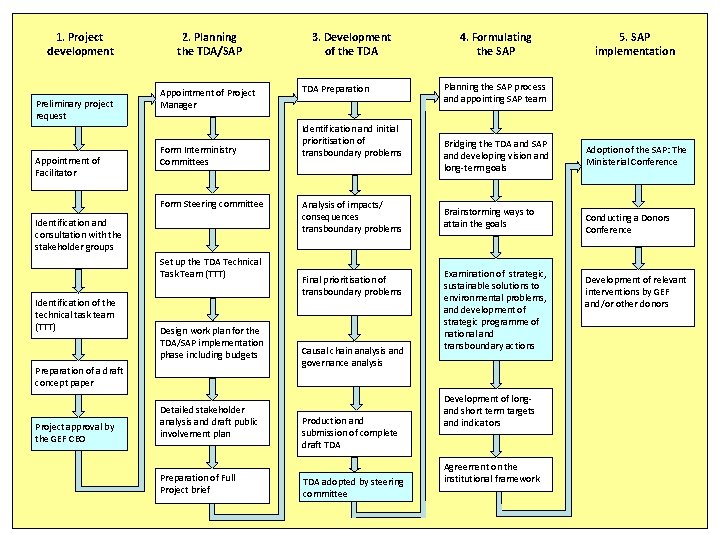
1. Project development Preliminary project request Appointment of Facilitator 2. Planning the TDA/SAP Appointment of Project Manager Form Interministry Committees Form Steering committee Identification and consultation with the stakeholder groups Set up the TDA Technical Task Team (TTT) Identification of the technical task team (TTT) Design work plan for the TDA/SAP implementation phase including budgets Preparation of a draft concept paper Project approval by the GEF CEO Detailed stakeholder analysis and draft public involvement plan Preparation of Full Project brief 3. Development of the TDA Preparation Identification and initial prioritisation of transboundary problems Analysis of impacts/ consequences transboundary problems Final prioritisation of transboundary problems Causal chain analysis and governance analysis Production and submission of complete draft TDA adopted by steering committee 4. Formulating the SAP 5. SAP implementation Planning the SAP process and appointing SAP team Bridging the TDA and SAP and developing vision and long-term goals Brainstorming ways to attain the goals Examination of strategic, sustainable solutions to environmental problems, and development of strategic programme of national and transboundary actions Development of long- and short term targets and indicators Agreement on the institutional framework Adoption of the SAP: The Ministerial Conference Conducting a Donors Conference Development of relevant interventions by GEF and/or other donors
TRANSBOUNDARY DIAGNOSTIC ANALYSIS LAKE BAIKAL BASIN TDA AS BASIS FOR THE SAP • Findings from the TDA, particularly those relating to the problems, sectors and causes, will be used in the first stages of SAP development • Long-term goals and targets of the SAP should flow from the problems, sectors, and causes identified in the TDA • SAP development should involve developing a matrix of options and identifying which part of the causal chain from the TDA they address
TRANSBOUNDARY DIAGNOSTIC ANALYSIS LAKE BAIKAL BASIN VISION In the context of the TDA/SAP Approach, the vision is a long-term view describing the way the stakeholders think the water system should look in the future. A long term vision should be: • • Understandable: to scientific audience, managers, and the general public Aspirational: SAP must inspire and encourage stakeholders so that they want to take action Ambitious: the goal should be to really make a difference and achieve sustainability Attainable: the actions in the SAP should be realistic and possible Lake Baikal Transboundary Basin: “People of the region are prospering from healthy aquatic and terrestrial ecosystems in the Lake Baikal Basin that continue to harbour high levels of biodiversity and provide sufficient natural resources and ecosystem services to sustain future generations”
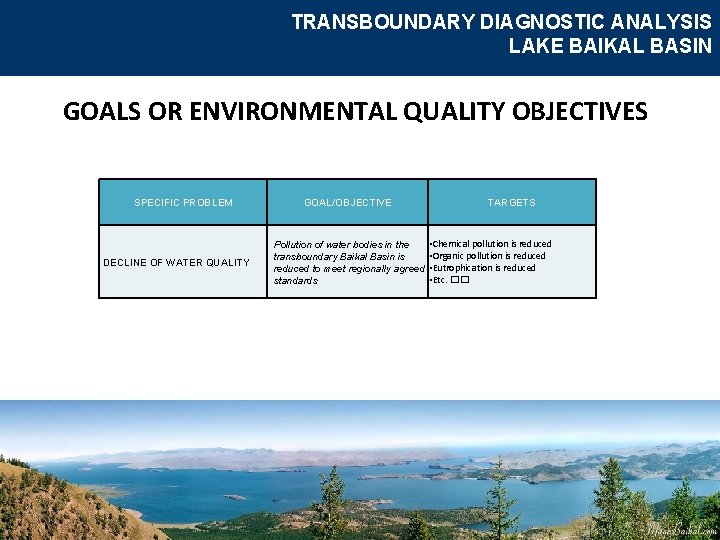
TRANSBOUNDARY DIAGNOSTIC ANALYSIS LAKE BAIKAL BASIN GOALS OR ENVIRONMENTAL QUALITY OBJECTIVES SPECIFIC PROBLEM DECLINE OF WATER QUALITY GOAL/OBJECTIVE Pollution of water bodies in the transboundary Baikal Basin is reduced to meet regionally agreed standards TARGETS • Chemical pollution is reduced • Organic pollution is reduced • Eutrophication is reduced • Etc. � �
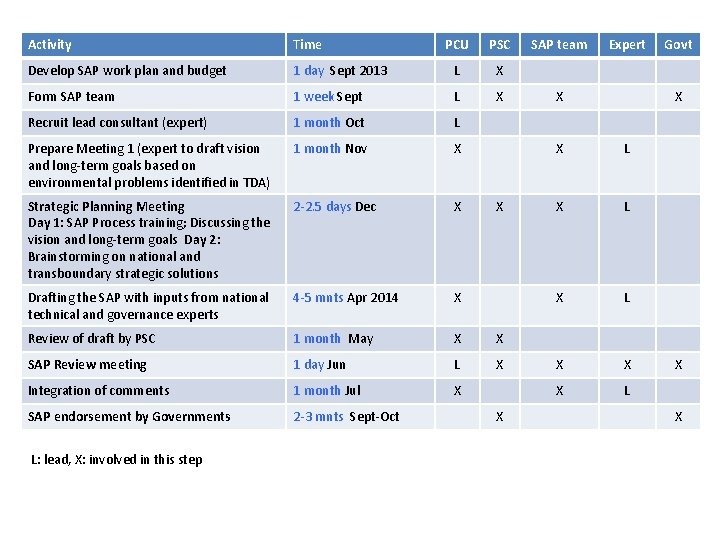
Activity Time PCU PSC Develop SAP work plan and budget 1 day Sept 2013 L X Form SAP team 1 week Sept L X Recruit lead consultant (expert) 1 month Oct L Prepare Meeting 1 (expert to draft vision and long-term goals based on environmental problems identified in TDA) 1 month Nov X Strategic Planning Meeting Day 1: SAP Process training; Discussing the vision and long-term goals Day 2: Brainstorming on national and transboundary strategic solutions 2 -2. 5 days Dec X Drafting the SAP with inputs from national technical and governance experts 4 -5 mnts Apr 2014 X Review of draft by PSC 1 month May X X SAP Review meeting 1 day Jun L X Integration of comments 1 month Jul X SAP endorsement by Governments 2 -3 mnts Sept-Oct L: lead, X: involved in this step X X SAP team Expert X Govt X X L X L X X