
Project Monitoring Evaluation PME Project Cycle Management for
- Slides: 14
Project Monitoring & Evaluation (PME) Project Cycle Management for CBOs, CSOs and NGOs By Piseth Vann, 30 Aug 2016
5. M&E Approach 3/4/2021 2
M&E Approach (Cont) The core methods recommended are: 1. Logical Framework Analysis (LFA) 2. Stakeholder analysis, 3. Documentation review, 4. Biophysical measurements, 5. Direct observation, 6. Cost-benefit analysis, 7. Questionnaires and surveys, 8. Semi-structure interviews, and 9. Case studies. 3
M&E Approach (Cont) Objective: After this session, participants will be able to understand adopt some of the approaches and tools and identify appropriate indicators of M&E for the organization 4
M&E Approach (Cont) There are different kinds of M&E approaches and tools (1) (2) (3) (4) (5) (6) (7) (8) stakeholder analysis, documentation review, biophysical measurements, direct observation, cost-benefit analysis, questionnaires and surveys, semi-structure interviews, and case studies and most significant change story. 5
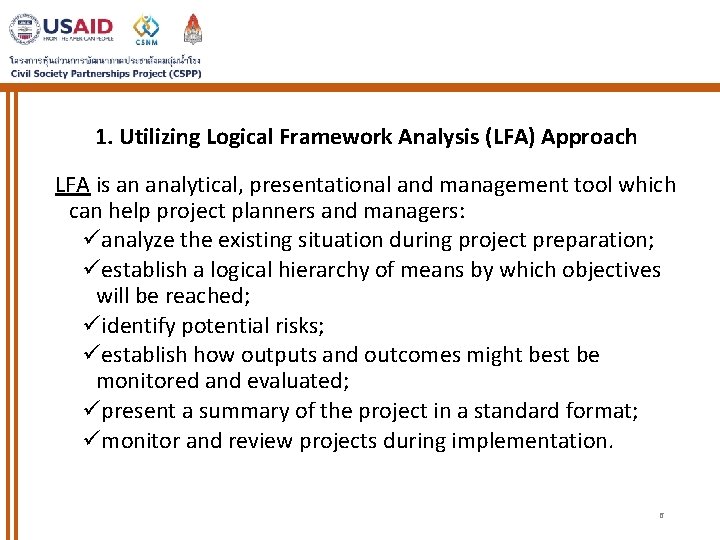
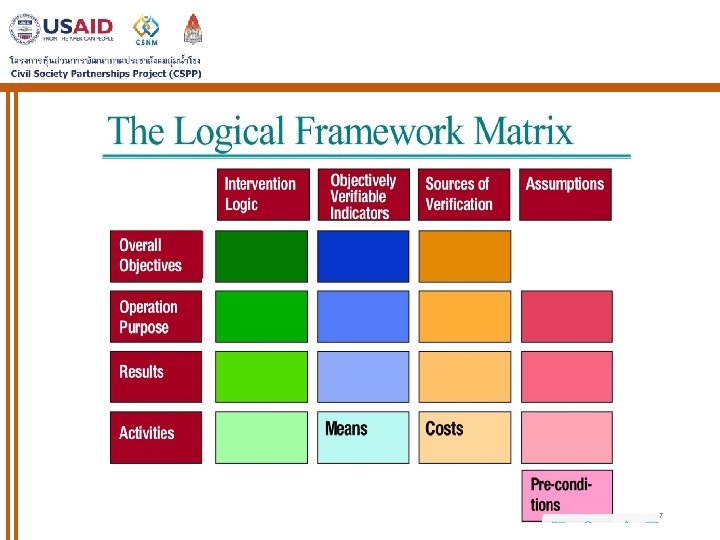
1. Utilizing Logical Framework Analysis (LFA) Approach LFA is an analytical, presentational and management tool which can help project planners and managers: üanalyze the existing situation during project preparation; üestablish a logical hierarchy of means by which objectives will be reached; üidentify potential risks; üestablish how outputs and outcomes might best be monitored and evaluated; üpresent a summary of the project in a standard format; ümonitor and review projects during implementation. 6
7
2. Understanding about Indicators • Indicators are measure of progress or lack of progress used to assess progress towards meeting stated objectives. An indicator should provide, where possible, a clearly defined unit of measurement and a target detailing the quantity, quality and timing of expected results 8
Understanding about Indicators (Cont) For example: • Number of youth who participate in vocational training • Number of communities where the program has operated • Number of partner staff members who attend training • Percentage of the population who live below the poverty line • Percentage of employment or unemployment of a particular group of the population • Number of training or workshop conducted • Number of promotional campaign materials (e. g. poster, fliers…) distributed • Percentage of the population who are literate or illiterate • Number or percentage of the population who are infected by a particular disease (e. g. HIV/AIDS) 9
SMART Indicator in designing logframe S M A R T = Specific = Measurable = Achievable or Attainable = Realistic or Result Oriented = Time-bound 10
The “CREAM” of Good Performance Indicators Clear = Precise and unambiguous Relevant = Appropriate to subject at hand Economic = Available at reasonable cost Adequate = Sufficient to assess performance Monitorable = Amenable to independent validation 11
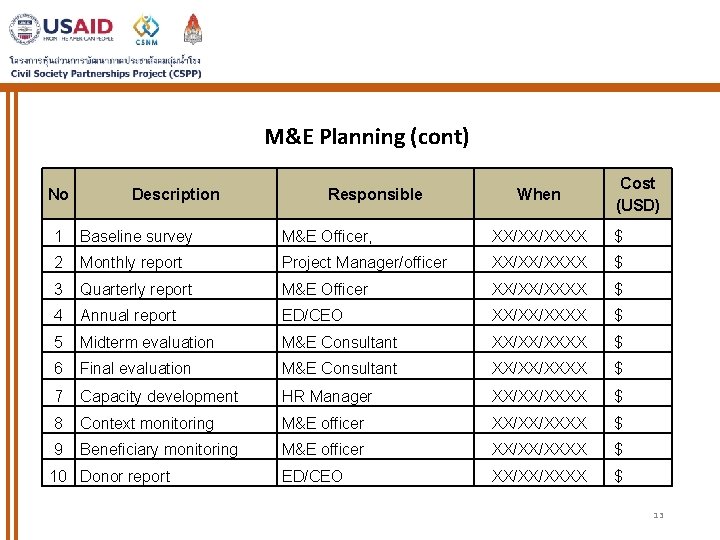
3. M&E Planning and Budgeting It is best to begin systematically planning the M&E and related budget early in the project/program design process so that adequate funds are allocated and available for M&E activities. 12
M&E Planning (cont) No Description Responsible When Cost (USD) 1 Baseline survey M&E Officer, XX/XX/XXXX $ 2 Monthly report Project Manager/officer XX/XX/XXXX $ 3 Quarterly report M&E Officer XX/XX/XXXX $ 4 Annual report ED/CEO XX/XX/XXXX $ 5 Midterm evaluation M&E Consultant XX/XX/XXXX $ 6 Final evaluation M&E Consultant XX/XX/XXXX $ 7 Capacity development HR Manager XX/XX/XXXX $ 8 Context monitoring M&E officer XX/XX/XXXX $ 9 Beneficiary monitoring M&E officer XX/XX/XXXX $ ED/CEO XX/XX/XXXX $ 10 Donor report 13
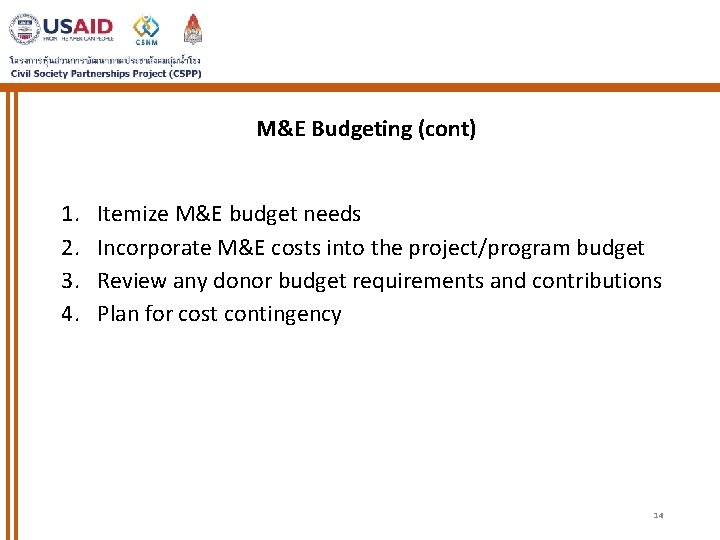
M&E Budgeting (cont) 1. 2. 3. 4. Itemize M&E budget needs Incorporate M&E costs into the project/program budget Review any donor budget requirements and contributions Plan for cost contingency 14