
Project Mangement Chapter 4 Framework for Project Management


- Slides: 33
Project Mangement Chapter 4 Framework for Project Management
Framework for Project Management • • • Project Management as a profession The Project Management Institute (PMI) Project Management Knowledge Areas Project Management Certifications Scrum development The Project Management Office
Project Management as a Profession Body of knowledge Standards Professional organizations Currently, anyone can call him or herself a project manager • Unresolved issue: to what extent can an expert PM move from one industry to another? • •
Project Management Standards • Standards organizations • PMI – Project Management Institute: http: //www. pmi. org/ – CAPM, PMP and other professional standards • IPMA – International Project Management Association: http: //ipma. ch/ – Several certifications 4
Project Management Institute (PMI) • Established in 1969 • Certifications: most popular is PMP – Also offer CAPM, for novice PMs, and several specialized certifications • Currently over 590, 000 PMPs in the world • Have published the Project Management Body of Knowledge or PMBOK, now in its 5 th edition.
Project Management Professional (PMP) • Requirements: – 5 years of project management experience – pass a rigorous exam – maintain ongoing professional development • Currently over 590, 000 PMPs in the world • The CAPM or Certified Associate in Project Management only requires an exam and is considered to be a step along the way to a PMP
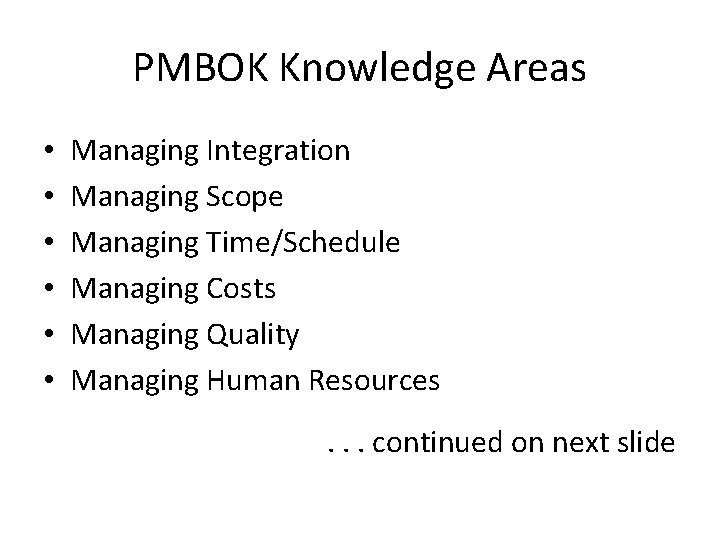
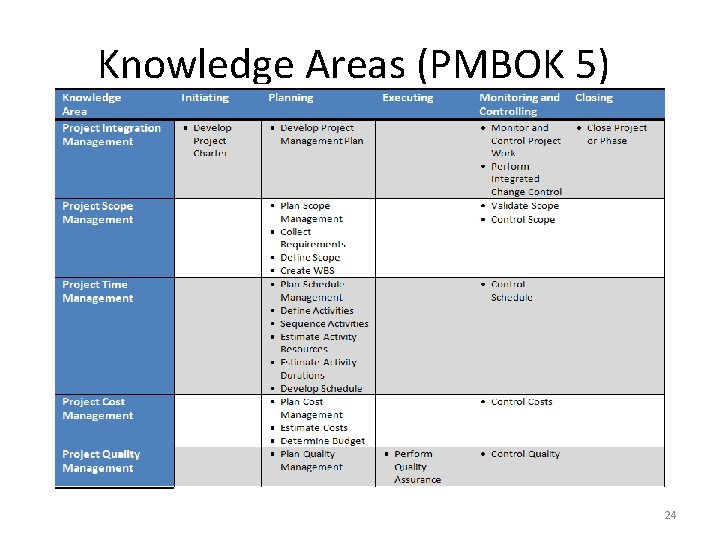
PMBOK Knowledge Areas • • • Managing Integration Managing Scope Managing Time/Schedule Managing Costs Managing Quality Managing Human Resources. . . continued on next slide
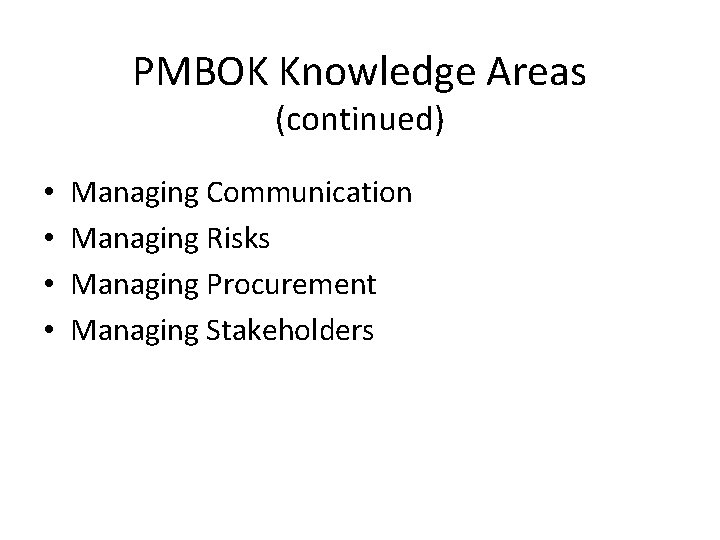
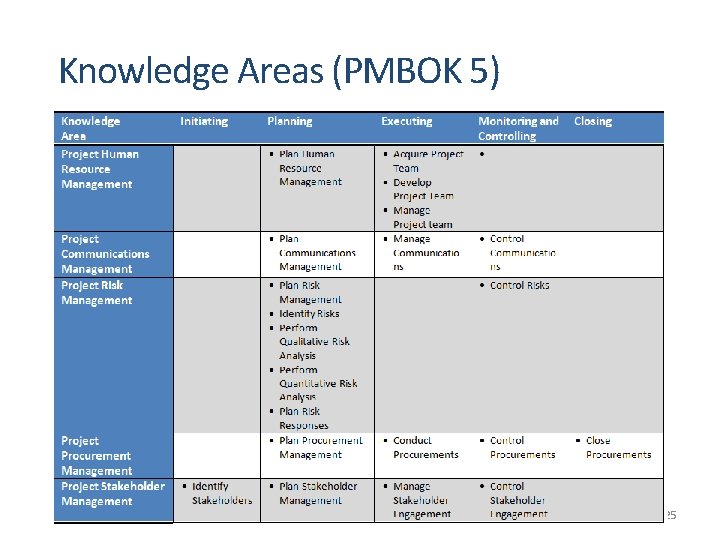
PMBOK Knowledge Areas (continued) • • Managing Communication Managing Risks Managing Procurement Managing Stakeholders
Project Integration • Very active during the startup • Coordinates all activities in all other knowledge areas
Project Scope • Scope generally defines what the project is all about • Forms the basis of agreement between the project SPONSOR and the project team • Changes in the scope may be proposed at any time during a project, but should follow a clearly defined approval process
Scope Statement • • • Description of the scope Acceptance criteria Deliverables Exclusions Constraints Assumptions
Scope and the WBS • A Work breakdown structure or WBS is the breakdown of the deliverables into manageable units of work.
Schedule and Time Management • Based on the units of work defined by the WBS • Resources required are identified • Time durations are estimated • Dependencies are identified (such as, what task must be completed before another task can begin) • And a schedule can be created
Schedule and Time Management • Several methods are available—details in a later chapter • Software is frequently used to assist with managing the time schedule
Project Costs • Develop a budget – Several methods can be used to estimate • Plan for the cash flow • Track the expenditures • Explain deviations and make adjustments where required
Project Quality • Quality plan defines – The quality standards – The methods that will be used to achieve the standards – The methods that will be used to measure the standards
Human Resources • • Identification of HR requirements Selection of project team Development of project team Motivation and management of the project team
Communication • Communication includes within the team and with others outside the team • The project should have a communication plan – Who needs to be communicated with – What methods will be used – What frequency – Who within the project will be responsible
Risk • Risk represents the likelihood of the occurrence of an event that will negatively or positively impact the achievement of the project goals • Processes: – Identify risks – Analyze risks – Manage risks
Procurement • Contracting to obtain supplies or services required to carry out the project • May be extremely complex • Time schedules can be crucial • On complex projects, almost always involves additional experts such as lawyers
Stakeholder Management • Stakeholders are people or organizations who either will be impacted by the project or who can impact the project. • Always include: project sponsor, project team • May include: customers, suppliers, vendors, the public, land owners, voters, other departments within the organization, government, etc.
Stakeholder Management • • Major tool is the stakeholder register Lists stakeholder, role, all communications Updated regularly throughout the project New stakeholders can appear at any time
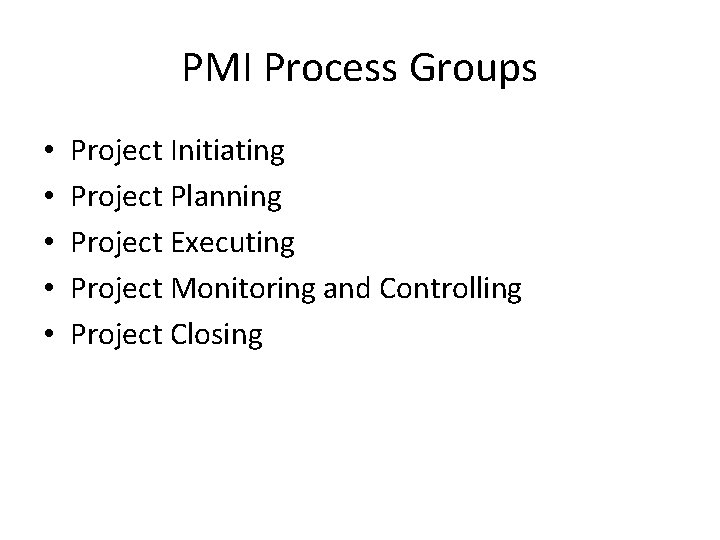
PMI Process Groups • • • Project Initiating Project Planning Project Executing Project Monitoring and Controlling Project Closing
Knowledge Areas (PMBOK 5) 24
Knowledge Areas (PMBOK 5) 25
Scrum Development Overview • Known as an Agile method • Used when requirements are difficult to define or subject to rapid change • Iterative approach • Uses sprints or 2 to 4 week cycles
Scrum Development Overview • Roles – Product owner – Scrum Master – Development Team • May include specialist roles such as developer, subject matter expert
Scrum Development Overview • Priorities: stories are either on the: – Front burner (currently working on) – Back burner (next up) – Fridge (for later) • Priorities are revisited before each new sprint
Scrum Development Overview • Daily stand-up meeting (short meeting with fixed agenda) – What was done yesterday – What will be done today – Are there any problems the scrum master must address, such as resource issues out of the control of the team
Scrum Development Caveats • Requires committed, mature developers • Major work must still be done up front • Needs commitment and involvement of Product Owner • Best for products that require frequent updates • Not so good for large, totally new products that will not allow frequent updates after release
The Project Management Office (PMO) • Medium and large organizations • Typical objectives – Align projects with organizational objectives – Set standards for projects – Provide resources to project managers – Provide training and mentorship – Provide facilitation – Stay abreast of best practices in Project Management – Repository for project reports and lessons learned
Framework for Project Management • Project management as a profession • The Project Management Institute • Project Management Certifications: PMP, CAPM • PMBOK overview: ten knowledge areas; five process groups • Scrum methodology • The Project Management Office
QUESTIONS?