
Project Management Still More Art Than Science Presented
![What Makes a Project Successful? § Plan-Do-Check-Act [PDCA] (Walter Shewhart) - Limited knowledge, improving](https://slidetodoc.com/presentation_image/060bfc5d0e2175a7e27a5943c1e34098/image-8.jpg "What Makes a Project Successful? § Plan-Do-Check-Act [PDCA] (Walter Shewhart) - Limited knowledge, improving")
- Slides: 24
Project Management: Still More Art Than Science Presented By Donald W. Larson AC Bronze, CL June 6, 2007
Click mouse to continue
Original Whitepaper Source § Author: Kate Belzer - Copyright © 2001 § http: //www. pmforum. org/library/pap ers/2001/0102 papers. htm#01 § Used here by Don Larson for Technical Presentations Manual Project #4, “Presenting a Technical Paper” Click mouse to continue
Change is Here to Stay § Organizations change at breakneck speed to satisfy customers and maintain competitive § To thrive in this environment, project managers must meet the needs of the organization and assist businesses in delivering value to customers Click mouse to continue
Understanding Business Value § Who are our customers? § What value do we provide to them? (GAP Analysis) § Who will be our customers in the future? § How will we satisfy their needs? Click mouse to continue 1
Delivering Business Value 2 § Strategic planning, through thoughtful consideration of these questions, leads to the creation of an organization that satisfies customer needs and provides an acceptable benefit to stakeholders § Strategic planning also provides a framework that stimulates projects to introduce new products and improve processes Click mouse to continue
Strategies Beget Projects 3 § Projects are implemented to advance organizational goals § Potential projects must be aligned with your company's mission and strategic direction § Project must be a strategic fit Click mouse to continue
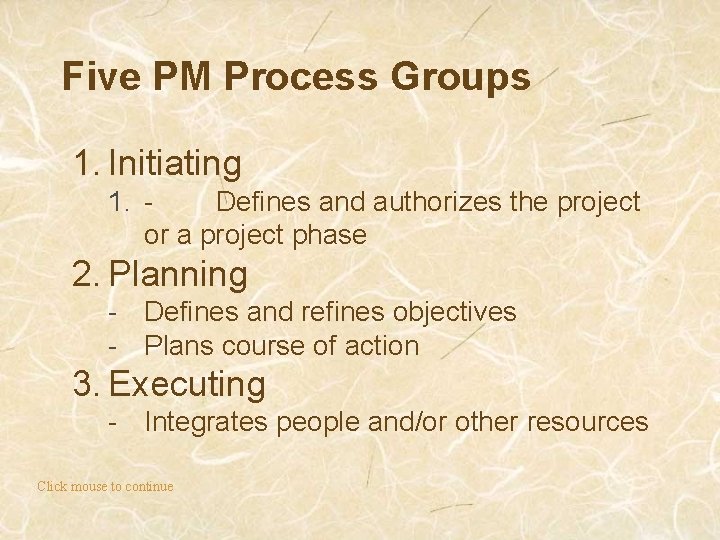
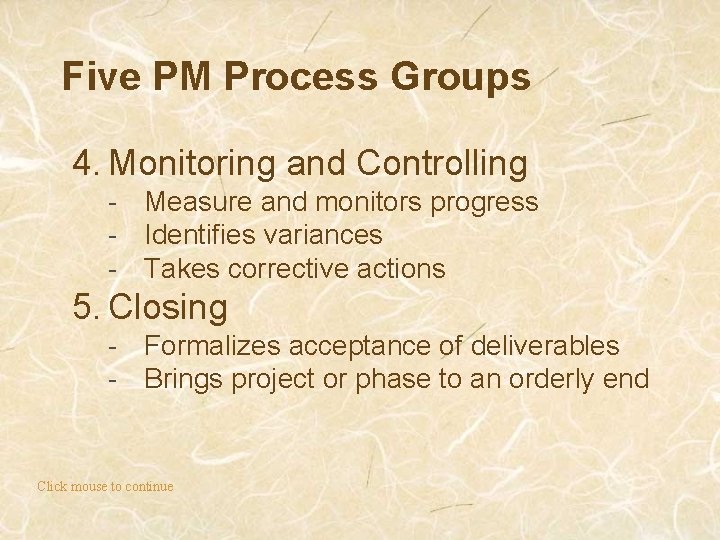
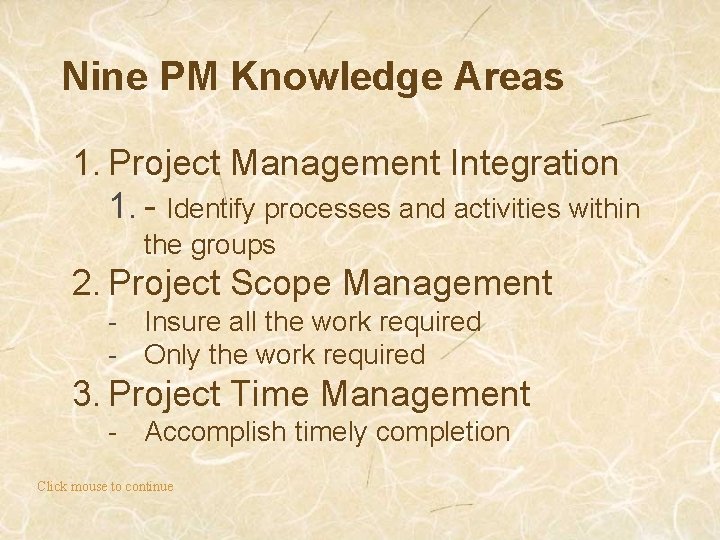
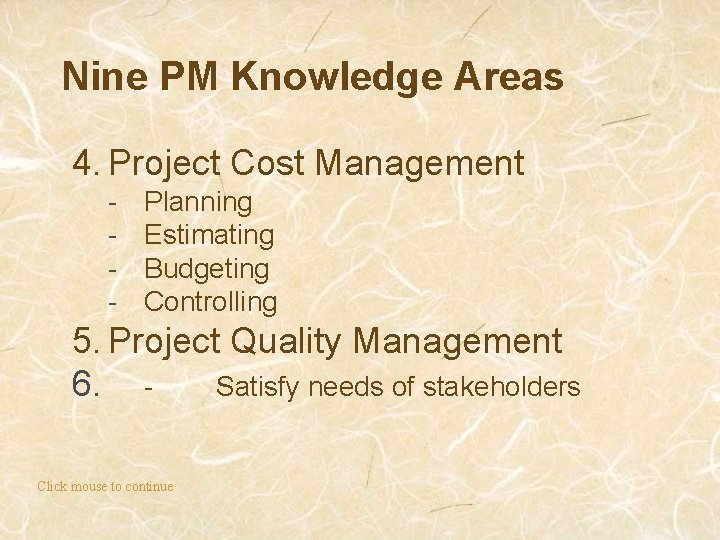
What Makes a Project Successful? § Plan-Do-Check-Act [PDCA] (Walter Shewhart) - Limited knowledge, improving as we go Velocity of change through iterations § Use processes, tools, and techniques § Soft skills - Working within the organization § Hard Skills (Supplemental Information) - Project Management Institute’s (PMI): - Five Process Groups - Nine Knowledge Areas Click mouse to continue
Project Approaches § Project Management Body of Knowledge (PMBOK) § Unified Software Development Process § Critical Chain Project Management § Experience Click mouse to continue
PMBOK Tools, Processes, and Techniques § What is required by the process: - Inputs § What occurs during the process § What are the deliverables of the process: - Outputs Click mouse to continue
Using Only Hard Skills § No clear communication means unclear deliverables, requirements, and dissatisfied customer § Lack of open communication can lead to issues reaching a critical point § Developing a plan in isolation cause team instability § Lack of leadership results in failure Click mouse to continue
Missing Link: The Appropriate Application of Soft Skills § A clear understanding and effective application of soft skills enhance the success of a project exponentially: - A project manager must communicate effectively, work within the organization’s culture, motivate the team, manage stakeholder expectations, understand business objectives, solve problems effectively, and make clear and knowledgeable decisions Click mouse to continue
Soft Skills: Communication § The most important skill: - Convey complex ideas easily Clearly articulate what must be accomplished Keep team moving toward a common goal Foster an environment that allows team members to communicate openly and honestly Admit own mistakes without losing respect Negotiate, listen, and facilitate Click mouse to continue
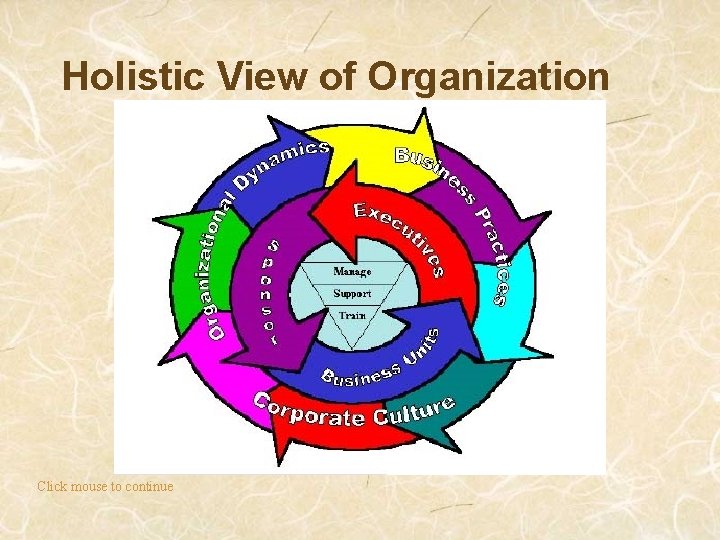
Holistic View of Organization Click mouse to continue
Grow with Today’s Business § It is inherently complex § Constantly changing § Focused on customer satisfaction Click mouse to continue
Master the Challenge § Delivering business value on time, within budget, and to the customers' satisfaction is both science and art § Master the timeless soft skills to supplement the hard skills for success Click mouse to continue
Supplemental Information § Five PM Process Groups § Nine PM Knowledge Areas § 20 Key Project Manager Actions and Results § Management By Objective § The Center for Collaborative Organizations § Managing Team Conflict Click mouse to continue
Five PM Process Groups 1. Initiating 1. Defines and authorizes the project or a project phase 2. Planning - Defines and refines objectives - Plans course of action 3. Executing - Integrates people and/or other resources Click mouse to continue
Five PM Process Groups 4. Monitoring and Controlling - Measure and monitors progress - Identifies variances - Takes corrective actions 5. Closing - Formalizes acceptance of deliverables - Brings project or phase to an orderly end Click mouse to continue
Nine PM Knowledge Areas 1. Project Management Integration 1. - Identify processes and activities within the groups 2. Project Scope Management - Insure all the work required - Only the work required 3. Project Time Management - Accomplish timely completion Click mouse to continue
Nine PM Knowledge Areas 4. Project Cost Management - Planning Estimating Budgeting Controlling 5. Project Quality Management 6. Satisfy needs of stakeholders Click mouse to continue
Nine PM Knowledge Areas 6. Project Human Resources Management - Organize and manage team 7. Project Communications Management 8. Ensure timely and appropriate: 9. - generation, collection, distribution, storage, retrieval, and ultimate disposition of project Click mouse information to continue
Nine PM Knowledge Areas 8. Project Risk Management - Planning, identification, analysis, and appropriate responses for positive project outcome 9. Project Procurement Management - Purchase external products, services, or results Click mouse to continue
Title Footnotes § 1; 2; and 3 § Source: Project Management Fundamentals - Tony Swaim Click mouse to continue