
Project Management Process Technology and Practice Ganesh Vaidyanathan


- Slides: 63
Project Management: Process, Technology, and Practice Ganesh Vaidyanathan Chapter 2 Process and Methods Copyright © 2013 Pearson Education, Inc. Publishing as Prentice Hall 2 -1
Process and Methods § § Learning objectives Define project process and how organizations benefit from adopting those processes oriented towards customer satisfaction. Understand PMBOK® project management processes and how project activities are mapped to these processes for successful project management. Explain what Continuous Improvement Management (CIM) is and how CIM methodology can be used in projects with examples. Explain what Six Sigma is and how this process improvement approach is used to find defects and errors of a project with examples. Copyright © 2013 Pearson Education, Inc. Publishing as Prentice Hall 2 -2
Process and Methods Learning objectives § Describe the five levels of Capability Maturity Model (CMM) in software projects and understand how organizations can attain the highest software maturity level. § Describe Software Development Life Cycle (SDLC) and the new paradigms in software projects including extreme programming and agile modeling, their inputs and outputs, and how those software development models can be used effectively in software projects. Copyright © 2013 Pearson Education, Inc. Publishing as Prentice Hall 2 -3
Process and Methods Copyright © 2013 Pearson Education, Inc. Publishing as Prentice Hall 2 -4
Process and Methods Process § Process is a specific ordering of structured work activities that include a beginning, an end, and clearly defined inputs and outputs. § A business process is a collection of related, structured business activities or tasks in a specific order that produce a specific service or product for a customer. § A project process is a collection of project related structured activities or tasks. In order for a project to be effective, the activities or tasks have to be structured. § A structure provides a standardized way of implementing projects leading to project improvement. The project life span is a structured methodology to implement projects and can be considered an overall project process. Copyright © 2013 Pearson Education, Inc. Publishing as Prentice Hall 2 -5
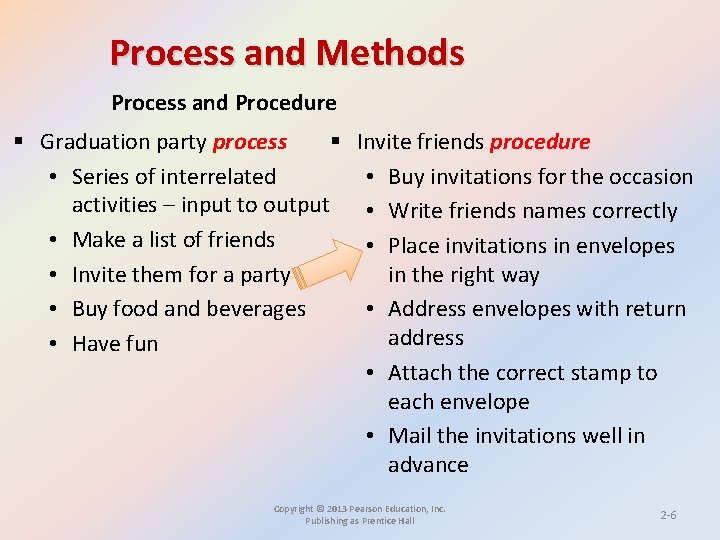
Process and Methods Process and Procedure § Graduation party process § Invite friends procedure • Series of interrelated • Buy invitations for the occasion activities – input to output • Write friends names correctly • Make a list of friends • Place invitations in envelopes • Invite them for a party in the right way • Buy food and beverages • Address envelopes with return address • Have fun • Attach the correct stamp to each envelope • Mail the invitations well in advance Copyright © 2013 Pearson Education, Inc. Publishing as Prentice Hall 2 -6
Process and Methods Process Improvement § Is a systematic method to continuously improve how organizations conduct businesses and projects § When employees of an organization get involved in process management, they work together and make the organization better and more profitable by: • satisfying customers • producing products with almost no defects, • eliminating waste, and • implementing successful projects. Project process improvements contribute to the success of projects. Copyright © 2013 Pearson Education, Inc. Publishing as Prentice Hall 2 -7
Process and Methods Process Improvement § Process improvement has worked well for many organizations in their projects, helping facilitate: • better quality, • lower cost, • faster delivery, • better performance, and • increased value. § Continuous Improvement Method (CIM) § Six Sigma process § Capability Maturity Model (CMM) process § Systems Development Life Cycle (SDLC) and other MIS models Copyright © 2013 Pearson Education, Inc. Publishing as Prentice Hall 2 -8
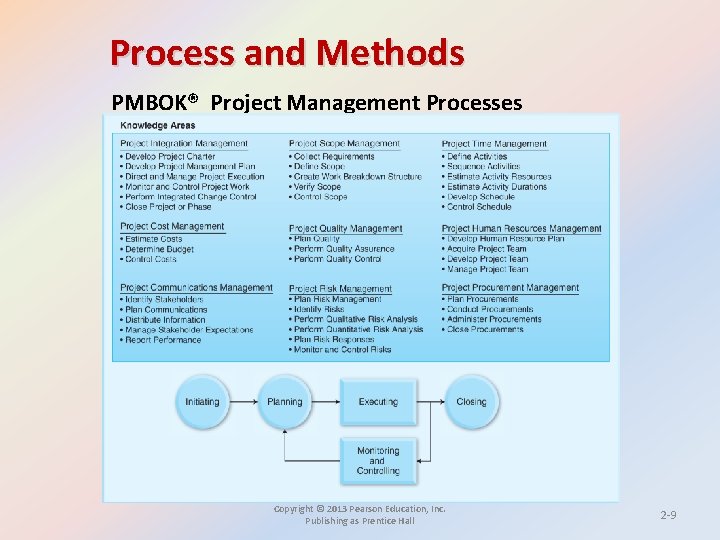
Process and Methods PMBOK® Project Management Processes Copyright © 2013 Pearson Education, Inc. Publishing as Prentice Hall 2 -9
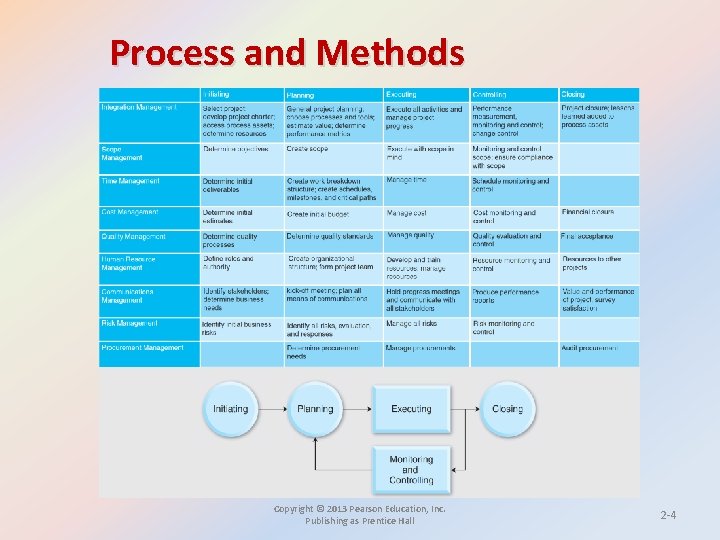
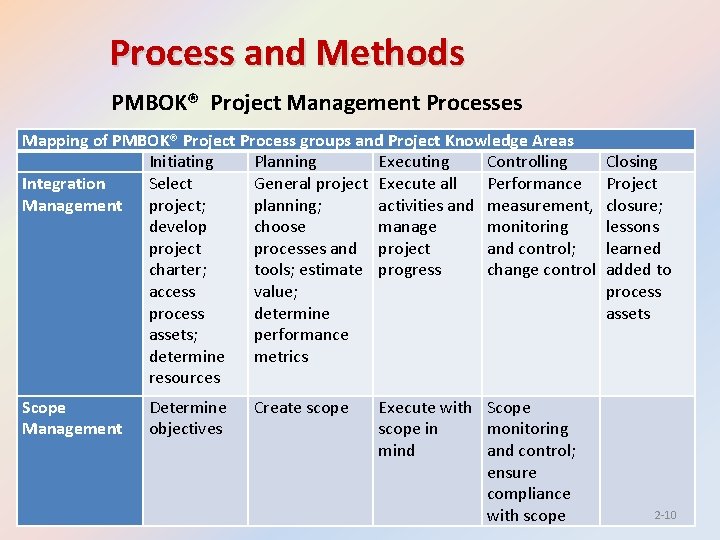
Process and Methods PMBOK® Project Management Processes Mapping of PMBOK® Project Process groups and Project Knowledge Areas Initiating Planning Executing Controlling Integration Select General project Execute all Performance Management project; planning; activities and measurement, develop choose manage monitoring project processes and project and control; charter; tools; estimate progress change control access value; process determine assets; performance determine metrics resources Scope Management Determine objectives Create scope Execute with Scope scope in monitoring mind and control; ensure compliance Copyright © 2013 Pearson Education, Inc. with scope Publishing as Prentice Hall Closing Project closure; lessons learned added to process assets 2 -10
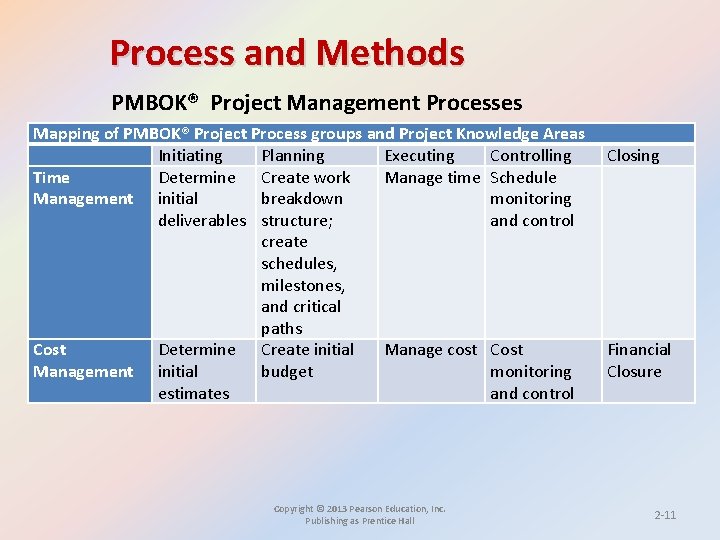
Process and Methods PMBOK® Project Management Processes Mapping of PMBOK® Project Process groups and Project Knowledge Areas Initiating Planning Executing Controlling Time Determine Create work Manage time Schedule Management initial breakdown monitoring deliverables structure; and control create schedules, milestones, and critical paths Cost Determine Create initial Manage cost Cost Management initial budget monitoring estimates and control Copyright © 2013 Pearson Education, Inc. Publishing as Prentice Hall Closing Financial Closure 2 -11
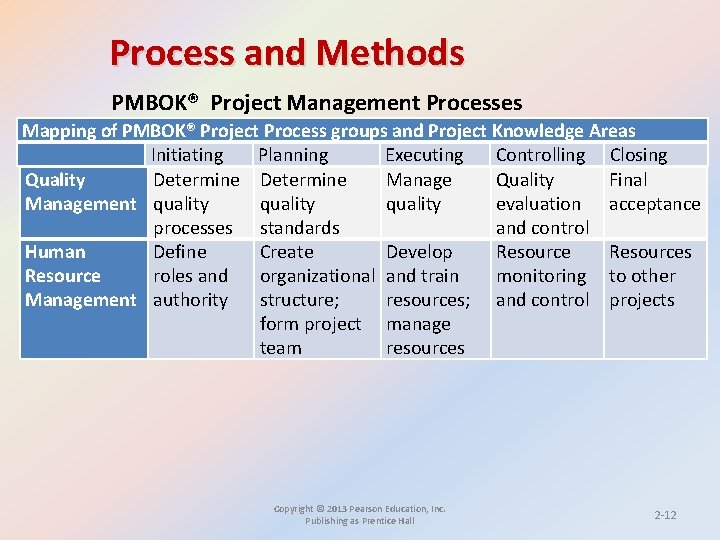
Process and Methods PMBOK® Project Management Processes Mapping of PMBOK® Project Process groups and Project Knowledge Areas Initiating Planning Executing Controlling Closing Quality Determine Manage Quality Final Management quality evaluation acceptance processes standards and control Human Define Create Develop Resources Resource roles and organizational and train monitoring to other Management authority structure; resources; and control projects form project manage team resources Copyright © 2013 Pearson Education, Inc. Publishing as Prentice Hall 2 -12
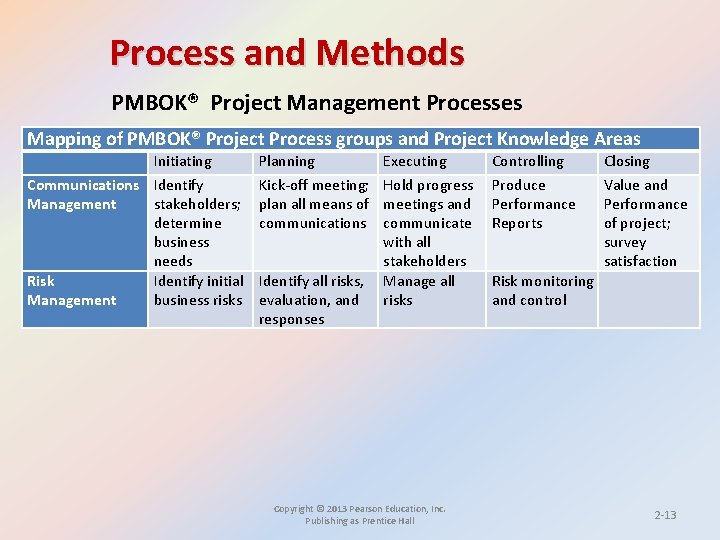
Process and Methods PMBOK® Project Management Processes Mapping of PMBOK® Project Process groups and Project Knowledge Areas Initiating Communications Identify Management stakeholders; determine business needs Risk Identify initial Management business risks Planning Kick-off meeting; plan all means of communications Executing Hold progress meetings and communicate with all stakeholders Identify all risks, Manage all evaluation, and risks responses Copyright © 2013 Pearson Education, Inc. Publishing as Prentice Hall Controlling Produce Performance Reports Closing Value and Performance of project; survey satisfaction Risk monitoring and control 2 -13
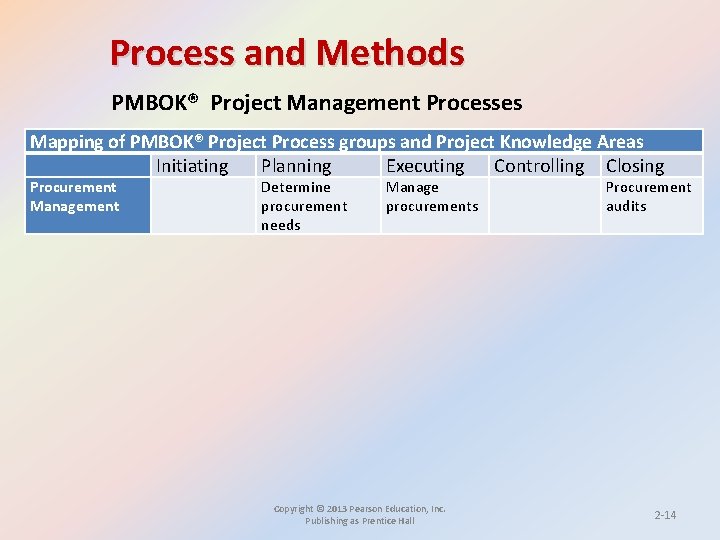
Process and Methods PMBOK® Project Management Processes Mapping of PMBOK® Project Process groups and Project Knowledge Areas Initiating Planning Executing Controlling Closing Procurement Management Determine procurement needs Manage procurements Copyright © 2013 Pearson Education, Inc. Publishing as Prentice Hall Procurement audits 2 -14
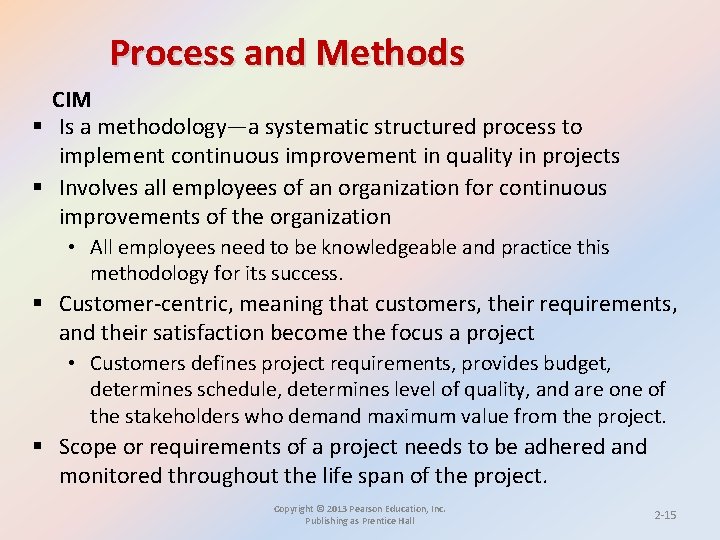
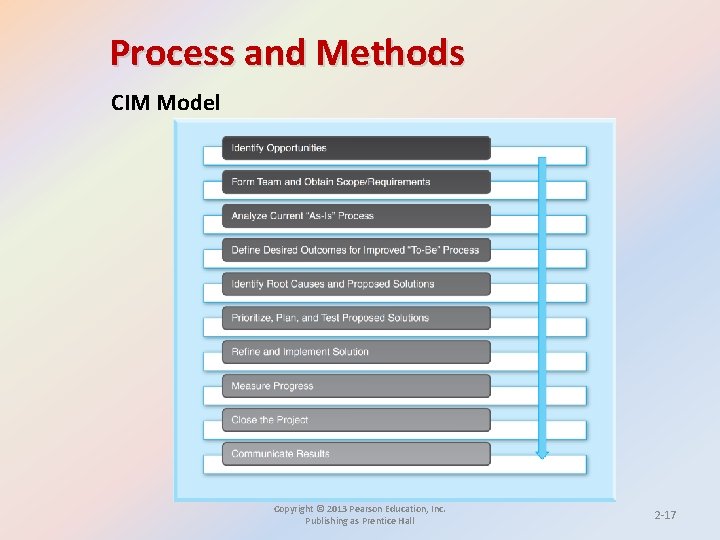
Process and Methods CIM § Is a methodology—a systematic structured process to implement continuous improvement in quality in projects § Involves all employees of an organization for continuous improvements of the organization • All employees need to be knowledgeable and practice this methodology for its success. § Customer-centric, meaning that customers, their requirements, and their satisfaction become the focus a project • Customers defines project requirements, provides budget, determines schedule, determines level of quality, and are one of the stakeholders who demand maximum value from the project. § Scope or requirements of a project needs to be adhered and monitored throughout the life span of the project. Copyright © 2013 Pearson Education, Inc. Publishing as Prentice Hall 2 -15
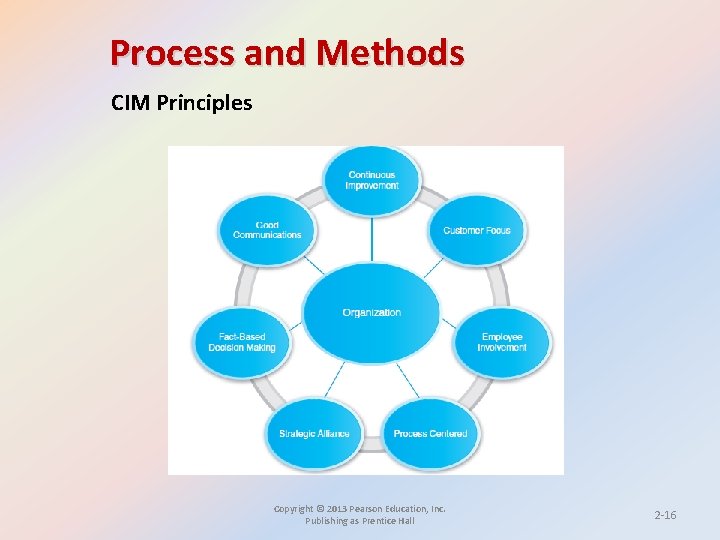
Process and Methods CIM Principles Copyright © 2013 Pearson Education, Inc. Publishing as Prentice Hall 2 -16
Process and Methods CIM Model Copyright © 2013 Pearson Education, Inc. Publishing as Prentice Hall 2 -17
Process and Methods § § § CIM Model – Identify Opportunities Identification of opportunities is often associated with a specific problem which needs improvement. These may be existing problems or “to-be” created products or systems or services. There may be a number of projects that were identified during a period of time. There may be choices that need to be made. Choosing projects is accomplished according to organizational criteria. Copyright © 2013 Pearson Education, Inc. Publishing as Prentice Hall 2 -18
Process and Methods CIM Model – Identify Opportunities § These criteria may include: • Urgency of a project • Whether the project may be controlled • The difficulty, or complexity of the project • Time period of the project • The amount of resources required for the project. Copyright © 2013 Pearson Education, Inc. Publishing as Prentice Hall 2 -19
Process and Methods CIM Model – Form Team and Create Scope § Team formation is critical to the success of a project. § This process helps to clarify roles and responsibilities and designate initial members of a project. § Using team resources, requirements from customer need to be analyzed to establish the scope of a project. § Using the scope of a project, a clear purpose of the project has to be developed. Copyright © 2013 Pearson Education, Inc. Publishing as Prentice Hall 2 -20
Process and Methods CIM Model – Form Team and Create Scope § This clear, unambiguous project purpose from project scope will be used later to determine: • Budget • Resources • Schedule • Performance measures • Overall value of a project. Copyright © 2013 Pearson Education, Inc. Publishing as Prentice Hall 2 -21
Process and Methods CIM Model – Analyze “as-is” and determine “to-be” § ”As-Is” phase • Helps to deduce necessary actions in order to improve the project process • Helps to achieve complete understanding of the existing process so that a project team can have the basis to start the “to-be” part of the project that complies with project scope Copyright © 2013 Pearson Education, Inc. Publishing as Prentice Hall 2 -22
Process and Methods CIM Model – Identify root-causes & proposed solutions § Root cause analysis should include: • Technical feasibility, or whether technology exists to implement the proposed system • Economic feasibility to establish the cost-effectiveness of the proposed system • Legal feasibility that determines legal requirements • Operational feasibility, or whether current work practices and procedures are adequate to support the new system • Social feasibility to reflect on organizational changes that may affect users of the system, and • Project feasibility to determine scope, schedule, budget, performance, and value. Copyright © 2013 Pearson Education, Inc. Publishing as Prentice Hall 2 -23
Process and Methods CIM Model – Implementation, Progress, Closure § Priorities and planning of a project can be achieved to implement these solutions. § Progress, performance, and value must be measured, monitored, and controlled at every point of a project. § Budget and schedule has to be monitored and controlled at every point of a project. § Project has to be monitored and controlled to adhere to project scope and project requirements at every point of the on-going project. § Results of projects need to be communicated to all stakeholders on an ongoing basis and should be used for lessons learned from the project. Copyright © 2013 Pearson Education, Inc. Publishing as Prentice Hall 2 -24
Process and Methods Six Sigma § Six Sigma is a process improvement approach that is used to find and eliminate errors and defects, reduce cycle times, reduce cost, improve productivity, and meet customer expectations. § Six Sigma is oriented toward the solution of problems at root cause and prevention of their recurrence. Project management typically is to control potential causes of failure. Since we have recognized that project management is a process, Six Sigma is a potential candidate applicable to project process improvement. § Six Sigma provides a structured data-driven methodology with tools and techniques that help organizations measure their performance. Copyright © 2013 Pearson Education, Inc. Publishing as Prentice Hall 2 -25
Process and Methods Six Sigma § Using Six Sigma, organizations can measure the baseline performance of their project, determine the root causes of variations in processes in those projects, and improve their processes to meet and exceed desired performance levels. Six sigma can be used in projects to improve quality performance of projects. § Six Sigma is a metric-driven methodology. Copyright © 2013 Pearson Education, Inc. Publishing as Prentice Hall 2 -26
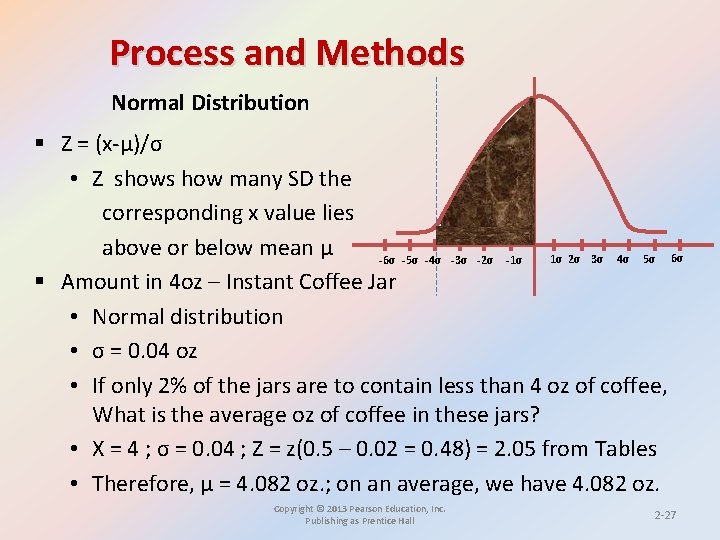
Process and Methods Normal Distribution § Z = (x-μ)/σ • Z shows how many SD the corresponding x value lies above or below mean μ 1σ 2σ 3σ 4σ 5σ 6σ -5σ -4σ -3σ -2σ -1σ § Amount in 4 oz – Instant Coffee Jar • Normal distribution • σ = 0. 04 oz • If only 2% of the jars are to contain less than 4 oz of coffee, What is the average oz of coffee in these jars? • X = 4 ; σ = 0. 04 ; Z = z(0. 5 – 0. 02 = 0. 48) = 2. 05 from Tables • Therefore, μ = 4. 082 oz. ; on an average, we have 4. 082 oz. Copyright © 2013 Pearson Education, Inc. Publishing as Prentice Hall 2 -27
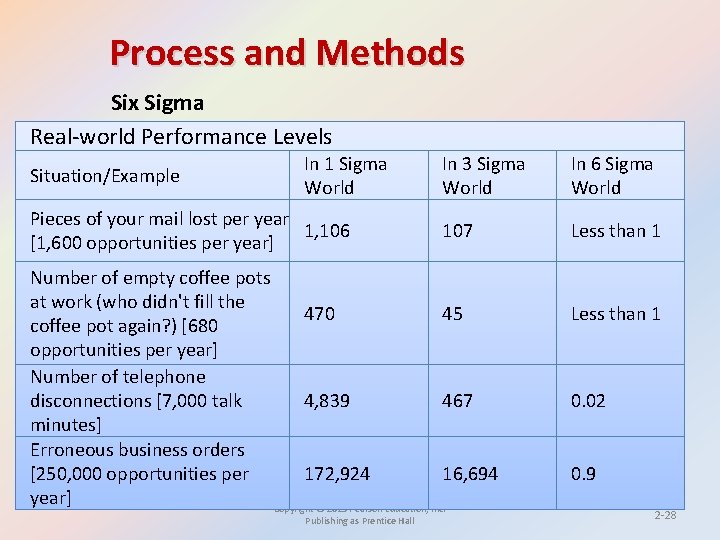
Process and Methods Six Sigma Real-world Performance Levels Situation/Example In 1 Sigma World Pieces of your mail lost per year 1, 106 [1, 600 opportunities per year] In 3 Sigma World In 6 Sigma World 107 Less than 1 Number of empty coffee pots at work (who didn't fill the 470 45 coffee pot again? ) [680 opportunities per year] Number of telephone disconnections [7, 000 talk 4, 839 467 minutes] Erroneous business orders [250, 000 opportunities per 172, 924 16, 694 year] Copyright © 2013 Pearson Education, Inc. Publishing as Prentice Hall Less than 1 0. 02 0. 9 2 -28
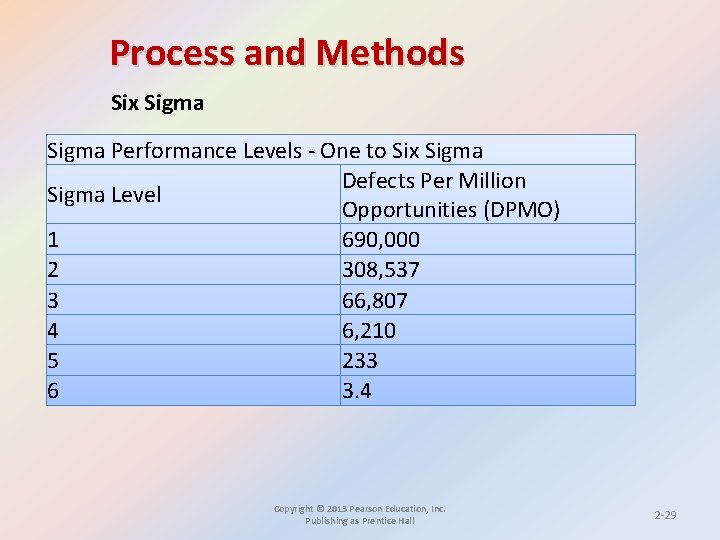
Process and Methods Six Sigma Performance Levels - One to Six Sigma Defects Per Million Sigma Level Opportunities (DPMO) 1 690, 000 2 308, 537 3 66, 807 4 6, 210 5 233 6 3. 4 Copyright © 2013 Pearson Education, Inc. Publishing as Prentice Hall 2 -29
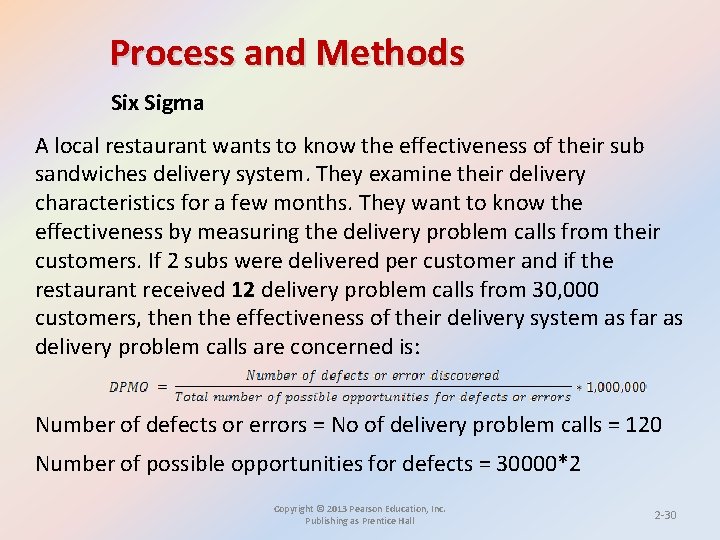
Process and Methods Six Sigma A local restaurant wants to know the effectiveness of their sub sandwiches delivery system. They examine their delivery characteristics for a few months. They want to know the effectiveness by measuring the delivery problem calls from their customers. If 2 subs were delivered per customer and if the restaurant received 12 delivery problem calls from 30, 000 customers, then the effectiveness of their delivery system as far as delivery problem calls are concerned is: Number of defects or errors = No of delivery problem calls = 120 Number of possible opportunities for defects = 30000*2 Copyright © 2013 Pearson Education, Inc. Publishing as Prentice Hall 2 -30
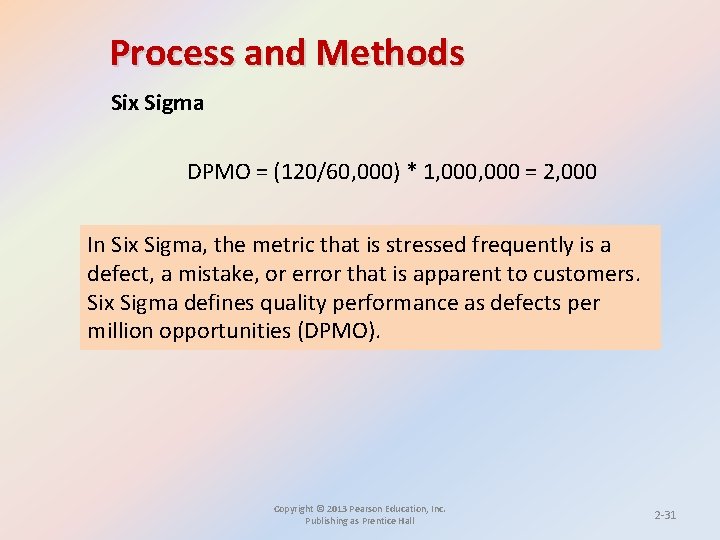
Process and Methods Six Sigma DPMO = (120/60, 000) * 1, 000 = 2, 000 In Six Sigma, the metric that is stressed frequently is a defect, a mistake, or error that is apparent to customers. Six Sigma defines quality performance as defects per million opportunities (DPMO). Copyright © 2013 Pearson Education, Inc. Publishing as Prentice Hall 2 -31
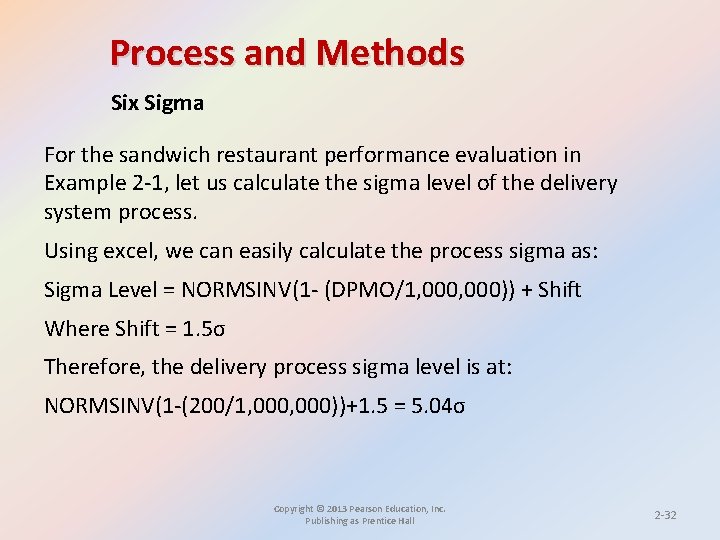
Process and Methods Six Sigma For the sandwich restaurant performance evaluation in Example 2 -1, let us calculate the sigma level of the delivery system process. Using excel, we can easily calculate the process sigma as: Sigma Level = NORMSINV(1 - (DPMO/1, 000)) + Shift Where Shift = 1. 5σ Therefore, the delivery process sigma level is at: NORMSINV(1 -(200/1, 000))+1. 5 = 5. 04σ Copyright © 2013 Pearson Education, Inc. Publishing as Prentice Hall 2 -32
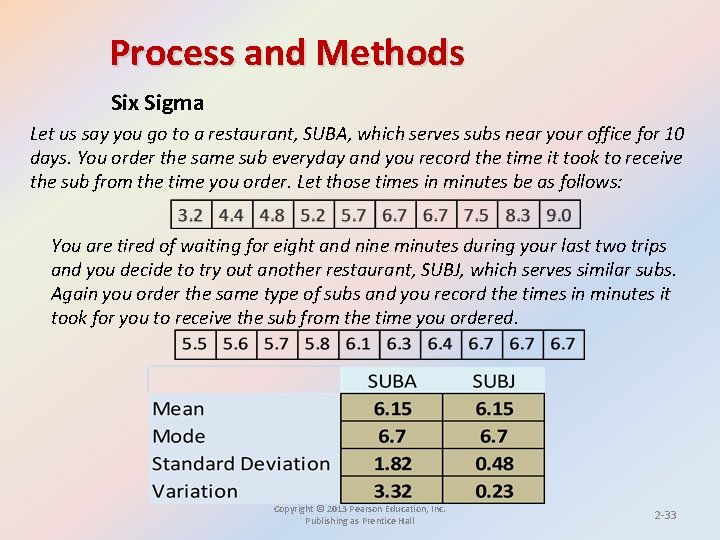
Process and Methods Six Sigma Let us say you go to a restaurant, SUBA, which serves subs near your office for 10 days. You order the same sub everyday and you record the time it took to receive the sub from the time you order. Let those times in minutes be as follows: You are tired of waiting for eight and nine minutes during your last two trips and you decide to try out another restaurant, SUBJ, which serves similar subs. Again you order the same type of subs and you record the times in minutes it took for you to receive the sub from the time you ordered. Copyright © 2013 Pearson Education, Inc. Publishing as Prentice Hall 2 -33
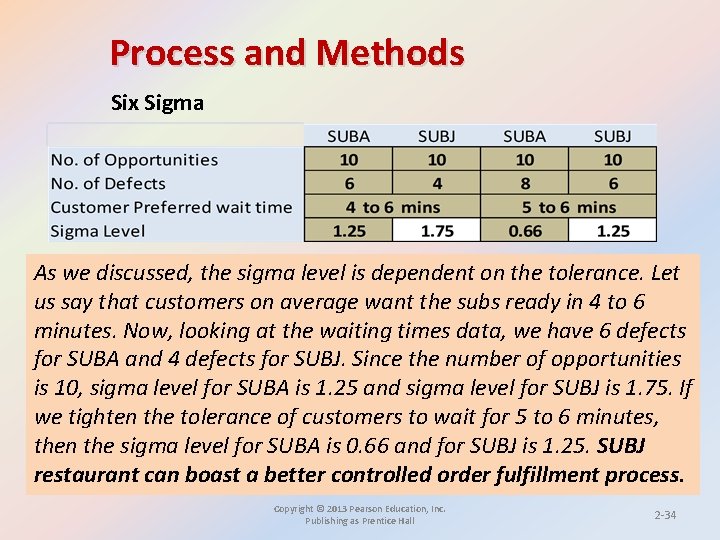
Process and Methods Six Sigma As we discussed, the sigma level is dependent on the tolerance. Let us say that customers on average want the subs ready in 4 to 6 minutes. Now, looking at the waiting times data, we have 6 defects for SUBA and 4 defects for SUBJ. Since the number of opportunities is 10, sigma level for SUBA is 1. 25 and sigma level for SUBJ is 1. 75. If we tighten the tolerance of customers to wait for 5 to 6 minutes, then the sigma level for SUBA is 0. 66 and for SUBJ is 1. 25. SUBJ restaurant can boast a better controlled order fulfillment process. Copyright © 2013 Pearson Education, Inc. Publishing as Prentice Hall 2 -34
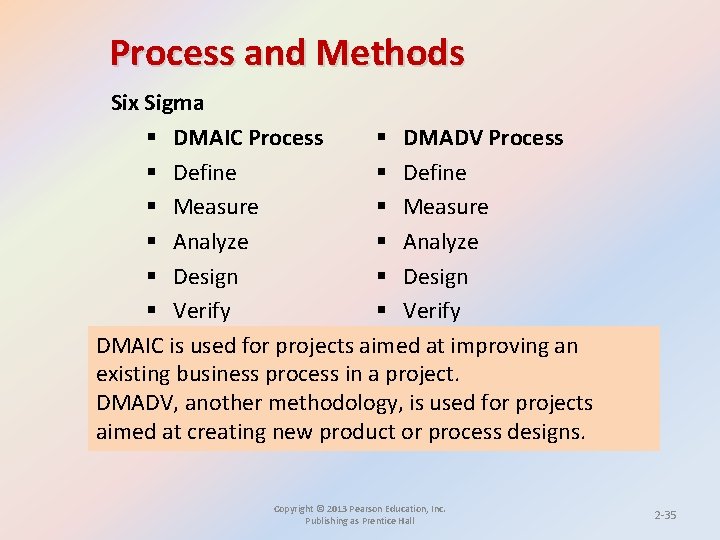
Process and Methods Six Sigma § DMAIC Process § DMADV Process § Define § Measure § Analyze § Design § Verify DMAIC is used for projects aimed at improving an existing business process in a project. DMADV, another methodology, is used for projects aimed at creating new product or process designs. Copyright © 2013 Pearson Education, Inc. Publishing as Prentice Hall 2 -35
Process and Methods DMAIC § Define • This phase is about defining the problem statement of the project. • A problem statement is a clear description of project issues that have to be addressed by a project team in order to implement a project effectively and efficiently. • This phase is very much like the project initiation phase that we will discuss in detail in later chapters. Copyright © 2013 Pearson Education, Inc. Publishing as Prentice Hall 2 -36
Process and Methods DMAIC § Measure • This phase focuses on the measurement of internal process that impacts factors that are critical to quality. • All important factors that can be controlled or changed to improve factors that are critical to quality have to be understood clearly. • For example, in the restaurant delivery system that we discussed before, delivery of subs to the customers may be a function of many factors that are critical to quality. • Once the relationships are established, data and observations can be collected. Copyright © 2013 Pearson Education, Inc. Publishing as Prentice Hall 2 -37
Process and Methods DMAIC § Analyze • This phase focuses on why and how defects and errors occur. • Processes are analyzed to determine the root causes of poor performance and whether the process can be improved or should be redesigned. • The collected data and observations are used to verify relationships between variables. • This root cause analysis gives a stable and reasonable approach to find which factors critical to quality need to be improved. Copyright © 2013 Pearson Education, Inc. Publishing as Prentice Hall 2 -38
Process and Methods DMAIC § Improve • This phase is devoted to idea generation for improvement of factors that are critical to quality. • Improving processes based on measurements and analysis can ensure that defects are lowered and processes are streamlined. • Project management techniques are used to plan and implement these ideas. • We will discuss project management techniques for planning and implementation in later chapters. Copyright © 2013 Pearson Education, Inc. Publishing as Prentice Hall 2 -39
Process and Methods DMAIC § Control • Control ensures that variances that display in the project process are corrected. • Controls can be in the form of pilot-runs to determine if the processes are within specifications and then transitioned into project implementation. • Continued measurement and analysis must ensue to keep processes on track and free of defects to ensure the targeted sigma level. • The difference in this type of control to project management control is that in this method Statistical Process Control (SPC) technique is employed to monitor the performance of key Copyright © 2013 Pearson Education, Inc. measures. 2 -40 Publishing as Prentice Hall
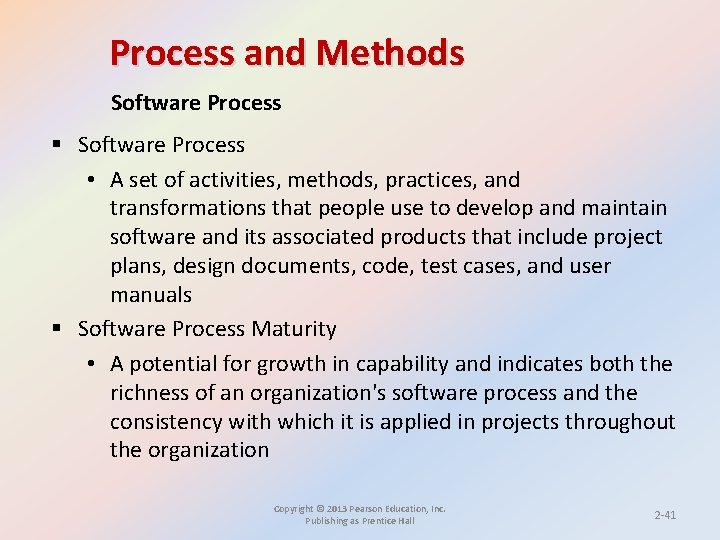
Process and Methods Software Process § Software Process • A set of activities, methods, practices, and transformations that people use to develop and maintain software and its associated products that include project plans, design documents, code, test cases, and user manuals § Software Process Maturity • A potential for growth in capability and indicates both the richness of an organization's software process and the consistency with which it is applied in projects throughout the organization Copyright © 2013 Pearson Education, Inc. Publishing as Prentice Hall 2 -41
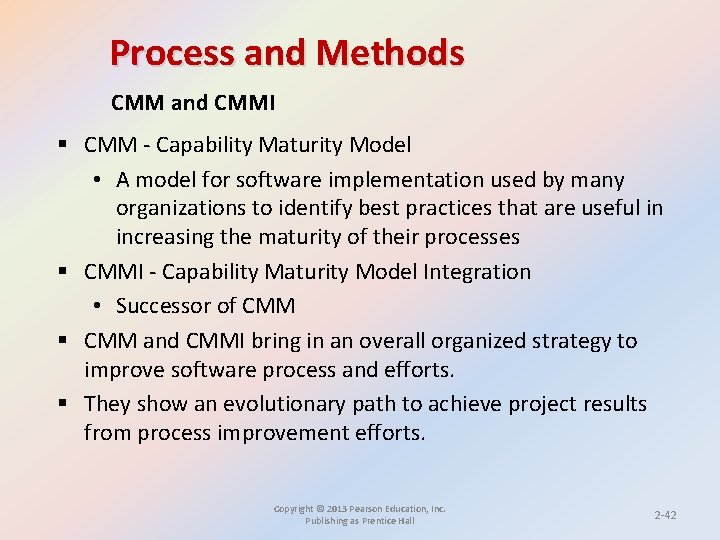
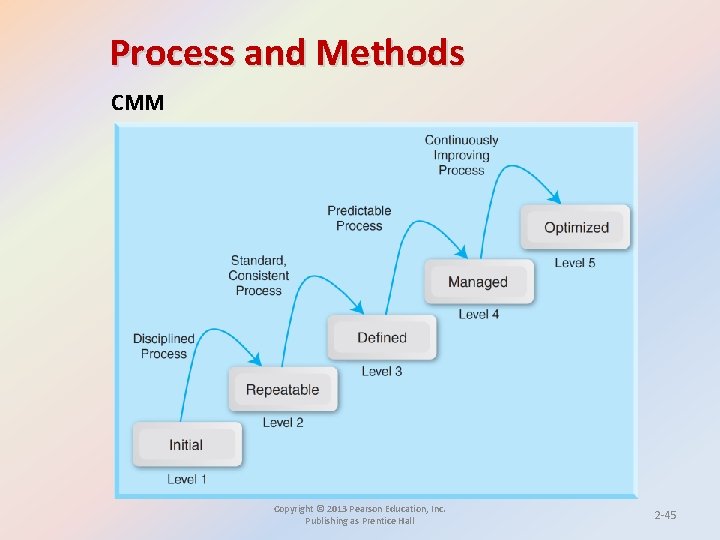
Process and Methods CMM and CMMI § CMM - Capability Maturity Model • A model for software implementation used by many organizations to identify best practices that are useful in increasing the maturity of their processes § CMMI - Capability Maturity Model Integration • Successor of CMM § CMM and CMMI bring in an overall organized strategy to improve software process and efforts. § They show an evolutionary path to achieve project results from process improvement efforts. Copyright © 2013 Pearson Education, Inc. Publishing as Prentice Hall 2 -42
Process and Methods CMM and CMMI § They provide a roadmap for continuous process improvement. § They act as guides to the advancement and identify deficiencies in an organization. § They are not intended to provide a quick fix for projects in trouble. Copyright © 2013 Pearson Education, Inc. Publishing as Prentice Hall 2 -43
Process and Methods The Benefits of CMM and CMMI § Provide guidance on how to gain control of their processes to develop and maintain software § Allow organizations to strategize how to evolve toward a culture of software engineering and management excellence § Guide software organizations in selecting process improvement strategies by determining current process maturity and identifying the few issues most critical to software quality and process improvement § Allow organizations to focus on a limited set of activities and work aggressively to achieve them so that organization-wide software processes are enabled to be continuous and lasting gains in software process capability Copyright © 2013 Pearson Education, Inc. Publishing as Prentice Hall 2 -44
Process and Methods CMM Copyright © 2013 Pearson Education, Inc. Publishing as Prentice Hall 2 -45
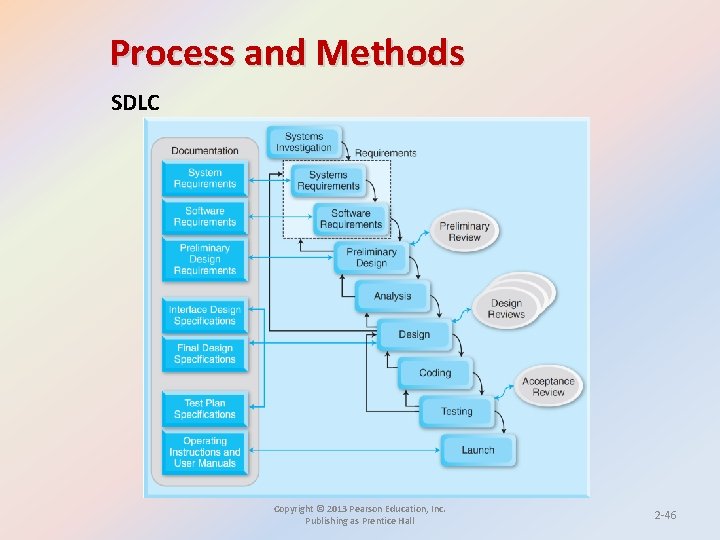
Process and Methods SDLC Copyright © 2013 Pearson Education, Inc. Publishing as Prentice Hall 2 -46
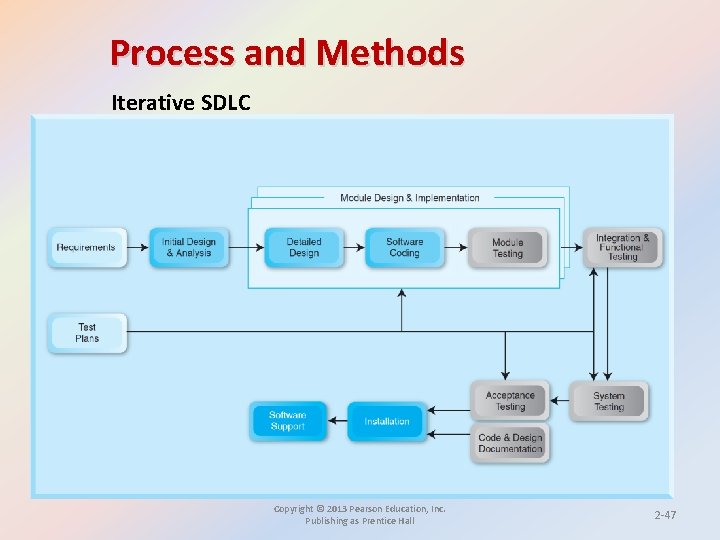
Process and Methods Iterative SDLC Copyright © 2013 Pearson Education, Inc. Publishing as Prentice Hall 2 -47
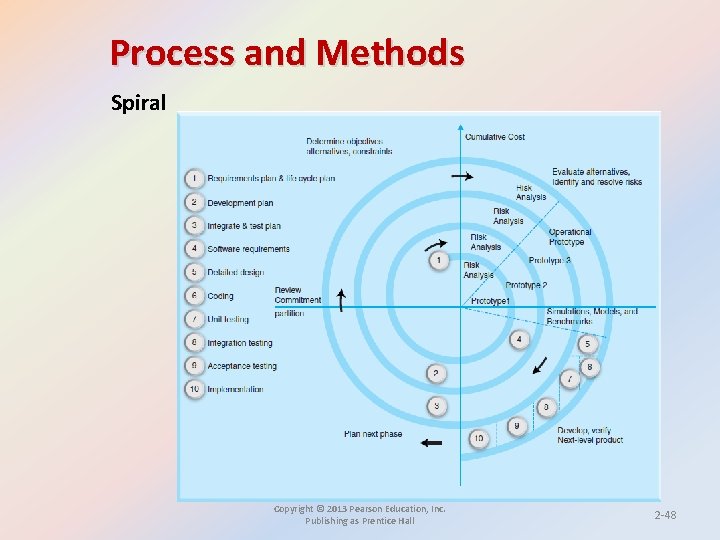
Process and Methods Spiral Copyright © 2013 Pearson Education, Inc. Publishing as Prentice Hall 2 -48
Process and Methods Unified Process § The Unified Process (UP) is a software engineering process. § It is used to develop object-oriented software. § The Unified Modeling Language (UML) is a core notation incorporated within UP. § UML is designed to clearly communicate the most essential elements of object-oriented software development projects including requirements, architectures, and design. § UML is a graphical language for visualizing, specifying, constructing, and documenting object-oriented software. Copyright © 2013 Pearson Education, Inc. Publishing as Prentice Hall 2 -49
Process and Methods Unified Process § The UML offers a standard way to write the blueprints of an intended system including: • business domain specifications • system functions • programming language statements • database schematics, and • reusable software components. § To create specifications, the object-oriented approach and the UML require several interrelated models. Copyright © 2013 Pearson Education, Inc. Publishing as Prentice Hall 2 -50
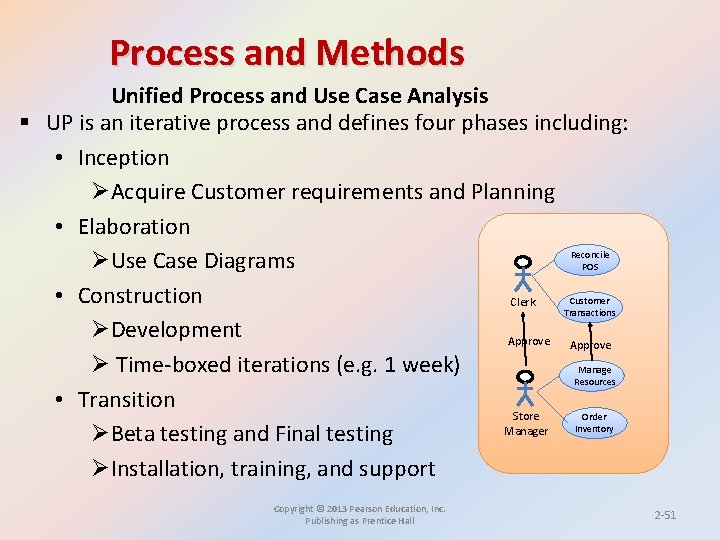
Process and Methods Unified Process and Use Case Analysis § UP is an iterative process and defines four phases including: • Inception ØAcquire Customer requirements and Planning • Elaboration Reconcile ØUse Case Diagrams POS • Construction Customer Clerk Transactions ØDevelopment Approve Ø Time-boxed iterations (e. g. 1 week) Manage Resources • Transition Order Store Inventory Manager ØBeta testing and Final testing ØInstallation, training, and support Copyright © 2013 Pearson Education, Inc. Publishing as Prentice Hall 2 -51
Process and Methods § § § § Unified Process Agile Unified Process (AUP) Basic Unified Process (BUP) Enterprise Unified Process (EUP) Essential Unified Process (Ess. UP) Open Unified Process (Open. UP) Rational Unified Process (RUP) Oracle Unified Method (OUM) Rational Unified Process-System Engineering (RUP-SE) Copyright © 2013 Pearson Education, Inc. Publishing as Prentice Hall 2 -52
Process and Methods Unified Process § Rational Unified Process-System Engineering (RUP-SE) • Develop software iteratively • Manage requirements • Use component-based architectures • Visually model software • Verify software quality • Control changes to software Copyright © 2013 Pearson Education, Inc. Publishing as Prentice Hall 2 -53
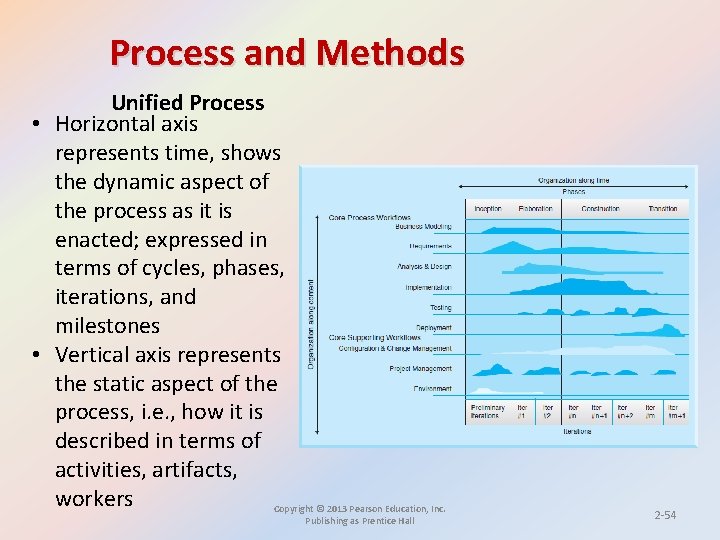
Process and Methods Unified Process • Horizontal axis represents time, shows the dynamic aspect of the process as it is enacted; expressed in terms of cycles, phases, iterations, and milestones • Vertical axis represents the static aspect of the process, i. e. , how it is described in terms of activities, artifacts, workers Copyright © 2013 Pearson Education, Inc. Publishing as Prentice Hall 2 -54
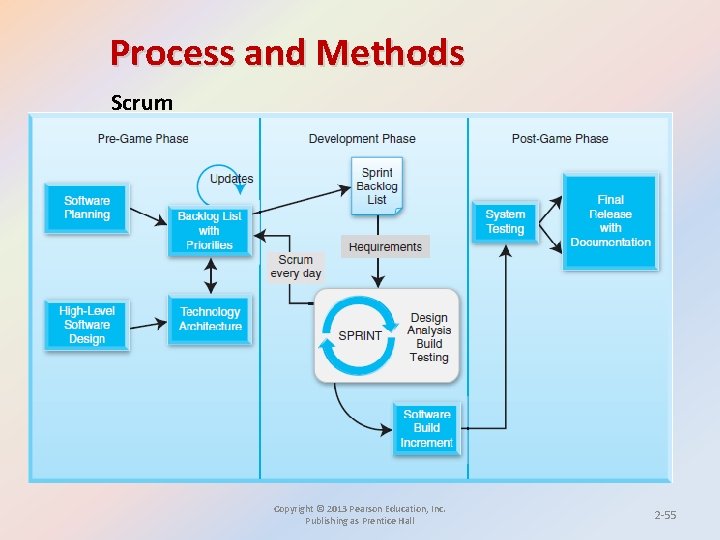
Process and Methods Scrum Copyright © 2013 Pearson Education, Inc. Publishing as Prentice Hall 2 -55
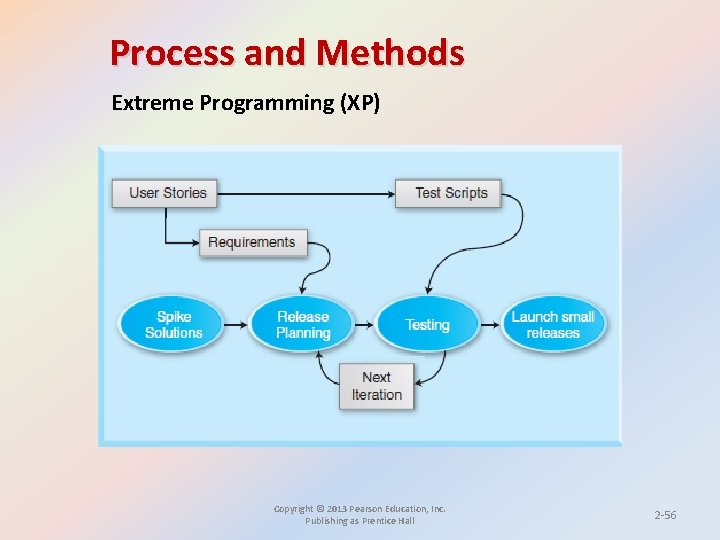
Process and Methods Extreme Programming (XP) Copyright © 2013 Pearson Education, Inc. Publishing as Prentice Hall 2 -56
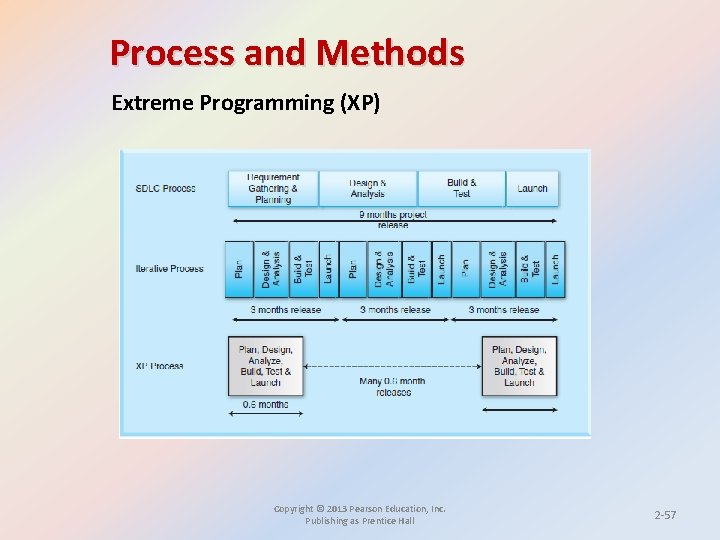
Process and Methods Extreme Programming (XP) Copyright © 2013 Pearson Education, Inc. Publishing as Prentice Hall 2 -57
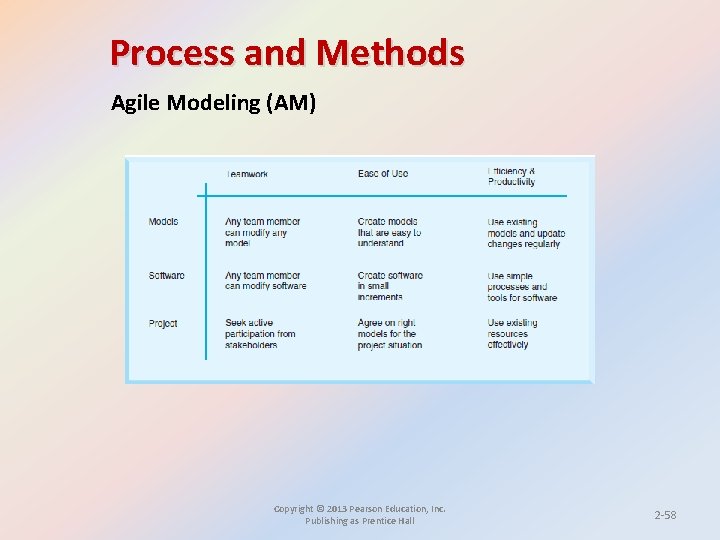
Process and Methods Agile Modeling (AM) Copyright © 2013 Pearson Education, Inc. Publishing as Prentice Hall 2 -58
Process and Methods Summary § A project process is a collection of related structured activities or tasks of a project. § Every project is aligned to the strategy of an organization and is always a part of a continuous improvement process. § Process improvement is a systematic method to continuously improving how organizations conduct businesses and projects. § When employees of an organization get involved in process management, they work together and contribute to the success of projects. Copyright © 2013 Pearson Education, Inc. Publishing as Prentice Hall 2 -59
Process and Methods Summary § While most organizations use integrated philosophies and techniques such as total quality management, continuous quality improvement, and Six Sigma in their process management approaches, computer-related software projects use Systems Development Life Cycle (SDLC), Iterative, Spiral, Unified Process, Scrum, XP, and Capability Maturity Model (CMM) processes. § SDLC is being followed for large complex software projects. Agile methods like XP and Scrum are beginning to become popular with smaller teams for small projects. Copyright © 2013 Pearson Education, Inc. Publishing as Prentice Hall 2 -60
Process and Methods Summary § Both XP and Scrum are very customer driven, boast of frequent product or software releases and constant testing. Agile Methods are driven towards collaborative teamwork and adapt well to organizational culture. Copyright © 2013 Pearson Education, Inc. Publishing as Prentice Hall 2 -61
Process and Methods Class Discussions § Can CIM be used in any project? What are the pros and cons of CIM in any of these projects? § Can Six Sigma be used as a benchmark to measure quality in any project? How can Six Sigma be used in activities of an instructor in assigning grades? § Is documentation in MIS projects needed? Why not? § How do processes help organizations realize stakeholder satisfaction? § Can all benefits of project management be realized? § Compare SDLC to AM and discuss their pros and cons. Copyright © 2013 Pearson Education, Inc. Publishing as Prentice Hall 2 -62
Copyright © 2013 Pearson Education, Inc. Publishing as Prentice Hall 1 -63