
Project Management Overview By Engr Dr Attaullah Shah

Project Management Overview By: Engr. Dr. Attaullah Shah Ph. D ( Civil) Engg , MSc Engg ( Strs), BSc Engg ( Gold Medalist), MBA, MA ( Eco), M. Phil (Eco) MSc Envir Design, PGD Computer Sc. Tel: 051 -9250100 E-mail: pdaiou@yahoo. com.

Bio details of the Speaker n Dr. Attaullah Shah n Director ( Planning and Projects AIOU) n n n n pdaiou@yahoo. com. pd@aiou. edu. pk, www. drshahpak. weebly. com +92 -333 -5729809, +92 -51 -9057212 Qualification Ph. D Civil Engineering , M. Phil Eco , MSc Structure Engg MBA, MA Eco, MSc Envir Design, BSc Civil Engg (Gold Medal), Post Grad Dip Comp (Gold Medal) Professional and Field experience: n 25 Years Research Publications in refereed journals and conferences: n 25 Journals publications+40 Conference publications Areas of interests n n n Structural Engineering Sustainable built Environment Construction project Management
Some quotes about project management n n n Let our advance worrying become advance thinking and planning. ~ Winston Churchill Plans are only good intentions unless they immediately degenerate into hard work. ~ Peter Drucker To accomplish great things, we must not only act, but also dream; not only plan, but also believe. ~ Anatole France “A project is complete when it starts working for you, rather than you working for it. ” – Scott Allen “Get the right people. Then no matter what all else you might do wrong after that, the people will save you. That’s what management is all about. ” – Tom De. Marco “Everybody gets so much information all day long that they lose their common sense. ” – Gertrude Stein
Some quotes about project management n n n One of the true tests of leadership is the ability to recognize a problem before it becomes an emergency. ~ Arnold Glasow Being a Project Manager is like being an artist, you have the different colored process streams combining into a work of art” – Greg Cimmarrusti, PMP Good judgment comes from experience, and experience comes from bad judgment. – Fred Brooks Of all the things I’ve done, the most vital is coordinating the talents of those who work for us and pointing them towards a certain goal. – Walt Disney Project management is … The art of creating the illusion that any outcome is the result of a series of predetermined, deliberate acts when, in fact, it was dumb luck. – Harold Kerzner
What is a Project? n n n An temporary endeavor to create a Unique Product or Service. A unique one time effort bound by cost, time and resources/technical performance ( CST) and has defined objectives to satisfy the customer needs. Project is an undertaking having definite objectives, and specific beginning and ending points, limited budgets, defined scope. Sum of certain activities and tasks required to be performed in a specified period of time with human and non-human resources for specified objectives. ( Is your training a project? ) n
What is a Project? n Project is a one time non-routine opportunity to develop a new product. To satisfy the customer to achieve the organizational objectives. To be completed with in n Allocated budget. n Scheduled Time. n Approved Technical Performance. n Approved and agreed Scope of Work. n Without any change in the existing culture.
What is management? The process of Planning, Organizing, Staffing, controlling and leading. Project management: The art of Directing and coordinating the human and non human Resources throughout the life of project by using modern Management techniques to achieve pre-determined objectives of scope, cost, time, quality and participants satisfaction. ( Project Management Institute America) n - Project management includes: Project Appraisal ( Before Commencement of Project PC-I, PC-II). - Project monitoring. ( During Execution of the Projects PC-III) - Project Evaluation ( After Completion of the projects. PC-IV, PC-V)
Introduction n In the early days, project mgmt was mainly used for very large, complex projects n Dam, ships, refineries, freeways, etc n Today, we see proj mgmt for even small software projects Many organizations today have a new or renewed interest in project management. Computer hardware, software, networks, and the use of interdisciplinary and global work teams have radically changed the work environment. n The U. S. spends $2. 3 trillion on projects every year (1/4 of GDP) n World as a whole spends nearly $10 trillion of its $40. 7 gross product on projects of all kinds.
Advantages of Using Formal Project Management n n n n n Better control of financial, physical, and human resources. Improved customer relations. Shorter development times. Lower costs. Higher quality and increased reliability. Higher profit margins. Improved productivity. Better internal coordination. Higher worker morale (less stress). 10 of 54
Project and Program Managers n n n Project managers work with project sponsors, project teams, and other people involved in projects to meet project goals. Program: “A group of related projects managed in a coordinated way to obtain benefits and control not available from managing them individually. ”* Program managers oversee programs and often act as bosses for project managers. *PMI, A Guide to the Project Management Body of Knowledge (PMBOK® Guide) (2004), p. 16.
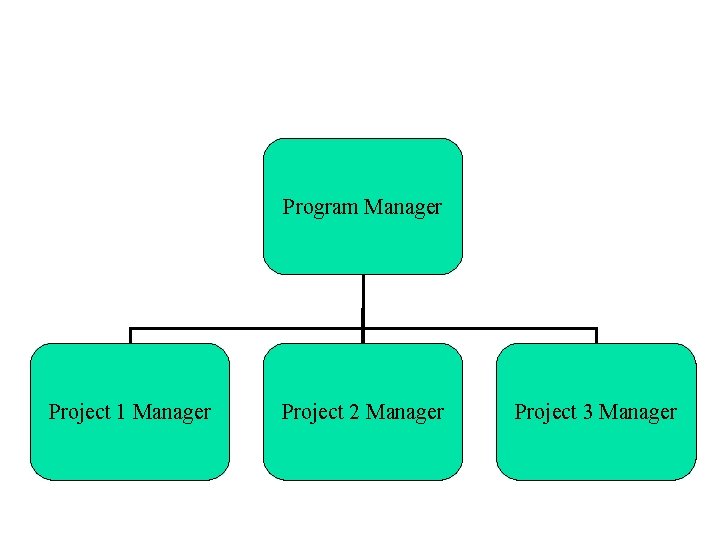
Program Manager Project 1 Manager Project 2 Manager Project 3 Manager

Project Portfolio Management n Many organizations support an emerging business strategy of project portfolio management: n High risk High payoff Low risk High payoff Organizations group and manage projects as a High risk portfolio of investments Low payoff that contribute to the entire enterprise’s success. Low risk Low payoff
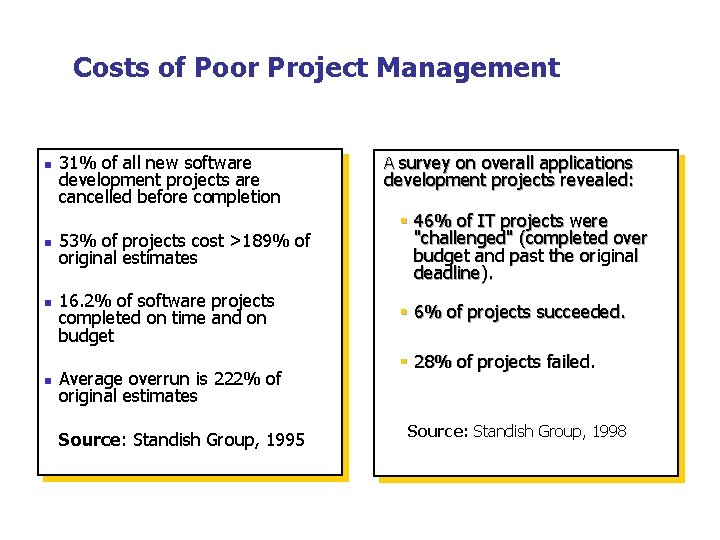
Costs of Poor Project Management n n 31% of all new software development projects are cancelled before completion A survey on overall applications development projects revealed: 53% of projects cost >189% of original estimates § 46% of IT projects were "challenged" (completed over budget and past the original deadline). 16. 2% of software projects completed on time and on budget § 6% of projects succeeded. Average overrun is 222% of original estimates Source: Standish Group, 1995 § 28% of projects failed. Source: Standish Group, 1998

Improved Project Performance § The Standish Group’s CHAOS studies show improvements in IT projects in the past decade. * *The Standish Group, “Latest Standish Group CHAOS Report Shows Project Success Rates Have Improved by 50%” (March 25, 2003).
Why the Improvements? “The reasons for the increase in successful projects vary. First, the average cost of a project has been more than cut in half. Better tools have been created to monitor and control progress and better skilled project managers with better management processes are being used. The fact that there are processes is significant in itself. ”* *The Standish Group, “CHAOS 2001: A Recipe for Success” (2001).
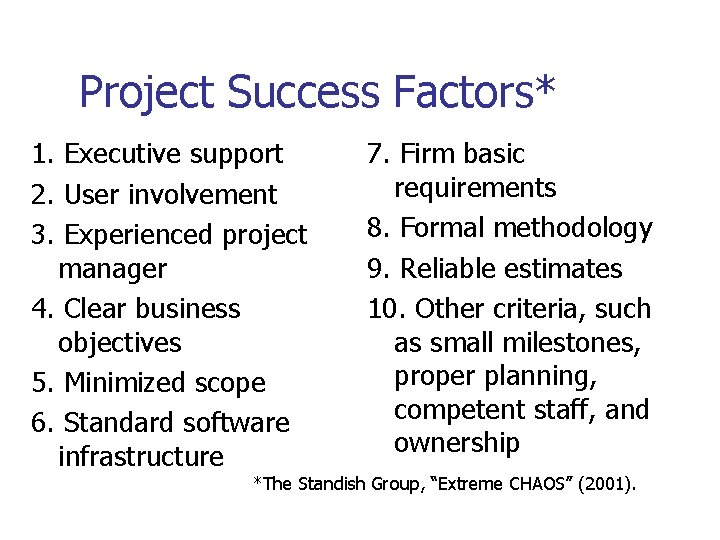
Project Success Factors* 1. Executive support 2. User involvement 3. Experienced project manager 4. Clear business objectives 5. Minimized scope 6. Standard software infrastructure 7. Firm basic requirements 8. Formal methodology 9. Reliable estimates 10. Other criteria, such as small milestones, proper planning, competent staff, and ownership *The Standish Group, “Extreme CHAOS” (2001).
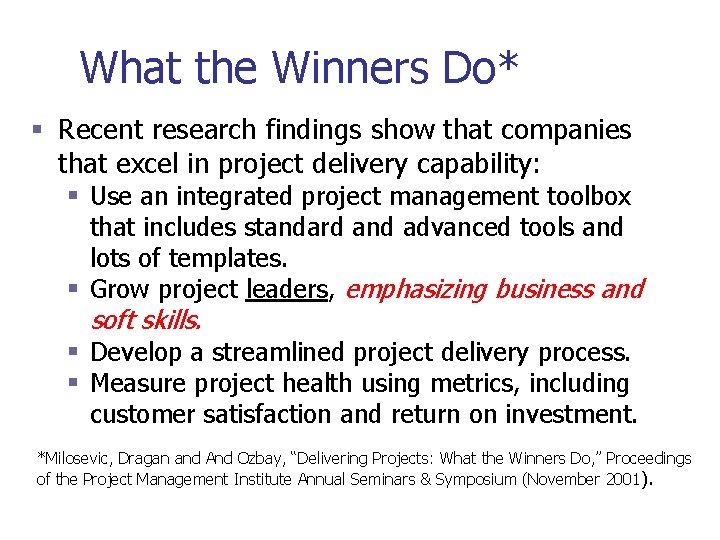
What the Winners Do* § Recent research findings show that companies that excel in project delivery capability: § Use an integrated project management toolbox that includes standard and advanced tools and lots of templates. § Grow project leaders, emphasizing business and soft skills. § Develop a streamlined project delivery process. § Measure project health using metrics, including customer satisfaction and return on investment. *Milosevic, Dragan and And Ozbay, “Delivering Projects: What the Winners Do, ” Proceedings of the Project Management Institute Annual Seminars & Symposium (November 2001 ).
The Role of the Project Manager n n Job descriptions vary, but most include responsibilities such as planning, scheduling, coordinating, and working with people to achieve project goals. Remember that 97 percent of successful projects were led by experienced project managers.
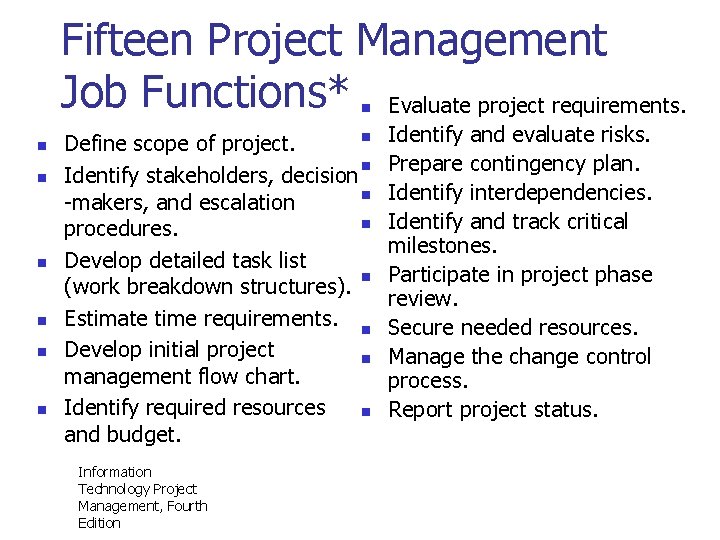
Fifteen Project Management Job Functions* Evaluate project requirements. n n n n Define scope of project. n Identify stakeholders, decision n -makers, and escalation n procedures. Develop detailed task list n (work breakdown structures). Estimate time requirements. n Develop initial project n management flow chart. Identify required resources n and budget. Information Technology Project Management, Fourth Edition Identify and evaluate risks. Prepare contingency plan. Identify interdependencies. Identify and track critical milestones. Participate in project phase review. Secure needed resources. Manage the change control process. Report project status.
Suggested Skills for Project Managers n Project managers need a wide variety of skills. n They should: n Be comfortable with change. n Understand the organizations they work in and with. (who to go to, SOP, etc) n Lead teams to accomplish project goals.
Suggested Skills for Project Managers n Project managers need both “hard” and “soft” skills. n n Hard skills include product knowledge and knowing how to use various project management tools and techniques. Soft skills include being able to work with various types of people. 22 of 54
l u f s ces Suc ^ Suggested Skills for Project Managers n n n Communication skills: Listens, persuades. Organizational skills: Plans, sets goals, analyzes. Team-building skills: Shows empathy, motivates, promotes esprit de corps. Leadership skills: Sets examples, provides vision (big picture), delegates, positive, energetic. Coping skills: Flexible, creative, patient, persistent. Technology skills: Experience, project knowledge. 23 of 54
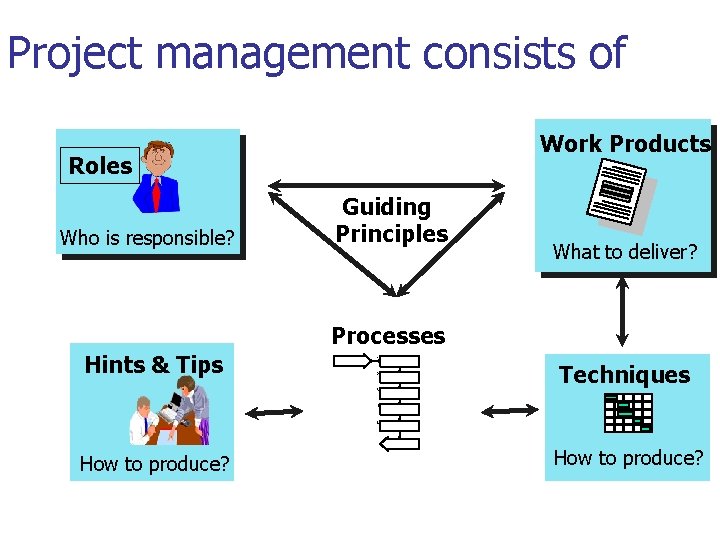
Project management consists of Work Products Roles Who is responsible? Guiding Principles What to deliver? Processes Hints & Tips 1 2 3 Techniques 7 8 How to produce?

Stages of PM
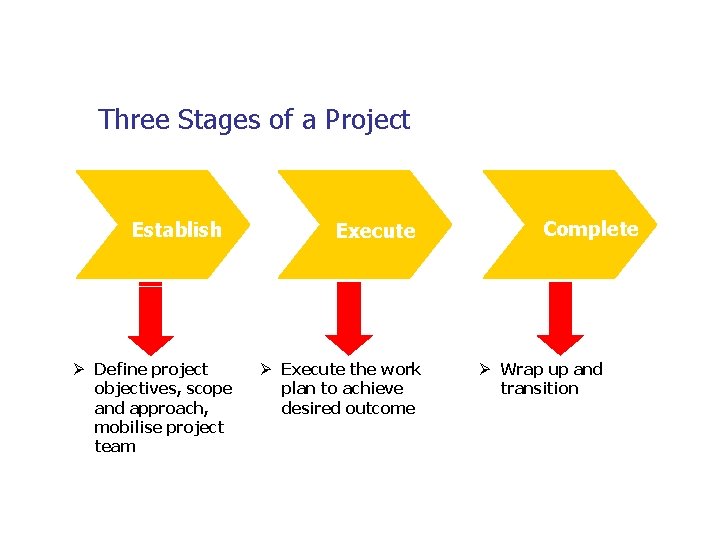
Three Stages of a Project Establish Ø Define project objectives, scope and approach, mobilise project team Execute Ø Execute the work plan to achieve desired outcome Complete Ø Wrap up and transition
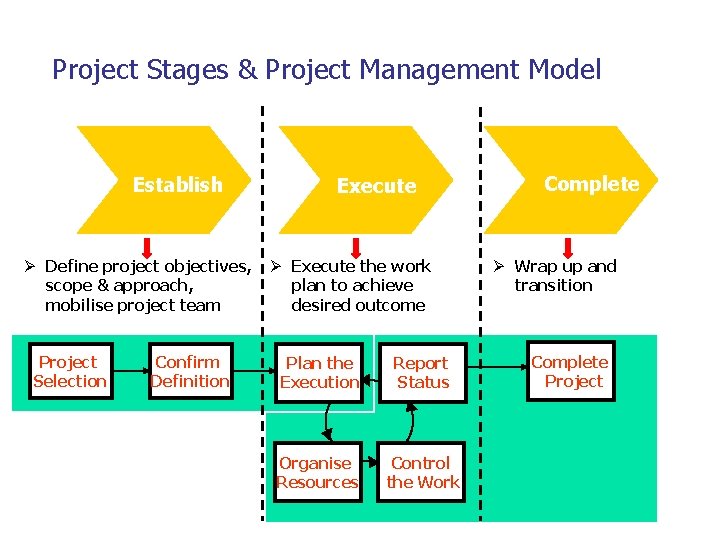
Project Stages & Project Management Model Establish Ø Define project objectives, scope & approach, mobilise project team Project Selection Confirm Definition Execute Ø Execute the work plan to achieve desired outcome Plan the Execution Report Status Organise Resources Control the Work Complete Ø Wrap up and transition Complete Project
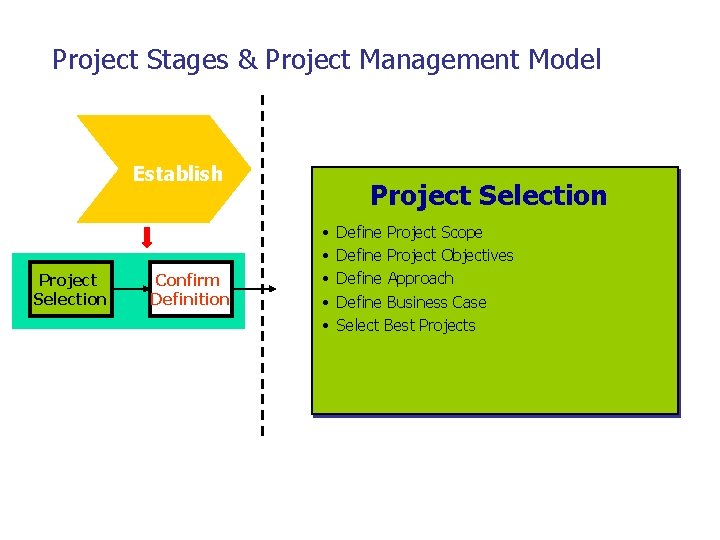
Project Stages & Project Management Model Establish Project Selection Confirm Definition Project Selection • • • Define Project Scope Define Project Objectives Define Approach Define Business Case Select Best Projects
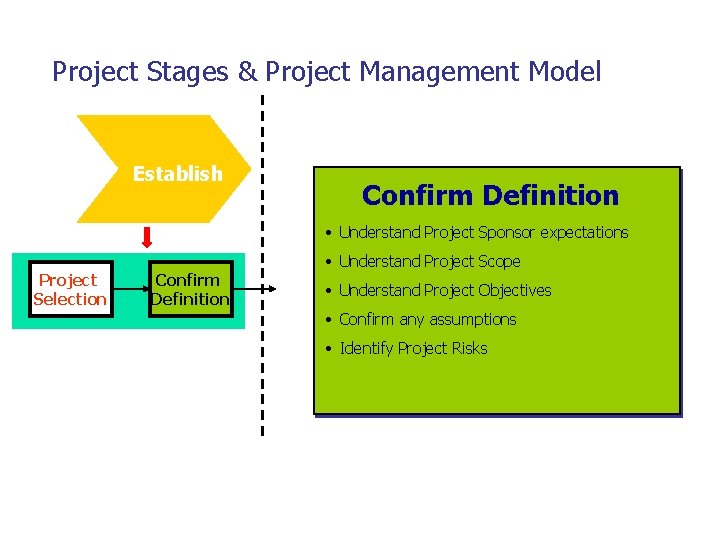
Project Stages & Project Management Model Establish Confirm Definition • Understand Project Sponsor expectations Project Selection Confirm Definition • Understand Project Scope • Understand Project Objectives • Confirm any assumptions • Identify Project Risks
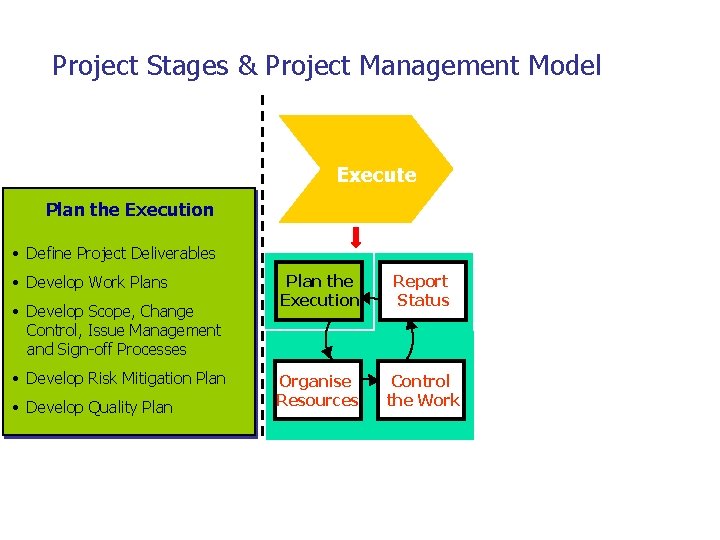
Project Stages & Project Management Model Execute Plan the Execution • Define Project Deliverables • Develop Work Plans • Develop Scope, Change Control, Issue Management and Sign-off Processes • Develop Risk Mitigation Plan • Develop Quality Plan the Execution Report Status Organise Resources Control the Work
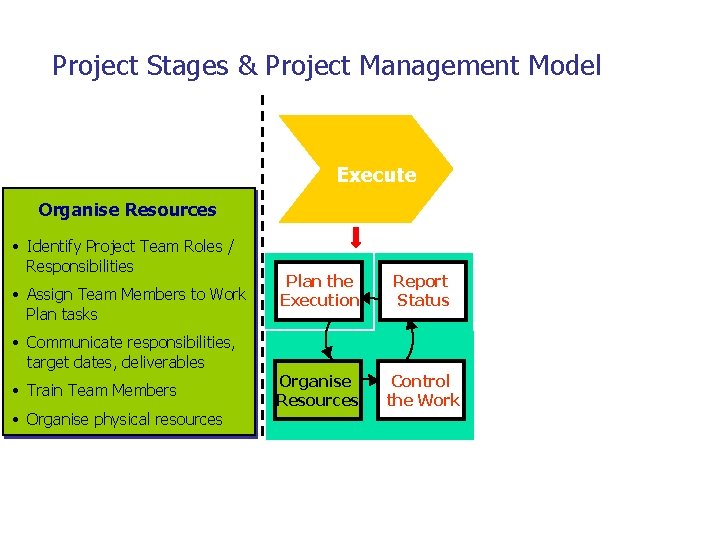
Project Stages & Project Management Model Execute Organise Resources • Identify Project Team Roles / Responsibilities • Assign Team Members to Work Plan tasks Plan the Execution Report Status Organise Resources Control the Work • Communicate responsibilities, target dates, deliverables • Train Team Members • Organise physical resources
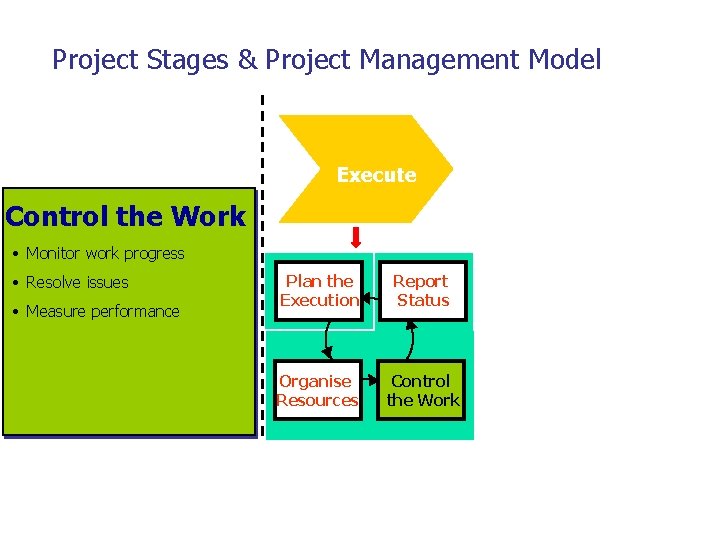
Project Stages & Project Management Model Execute Control the Work • Monitor work progress • Resolve issues • Measure performance Plan the Execution Report Status Organise Resources Control the Work
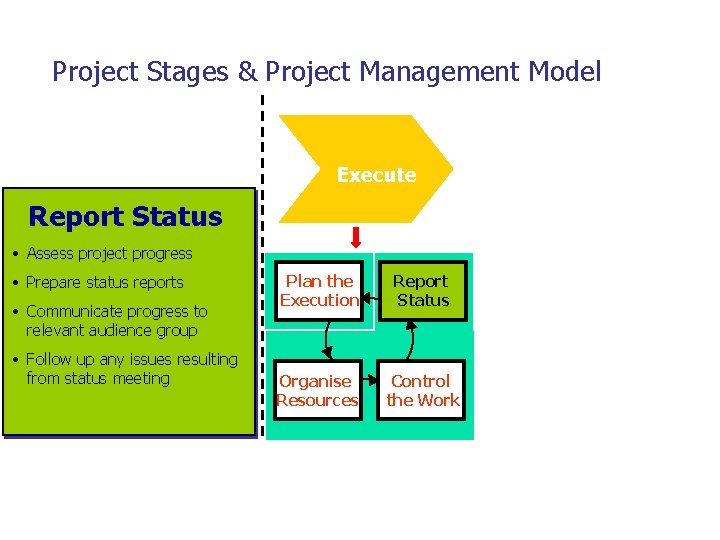
Project Stages & Project Management Model Execute Report Status • Assess project progress • Prepare status reports • Communicate progress to relevant audience group • Follow up any issues resulting from status meeting Plan the Execution Report Status Organise Resources Control the Work
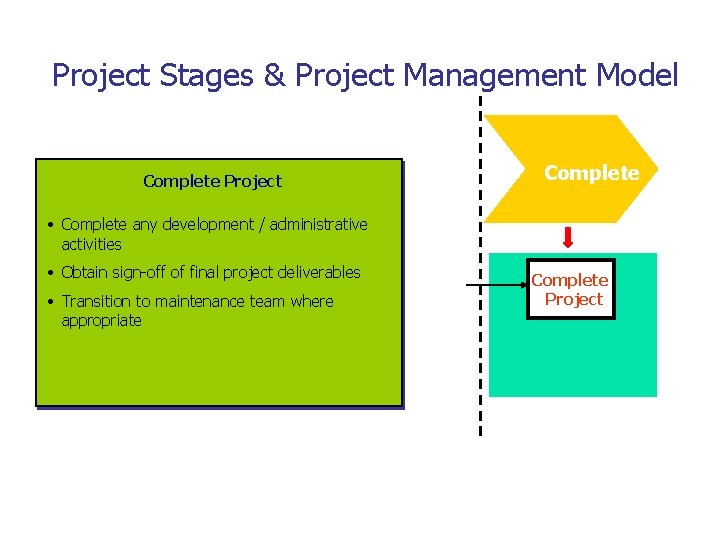
Project Stages & Project Management Model Complete Project Complete • Complete any development / administrative activities • Obtain sign-off of final project deliverables • Transition to maintenance team where appropriate Complete Project
The Project Management Profession n Professional societies such as the Project Management Institute (PMI) have grown significantly. PMI There are specific interest groups in many areas, such as engineering, financial services, health care, and IT. Project management research and certification programs continue to grow.
Project Management Certification n n PMI provides certification as a Project Management Professional (PMP). A PMP has documented sufficient project experience, agreed to follow a code of ethics, and passed the PMP exam. The number of people earning PMP certification is increasing quickly. PMI and other organizations are offering new certification programs
Growth in PMP Certification, 1993 -2003
Ethics in Project Management n n Ethics is an important part of all professions. Project managers often face ethical dilemmas. In order to earn PMP certification, applicants must agree to the PMP code of professional conduct. Several questions on the PMP exam are related to professional responsibility, including ethics.
Project Management Software n n There are currently hundreds of different products to assist in performing project management. Three main categories of tools: n Low-end tools: Handle single or smaller projects well; cost under $200 per user. n Midrange tools: Handle multiple projects and users; cost $200 -500 per user; Project 2003 most popular (includes an enterprise version). n High-end tools: Also called enterprise project management software; often licensed on a per-user basis; VPMi Enterprise Online (www. vcsonline. com).
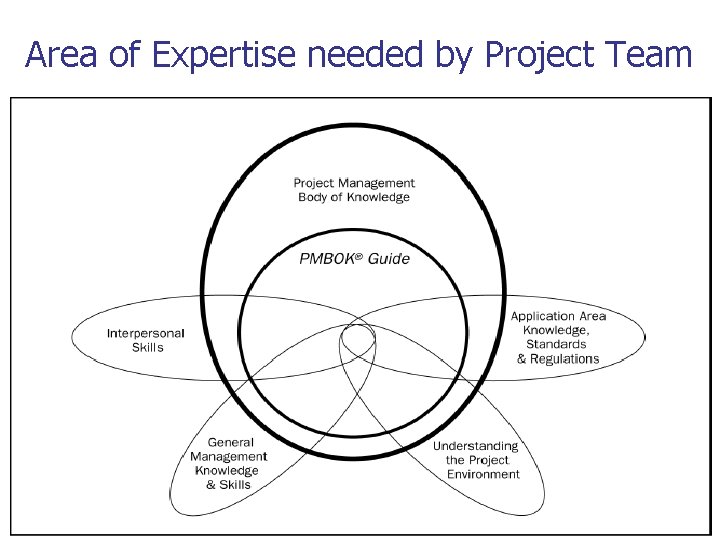
Area of Expertise needed by Project Team
Project Management Office n n n A project management office (PMO) is an organizational unit to centralize and coordinate the management of projects under its domain. A PMO can also be referred to as a “program management office, ” “project office, ” or “program office. ” A PMO oversees the management of projects, programs, or a combination of both. The PMO focuses on the coordinated planning, prioritization and execution of projects and subprojects that are tied to the parent organization’s or client’s overall business objectives. PMOs can operate on a continuum, from providing project management support functions in the form of training, software, standardized policies, and procedures, to actual direct management and responsibility for achieving the project objectives.
Project Management Processes for a Project n Project management is accomplished through processes, using project management knowledge, skills, tools, and techniques that receive inputs and generate outputs. n n n In order for a project to be successful, the project team must: Select appropriate processes within the Project Management Process Groups (also known as Process Groups) that are required to meet the project objectives Use a defined approach to adapt the product specifications and plans to meet project and product requirements Comply with requirements to meet stakeholder needs, wants and expectations Balance the competing demands of scope, time, cost, quality, resources, and risk to produce a quality product.
Project management Processes n n n Five Processes. Initiating: Authorizing the project or phase Planning: Defining Objectives and selecting approach Execution: Managing human and non human resources to execute the project. Controlling: Monitoring, evaluation and correcting Closing: Formal acceptance and close out.
Nine Project Management Knowledge Areas n Knowledge areas describe the key competencies that project managers must develop. n Four core knowledge areas lead to specific project objectives (scope, time, cost, and quality). n Four facilitating knowledge areas are the means through which the project objectives are achieved (human resources, communication, risk, and procurement management). n One knowledge area (project integration management) affects and is affected by all of the other knowledge areas. n All knowledge areas are important! 44 of 54
Knowledge Areas for Project Management n n n n n Project Integration Management Project Scope Management Project Time Management Project Cost Management Project Quality Management Project Human Resource Management Project Communications Management Project Risk Management Project Procurement Management
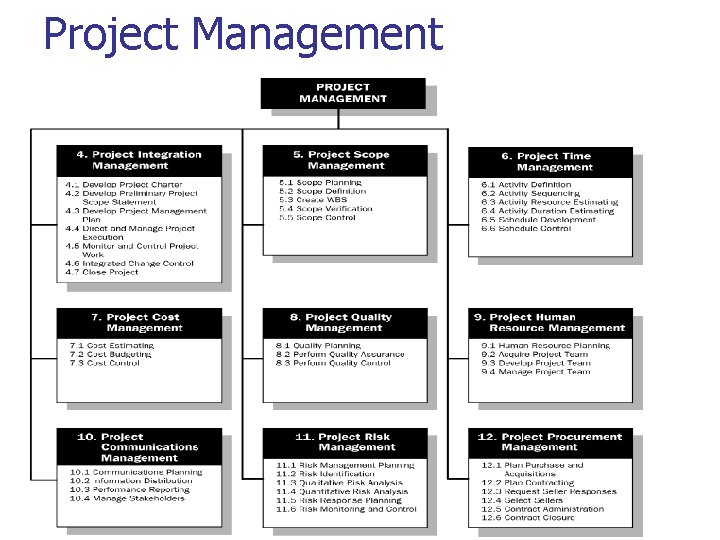
Project Management
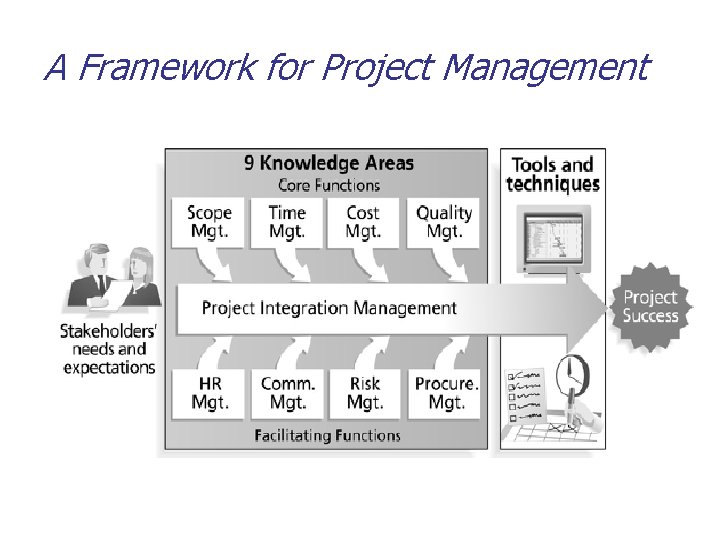
A Framework for Project Management
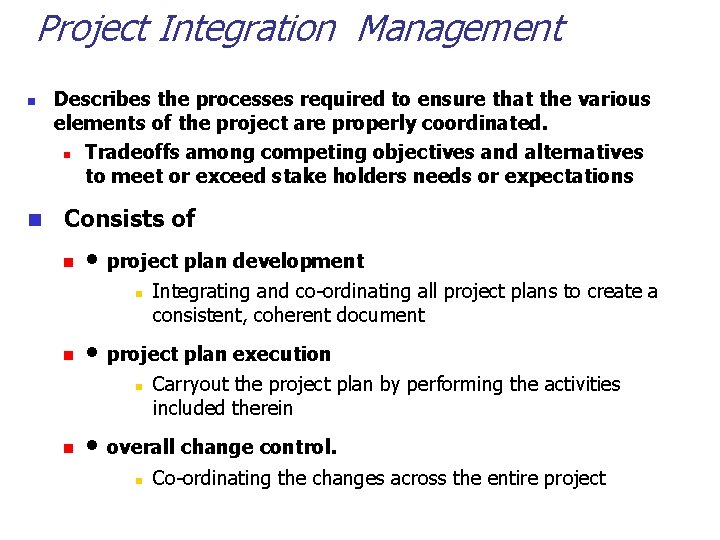
Project Integration Management n n Describes the processes required to ensure that the various elements of the project are properly coordinated. n Tradeoffs among competing objectives and alternatives to meet or exceed stake holders needs or expectations Consists of n • project plan development n n • project plan execution n n Integrating and co-ordinating all project plans to create a consistent, coherent document Carryout the project plan by performing the activities included therein • overall change control. n Co-ordinating the changes across the entire project
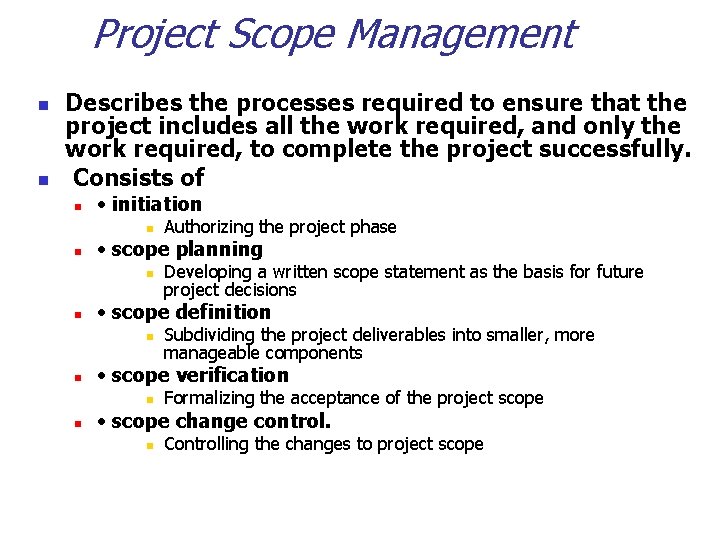
Project Scope Management n n Describes the processes required to ensure that the project includes all the work required, and only the work required, to complete the project successfully. Consists of n • initiation n n • scope planning n n Subdividing the project deliverables into smaller, more manageable components • scope verification n n Developing a written scope statement as the basis for future project decisions • scope definition n n Authorizing the project phase Formalizing the acceptance of the project scope • scope change control. n Controlling the changes to project scope
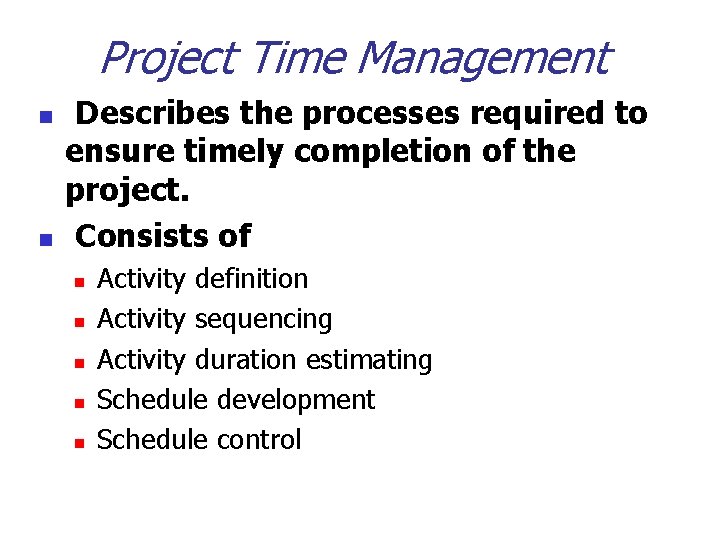
Project Time Management n n Describes the processes required to ensure timely completion of the project. Consists of n n n Activity definition Activity sequencing Activity duration estimating Schedule development Schedule control
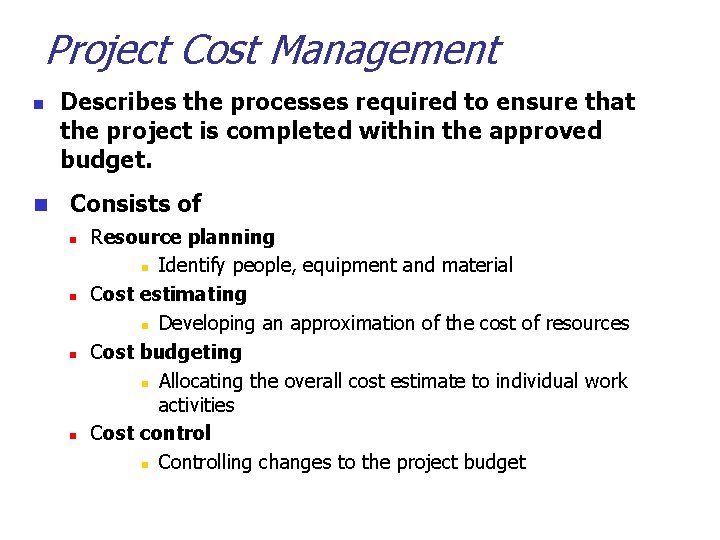
Project Cost Management n n Describes the processes required to ensure that the project is completed within the approved budget. Consists of n n Resource planning n Identify people, equipment and material Cost estimating n Developing an approximation of the cost of resources Cost budgeting n Allocating the overall cost estimate to individual work activities Cost control n Controlling changes to the project budget
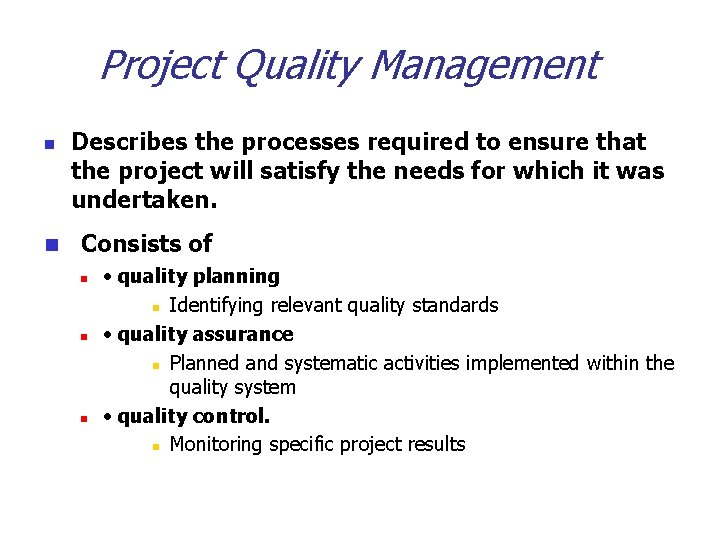
Project Quality Management n n Describes the processes required to ensure that the project will satisfy the needs for which it was undertaken. Consists of n n n • quality planning n Identifying relevant quality standards • quality assurance n Planned and systematic activities implemented within the quality system • quality control. n Monitoring specific project results
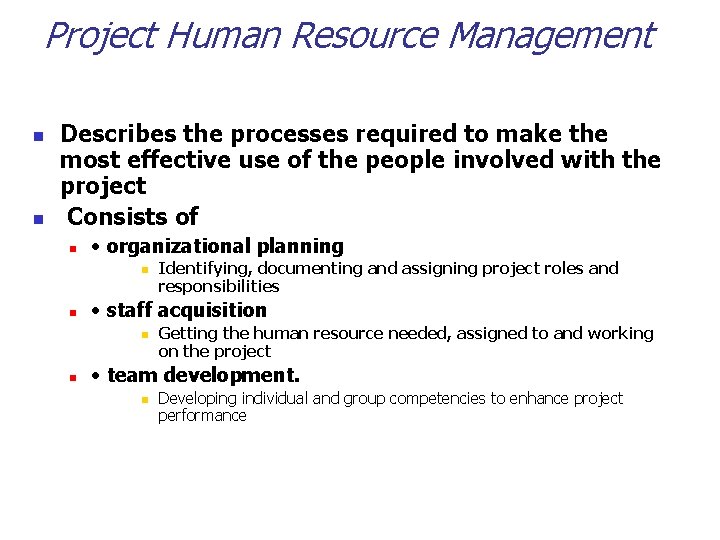
Project Human Resource Management n n Describes the processes required to make the most effective use of the people involved with the project Consists of n • organizational planning n n • staff acquisition n n Identifying, documenting and assigning project roles and responsibilities Getting the human resource needed, assigned to and working on the project • team development. n Developing individual and group competencies to enhance project performance
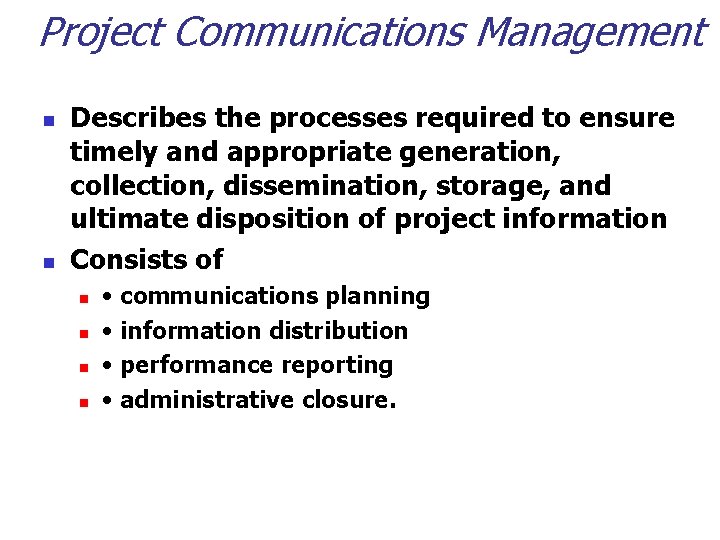
Project Communications Management n n Describes the processes required to ensure timely and appropriate generation, collection, dissemination, storage, and ultimate disposition of project information Consists of n n • communications planning • information distribution • performance reporting • administrative closure.
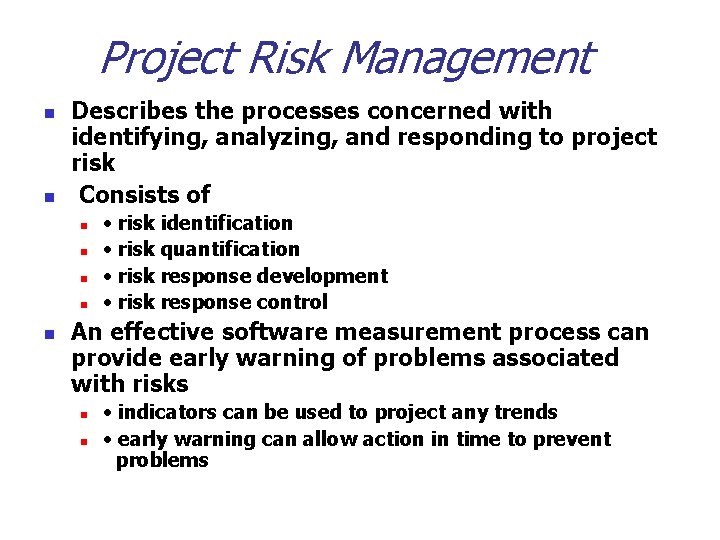
Project Risk Management n n Describes the processes concerned with identifying, analyzing, and responding to project risk Consists of n n n • risk identification • risk quantification • risk response development • risk response control An effective software measurement process can provide early warning of problems associated with risks n n • indicators can be used to project any trends • early warning can allow action in time to prevent problems
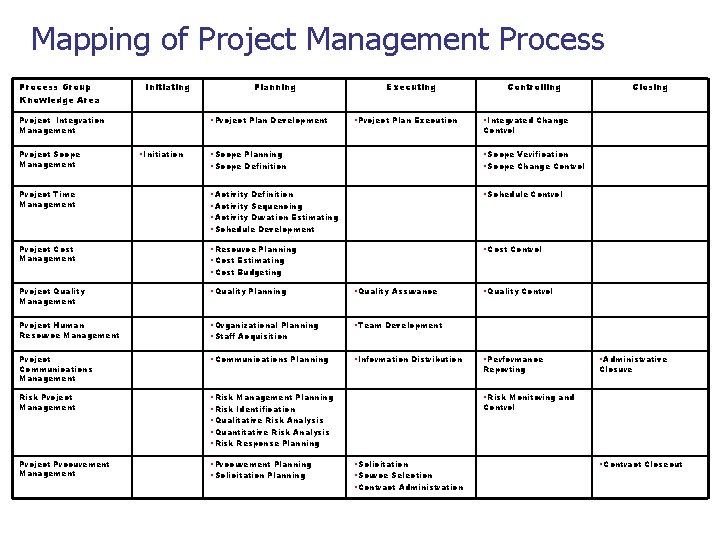
Mapping of Project Management Process Group Knowledge Area Initiating Planning • Project Plan Development Project Integration Management • Project Plan Execution Controlling Closing • Integrated Change Control • Scope Planning • Scope Definition • Scope Verification • Scope Change Control Project Time Management • Activity Definition • Activity Sequencing • Activity Duration Estimating • Schedule Development • Schedule Control Project Cost Management • Resource Planning • Cost Estimating • Cost Budgeting • Cost Control Project Quality Management • Quality Planning • Quality Assurance Project Human Resource Management • Organizational Planning • Staff Acquisition • Team Development Project Communications Management • Communications Planning • Information Distribution Risk Project Management • Risk Management Planning • Risk Identification • Qualitative Risk Analysis • Quantitative Risk Analysis • Risk Response Planning Project Procurement Management • Procurement Planning • Solicitation Planning Project Scope Management • Initiation Executing • Quality Control • Performance Reporting • Administrative Closure • Risk Monitoring and Control • Solicitation • Source Selection • Contract Administration • Contract Closeout
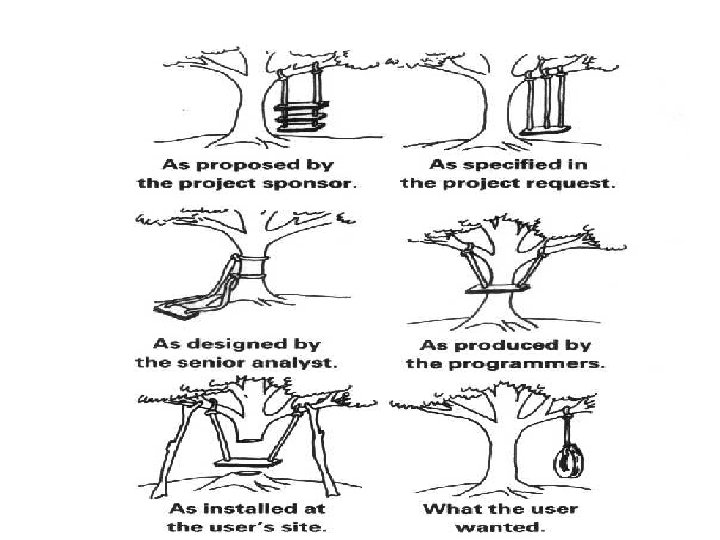
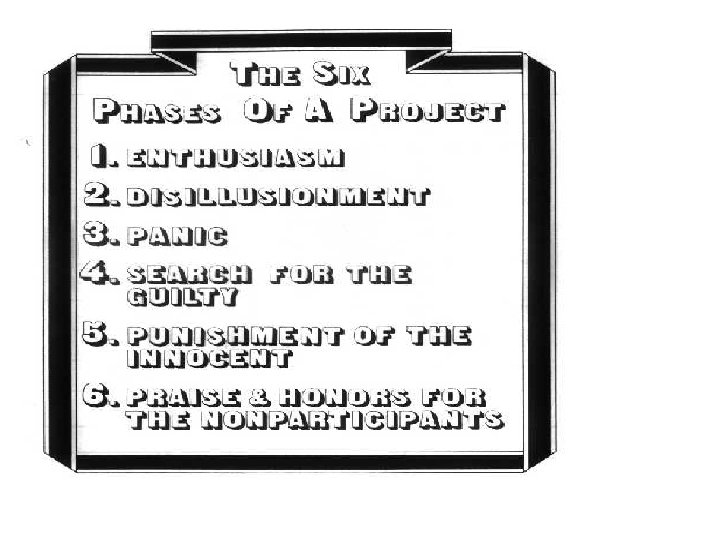
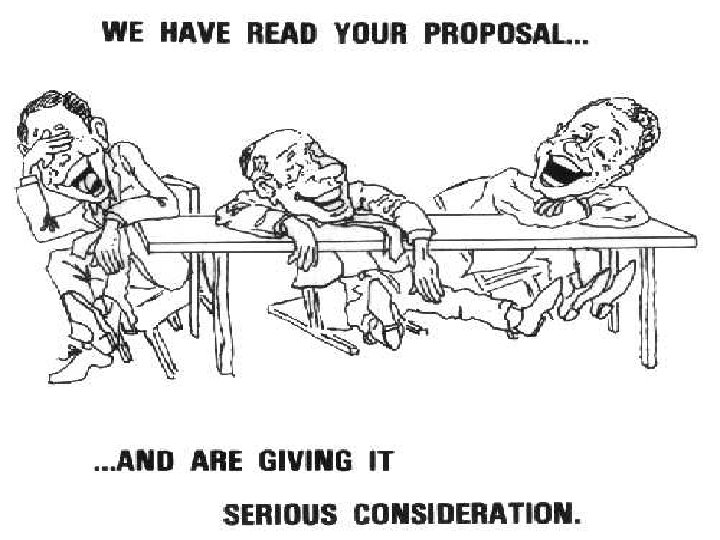
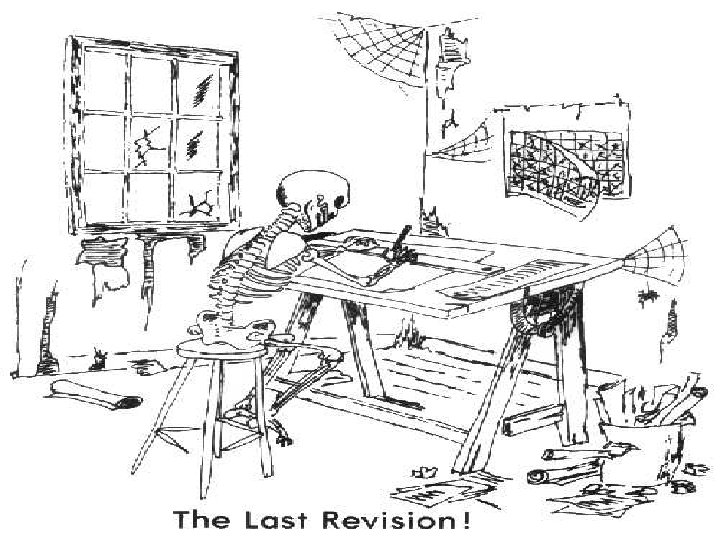
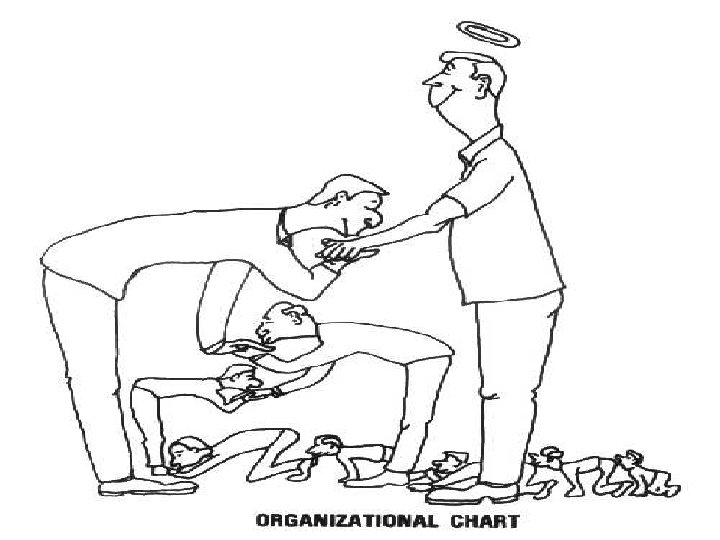
Some Funny Quotes of Project Managers n As of tomorrow, employees will only be able to access the building using individual security cards. Pictures will be taken next Wednesday and employees will receive their cards in two weeks. What I need is a list of specific unknown problems we will encounter. E-mail is not to be used to pass on information or data. It should be used only to be used for company business. Turnover is good for the company, as it proves that we are doing a good job in training people. This project is so important, we can't let things that are more important interfere with it. Doing it right is no excuse for not meeting the schedule. No one will believe you solved this problem in one day! We've been working on it for months. Now, go act busy for a few weeks and I'll let you know when it's time to tell them
- Slides: 62