
Project Management Newspaper Delivery System presented by Aaron
Project Management Newspaper Delivery System presented by Aaron Molloy - Jimmy Kenny - Taras Voloshyn
Introduction Newspaper Delivery System • System Overview • Printing • Summary Reports • Billing Information • Geographical Information • Customer specific settings • Web based application
Introduction Why a Web Application ? • Our skillsets are in the area of web development. • Better for casual users(i. e. newsagents) • Greater accessibility. • Offsite hosting
Hardware Requirements • 3 PCs • Printer • Internet Connection • Source Control Server (i. e. Git)
Software requirements • Eclipse with J-Unit plugin shall be used to develop and test the project. • My. SQL shall be used to develop the database required for the project. • Google Maps integration shall be used to find out where customers are located. • PHP, Xampp, Java. Script, AJAX/JSON, HTML and CSS shall be used in the web development side of the project.
Software requirements • Microsoft Office Excel shall be used to organize and input users billing information. • Microsoft Office Word shall be used to write up the requirements document. • GIT shall be used to manage the changes to the project.
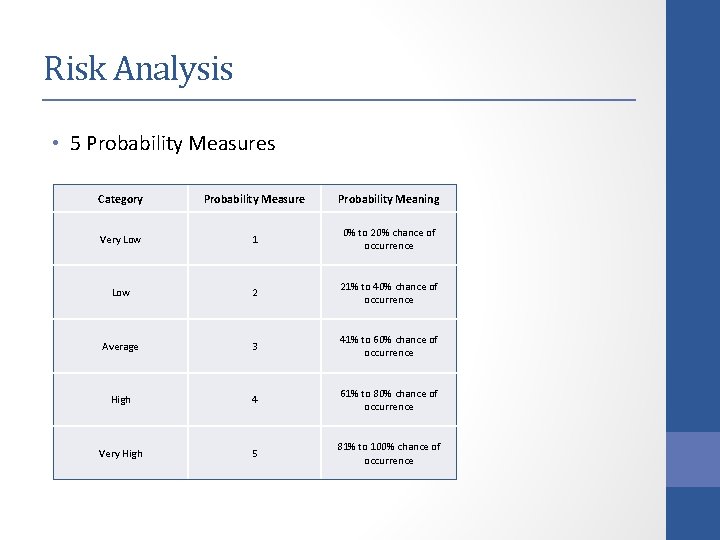
Risk Analysis • 5 Probability Measures Category Probability Measure Probability Meaning Very Low 1 0% to 20% chance of occurrence Low 2 21% to 40% chance of occurrence Average 3 41% to 60% chance of occurrence High 4 61% to 80% chance of occurrence Very High 5 81% to 100% chance of occurrence
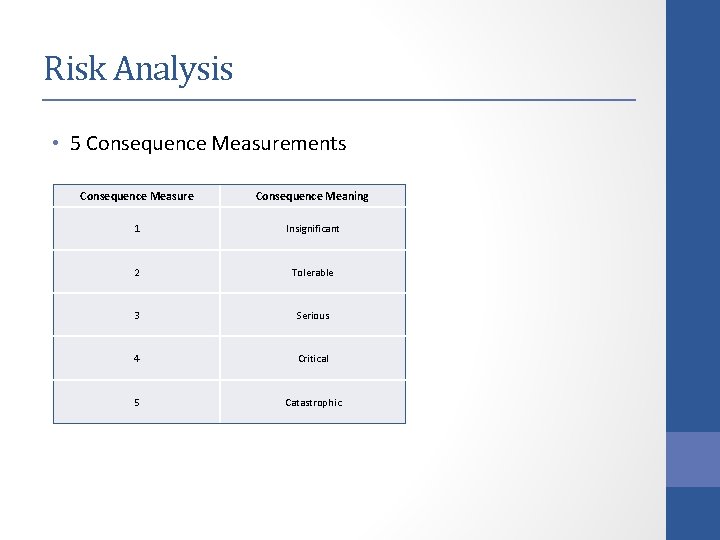
Risk Analysis • 5 Consequence Measurements Consequence Measure Consequence Meaning 1 Insignificant 2 Tolerable 3 Serious 4 Critical 5 Catastrophic
Risk Analysis • 17 Risks identified altogether • Risk Exposure = Probability x Consequence • Main risks identified: • Requirements change • Data loss • System performance • Development time underestimated • Budget concerns
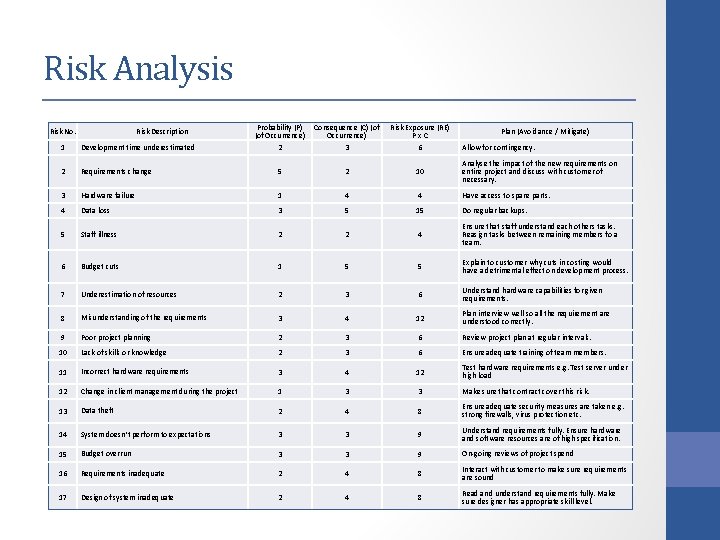
Risk Analysis Risk No. Risk Description Probability (P) (of Occurrence) Consequence (C) (of Occurrence) Risk Exposure (RE) Px. C Plan (Avoidance / Mitigate) 1 Development time underestimated 2 3 6 Allow for contingency. 2 Requirements change 5 2 10 Analyse the impact of the new requirements on entire project and discuss with customer of necessary. 3 Hardware failure 1 4 4 Have access to spare parts. 4 Data loss 3 5 15 Do regular backups. 5 Staff illness 2 2 4 Ensure that staff understand each others tasks. Reasign tasks between remaining members fo a team. 6 Budget cuts 1 5 5 Explain to customer why cuts in costing would have a detrimental effect on development process. 7 Underestimation of resources 2 3 6 Understand hardware capabilities for given requirements. 8 Misunderstanding of the requirements 3 4 12 Plan interview well so all the requirement are understood correctly. 9 Poor project planning 2 3 6 Review project plan at regular intervals. 10 Lack of skills or knowledge 2 3 6 Ensure adequate training of team members. 11 Incorrect hardware requirements 3 4 12 Test hardware requirements e. g. Test server under high load 12 Change in client management during the project 1 3 3 Make sure that contract cover this risk. 13 Data theft 2 4 8 Ensure adequate security measures are taken e. g. strong firewalls, virus protection etc. 14 System doesn’t perform to expectations 3 3 9 Understand requirements fully. Ensure hardware and software resources are of high specification. 15 Budget overrun 3 3 9 On-going reviews of project spend 16 Requirements inadequate 2 4 8 Interact with customer to make sure requirements are sound 17 Design of system inadequate 2 4 8 Read and understand requirements fully. Make sure designer has appropriate skill level.
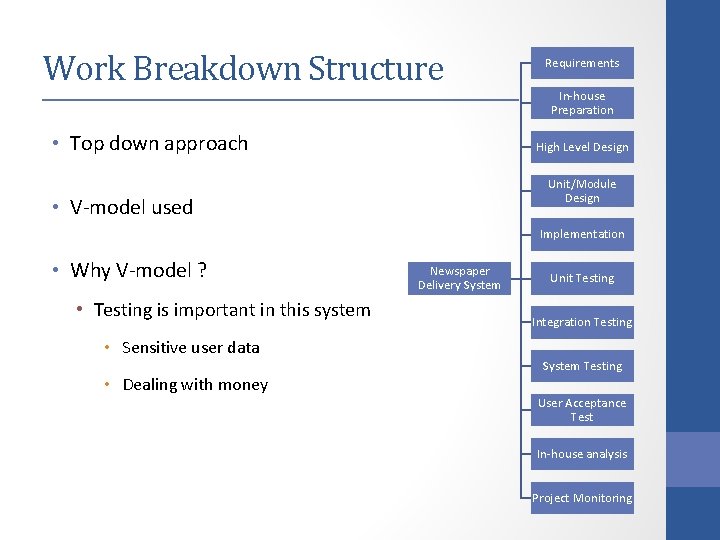
Work Breakdown Structure • Top down approach Requirements In-house Preparation High Level Design Unit/Module Design • V-model used Implementation • Why V-model ? • Testing is important in this system Newspaper Delivery System Unit Testing Integration Testing • Sensitive user data • Dealing with money System Testing User Acceptance Test In-house analysis Project Monitoring
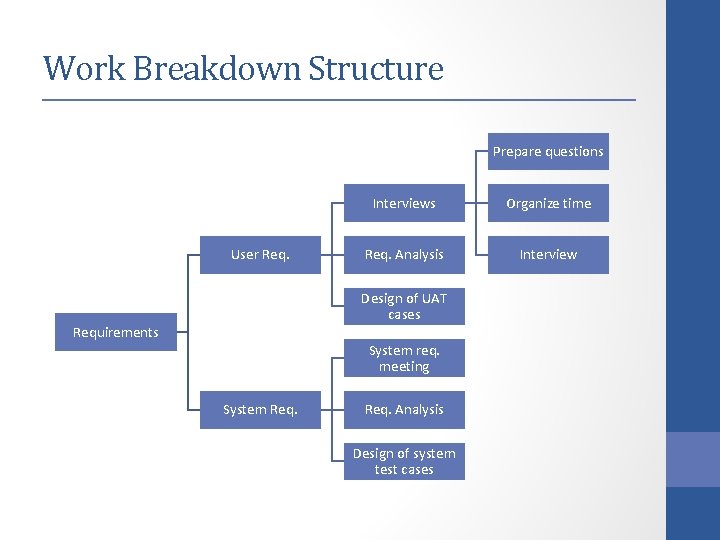
Work Breakdown Structure Prepare questions User Req. Interviews Organize time Req. Analysis Interview Design of UAT cases Requirements System req. meeting System Req. Analysis Design of system test cases
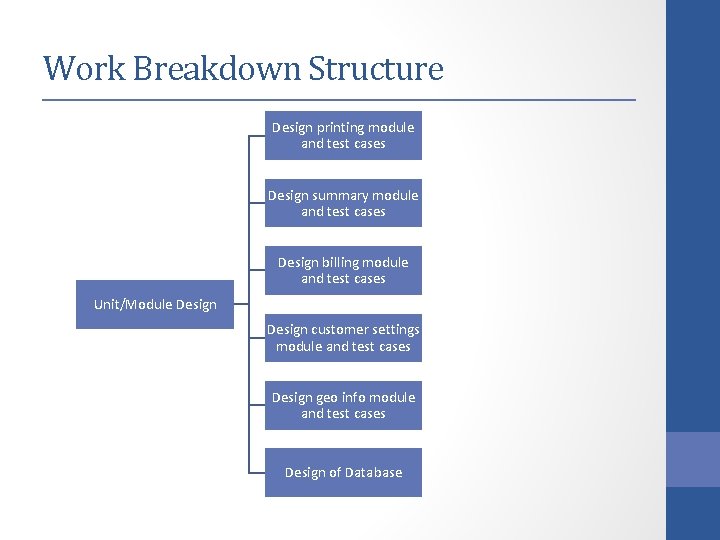
Work Breakdown Structure Design printing module and test cases Design summary module and test cases Design billing module and test cases Unit/Module Design customer settings module and test cases Design geo info module and test cases Design of Database
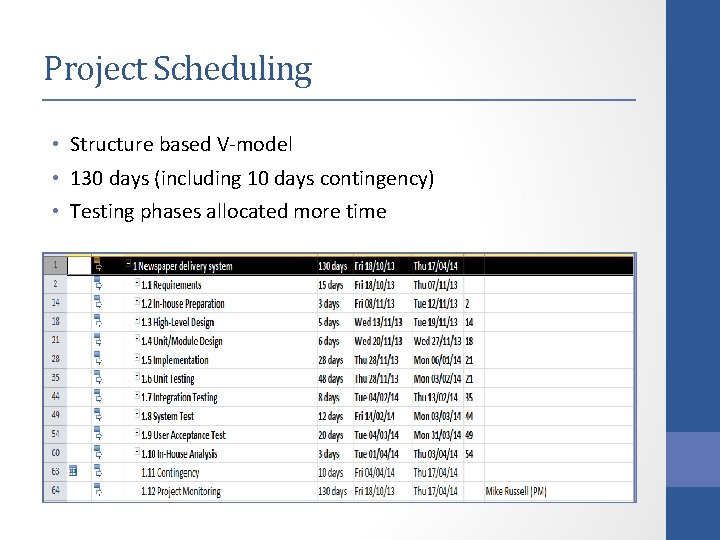
Project Scheduling • Structure based V-model • 130 days (including 10 days contingency) • Testing phases allocated more time
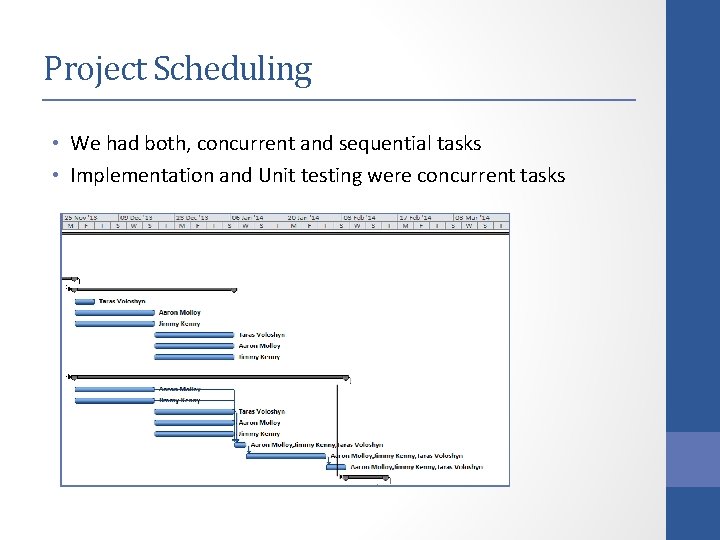
Project Scheduling • We had both, concurrent and sequential tasks • Implementation and Unit testing were concurrent tasks
Project Scheduling Where’s the Critical Path ? • Concurrent tasks run over the same period of time • No divergent path • One path through the project
Milestones and Deliverables Milestones • Requirements Elicitation and User Acceptance Test • Requirements Analysis and System Testing • High Level Design and Integration Testing • Unit/Module Design and Unit/Module Testing • Implementation
Milestones and Deliverables are the work products we will give the client for evaluation. The deliverables are as follows: • Project Plan • Requirements Document • Design Document • Executable Code Modules • Integrated Modules for testing • User Manual
Monitoring and Reporting Throughout the course of the project we will implement Monitoring and Reporting mechanisms as follows • Weekly Informal Team Meetings • Evaluate project status and issues to be addressed • Formal report created at each Milestone • • • Submitted to Project Manager. Details what was done during phase Highlight any actual or potential problems Formal meeting with the Project Manager Follow-up meetings may be required. • Report accompanies each Deliverable • Formal meeting arranged with Client • Discuss issues arising • Follow-up meetings may be required.
Summary Learning Outcomes • Risk Analysis • Work Breakdown Structure • Project Scheduling • Critical Path • Milestones and Deliverables • Monitoring and Reporting • Teamwork
- Slides: 20