
Project management Learning Unit 5 Introduction Project management
- Slides: 33
Project management Learning Unit 5
Introduction • • Project management and events? 1950’s WBS PMBOK - helps to track changes and progress • Event is a project – Thus Project management
Outcomes
Project • Temporary endeavour to create unique product or service. • Carefully designed set of activities using resources to meet pre-defined objectives • Length of project = commencement to completion. • = Days, weeks, months, years. • Events: Unique, perishable, intangible time-driven happenings that deliver memorable experiences to the attendees.
Project Management • Defining and achieving targets • While organising and managing • Available resources over the run of project. 5 CONSTRAINTS ……. . • TIME • COST • QUALITY • SCOPE • RISK
Time • Amount of time is numbers of hours, days, weeks to complete the project.
Cost • Time variable (time is money) (using staff hourly) • Cost of disbursements – real expenses
Quality • What does the client expect regarding value? • Time and money = quality • More quality…. . Need more time…. . But time is money……. All has to balance out.
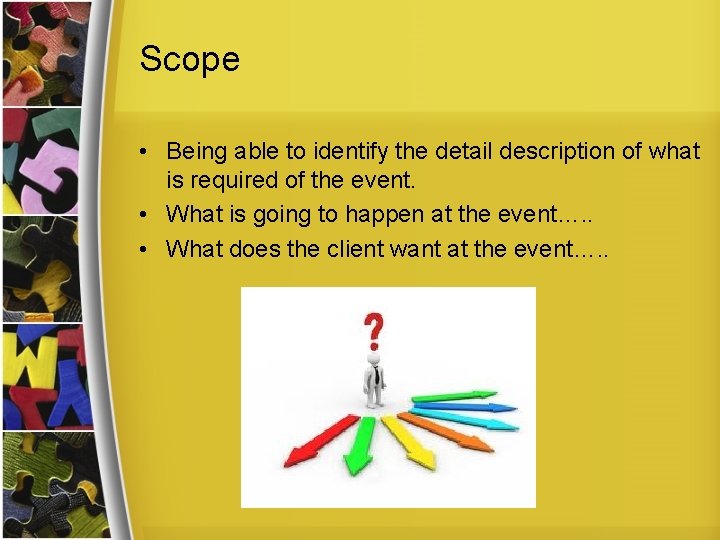
Scope • Being able to identify the detail description of what is required of the event. • What is going to happen at the event…. . • What does the client want at the event…. .
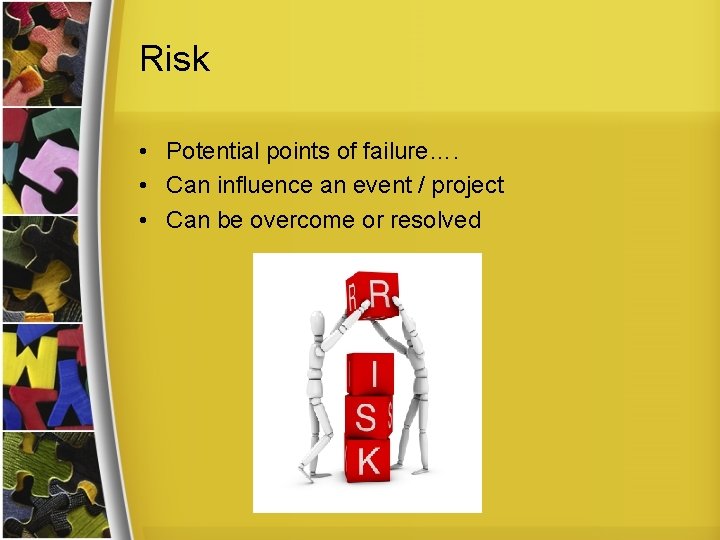
Risk • Potential points of failure…. • Can influence an event / project • Can be overcome or resolved
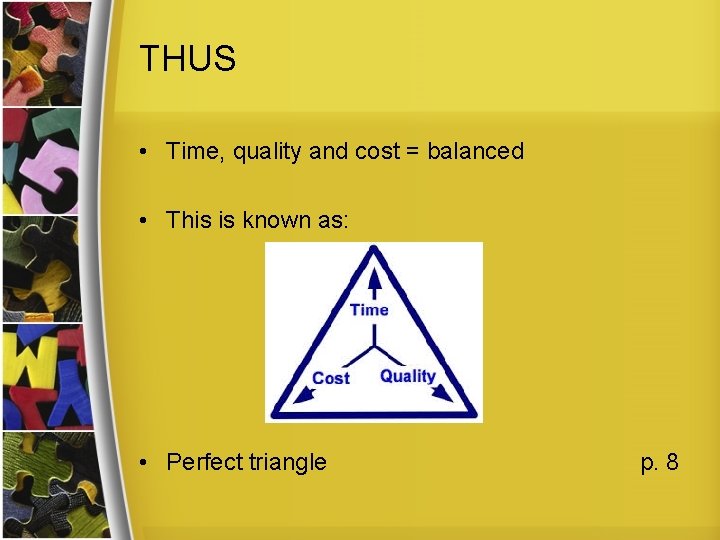
THUS • Time, quality and cost = balanced • This is known as: • Perfect triangle p. 8
Ice Questions: Question 1 • Do you think there is a perfect triangle in events?
Project management activities STEPS IN PROJECT MANAGEMENT • Plan the work • Estimate the resources required • Organise the work • Get staff and material (resources) • Assign tasks • Direct activities • Control the project (as it is happening) • Report progress (to the client) • Analyse results based on achievements CARPEGADO
Tools in project management • • Planning Earned value Risk management Scheduling
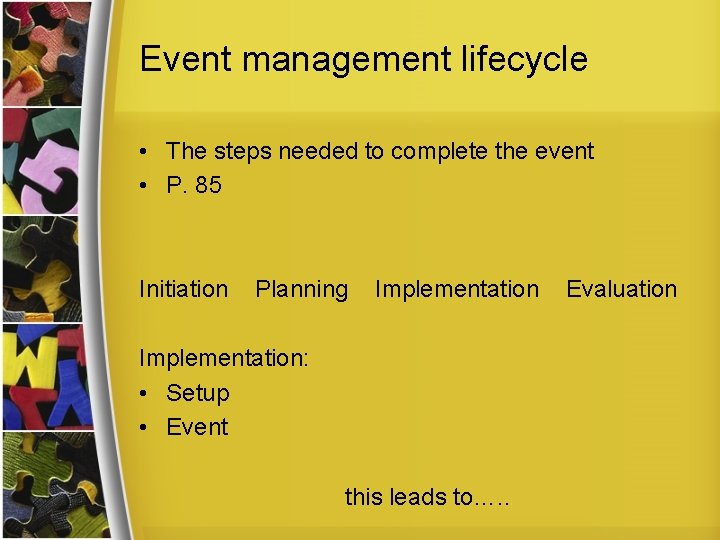
Event management lifecycle • The steps needed to complete the event • P. 85 Initiation Planning Implementation: • Setup • Event this leads to…. . Evaluation
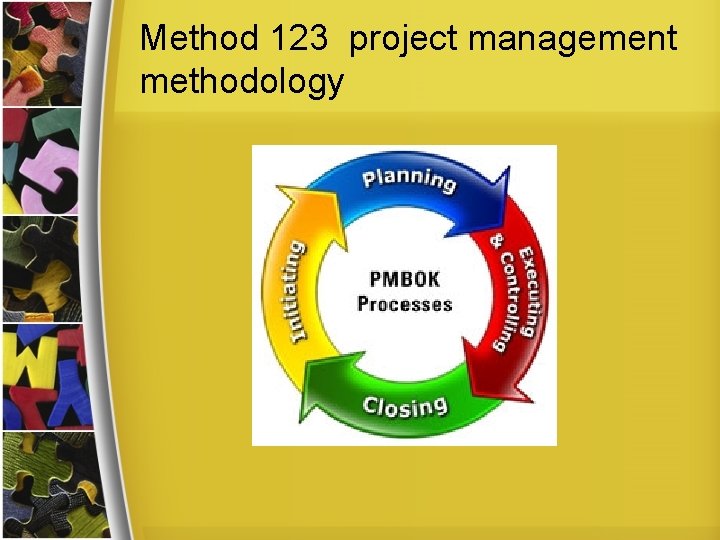
Method 123 project management methodology
Initiation (Starting up the event) • Client meeting • Feasibility study - do proposal – 4 m’s (manpower, money, materials & machinery) • • Signing of contract Identifying scope objectives (individual elements) Identify goals Team selection (team leader? )
Ice Question 2 • What does the 4 m’s stand for in the feasibility study?
Planning • Project planning phase…… • Documents to help you plan…. . • EVENT MANUAL – – – Administration HR Operations Logistics Risk management Communications
… planning • Planning phases: – Budgeting – WBS (Work breakdown structure) – Defining targets (what you want to achieve… the target) • Quality expected • Risk assessment – Buying decisions • What suppliers / vendors to use…. BBBEE statuses… – Scheduling • Timelines for each task… (GANTT CHART)
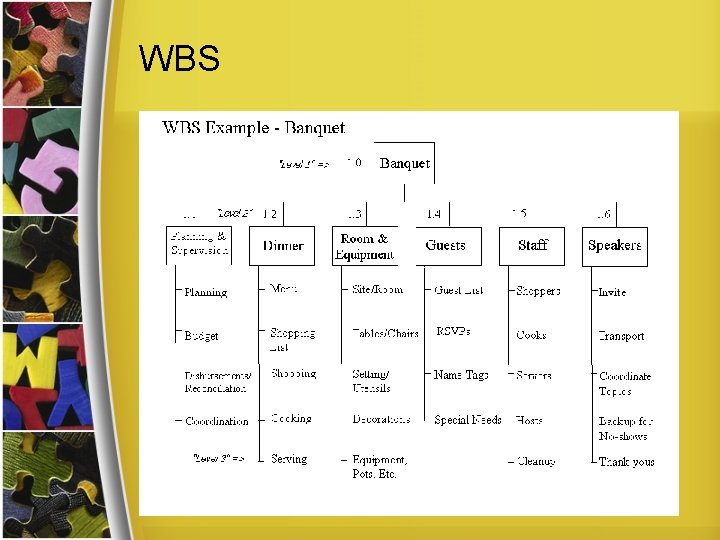
…. . Planning • Planning TOOLS : WBS – tree structure see p. 92 examples – It helps to determine each task that needs to be done, and who is responsible for each task. – See if there is overlapping tasks… – How do I make a wbs? Software available, whiteboard….
WBS
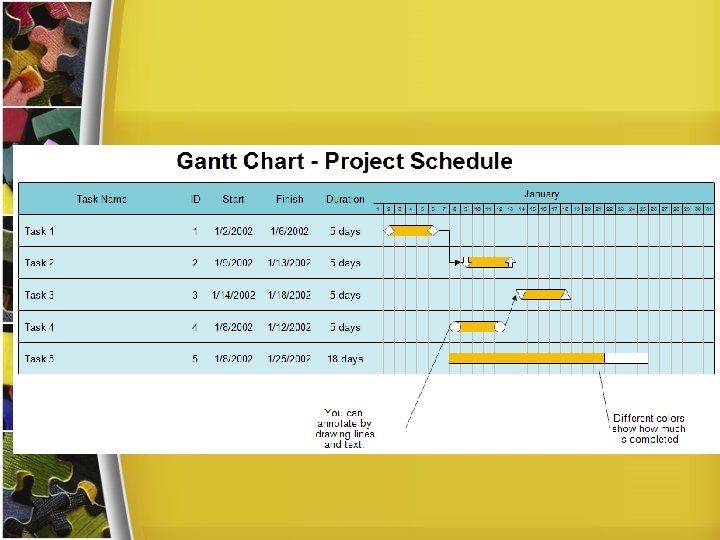
GANNT chart • Useful tool for analysing and planning complex projects. – – Help to plan tasks Basis for scheduling Plan allocation of resources Critical path – need to be done by certain date – Terminal and summary elements: • Shows timing between certain tasks. • It represents phases, tasks and activities on a timeline
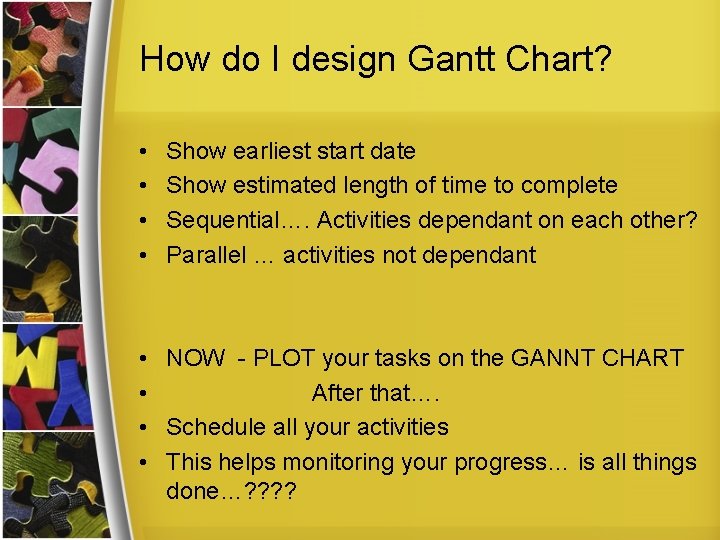
How do I design Gantt Chart? • • Show earliest start date Show estimated length of time to complete Sequential…. Activities dependant on each other? Parallel … activities not dependant • NOW - PLOT your tasks on the GANNT CHART • After that…. • Schedule all your activities • This helps monitoring your progress… is all things done…? ?
Implementation NOW THE EVENT TAKES PLACE !!!!!!
Consists of: • Set-up of event • The actual event • Breakdown
Implementation phases • Manage contracts (all contractual obligations) – Who must do what? – When? Deadlines – Where and in what quantities and quality? • Monitor all phases of the event – Time, cost, quality triangle • Timelines, budgets and client requirements – – Changes, risks… Suppliers…. Clients and delegates Communication
… implementation phases • Identifying problems… – What happens when there is problems…. p. 98 • Problem solving? – – – Combine ideas to build a solution Use different perspectives Brainstorm Pull problems apart and put back together Storyboard….
…implementation phases • Adjust targets: – If you cant achieve something…. Make another plan. • Manage subcontractors: – Manage them… policies in place?
Closure / evalution • Event not done until…. – Hand-over of documentation to client – Show you delivered on the goals of the event – Have meeting with sponsors …. Give them feedback
Ice Question 3 • 3. 1 What does a GANNT chart help with? • 3. 2 What is a sequential activity?
Are you still with me ? ? ?