
PROJECT MANAGEMENT Gobinda Bhandari 2 What is Project
PROJECT MANAGEMENT Gobinda Bhandari
2 What is Project and What is not?
What is Project? 3 A project can be considered to be any series of activities and tasks that: § Have specific objective to be completed within certain specifications. § Have defined start and end dates § Have funding limits § Consume resources human and nonhuman
What is Project? Cont… 4 Project may range from small infrastructure project to more complex multipart project such as integrated hydroelectric project with irrigation, power and tourism as its components. Some examples are: � Melemchi Drinking Water Project, � Upper Tamakoshi Hydro Power Project, � Amazon's "Octocoper" Mini- drones concept project, � Google’s Driverless Car Project
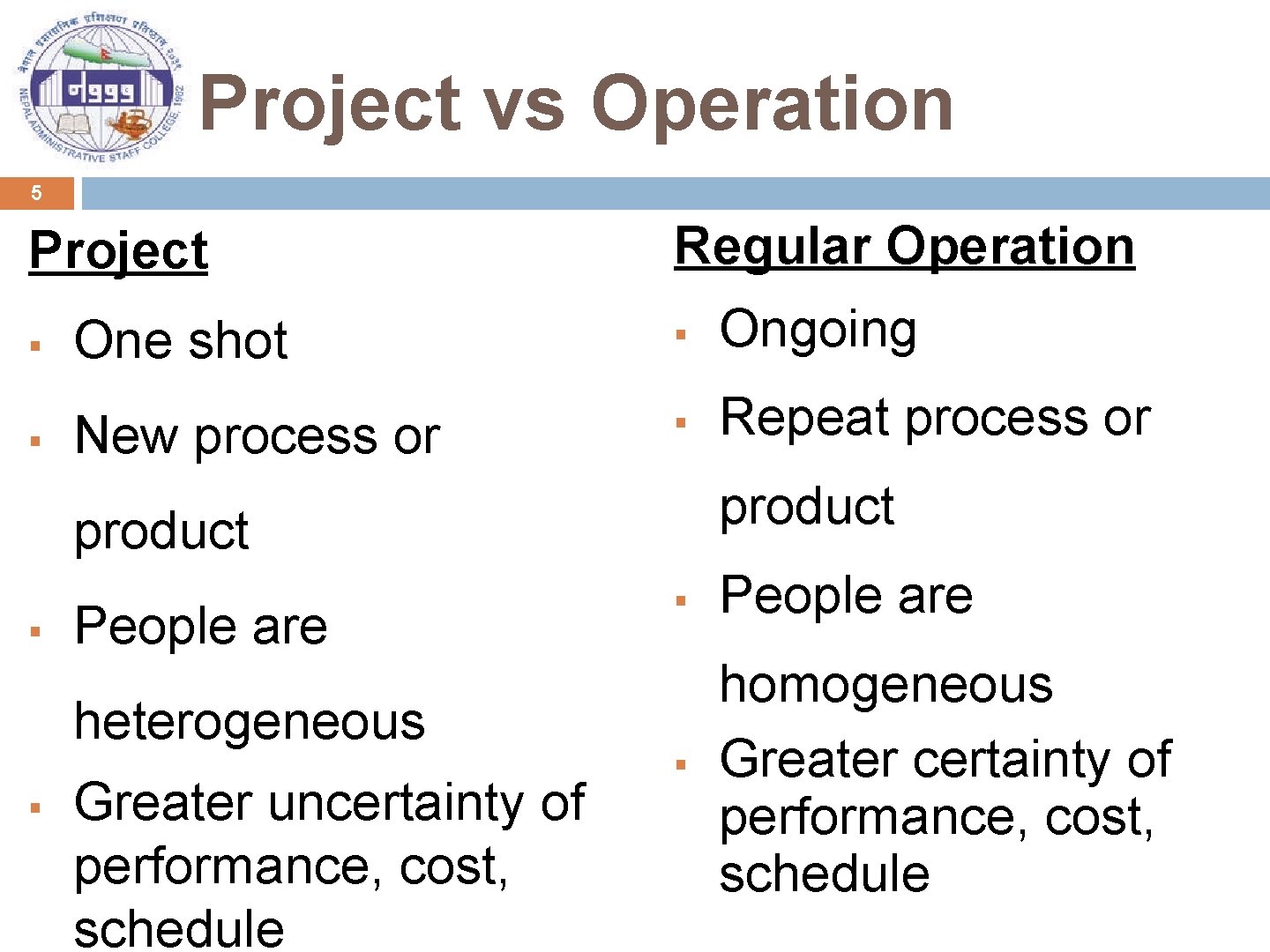
Project vs Operation 5 Project Regular Operation § One shot § Ongoing § New process or § Repeat process or product § People are heterogeneous § Greater uncertainty of performance, cost, schedule § People are § homogeneous Greater certainty of performance, cost, schedule
Roles of Project 6 Project is one of the principle means by which we change our world. Organizations compete by planning and execution of new projects Projects are the means to execute strategies of organization Projects are the basic building blocks of development. Without successful project identification, preparation and implementation, development plans are no more than wishes (Dennis A. Rondineli (1976), Project Management
Project as a Dream of the Organization 7 Dream of www. amazon. com to modernize delivery of goods to customers using drones Dream of Google to develop Self Driving Car Dream of Nepal to Make Modern Second International Airport in Bara District Dream of Kathmandu Metropolitan City to make Mono Rail System
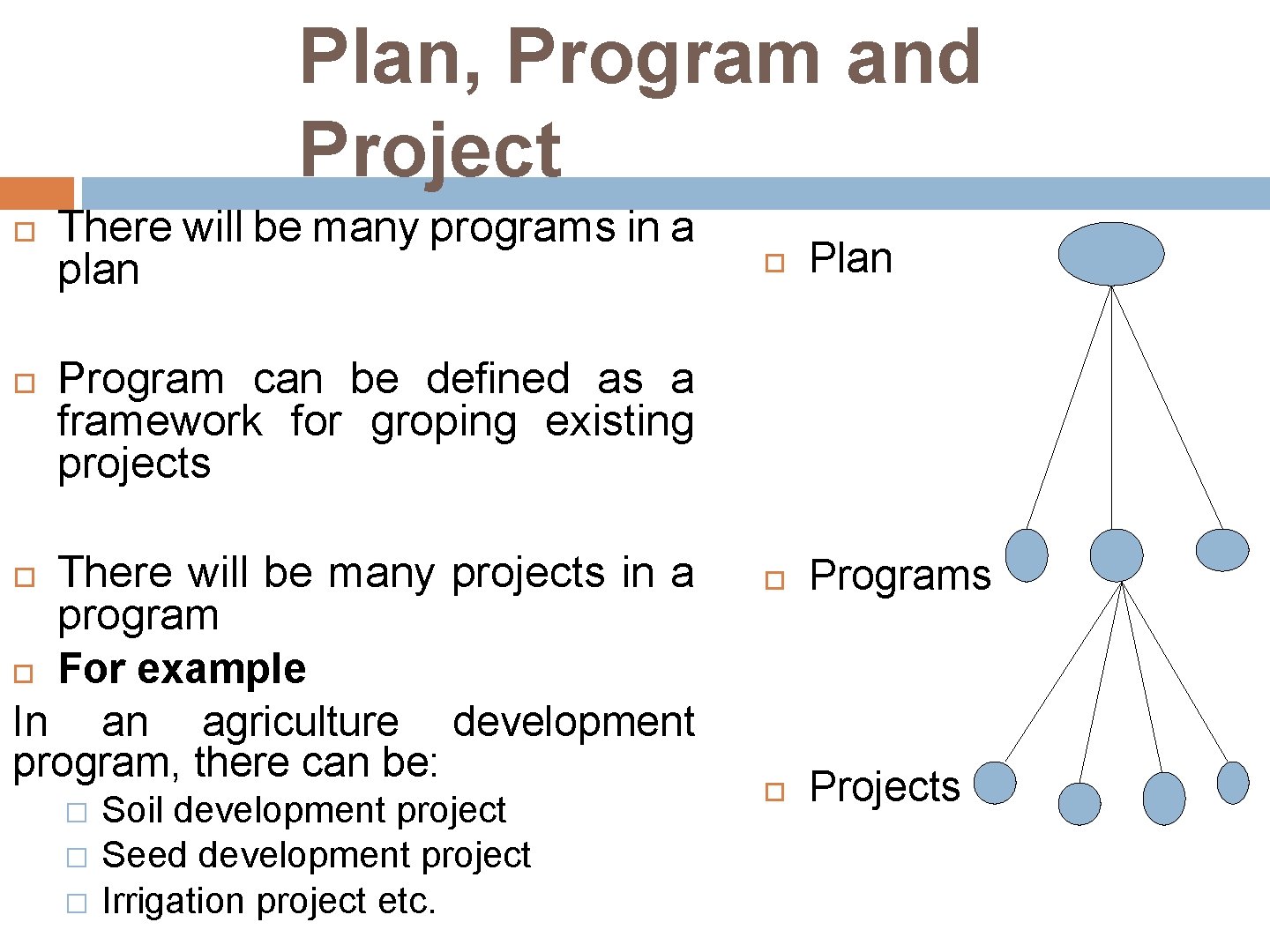
Plan, Program and Project There will be many programs in a plan Programs Projects Program can be defined as a framework for groping existing projects There will be many projects in a program For example In an agriculture development program, there can be: � � � Soil development project Seed development project Irrigation project etc.
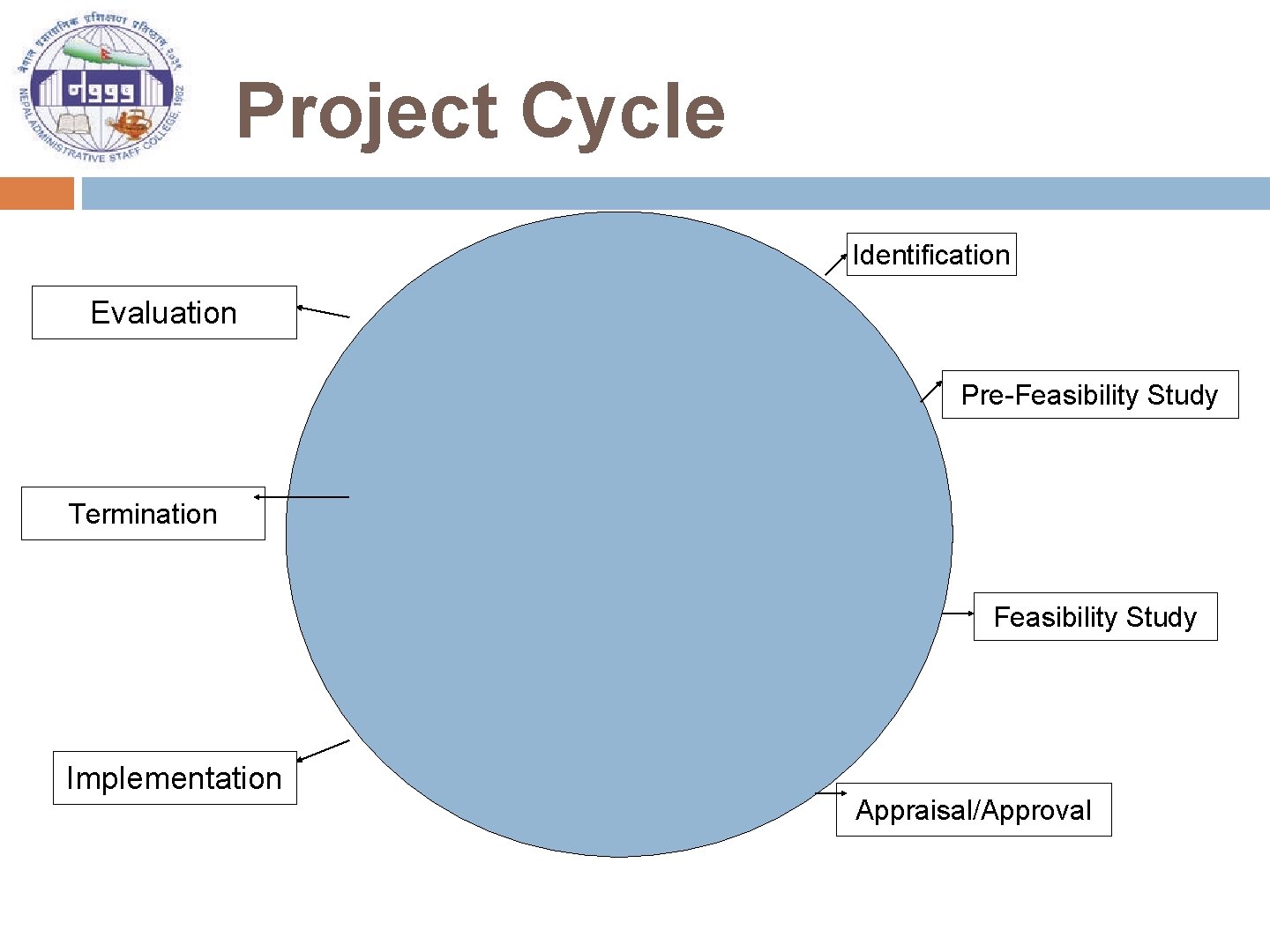
Project Cycle Identification Evaluation Pre-Feasibility Study Termination Feasibility Study Implementation Appraisal/Approval
Project Management Project management is the planning, organizing, executing and controlling works within a time frame and budget for achieving objectives. PMBOK: Project management is the application of knowledge, skills, tools and techniques to project activities to meet the project requirements.
Project Management … 11 PMBOK identified ten knowledge areas: � Project Integration Management � Project Scope Management � Project Time Management � Project Cost Management � Project Quality Management � Project Human Resource Management � Project Communication Management � Project Risk Management � Project Procurement Management � Project Stakeholder Management
Project Management Involves Defining project scope. Dividing project into tasks and activities Deciding the types of project organizations suitable for project Establishing project offices and acquiring people Managing Team Managing Stakeholders Managing Risks Managing Outsourcing Executing plan and monitoring performance and correcting deviation Reporting
Organizing Project Functional Organization Pure project organization Matrix organization
Project Manager (PM) The project manager is the person responsible for achieving project objectives. Involves in Planning , organizing , coordinating and controlling project performance. Refines and updates plans and schedules Develops mechanism to facilitate communication between the project manager and top management, functional areas and the
Functions of Project Manager To prepare budget and schedule To help select people to serve on the project team To motivate team members To procure works, goods and services To take care of routine details necessary to get the project moving. To facilitate communication between the PM and top management and other stakeholders To manage conflicts between various stakeholders To monitor and control To prepare report and submit to Govt and donors on time (monthly, quarterly, annual reports, and PCR)
Quality of Project Manager A good Project Manager needs to be: § Firm & decisive, fair, dedicated, and a motivator § Good & regular communication/interaction with staff. § Demonstrating strong leadership and management. § Recognize good staff performances. § Provide work place tools and conducive working conditions. § Ensure regular project plan monitoring and actions § Be in full control for getting work done on time
Quality of Project Manager (PM) A good PM can make a badly designed project successful, while a poor PM can make a good project fail
Consultant in the project organization q A knowledgeable and experienced consultant can be a good component of project organization. The reasons for appointing a consultant are: § To gain from the consultant's deep knowledge and rich experience § An independent consultant will view all matters in an unbiased manner. § To give full attention to the particular project as the functional experts will have many other responsibilities.
Managing Team A team is a small number of people with complementary skills who are committed to a common purpose, performance goals, and approach for which they hold themselves mutually accountable (Harvard Business School) Project teams are multi-disciplinary – internal or external Project team is responsible for completing the project (doing the work) according to the project
As Per Michael Jordan The most talented basketball player of all time and six-time world champion Michael Jorden: “There are plenty of teams in every sport that have great players and never win titles. Most of the time, those players aren’t willing to sacrifice for the greater good of the team. The funny thing is, in the end, their unwillingness to sacrifice only makes individual goals more difficult to achieve. Talent wins games, but teamwork and intelligence win championships. ” (source: John C Maxwell (2010). Teamwork: What Every Leaders Needs to Know, JAICO Publishing House, Delhi)
Making the Project Team When we have a dream, we need a team to accomplish it. Designing a dream team Identify necessary skills of team members Talk to potential team members matching skill Add key team members Develop team members Remove ineffective team members Motivate Team Members for effective performance
Managing Stakeholders are defined as an individuals or groups or organizations who are influencing / affected / involved /interested in the project and can potentially impact, either positively or negatively. Identifying stakeholders, their interests, power and influence Develop strategies to manage for positive results
Managing Procurement is the act of acquiring goods, works and services by projects or organizations at the best possible cost in the right quantity and quality at required time. Identify potential sellers Selecting a seller and awarding a contract Monitoring contract performance closing/completing project procurements and
Managing Schedule § § § Prepare time schedule Give extra care to critical activities in order to complete them in scheduled time. Making priorities in resource allocation to critical activities in case of resource constraints § Regular monitoring and reporting § Ensuring critical activities get done on time
Schedule Awareness 25 The simple way to create schedule awareness is by displaying the progress achievements and target dates at visible place to remind project team about project activity deadlines and project completion time
Managing Resource To complete project in time with minimum resource, careful planning and managing of resource is necessary to deliver project results Updating resource plan as per updated schedule and arrangement of resource as per requirements Acquiring resource as per required
Prioritizing Time and Resource for Critical Activities Project management involves identifying critical and non critical activities Giving high priority in resources for critical activities Taking extra for critical activities Assuring timely completion of critical activities If any delay occur, taking immediate actions and finishing execution as per plan.
Managing Quality Managing quality means to assure project deliverable as per specification. If projects are not completed within desired/or planned quality, we can not assure that project will generate heavier benefits than costs. Plan, assure and control quality
Managing Quality Cont… Are Inputs as per requirement? Are labour skilled as needed? Is process as per standard? Does project output as per specification?
Managing Budget § § Assuring timely budget available Making effective and efficient use of budget
Managing Risks Project risk is an uncertain event or condition, that, if it occurs, has a positive or a negative effect on a project objective (cost, time, quality). In risk management, probability and impact of the risks are considered.
Managing Risks…. 32 Identifying different risks during execution Analyzing risks and making strategy to reduce risks Executing risks reduction plans Tracking identified risks, monitoring residual risks, identifying new risks, executing risk reduction plans and evaluating their effectiveness
Project Monitoring and Control Project monitoring is observing or checking on project activities to identify the current status of the project, identifying deviation of the project cost, schedule and quality with the plan and identifying potential problems. A project monitoring system involves determining what data to collect; how, when, and who will collect the data, analysis of the data; and reporting current progress
Controlling and Moving Ahead Once we detect significant deviations from the project plan, it becomes necessary to engage in some form of corrective action to minimize or remove the deviations. Updating plan, speeding up activities, maintaining quality and moving ahead to complete project deliverables until project results are achieved
Successful Project that meets the objectives of time, cost and performance objectives is able to deliver intended results
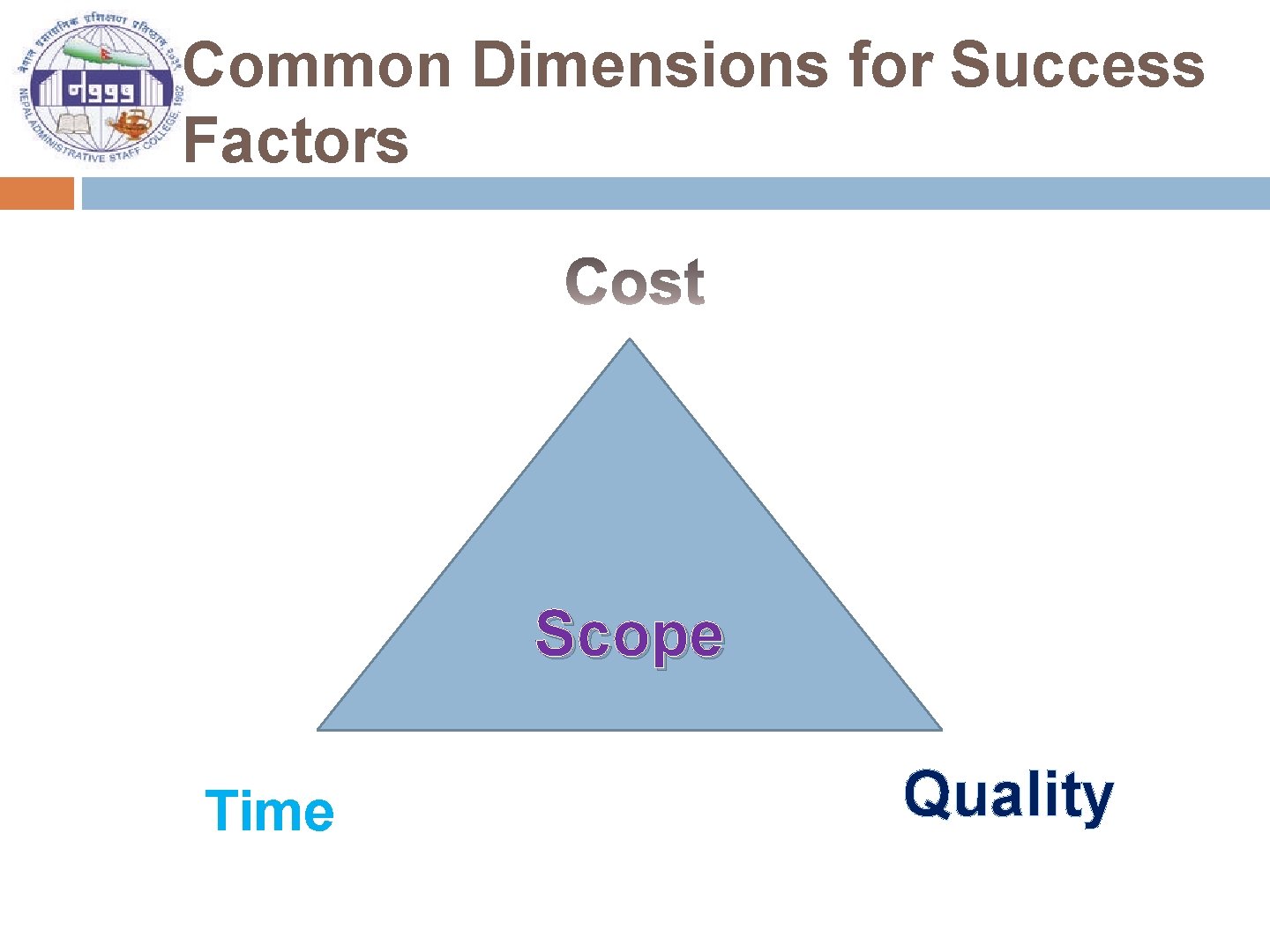
Common Dimensions for Success Factors Scope Time Quality
Cost of not Completing in time, cost, quality
Principles/Policies/Guideline for Project management q q Many principles, policy and guidelines describe the way project should be developed and implemented. In the project Preparation Phase, these documents describe what should be studied analyzed. q Environment Protection Act 1996, q Environment Protection Regulation 1997, q National Environmental Impact Assessment Guidelines, 1993.
During Project Implementation Procurement Act/Regulation of Go. N, Nepal World Bank Procurement Guidelines ADB Procurement and Consultant Selection Guidelines ADB Safeguards Policy Statement, 2009
Project Administration Manual (PAM) The PAM describes how the borrower (executing and implementing agencies) will implement the project and deliver the results on time, with quality, within budget, and in accordance with government and Asian Development Bank (ADB) policies and procedures.
Ethical Guides for Public Sectors officials while working in Procurement Be Independent Act only in the interest of the organization Follow the law Work hard for efficiency Take Nothing, ever Do not socialize with venders Do not play favorites (promoting competition, fairness, equal opportunity) Maintain Confidentiality

- Slides: 42