
Project Management Excerpts from Project Management 2 nd
- Slides: 39
Project Management Excerpts from Project Management, 2 nd Edition Adrienne Watt
PROJECT MANAGEMENT Chapter 2 Project Management Overview Excerpts from Project Management, 2 nd Edition Adrienne Watt
Project Attributes • A project has distinctive attributes that distinguish it from ongoing work or business operations. • Projects are temporary in nature. They are not an everyday business process and have definitive start dates and end dates. – This characteristic is important because a large part of the project effort is dedicated to ensuring that the project is completed at the appointed time. – To do this, schedules are created showing when tasks should begin and end. • Projects can last minutes, hours, days, weeks, months, or years. Chapter 2 - Project Management Overview | PROJECT MANAGEMENT
Project Attributes • Projects exist to bring about a product or service that hasn’t existed before. – In this sense, a project is unique. Unique means that this is new; this has never been done before. Maybe it’s been done in a very similar fashion before but never exactly in this way. – For example, Ford Motor Company is in the business of designing and assembling cars. Each model that Ford designs and produces can be considered a project. – The models differ from each other in their features and are marketed to people with various needs. An SUV serves a different purpose and clientele than a luxury car. – The design and marketing of these two models are unique projects. However, the actual assembly of the cars is considered an operation (i. e. , a repetitive process that is followed for most makes and models). Chapter 2 - Project Management Overview | PROJECT MANAGEMENT
Project vs Operations • In contrast with projects, operations are ongoing and repetitive. – They involve work that is continuous without an ending date and with the same processes repeated to produce the same results. • The purpose of operations is to keep the organization functioning while the purpose of a project is to meet its goals and conclude. • Therefore, operations are ongoing while projects are unique and temporary. Chapter 2 - Project Management Overview | PROJECT MANAGEMENT
Project Attributes • A project is completed when its goals and objectives are accomplished. – It is these goals that drive the project, and all the planning and implementation efforts undertaken to achieve them. • Sometimes projects end when it is determined that the goals and objectives cannot be accomplished or when the product or service of the project is no longer needed and the project is cancelled. Chapter 2 - Project Management Overview | PROJECT MANAGEMENT
Definition of a Project • There are many written definitions of a project. All of them contain the key elements described above. • For those looking for a formal definition of a project, the Project Management Institute (PMI) defines a project as a temporary endeavor undertaken to create a unique product, service, or result. • The temporary nature of projects indicates a definite beginning and end. The end is reached when the project’s objectives have been achieved or when the project is terminated because its objectives will not or cannot be met, or when the need for the project no longer exists. Chapter 2 - Project Management Overview | PROJECT MANAGEMENT
Project Characteristics • When considering whether or not you have a project on your hands, there are some things to keep in mind. – First, is it a project or an ongoing operation? – Second, if it is a project, who are the stakeholders? – And third, what characteristics distinguish this endeavor as a project? • Projects have several characteristics: 1. Projects are unique. 2. Projects are temporary in nature and have a definite beginning and ending date. 3. Projects are completed when the project goals are achieved or it’s determined the project is no longer viable. • A successful project is one that meets or exceeds the expectations of the stakeholders. Chapter 2 - Project Management Overview | PROJECT MANAGEMENT
The Process of Project Management • Managing a project includes identifying your project’s requirements and writing down what everyone needs from the project. • What are the objectives for your project? – When everyone understands the goal, it’s much easier to keep them all on the right path. – Make sure you set goals that everyone agrees on to avoid team conflicts later on. – Understanding and addressing the needs of everyone affected by the project means the end result of your project is far more likely to satisfy your stakeholders. • Last but not least, as project manager, you will also be balancing the many competing project constraints. Chapter 2 - Project Management Overview | PROJECT MANAGEMENT
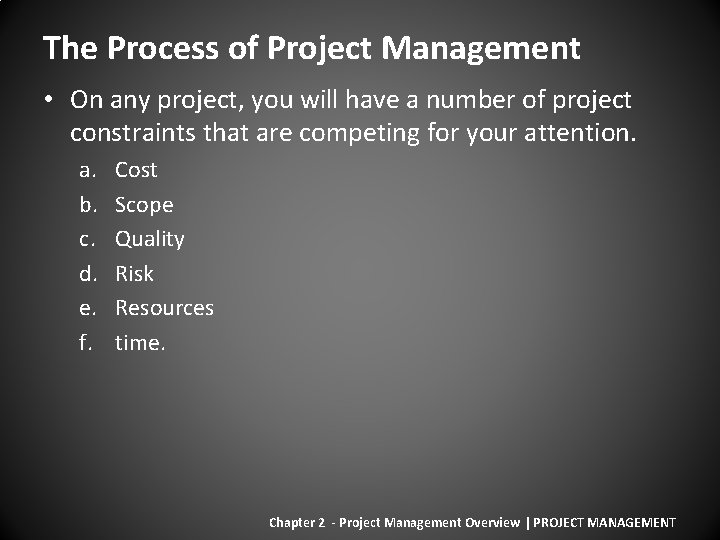
The Process of Project Management • On any project, you will have a number of project constraints that are competing for your attention. a. b. c. d. e. f. Cost Scope Quality Risk Resources time. Chapter 2 - Project Management Overview | PROJECT MANAGEMENT
The Process of Project Management Project Constraint | Cost • Cost is the budget approved for the project including all necessary expenses needed to deliver the project. – Within organizations, project managers have to balance between not running out of money and not underspending because many projects receive funds or grants that have contract clauses with a “use it or lose it” approach to project funds. – Poorly executed budget plans can result in a last minute rush to spend the allocated funds. – For virtually all projects, cost is ultimately a limiting constraint; few projects can go over budget without eventually requiring a corrective action. Chapter 2 - Project Management Overview | PROJECT MANAGEMENT
The Process of Project Management Project Constraint | Scope • Scope is what the project is trying to achieve. – It entails all the work involved in delivering the project outcomes and the processes used to produce them. – It is the reason and the purpose of the project. Chapter 2 - Project Management Overview | PROJECT MANAGEMENT
The Process of Project Management Project Constraint | Quality • Quality is a combination of the standards and criteria to which the project’s products must be delivered for them to perform effectively. – The product must perform to provide the functionality expected, solve the identified problem, and deliver the benefit and value expected. – It must also meet other performance requirements, or service levels, such as availability, reliability, and maintainability, and have acceptable finish and polish. – Quality on a project is controlled through quality assurance (QA), which is the process of evaluating overall project performance on a regular basis to provide confidence that the project will satisfy the relevant quality standards. Chapter 2 - Project Management Overview | PROJECT MANAGEMENT
The Process of Project Management Project Constraint | Risk • Risk is defined by potential external events that will have a negative impact on your project if they occur. – Risk refers to the combination of the probability the event will occur and the impact on the project if the event occurs. – If the combination of the probability of the occurrence and the impact on the project is too high, you should identify the potential event as a risk and put a proactive plan in place to manage the risk. Chapter 2 - Project Management Overview | PROJECT MANAGEMENT
The Process of Project Management Project Constraint | Resources • Resources are required to carry out the project tasks. – They can be: a. b. c. d. e. people, equipment, facilities, funding, or anything else capable of definition (usually other than labor) required for the completion of a project activity. Chapter 2 - Project Management Overview | PROJECT MANAGEMENT
The Process of Project Management Project Constraint | Time • Time is defined as the time to complete the project. – Time is often the most frequent project oversight in developing projects. – This is reflected in missed deadlines and incomplete deliverables. – Proper control of the schedule requires the careful identification of tasks to be performed and accurate estimations of their durations, the sequence in which they are going to be done, and how people and other resources are to be allocated. – Any schedule should take into account vacations and holidays. Chapter 2 - Project Management Overview | PROJECT MANAGEMENT
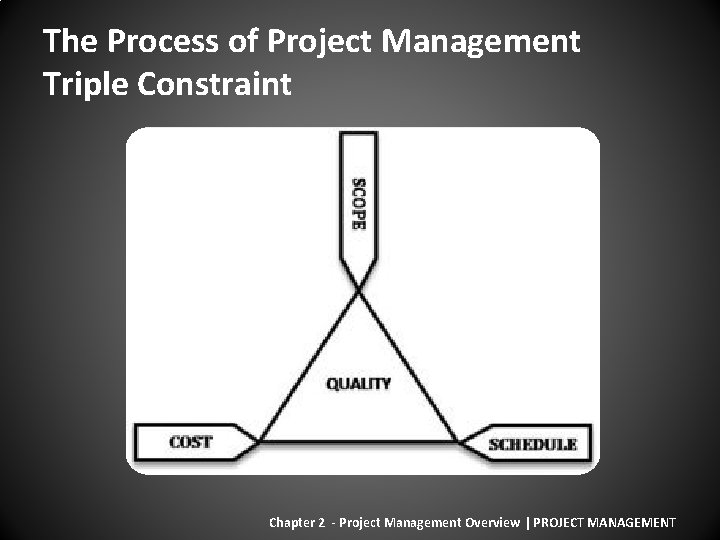
The Process of Project Management Triple Constraint • You may have heard of the term “triple constraint, ” which traditionally consisted of only time, cost, and scope. – These are the primary competing project constraints that you have to be most aware of. – The triple constraint is illustrated in the form of a triangle to visualize the project work and see the relationship between the scope/quality, schedule/time, and cost/resource (see figure on next slide). – In this triangle, each side represents one of the constraints (or related constraints) wherein any changes to any one side cause a change in the other sides. – The best projects have a perfectly balanced triangle. – Maintaining this balance is difficult because projects are prone to change. For example, if scope increases, cost and time may increase disproportionately. – Alternatively, if the amount of money you have for your project decreases, you may be able to do as much, but your time may increase. Chapter 2 - Project Management Overview | PROJECT MANAGEMENT
The Process of Project Management Triple Constraint Chapter 2 - Project Management Overview | PROJECT MANAGEMENT
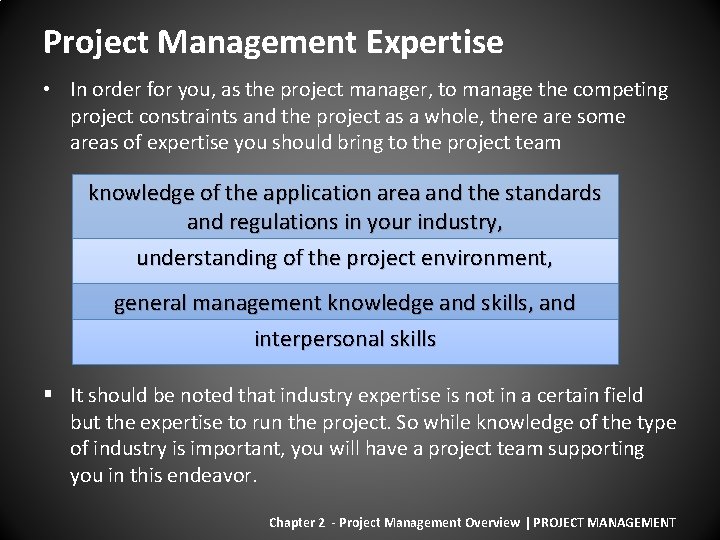
Project Management Expertise • In order for you, as the project manager, to manage the competing project constraints and the project as a whole, there are some areas of expertise you should bring to the project team knowledge of the application area and the standards and regulations in your industry, understanding of the project environment, general management knowledge and skills, and interpersonal skills § It should be noted that industry expertise is not in a certain field but the expertise to run the project. So while knowledge of the type of industry is important, you will have a project team supporting you in this endeavor. Chapter 2 - Project Management Overview | PROJECT MANAGEMENT
Project Management Expertise Application knowledge, standards and regulations • By standards, we mean guidelines or preferred approaches that are not necessarily mandatory. • In contrast, when referring to regulations we mean mandatory rules that must be followed, such as government imposed requirements through laws. • It should go without saying that as a professional, you’re required to follow all applicable laws and rules that apply to your industry, organization, or project. • Every industry has standards and regulations. Knowing which ones affect your project before you begin work will not only help the project to unfold smoothly, but will also allow for effective risk analysis. Chapter 2 - Project Management Overview | PROJECT MANAGEMENT
Project Management Expertise Application knowledge, standards and regulations • Some projects require specific skills in certain application areas. – Application areas are made up of categories of projects that have common elements. – They can be defined by industry group (pharmaceutical, financial, etc. ), department (accounting, marketing, legal, etc. ), technology (software development, engineering, etc), or management specialties (procurement, research and development, etc. ). – These application areas are usually concerned with disciplines, regulations, and the specific needs of the project, the customer, or the industry. – You need to stay up to date regarding your industry so that you can apply your knowledge effectively. Today’s fast paced advances can leave you behind fairly quickly if you don’t stay abreast of current trends Chapter 2 - Project Management Overview | PROJECT MANAGEMENT
Project Management Expertise Application knowledge, standards and regulations • Having some level of experience in the application area you’re working in will give you an advantage when it comes to project management. – While you can call in experts who have the application area knowledge, it doesn’t hurt for you to understand the specific aspects of the application areas of your project. Chapter 2 - Project Management Overview | PROJECT MANAGEMENT
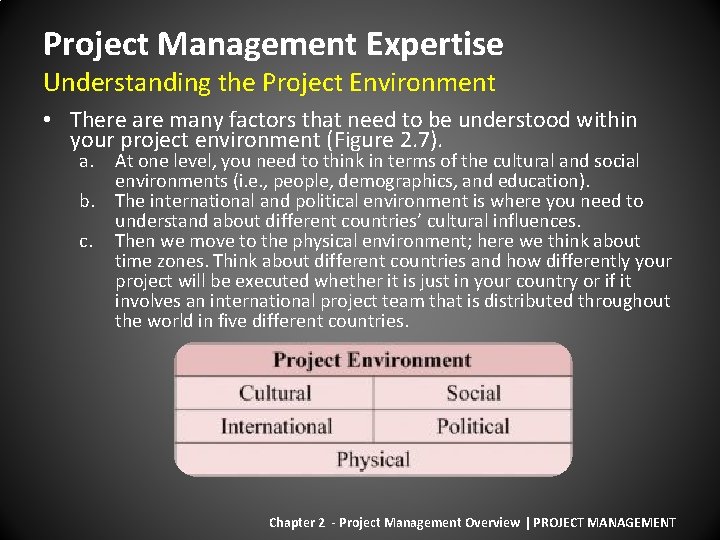
Project Management Expertise Understanding the Project Environment • There are many factors that need to be understood within your project environment (Figure 2. 7). a. b. c. At one level, you need to think in terms of the cultural and social environments (i. e. , people, demographics, and education). The international and political environment is where you need to understand about different countries’ cultural influences. Then we move to the physical environment; here we think about time zones. Think about different countries and how differently your project will be executed whether it is just in your country or if it involves an international project team that is distributed throughout the world in five different countries. Chapter 2 - Project Management Overview | PROJECT MANAGEMENT
Project Management Expertise Understanding the Project Environment • Of all the factors, the physical ones are the easiest to understand, and it is the cultural and international factors that are often misunderstood or ignored. • How we deal with clients, customers, or project members from other countries can be critical to the success of the project. • How a product is received can be very dependent on the international cultural differences. – For example, in the 1990 s, when many large American and European telecommunications companies were cultivating new markets in Asia, their customer’s cultural differences often produced unexpected situations. – Western companies planned their telephone systems to work the same way in Asia as they did in Europe and the United States. But the protocol of conversation was different. Call waiting, a popular feature in the West, is considered impolite in some parts of Asia. – This cultural blunder could have been avoided had the team captured the project environment requirements and involved the customer. Chapter 2 - Project Management Overview | PROJECT MANAGEMENT
Project Management Expertise Understanding the Project Environment • The diversity of practices and cultures and its impact on products in general and on software in particular goes well beyond the date issue. • You may be managing a project to create a new website for a company that sells products worldwide. • There are language and presentation style issues to take into consideration; converting the site into different languages isn’t enough. • It is obvious that you need to ensure the translation is correct; however, the presentation layer will have its own set of requirements for different cultures. • The left side of a website may be the first focus of attention for a Canadian; the right side would be the initial focus for anyone from the Middle East, as both Arabic and Hebrew are written from right to left. • Colors also have different meanings in different cultures. • White, which is a sign of purity in North America (e. g. , a bride’s wedding dress), and thus would be a favored background color in North America, signifies death in Japan (e. g. , a burial shroud). Table 2. 1 summarizes different meanings of common colors. Chapter 2 - Project Management Overview | PROJECT MANAGEMENT
Project Management Expertise Understanding the Project Environment • Project managers in multicultural projects must appreciate the culture dimensions and try to learn relevant customs, courtesies, and business protocols before taking responsibility for managing an international project. • A project manager must take into consideration these various cultural influences and how they may affect the project’s completion, schedule, scope, and cost. Chapter 2 - Project Management Overview | PROJECT MANAGEMENT
Project Management Expertise Management Knowledge and Skills • As the project manager, you have to rely on your project management knowledge and your general manage ment skills. – Here, we are thinking of items like your ability to plan the project, execute it properly, and of course control it and bring it to a successful conclusion, along with your ability to guide the project team to achieve project objectives and balance project constraints. Chapter 2 - Project Management Overview | PROJECT MANAGEMENT
Project Management Expertise Management Knowledge and Skills • There is more to project management than just getting the work done. – Inherent in the process of project management are the general management skills that allow the project manager to complete the project with some level of efficiency and control. – In some respects, managing a project is similar to running a business: there are risk and rewards, finance and accounting activities, human resource issues, time management, stress management, and a purpose for the project to exist. • General management skills are needed in every project. Chapter 2 - Project Management Overview | PROJECT MANAGEMENT
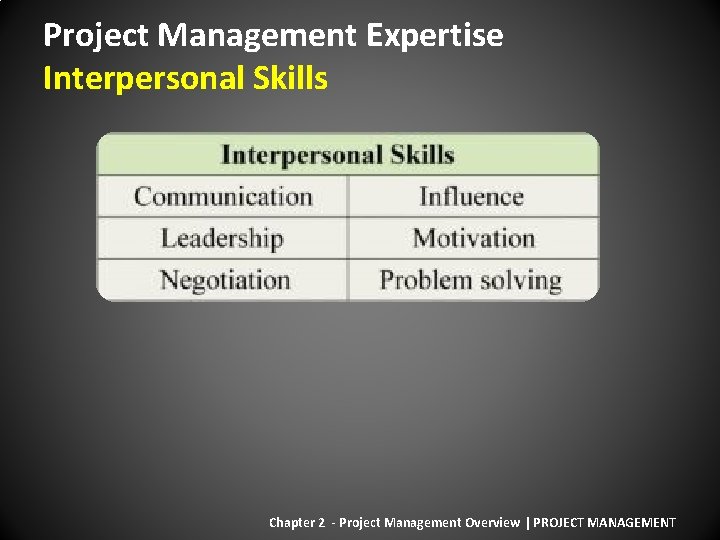
Project Management Expertise Interpersonal Skills Chapter 2 - Project Management Overview | PROJECT MANAGEMENT
Project Management Expertise Interpersonal Skills | Communication • Project managers spend 90% of their time communicating. Therefore they must be good communicators, promoting clear, unambiguous exchange of information. – As a project manager, it is your job to keep a number of people well informed. – It is essential that your project staff know what is expected of them: what they have to do, when they have to do it, and what budget and time constraints and quality specifications they are working toward. – If project staff members do not know what their tasks are, or how to accomplish them, then the entire project will grind to a halt. – If you do not know what the project staff is (or often is not) doing, then you will be unable to monitor project progress. – Finally, if you are uncertain of what the customer expects of you, then the project will not even get off the ground. • Project communication can thus be summed up as knowing “who needs what information and when” and making sure they have it. Chapter 2 - Project Management Overview | PROJECT MANAGEMENT
Project Management Expertise Interpersonal Skills | Communication • Project managers spend 90% of their time communicating. Therefore they must be good communicators, promoting clear, unambiguous exchange of information. – As a project manager, it is your job to keep a number of people well informed. – It is essential that your project staff know what is expected of them: what they have to do, when they have to do it, and what budget and time constraints and quality specifications they are working toward. – If project staff members do not know what their tasks are, or how to accomplish them, then the entire project will grind to a halt. – If you do not know what the project staff is (or often is not) doing, then you will be unable to monitor project progress. – Finally, if you are uncertain of what the customer expects of you, then the project will not even get off the ground. • Project communication can thus be summed up as knowing “who needs what information and when” and making sure they have it. Chapter 2 - Project Management Overview | PROJECT MANAGEMENT
Project Management Expertise Interpersonal Skills | Influence • Project management is about getting things done. – Every organization is different in its policies, modes of operations, and underlying culture. – There are political alliances, differing motivations, conflicting interests, and power struggles. – A project manager must understand all of the unspoken influences at work within an organization. Chapter 2 - Project Management Overview | PROJECT MANAGEMENT
Project Management Expertise Interpersonal Skills | Leadership • Leadership is the ability to motivate and inspire individuals to work toward expected results. – Leaders inspire vision and rally people around common goals. – A good project manager can motivate and inspire the project team to see the vision and value of the project. – The project manager as a leader can inspire the project team to find a solution to overcome perceived obstacles to get the work done. Chapter 2 - Project Management Overview | PROJECT MANAGEMENT
Project Management Expertise Interpersonal Skills | Motivation • Motivation helps people work more efficiently and produce better results. – Motivation is a constant process that the project manager must guide to help the team move toward completion with passion and a profound reason to complete the work. – Motivating the team is accomplished by using a variety of team building techniques and exercises. – Team building is simply getting a diverse group of people to work together in the most efficient and effective manner possible. – This may involve management events as well as individual actions designed to improve team performance. Chapter 2 - Project Management Overview | PROJECT MANAGEMENT
Project Management Expertise Interpersonal Skills | Motivation • Recognition and rewards are an important part of team motivations. – They are formal ways of recognizing and promoting desirable behavior and are most effective when carried out by the management team and the project manager. – Consider individual preferences and cultural differences when using rewards and recognition. – Some people don’t like to be recognized in front of a group; others thrive on it. Chapter 2 - Project Management Overview | PROJECT MANAGEMENT
Project Management Expertise Interpersonal Skills | Negotiation • Project managers must negotiate for the good of the project. – In any project, the project manager, the project sponsor, and the project team will have to negotiate with stakeholders, vendors, and customers to reach a level of agreement acceptable to all parties involved in the negotiation process. Chapter 2 - Project Management Overview | PROJECT MANAGEMENT
Project Management Expertise Interpersonal Skills | Problem Solving • Problem solving is the ability to understand the heart of a problem, look for a viable solution, and then make a decision to implement that solution. – The starting point for problem solving is problem definition. Problem definition is the ability to understand the cause and effect of the problem; this centers on root cause analysis. – If a project manager treats only the symptoms of a problem rather than its cause, the symptoms will perpetuate and continue through the project life. – Even worse, treating a symptom may result in a greater problem. • For example, increasing the ampere rating of a fuse in your car because the old one keeps blowing does not solve the problem of an electrical short that could result in a fire. – Root cause analysis looks beyond the immediate symptoms to the cause of the symptoms, which then affords opportunities for solutions. – Once the root of a problem has been identified, a decision must be made to effectively address the problem. Chapter 2 - Project Management Overview | PROJECT MANAGEMENT
Project Management Expertise Interpersonal Skills | Problem Solving • Solutions can be presented from vendors, the project team, the project manager, or various stakeholders. – A viable solution focuses on more than just the problem; it looks at the cause and effect of the solution itself. – In addition, a timely decision is needed or the window of opportunity may pass and then a new decision will be needed to address the problem. As in most cases, the worst thing you can do is nothing. Chapter 2 - Project Management Overview | PROJECT MANAGEMENT
End of Chapter 2 | Thank you!!! Chapter 2 - Project Management Overview | PROJECT MANAGEMENT