
PROJECT MANAGEMENT CHAPTER 18 DAVID A COLLIER AND
- Slides: 53
PROJECT MANAGEMENT CHAPTER 18 DAVID A. COLLIER AND JAMES R. EVANS OM 3 Chapter 18 Project Management © 2012 Cengage Learning. All Rights Reserved. May not be scanned, copied or duplicated, or posted to a publicly accessible website, in whole or in part. 1
CHAPTER 18 PROJECT MANAGEMENT LO 1 Explain the key issues associated with project management. LO 2 Describe how to apply the Critical Path Method (CPM). LO 3 Explain how to make time/cost trade-off decisions in projects. LO 4 Describe how to calculate probabilities for project completion time using PERT. OM 3 Chapter 18 Project Management © 2012 Cengage Learning. All Rights Reserved. May not be scanned, copied or duplicated, or posted to a publicly accessible website, in whole or in part. 2
t CHAPTER 18 PROJECT MANAGEMENT he Olympic Games were established over 2, 500 years ago. Athens, Greece, was chosen in 1997 to host the 2004 Games but badly underestimated the cost and overestimated the city’s ability to meet construction and preparation schedules. Organizers were plagued with construction delays and budget overruns, forcing them to complete 7 years’ work in just 4. Delays in the main stadium’s glass-and-steel room pushed back delivery of the entire complex to the end of July, immediately preceding the August 13, 2004, opening ceremonies. The International Olympic Committee had even considered asking the Athens organizers to cancel the games. Problems also occurred with other venues. Construction delays had consequences for Greece’s own athletes, forcing them out of their own training centers. Even the famed Parthenon, which was to have been restored for the Games, was still shrouded with scaffolding when tourists began arriving. Despite all this, the venues were ready—although some at the last minute, and the Games were successfully completed. OM 3 Chapter 18 Project Management © 2012 Cengage Learning. All Rights Reserved. May not be scanned, copied or duplicated, or posted to a publicly accessible website, in whole or in part. 3
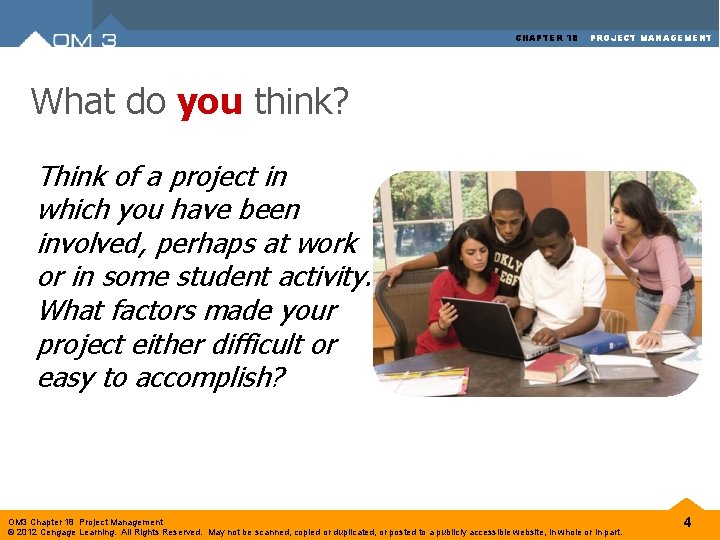
CHAPTER 18 PROJECT MANAGEMENT What do you think? Think of a project in which you have been involved, perhaps at work or in some student activity. What factors made your project either difficult or easy to accomplish? OM 3 Chapter 18 Project Management © 2012 Cengage Learning. All Rights Reserved. May not be scanned, copied or duplicated, or posted to a publicly accessible website, in whole or in part. 4
CHAPTER 18 PROJECT MANAGEMENT • A project is a temporary and often customized initiative that consists of many smaller tasks and activities that must be coordinated and completed to finish the entire initiative on time and within budget. - Examples: Market research studies, construction, movie production, software development, book publishing, wedding planning. • Project management involves all activities associated with planning, scheduling, and controlling projects. OM 3 Chapter 18 Project Management © 2012 Cengage Learning. All Rights Reserved. May not be scanned, copied or duplicated, or posted to a publicly accessible website, in whole or in part. 5
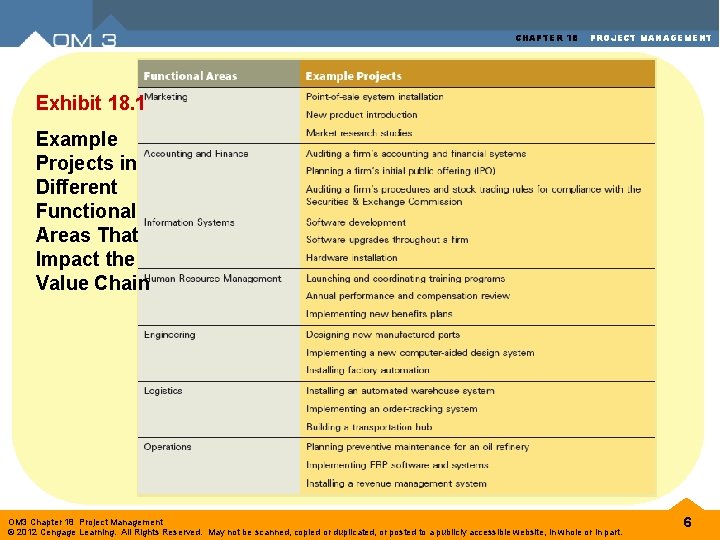
CHAPTER 18 PROJECT MANAGEMENT Exhibit 18. 1 Example Projects in Different Functional Areas That Impact the Value Chain OM 3 Chapter 18 Project Management © 2012 Cengage Learning. All Rights Reserved. May not be scanned, copied or duplicated, or posted to a publicly accessible website, in whole or in part. 6
CHAPTER 18 PROJECT MANAGEMENT The Scope of Project Management 1. Define: Clearly understand the goal of the project, responsibilities, deliverables, and what must be accomplished. 2. Plan: Determine the steps needed to execute the project, delegate tasks, and identify start and completion dates. 3. Organize: Coordinating the resources to execute the plan cost-effectively. 4. Control: Collecting and assessing status reports and managing changes to baselines. 5. Close: Compiling statistics, reassigning people, and preparing a “lessons learned” list. OM 3 Chapter 18 Project Management © 2012 Cengage Learning. All Rights Reserved. May not be scanned, copied or duplicated, or posted to a publicly accessible website, in whole or in part. 7
CHAPTER 18 PROJECT MANAGEMENT The Scope of Project Management Principles for Project Managers • Manage people individually and as a project team. • Reinforce the commitment and excitement of the project team. • Keep everyone informed. • Build agreements and consensus among the team. • Empower the project team. OM 3 Chapter 18 Project Management © 2012 Cengage Learning. All Rights Reserved. May not be scanned, copied or duplicated, or posted to a publicly accessible website, in whole or in part. 8
CHAPTER 18 PROJECT MANAGEMENT The Scope of Project Management Organizational Structure • Pure project structure with team members assigned exclusively to projects and report to a project manager. - Results in duplication of resources. • Pure functional structure charters projects exclusively within functional departments. - Ignores cross-functional issues. • Matrix structure, which “lends” resources to projects while still maintaining functional control. - Minimizes duplication of resources and facilitates communication. OM 3 Chapter 18 Project Management © 2012 Cengage Learning. All Rights Reserved. May not be scanned, copied or duplicated, or posted to a publicly accessible website, in whole or in part. 9
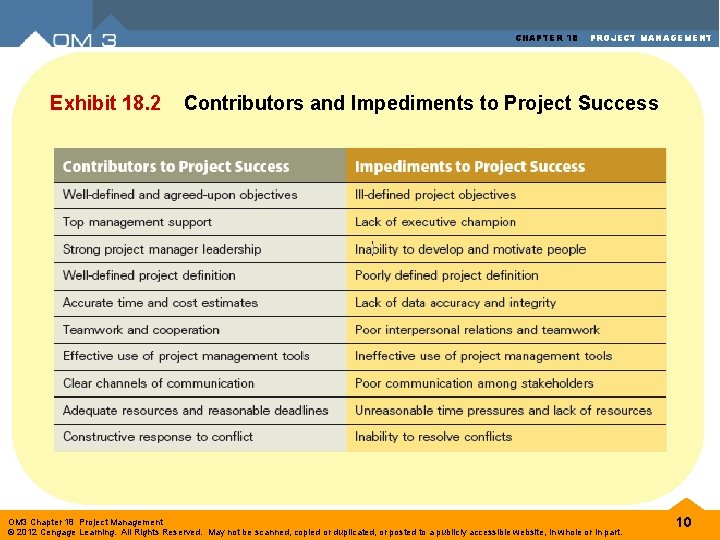
CHAPTER 18 Exhibit 18. 2 PROJECT MANAGEMENT Contributors and Impediments to Project Success OM 3 Chapter 18 Project Management © 2012 Cengage Learning. All Rights Reserved. May not be scanned, copied or duplicated, or posted to a publicly accessible website, in whole or in part. 10
CHAPTER 18 PROJECT MANAGEMENT OM 3 Chapter 18 Project Management © 2012 Cengage Learning. All Rights Reserved. May not be scanned, copied or duplicated, or posted to a publicly accessible website, in whole or in part. 11
CHAPTER 18 PROJECT MANAGEMENT Techniques for Planning, Scheduling, and Controlling Projects • • All project management decisions involve three factors: time, resources, and cost. Key steps to help plan, schedule, and control projects are: 1. Project definition: Identifying the activities that must be completed and the sequence to perform them. 2. Resource planning: Determining resource needs for each activity. 3. Project scheduling: Specifying a time schedule for the completion of each activity. 4. Project control: Establishing controls for determining progress and responding to problems. OM 3 Chapter 18 Project Management © 2012 Cengage Learning. All Rights Reserved. May not be scanned, copied or duplicated, or posted to a publicly accessible website, in whole or in part. 12
CHAPTER 18 PROJECT MANAGEMENT Project Definition • Example: Design and installation of a new software system. • Project Objective: To develop an integrative software package within a predetermined budget and promised project completion date that meets all system requirements while providing adequate interfaces with legacy systems. • Deliverables: (1) New software package, (2) Successful implementation of the package, (3) Pretraining of sales force and PC system operators. OM 3 Chapter 18 Project Management © 2012 Cengage Learning. All Rights Reserved. May not be scanned, copied or duplicated, or posted to a publicly accessible website, in whole or in part. 13
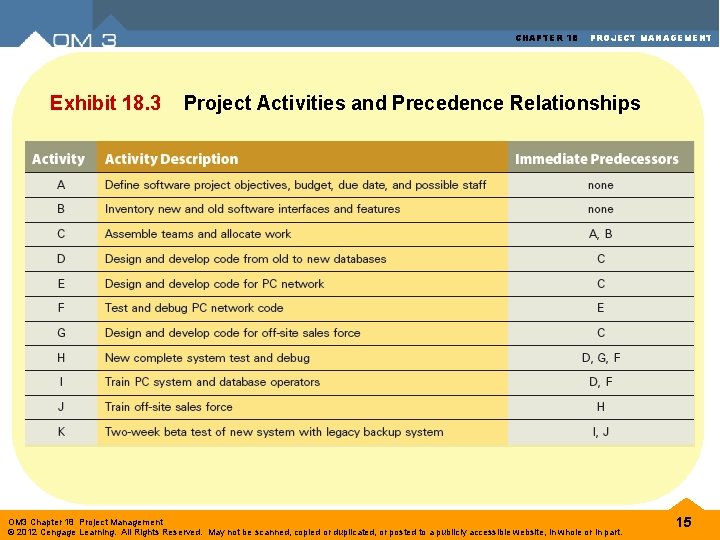
CHAPTER 18 PROJECT MANAGEMENT Project Definition • Activities are discrete tasks that consume resources and time. • Immediate predecessors are those activities that must be completed immediately before an activity may start. Precedence relationships ensure that activities are performed in the proper sequence when they are scheduled. • The work breakdown structure is a hierarchical tree of end items that will be accomplished by the project team during the project. OM 3 Chapter 18 Project Management © 2012 Cengage Learning. All Rights Reserved. May not be scanned, copied or duplicated, or posted to a publicly accessible website, in whole or in part. 14
CHAPTER 18 Exhibit 18. 3 PROJECT MANAGEMENT Project Activities and Precedence Relationships OM 3 Chapter 18 Project Management © 2012 Cengage Learning. All Rights Reserved. May not be scanned, copied or duplicated, or posted to a publicly accessible website, in whole or in part. 15
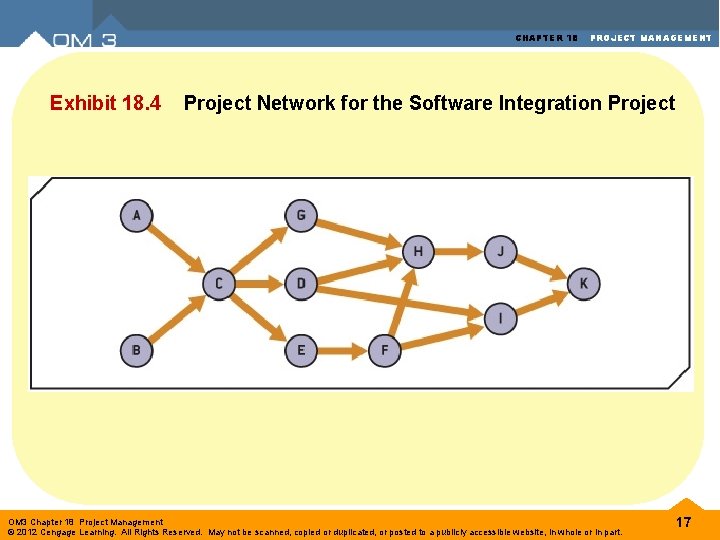
CHAPTER 18 PROJECT MANAGEMENT Project Definition • A project network consists of a set of circles or boxes called nodes, which represent activities, and a set of arrows called arcs, which define the precedence relationships between activities. - This is called an activity-on-node (AON) network representation. OM 3 Chapter 18 Project Management © 2012 Cengage Learning. All Rights Reserved. May not be scanned, copied or duplicated, or posted to a publicly accessible website, in whole or in part. 16
CHAPTER 18 Exhibit 18. 4 PROJECT MANAGEMENT Project Network for the Software Integration Project OM 3 Chapter 18 Project Management © 2012 Cengage Learning. All Rights Reserved. May not be scanned, copied or duplicated, or posted to a publicly accessible website, in whole or in part. 17
CHAPTER 18 PROJECT MANAGEMENT Resource Planning • Resource planning includes developing time estimates for each activity and allocating resources that will be required. • Cost control is a vital part of project management, and resource planning aids in good budgeting. OM 3 Chapter 18 Project Management © 2012 Cengage Learning. All Rights Reserved. May not be scanned, copied or duplicated, or posted to a publicly accessible website, in whole or in part. 18
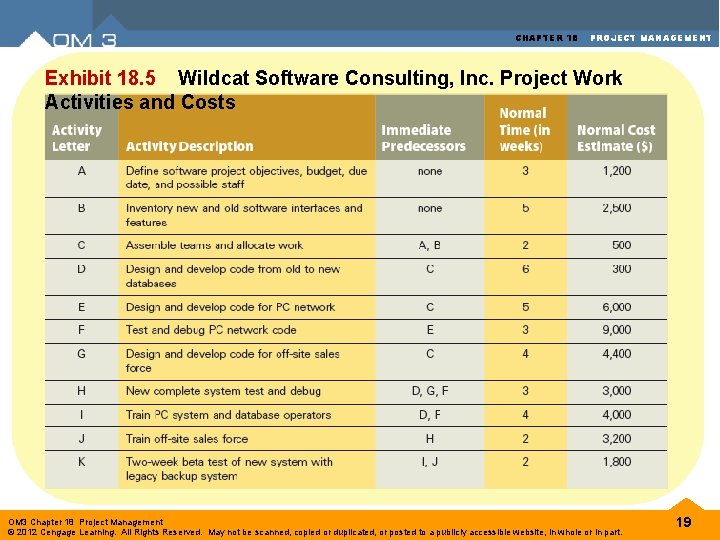
CHAPTER 18 PROJECT MANAGEMENT Exhibit 18. 5 Wildcat Software Consulting, Inc. Project Work Activities and Costs OM 3 Chapter 18 Project Management © 2012 Cengage Learning. All Rights Reserved. May not be scanned, copied or duplicated, or posted to a publicly accessible website, in whole or in part. 19
CHAPTER 18 PROJECT MANAGEMENT Project Scheduling With the Critical Path Method • The critical path is the sequence of activities that takes the longest time and defines the total project completion time. -Assumptions: The project network defines a correct sequence of work in terms of technology and workflow. - Activities are assumed to be independent of one another with clearly defined start and finish dates. - The activity time estimates are accurate and stable. - Once an activity is started, it continues uninterrupted until it is completed. OM 3 Chapter 18 Project Management © 2012 Cengage Learning. All Rights Reserved. May not be scanned, copied or duplicated, or posted to a publicly accessible website, in whole or in part. 20
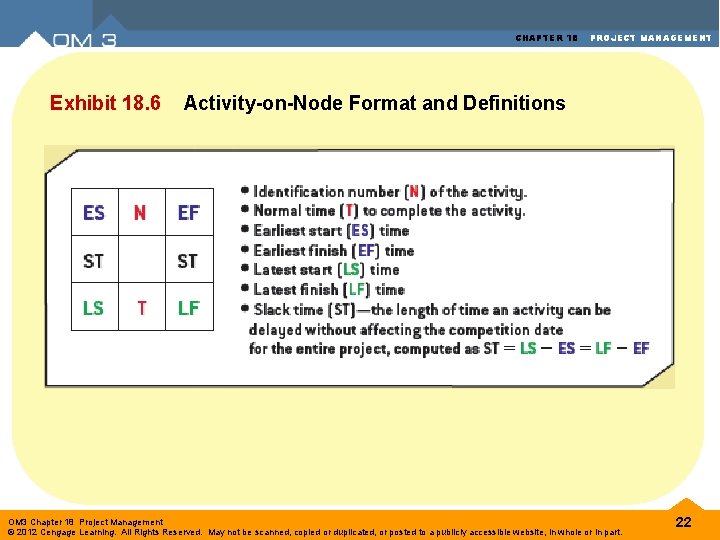
CHAPTER 18 PROJECT MANAGEMENT Project Scheduling With the Critical Path Method Rules for calculating activity times: • Rule 1: EF = ES + T • Rule 2: The ES time for an activity equals the largest EF time of all immediate predecessors. • Rule 3: LS = LF – T • Rule 4: The LF time for an activity is the smallest LS of all immediate successors. OM 3 Chapter 18 Project Management © 2012 Cengage Learning. All Rights Reserved. May not be scanned, copied or duplicated, or posted to a publicly accessible website, in whole or in part. 21
CHAPTER 18 Exhibit 18. 6 PROJECT MANAGEMENT Activity-on-Node Format and Definitions OM 3 Chapter 18 Project Management © 2012 Cengage Learning. All Rights Reserved. May not be scanned, copied or duplicated, or posted to a publicly accessible website, in whole or in part. 22
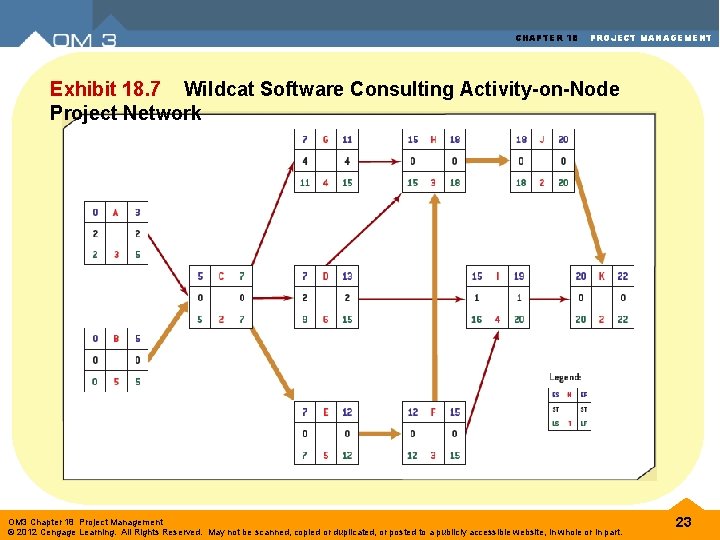
CHAPTER 18 PROJECT MANAGEMENT Exhibit 18. 7 Wildcat Software Consulting Activity-on-Node Project Network OM 3 Chapter 18 Project Management © 2012 Cengage Learning. All Rights Reserved. May not be scanned, copied or duplicated, or posted to a publicly accessible website, in whole or in part. 23
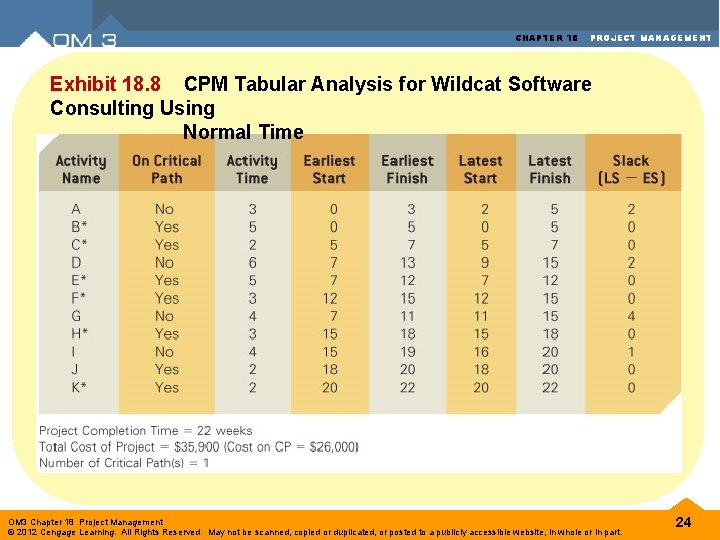
CHAPTER 18 PROJECT MANAGEMENT Exhibit 18. 8 CPM Tabular Analysis for Wildcat Software Consulting Using Normal Time OM 3 Chapter 18 Project Management © 2012 Cengage Learning. All Rights Reserved. May not be scanned, copied or duplicated, or posted to a publicly accessible website, in whole or in part. 24
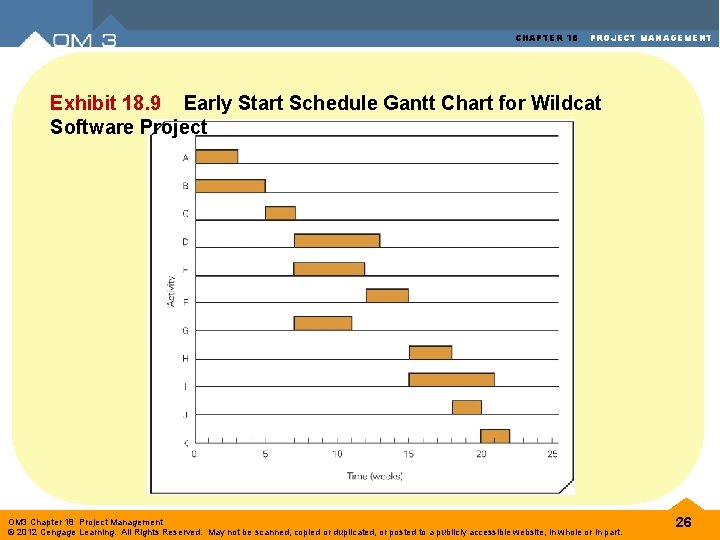
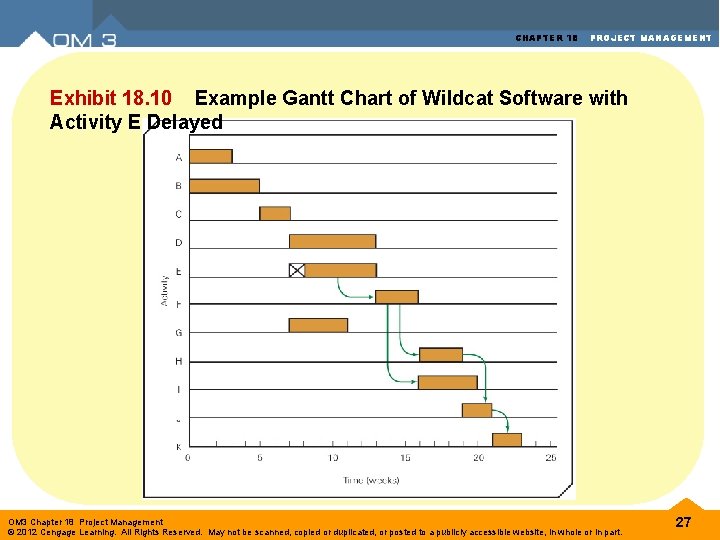
CHAPTER 18 PROJECT MANAGEMENT Project Control • A schedule specifies when activities are to be performed. - Because of uncertainty of task times, unavoidable delays, or other problems, projects rarely progress on schedule. - Gantt charts graphically depict the project schedule so that a project manager knows exactly what activities should be performed at a given time. - Project management software can assist in allocating limited resources, such as labor and equipment that are shared among all the activities. OM 3 Chapter 18 Project Management © 2012 Cengage Learning. All Rights Reserved. May not be scanned, copied or duplicated, or posted to a publicly accessible website, in whole or in part. 25
CHAPTER 18 PROJECT MANAGEMENT Exhibit 18. 9 Early Start Schedule Gantt Chart for Wildcat Software Project OM 3 Chapter 18 Project Management © 2012 Cengage Learning. All Rights Reserved. May not be scanned, copied or duplicated, or posted to a publicly accessible website, in whole or in part. 26
CHAPTER 18 PROJECT MANAGEMENT Exhibit 18. 10 Example Gantt Chart of Wildcat Software with Activity E Delayed OM 3 Chapter 18 Project Management © 2012 Cengage Learning. All Rights Reserved. May not be scanned, copied or duplicated, or posted to a publicly accessible website, in whole or in part. 27
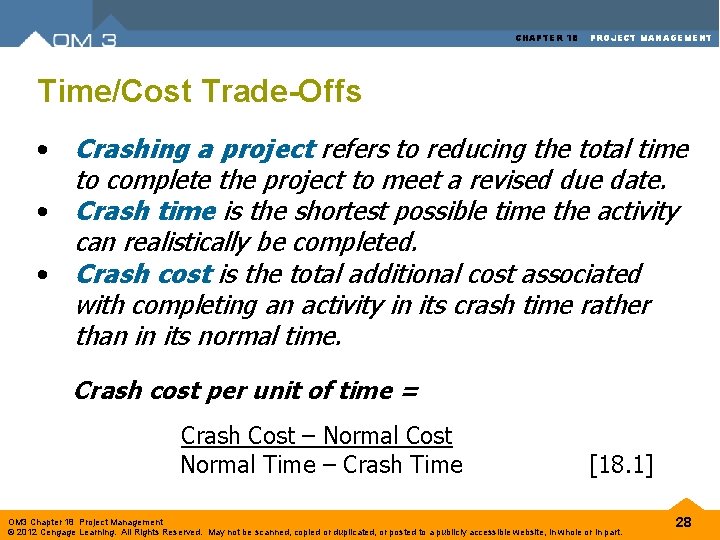
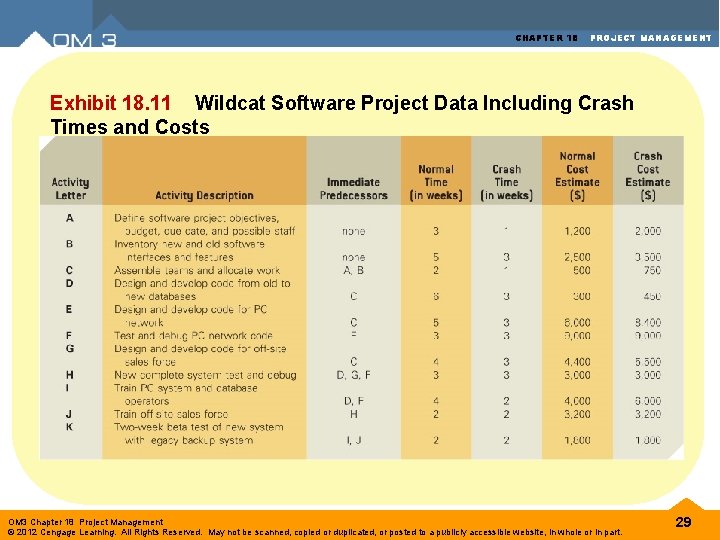
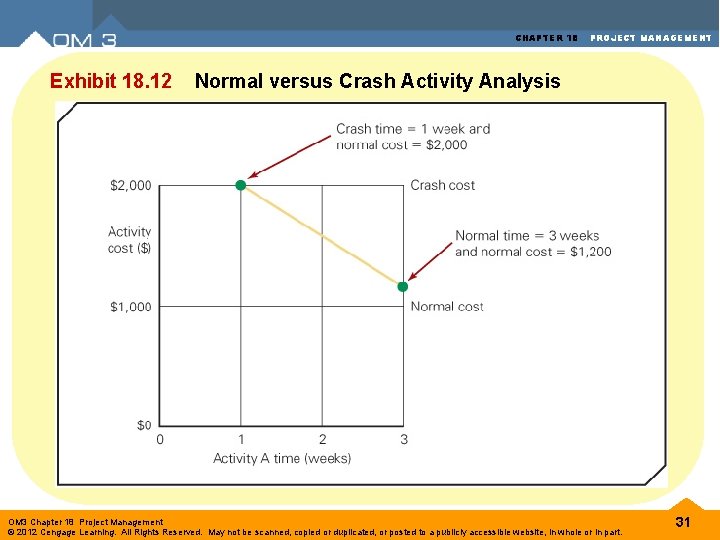
CHAPTER 18 PROJECT MANAGEMENT Time/Cost Trade-Offs • Crashing a project refers to reducing the total time to complete the project to meet a revised due date. • Crash time is the shortest possible time the activity can realistically be completed. • Crash cost is the total additional cost associated with completing an activity in its crash time rather than in its normal time. Crash cost per unit of time = Crash Cost – Normal Cost Normal Time – Crash Time [18. 1] OM 3 Chapter 18 Project Management © 2012 Cengage Learning. All Rights Reserved. May not be scanned, copied or duplicated, or posted to a publicly accessible website, in whole or in part. 28
CHAPTER 18 PROJECT MANAGEMENT Exhibit 18. 11 Wildcat Software Project Data Including Crash Times and Costs OM 3 Chapter 18 Project Management © 2012 Cengage Learning. All Rights Reserved. May not be scanned, copied or duplicated, or posted to a publicly accessible website, in whole or in part. 29
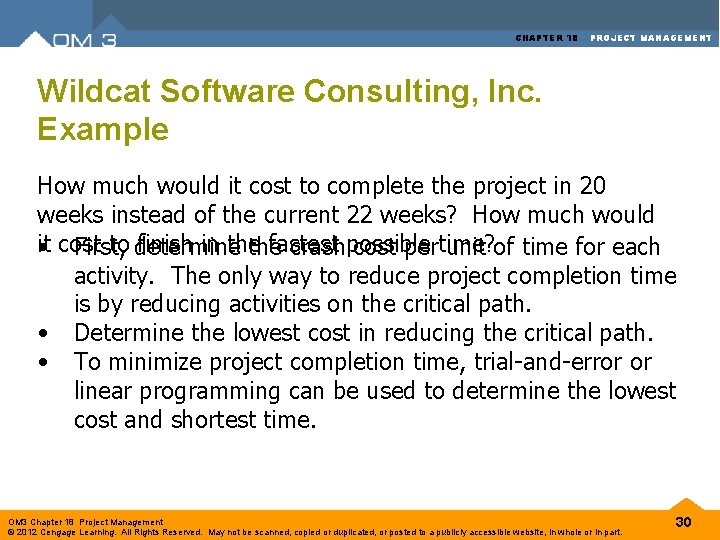
CHAPTER 18 PROJECT MANAGEMENT Wildcat Software Consulting, Inc. Example How much would it cost to complete the project in 20 weeks instead of the current 22 weeks? How much would it to determine finish in the fastest • cost First, the crashpossible cost pertime? unit of time for each activity. The only way to reduce project completion time is by reducing activities on the critical path. • Determine the lowest cost in reducing the critical path. • To minimize project completion time, trial-and-error or linear programming can be used to determine the lowest cost and shortest time. OM 3 Chapter 18 Project Management © 2012 Cengage Learning. All Rights Reserved. May not be scanned, copied or duplicated, or posted to a publicly accessible website, in whole or in part. 30
CHAPTER 18 Exhibit 18. 12 PROJECT MANAGEMENT Normal versus Crash Activity Analysis OM 3 Chapter 18 Project Management © 2012 Cengage Learning. All Rights Reserved. May not be scanned, copied or duplicated, or posted to a publicly accessible website, in whole or in part. 31
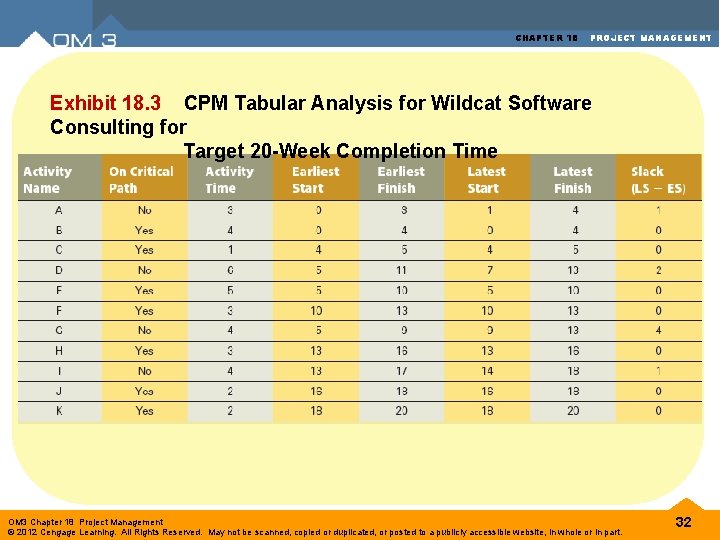
CHAPTER 18 PROJECT MANAGEMENT Exhibit 18. 3 CPM Tabular Analysis for Wildcat Software Consulting for Target 20 -Week Completion Time OM 3 Chapter 18 Project Management © 2012 Cengage Learning. All Rights Reserved. May not be scanned, copied or duplicated, or posted to a publicly accessible website, in whole or in part. 32
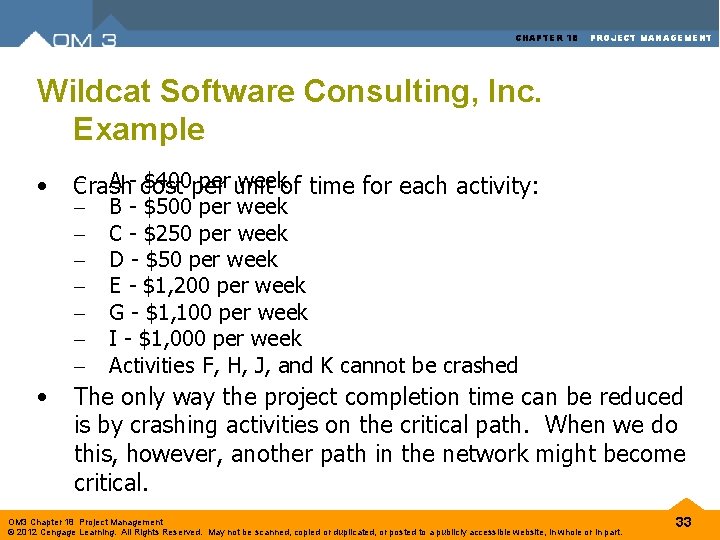
CHAPTER 18 PROJECT MANAGEMENT Wildcat Software Consulting, Inc. Example • - A - cost $400 per unit weekof time for each activity: Crash • The only way the project completion time can be reduced is by crashing activities on the critical path. When we do this, however, another path in the network might become critical. - B - $500 per week C - $250 per week D - $50 per week E - $1, 200 per week G - $1, 100 per week I - $1, 000 per week Activities F, H, J, and K cannot be crashed OM 3 Chapter 18 Project Management © 2012 Cengage Learning. All Rights Reserved. May not be scanned, copied or duplicated, or posted to a publicly accessible website, in whole or in part. 33
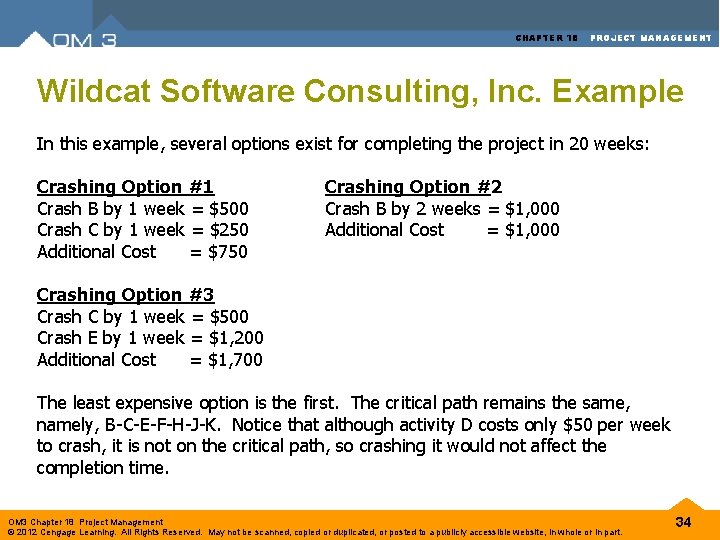
CHAPTER 18 PROJECT MANAGEMENT Wildcat Software Consulting, Inc. Example In this example, several options exist for completing the project in 20 weeks: Crashing Option #1 Crash B by 1 week = $500 Crash C by 1 week = $250 Additional Cost = $750 Crashing Option #2 Crash B by 2 weeks = $1, 000 Additional Cost = $1, 000 Crashing Option #3 Crash C by 1 week = $500 Crash E by 1 week = $1, 200 Additional Cost = $1, 700 The least expensive option is the first. The critical path remains the same, namely, B-C-E-F-H-J-K. Notice that although activity D costs only $50 per week to crash, it is not on the critical path, so crashing it would not affect the completion time. OM 3 Chapter 18 Project Management © 2012 Cengage Learning. All Rights Reserved. May not be scanned, copied or duplicated, or posted to a publicly accessible website, in whole or in part. 34
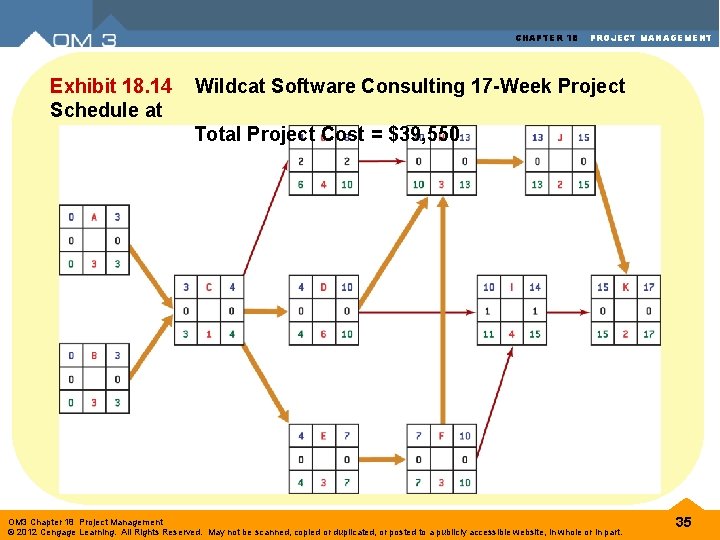
CHAPTER 18 Exhibit 18. 14 Schedule at PROJECT MANAGEMENT Wildcat Software Consulting 17 -Week Project Total Project Cost = $39, 550 OM 3 Chapter 18 Project Management © 2012 Cengage Learning. All Rights Reserved. May not be scanned, copied or duplicated, or posted to a publicly accessible website, in whole or in part. 35
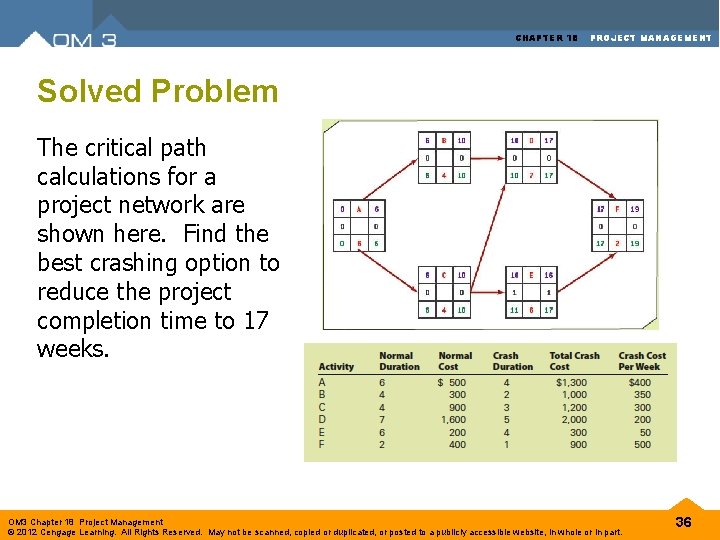
CHAPTER 18 PROJECT MANAGEMENT Solved Problem The critical path calculations for a project network are shown here. Find the best crashing option to reduce the project completion time to 17 weeks. OM 3 Chapter 18 Project Management © 2012 Cengage Learning. All Rights Reserved. May not be scanned, copied or duplicated, or posted to a publicly accessible website, in whole or in part. 36
CHAPTER 18 PROJECT MANAGEMENT Solution There are 2 critical paths: 1. Path A-B-D-F 2. Path A-C-D-F Both paths take 19 weeks to complete. Only activity E has a slack time of 1 week. OM 3 Chapter 18 Project Management © 2012 Cengage Learning. All Rights Reserved. May not be scanned, copied or duplicated, or posted to a publicly accessible website, in whole or in part. 37
CHAPTER 18 PROJECT MANAGEMENT Solution One Week Crash Options: We might first look at activities common to both critical paths, namely A and D, and consider crashing each of them individually. Other options are to crash activities B and C together, activity F, and activities A and D together. Crashing Option #1 Crashing Option #2 Crashing Option #3 Crash A by 1 week=$400 Crash D by 1 week=$200 Crash B by 1 week=$350 Crash C by 1 week=$300 Total cost=$650 Crashing Option #4 Crash Option # 5 Crash F by 1 week=$500 Crash A by 1 week=$400 Crash D by 1 week=$200 Total cost=$600 The lowest cost option is to crash activity D by 1 week, costing $200. Now, all three paths through the network are critical paths with a total duration of 18 weeks. OM 3 Chapter 18 Project Management © 2012 Cengage Learning. All Rights Reserved. May not be scanned, copied or duplicated, or posted to a publicly accessible website, in whole or in part. 38
CHAPTER 18 PROJECT MANAGEMENT Second Week Crash Options: Crashing Option #1 Crashing Option #2 Crash A by 1 week=$400 Crash D by 1 week=$200 Crash E by 1 week=$ 50 Total cost=$250 Crashing Option #4 Crash F by 1 week=$500 Crashing Option #3 Crash B by 1 week=$350 Crash C by 1 week=$300 Total cost=$650 All other crash options cost more than Option #2. Therefore, we should recommend that we crash D by a second week and E by 1 week for a total cost of $250. All three network paths take 17 weeks to complete. The total normal costs are $3, 900 plus crashing D by 2 weeks (+$400) and E by 1 week (+$50), so the total cost of a 17 week project completion schedule is $4, 350. OM 3 Chapter 18 Project Management © 2012 Cengage Learning. All Rights Reserved. May not be scanned, copied or duplicated, or posted to a publicly accessible website, in whole or in part. 39
CHAPTER 18 PROJECT MANAGEMENT Uncertainty in Project Management • PERT (Project Evaluation and Review Technique) is another approach to project management. • PERT was developed to handle uncertainties in activity completion times. • In contrast, CPM assumes that activity times are constant. OM 3 Chapter 18 Project Management © 2012 Cengage Learning. All Rights Reserved. May not be scanned, copied or duplicated, or posted to a publicly accessible website, in whole or in part. 40
CHAPTER 18 PROJECT MANAGEMENT Uncertainty in Project Management Three PERT estimates are obtained for each activity: 1. Optimistic time (a): Activity time under ideal conditions. 2. Most probable time (m): Most likely activity time under normal conditions. 3. Pessimistic time (b): Activity time if breakdowns or serious delays occur. OM 3 Chapter 18 Project Management © 2012 Cengage Learning. All Rights Reserved. May not be scanned, copied or duplicated, or posted to a publicly accessible website, in whole or in part. 41
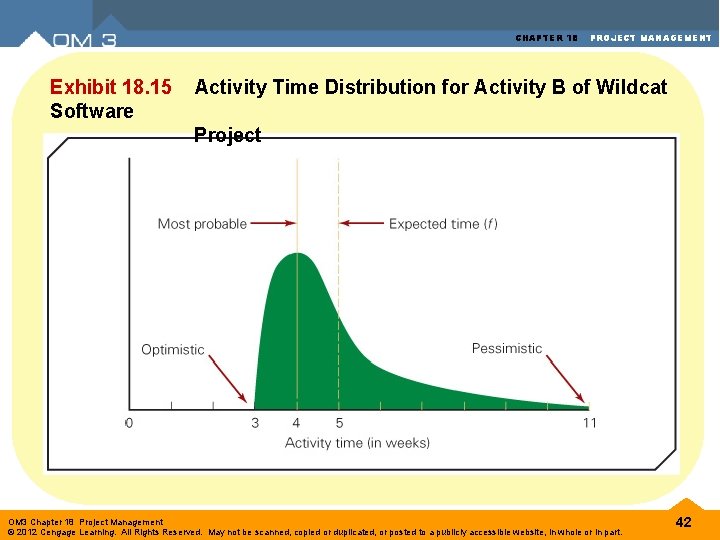
CHAPTER 18 Exhibit 18. 15 Software PROJECT MANAGEMENT Activity Time Distribution for Activity B of Wildcat Project OM 3 Chapter 18 Project Management © 2012 Cengage Learning. All Rights Reserved. May not be scanned, copied or duplicated, or posted to a publicly accessible website, in whole or in part. 42
CHAPTER 18 PROJECT MANAGEMENT Uncertainty in Project Management Expected Time = (a + 4 m + b)/6 [18. 2] Variance = (b – a)2/36 [18. 3] Where: a = The optimistic time estimate. m = Most likely or probable. b = The pessimistic time estimate. PERT assumes a beta probability distribution. OM 3 Chapter 18 Project Management © 2012 Cengage Learning. All Rights Reserved. May not be scanned, copied or duplicated, or posted to a publicly accessible website, in whole or in part. 43
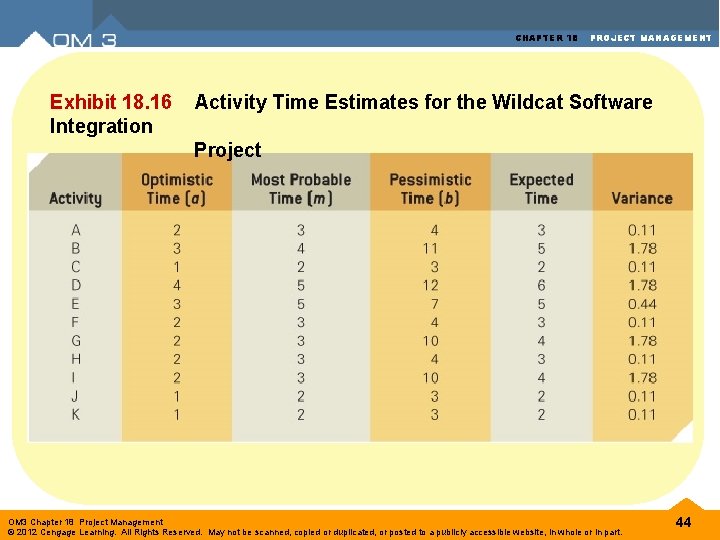
CHAPTER 18 Exhibit 18. 16 Integration PROJECT MANAGEMENT Activity Time Estimates for the Wildcat Software Project OM 3 Chapter 18 Project Management © 2012 Cengage Learning. All Rights Reserved. May not be scanned, copied or duplicated, or posted to a publicly accessible website, in whole or in part. 44
CHAPTER 18 PROJECT MANAGEMENT Uncertainty in Project Management • The critical path is found using the expected times in the same fashion as in the Critical Path Method. • PERT allows us to investigate the effects of uncertainty of activity times on the project completion time. OM 3 Chapter 18 Project Management © 2012 Cengage Learning. All Rights Reserved. May not be scanned, copied or duplicated, or posted to a publicly accessible website, in whole or in part. 45
CHAPTER 18 PROJECT MANAGEMENT Uncertainty in Project Management • • The critical path is B-C-E-F-H-J-K with an expected completion time of 22 weeks. The variance (σ2) in project duration is given by the sum of the variances of the critical-path activities: σ2 = 1. 78 + 0. 11 + 0. 44 + 0. 11 = 2. 77. This formula is based on the assumption that all the activity times are independent. We can also assume that the distribution of the project completion time is normally distributed. OM 3 Chapter 18 Project Management © 2012 Cengage Learning. All Rights Reserved. May not be scanned, copied or duplicated, or posted to a publicly accessible website, in whole or in part. 46
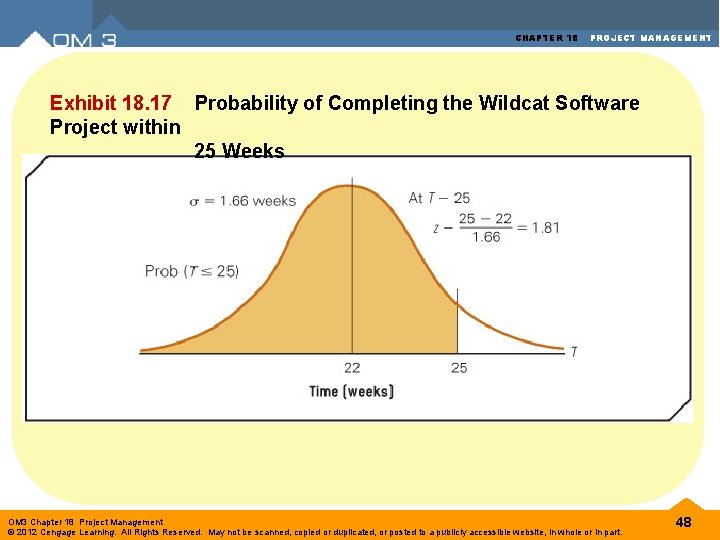
CHAPTER 18 PROJECT MANAGEMENT Uncertainty in Project Management Although they expect completion in 22 weeks, the project manager wants to know the probability that they will meet the 25 -week deadline. The z-value for the normal distribution at T = 25 is given by: z = (25 – 22)/1. 66 = 1. 81 Using z = 1. 81 and the tables for the standard normal distribution, we see that the probability of the project meeting the 25 -week deadline is 0. 4649 + 0. 5000 = 0. 9649. OM 3 Chapter 18 Project Management © 2012 Cengage Learning. All Rights Reserved. May not be scanned, copied or duplicated, or posted to a publicly accessible website, in whole or in part. 47
CHAPTER 18 PROJECT MANAGEMENT Exhibit 18. 17 Probability of Completing the Wildcat Software Project within 25 Weeks OM 3 Chapter 18 Project Management © 2012 Cengage Learning. All Rights Reserved. May not be scanned, copied or duplicated, or posted to a publicly accessible website, in whole or in part. 48
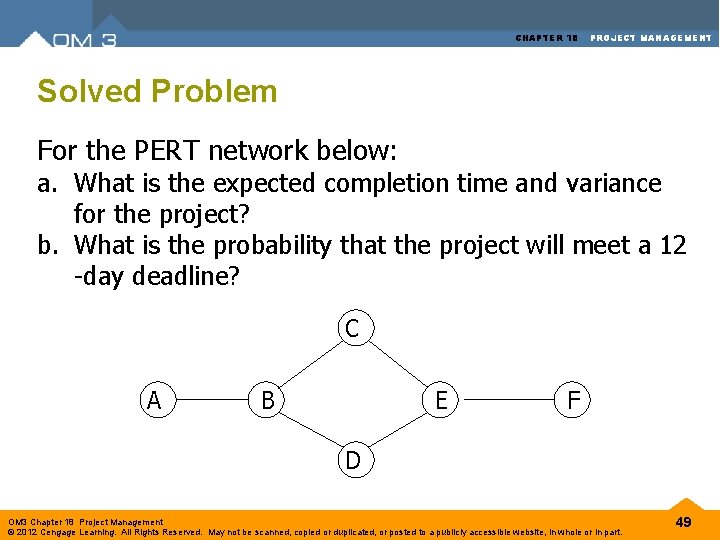
CHAPTER 18 PROJECT MANAGEMENT Solved Problem For the PERT network below: a. What is the expected completion time and variance for the project? b. What is the probability that the project will meet a 12 -day deadline? C A B E F D OM 3 Chapter 18 Project Management © 2012 Cengage Learning. All Rights Reserved. May not be scanned, copied or duplicated, or posted to a publicly accessible website, in whole or in part. 49
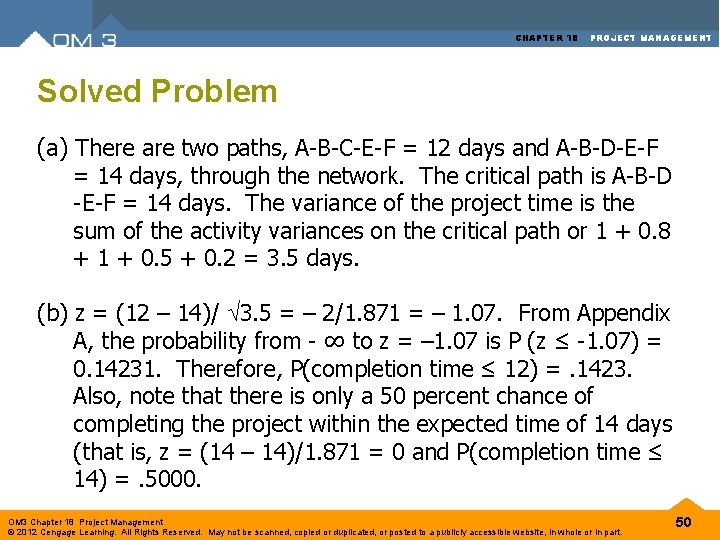
CHAPTER 18 PROJECT MANAGEMENT Solved Problem (a) There are two paths, A-B-C-E-F = 12 days and A-B-D-E-F = 14 days, through the network. The critical path is A-B-D -E-F = 14 days. The variance of the project time is the sum of the activity variances on the critical path or 1 + 0. 8 + 1 + 0. 5 + 0. 2 = 3. 5 days. (b) z = (12 – 14)/ 3. 5 = – 2/1. 871 = – 1. 07. From Appendix A, the probability from - ∞ to z = – 1. 07 is P (z ≤ -1. 07) = 0. 14231. Therefore, P(completion time ≤ 12) =. 1423. Also, note that there is only a 50 percent chance of completing the project within the expected time of 14 days (that is, z = (14 – 14)/1. 871 = 0 and P(completion time ≤ 14) =. 5000. OM 3 Chapter 18 Project Management © 2012 Cengage Learning. All Rights Reserved. May not be scanned, copied or duplicated, or posted to a publicly accessible website, in whole or in part. 50
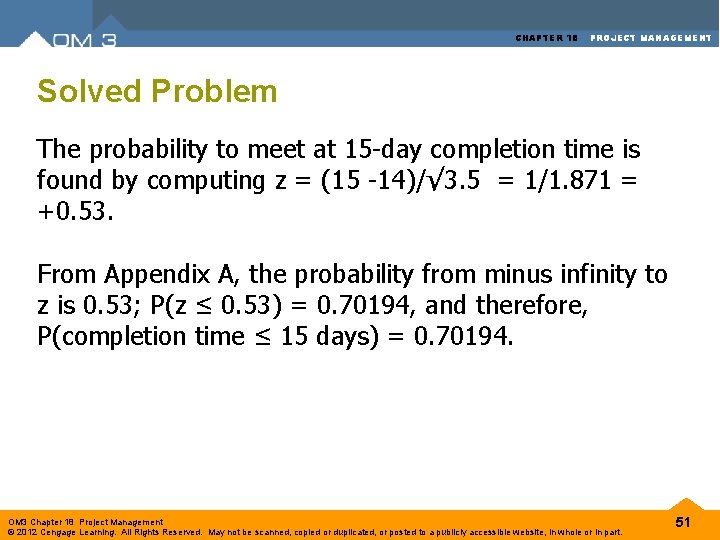
CHAPTER 18 PROJECT MANAGEMENT Solved Problem The probability to meet at 15 -day completion time is found by computing z = (15 -14)/√ 3. 5 = 1/1. 871 = +0. 53. From Appendix A, the probability from minus infinity to z is 0. 53; P(z ≤ 0. 53) = 0. 70194, and therefore, P(completion time ≤ 15 days) = 0. 70194. OM 3 Chapter 18 Project Management © 2012 Cengage Learning. All Rights Reserved. May not be scanned, copied or duplicated, or posted to a publicly accessible website, in whole or in part. 51
CHAPTER 18 PROJECT MANAGEMENT OM 3 Chapter 18 Project Management © 2012 Cengage Learning. All Rights Reserved. May not be scanned, copied or duplicated, or posted to a publicly accessible website, in whole or in part. 52
CHAPTER 18 PROJECT MANAGEMENT St. Mary’s Medical Center Case Study 1. Develop a network for this project. 2. It is important to realize that the activities shown need to be broken down into more detail for actual implementation. For example, for the activity “patient move, ” managers have to determine which patients to move first (for example, intensive care), the equipment that would have to be in place to support each class of patient, and so on. Discuss what types of subactivities might have to be accomplished in an expanded network for two example activities. You need not draw this expanded network, however. 3. Use the information to find the critical path and the project completion time. Summarize your findings in a report to the hospital administrator. OM 3 Chapter 18 Project Management © 2012 Cengage Learning. All Rights Reserved. May not be scanned, copied or duplicated, or posted to a publicly accessible website, in whole or in part. 53