
Project Management BUS 574 AH 2 1 COURSE
Project Management BUS 574 AH 2 1
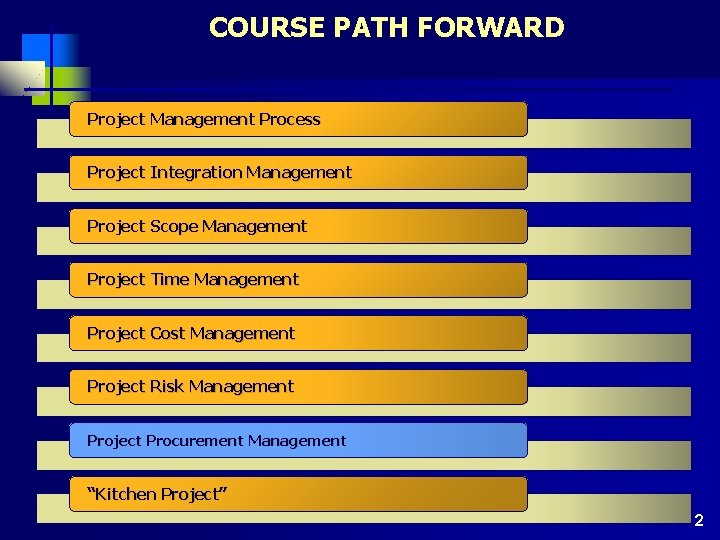
COURSE PATH FORWARD Project Management Process Project Integration Management Project Scope Management Project Time Management Project Cost Management Project Risk Management Project Procurement Management “Kitchen Project” 2
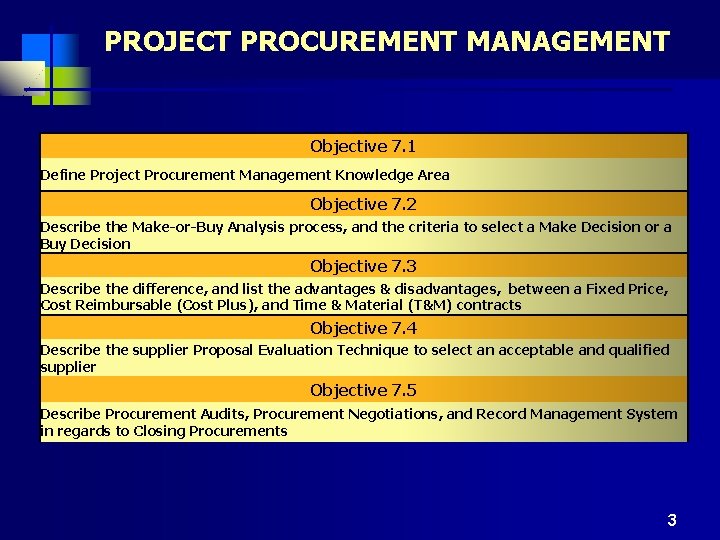
PROJECT PROCUREMENT MANAGEMENT Objective 7. 1 Define Project Procurement Management Knowledge Area Objective 7. 2 Describe the Make-or-Buy Analysis process, and the criteria to select a Make Decision or a Buy Decision Objective 7. 3 Describe the difference, and list the advantages & disadvantages, between a Fixed Price, Cost Reimbursable (Cost Plus), and Time & Material (T&M) contracts Objective 7. 4 Describe the supplier Proposal Evaluation Technique to select an acceptable and qualified supplier Objective 7. 5 Describe Procurement Audits, Procurement Negotiations, and Record Management System in regards to Closing Procurements 3
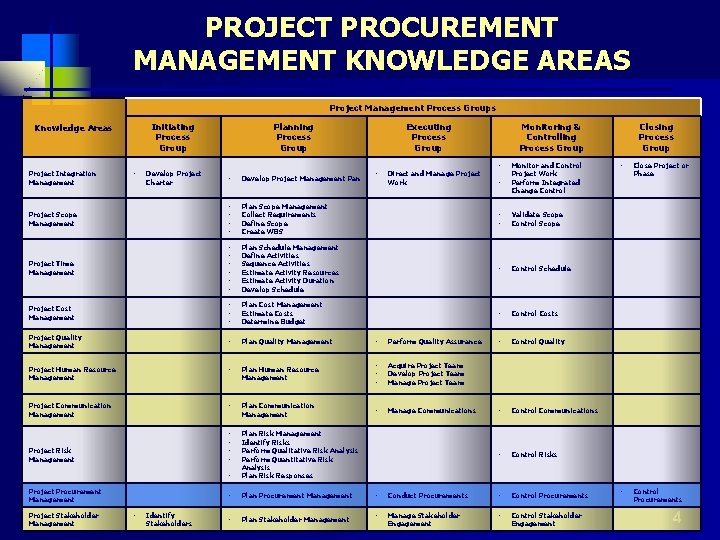
PROJECT PROCUREMENT MANAGEMENT KNOWLEDGE AREAS Project Management Process Groups Initiating Process Group Knowledge Areas Project Integration Management • Develop Project Charter Planning Process Group Executing Process Group • Direct and Manage Project Work Monitoring & Controlling Process Group • Monitor and Control Project Work Perform Integrated Change Control • Develop Project Management Pan Project Scope Management • • Plan Scope Management Collect Requirements Define Scope Create WBS • • Validate Scope Control Scope Project Time Management • • • Plan Schedule Management Define Activities Sequence Activities Estimate Activity Resources Estimate Activity Duration Develop Schedule • Control Schedule Project Cost Management • • • Plan Cost Management Estimate Costs Determine Budget • Control Costs Project Quality Management • Plan Quality Management • Perform Quality Assurance • Control Quality Project Human Resource Management • Plan Human Resource Management • • • Acquire Project Team Develop Project Team Manage Project Team Project Communication Management • Plan Communication Management • Manage Communications • Control Communications • • • Control Risks • Plan Risk Management Identify Risks Perform Qualitative Risk Analysis Perform Quantitative Risk Analysis Plan Risk Responses • Plan Procurement Management • Plan Stakeholder Management Project Risk Management Project Procurement Management Project Stakeholder Management • Identify Stakeholders • • Conduct Procurements • Control Procurements • Manage Stakeholder Engagement • Control Stakeholder Engagement Closing Process Group • Close Project or Phase • Control Procurements 4
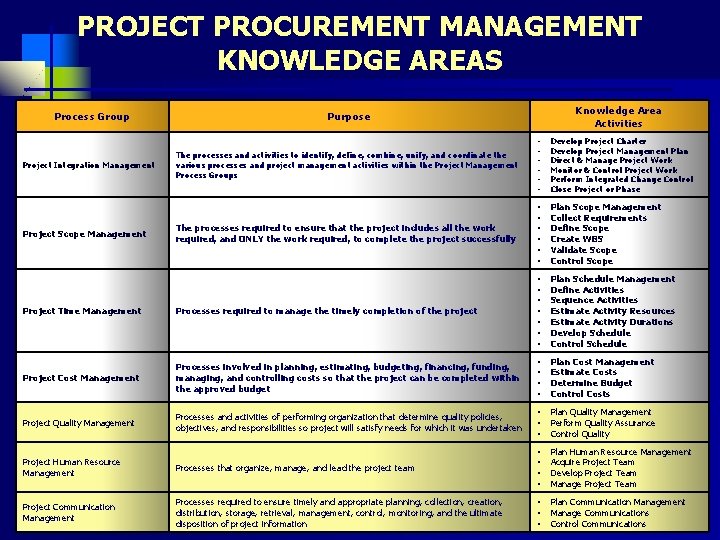
PROJECT PROCUREMENT MANAGEMENT KNOWLEDGE AREAS Process Group Knowledge Area Activities Purpose The processes and activities to identify, define, combine, unify, and coordinate the various processes and project management activities within the Project Management Process Groups • • • Develop Project Charter Develop Project Management Plan Direct & Manage Project Work Monitor & Control Project Work Perform Integrated Change Control Close Project or Phase The processes required to ensure that the project includes all the work required, and ONLY the work required, to complete the project successfully • • • Plan Scope Management Collect Requirements Define Scope Create WBS Validate Scope Control Scope Project Time Management Processes required to manage the timely completion of the project • • Plan Schedule Management Define Activities Sequence Activities Estimate Activity Resources Estimate Activity Durations Develop Schedule Control Schedule Project Cost Management Processes involved in planning, estimating, budgeting, financing, funding, managing, and controlling costs so that the project can be completed within the approved budget • • Plan Cost Management Estimate Costs Determine Budget Control Costs Project Quality Management Processes and activities of performing organization that determine quality policies, objectives, and responsibilities so project will satisfy needs for which it was undertaken • • • Plan Quality Management Perform Quality Assurance Control Quality Project Human Resource Management Processes that organize, manage, and lead the project team • • Plan Human Resource Management Acquire Project Team Develop Project Team Manage Project Team Project Communication Management Processes required to ensure timely and appropriate planning, collection, creation, distribution, storage, retrieval, management, control, monitoring, and the ultimate disposition of project information • • • Plan Communication Management Manage Communications Control Communications Project Integration Management Project Scope Management 5
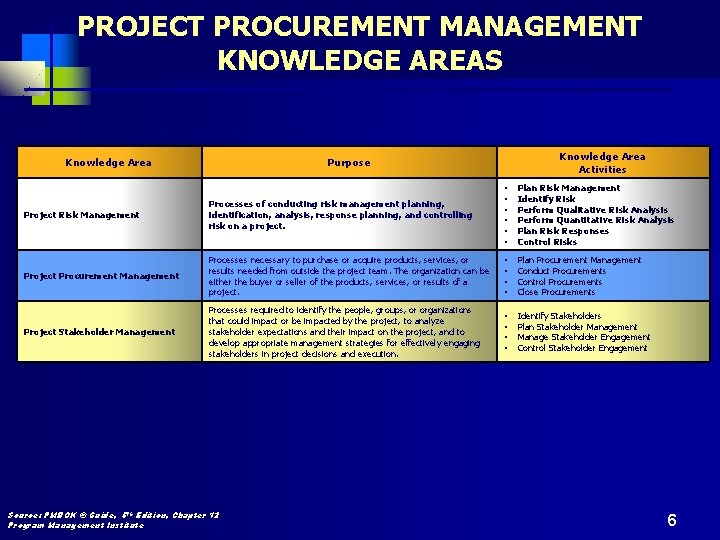
PROJECT PROCUREMENT MANAGEMENT KNOWLEDGE AREAS Knowledge Area Activities Purpose Plan Risk Management Identify Risk Perform Qualitative Risk Analysis Perform Quantitative Risk Analysis Plan Risk Responses Control Risks Project Risk Management Processes of conducting risk management planning, identification, analysis, response planning, and controlling risk on a project. • • • Project Procurement Management Processes necessary to purchase or acquire products, services, or results needed from outside the project team. The organization can be either the buyer or seller of the products, services, or results of a project. • • Plan Procurement Management Conduct Procurements Control Procurements Close Procurements Project Stakeholder Management Processes required to identify the people, groups, or organizations that could impact or be impacted by the project, to analyze stakeholder expectations and their impact on the project, and to develop appropriate management strategies for effectively engaging stakeholders in project decisions and execution. • • Identify Stakeholders Plan Stakeholder Management Manage Stakeholder Engagement Control Stakeholder Engagement Source: PMBOK ® Guide, 5 th Edition, Chapter 12 Program Management Institute 6
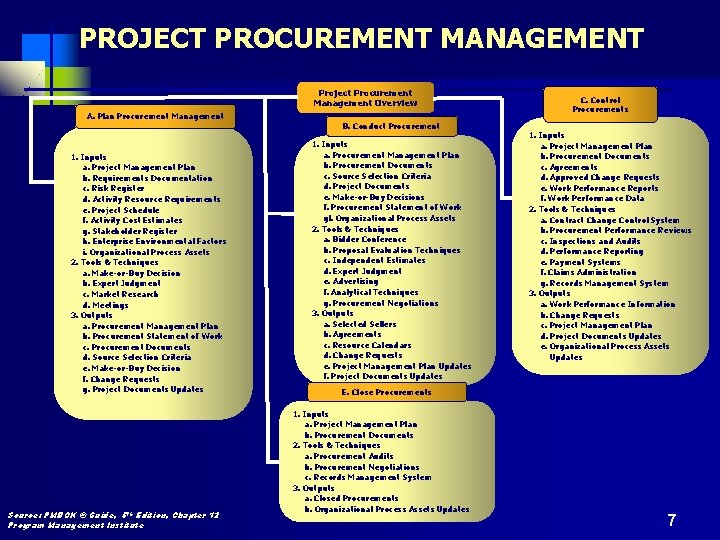
PROJECT PROCUREMENT MANAGEMENT Project Procurement Management Overview A. Plan Procurement Management B. Conduct Procurement 1. Inputs a. Project Management Plan b. Requirements Documentation c. Risk Register d. Activity Resource Requirements e. Project Schedule f. Activity Cost Estimates g. Stakeholder Register h. Enterprise Environmental Factors i. Organizational Process Assets 2. Tools & Techniques a. Make-or-Buy Decision b. Expert Judgment c. Market Research d. Meetings 3. Outputs a. Procurement Management Plan b. Procurement Statement of Work c. Procurement Documents d. Source Selection Criteria e. Make-or-Buy Decision f. Change Requests g. Project Documents Updates Source: PMBOK ® Guide, 5 th Edition, Chapter 12 Program Management Institute 1. Inputs a. Procurement Management Plan b. Procurement Documents c. Source Selection Criteria d. Project Documents e. Make-or-Buy Decisions f. Procurement Statement of Work gl. Organizational Process Assets 2. Tools & Techniques a. Bidder Conference b. Proposal Evaluation Techniques c. Independent Estimates d. Expert Judgment e. Advertising f. Analytical Techniques g. Procurement Negotiations 3. Outputs a. Selected Sellers b. Agreements c. Resource Calendars d. Change Requests e. Project Management Plan Updates f. Project Documents Updates C. Control Procurements 1. Inputs a. Project Management Plan b. Procurement Documents c. Agreements d. Approved Change Requests e. Work Performance Reports f. Work Performance Data 2. Tools & Techniques a. Contract Change Control System b. Procurement Performance Reviews c. Inspections and Audits d. Performance Reporting e. Payment Systems f. Claims Administration g. Records Management System 3. Outputs a. Work Performance Information b. Change Requests c. Project Management Plan d. Project Documents Updates e. Organizational Process Assets Updates E. Close Procurements 1. Inputs a. Project Management Plan b. Procurement Documents 2. Tools & Techniques a. Procurement Audits b. Procurement Negotiations c. Records Management System 3. Outputs a. Closed Procurements b. Organizational Process Assets Updates 7
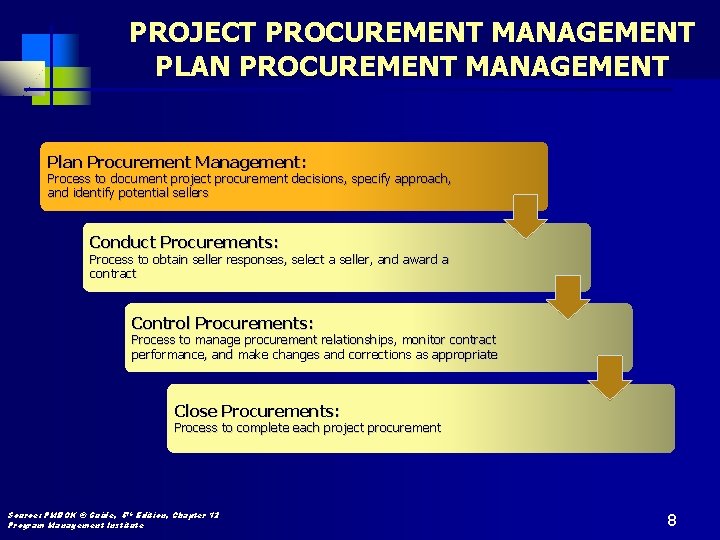
PROJECT PROCUREMENT MANAGEMENT PLAN PROCUREMENT MANAGEMENT Plan Procurement Management: Process to document project procurement decisions, specify approach, and identify potential sellers Conduct Procurements: Process to obtain seller responses, select a seller, and award a contract Control Procurements: Process to manage procurement relationships, monitor contract performance, and make changes and corrections as appropriate Close Procurements: Process to complete each project procurement Source: PMBOK ® Guide, 5 th Edition, Chapter 12 Program Management Institute 8
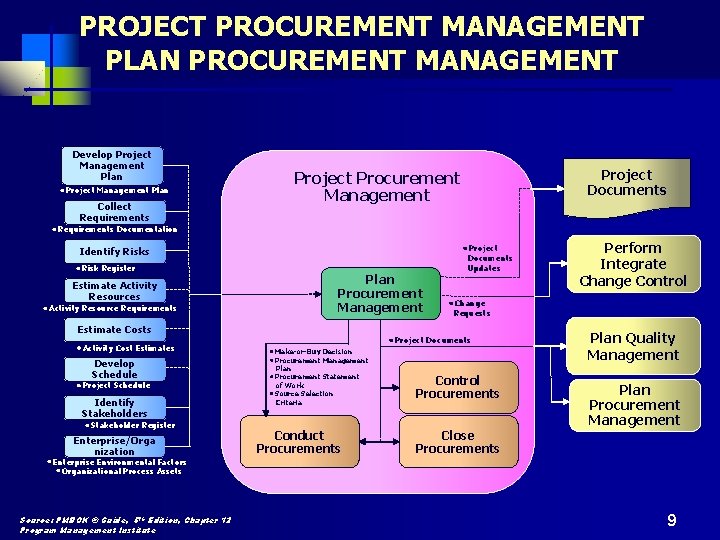
PROJECT PROCUREMENT MANAGEMENT PLAN PROCUREMENT MANAGEMENT Develop Project Management Plan Collect Requirements Project Documents Project Procurement Management Requirements Documentation Identify Risks Risk Register Estimate Activity Resources Activity Resource Requirements Plan Procurement Management Estimate Costs Activity Cost Estimates Develop Schedule Project Schedule Identify Stakeholders Stakeholder Register Enterprise/Orga nization Project Documents Updates Change Requests Project Documents Make-or-Buy Decision Procurement Management Plan Procurement Statement of Work Source Selection Criteria Conduct Procurements Perform Integrate Change Control Procurements Close Procurements Plan Quality Management Plan Procurement Management Enterprise Environmental Factors Organizational Process Assets Source: PMBOK ® Guide, 5 th Edition, Chapter 12 Program Management Institute 9
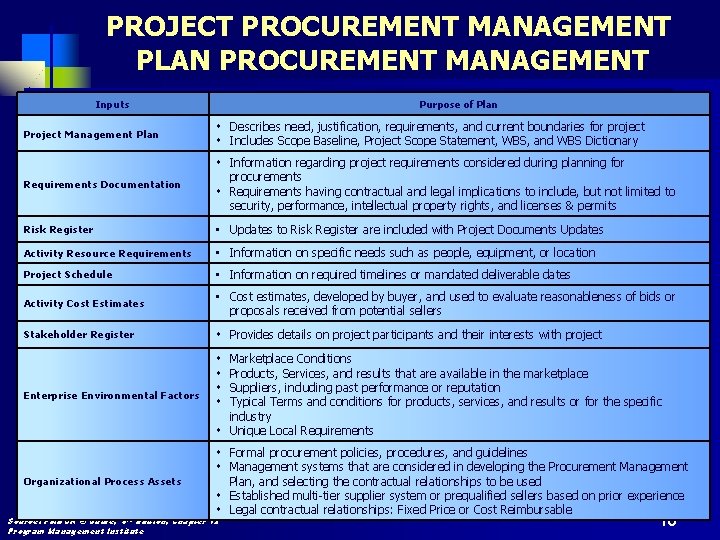
PROJECT PROCUREMENT MANAGEMENT PLAN PROCUREMENT MANAGEMENT Inputs Purpose of Plan Project Management Plan Describes need, justification, requirements, and current boundaries for project Includes Scope Baseline, Project Scope Statement, WBS, and WBS Dictionary Requirements Documentation Information regarding project requirements considered during planning for procurements Requirements having contractual and legal implications to include, but not limited to security, performance, intellectual property rights, and licenses & permits Risk Register • Updates to Risk Register are included with Project Documents Updates Activity Resource Requirements • Information on specific needs such as people, equipment, or location Project Schedule • Information on required timelines or mandated deliverable dates Activity Cost Estimates • Cost estimates, developed by buyer, and used to evaluate reasonableness of bids or proposals received from potential sellers Stakeholder Register Provides details on project participants and their interests with project Enterprise Environmental Factors Organizational Process Assets Marketplace Conditions Products, Services, and results that are available in the marketplace Suppliers, including past performance or reputation Typical Terms and conditions for products, services, and results or for the specific industry Unique Local Requirements Formal procurement policies, procedures, and guidelines Management systems that are considered in developing the Procurement Management Plan, and selecting the contractual relationships to be used Established multi-tier supplier system or prequalified sellers based on prior experience Legal contractual relationships: Fixed Price or Cost Reimbursable Source: PMBOK ® Guide, 5 th Edition, Chapter 12 Program Management Institute 10

PROJECT PROCUREMENT MANAGEMENT FIXED PRICE CONTRACTS Contract Types Description Fixed Price Contracts • Fixed total price set for a defined product, service, or result to be provided • Sellers legally obligated to complete contract, or face possible financial damages • Change in scope may be accommodated, but generally with increase in contract price • Fixed Price contracts place risks on seller – any cost overruns are responsibility of seller Firm Fixed Price (FFP) • Buyers favor FFP contracts: price for goods or services is set at outset - not subject to change unless scope of work changes • Any cost increase due to adverse performance is responsibility of seller Fixed Price Incentive Fee (FPIF) • Provides flexibility to both buyer and seller • Allows deviations from performance, with financial incentives tied to achieving agreed-upon metrics • Financial incentives related to cost, schedule, or technical performance of seller • FPIF contracts set a price ceiling - all costs above ceiling responsibility of seller Fixed Price with Economic Price Adjustment (FP-EPA) • Used when performance period spans considerable period of years • Special provisions allow for pre-defined final adjustment to contract price due to changed conditions, such as inflation or cost increases (or decreases) • FP-EPA intended to protect seller and buyer from external conditions beyond their control Source: PMBOK ® Guide, 5 th Edition, Chapter 12 Program Management Institute 11
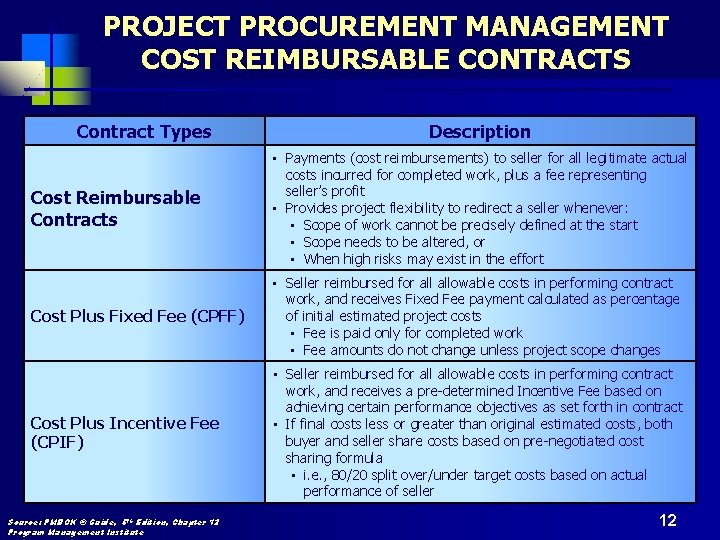
PROJECT PROCUREMENT MANAGEMENT COST REIMBURSABLE CONTRACTS Contract Types Description Cost Reimbursable Contracts • Payments (cost reimbursements) to seller for all legitimate actual costs incurred for completed work, plus a fee representing seller’s profit • Provides project flexibility to redirect a seller whenever: • Scope of work cannot be precisely defined at the start • Scope needs to be altered, or • When high risks may exist in the effort Cost Plus Fixed Fee (CPFF) • Seller reimbursed for allowable costs in performing contract work, and receives Fixed Fee payment calculated as percentage of initial estimated project costs • Fee is paid only for completed work • Fee amounts do not change unless project scope changes Cost Plus Incentive Fee (CPIF) • Seller reimbursed for allowable costs in performing contract work, and receives a pre-determined Incentive Fee based on achieving certain performance objectives as set forth in contract • If final costs less or greater than original estimated costs, both buyer and seller share costs based on pre-negotiated cost sharing formula • i. e. , 80/20 split over/under target costs based on actual performance of seller Source: PMBOK ® Guide, 5 th Edition, Chapter 12 Program Management Institute 12
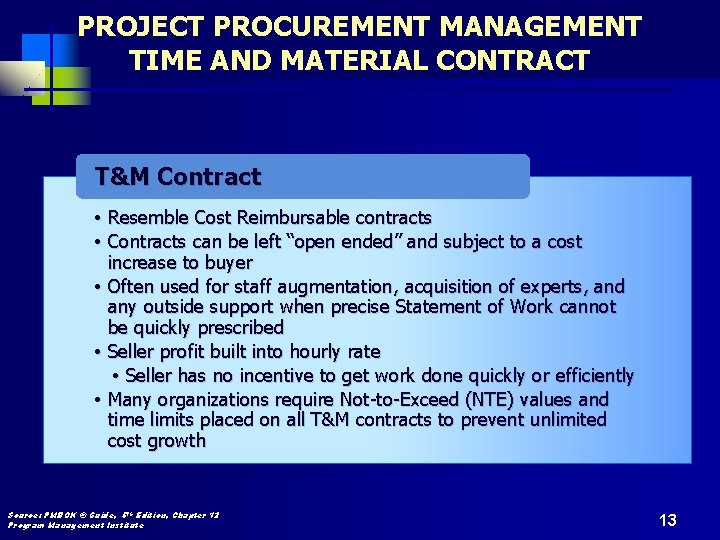
PROJECT PROCUREMENT MANAGEMENT TIME AND MATERIAL CONTRACT T&M Contract • Resemble Cost Reimbursable contracts • Contracts can be left “open ended” and subject to a cost increase to buyer • Often used for staff augmentation, acquisition of experts, and any outside support when precise Statement of Work cannot be quickly prescribed • Seller profit built into hourly rate • Seller has no incentive to get work done quickly or efficiently • Many organizations require Not-to-Exceed (NTE) values and time limits placed on all T&M contracts to prevent unlimited cost growth Source: PMBOK ® Guide, 5 th Edition, Chapter 12 Program Management Institute 13
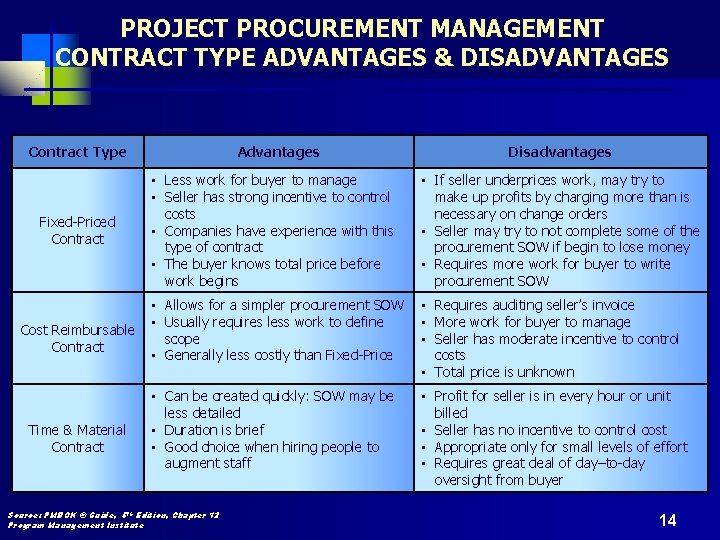
PROJECT PROCUREMENT MANAGEMENT CONTRACT TYPE ADVANTAGES & DISADVANTAGES Contract Type Fixed-Priced Contract Cost Reimbursable Contract Time & Material Contract Advantages Disadvantages • Less work for buyer to manage • Seller has strong incentive to control costs • Companies have experience with this type of contract • The buyer knows total price before work begins • If seller underprices work, may try to make up profits by charging more than is necessary on change orders • Seller may try to not complete some of the procurement SOW if begin to lose money • Requires more work for buyer to write procurement SOW • Allows for a simpler procurement SOW • Usually requires less work to define scope • Generally less costly than Fixed-Price • Requires auditing seller’s invoice • More work for buyer to manage • Seller has moderate incentive to control costs • Total price is unknown • Can be created quickly: SOW may be less detailed • Duration is brief • Good choice when hiring people to augment staff • Profit for seller is in every hour or unit billed • Seller has no incentive to control cost • Appropriate only for small levels of effort • Requires great deal of day–to-day oversight from buyer Source: PMBOK ® Guide, 5 th Edition, Chapter 12 Program Management Institute 14
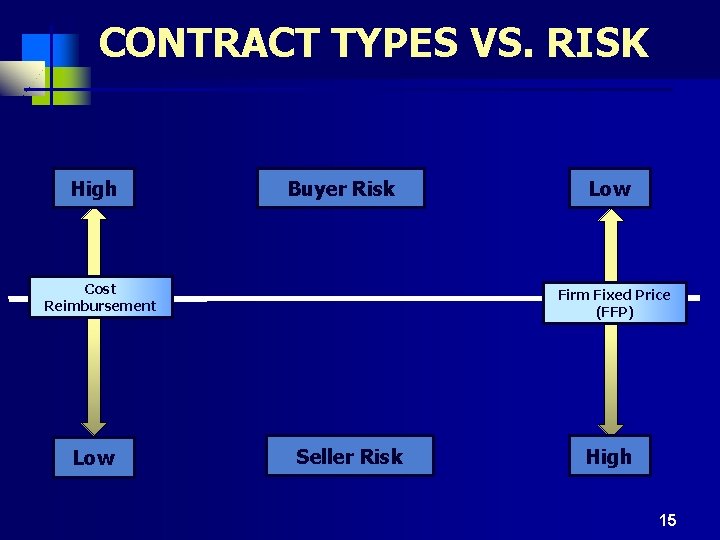
CONTRACT TYPES VS. RISK High Buyer Risk Cost Reimbursement Low Firm Fixed Price (FFP) Seller Risk High 15
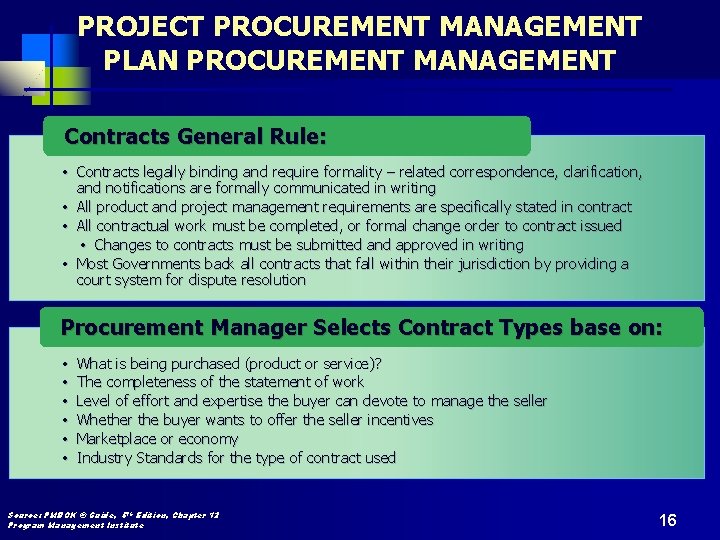
PROJECT PROCUREMENT MANAGEMENT PLAN PROCUREMENT MANAGEMENT Contracts General Rule: • Contracts legally binding and require formality – related correspondence, clarification, and notifications are formally communicated in writing • All product and project management requirements are specifically stated in contract • All contractual work must be completed, or formal change order to contract issued • Changes to contracts must be submitted and approved in writing • Most Governments back all contracts that fall within their jurisdiction by providing a court system for dispute resolution Procurement Manager Selects Contract Types base on: • • • What is being purchased (product or service)? The completeness of the statement of work Level of effort and expertise the buyer can devote to manage the seller Whether the buyer wants to offer the seller incentives Marketplace or economy Industry Standards for the type of contract used Source: PMBOK ® Guide, 5 th Edition, Chapter 12 Program Management Institute 16
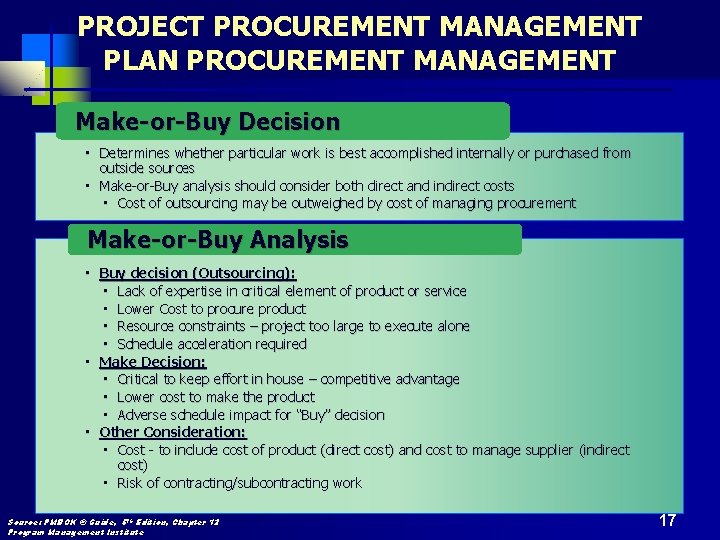
PROJECT PROCUREMENT MANAGEMENT PLAN PROCUREMENT MANAGEMENT Make-or-Buy Decision • Determines whether particular work is best accomplished internally or purchased from outside sources • Make-or-Buy analysis should consider both direct and indirect costs • Cost of outsourcing may be outweighed by cost of managing procurement Make-or-Buy Analysis • Buy decision (Outsourcing): • Lack of expertise in critical element of product or service • Lower Cost to procure product • Resource constraints – project too large to execute alone • Schedule acceleration required • Make Decision: • Critical to keep effort in house – competitive advantage • Lower cost to make the product • Adverse schedule impact for “Buy” decision • Other Consideration: • Cost - to include cost of product (direct cost) and cost to manage supplier (indirect cost) • Risk of contracting/subcontracting work Source: PMBOK ® Guide, 5 th Edition, Chapter 12 Program Management Institute 17
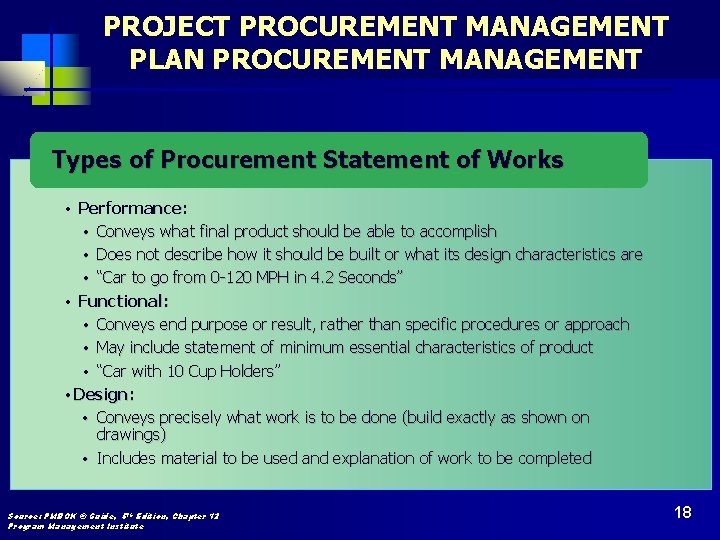
PROJECT PROCUREMENT MANAGEMENT PLAN PROCUREMENT MANAGEMENT Types of Procurement Statement of Works • Performance: • Conveys what final product should be able to accomplish • Does not describe how it should be built or what its design characteristics are • “Car to go from 0 -120 MPH in 4. 2 Seconds” • Functional: • Conveys end purpose or result, rather than specific procedures or approach • May include statement of minimum essential characteristics of product • “Car with 10 Cup Holders” • Design: • Conveys precisely what work is to be done (build exactly as shown on drawings) • Includes material to be used and explanation of work to be completed Source: PMBOK ® Guide, 5 th Edition, Chapter 12 Program Management Institute 18
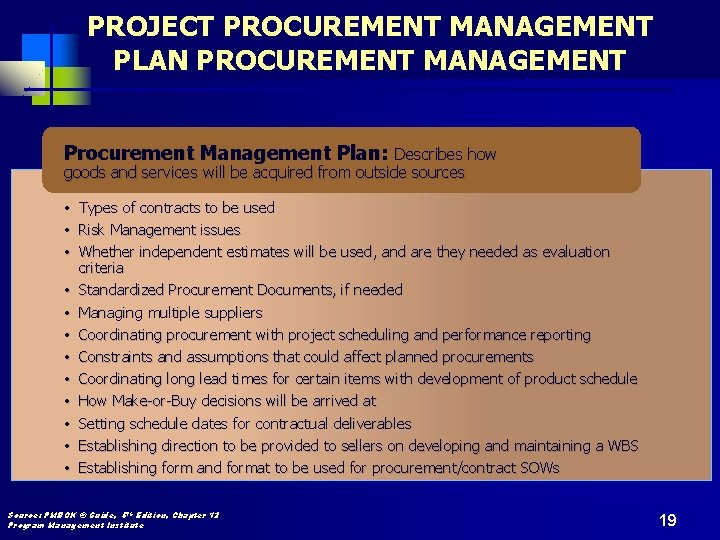
PROJECT PROCUREMENT MANAGEMENT PLAN PROCUREMENT MANAGEMENT Procurement Management Plan: Describes how goods and services will be acquired from outside sources • Types of contracts to be used • Risk Management issues • Whether independent estimates will be used, and are they needed as evaluation criteria • Standardized Procurement Documents, if needed • Managing multiple suppliers • Coordinating procurement with project scheduling and performance reporting • Constraints and assumptions that could affect planned procurements • Coordinating long lead times for certain items with development of product schedule • How Make-or-Buy decisions will be arrived at • Setting schedule dates for contractual deliverables • Establishing direction to be provided to sellers on developing and maintaining a WBS • Establishing form and format to be used for procurement/contract SOWs Source: PMBOK ® Guide, 5 th Edition, Chapter 12 Program Management Institute 19
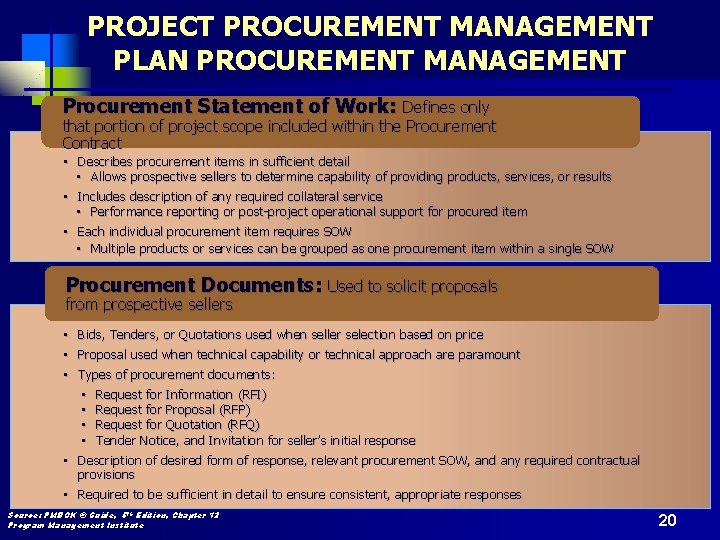
PROJECT PROCUREMENT MANAGEMENT PLAN PROCUREMENT MANAGEMENT Procurement Statement of Work: Defines only that portion of project scope included within the Procurement Contract • Describes procurement items in sufficient detail • Allows prospective sellers to determine capability of providing products, services, or results • Includes description of any required collateral service • Performance reporting or post-project operational support for procured item • Each individual procurement item requires SOW • Multiple products or services can be grouped as one procurement item within a single SOW Procurement Documents: Used to solicit proposals from prospective sellers • Bids, Tenders, or Quotations used when seller selection based on price • Proposal used when technical capability or technical approach are paramount • Types of procurement documents: • Request for Information (RFI) • Request for Proposal (RFP) • Request for Quotation (RFQ) • Tender Notice, and Invitation for seller’s initial response • Description of desired form of response, relevant procurement SOW, and any required contractual provisions • Required to be sufficient in detail to ensure consistent, appropriate responses Source: PMBOK ® Guide, 5 th Edition, Chapter 12 Program Management Institute 20
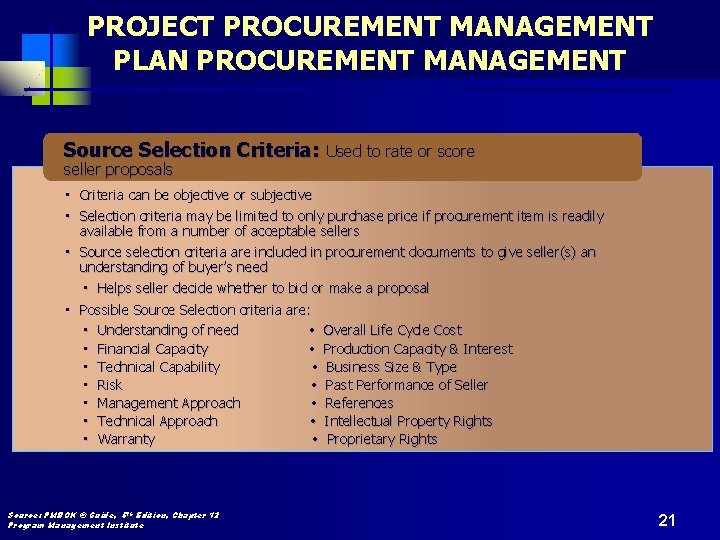
PROJECT PROCUREMENT MANAGEMENT PLAN PROCUREMENT MANAGEMENT Source Selection Criteria: seller proposals Used to rate or score • Criteria can be objective or subjective • Selection criteria may be limited to only purchase price if procurement item is readily available from a number of acceptable sellers • Source selection criteria are included in procurement documents to give seller(s) an understanding of buyer’s need • Helps seller decide whether to bid or make a proposal • Possible Source Selection criteria are: • Understanding of need Overall Life Cycle Cost • Financial Capacity Production Capacity & Interest • Technical Capability Business Size & Type • Risk Past Performance of Seller • Management Approach References • Technical Approach Intellectual Property Rights • Warranty Proprietary Rights Source: PMBOK ® Guide, 5 th Edition, Chapter 12 Program Management Institute 21
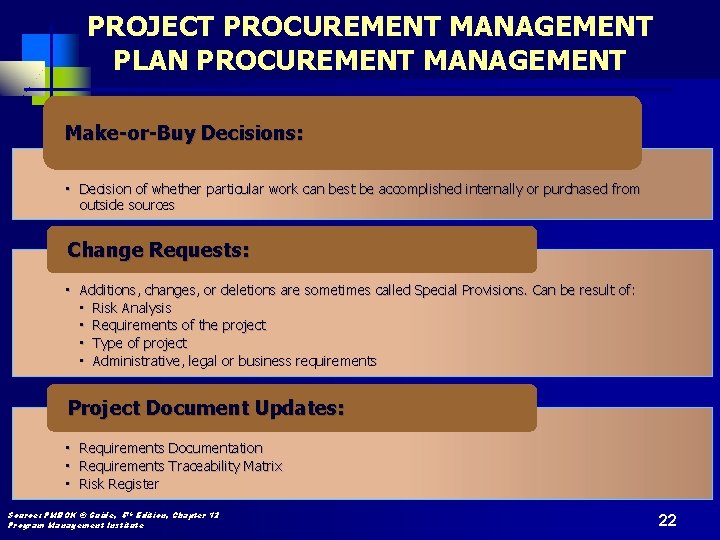
PROJECT PROCUREMENT MANAGEMENT PLAN PROCUREMENT MANAGEMENT Make-or-Buy Decisions: • Decision of whether particular work can best be accomplished internally or purchased from outside sources Change Requests: • Additions, changes, or deletions are sometimes called Special Provisions. Can be result of: • Risk Analysis • Requirements of the project • Type of project • Administrative, legal or business requirements Project Document Updates: • Requirements Documentation • Requirements Traceability Matrix • Risk Register Source: PMBOK ® Guide, 5 th Edition, Chapter 12 Program Management Institute 22
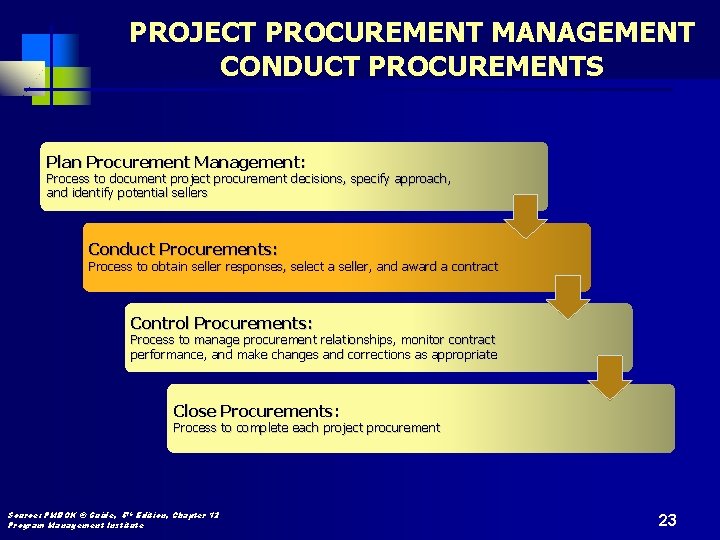
PROJECT PROCUREMENT MANAGEMENT CONDUCT PROCUREMENTS Plan Procurement Management: Process to document project procurement decisions, specify approach, and identify potential sellers Conduct Procurements: Process to obtain seller responses, select a seller, and award a contract Control Procurements: Process to manage procurement relationships, monitor contract performance, and make changes and corrections as appropriate Close Procurements: Process to complete each project procurement Source: PMBOK ® Guide, 5 th Edition, Chapter 12 Program Management Institute 23
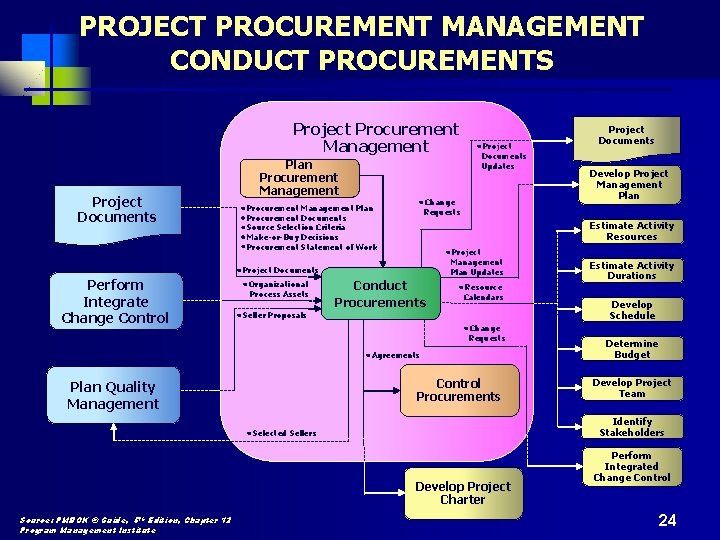
PROJECT PROCUREMENT MANAGEMENT CONDUCT PROCUREMENTS Project Procurement Management Project Documents Plan Procurement Management Plan Procurement Documents Source Selection Criteria Make-or-Buy Decisions Procurement Statement of Work Change Requests Organizational Process Assets Project Management Plan Updates Conduct Procurements Resource Calendars Seller Proposals Change Requests Agreements Control Procurements Plan Quality Management Estimate Activity Durations Develop Schedule Determine Budget Develop Project Team Identify Stakeholders Selected Sellers Develop Project Charter Source: PMBOK ® Guide, 5 th Edition, Chapter 12 Program Management Institute Develop Project Management Plan Estimate Activity Resources Project Documents Perform Integrate Change Control Project Documents Updates Project Documents Perform Integrated Change Control 24
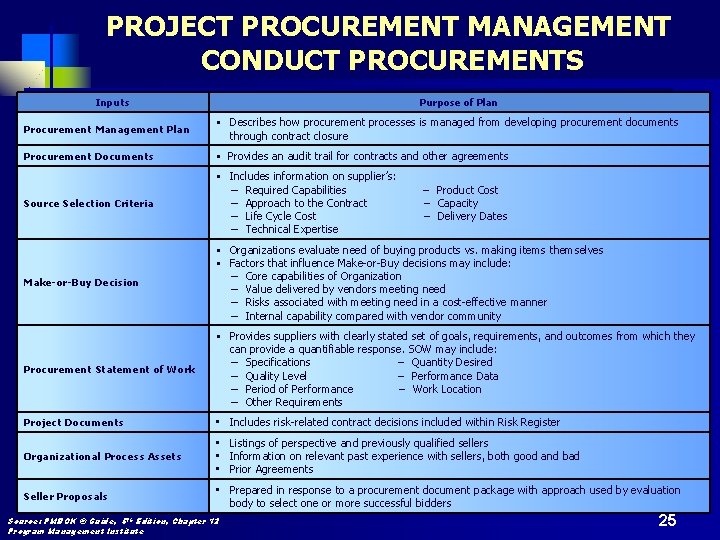
PROJECT PROCUREMENT MANAGEMENT CONDUCT PROCUREMENTS Inputs Purpose of Plan Procurement Management Plan Describes how procurement processes is managed from developing procurement documents through contract closure Procurement Documents Provides an audit trail for contracts and other agreements Source Selection Criteria Includes information on supplier’s: − Required Capabilities − Approach to the Contract − Life Cycle Cost − Technical Expertise Make-or-Buy Decision Organizations evaluate need of buying products vs. making items themselves Factors that influence Make-or-Buy decisions may include: − Core capabilities of Organization − Value delivered by vendors meeting need − Risks associated with meeting need in a cost-effective manner − Internal capability compared with vendor community Procurement Statement of Work Provides suppliers with clearly stated set of goals, requirements, and outcomes from which they can provide a quantifiable response. SOW may include: − Specifications − Quantity Desired − Quality Level − Performance Data − Period of Performance − Work Location − Other Requirements Project Documents • Includes risk-related contract decisions included within Risk Register Organizational Process Assets • Listings of perspective and previously qualified sellers • Information on relevant past experience with sellers, both good and bad • Prior Agreements Seller Proposals • Prepared in response to a procurement document package with approach used by evaluation body to select one or more successful bidders Source: PMBOK ® Guide, 5 th Edition, Chapter 12 Program Management Institute − Product Cost − Capacity − Delivery Dates 25
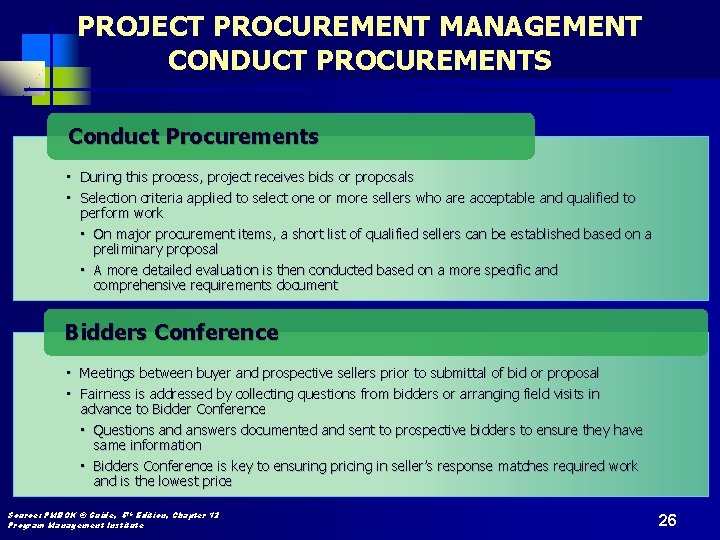
PROJECT PROCUREMENT MANAGEMENT CONDUCT PROCUREMENTS Conduct Procurements • During this process, project receives bids or proposals • Selection criteria applied to select one or more sellers who are acceptable and qualified to perform work • On major procurement items, a short list of qualified sellers can be established based on a preliminary proposal • A more detailed evaluation is then conducted based on a more specific and comprehensive requirements document Bidders Conference • Meetings between buyer and prospective sellers prior to submittal of bid or proposal • Fairness is addressed by collecting questions from bidders or arranging field visits in advance to Bidder Conference • Questions and answers documented and sent to prospective bidders to ensure they have same information • Bidders Conference is key to ensuring pricing in seller’s response matches required work and is the lowest price Source: PMBOK ® Guide, 5 th Edition, Chapter 12 Program Management Institute 26
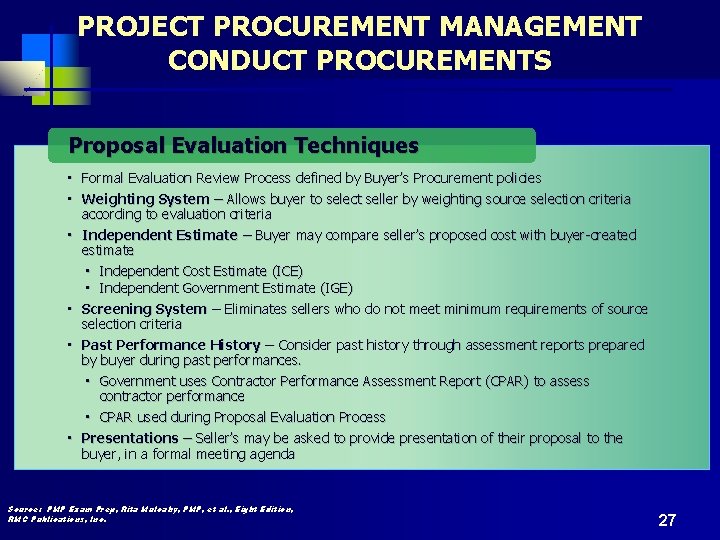
PROJECT PROCUREMENT MANAGEMENT CONDUCT PROCUREMENTS Proposal Evaluation Techniques • Formal Evaluation Review Process defined by Buyer’s Procurement policies • Weighting System – Allows buyer to select seller by weighting source selection criteria according to evaluation criteria • Independent Estimate – Buyer may compare seller’s proposed cost with buyer-created estimate • Independent Cost Estimate (ICE) • Independent Government Estimate (IGE) • Screening System – Eliminates sellers who do not meet minimum requirements of source selection criteria • Past Performance History – Consider past history through assessment reports prepared by buyer during past performances. • Government uses Contractor Performance Assessment Report (CPAR) to assess contractor performance • CPAR used during Proposal Evaluation Process • Presentations – Seller’s may be asked to provide presentation of their proposal to the buyer, in a formal meeting agenda Source: PMP Exam Prep, Rita Mulcahy, PMP, et al. , Eight Edition, RMC Publications, Inc. 27
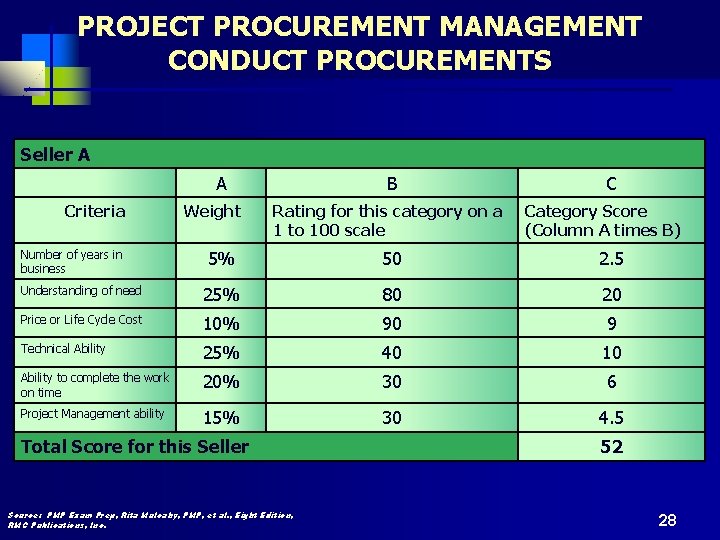
PROJECT PROCUREMENT MANAGEMENT CONDUCT PROCUREMENTS Seller A A Criteria Weight B Rating for this category on a 1 to 100 scale C Category Score (Column A times B) 5% 50 2. 5 Understanding of need 25% 80 20 Price or Life Cycle Cost 10% 90 9 Technical Ability 25% 40 10 Ability to complete the work on time 20% 30 6 Project Management ability 15% 30 4. 5 Number of years in business Total Score for this Seller Source: PMP Exam Prep, Rita Mulcahy, PMP, et al. , Eight Edition, RMC Publications, Inc. 52 28
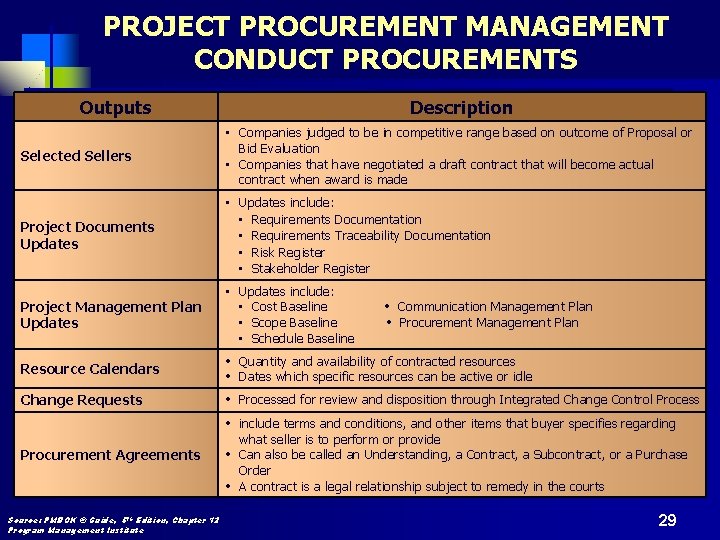
PROJECT PROCUREMENT MANAGEMENT CONDUCT PROCUREMENTS Outputs Description Selected Sellers • Companies judged to be in competitive range based on outcome of Proposal or Bid Evaluation • Companies that have negotiated a draft contract that will become actual contract when award is made Project Documents Updates • Updates include: • Requirements Documentation • Requirements Traceability Documentation • Risk Register • Stakeholder Register Project Management Plan Updates • Updates include: • Cost Baseline • Scope Baseline • Schedule Baseline Resource Calendars Quantity and availability of contracted resources Dates which specific resources can be active or idle Change Requests Processed for review and disposition through Integrated Change Control Process Procurement Agreements include terms and conditions, and other items that buyer specifies regarding what seller is to perform or provide Can also be called an Understanding, a Contract, a Subcontract, or a Purchase Order A contract is a legal relationship subject to remedy in the courts Source: PMBOK ® Guide, 5 th Edition, Chapter 12 Program Management Institute Communication Management Plan Procurement Management Plan 29
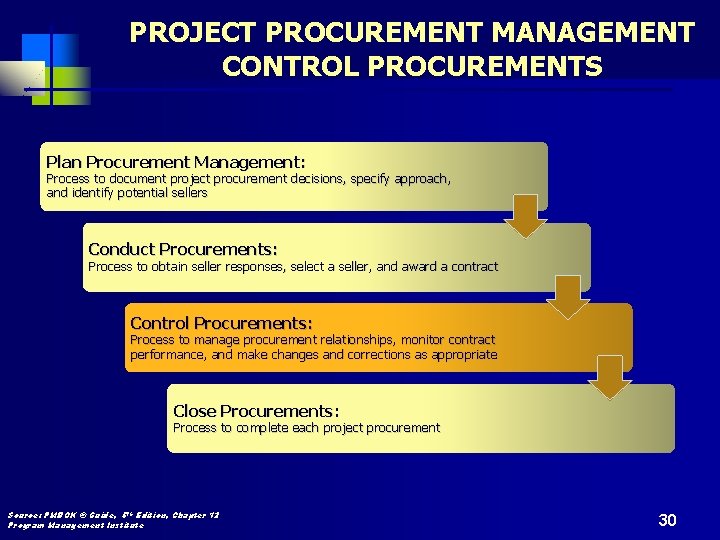
PROJECT PROCUREMENT MANAGEMENT CONTROL PROCUREMENTS Plan Procurement Management: Process to document project procurement decisions, specify approach, and identify potential sellers Conduct Procurements: Process to obtain seller responses, select a seller, and award a contract Control Procurements: Process to manage procurement relationships, monitor contract performance, and make changes and corrections as appropriate Close Procurements: Process to complete each project procurement Source: PMBOK ® Guide, 5 th Edition, Chapter 12 Program Management Institute 30
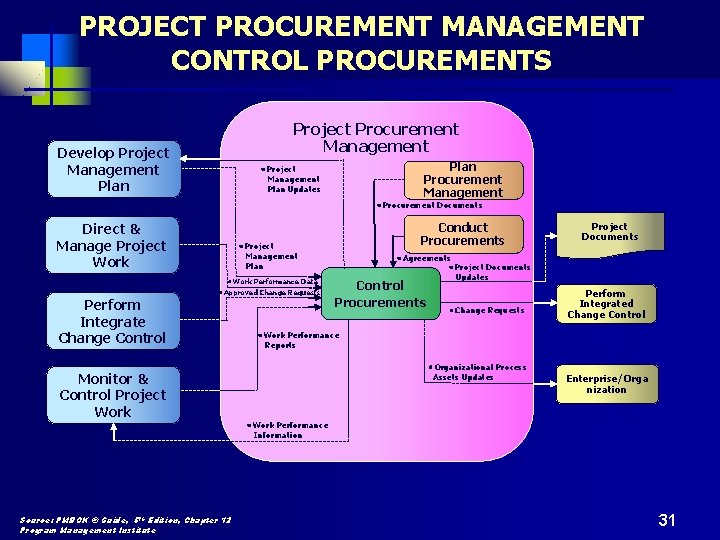
PROJECT PROCUREMENT MANAGEMENT CONTROL PROCUREMENTS Project Procurement Management Develop Project Management Plan Procurement Management Project Management Plan Updates Procurement Documents Direct & Manage Project Work Project Management Plan Work Performance Data Perform Integrate Change Control Conduct Procurements Approved Change Requests Monitor & Control Project Work Source: PMBOK ® Guide, 5 th Edition, Chapter 12 Program Management Institute Project Documents Agreements Project Documents Updates Control Procurements Change Requests Perform Integrated Change Control Work Performance Reports Organizational Process Assets Updates Enterprise/Orga nization Work Performance Information 31
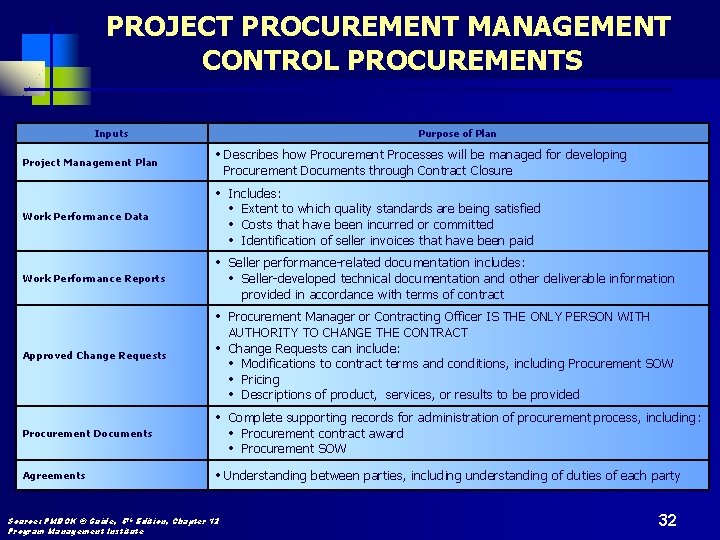
PROJECT PROCUREMENT MANAGEMENT CONTROL PROCUREMENTS Inputs Purpose of Plan Project Management Plan Describes how Procurement Processes will be managed for developing Procurement Documents through Contract Closure Work Performance Data Includes: Extent to which quality standards are being satisfied Costs that have been incurred or committed Identification of seller invoices that have been paid Work Performance Reports Seller performance-related documentation includes: Seller-developed technical documentation and other deliverable information provided in accordance with terms of contract Approved Change Requests Procurement Manager or Contracting Officer IS THE ONLY PERSON WITH AUTHORITY TO CHANGE THE CONTRACT Change Requests can include: Modifications to contract terms and conditions, including Procurement SOW Pricing Descriptions of product, services, or results to be provided Procurement Documents Complete supporting records for administration of procurement process, including: Procurement contract award Procurement SOW Agreements Understanding between parties, including understanding of duties of each party Source: PMBOK ® Guide, 5 th Edition, Chapter 12 Program Management Institute 32
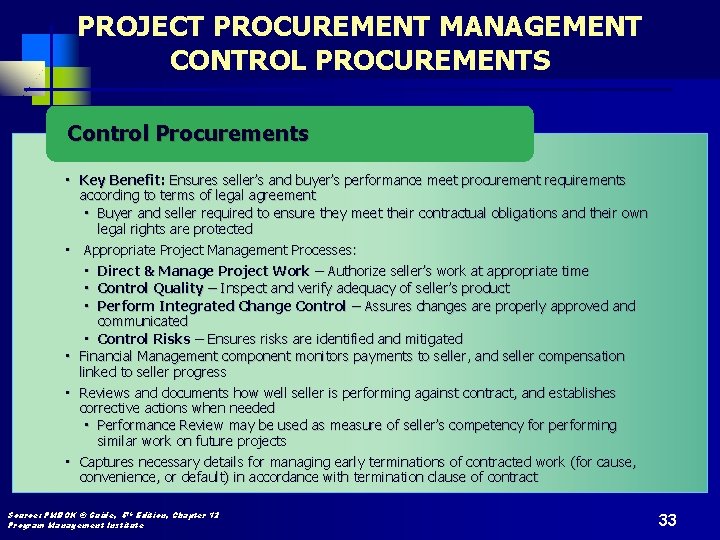
PROJECT PROCUREMENT MANAGEMENT CONTROL PROCUREMENTS Control Procurements • Key Benefit: Ensures seller’s and buyer’s performance meet procurement requirements according to terms of legal agreement • Buyer and seller required to ensure they meet their contractual obligations and their own legal rights are protected • Appropriate Project Management Processes: • Direct & Manage Project Work – Authorize seller’s work at appropriate time • Control Quality – Inspect and verify adequacy of seller’s product • Perform Integrated Change Control – Assures changes are properly approved and communicated • Control Risks – Ensures risks are identified and mitigated • Financial Management component monitors payments to seller, and seller compensation linked to seller progress • Reviews and documents how well seller is performing against contract, and establishes corrective actions when needed • Performance Review may be used as measure of seller’s competency for performing similar work on future projects • Captures necessary details for managing early terminations of contracted work (for cause, convenience, or default) in accordance with termination clause of contract Source: PMBOK ® Guide, 5 th Edition, Chapter 12 Program Management Institute 33
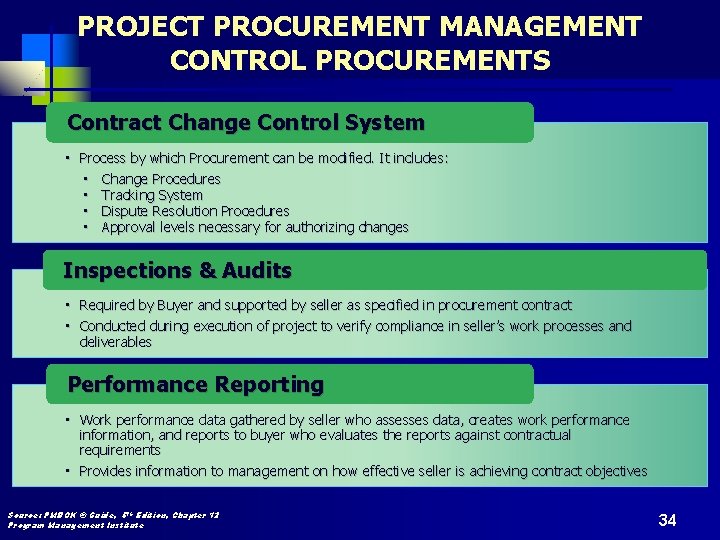
PROJECT PROCUREMENT MANAGEMENT CONTROL PROCUREMENTS Contract Change Control System • Process by which Procurement can be modified. It includes: • Change Procedures • Tracking System • Dispute Resolution Procedures • Approval levels necessary for authorizing changes Inspections & Audits • Required by Buyer and supported by seller as specified in procurement contract • Conducted during execution of project to verify compliance in seller’s work processes and deliverables Performance Reporting • Work performance data gathered by seller who assesses data, creates work performance information, and reports to buyer who evaluates the reports against contractual requirements • Provides information to management on how effective seller is achieving contract objectives Source: PMBOK ® Guide, 5 th Edition, Chapter 12 Program Management Institute 34
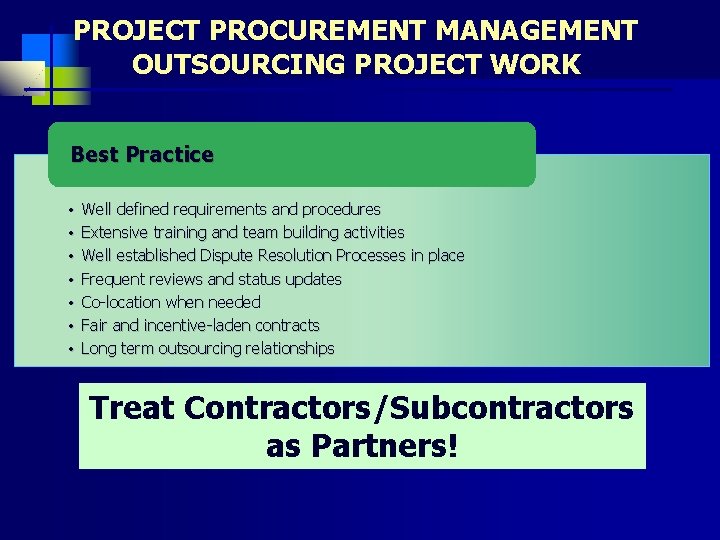
PROJECT PROCUREMENT MANAGEMENT OUTSOURCING PROJECT WORK Best Practice • • Well defined requirements and procedures Extensive training and team building activities Well established Dispute Resolution Processes in place Frequent reviews and status updates Co-location when needed Fair and incentive-laden contracts Long term outsourcing relationships Treat Contractors/Subcontractors as Partners!
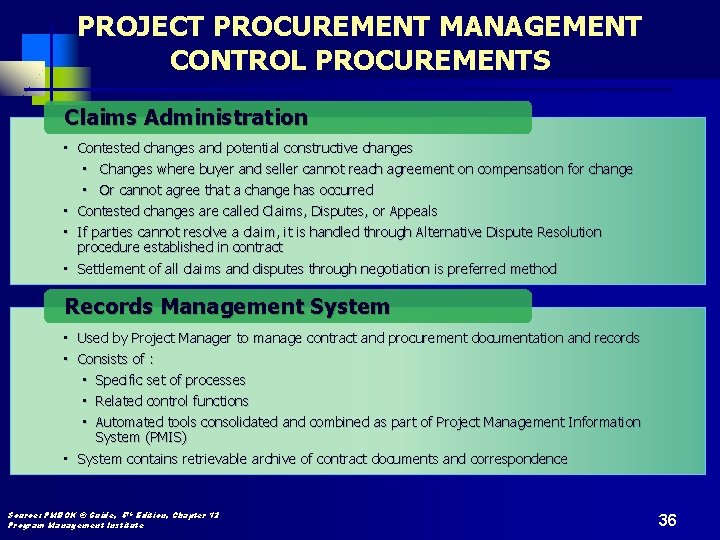
PROJECT PROCUREMENT MANAGEMENT CONTROL PROCUREMENTS Claims Administration • Contested changes and potential constructive changes • Changes where buyer and seller cannot reach agreement on compensation for change • Or cannot agree that a change has occurred • Contested changes are called Claims, Disputes, or Appeals • If parties cannot resolve a claim, it is handled through Alternative Dispute Resolution procedure established in contract • Settlement of all claims and disputes through negotiation is preferred method Records Management System • Used by Project Manager to manage contract and procurement documentation and records • Consists of : • Specific set of processes • Related control functions • Automated tools consolidated and combined as part of Project Management Information System (PMIS) • System contains retrievable archive of contract documents and correspondence Source: PMBOK ® Guide, 5 th Edition, Chapter 12 Program Management Institute 36
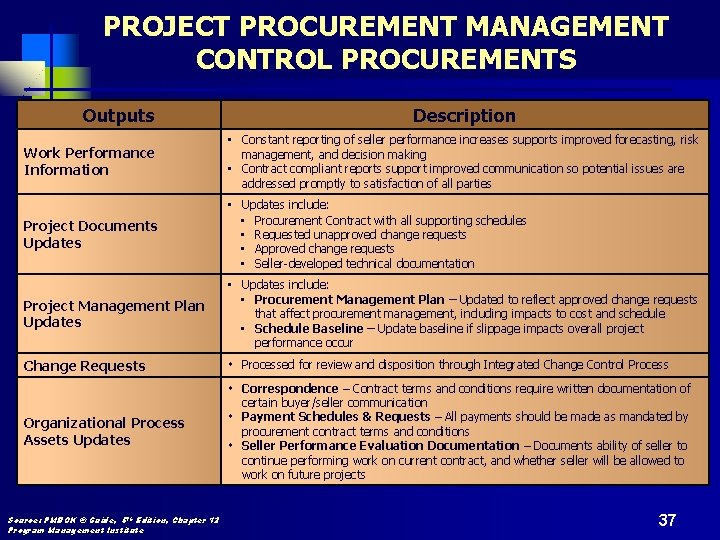
PROJECT PROCUREMENT MANAGEMENT CONTROL PROCUREMENTS Outputs Description Work Performance Information • Constant reporting of seller performance increases supports improved forecasting, risk management, and decision making • Contract compliant reports support improved communication so potential issues are addressed promptly to satisfaction of all parties Project Documents Updates • Updates include: • Procurement Contract with all supporting schedules • Requested unapproved change requests • Approved change requests • Seller-developed technical documentation Project Management Plan Updates • Updates include: • Procurement Management Plan – Updated to reflect approved change requests that affect procurement management, including impacts to cost and schedule • Schedule Baseline – Update baseline if slippage impacts overall project performance occur Change Requests Processed for review and disposition through Integrated Change Control Process Organizational Process Assets Updates Correspondence – Contract terms and conditions require written documentation of certain buyer/seller communication Payment Schedules & Requests – All payments should be made as mandated by procurement contract terms and conditions Seller Performance Evaluation Documentation – Documents ability of seller to continue performing work on current contract, and whether seller will be allowed to work on future projects Source: PMBOK ® Guide, 5 th Edition, Chapter 12 Program Management Institute 37
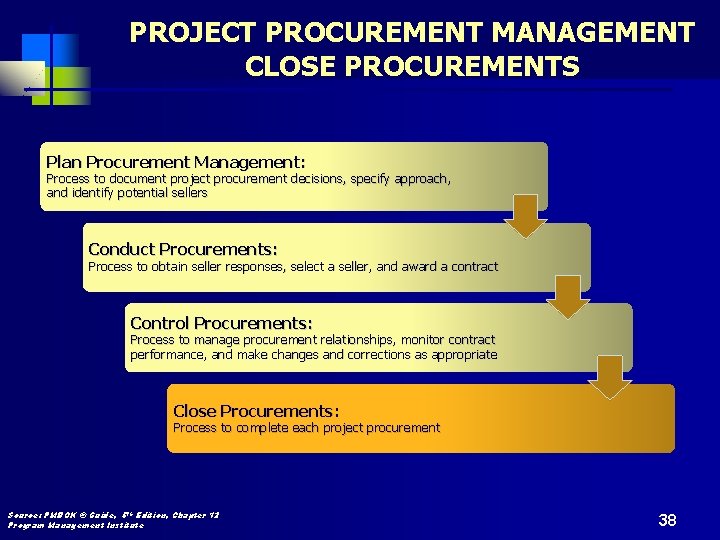
PROJECT PROCUREMENT MANAGEMENT CLOSE PROCUREMENTS Plan Procurement Management: Process to document project procurement decisions, specify approach, and identify potential sellers Conduct Procurements: Process to obtain seller responses, select a seller, and award a contract Control Procurements: Process to manage procurement relationships, monitor contract performance, and make changes and corrections as appropriate Close Procurements: Process to complete each project procurement Source: PMBOK ® Guide, 5 th Edition, Chapter 12 Program Management Institute 38
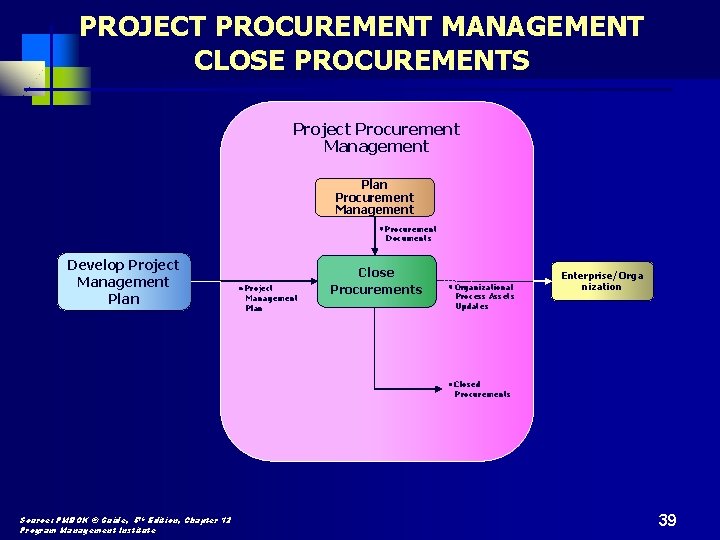
PROJECT PROCUREMENT MANAGEMENT CLOSE PROCUREMENTS Project Procurement Management Plan Procurement Management Procurement Documents Develop Project Management Plan Close Procurements Organizational Process Assets Updates Enterprise/Orga nization Closed Procurements Source: PMBOK ® Guide, 5 th Edition, Chapter 12 Program Management Institute 39
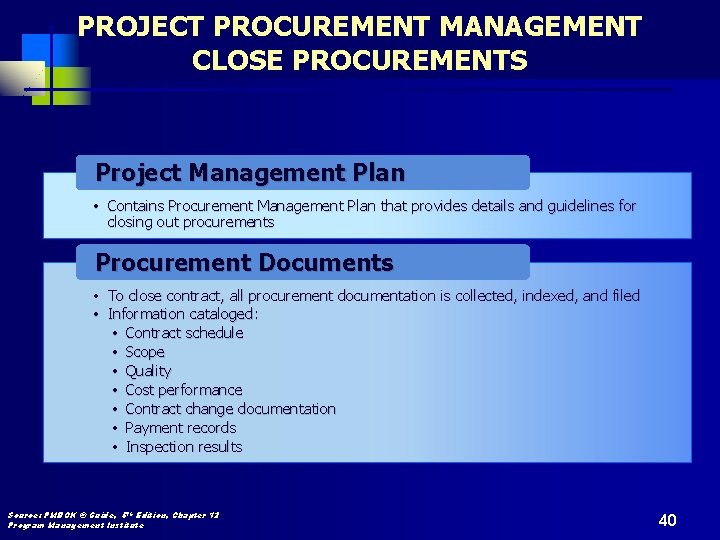
PROJECT PROCUREMENT MANAGEMENT CLOSE PROCUREMENTS Project Management Plan • Contains Procurement Management Plan that provides details and guidelines for closing out procurements Procurement Documents • To close contract, all procurement documentation is collected, indexed, and filed • Information cataloged: • Contract schedule • Scope • Quality • Cost performance • Contract change documentation • Payment records • Inspection results Source: PMBOK ® Guide, 5 th Edition, Chapter 12 Program Management Institute 40
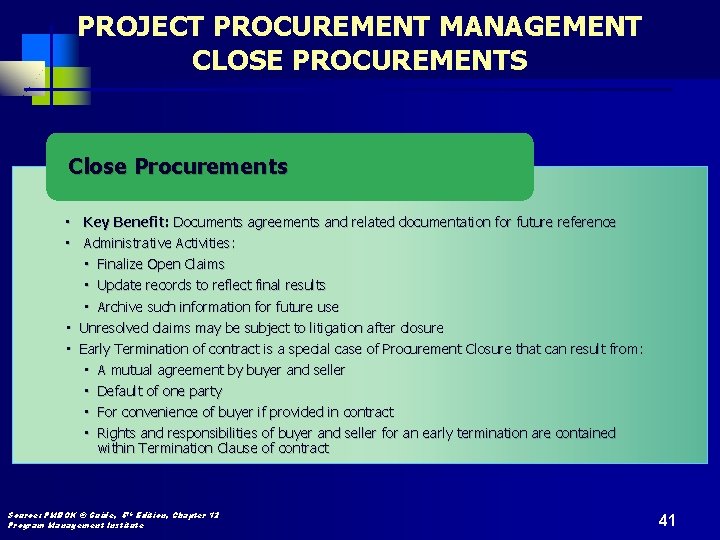
PROJECT PROCUREMENT MANAGEMENT CLOSE PROCUREMENTS Close Procurements • Key Benefit: Documents agreements and related documentation for future reference • Administrative Activities: • Finalize Open Claims • Update records to reflect final results • Archive such information for future use • Unresolved claims may be subject to litigation after closure • Early Termination of contract is a special case of Procurement Closure that can result from: • A mutual agreement by buyer and seller • Default of one party • For convenience of buyer if provided in contract • Rights and responsibilities of buyer and seller for an early termination are contained within Termination Clause of contract Source: PMBOK ® Guide, 5 th Edition, Chapter 12 Program Management Institute 41
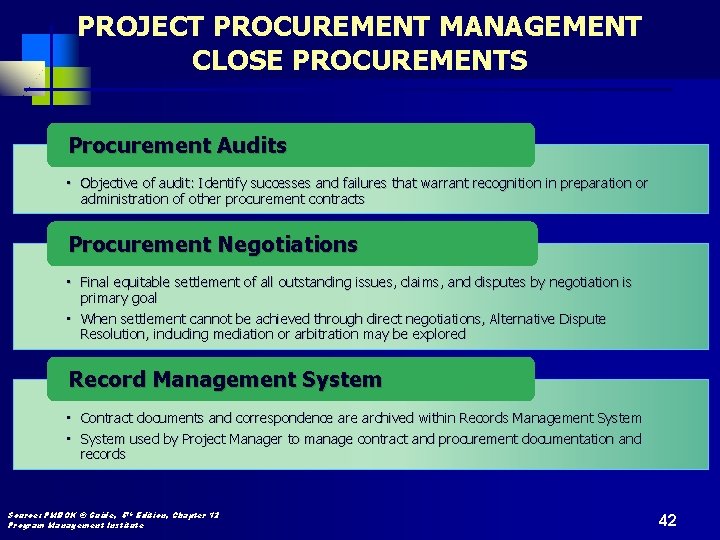
PROJECT PROCUREMENT MANAGEMENT CLOSE PROCUREMENTS Procurement Audits • Objective of audit: Identify successes and failures that warrant recognition in preparation or administration of other procurement contracts Procurement Negotiations • Final equitable settlement of all outstanding issues, claims, and disputes by negotiation is primary goal • When settlement cannot be achieved through direct negotiations, Alternative Dispute Resolution, including mediation or arbitration may be explored Record Management System • Contract documents and correspondence archived within Records Management System • System used by Project Manager to manage contract and procurement documentation and records Source: PMBOK ® Guide, 5 th Edition, Chapter 12 Program Management Institute 42
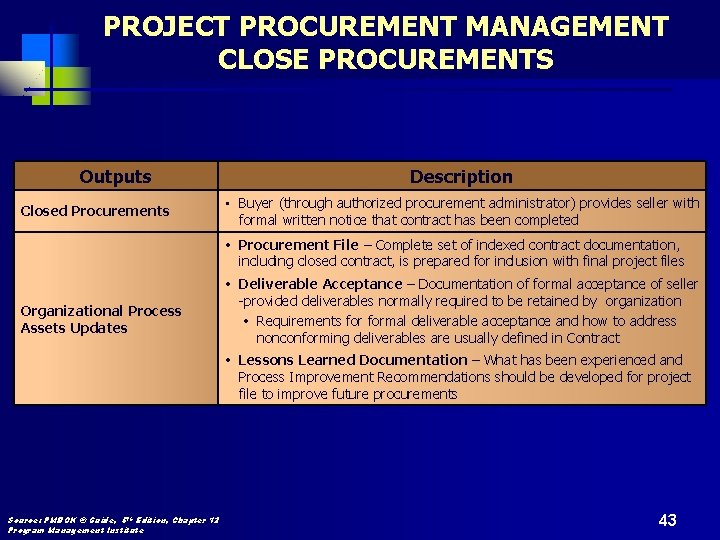
PROJECT PROCUREMENT MANAGEMENT CLOSE PROCUREMENTS Outputs Closed Procurements Description • Buyer (through authorized procurement administrator) provides seller with formal written notice that contract has been completed Procurement File – Complete set of indexed contract documentation, including closed contract, is prepared for inclusion with final project files Organizational Process Assets Updates Deliverable Acceptance – Documentation of formal acceptance of seller -provided deliverables normally required to be retained by organization Requirements formal deliverable acceptance and how to address nonconforming deliverables are usually defined in Contract Lessons Learned Documentation – What has been experienced and Process Improvement Recommendations should be developed for project file to improve future procurements Source: PMBOK ® Guide, 5 th Edition, Chapter 12 Program Management Institute 43
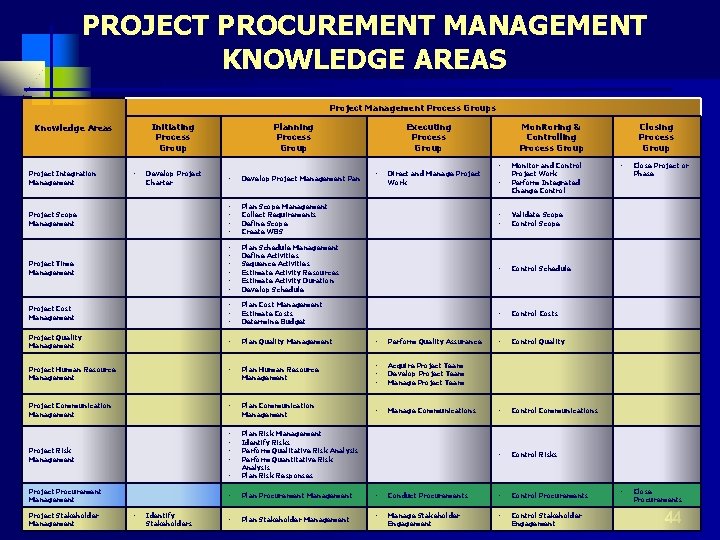
PROJECT PROCUREMENT MANAGEMENT KNOWLEDGE AREAS Project Management Process Groups Initiating Process Group Knowledge Areas Project Integration Management • Develop Project Charter Planning Process Group Executing Process Group • Direct and Manage Project Work Monitoring & Controlling Process Group • Monitor and Control Project Work Perform Integrated Change Control • Develop Project Management Pan Project Scope Management • • Plan Scope Management Collect Requirements Define Scope Create WBS • • Validate Scope Control Scope Project Time Management • • • Plan Schedule Management Define Activities Sequence Activities Estimate Activity Resources Estimate Activity Duration Develop Schedule • Control Schedule Project Cost Management • • • Plan Cost Management Estimate Costs Determine Budget • Control Costs Project Quality Management • Plan Quality Management • Perform Quality Assurance • Control Quality Project Human Resource Management • Plan Human Resource Management • • • Acquire Project Team Develop Project Team Manage Project Team Project Communication Management • Plan Communication Management • Manage Communications • Control Communications • • • Control Risks • Plan Risk Management Identify Risks Perform Qualitative Risk Analysis Perform Quantitative Risk Analysis Plan Risk Responses • Plan Procurement Management • Plan Stakeholder Management Project Risk Management Project Procurement Management Project Stakeholder Management • Identify Stakeholders • • Conduct Procurements • Control Procurements • Manage Stakeholder Engagement • Control Stakeholder Engagement Closing Process Group • Close Project or Phase • Close Procurements 44
- Slides: 44