
Project Management Basics Every Administrative Professional Should Know
Project Management Basics Every Administrative Professional Should Know
Presentation • Prepared by Margaret C. Mullin, PMP, CSM, MBA on behalf of the PMI Puget Sound Chapter for the Washington-Alaska Division of the International Association of Administrative Professionals for their annual meeting and education forum, 5/13/2011 • All rights reserved 2011 Project Management Basics
Today’s Presentation • IAAP Survey – What I Heard You Say • How can Project Management help you? • What is a Project? What is Project Management? • What is the Project Management Life Cycle? • What is the Work Breakdown Structure? • The Work Breakdown Structure Team Project • Putting it all Together • Questions Project Management Basics
IAAP Survey: What I Heard You Say • What you consider Project Management • Your role on projects • Your competing responsibilities • Your challenges managing projects
WIIIFM? • Better understanding of projects and project management • Tools to help with project management • Hands on experience • Resources to learn more about project management
What is the Project Management Institute (PMI)? • One of the largest not-for-profit professional associations in the world • Global Standards • The premier standard, A Guide to the Project Management Body of Knowledge (PMBOK® Guide ) • Globally Recognized Credentials • Credentials recognized by business, government, and NGOs worldwide; 390, 000 credential holders globally • Global Organization Project Management Basics
About Puget Sound PMI Chapter • PMI Puget Sound - non-profit, tax exempt corporation founded in 1986, and facilitates professional growth through education and volunteerism • Creating opportunities for development and learning in project management • Providing programs and services to the Project Management community • Promoting project management certification, PMI®, and project management professionalism to the community. Project Management Basics
What is a Project? • A temporary endeavor undertaken to create a unique product, service or result. • A project has a clearly defined beginning and end. • Projects can vary in duration, size and complexity. Project Management Basics

What is Project Management? • The application of knowledge, skills, tools and techniques to project activities to meet the project requirements. • Accomplished through the use of project management process groups, such as Initiating, Planning, Executing, Monitoring, and Controlling and Closing. • An iterative process because of the progressive elaboration that takes place throughout the duration of the project. Project Management Basics
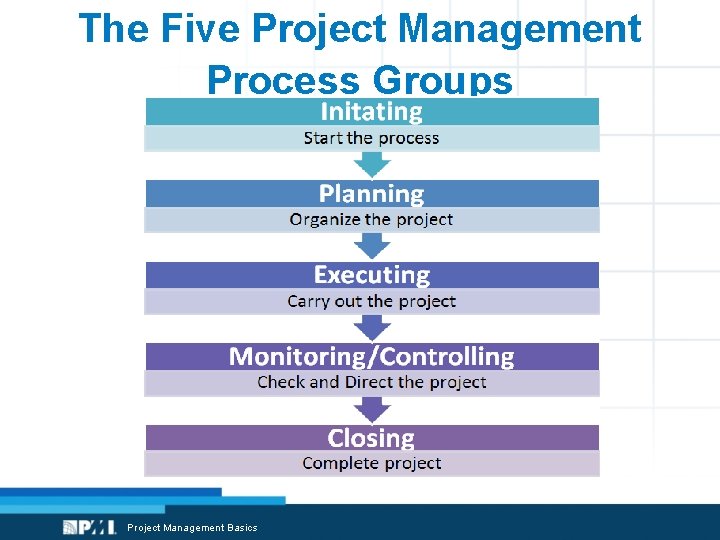
The Five Project Management Process Groups Project Management Basics
The Project Management Lifecycle No matter how large or small, simple or complex, all projects can be mapped to the following life cycle structure: 1. Starting the project (Initiating) 2. Organizing and preparing the project (Planning) 3. Carrying out the project work, and (Executing and Monitoring & Controlling) 4. Closing the project (Closing) Creating a Work Breakdown Structure 11
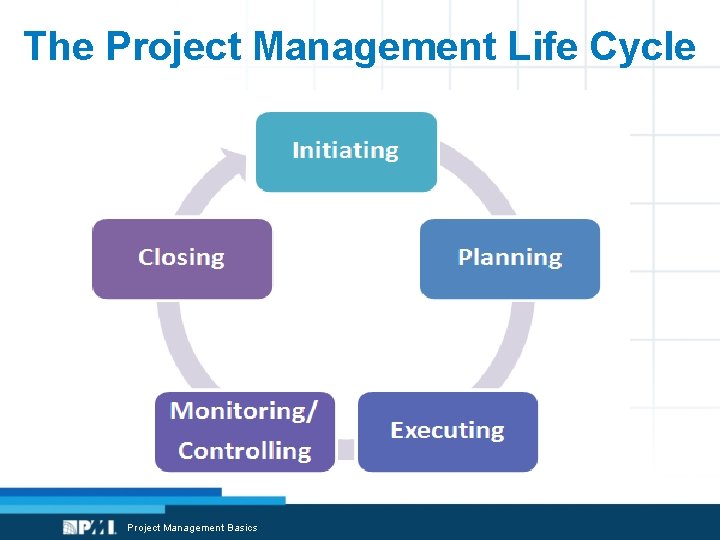
The Project Management Life Cycle Project Management Basics

Where Do I Start? Start with the Scope Project Management Basics Create: The WBS Develop: The Project Schedule
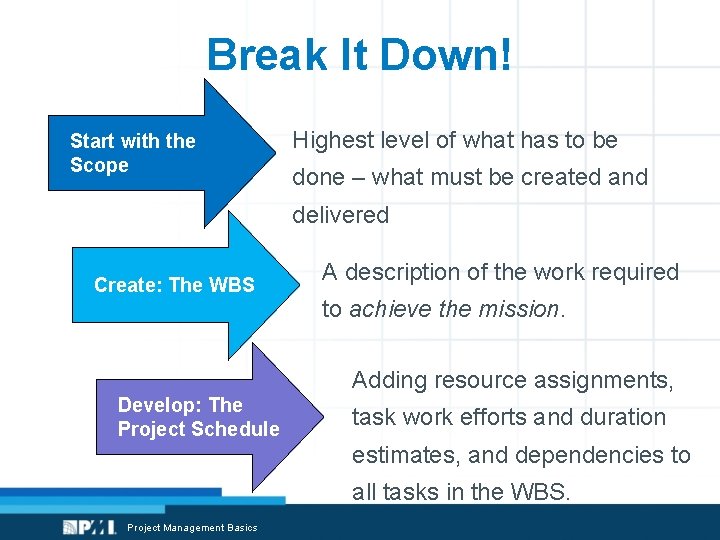
Break It Down! Start with the Scope Highest level of what has to be done – what must be created and delivered Create: The WBS A description of the work required to achieve the mission. Adding resource assignments, Develop: The Project Schedule task work efforts and duration estimates, and dependencies to all tasks in the WBS. Project Management Basics
What is a Work Breakdown Structure? The WBS: • Provides an approach for “decomposing” the work into measurable units. • Allows breakdown of work into deliverables, activities, and tasks that can be assigned to an owner. • Helps ensure that the scope is completely defined and the team has not forgotten any work. Project Management Basics

Estimating Project Activities You need to define and estimate the work activities that will need to be done to successfully complete your project – Identify specific actions needed to produce your project deliverables – Identify actions at the lowest level possible – the work packages [For example, if building a house, identify the “frame, ” and within that: “frame, ” “walls, ” “windows, ” “doors” and “floor” work packages] Creating a Work Breakdown Structure 16
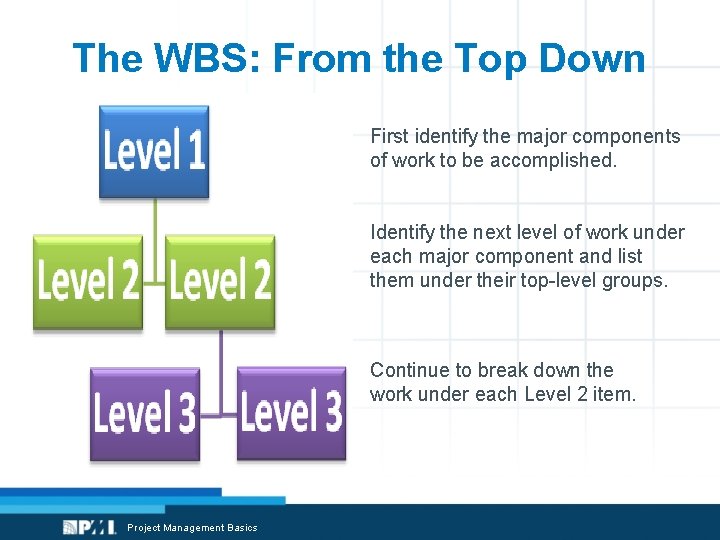
The WBS: From the Top Down First identify the major components of work to be accomplished. Identify the next level of work under each major component and list them under their top-level groups. Continue to break down the work under each Level 2 item. Project Management Basics
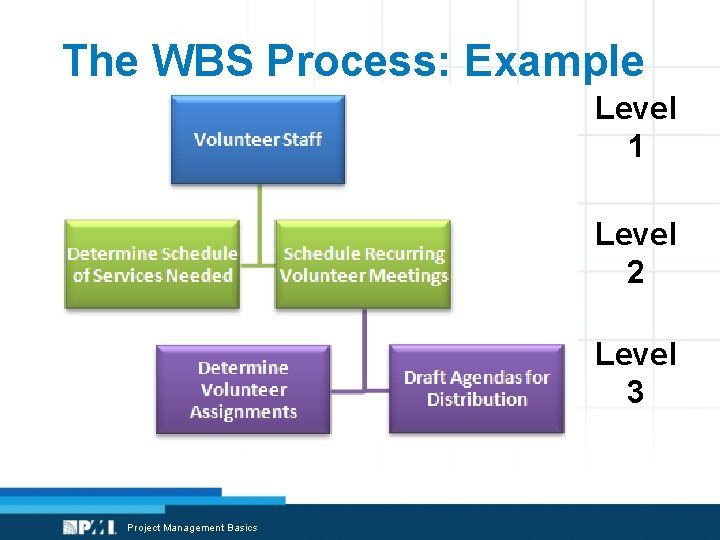
The WBS Process: Example Level 1 Level 2 Level 3 Project Management Basics
WBS Structure: How Much Detail is Enough? When working on a WBS it is important to remember: • Only one owner per task • Set clear measurable deliverables with measurements specified • Task durations should be small enough for tracking Project Management Basics
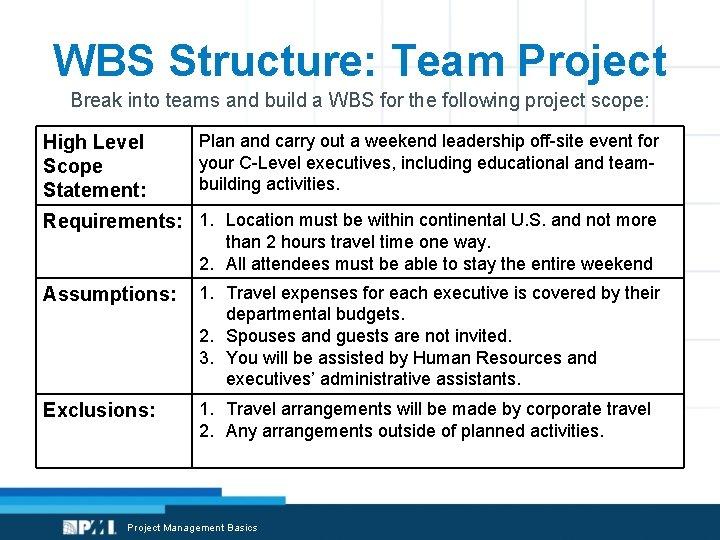
WBS Structure: Team Project Break into teams and build a WBS for the following project scope: High Level Scope Statement: Plan and carry out a weekend leadership off-site event for your C-Level executives, including educational and teambuilding activities. Requirements: 1. Location must be within continental U. S. and not more than 2 hours travel time one way. 2. All attendees must be able to stay the entire weekend Assumptions: 1. Travel expenses for each executive is covered by their departmental budgets. 2. Spouses and guests are not invited. 3. You will be assisted by Human Resources and executives’ administrative assistants. Exclusions: 1. Travel arrangements will be made by corporate travel 2. Any arrangements outside of planned activities. Project Management Basics
Discuss the Results Project Management Basics
Project Schedule After you have: – Defined and sequenced your project activities – Estimated needed resources and durations You are ready to put your project schedule together! When you develop your schedule, keep in mind; – You may need to revise your estimates – Once your schedule is complete, it becomes your benchmark [an unchanged version you measure project progress against] – Your schedule can change, but keep a copy of the original so you can always measure against your original plan Creating a Work Breakdown Structure 22
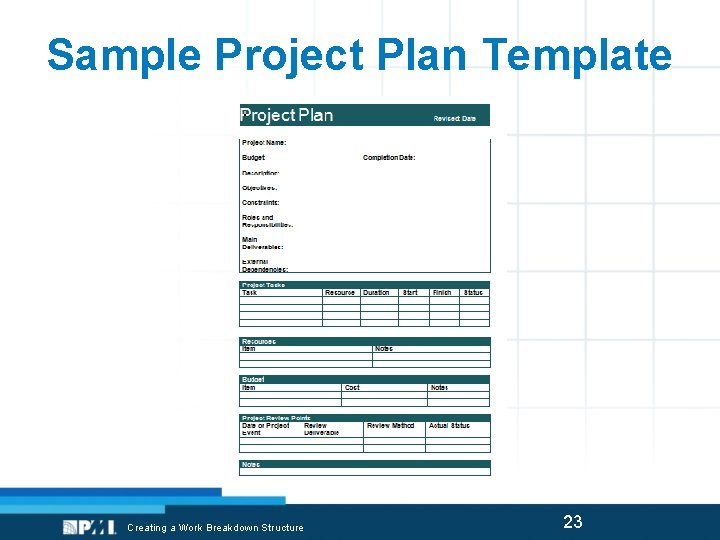
Sample Project Plan Template Creating a Work Breakdown Structure 23
Questions? Project Management Basics
Resources • Project Management Institute (PMI) – http: //www. pmi. org • PMI Puget Sound Chapter – http: //www. pugetsoundpmi. org • Project Management Essentials – http: //projectmanagementessentials. wordpress. com • Gantthead – http: //www. gantthead. com Margaret C. Mullin, PMP, CSM, MBA margaretmullin@comcast. net http: //www. linkedin. com/in/margaretmullinpmpcsmmba http: //projectmanagementessentials. wordpress. com Creating a Work Breakdown Structure 25
- Slides: 25