
Project Management Achieving Competitive Advantage Fifth Edition Global
Project Management: Achieving Competitive Advantage Fifth Edition, Global Edition Chapter 2 The Organizational Context: Strategy, Structure, and Culture Copyright © 2020 Pearson Education, Ltd. All Rights Reserved
Learning Objectives (1 of 2) 2. 1 Understand how effective project management contributes to achieving strategic objectives. 2. 2 Recognize three components of the corporate strategy model: formulation, implementation, and evaluation. 2. 3 See the importance of identifying critical project stakeholders and managing them within the context of project development. 2. 4 Recognize the strengths and weaknesses of three basic forms of organizational structure and their implications for managing projects. Copyright © 2020 Pearson Education, Ltd. All Rights Reserved

Learning Objectives (2 of 2) 2. 5 Identify the characteristics of three forms of a project management office (PMO). 2. 6 Understand key concepts of corporate culture and how cultures are formed. Copyright © 2020 Pearson Education, Ltd. All Rights Reserved
PMBo. K Core Concepts Project Management Body of Knowledge (PMBo. K) covered in this chapter includes: 1. Project Procurement Management (PMBo. K 12) 2. Identify Stakeholders (PMBo. K 13. 1) 3. Plan Stakeholder Management (PMBo. K 13. 2) 4. Manage Stakeholder Engagement (PMBo. K 13. 3) 5. Organizational Influences on Project Management (PMBo. K 2. 1) 6. Organizational Structures (PMBo. K 2. 1. 3) 7. Organizational Cultures and Styles (PMBo. K 2. 1. 1) 8. Enterprise Environmental Factors (PMBo. K 2. 1. 5) Copyright © 2020 Pearson Education, Ltd. All Rights Reserved
Projects and Organizational Strategy Strategic management—the science of formulating, implementing, and evaluating cross-functional decisions that enable an organization to achieve its objectives. Consists of: • Developing vision and mission statements • Formulating, implementing, and evaluating • Making cross-functional decisions • Achieving objectives Copyright © 2020 Pearson Education, Ltd. All Rights Reserved
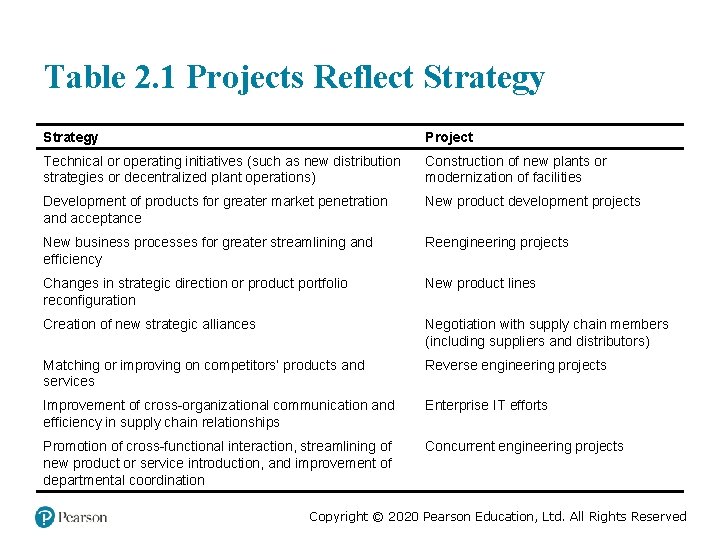
Table 2. 1 Projects Reflect Strategy Project Technical or operating initiatives (such as new distribution strategies or decentralized plant operations) Construction of new plants or modernization of facilities Development of products for greater market penetration and acceptance New product development projects New business processes for greater streamlining and efficiency Reengineering projects Changes in strategic direction or product portfolio reconfiguration New product lines Creation of new strategic alliances Negotiation with supply chain members (including suppliers and distributors) Matching or improving on competitors’ products and services Reverse engineering projects Improvement of cross-organizational communication and efficiency in supply chain relationships Enterprise IT efforts Promotion of cross-functional interaction, streamlining of new product or service introduction, and improvement of departmental coordination Concurrent engineering projects Copyright © 2020 Pearson Education, Ltd. All Rights Reserved
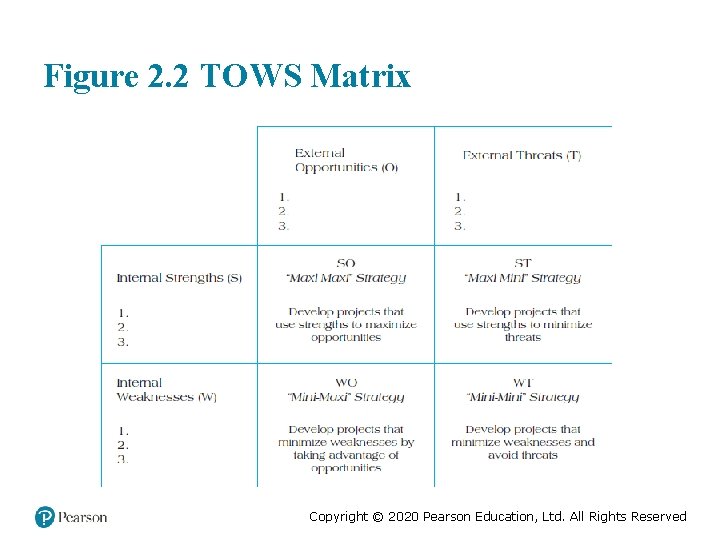
Figure 2. 2 TOWS Matrix Copyright © 2020 Pearson Education, Ltd. All Rights Reserved
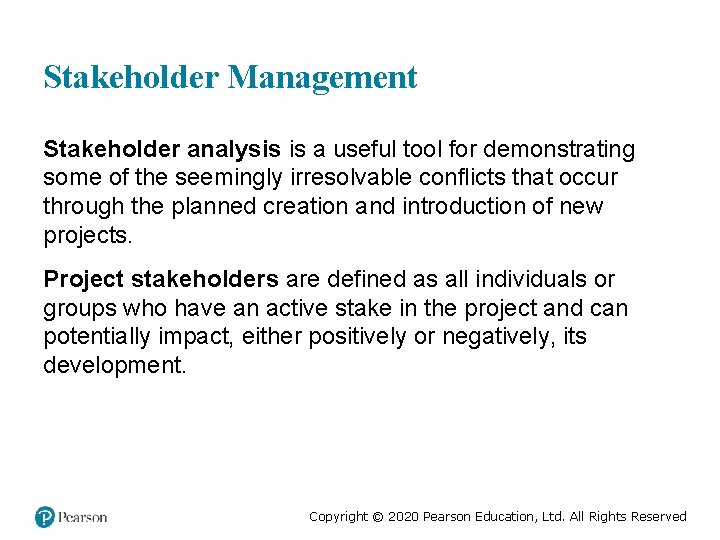
Stakeholder Management Stakeholder analysis is a useful tool for demonstrating some of the seemingly irresolvable conflicts that occur through the planned creation and introduction of new projects. Project stakeholders are defined as all individuals or groups who have an active stake in the project and can potentially impact, either positively or negatively, its development. Copyright © 2020 Pearson Education, Ltd. All Rights Reserved
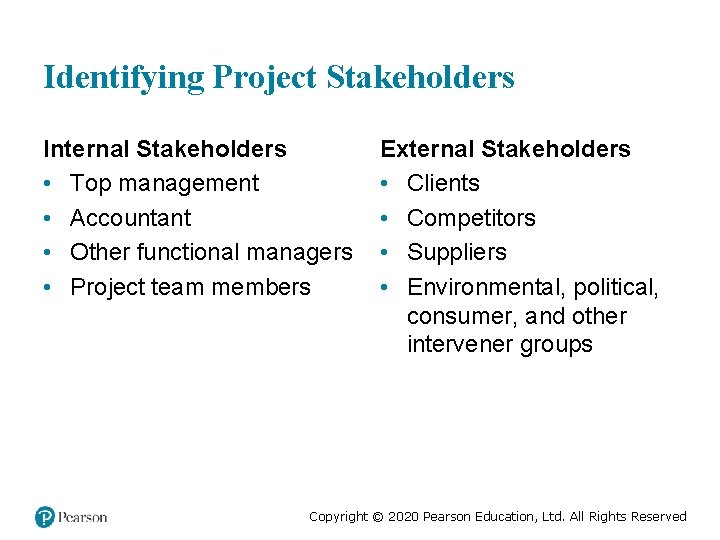
Identifying Project Stakeholders Internal Stakeholders • Top management • Accountant • Other functional managers • Project team members External Stakeholders • Clients • Competitors • Suppliers • Environmental, political, consumer, and other intervener groups Copyright © 2020 Pearson Education, Ltd. All Rights Reserved
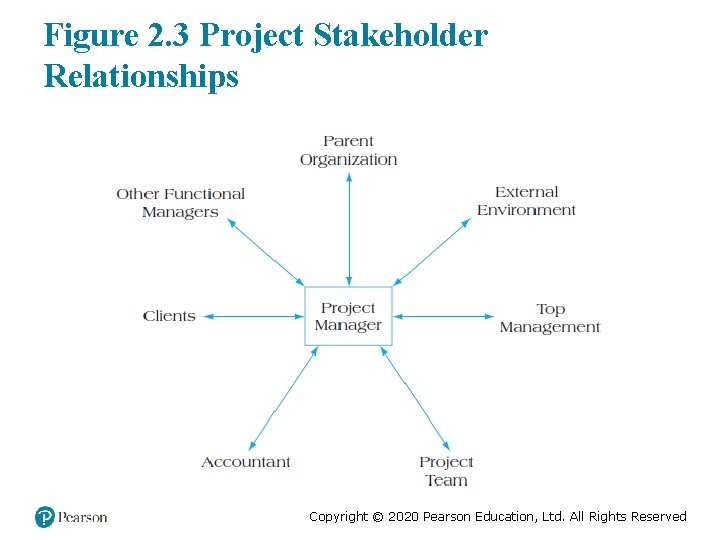
Figure 2. 3 Project Stakeholder Relationships Copyright © 2020 Pearson Education, Ltd. All Rights Reserved
Managing Stakeholders 1. Assess the environment. 2. Identify the goals of the principal actors. 3. Assess your own capabilities. 4. Define the problem. 5. Develop solutions. 6. Test and refine the solutions. Copyright © 2020 Pearson Education, Ltd. All Rights Reserved
Organizational Structure Consists of three key elements: 1. Designates formal reporting relationships – number of levels in the hierarchy – span of control 2. Identifies groupings of – individuals into departments – departments into the total organization 3. Design of systems to ensure – effective communication – coordination – integration across departments Copyright © 2020 Pearson Education, Ltd. All Rights Reserved
Forms of Organization Structure • Functional organizations—group people performing similar activities into departments • Project organizations—group people into project teams on temporary assignments • Matrix organizations—create a dual hierarchy in which functions and projects have equal prominence Copyright © 2020 Pearson Education, Ltd. All Rights Reserved
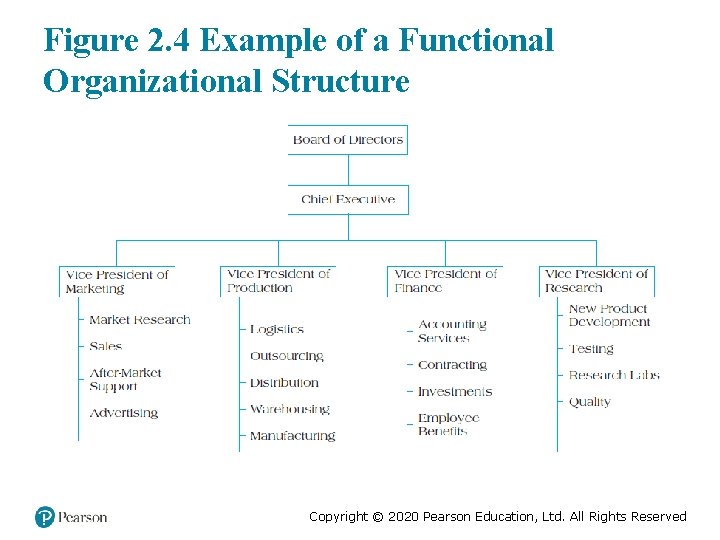
Figure 2. 4 Example of a Functional Organizational Structure Copyright © 2020 Pearson Education, Ltd. All Rights Reserved

Table 2. 2 Strengths and Weaknesses of Functional Structures Strengths for Project Management Weaknesses for Project Management 1. Projects developed within basic functional structure require no disruption or change to firm’s design. 1. Functional siloing makes it difficult to achieve cross-functional cooperation. 2. Enables development of indepth knowledge and intellectual capital. 2. Lack of customer focus. 3. Allows for standard career paths. 3. Longer time to complete projects. Blank 4. Varying interest or commitment. Copyright © 2020 Pearson Education, Ltd. All Rights Reserved
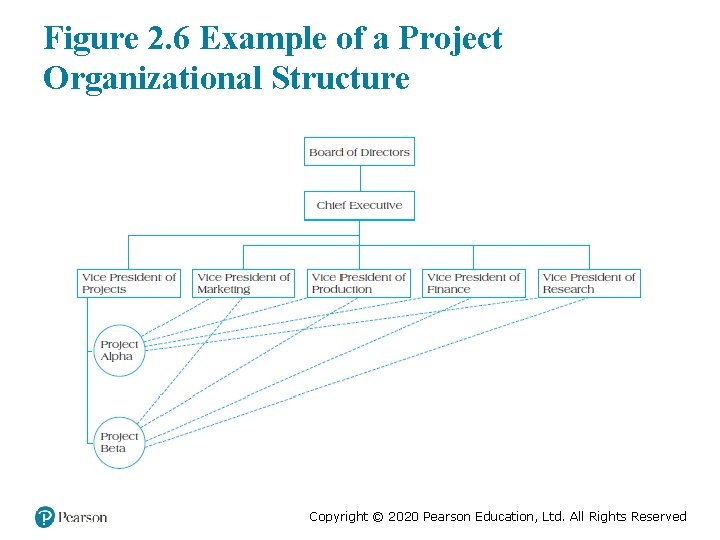
Figure 2. 6 Example of a Project Organizational Structure Copyright © 2020 Pearson Education, Ltd. All Rights Reserved
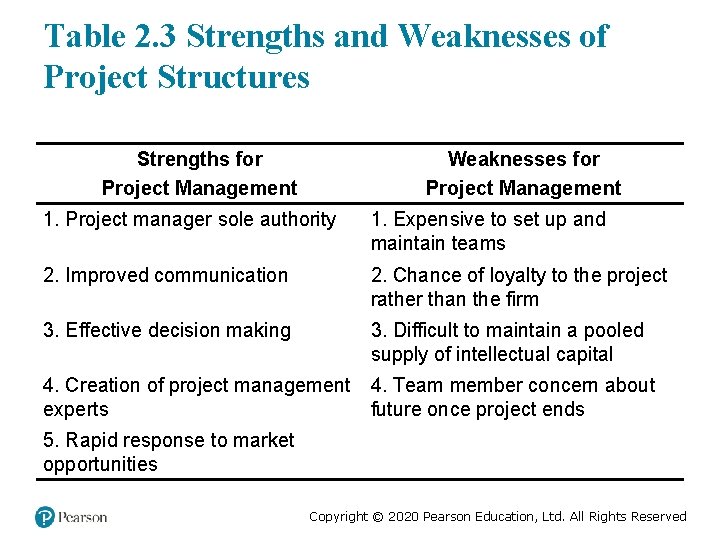
Table 2. 3 Strengths and Weaknesses of Project Structures Strengths for Project Management Weaknesses for Project Management 1. Project manager sole authority 1. Expensive to set up and maintain teams 2. Improved communication 2. Chance of loyalty to the project rather than the firm 3. Effective decision making 3. Difficult to maintain a pooled supply of intellectual capital 4. Creation of project management 4. Team member concern about experts future once project ends 5. Rapid response to market opportunities Blank Copyright © 2020 Pearson Education, Ltd. All Rights Reserved
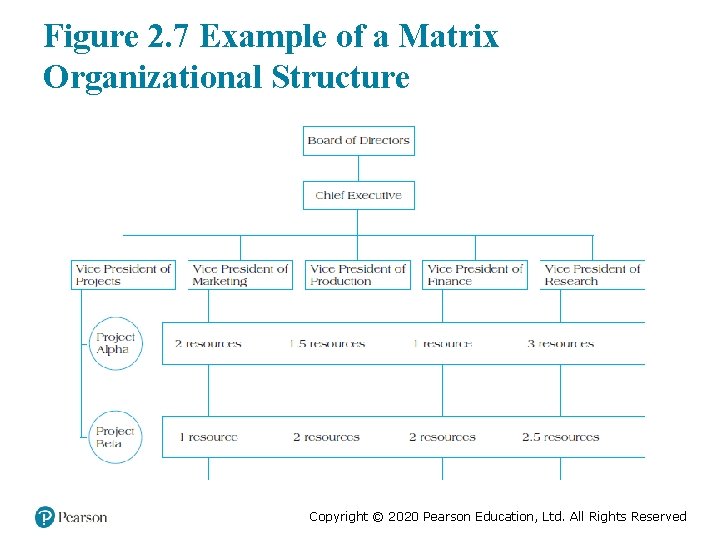
Figure 2. 7 Example of a Matrix Organizational Structure Copyright © 2020 Pearson Education, Ltd. All Rights Reserved
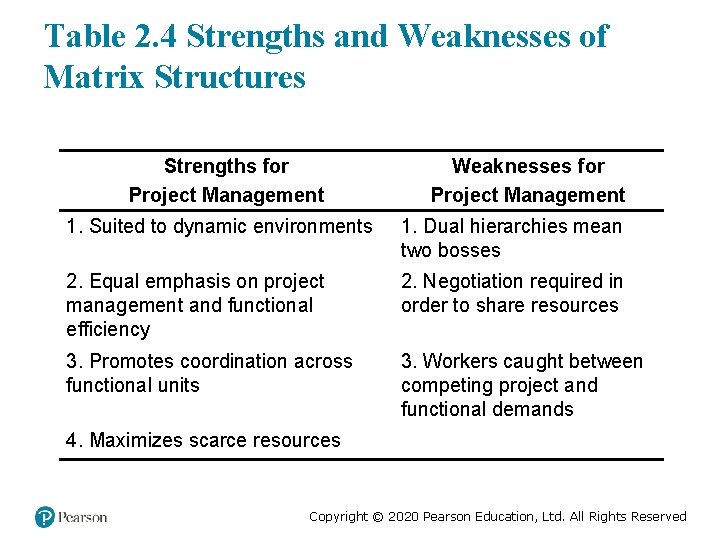
Table 2. 4 Strengths and Weaknesses of Matrix Structures Strengths for Project Management Weaknesses for Project Management 1. Suited to dynamic environments 1. Dual hierarchies mean two bosses 2. Equal emphasis on project management and functional efficiency 2. Negotiation required in order to share resources 3. Promotes coordination across functional units 3. Workers caught between competing project and functional demands 4. Maximizes scarce resources Blank Copyright © 2020 Pearson Education, Ltd. All Rights Reserved
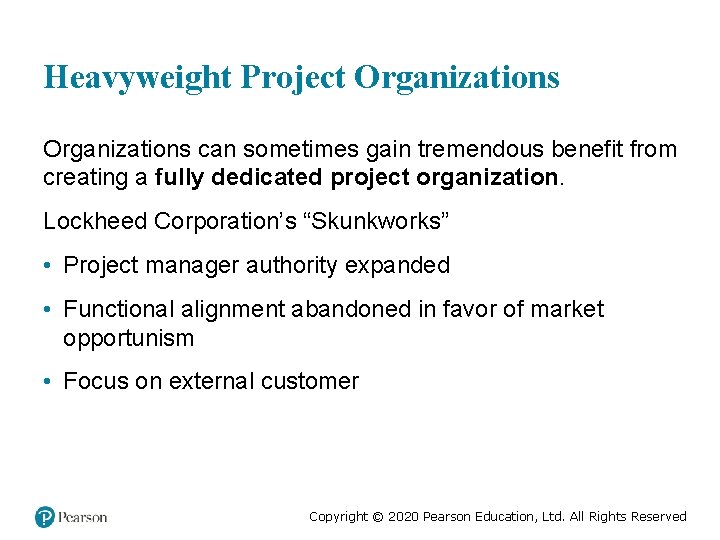
Heavyweight Project Organizations can sometimes gain tremendous benefit from creating a fully dedicated project organization. Lockheed Corporation’s “Skunkworks” • Project manager authority expanded • Functional alignment abandoned in favor of market opportunism • Focus on external customer Copyright © 2020 Pearson Education, Ltd. All Rights Reserved
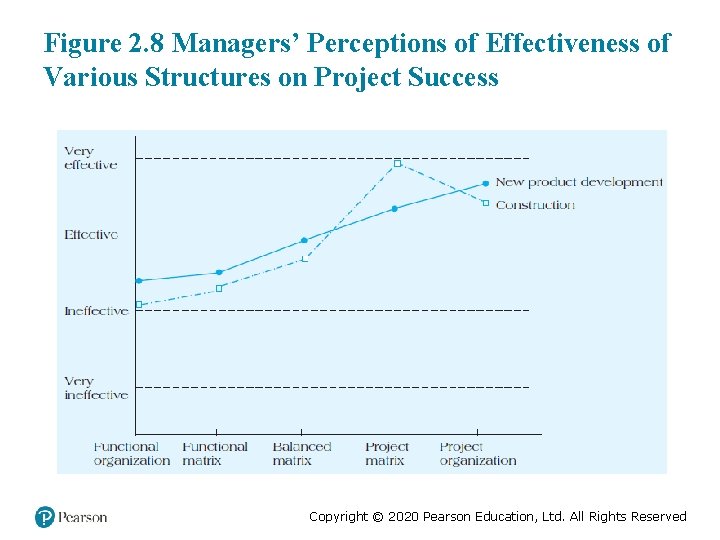
Figure 2. 8 Managers’ Perceptions of Effectiveness of Various Structures on Project Success Copyright © 2020 Pearson Education, Ltd. All Rights Reserved
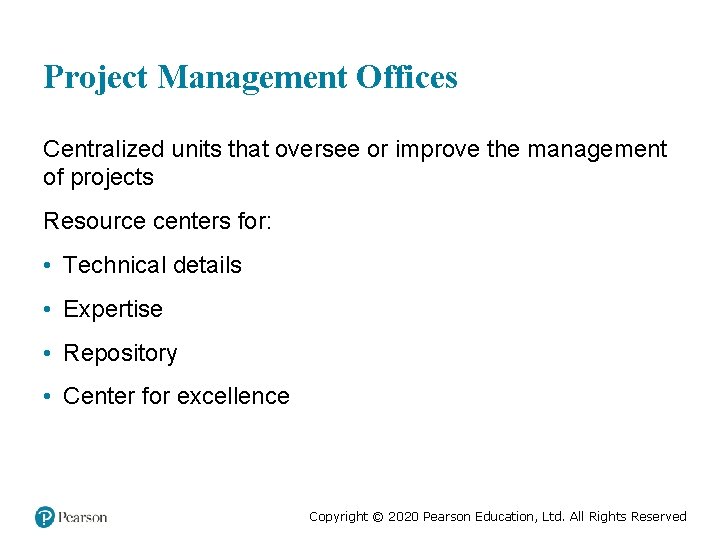
Project Management Offices Centralized units that oversee or improve the management of projects Resource centers for: • Technical details • Expertise • Repository • Center for excellence Copyright © 2020 Pearson Education, Ltd. All Rights Reserved
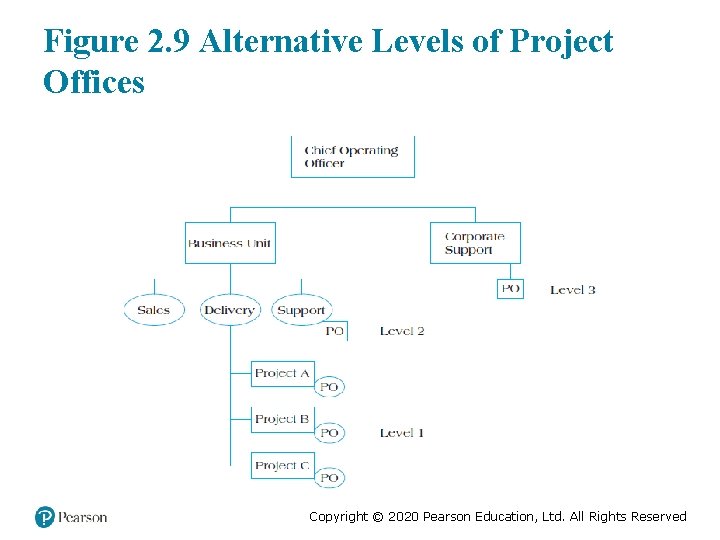
Figure 2. 9 Alternative Levels of Project Offices Copyright © 2020 Pearson Education, Ltd. All Rights Reserved
Forms of PMOs and Control Three forms of PMOs, varying with degrees of control and influence include: • Supportive—low control; consultative and provide PM resources and training • Controlling—moderate control; requires compliance to adopted PM standards/processes • Directive—high control; directly manages projects Copyright © 2020 Pearson Education, Ltd. All Rights Reserved
Models of PMOs In addition to the forms of PMO and varying levels of control, there are models of PMOs with various purposes for companies: • Weather station—monitoring and tracking • Control tower—project management is a skill to be protected and supported • Resource pool—maintain and provide a cadre of skilled project professionals Copyright © 2020 Pearson Education, Ltd. All Rights Reserved
PMO Control Tower • Performs four functions: – Establishes standards for managing projects – Consults on how to follow these standards – Enforces the standards – Improves the standards Copyright © 2020 Pearson Education, Ltd. All Rights Reserved
Organizational Culture • Unwritten • Rules of behavior • Held by some subset of the organization • Taught to all new members Copyright © 2020 Pearson Education, Ltd. All Rights Reserved
Key Factors That Affect Culture Development • Technology • Environment • Geographical location • Reward systems • Rules and procedures • Key organizational members • Critical incidents Copyright © 2020 Pearson Education, Ltd. All Rights Reserved
Organizational Culture: Effects on Project Management • Departmental interaction • Employee commitment to goals • Project planning • Performance evaluation Copyright © 2020 Pearson Education, Ltd. All Rights Reserved
Summary (1 of 2) 1. Understand how effective project management contributes to achieving strategic objectives. 2. Recognize three components of the corporate strategy model: formulation, implementation, and evaluation. 3. See the importance of identifying critical project stakeholders and managing them within the context of project development. 4. Recognize the strengths and weaknesses of three basic forms of organizational structure and their implications for managing projects. Copyright © 2020 Pearson Education, Ltd. All Rights Reserved
Summary (2 of 2) 5. Identify the characteristics of three forms of a project management office (PMO). 6. Understand key concepts of corporate culture and how cultures are formed. Copyright © 2020 Pearson Education, Ltd. All Rights Reserved
Copyright © 2020 Pearson Education, Ltd. All Rights Reserved
- Slides: 32