
Project Management Achieving Competitive Advantage Fifth Edition Global
Project Management: Achieving Competitive Advantage Fifth Edition, Global Edition Chapter 1 Introduction: Why Project Management? Copyright © 2020 Pearson Education, Ltd. All Rights Reserved
Learning Objectives (1 of 2) 1. 1 Understand why project management is becoming such a powerful and popular practice in business. 1. 2 Recognize the basic properties of projects, including their definition. 1. 3 Understand why effective project management is such a challenge. 1. 4 Understand explain the project life cycle, its stages, and the activities that typically occur at each stage in the project. Copyright © 2020 Pearson Education, Ltd. All Rights Reserved
Learning Objectives (2 of 2) 1. 5 Understand the concept of project “success, ” including various definitions of success, as well as the alternative models of success. 1. 6 Understand the purpose of project management maturity models and the process of benchmarking in organizations. 1. 7 Recognize how mastery of the discipline of project management enhances critical employability skills for university graduates. Copyright © 2020 Pearson Education, Ltd. All Rights Reserved
PMBo. K Core Concepts Project Management Body of Knowledge (PMBo. K) covered in this chapter includes: 1. Definition of a Project (PMBo. K 1. 2) 2. Definition of Project Management (PMBo. K 1. 3) 3. Relationship to Other Management Disciplines (PMBo. K 1. 4) 4. Project Phases and the Project Life Cycle (PMBo. K 2. 1) Copyright © 2020 Pearson Education, Ltd. All Rights Reserved
What Is a Project? • Projects are complex, one-time processes. • Projects are limited by budget, schedule, and resources. • Projects are developed to resolve a clear goal or set of goals. • Projects are customer-focused. A project is a temporary endeavor undertaken to create a unique product, service, or result. PMBo. K 5 th edition Copyright © 2020 Pearson Education, Ltd. All Rights Reserved
General Project Characteristics (1 of 2) • Projects are ad hoc endeavors with a clear life cycle. • Projects are building blocks in the design and execution of organizational strategies. • Projects are responsible for the newest and most improved products, services, and organizational processes. • Projects provide a philosophy and strategy for the management of change. • Project management entails crossing functional and organizational boundaries. Copyright © 2020 Pearson Education, Ltd. All Rights Reserved
General Project Characteristics (2 of 2) • Traditional management functions of planning, organizing, motivation, directing, and controlling apply to project management. • Principal outcomes of a project are the satisfaction of customer requirements within the constraints of technical, cost, and schedule objectives. • Projects are terminated upon successful completion of performance objectives. Copyright © 2020 Pearson Education, Ltd. All Rights Reserved
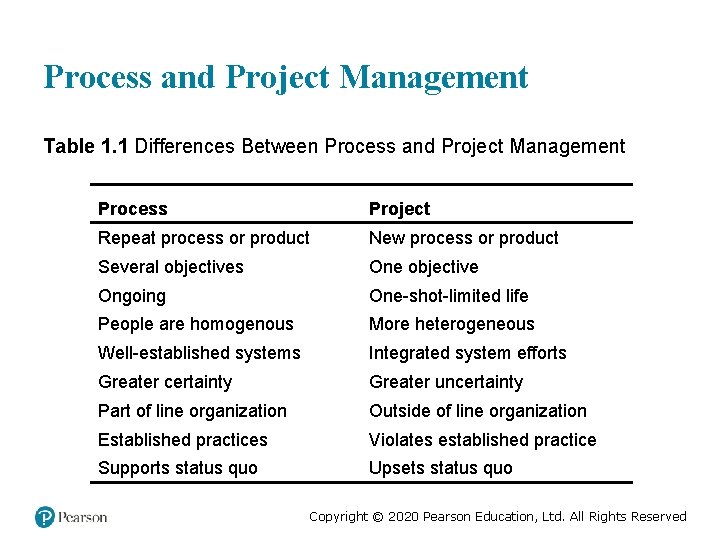
Process and Project Management Table 1. 1 Differences Between Process and Project Management Process Project Repeat process or product New process or product Several objectives One objective Ongoing One-shot-limited life People are homogenous More heterogeneous Well-established systems Integrated system efforts Greater certainty Greater uncertainty Part of line organization Outside of line organization Established practices Violates established practice Supports status quo Upsets status quo Copyright © 2020 Pearson Education, Ltd. All Rights Reserved
Project Success Rates • Software and hardware projects fail at a 65% rate. • Over half of all IT projects become runaways. • Only 30% of technology-based projects and programs are a success. • Ten major government contracts have over $16 billion in cost overruns and are a combined 38 years behind schedule. • One out of six IT projects has an average cost overrun of 200% and a schedule overrun of 70%. • More than one-third of the $110 billion in costs spent on the postwar reconstruction projects in Afghanistan, total $110 billion was lost due to fraud, waste, and abuse. Copyright © 2020 Pearson Education, Ltd. All Rights Reserved
Why Are Projects Important? 1. Shortened product life cycles 2. Narrow product launch windows 3. Increasingly complex and technical products 4. Emergence of global markets 5. An economic period marked by low inflation Copyright © 2020 Pearson Education, Ltd. All Rights Reserved
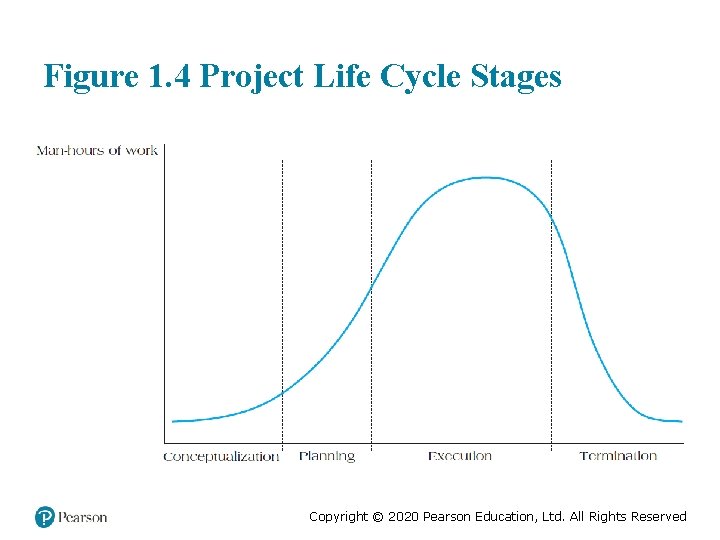
Figure 1. 4 Project Life Cycle Stages Copyright © 2020 Pearson Education, Ltd. All Rights Reserved
Project Life Cycles A project life cycle refers to the stages in a project’s development and are divided into four distinct phases: • Conceptualization—development of the initial goal and technical specifications of the project. Key stakeholders are identified and signed on at this phase. • Planning—all detailed specifications, schedules, schematics, and plans are developed. • Execution—the actual “work” of the project is performed. • Termination—project is transferred to the customer, resources reassigned, project is closed out. Copyright © 2020 Pearson Education, Ltd. All Rights Reserved
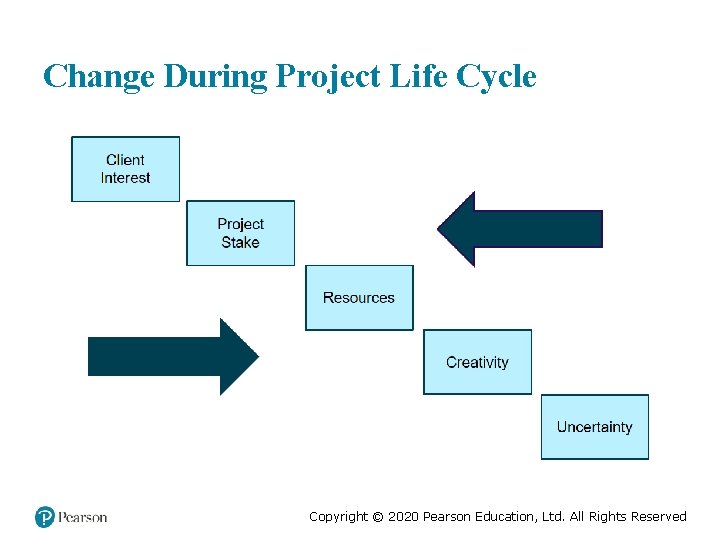
Change During Project Life Cycle Copyright © 2020 Pearson Education, Ltd. All Rights Reserved
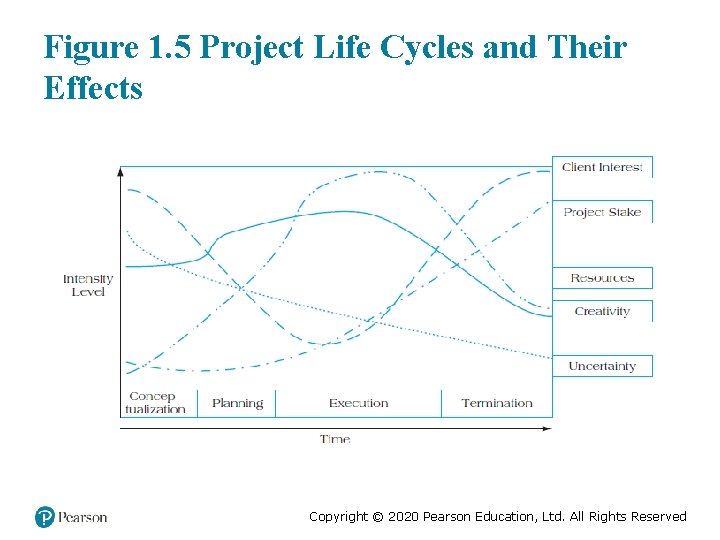
Figure 1. 5 Project Life Cycles and Their Effects Copyright © 2020 Pearson Education, Ltd. All Rights Reserved
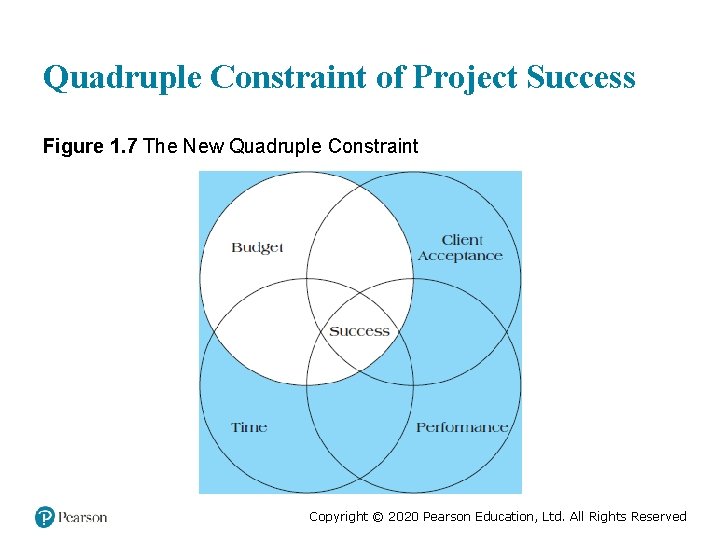
Quadruple Constraint of Project Success Figure 1. 7 The New Quadruple Constraint Copyright © 2020 Pearson Education, Ltd. All Rights Reserved
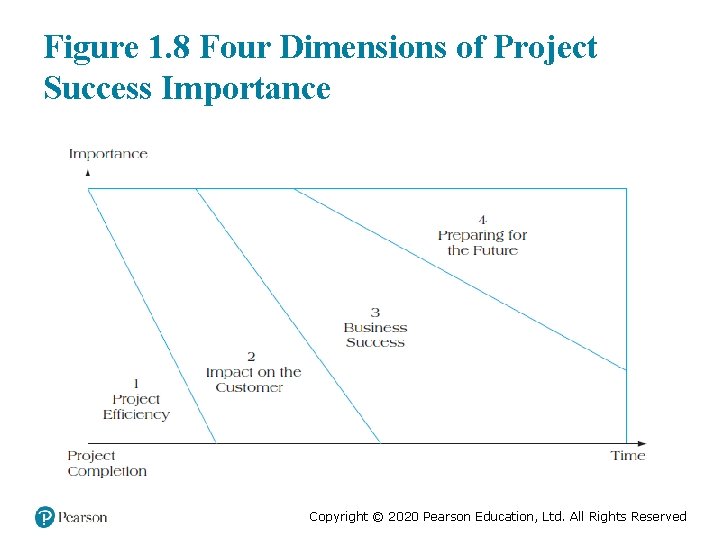
Figure 1. 8 Four Dimensions of Project Success Importance Copyright © 2020 Pearson Education, Ltd. All Rights Reserved

Table 1. 2 Understanding Success Criteria Iron Triangle Information System Benefits (Organization) Benefits (Stakeholders) Cost Maintainability Improved efficiency Satisfied users Quality Reliability Improved effectiveness Social and environmental impact Time Validity Increased profits Personal development Blank Information quality Strategic goals Professional learning, contractors’ profits Blank Use Organization learning Capital suppliers, content Blank Reduced waste Project team, economic impact to surrounding community Copyright © 2020 Pearson Education, Ltd. All Rights Reserved
Six Criteria for IT Project Success • System Quality • Information Quality • User Satisfaction • Individual Impact • Organizational Impact Copyright © 2020 Pearson Education, Ltd. All Rights Reserved
Project Management Maturity • Project management maturity (PMM) models are used to allow organizations to benchmark the best practices of successful project management firms. • Benchmarking is the practice of systematically managing the process improvements of project delivery by a single organization of a period of time. Copyright © 2020 Pearson Education, Ltd. All Rights Reserved
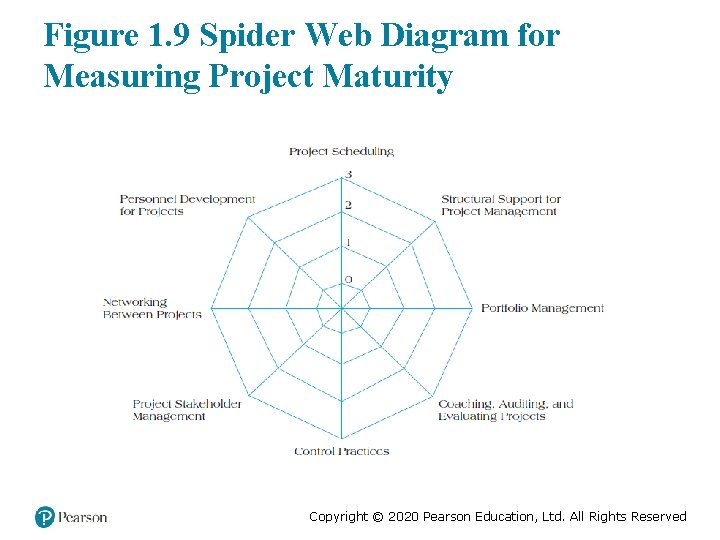
Figure 1. 9 Spider Web Diagram for Measuring Project Maturity Copyright © 2020 Pearson Education, Ltd. All Rights Reserved
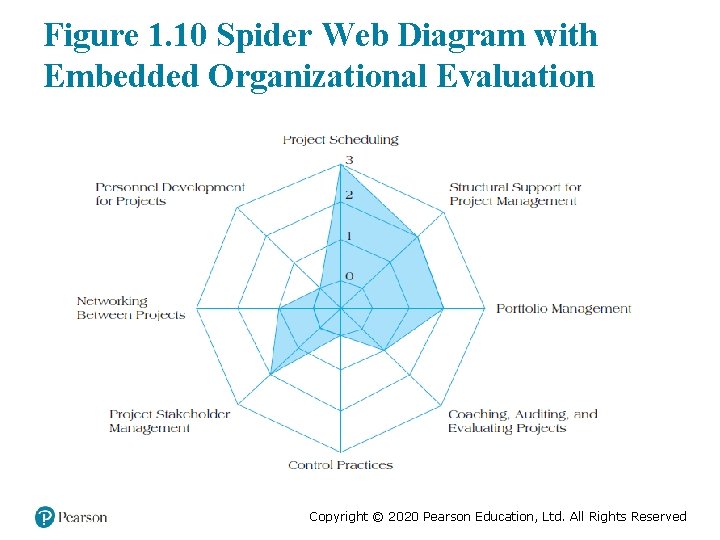
Figure 1. 10 Spider Web Diagram with Embedded Organizational Evaluation Copyright © 2020 Pearson Education, Ltd. All Rights Reserved
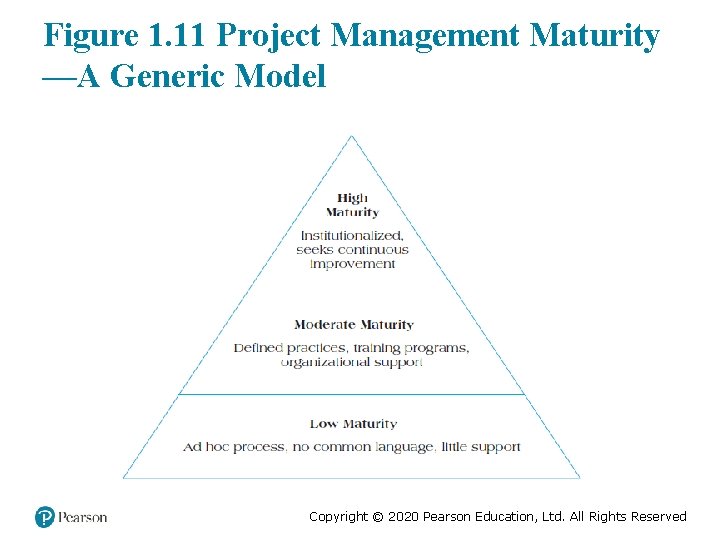
Figure 1. 11 Project Management Maturity —A Generic Model Copyright © 2020 Pearson Education, Ltd. All Rights Reserved

Developing Project Management Maturity PMM models • Center for Business Practices • Kerzner’s Project Management Maturity Model • ESI International’s Project Framework • SEI’s Capability Maturity Model Integration Copyright © 2020 Pearson Education, Ltd. All Rights Reserved
Center for Business Practices PMM • Level 1: Initial Phase • Level 2: Structure, Process, and Standards • Level 3: Institutionalized Project Management • Level 4: Managed • Level 5: Optimizing Copyright © 2020 Pearson Education, Ltd. All Rights Reserved

Kerzner’s PMM Model • Level 1: Common Language • Level 2: Common Processes • Level 3: Singular Methodology • Level 4: Benchmarking • Level 5: Continuous Improvement Copyright © 2020 Pearson Education, Ltd. All Rights Reserved
ESI International’s Project Framework • Level 1: Ad Hoc • Level 2: Consistent • Level 3: Integrated • Level 4: Comprehensive • Level 5: Optimizing Copyright © 2020 Pearson Education, Ltd. All Rights Reserved
SEI’s Capability Maturity Model Integration • Level 1: Initial • Level 2: Managed • Level 3: Defined • Level 4: Quantitative Management • Level 5: Optimizing Copyright © 2020 Pearson Education, Ltd. All Rights Reserved
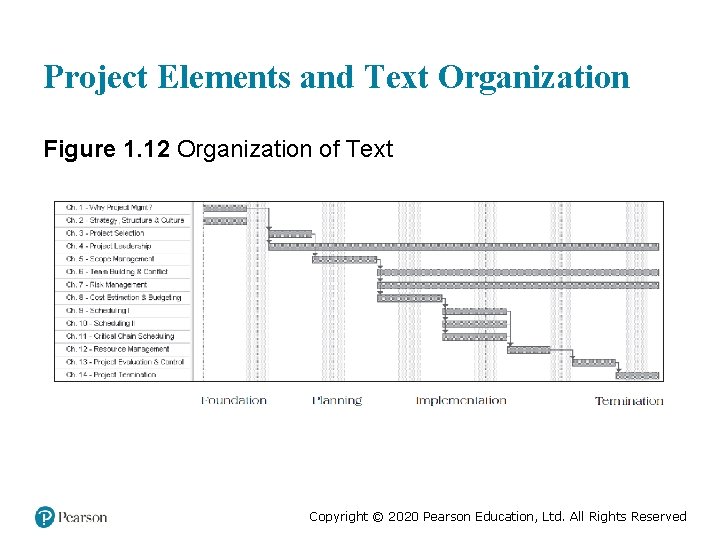
Project Elements and Text Organization Figure 1. 12 Organization of Text Copyright © 2020 Pearson Education, Ltd. All Rights Reserved
Project Management Employability Skills 1. Communication 2. Critical Thinking 3. Collaboration 4. Knowledge Application and Analysis 5. Business Ethics and Social Responsibility 6. Information Technology Application and Computing Skills 7. Data Literacy Copyright © 2020 Pearson Education, Ltd. All Rights Reserved
Project Manager Responsibilities 1. Selecting a team 2. Developing project objectives and a plan for execution 3. Performing risk management activities 4. Cost estimating and budgeting 5. Scheduling 6. Managing resources Copyright © 2020 Pearson Education, Ltd. All Rights Reserved
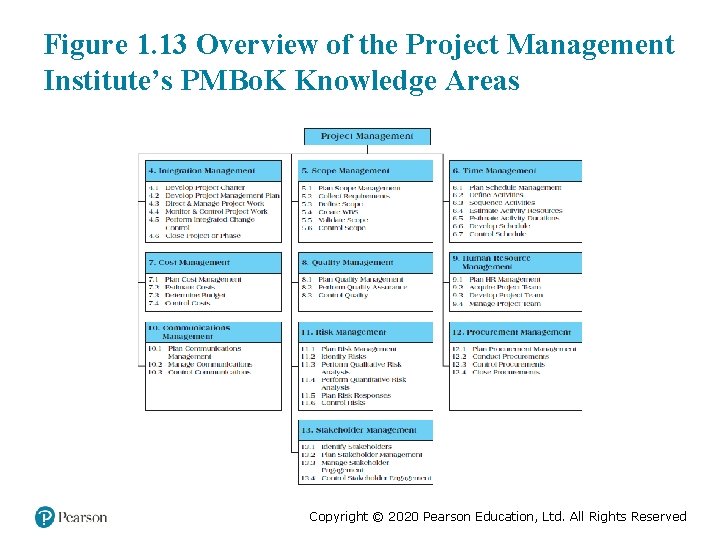
Figure 1. 13 Overview of the Project Management Institute’s PMBo. K Knowledge Areas Copyright © 2020 Pearson Education, Ltd. All Rights Reserved
Summary (1 of 2) 1. Understand why project management is becoming such a powerful and popular practice in business. 2. Recognize the basic properties of projects, including their definition. 3. Understand why effective project management is such a challenge. 4. Understand explain the project life cycle, its stages, and the activities that typically occur at each stage in the project. Copyright © 2020 Pearson Education, Ltd. All Rights Reserved
Summary (2 of 2) 5. Understand the concept of project “success, ” including various definitions of success, as well as the alternative models of success. 6. Understand the purpose of project management maturity models and the process of benchmarking in organizations. 7. Recognize how mastery of the discipline of project management enhances critical employability skills for university graduates. Copyright © 2020 Pearson Education, Ltd. All Rights Reserved
Copyright © 2020 Pearson Education, Ltd. All Rights Reserved
- Slides: 34