
Project Learning Progressive Inquiry How can these skills

- Slides: 17
Project Learning Progressive Inquiry - How can these skills be taught? Team Jupiter
Agenda • Project Learning – Video • Progressive Inquiry – Exercise
Project Learning • Interview with Mervi Jansson at Inno. Omnia • http: //www. youtube. com/watch? v=Rf. S 0 Cnj. J 9 Gs • Teachers role: – Help to get started – Motivate – tell the students why they are doing this way – Be the rock. Be present, guide, but let the students make the decisions
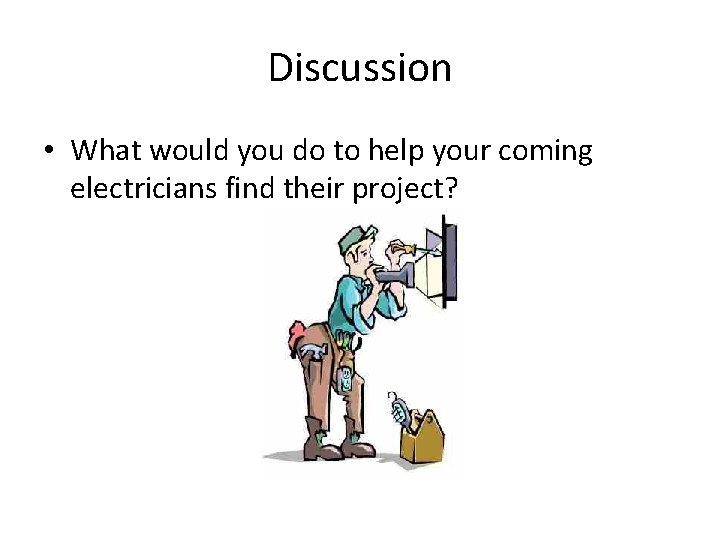
Discussion • What would you do to help your coming electricians find their project?
PROGRESSIVE INQUIRY • Exercise: We are a group of catering students, who are learning to make chocolate by using PI model.
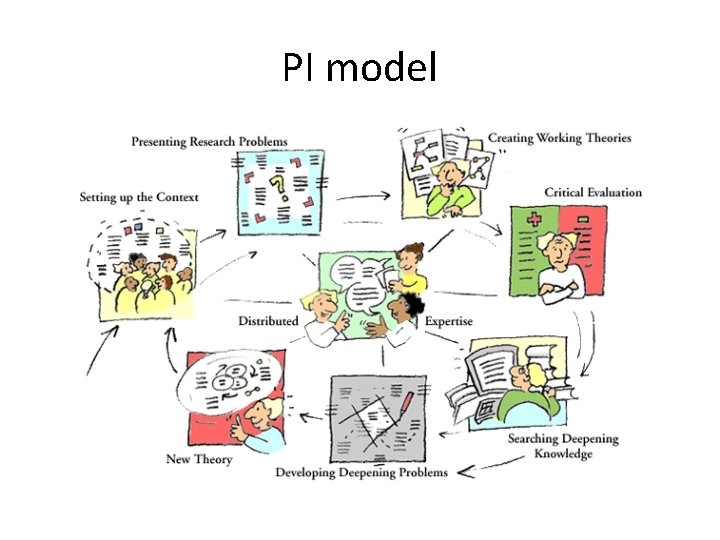
PI model
Distributed expertise • Teacher’s role: – Help students understand that the development of information is the responsibility of every student involved in the process. – To make sure that every participant is involved in the process with “own expertise and thoughts” by ensuring students mutual cooperation. – To arrange for experts to be involved in the process. – To encourage students to release their outcomes in various and experimental ways.
Setting up the Context • Teacher’s role: – To make sure that inquiry does not focus on learning something just for school. It is essential that teacher agree that the topic is worthy of investigation. – To help the students to determine the direction of the project through joint discussions.
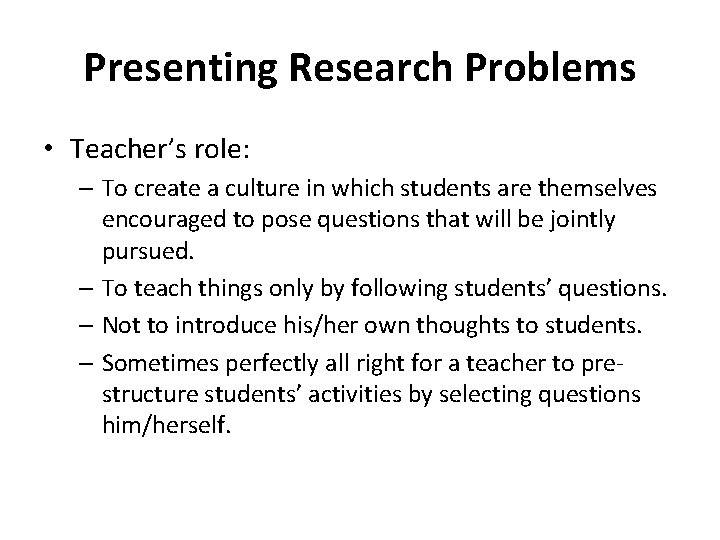
Presenting Research Problems • Teacher’s role: – To create a culture in which students are themselves encouraged to pose questions that will be jointly pursued. – To teach things only by following students’ questions. – Not to introduce his/her own thoughts to students. – Sometimes perfectly all right for a teacher to prestructure students’ activities by selecting questions him/herself.
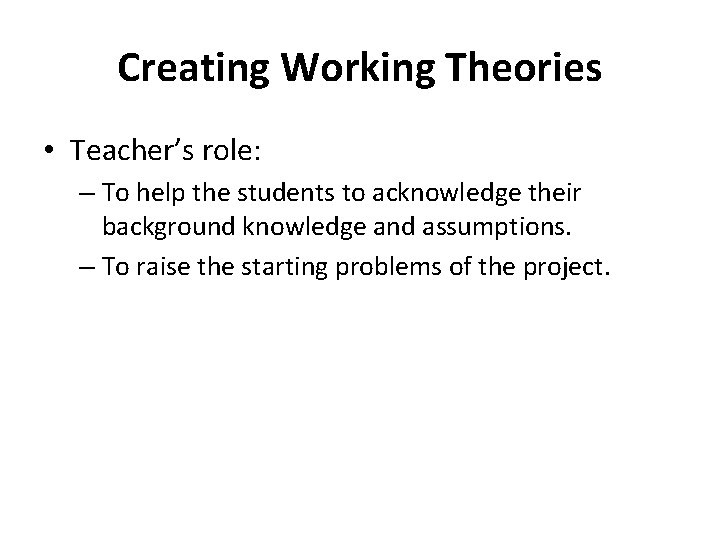
Creating Working Theories • Teacher’s role: – To help the students to acknowledge their background knowledge and assumptions. – To raise the starting problems of the project.
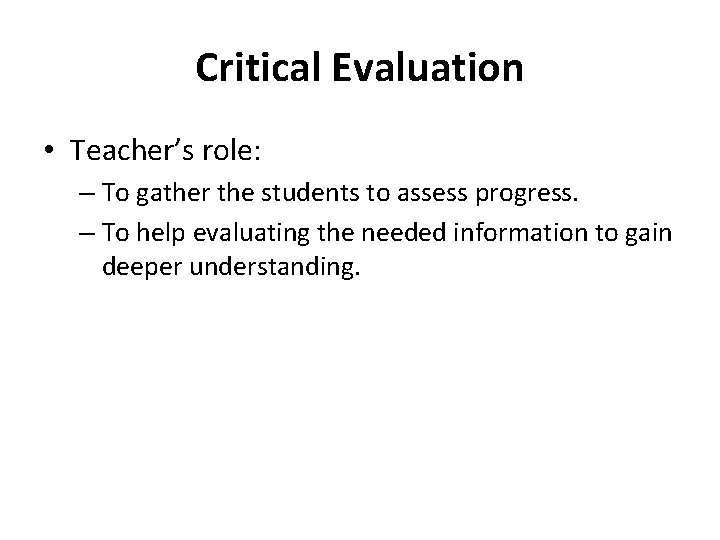
Critical Evaluation • Teacher’s role: – To gather the students to assess progress. – To help evaluating the needed information to gain deeper understanding.
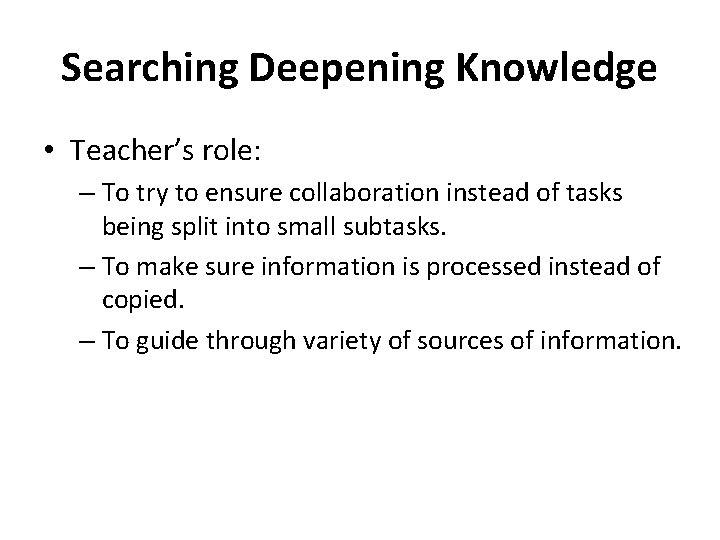
Searching Deepening Knowledge • Teacher’s role: – To try to ensure collaboration instead of tasks being split into small subtasks. – To make sure information is processed instead of copied. – To guide through variety of sources of information.
Developing Deepening Problems • Teacher’s role: – To help dividing questions into small enough subquestions. – To guide students to critical thinking and to build on their existing knowledge.
New Theory • Teacher’s role: – To guide students how to search for new information. – To create an environment where students are confident enough to use their knowledge and are able to develop their explanations and descriptions into new theories. – To guide students to use the support from their studying community
Teacher’s role in PB and PI - Guiding and facilitating - Help students take on responsibility themselves - Create an environment that supports learning - Direct students to open their minds and critical thinking
Discussion • In the context of vocational education, between PI and PL, which method do you think would be more practical and easier to use in reality? • A team of adult students are arguing and their work is not progressing. What would you do as a teacher to get them back on track? • What do you find the most rewarding in PI model and project learning as a teacher? • Do you feel like having chocolate now?