
Project Lead the Way Engineering Program Nimmy Gnanapragasam

- Slides: 50
Project Lead the Way Engineering Program Nimmy Gnanapragasam Ph. D, PE Affiliate Director – WA State Associate Professor in Civil Engineering Seattle University Nov 13, 2014
Outline • Demand for STEM and overview of PLTW • Middle and High school PLTW programs • Process for implementing PLTW in school
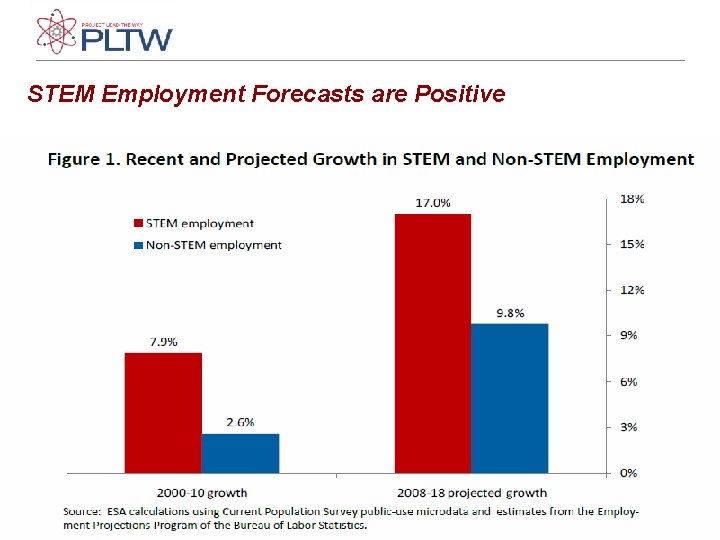
STEM Employment Forecasts are Positive
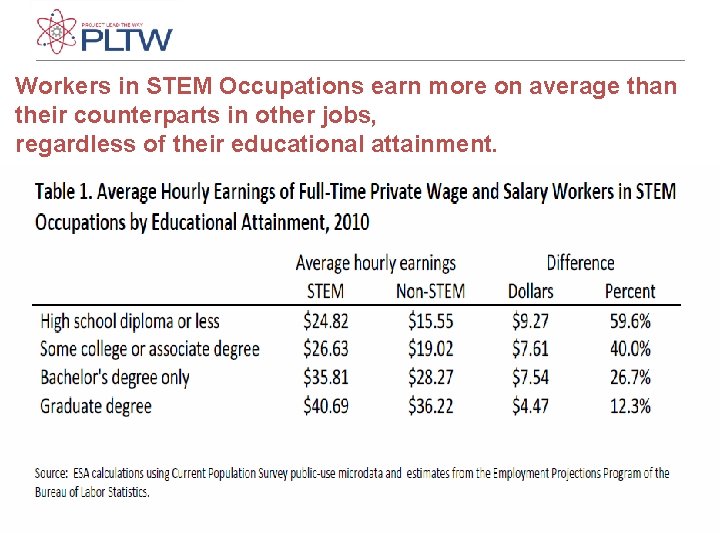
Workers in STEM Occupations earn more on average than their counterparts in other jobs, regardless of their educational attainment.
AN INCREASINGLY GLOBAL AND TECHNOLOGY-BASED ECONOMY HAS DRAMATICALLY INCREASED DEMAND FOR A HIGHLY-SKILLED WORKFORCE.
PROJECT LEAD THE WAY BEGAN IN 1997 IN UPSTATE NY AND HAS BECOME AMERICA’S LEADING PROVIDER OF INSCHOOL CURRICULUM FOR SCIENCE, TECHNOLOGY, ENGINEERING, AND MATHEMATICS. OUR MISSION IS TO PREPARE STUDENTS AS HIGHLY SKILLED WORKFORCE FOR THE GLOBAL ECONOMY.
PLTW: Meeting the needs of tomorrow by inspiring the students of today Program Goals Graduates Attributes • Address impending critical shortage of qualified engineering, engineering technology, science and health professionals • Communicate effectively • Prepare students for rigorous post-secondary education at two and four-year colleges and universities • Effective and efficient problem solving • Think creatively and critically • Practice professional conduct • Work effectively in teams • Understand how research is conducted
Engineering Accreditation (ABET) program requirements a) Fundamentals - an ability to apply knowledge of mathematics, science, and engineering b) Experimentation - an ability to design and conduct experiments, as well as to analyze and interpret data c) Design - an ability to design a system, component, or process to meet desired needs within realistic constraints such as economic, environmental, social, political, ethical, health and safety, manufacturability, and sustainability d) Teamwork - an ability to function on multi-disciplinary teams e) Problem Solving - an ability to identify, formulate, and solve engineering problems
ABET program requirements f) Ethics - an understanding of professional and ethical responsibility g) Communication - an ability to communicate effectively h) Global Awareness - the broad education necessary to understand the impact of engineering solutions in a global, economic, environmental, and societal context i) Life-long Learning - a recognition of the need for, and an ability to engage in life-long learning j) Contemporary Issues - a knowledge of contemporary issues k) Modern Tools - an ability to use the techniques, skills, and modern engineering tools necessary for engineering practice.
PLTW: Meeting the needs of tomorrow by inspiring the students of today Program Goals Graduates Attributes • Address impending critical shortage of qualified engineering, engineering technology, science and health professionals • Communicate effectively • Prepare students for rigorous post-secondary education at two and four-year colleges and universities • Effective and efficient problem solving • Think creatively and critically • Practice professional conduct • Work effectively in teams • Understand how research is conducted
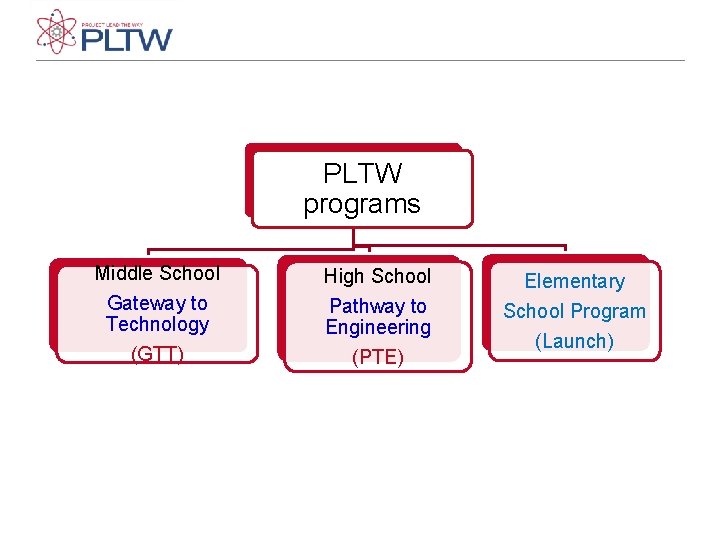
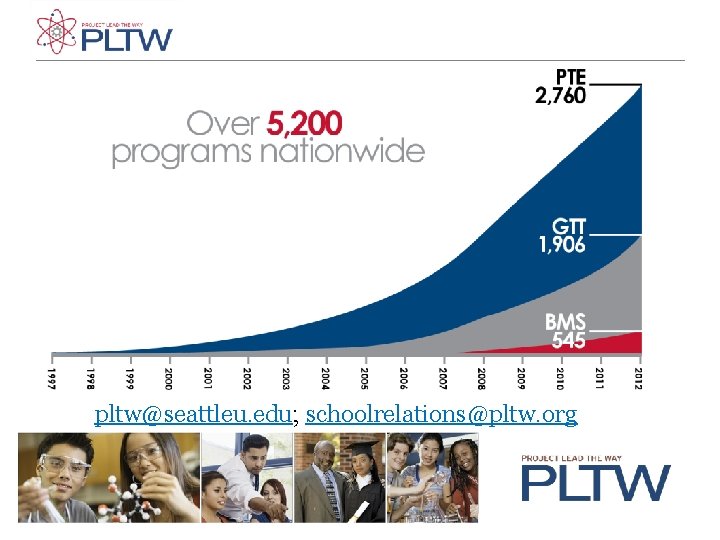
PLTW programs Middle School Gateway to Technology (GTT) High School Pathway to Engineering (PTE) Elementary School Program (Launch)
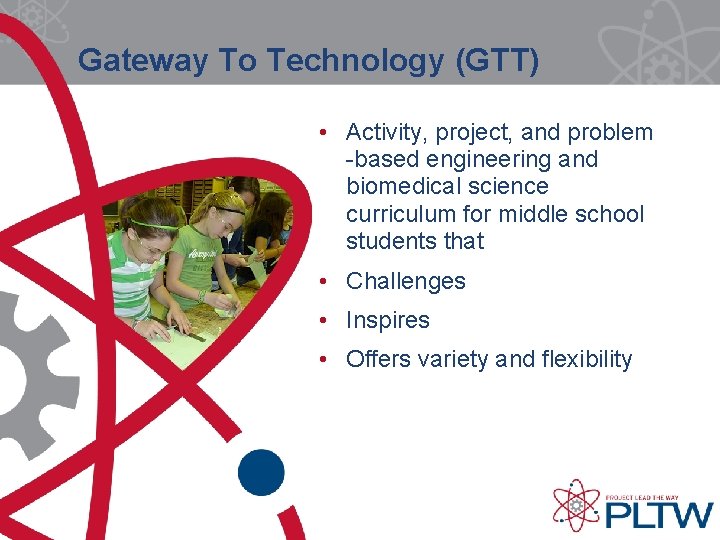
Gateway To Technology (GTT) • Activity, project, and problem -based engineering and biomedical science curriculum for middle school students that • Challenges • Inspires • Offers variety and flexibility
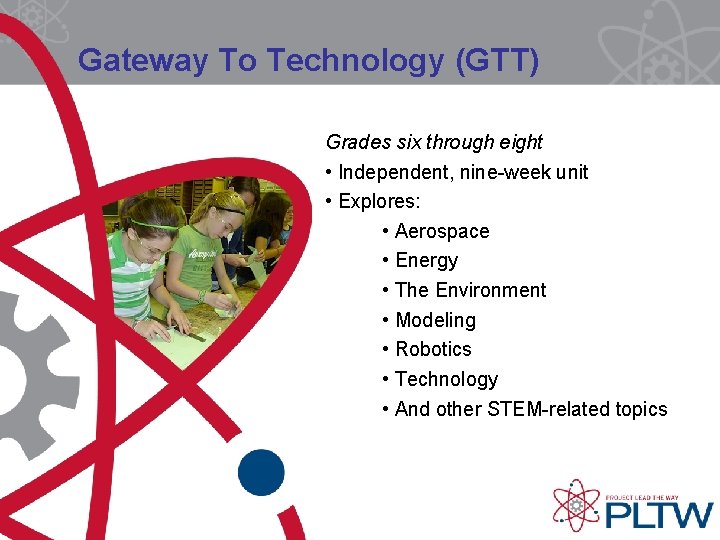
Gateway To Technology (GTT) Grades six through eight • Independent, nine-week unit • Explores: • Aerospace • Energy • The Environment • Modeling • Robotics • Technology • And other STEM-related topics
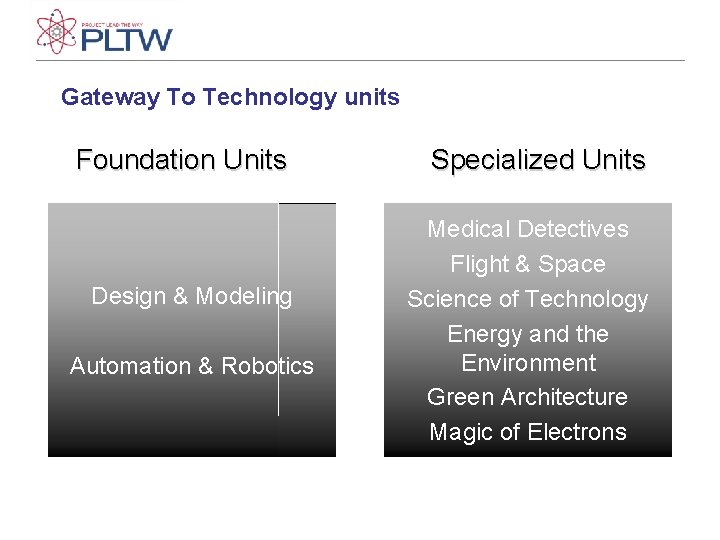
Gateway To Technology units 9 week units designed for grades 6 -8 Foundation Units Design & Modeling Automation & Robotics Specialized Units Medical Detectives Flight & Space Science of Technology Energy and the Environment Green Architecture Magic of Electrons
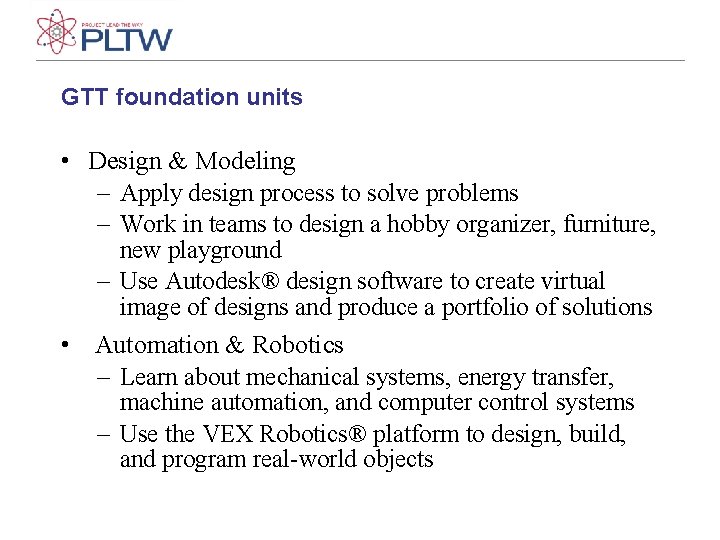
GTT foundation units • Design & Modeling – Apply design process to solve problems – Work in teams to design a hobby organizer, furniture, new playground – Use Autodesk® design software to create virtual image of designs and produce a portfolio of solutions • Automation & Robotics – Learn about mechanical systems, energy transfer, machine automation, and computer control systems – Use the VEX Robotics® platform to design, build, and program real-world objects
GTT specialization units • Energy and the Environment • Flight and Space • Green Architecture • Magic of Electrons • Medical Detective • Science of Technology
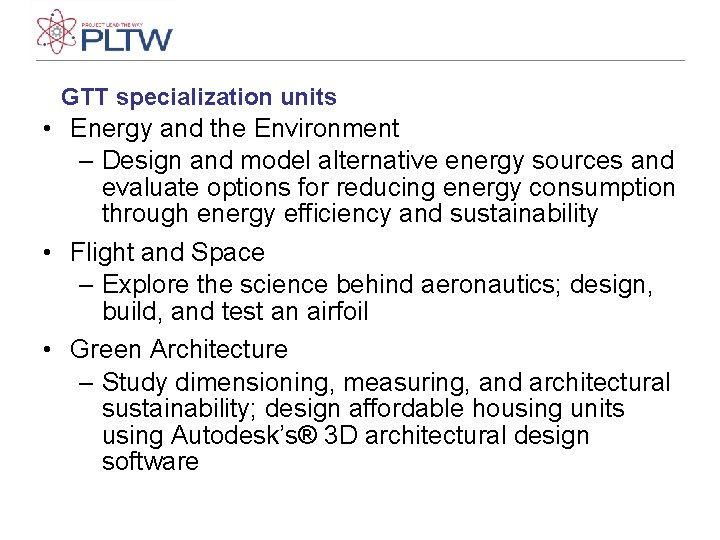
GTT specialization units • Energy and the Environment – Design and model alternative energy sources and evaluate options for reducing energy consumption through energy efficiency and sustainability • Flight and Space – Explore the science behind aeronautics; design, build, and test an airfoil • Green Architecture – Study dimensioning, measuring, and architectural sustainability; design affordable housing units using Autodesk’s® 3 D architectural design software
GTT specialization units • Magic of Electrons – Delve into electricity, the behavior and parts of atoms, and sensing devices; learn knowledge and skills in basic circuitry design and examine the impact of electricity • Medical Detective – Analyze genetic testing results to diagnose disease and study DNA evidence found at a “crime scene”; learn how to measure and interpret vital signs and diagnose diseases • Science of Technology – Apply concepts of physics, chemistry, and nanotechnology to activities and projects including making ice cream, cleaning up an oil spill, and designing, building, and testing a new product
Design and Modeling • Lessons – 1: What is Engineering? • 10 days – 2: Design Process • 5 days – 3: Measurement • 5 days – 4: Sketching and Dimensioning Techniques • 6 days – 5: Designing for Production • 22 days
Automation and Robotics • Lessons • 1: What is Automation and Robotics? • 7 days • 2: Mechanical Systems • 12 days • 3: Automated Systems • 26 days
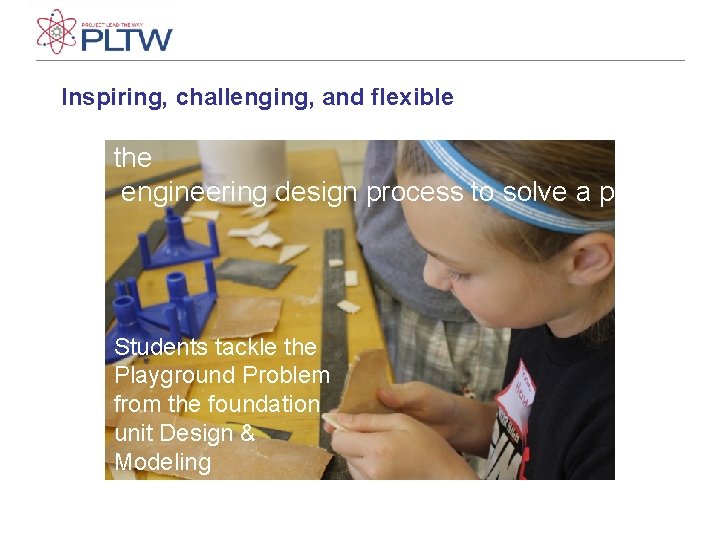
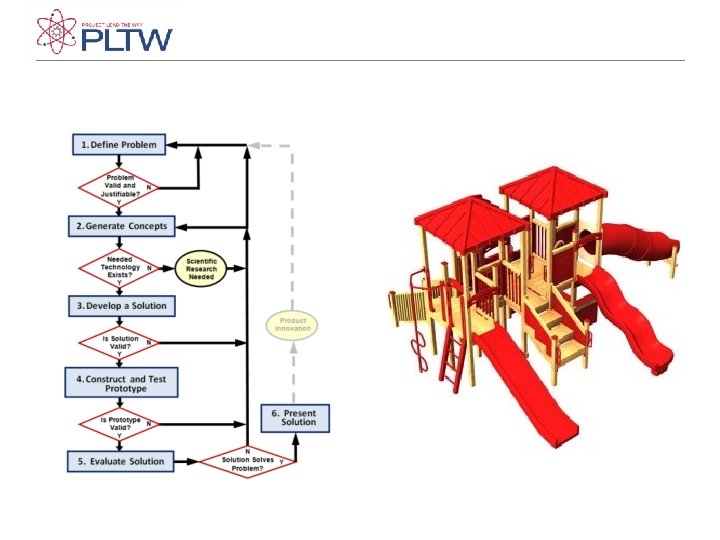
Inspiring, challenging, and flexible How do Gateway To Technology students use the engineering design process to solve a problem? Students tackle the Playground Problem from the foundation unit Design & Modeling
Students use the design process to research, design, and model a playground
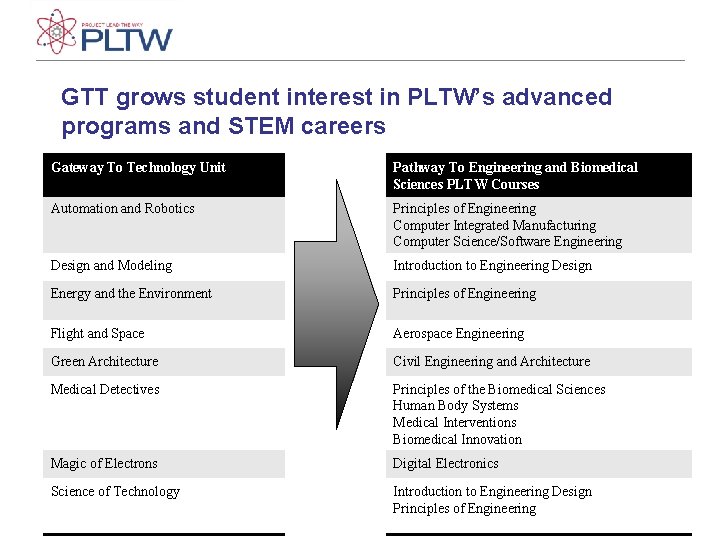
GTT grows student interest in PLTW’s advanced programs and STEM careers Gateway To Technology Unit Pathway To Engineering and Biomedical Sciences PLTW Courses Automation and Robotics Principles of Engineering Computer Integrated Manufacturing Computer Science/Software Engineering Design and Modeling Introduction to Engineering Design Energy and the Environment Principles of Engineering Flight and Space Aerospace Engineering Green Architecture Civil Engineering and Architecture Medical Detectives Principles of the Biomedical Sciences Human Body Systems Medical Interventions Biomedical Innovation Magic of Electrons Digital Electronics Science of Technology Introduction to Engineering Design Principles of Engineering
Flexibility • Implement GTT in the best way to fit your school – GTT units as 9 week or semester courses? – Full school implementation or elective? – Every class every year?
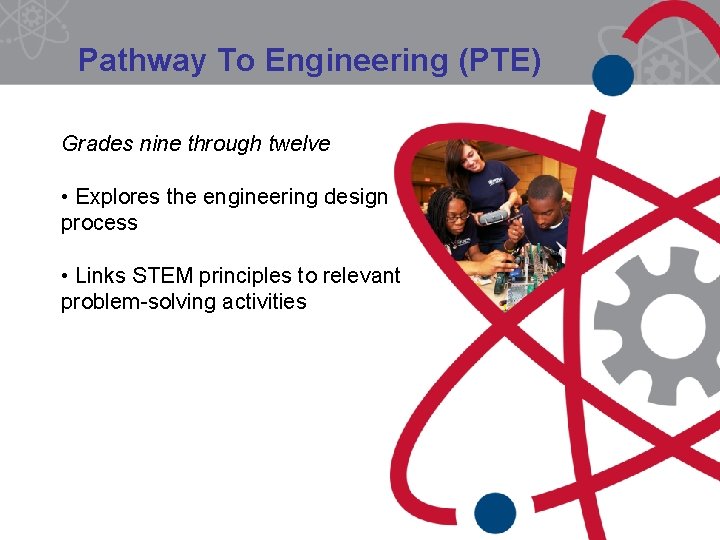
Pathway To Engineering (PTE) Grades nine through twelve • Explores the engineering design process • Links STEM principles to relevant problem-solving activities
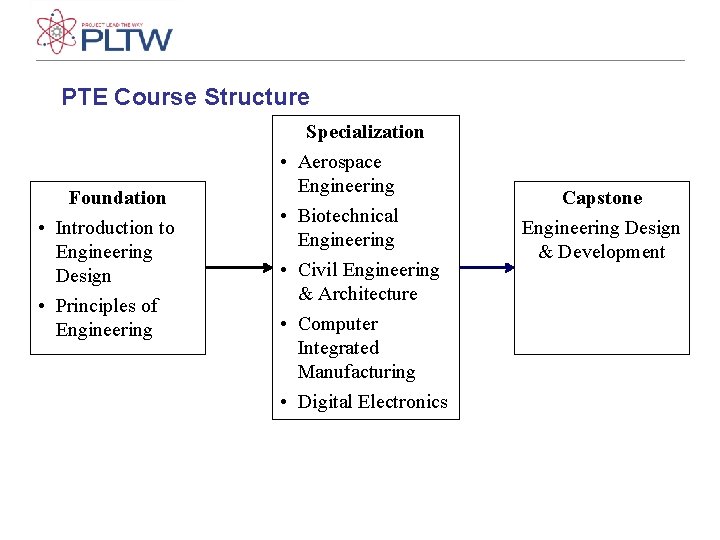
PTE Course Structure • Foundation • Introduction to Engineering Design • Principles of Engineering • • Specialization Aerospace Engineering Biotechnical Engineering Civil Engineering & Architecture Computer Integrated Manufacturing Digital Electronics Capstone Engineering Design & Development
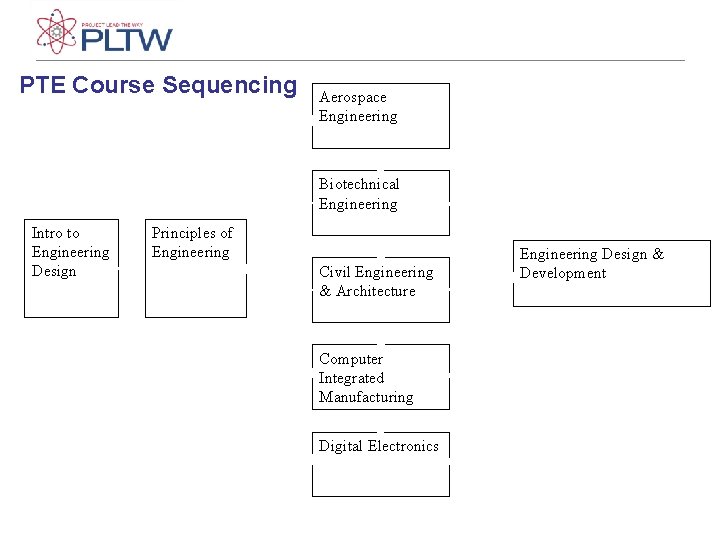
PTE Course Sequencing Aerospace Engineering Biotechnical Engineering Intro to Engineering Design Principles of Engineering Civil Engineering & Architecture Computer Integrated Manufacturing Digital Electronics Engineering Design & Development
PTE: Foundation Courses • Introduction to Engineering Design (IED) – Introduces the design process and how engineers use it to solve problems • Principles of Engineering (POE) – Covers basic concepts in engineering and exposes students to a wide variety of engineering fields
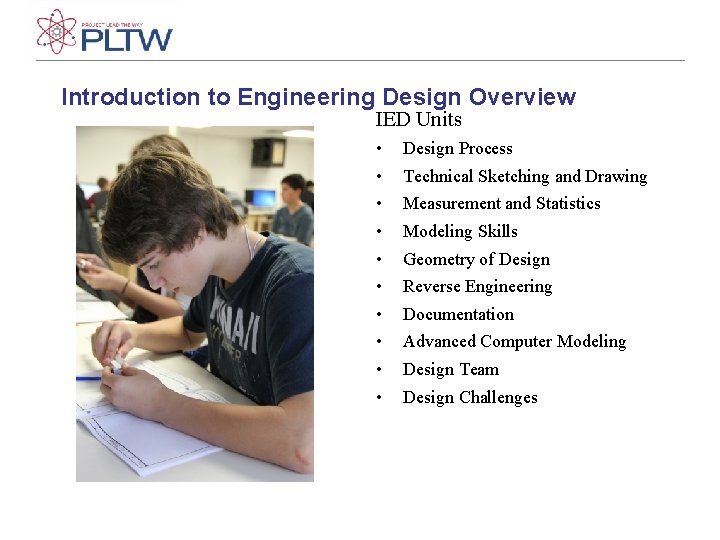
Introduction to Engineering Design Overview IED Units • • • Design Process Technical Sketching and Drawing Measurement and Statistics Modeling Skills Geometry of Design Reverse Engineering Documentation Advanced Computer Modeling Design Team Design Challenges
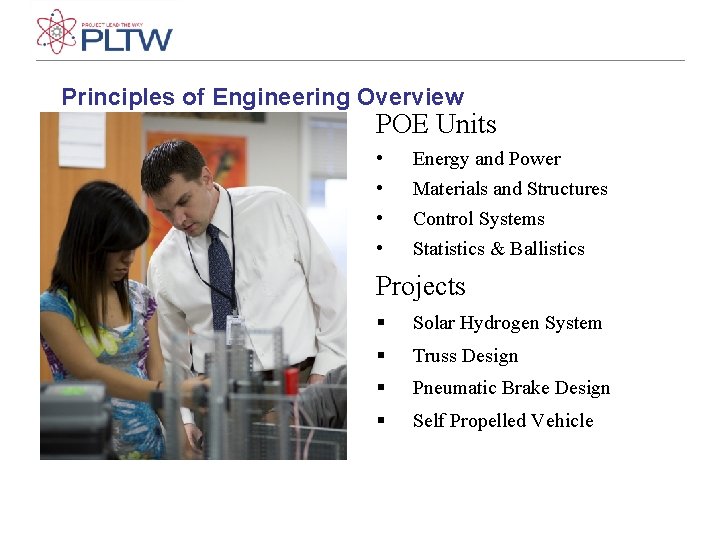
Principles of Engineering Overview POE Units • • Energy and Power Materials and Structures Control Systems Statistics & Ballistics Projects § Solar Hydrogen System § Truss Design § Pneumatic Brake Design § Self Propelled Vehicle
PTE: Specialization Courses • Aerospace Engineering (AE) – Learn the fundamentals of atmospheric and space flight through projects such as designing an airfoil, propulsion system, rocket and glider • Biotechnical Engineering (BE) – Engage in design problems related to biomechanics, cardiovascular engineering, genetic engineering, tissue engineering, biomedical devices, forensics and bioethics • Civil Engineering and Architecture (CEA) – Discover the design and construction industry while designing both residential and commercial projects using Autodesk® 3 D-architectural design software
PTE: Specialization Courses • Computer Integrated Manufacturing (CIM) – Explore designing products for manufacturability, manufacturing processes, CNC machining, factory system modeling, automation, and robotics • Digital Electronics (DE) – Learn the fundamentals of combinational and sequential logic circuit design and create fullyfunctioning digital circuits • Computer Science and Software Engineering
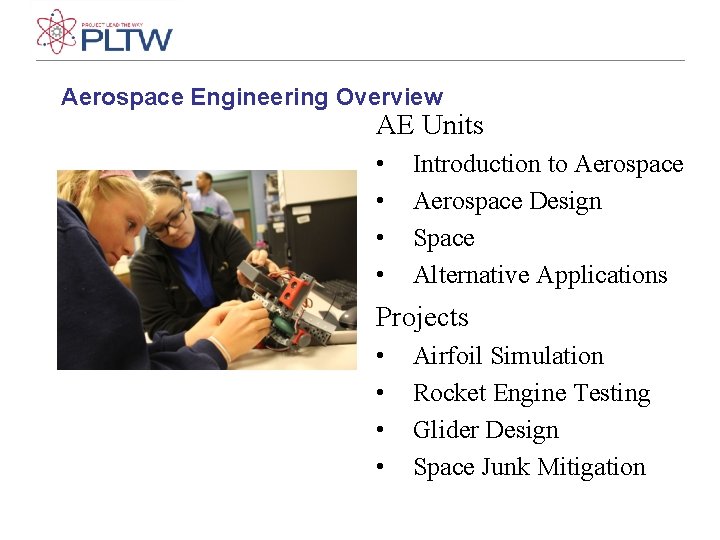
Aerospace Engineering Overview AE Units • • Introduction to Aerospace Design Space Alternative Applications Projects • • Airfoil Simulation Rocket Engine Testing Glider Design Space Junk Mitigation
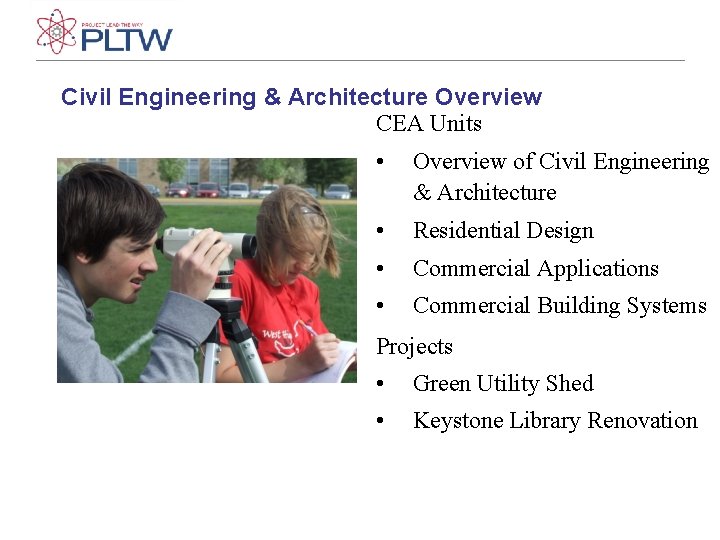
Civil Engineering & Architecture Overview CEA Units • Overview of Civil Engineering & Architecture • Residential Design • Commercial Applications • Commercial Building Systems Projects • Green Utility Shed • Keystone Library Renovation
Computer Integrated Manufacturing Overview CIM Units • Principles of Manufacturing • Manufacturing Processes • Elements of Automation • Integration of Manufacturing Elements Projects • Freight Elevator • Container Design • Autonomous Pick and Place
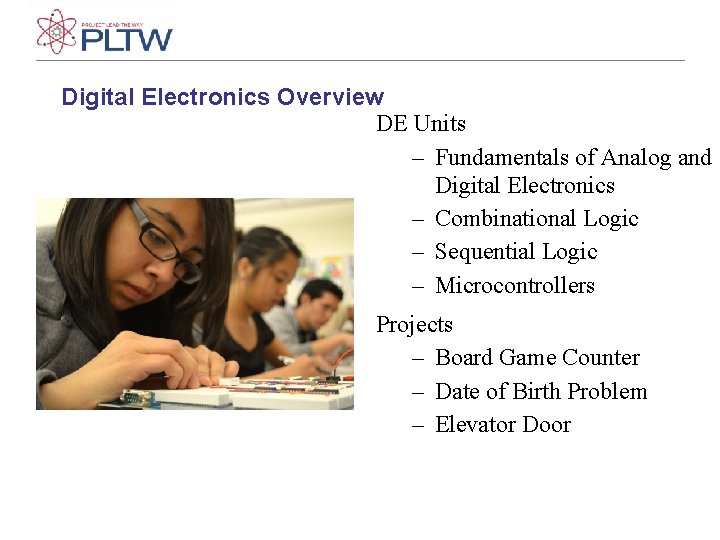
Digital Electronics Overview DE Units – Fundamentals of Analog and Digital Electronics – Combinational Logic – Sequential Logic – Microcontrollers Projects – Board Game Counter – Date of Birth Problem – Elevator Door
Pathway To Engineering: Capstone Course • Engineering Design and Development (EDD) – Research, design, and construct solutions to engineering problems • Components – – – – Project Management Researching a Problem Designing a Solution Creating a Prototype and Testing Plan Evaluation and Reflection on the Design Process Presentation of the Design Process Going Beyond Engineering Design and Development
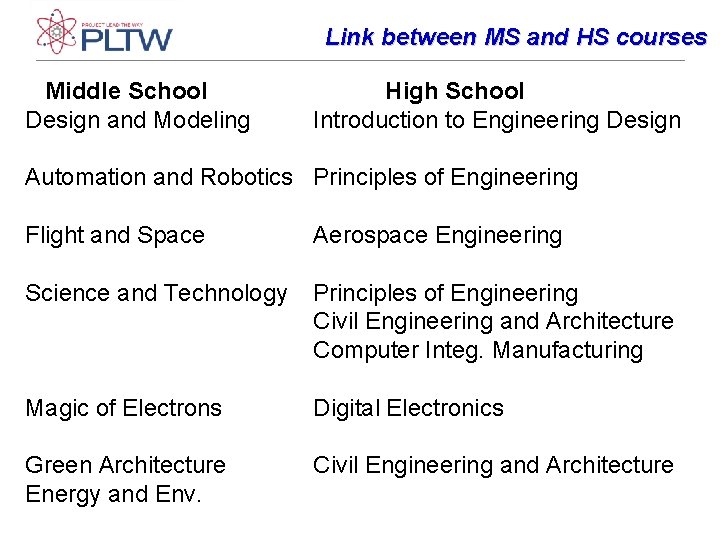
Link between MS and HS courses Middle School Design and Modeling High School Introduction to Engineering Design Automation and Robotics Principles of Engineering Flight and Space Aerospace Engineering Science and Technology Principles of Engineering Civil Engineering and Architecture Computer Integ. Manufacturing Magic of Electrons Digital Electronics Green Architecture Energy and Env. Civil Engineering and Architecture
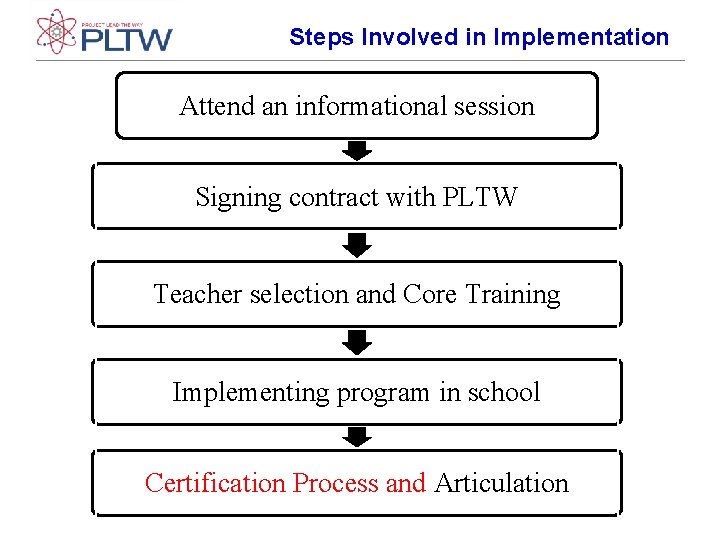
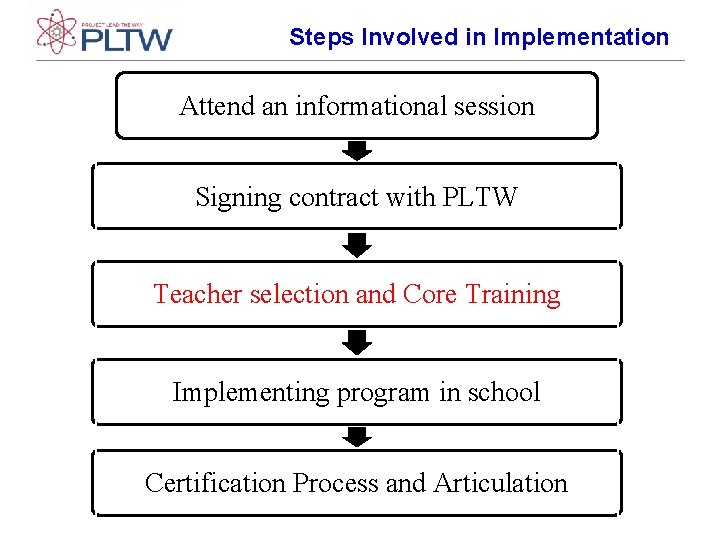
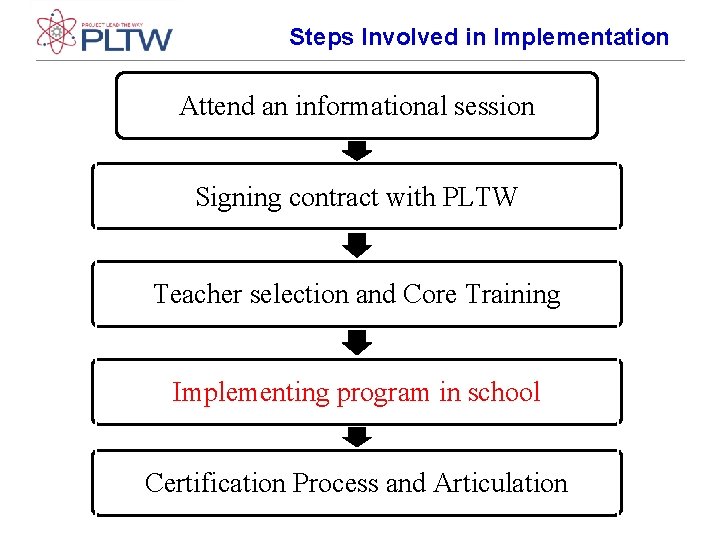
Steps Involved in Implementation Attend an informational session Signing contract with PLTW Teacher selection and Core Training Implementing program in school Certification Process and Articulation
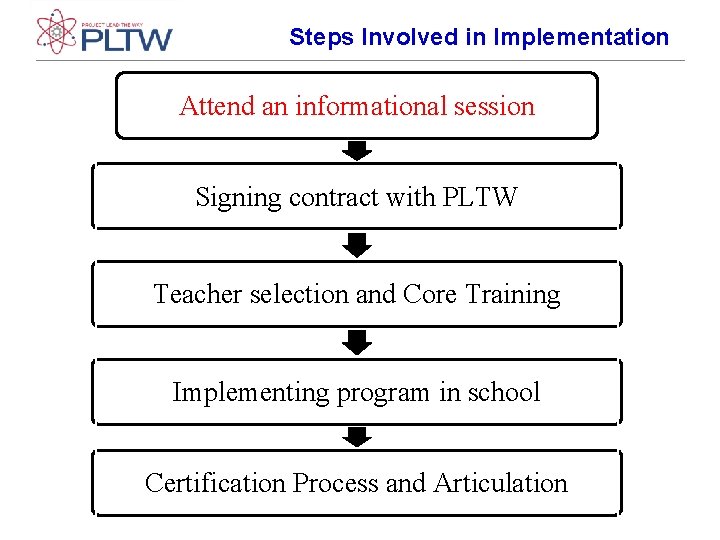
Steps Involved in Implementation Attend an informational session Signing contract with PLTW Teacher selection and Core Training Implementing program in school Certification Process and Articulation
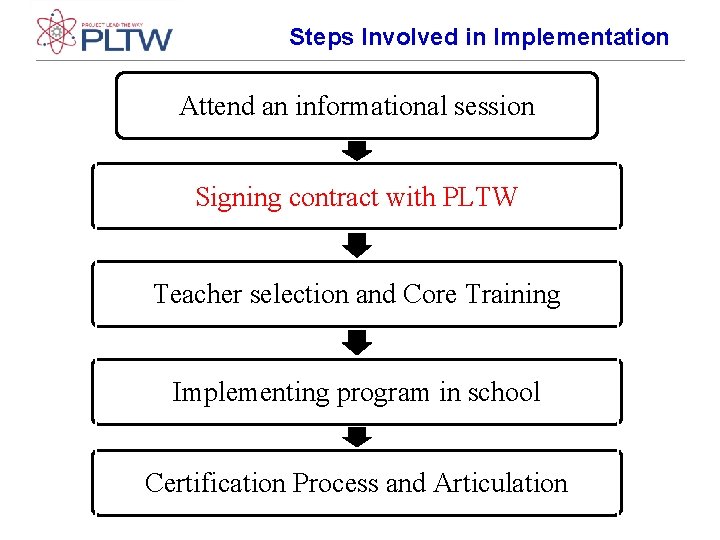
Steps Involved in Implementation Attend an informational session Signing contract with PLTW Teacher selection and Core Training Implementing program in school Certification Process and Articulation
Getting Started and Process of Implementation Signing contract with PLTW https: //www. pltw. org/get-involved/register-pltw schoolrelations@pltw. org • Getting started document • Info needed for registration – document • Look at cost to implement the program
Steps Involved in Implementation Attend an informational session Signing contract with PLTW Teacher selection and Core Training Implementing program in school Certification Process and Articulation
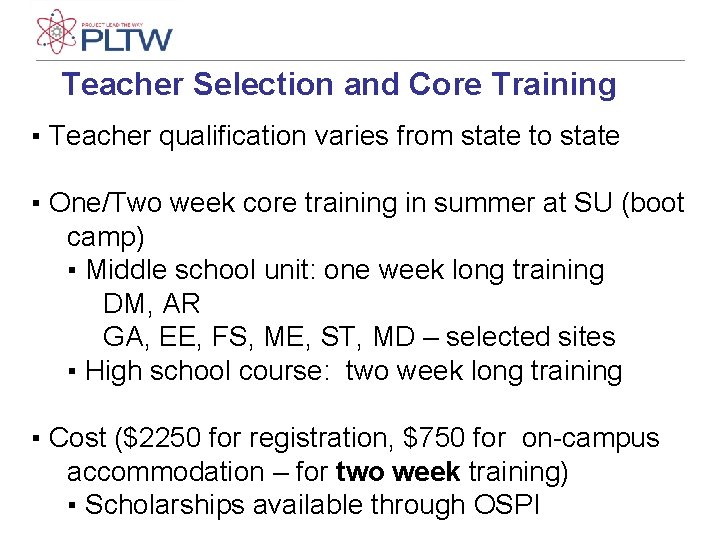
Teacher Selection and Core Training ▪ Teacher qualification varies from state to state ▪ One/Two week core training in summer at SU (boot camp) ▪ Middle school unit: one week long training DM, AR GA, EE, FS, ME, ST, MD – selected sites ▪ High school course: two week long training ▪ Cost ($2250 for registration, $750 for on-campus accommodation – for two week training) ▪ Scholarships available through OSPI
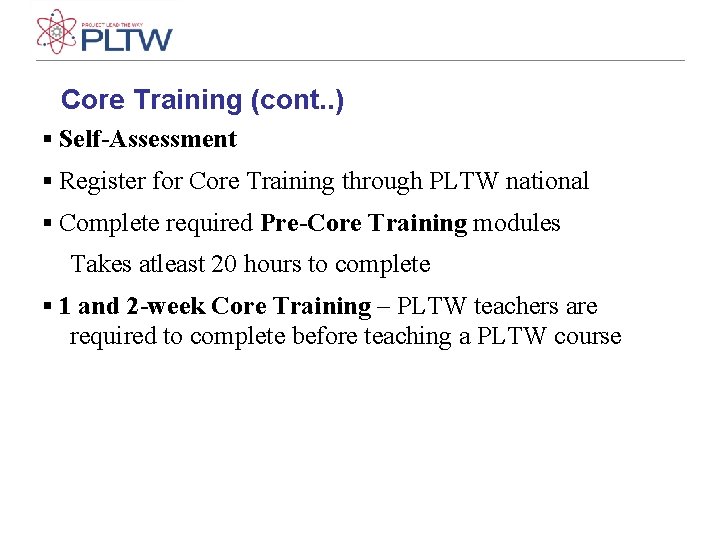
Core Training (cont. . ) ▪ Self-Assessment ▪ Register for Core Training through PLTW national ▪ Complete required Pre-Core Training modules Takes atleast 20 hours to complete ▪ 1 and 2 -week Core Training – PLTW teachers are required to complete before teaching a PLTW course
Professional Development support for teachers ▪ Virtual Academy for Teachers, provides detailed materials for each lesson in every PLTW course; many videos of PLTW Master Teachers teaching actual PLTW lessons; and, collaboration tools, including forums for teachers to use to ask questions, to update each other on changes, and to discuss PLTW lessons. ▪ Off campus training on individual units, as requested ▪ On or Off campus refresher training, as requested
Steps Involved in Implementation Attend an informational session Signing contract with PLTW Teacher selection and Core Training Implementing program in school Certification Process and Articulation
Implementation ▪ Purchasing Equipments and software downloads http: //www. pltw. org/program-support/2013 -2014 purchasing-manual ▪ Student/parent buy-in ▪ For sustainability, do not rely on one teacher for all PLTW classes
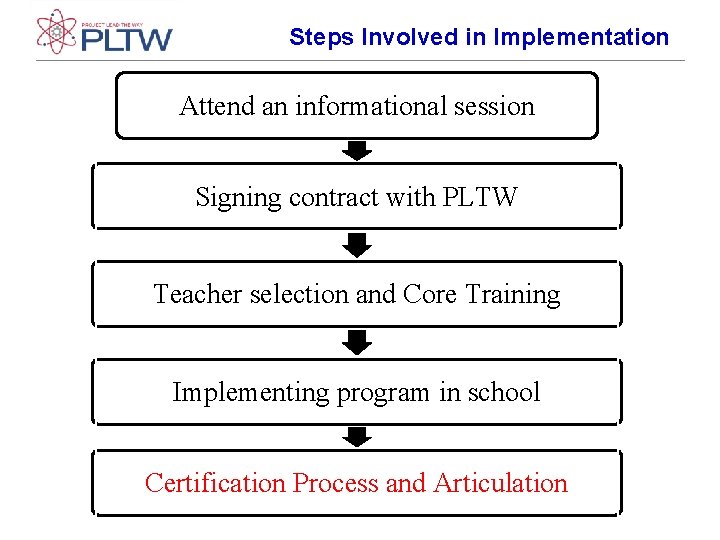
Steps Involved in Implementation Attend an informational session Signing contract with PLTW Teacher selection and Core Training Implementing program in school Certification Process and Articulation
pltw@seattleu. edu; schoolrelations@pltw. org