
Project Introduction Why Offshore Wave Energy In Comparison
- Slides: 1
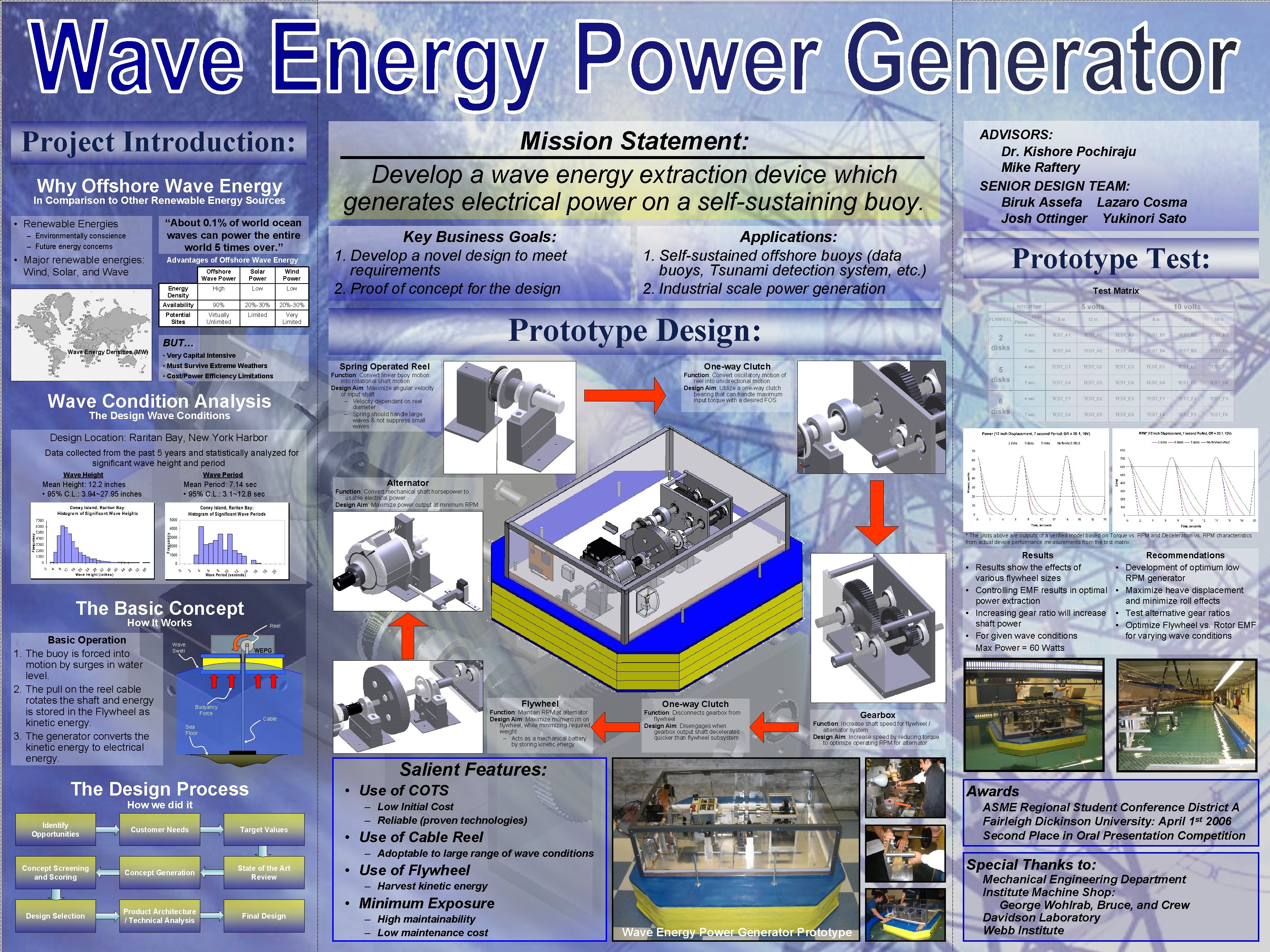
Project Introduction: Why Offshore Wave Energy In Comparison to Other Renewable Energy Sources “About 0. 1% of world ocean waves can power the entire world 5 times over. ” • Renewable Energies – Environmentally conscience – Future energy concerns • Major renewable energies: Wind, Solar, and Wave Advantages of Offshore Wave Energy Offshore Wave Power Solar Power Wind Power Energy Density High Low Availability 90% 20%-30% Potential Sites Virtually Unlimited Limited Very Limited Mission Statement: Develop a wave energy extraction device which generates electrical power on a self-sustaining buoy. Key Business Goals: 1. Develop a novel design to meet requirements 2. Proof of concept for the design Applications: 1. Self-sustained offshore buoys (data buoys, Tsunami detection system, etc. ) 2. Industrial scale power generation Prototype Test: Test Matrix Prototype Design: BUT… Wave Energy Densities (MW) ADVISORS: Dr. Kishore Pochiraju Mike Raftery SENIOR DESIGN TEAM: Biruk Assefa Lazaro Cosma Josh Ottinger Yukinori Sato • Very Capital Intensive Spring Operated Reel • Must Survive Extreme Weathers • Cost/Power Efficiency Limitations Wave Condition Analysis The Design Wave Conditions One-way Clutch Function: Convert linear buoy motion into rotational shaft motion Design Aim: Maximize angular velocity of input shaft – Velocity dependant on reel diameter – Spring should handle large waves & not suppress small waves Function: Convert oscillatory motion of reel into unidirectional motion Design Aim: Utilize a one-way clutch bearing that can handle maximum input torque with a desired FOS Design Location: Raritan Bay, New York Harbor Data collected from the past 5 years and statistically analyzed for significant wave height and period Wave Height Wave Period Mean Height: 12. 2 inches • 95% C. L. : 3. 94~27. 95 inches Alternator Mean Period: 7. 14 sec • 95% C. L. : 3. 1~12. 8 sec Function: Convert mechanical shaft horsepower to usable electrical power Design Aim: Maximize power output at minimum RPM * The plots above are outputs of a verified model based on Torque vs. RPM and Deceleration vs. RPM characteristics from actual device performance measurements from the test matrix. • • The Basic Concept How It Works Basic Operation 1. The buoy is forced into motion by surges in water level. 2. The pull on the reel cable rotates the shaft and energy is stored in the Flywheel as kinetic energy. 3. The generator converts the kinetic energy to electrical energy. • Reel • Wave Swell WEPG Flywheel Buoyancy Force Cable Sea Floor The Design Process How we did it Identify Opportunities Function: Maintain RPM at alternator Design Aim: Maximize momentum on flywheel, while minimizing required weight – Acts as a mechanical battery by storing kinetic energy Customer Needs Target Values Design Selection Concept Generation Product Architecture / Technical Analysis State of the Art Review Function: Disconnects gearbox from flywheel Design Aim: Disengages when gearbox output shaft decelerates quicker than flywheel subsystem • • • Gearbox Function: Increase shaft speed for flywheel / alternator system Design Aim: Increase speed by reducing torque to optimize operating RPM for alternator Salient Features: • Use of COTS Awards – Low Initial Cost – Reliable (proven technologies) ASME Regional Student Conference District A Fairleigh Dickinson University: April 1 st 2006 Second Place in Oral Presentation Competition • Use of Cable Reel Special Thanks to: • Use of Flywheel – Harvest kinetic energy • Minimum Exposure Final Design • Recommendations Development of optimum low RPM generator Maximize heave displacement and minimize roll effects Test alternative gear ratios Optimize Flywheel vs. Rotor EMF for varying wave conditions One-way Clutch – Adoptable to large range of wave conditions Concept Screening and Scoring Results show the effects of various flywheel sizes Controlling EMF results in optimal power extraction Increasing gear ratio will increase shaft power For given wave conditions Max Power = 60 Watts – High maintainability – Low maintenance cost Wave Energy Power Generator Prototype Mechanical Engineering Department Institute Machine Shop: George Wohlrab, Bruce, and Crew Davidson Laboratory Webb Institute