
Project Intake Evaluation and Decision Making Process Summary
- Slides: 26
Project Intake, Evaluation and Decision Making Process Summary & Recommendations September 11, 2017 1
Agenda ØScope of Work ØObjectives and Principles ØAssumptions ØOverall Approach ØProposed Process ØImplementation, Communication Plans 2
Scope of Work Ø Develop “IT Project Proposal” Definition Ø Create Project Proposal Intake Template Ø Develop Scoring/Classification Methodology, Routing Strategy Ø Route Proposals through IT Governance Ø Identify Issues, Types of Proposals that may Need Further Scrutiny by the IT Steering Committee (ITSC) 3
Objectives and Principles Ø Rationalization - create rational, effective, consistent framework Ø Prioritization – no more “one-off” project evaluation, funding requests Ø Minimize duplications and redundancies Ø Assess impact on IT infrastructure/resources capacities Ø Innovation – recognize/encourage innovative services Ø Governance driven, collaborative, transparent, expert-based Ø Agility and flexibility – easily modified/improved; “One size does not fit all. ” 4 Ø Pace/Speed – rapid evaluation and decision-making
Assumptions Ø Mandatory: All IT project proposals will go through the process Ø Vast majority of projects are expected to have their own funding: • This is NOT a “request for funding” process • Request for campus funding: A prioritized list will be taken to campus 3 times a year: September, January, May Ø Service Catalog and Project Repository will be used Ø Adequate professional and administrative staff 5
Overall Approach Ø Two Workgroups were Created • Project Proposal Intake, Scoring and Routing • Project Prioritization and Recommendation Ø Various Sources were used by Groups, Including EITDM Materials 6
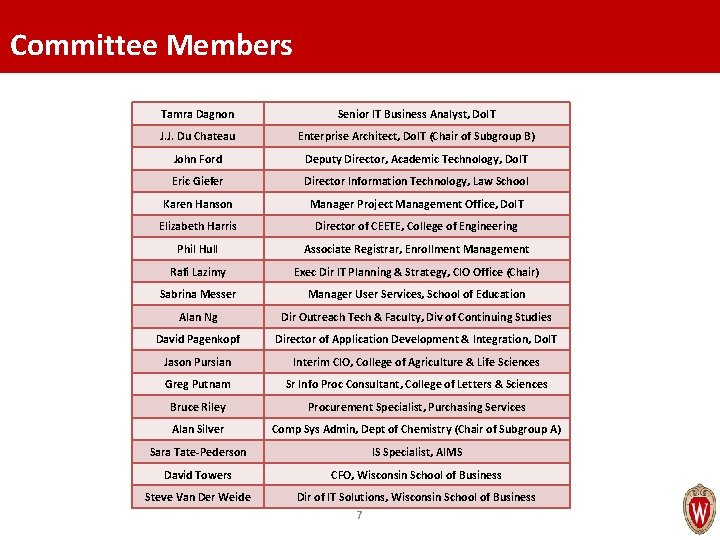
Committee Members Tamra Dagnon Senior IT Business Analyst, Do. IT J. J. Du Chateau Enterprise Architect, Do. IT (Chair of Subgroup B) John Ford Deputy Director, Academic Technology, Do. IT Eric Giefer Director Information Technology, Law School Karen Hanson Manager Project Management Office, Do. IT Elizabeth Harris Director of CEETE, College of Engineering Phil Hull Associate Registrar, Enrollment Management Rafi Lazimy Exec Dir IT Planning & Strategy, CIO Office (Chair) Sabrina Messer Manager User Services, School of Education Alan Ng Dir Outreach Tech & Faculty, Div of Continuing Studies David Pagenkopf Director of Application Development & Integration, Do. IT Jason Pursian Interim CIO, College of Agriculture & Life Sciences Greg Putnam Sr Info Proc Consultant, College of Letters & Sciences Bruce Riley Procurement Specialist, Purchasing Services Alan Silver Comp Sys Admin, Dept of Chemistry (Chair of Subgroup A) Sara Tate-Pederson IS Specialist, AIMS David Towers CFO, Wisconsin School of Business Steve Van Der Weide Dir of IT Solutions, Wisconsin School of Business 7
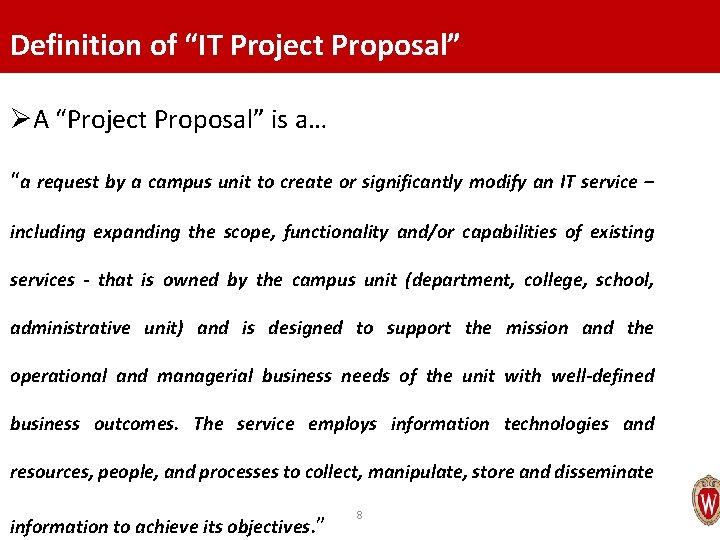
Definition of “IT Project Proposal” ØA “Project Proposal” is a… “a request by a campus unit to create or significantly modify an IT service – including expanding the scope, functionality and/or capabilities of existing services - that is owned by the campus unit (department, college, school, administrative unit) and is designed to support the mission and the operational and managerial business needs of the unit with well-defined business outcomes. The service employs information technologies and resources, people, and processes to collect, manipulate, store and disseminate information to achieve its objectives. ” 8
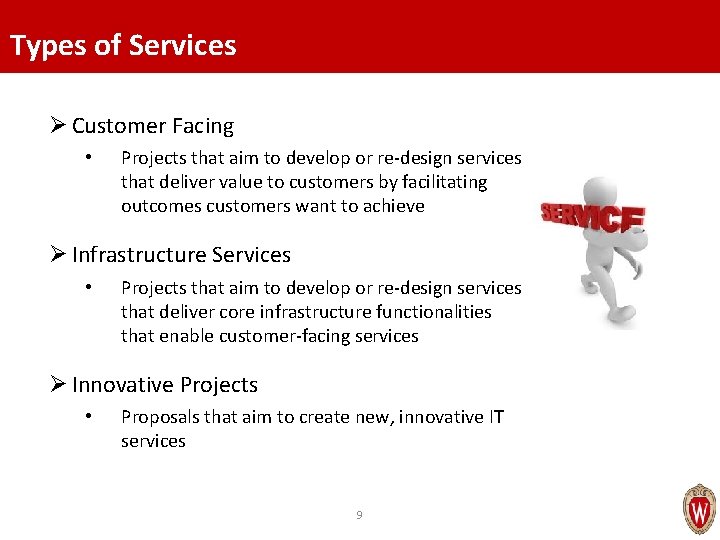
Types of Services Ø Customer Facing • Projects that aim to develop or re-design services that deliver value to customers by facilitating outcomes customers want to achieve Ø Infrastructure Services • Projects that aim to develop or re-design services that deliver core infrastructure functionalities that enable customer-facing services Ø Innovative Projects • Proposals that aim to create new, innovative IT services 9
Who Can Submit a Project; Project Sponsor; Notifications to Divisional Officials Ø Divisional CIOs have the authority to submit proposals. They can delegate that authority. Ø The divisional CIO should receive a copy of the proposal. Ø If a proposal seeks campus funding: The divisional CIO will notify divisional officials (dean/director; associate dean/director; CFO) so they can weigh in on the proposal. Ø A project proposal should have a sponsor. Typically - the owner/manager of the business process and/or functionality that the proposed IT service will support. The sponsor must approve the submission. 10
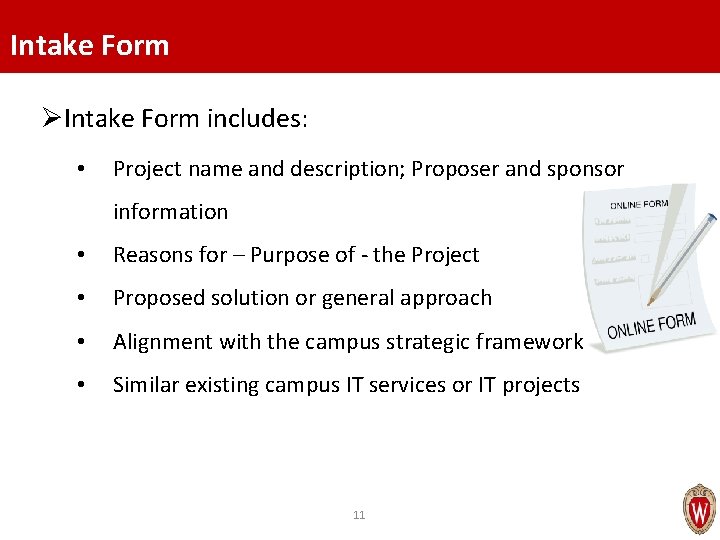
Intake Form ØIntake Form includes: • Project name and description; Proposer and sponsor information • Reasons for – Purpose of - the Project • Proposed solution or general approach • Alignment with the campus strategic framework • Similar existing campus IT services or IT projects 11
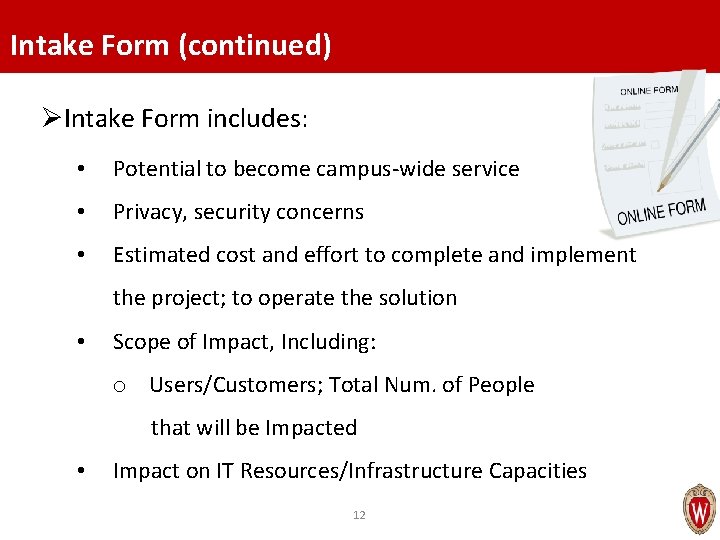
Intake Form (continued) ØIntake Form includes: • Potential to become campus-wide service • Privacy, security concerns • Estimated cost and effort to complete and implement the project; to operate the solution • Scope of Impact, Including: o Users/Customers; Total Num. of People that will be Impacted • Impact on IT Resources/Infrastructure Capacities 12
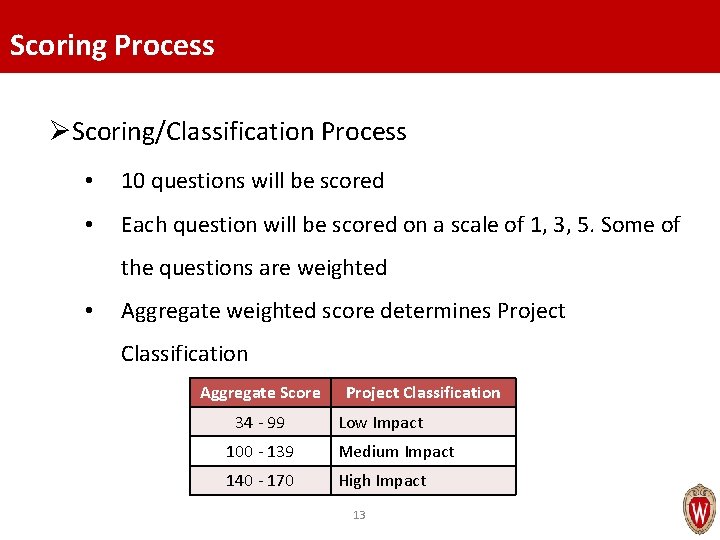
Scoring Process ØScoring/Classification Process • 10 questions will be scored • Each question will be scored on a scale of 1, 3, 5. Some of the questions are weighted • Aggregate weighted score determines Project Classification Aggregate Score 34 - 99 Project Classification Low Impact 100 - 139 Medium Impact 140 - 170 High Impact 13
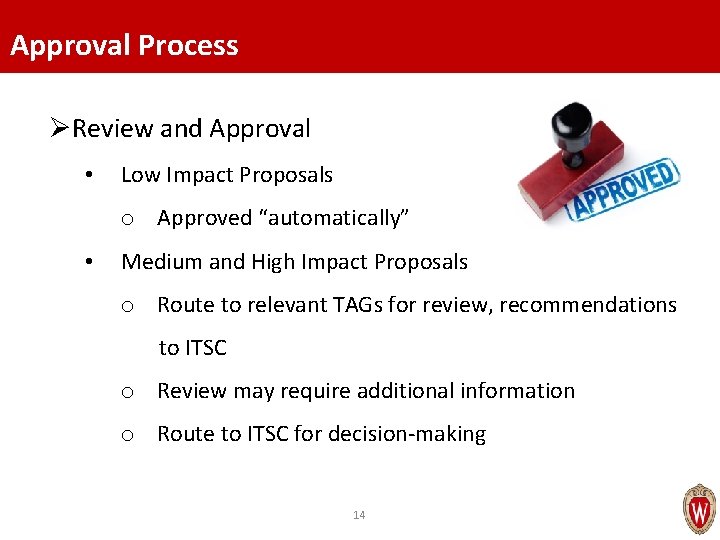
Approval Process ØReview and Approval • Low Impact Proposals o Approved “automatically” • Medium and High Impact Proposals o Route to relevant TAGs for review, recommendations to ITSC o Review may require additional information o Route to ITSC for decision-making 14
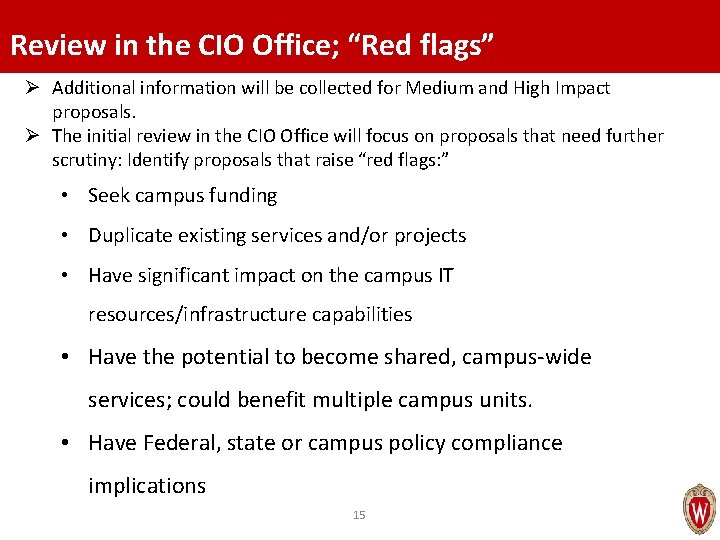
Review in the CIO Office; “Red flags” Ø Additional information will be collected for Medium and High Impact proposals. Ø The initial review in the CIO Office will focus on proposals that need further scrutiny: Identify proposals that raise “red flags: ” • Seek campus funding • Duplicate existing services and/or projects • Have significant impact on the campus IT resources/infrastructure capabilities • Have the potential to become shared, campus-wide services; could benefit multiple campus units. • Have Federal, state or campus policy compliance implications 15
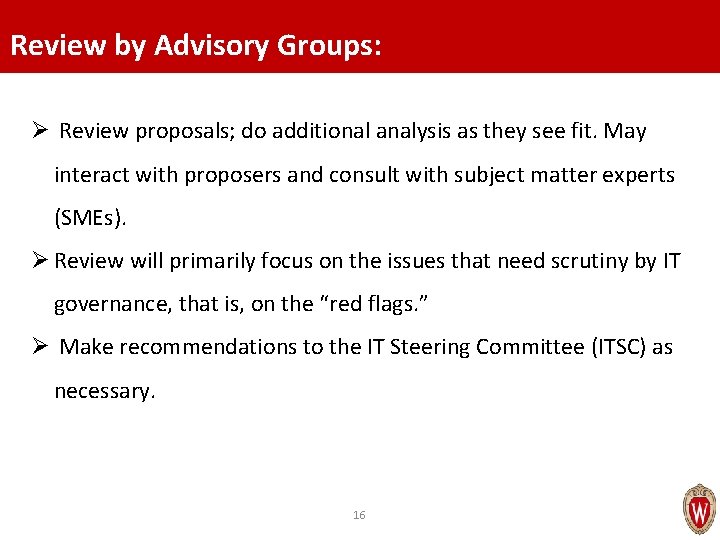
Review by Advisory Groups: Ø Review proposals; do additional analysis as they see fit. May interact with proposers and consult with subject matter experts (SMEs). Ø Review will primarily focus on the issues that need scrutiny by IT governance, that is, on the “red flags. ” Ø Make recommendations to the IT Steering Committee (ITSC) as necessary. 16
Review by Advisory Groups (continued) Ø Advisory Groups are encouraged to: • Establish a process to manage, review, make recommendations to the ITSC • Appoint standing and/or ad-hoc committees/subgroups to review, make recommendations • Establish and maintain a uniform, consistent format for making recommendations to ITSC 17
Decision-Making Ø The IT Steering Committee (ITSC) will make decisions about project proposals, based on recommendations by the Advisory Groups Ø Will focus on major issues and considerations (“red flags” issues) Ø Prioritize high impact projects, assemble a prioritized list of requests for campus funding, and take other necessary action(s). IT leadership will go to campus three times a year with a prioritized list of funding requests 18
Implementation Plan Ø The Intake Process will “go live” on Oct. 1, 2017 Ø Review Team in the CIO Office: • Executives/directors in the CIO Office. • Chairs of the Advisory Groups: DTAG, TLTAG, RTAG, IAG. • Professional staff: Business Analyst(s); Enterprise Architect(s). • Subject Matter Experts (as needed) • Administrative staff. 19
Implementation Plan (continued) Ø Reviewing issues that require further scrutiny (“red flags”): • Proposals that seem to duplicate an existing service or project: o The proposer/sponsor will be required to meet with the IT and/or business sponsors of the existing similar services/projects in order to explore opportunities for collaboration and consolidation. • Proposals with significant impact on campus IT infrastructure and resources: o Review group will periodically aggregate the impact of proposals on the campus IT infrastructure and resources. o Will discuss the aggregate impact with the “owners/managers” of IT infrastructure and resources in order to assess the effect on the campus infrastructure capacities and capabilities. 20
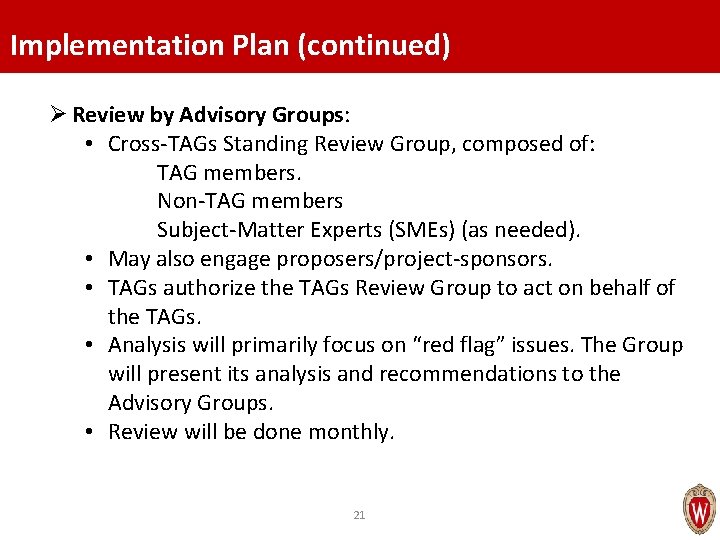
Implementation Plan (continued) Ø Review by Advisory Groups: • Cross-TAGs Standing Review Group, composed of: TAG members. Non-TAG members Subject-Matter Experts (SMEs) (as needed). • May also engage proposers/project-sponsors. • TAGs authorize the TAGs Review Group to act on behalf of the TAGs. • Analysis will primarily focus on “red flag” issues. The Group will present its analysis and recommendations to the Advisory Groups. • Review will be done monthly. 21
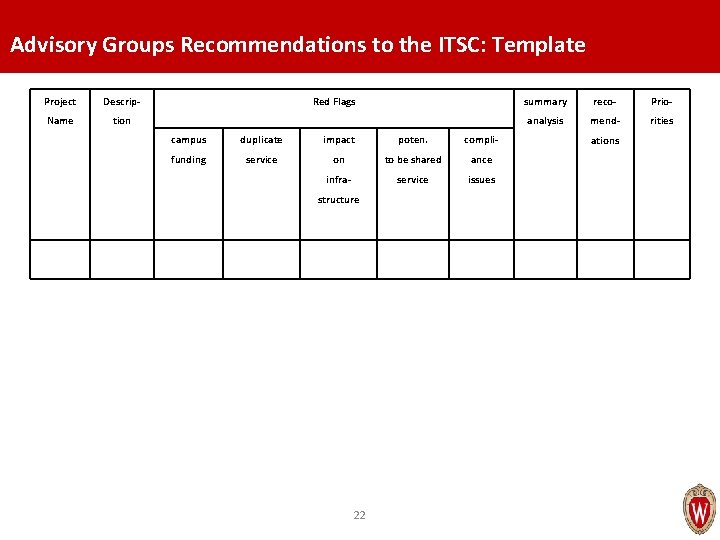
Advisory Groups Recommendations to the ITSC: Template Project Descrip- Name tion Red Flags campus duplicate impact poten. compli- funding service on to be shared ance infra- service issues summary reco- Prio- analysis mend- rities ations structure 22
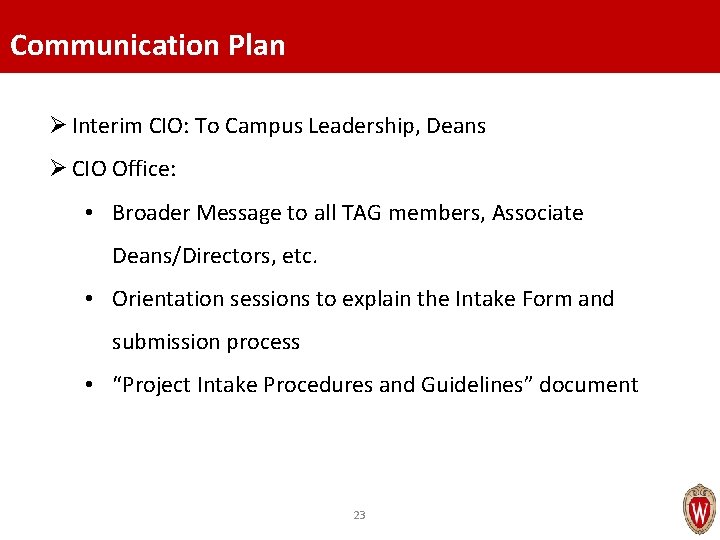
Communication Plan Ø Interim CIO: To Campus Leadership, Deans Ø CIO Office: • Broader Message to all TAG members, Associate Deans/Directors, etc. • Orientation sessions to explain the Intake Form and submission process • “Project Intake Procedures and Guidelines” document 23
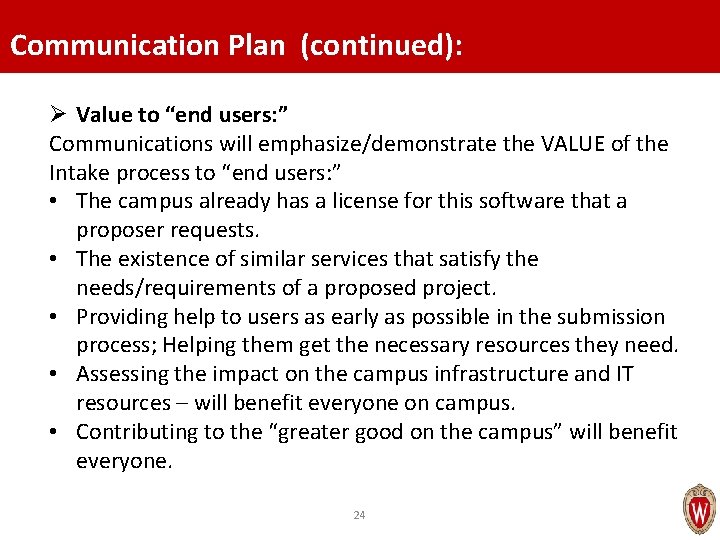
Communication Plan (continued): Ø Value to “end users: ” Communications will emphasize/demonstrate the VALUE of the Intake process to “end users: ” • The campus already has a license for this software that a proposer requests. • The existence of similar services that satisfy the needs/requirements of a proposed project. • Providing help to users as early as possible in the submission process; Helping them get the necessary resources they need. • Assessing the impact on the campus infrastructure and IT resources – will benefit everyone on campus. • Contributing to the “greater good on the campus” will benefit everyone. 24
Discussion Questions: 1. Are we missing any relevant questions in the Intake Process? 2. Are we missing important impact filtering questions? 3. Do you recommend other issues, considerations, and types of proposals that will help Advisory Groups in making recommendations to the ITSC and that may need further scrutiny by the ITSC? 25
Project Intake, Evaluation and Decision Making Process – Questions? Thank you for your time and attention! 26