
PROJECT INITIATION Chapter 2 Slide 1 Power Point





- Slides: 31
PROJECT INITIATION Chapter 2 Slide 1 Power. Point Presentation for Dennis, Wixom & Tegardem Systems Analysis and Design Copyright 2001 © John Wiley & Sons, Inc. All rights reserved.
Key Ideas Projects being when someone sees an opportunity to create business value from using information technology. Feasibility analysis is used to aid in the decision of whether or not to proceed with the IS project. 2 Power. Point Presentation for Dennis, Wixom & Tegardem Systems Analysis and Design Copyright 2001 © John Wiley & Sons, Inc. All rights reserved.
IDENTIFYING BUSINESS VALUE Projects that solve operational problems (Cost reduction) Projects that achieve the firm’s strategic objectives (New Markets/Products, Partnerships) Projects that exploit developments in technology (Product quality, New Products, Customer Service) 3 Power. Point Presentation for Dennis, Wixom & Tegardem Systems Analysis and Design Copyright 2001 © John Wiley & Sons, Inc. All rights reserved.
System Request Lists key elements of the project Project name Project sponsor Business need (Symptoms) Functionality (Objectives) Expected value Special issues or constraints (Scope)
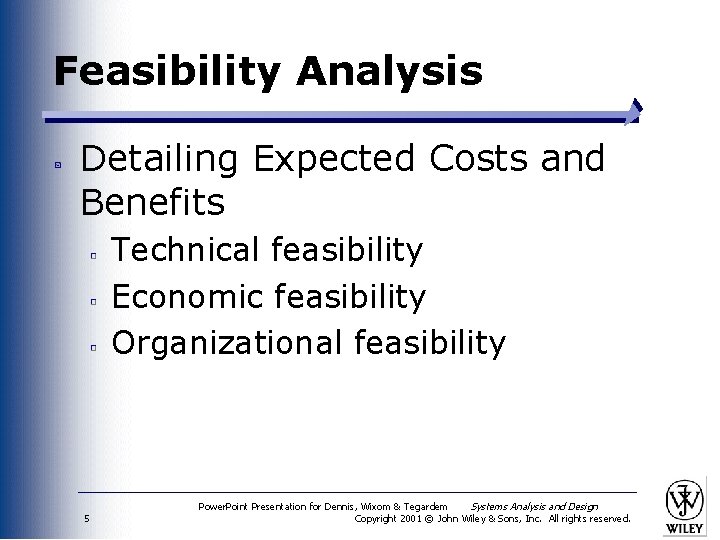
Feasibility Analysis Detailing Expected Costs and Benefits Technical feasibility Economic feasibility Organizational feasibility 5 Power. Point Presentation for Dennis, Wixom & Tegardem Systems Analysis and Design Copyright 2001 © John Wiley & Sons, Inc. All rights reserved.
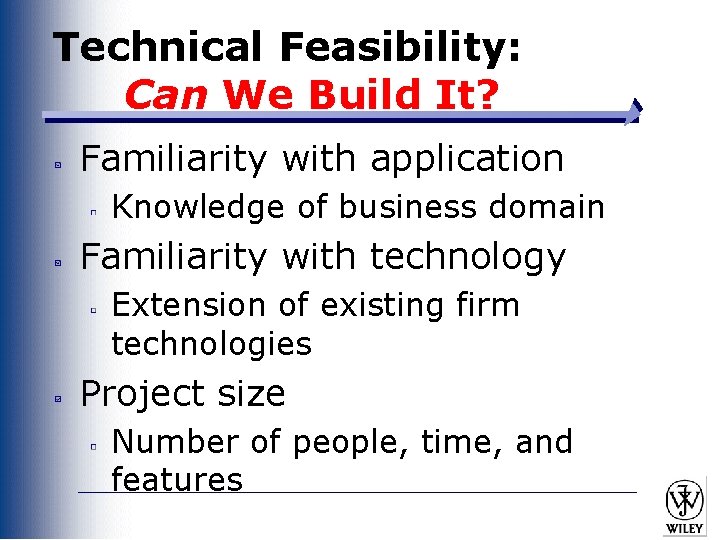
Technical Feasibility: Can We Build It? Familiarity with application Knowledge of business domain Familiarity with technology Extension of existing firm technologies Project size Number of people, time, and features
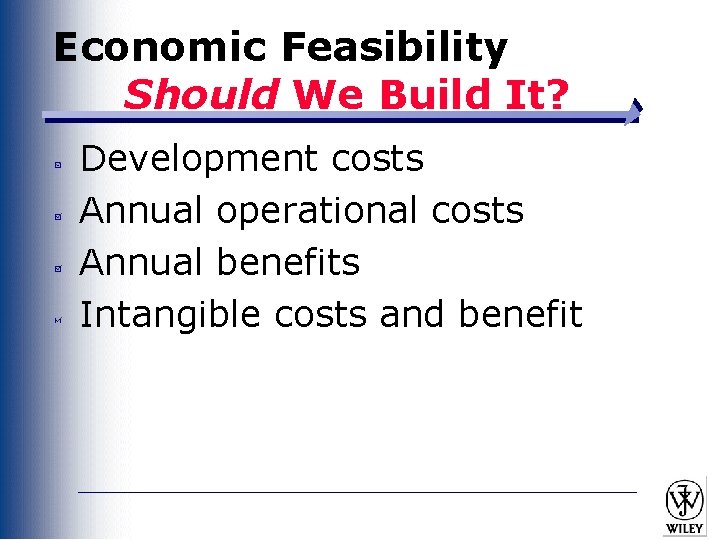
Economic Feasibility Should We Build It? Development costs Annual operational costs Annual benefits Intangible costs and benefit
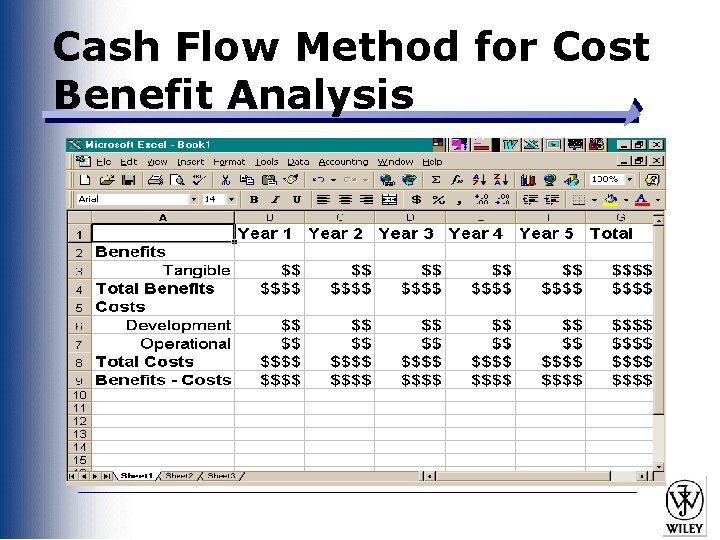
Cash Flow Method for Cost Benefit Analysis
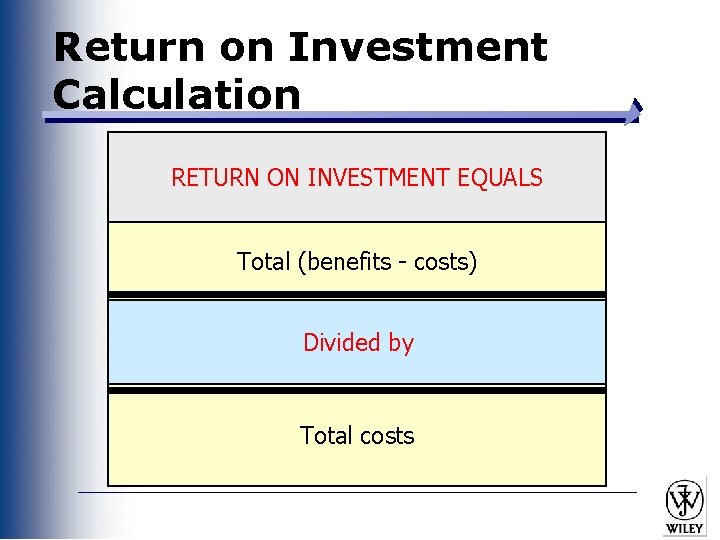
Return on Investment Calculation RETURN ON INVESTMENT EQUALS Total (benefits - costs) Divided by Total costs
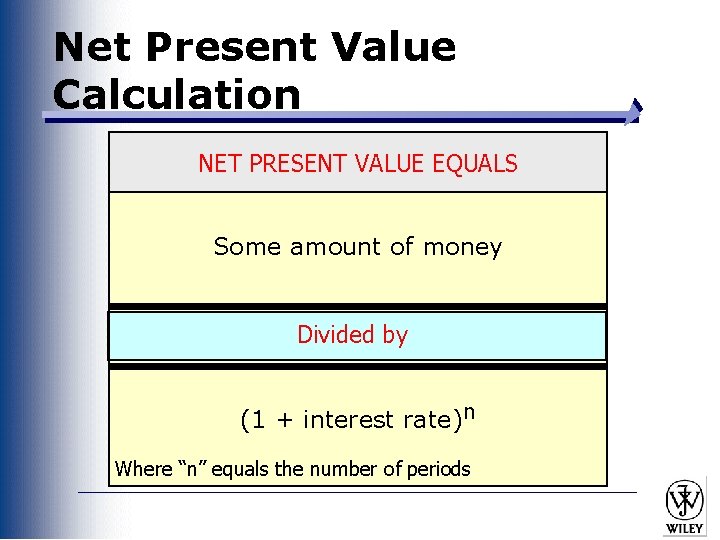
Net Present Value Calculation NET PRESENT VALUE EQUALS Some amount of money Divided by (1 + interest rate)n Where “n” equals the number of periods
Organizational Feasibility If we build it, will they come? Stakeholder analysis considers Project champion(s) Organizational management System users
Summary Project initiation involves creating and assessing goals and expectations for a new system Identifying the business value of the new project is a key to success The system request describes an overview of the proposed system. The feasibility study is concerned with insuring that technical, economic, and organizational benefits outweigh costs and risks 12 Power. Point Presentation for Dennis, Wixom & Tegardem Systems Analysis and Design Copyright 2001 © John Wiley & Sons, Inc. All rights reserved.
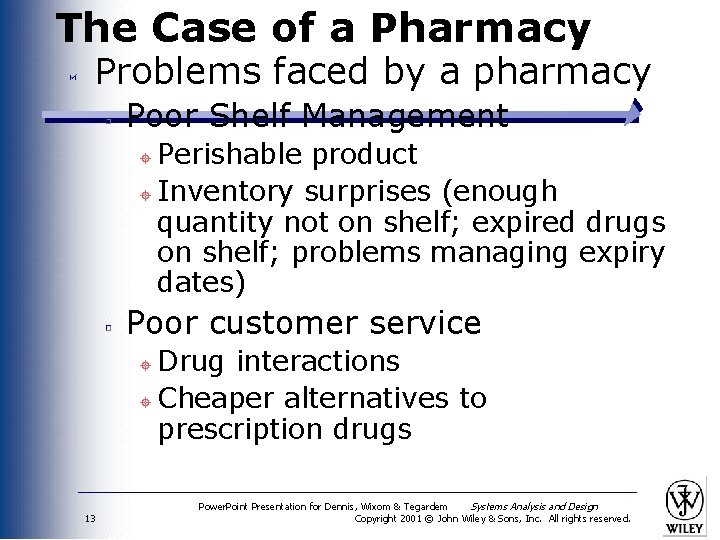
The Case of a Pharmacy Problems faced by a pharmacy Poor Shelf Management Perishable product ± Inventory surprises (enough quantity not on shelf; expired drugs on shelf; problems managing expiry dates) ± Poor customer service Drug interactions ± Cheaper alternatives to prescription drugs ± 13 Power. Point Presentation for Dennis, Wixom & Tegardem Systems Analysis and Design Copyright 2001 © John Wiley & Sons, Inc. All rights reserved.
Systems Analysis Chapter 4 Slide 14 Power. Point Presentation for Dennis, Wixom & Tegardem Systems Analysis and Design Copyright 2001 © John Wiley & Sons, Inc. All rights reserved.
Key Definitions The As-Is system is the current system and may or may not be computerized The To-Be system is the new system that is based on updated requirements 15 Power. Point Presentation for Dennis, Wixom & Tegardem Systems Analysis and Design Copyright 2001 © John Wiley & Sons, Inc. All rights reserved.
Key Ideas The goal of the analysis phase is to truly understand the requirements of the new system and develop a system that addresses them -- or decide a new system isn’t needed. The line between systems analysis and systems design is very blurry. 16 Power. Point Presentation for Dennis, Wixom & Tegardem Systems Analysis and Design Copyright 2001 © John Wiley & Sons, Inc. All rights reserved.
THE ANALYSIS PROCESS Slide 17 Power. Point Presentation for Dennis, Wixom & Tegardem Systems Analysis and Design Copyright 2001 © John Wiley & Sons, Inc. All rights reserved.
Analysis Across Areas Combines business and information technology Balance expertise of users and analysts 18 Power. Point Presentation for Dennis, Wixom & Tegardem Systems Analysis and Design Copyright 2001 © John Wiley & Sons, Inc. All rights reserved.
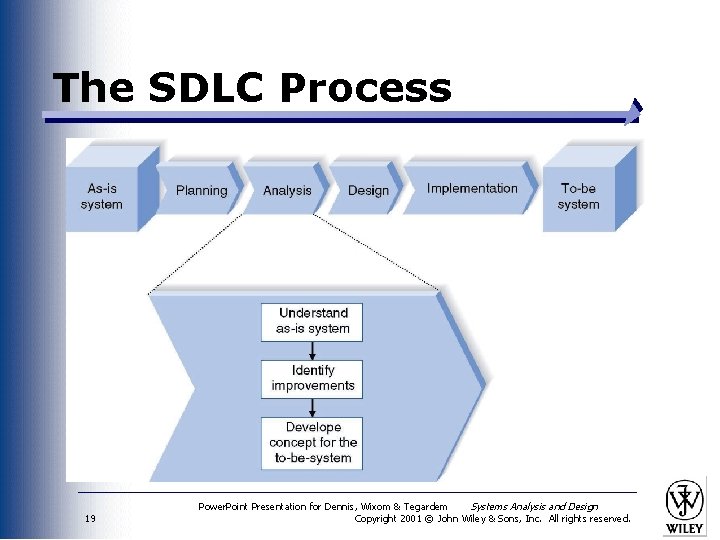
The SDLC Process 19 Power. Point Presentation for Dennis, Wixom & Tegardem Systems Analysis and Design Copyright 2001 © John Wiley & Sons, Inc. All rights reserved.
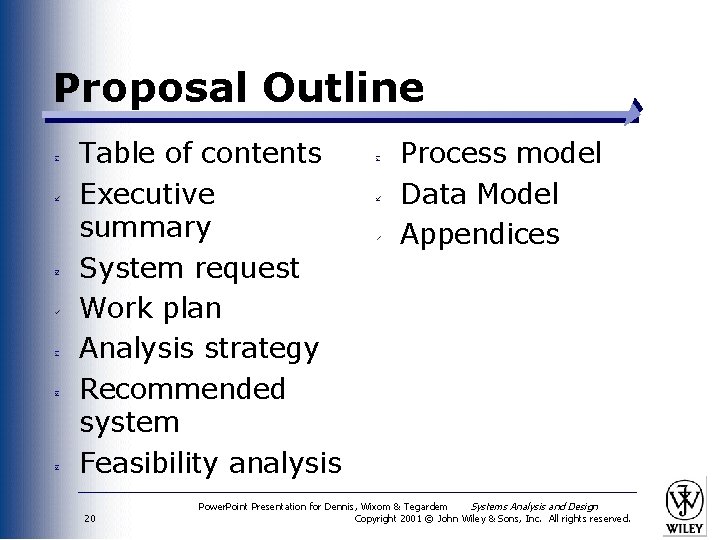
Proposal Outline Table of contents Executive summary System request Work plan Analysis strategy Recommended system Feasibility analysis 20 Process model Data Model Appendices Power. Point Presentation for Dennis, Wixom & Tegardem Systems Analysis and Design Copyright 2001 © John Wiley & Sons, Inc. All rights reserved.
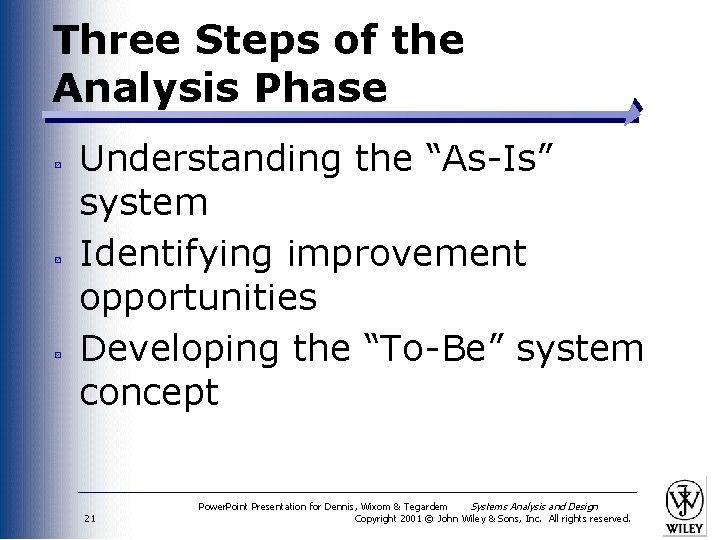
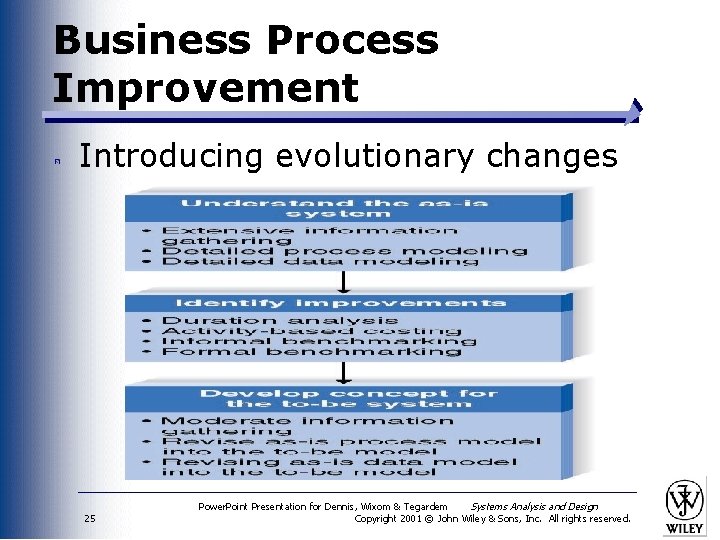
Three Steps of the Analysis Phase Understanding the “As-Is” system Identifying improvement opportunities Developing the “To-Be” system concept 21 Power. Point Presentation for Dennis, Wixom & Tegardem Systems Analysis and Design Copyright 2001 © John Wiley & Sons, Inc. All rights reserved.
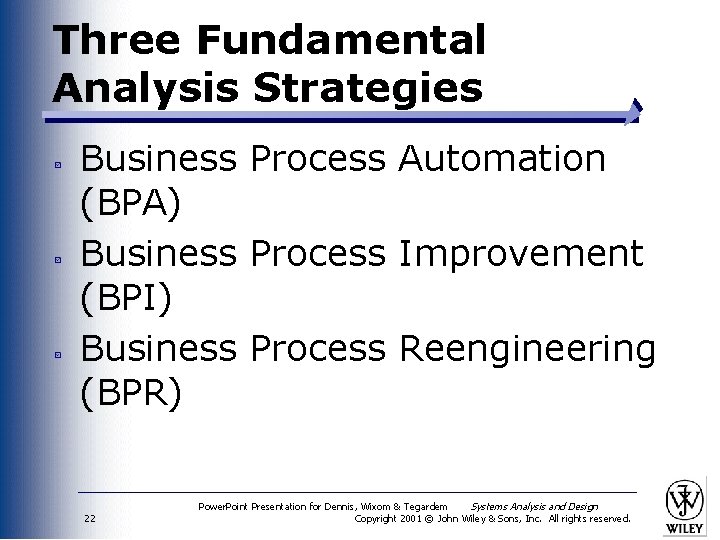
Three Fundamental Analysis Strategies Business Process Automation (BPA) Business Process Improvement (BPI) Business Process Reengineering (BPR) 22 Power. Point Presentation for Dennis, Wixom & Tegardem Systems Analysis and Design Copyright 2001 © John Wiley & Sons, Inc. All rights reserved.
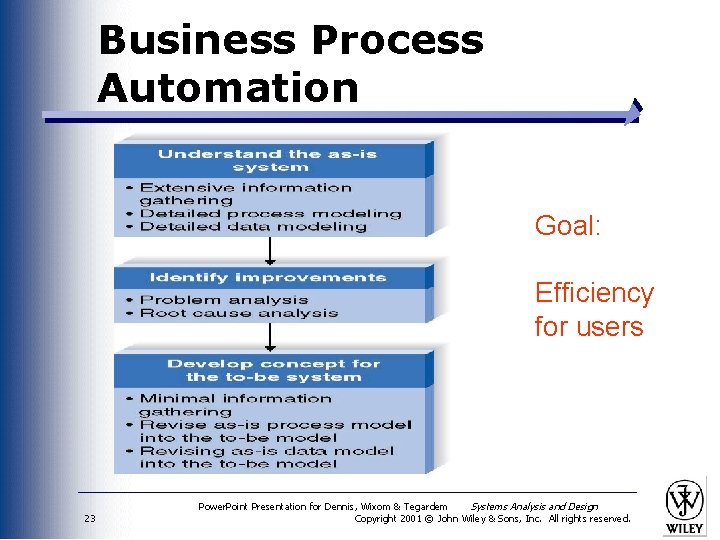
Business Process Automation Goal: Efficiency for users 23 Power. Point Presentation for Dennis, Wixom & Tegardem Systems Analysis and Design Copyright 2001 © John Wiley & Sons, Inc. All rights reserved.
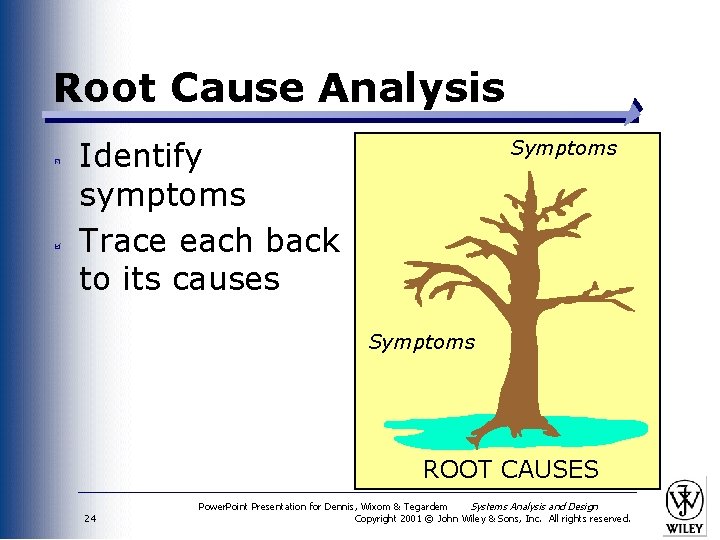
Root Cause Analysis Identify symptoms Trace each back to its causes Symptoms ROOT CAUSES 24 Power. Point Presentation for Dennis, Wixom & Tegardem Systems Analysis and Design Copyright 2001 © John Wiley & Sons, Inc. All rights reserved.
Business Process Improvement Introducing evolutionary changes 25 Power. Point Presentation for Dennis, Wixom & Tegardem Systems Analysis and Design Copyright 2001 © John Wiley & Sons, Inc. All rights reserved.
Business Process Reengineering Radical redesign of business processes 26 Power. Point Presentation for Dennis, Wixom & Tegardem Systems Analysis and Design Copyright 2001 © John Wiley & Sons, Inc. All rights reserved.
DEVELOPING AN ANALYSIS PLAN Slide 27 Power. Point Presentation for Dennis, Wixom & Tegardem Systems Analysis and Design Copyright 2001 © John Wiley & Sons, Inc. All rights reserved.
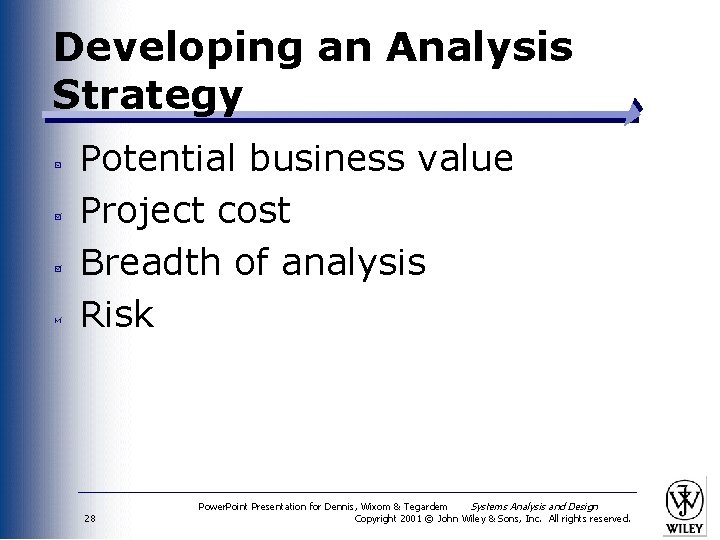
Developing an Analysis Strategy Potential business value Project cost Breadth of analysis Risk 28 Power. Point Presentation for Dennis, Wixom & Tegardem Systems Analysis and Design Copyright 2001 © John Wiley & Sons, Inc. All rights reserved.
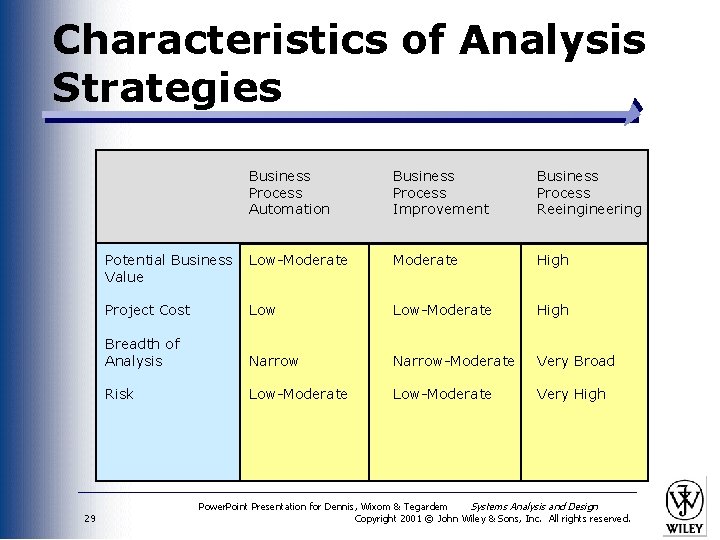
Characteristics of Analysis Strategies 29 Business Process Automation Business Process Improvement Business Process Reeingineering Potential Business Value Low-Moderate High Project Cost Low-Moderate High Breadth of Analysis Narrow-Moderate Very Broad Risk Low-Moderate Very High Power. Point Presentation for Dennis, Wixom & Tegardem Systems Analysis and Design Copyright 2001 © John Wiley & Sons, Inc. All rights reserved.
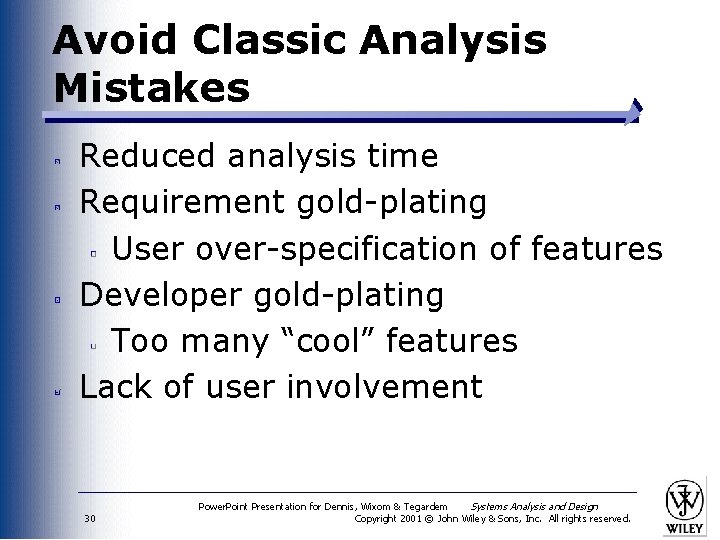
Avoid Classic Analysis Mistakes Reduced analysis time Requirement gold-plating User over-specification of features Developer gold-plating Too many “cool” features Lack of user involvement 30 Power. Point Presentation for Dennis, Wixom & Tegardem Systems Analysis and Design Copyright 2001 © John Wiley & Sons, Inc. All rights reserved.
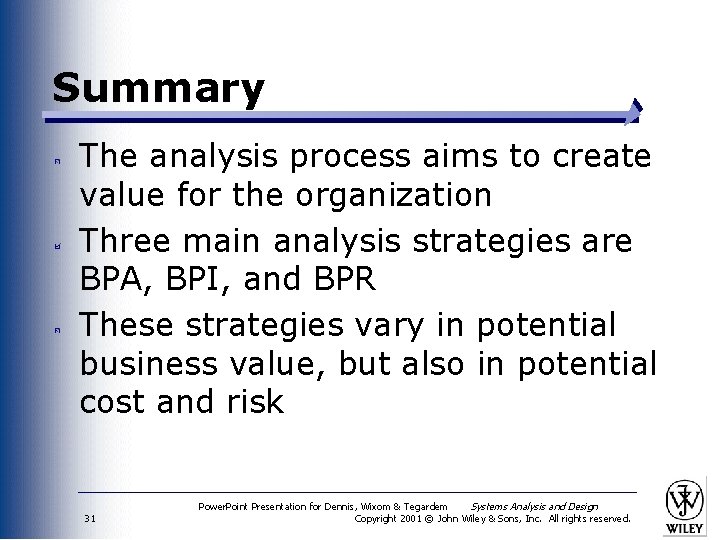
Summary The analysis process aims to create value for the organization Three main analysis strategies are BPA, BPI, and BPR These strategies vary in potential business value, but also in potential cost and risk 31 Power. Point Presentation for Dennis, Wixom & Tegardem Systems Analysis and Design Copyright 2001 © John Wiley & Sons, Inc. All rights reserved.