
Project Human Resource Management PMP Prep Course PMBOK
Project Human Resource Management PMP Prep Course – PMBOK 4 th Edition – Version 3. 0 PMP Study Group Human Resource Management © 2010 Long Island Chapter of the Project Management Institute ALL RIGHTS RESERVED

Project Human Resource Management PMP Prep Course – PMBOK 4 th Edition – Version 3. 0 Project Human Resource Management Definition “Project Human Resource Management includes the processes that organize, manage and lead the project team”. “The project team is comprised of the people with assigned roles and responsibilities for completing the project. ” PMBo. K® Guide, 4 th Edition, p. 215 © 2010 Long Island Chapter of the Project Management Institute ALL RIGHTS RESERVED 2
Project Human Resource Management PMP Prep Course – PMBOK 4 th Edition – Version 3. 0 Human Resource Management Processes 9. 1 Develop Human Resource Plan 9. 2 Acquire Project Team 9. 3 Develop Project Team 9. 4 Manage Project Team © 2010 Long Island Chapter of the Project Management Institute ALL RIGHTS RESERVED 3
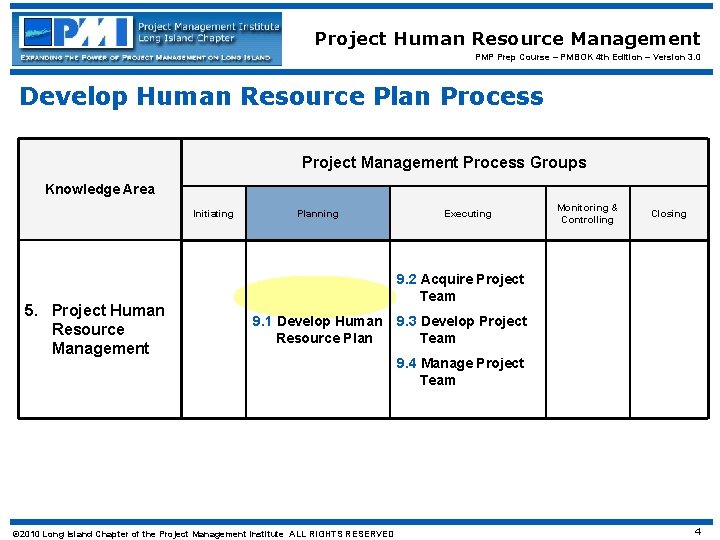
Project Human Resource Management PMP Prep Course – PMBOK 4 th Edition – Version 3. 0 Develop Human Resource Plan Process Project Management Process Groups Knowledge Area Initiating 5. Project Human Resource Management Planning Executing Monitoring & Controlling Closing 9. 2 Acquire Project Team 9. 1 Develop Human Resource Plan © 2010 Long Island Chapter of the Project Management Institute ALL RIGHTS RESERVED 9. 3 Develop Project Team 9. 4 Manage Project Team 4
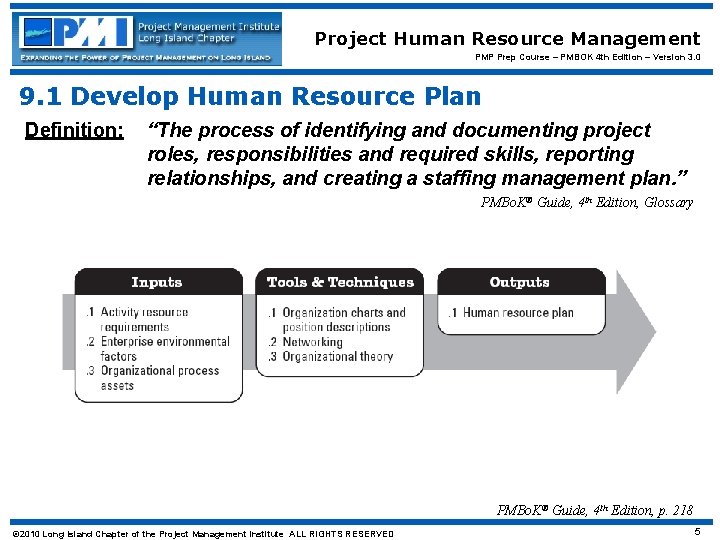
Project Human Resource Management PMP Prep Course – PMBOK 4 th Edition – Version 3. 0 9. 1 Develop Human Resource Plan Definition: “The process of identifying and documenting project roles, responsibilities and required skills, reporting relationships, and creating a staffing management plan. ” PMBo. K® Guide, 4 th Edition, Glossary PMBo. K® Guide, 4 th Edition, p. 218 © 2010 Long Island Chapter of the Project Management Institute ALL RIGHTS RESERVED 5
Project Human Resource Management PMP Prep Course – PMBOK 4 th Edition – Version 3. 0 9. 1 Develop Human Resource Plan - Notes Human resource planning is used to determine and identify human resources with the necessary skills required for project success. The human resource plan documents project roles and responsibilities, project organization charts and the staffing management plan including the timetable for staff acquisition and release. The human resource plan may also include identification of training needs, team building strategies, plans for recognition and rewards programs, compliance considerations, safety issues, and the impact of the staffing management plan on the organization © 2010 Long Island Chapter of the Project Management Institute ALL RIGHTS RESERVED 6
Project Human Resource Management PMP Prep Course – PMBOK 4 th Edition – Version 3. 0 9. 1. 1 Develop Human Resource Plan Inputs 9. 1. 1. 1 Activity Resource Requirements Human Resources planning uses activity resource requirements to determine the human resource needs for the project. Organizational culture and structure Enterprise 9. 1. 1. 2 Environmental Factors Existing human resources Personnel administration policies Market conditions and unique challenges 9. 1. 1. 3 Organizational Process Assets Organizational standard processes and policies and standardized role descriptions Templates for organizational charts and position descriptions Historical information that has worked in previous projects © 2010 Long Island Chapter of the Project Management Institute ALL RIGHTS RESERVED 7

Project Human Resource Management PMP Prep Course – PMBOK 4 th Edition – Version 3. 0 9. 1. 2 Develop Human Resource Plan Tools and Techniques Document team members’ roles & responsibilities Organizational 9. 1. 2. 1 Charts/Job Descriptions Some common types: Hierarchal type, ie: Organizational Breakdown Structure (OBS) Matrix Based, ie: Responsibility Assignment Matrix (RAM) Text Oriented format Formal and informal interaction with others within the organization, industry or professional environment 9. 1. 2. 2 Networking A constructive way to understand political and interpersonal factors that may impact the effectiveness of various staffing management options. Activities can include informal conversations, meetings, trade shows 9. 1. 2. 3 Organizational Theory Provides information on the way in which people, teams and organizational units behave. Effective use of this information can shorten the amount of time, cost and effort needed for human resource planning. © 2010 Long Island Chapter of the Project Management Institute ALL RIGHTS RESERVED 8
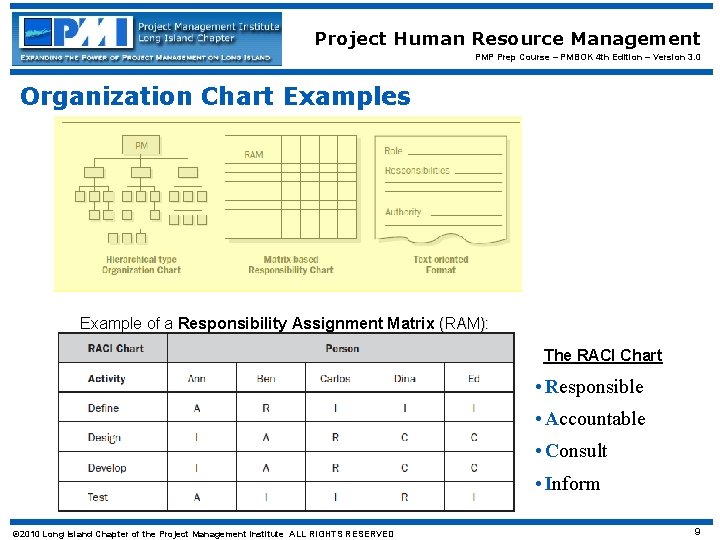
Project Human Resource Management PMP Prep Course – PMBOK 4 th Edition – Version 3. 0 Organization Chart Examples Example of a Responsibility Assignment Matrix (RAM): The RACI Chart • Responsible • Accountable • Consult • Inform © 2010 Long Island Chapter of the Project Management Institute ALL RIGHTS RESERVED 9

Project Human Resource Management PMP Prep Course – PMBOK 4 th Edition – Version 3. 0 9. 1. 3 Human Resource Plan Definition “The human resource plan, a part of the project management plan, provides guidance on how human resources should be defined, staffed, managed, controlled and eventually released. ” PMBo. K® Guide, 4 th Edition, p. 222 © 2010 Long Island Chapter of the Project Management Institute ALL RIGHTS RESERVED 10
Project Human Resource Management PMP Prep Course – PMBOK 4 th Edition – Version 3. 0 9. 1. 1 Develop Human Resource Plan Outputs The human resource plan should include: Roles & Responsibilities Role - Describes the portion of the project for which the person is accountable. Be sure everyone is familiar with their authority, duties and boundaries. 9. 1. 3. 1 Human Resource Plan Responsibility – The work a team member is expected to perform to complete the project’s activities. Authority – The right to apply project resources, make decisions and sign approvals Team members operate best when their authority matches their individual responsibilities. Competency – The skill and capacity required to complete project activities. When project team members do not have the required skills, performance can be jeopardized. © 2010 Long Island Chapter of the Project Management Institute ALL RIGHTS RESERVED 11
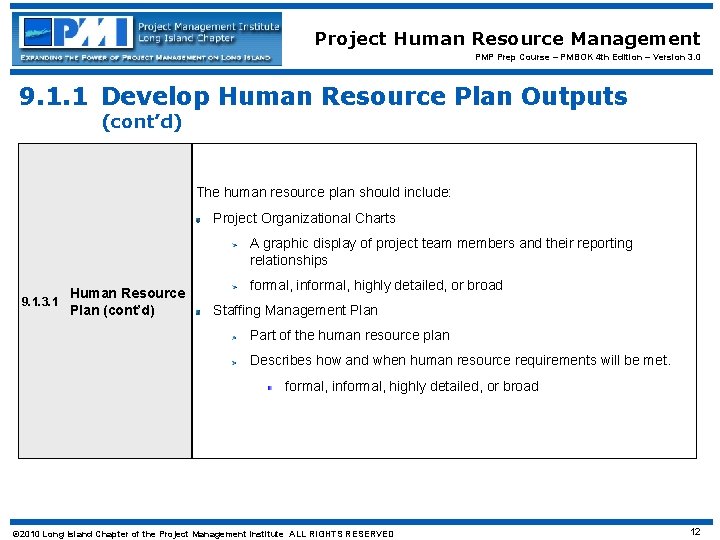
Project Human Resource Management PMP Prep Course – PMBOK 4 th Edition – Version 3. 0 9. 1. 1 Develop Human Resource Plan Outputs (cont’d) The human resource plan should include: Project Organizational Charts A graphic display of project team members and their reporting relationships Human Resource 9. 1. 3. 1 Plan (cont’d) formal, informal, highly detailed, or broad Staffing Management Plan Part of the human resource plan Describes how and when human resource requirements will be met. formal, informal, highly detailed, or broad © 2010 Long Island Chapter of the Project Management Institute ALL RIGHTS RESERVED 12
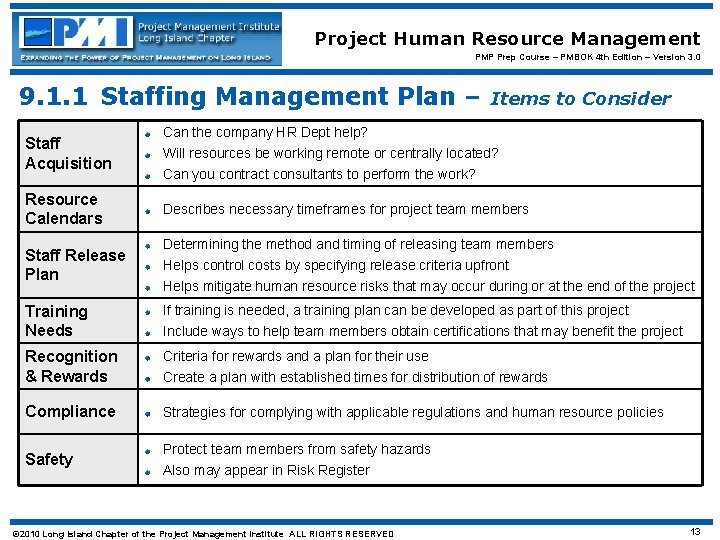
Project Human Resource Management PMP Prep Course – PMBOK 4 th Edition – Version 3. 0 9. 1. 1 Staffing Management Plan – Staff Acquisition Resource Calendars Staff Release Plan Items to Consider Can the company HR Dept help? Will resources be working remote or centrally located? Can you contract consultants to perform the work? Describes necessary timeframes for project team members Determining the method and timing of releasing team members Helps control costs by specifying release criteria upfront Helps mitigate human resource risks that may occur during or at the end of the project Training Needs If training is needed, a training plan can be developed as part of this project Recognition & Rewards Criteria for rewards and a plan for their use Compliance Strategies for complying with applicable regulations and human resource policies Safety Include ways to help team members obtain certifications that may benefit the project Create a plan with established times for distribution of rewards Protect team members from safety hazards Also may appear in Risk Register © 2010 Long Island Chapter of the Project Management Institute ALL RIGHTS RESERVED 13
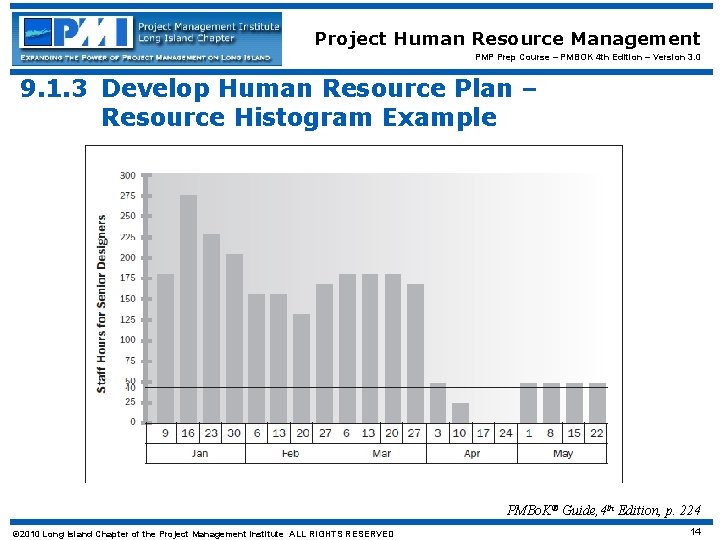
Project Human Resource Management PMP Prep Course – PMBOK 4 th Edition – Version 3. 0 9. 1. 3 Develop Human Resource Plan – Resource Histogram Example PMBo. K® Guide, 4 th Edition, p. 224 © 2010 Long Island Chapter of the Project Management Institute ALL RIGHTS RESERVED 14
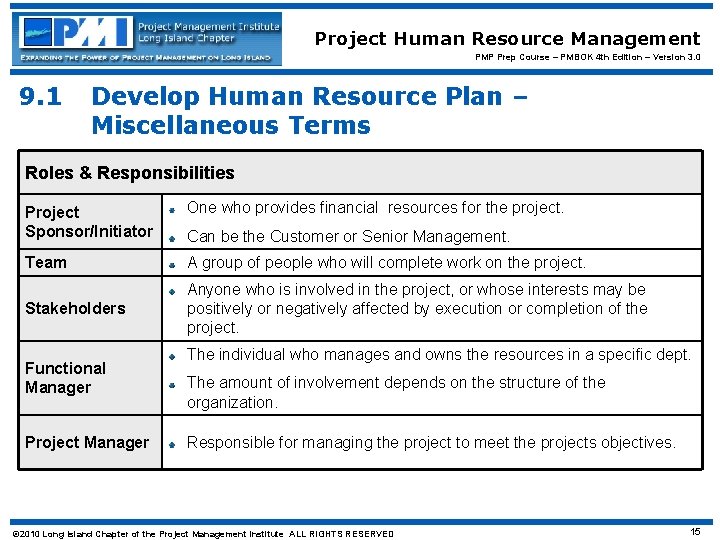
Project Human Resource Management PMP Prep Course – PMBOK 4 th Edition – Version 3. 0 9. 1 Develop Human Resource Plan – Miscellaneous Terms Roles & Responsibilities Project Sponsor/Initiator One who provides financial resources for the project. Team A group of people who will complete work on the project. Stakeholders Anyone who is involved in the project, or whose interests may be positively or negatively affected by execution or completion of the project. Functional Manager Project Manager Can be the Customer or Senior Management. The individual who manages and owns the resources in a specific dept. The amount of involvement depends on the structure of the organization. Responsible for managing the project to meet the projects objectives. © 2010 Long Island Chapter of the Project Management Institute ALL RIGHTS RESERVED 15
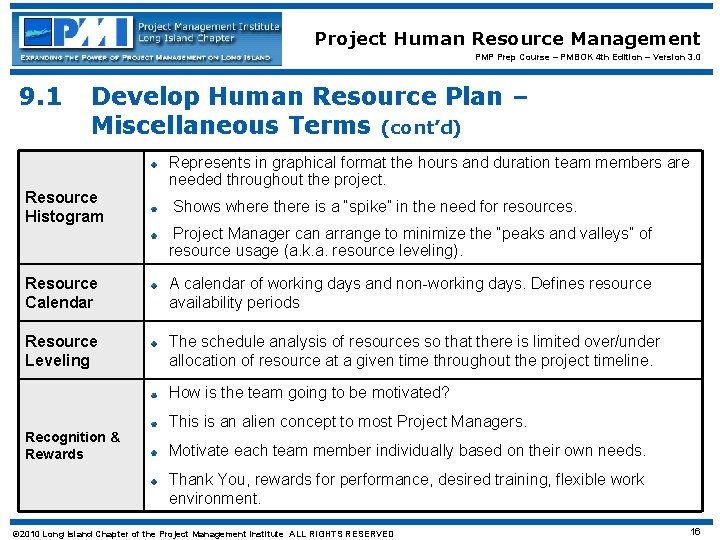
Project Human Resource Management PMP Prep Course – PMBOK 4 th Edition – Version 3. 0 9. 1 Develop Human Resource Plan – Miscellaneous Terms (cont’d) Represents in graphical format the hours and duration team members are needed throughout the project. Resource Histogram Shows where there is a “spike” in the need for resources. Project Manager can arrange to minimize the “peaks and valleys” of resource usage (a. k. a. resource leveling). Resource Calendar A calendar of working days and non-working days. Defines resource availability periods Resource Leveling The schedule analysis of resources so that there is limited over/under allocation of resource at a given time throughout the project timeline. How is the team going to be motivated? Recognition & Rewards This is an alien concept to most Project Managers. Motivate each team member individually based on their own needs. Thank You, rewards for performance, desired training, flexible work environment. © 2010 Long Island Chapter of the Project Management Institute ALL RIGHTS RESERVED 16
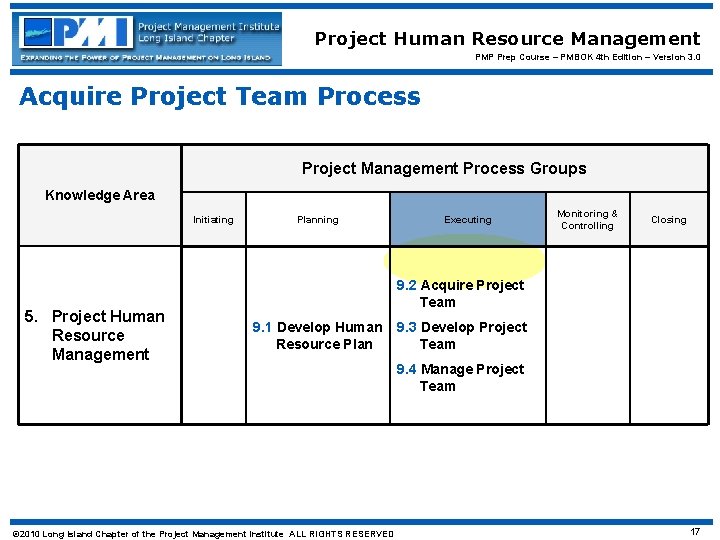
Project Human Resource Management PMP Prep Course – PMBOK 4 th Edition – Version 3. 0 Acquire Project Team Process Project Management Process Groups Knowledge Area Initiating 5. Project Human Resource Management Planning Executing Monitoring & Controlling Closing 9. 2 Acquire Project Team 9. 1 Develop Human Resource Plan © 2010 Long Island Chapter of the Project Management Institute ALL RIGHTS RESERVED 9. 3 Develop Project Team 9. 4 Manage Project Team 17
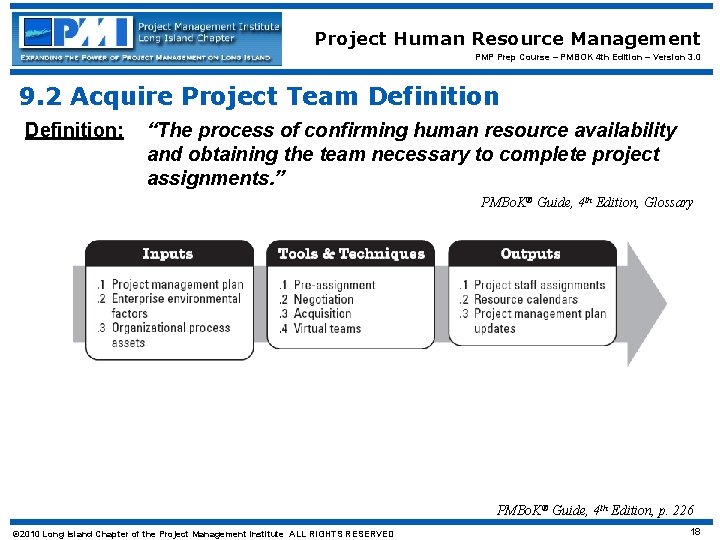
Project Human Resource Management PMP Prep Course – PMBOK 4 th Edition – Version 3. 0 9. 2 Acquire Project Team Definition: “The process of confirming human resource availability and obtaining the team necessary to complete project assignments. ” PMBo. K® Guide, 4 th Edition, Glossary PMBo. K® Guide, 4 th Edition, p. 226 © 2010 Long Island Chapter of the Project Management Institute ALL RIGHTS RESERVED 18
Project Human Resource Management PMP Prep Course – PMBOK 4 th Edition – Version 3. 0 9. 2 Acquire Project Team - Notes The project management team may or may not have direct control over team member selection for various reasons depending on the organizational structure Failure to acquire necessary resources may affect overall project success. © 2010 Long Island Chapter of the Project Management Institute ALL RIGHTS RESERVED 19
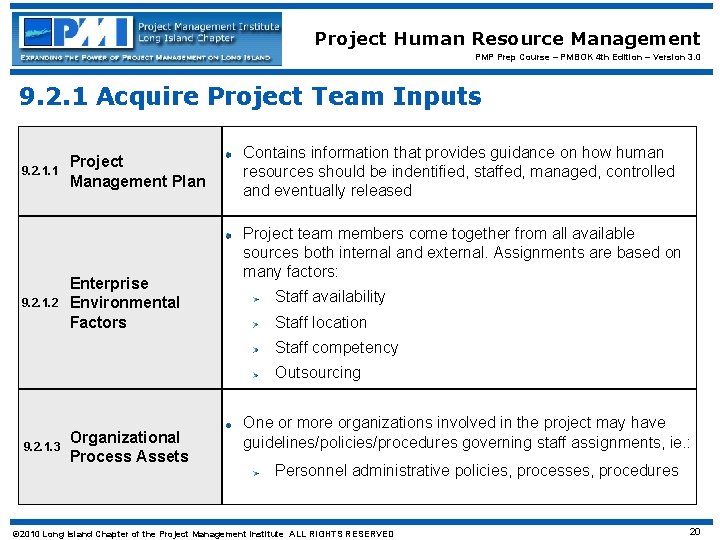
Project Human Resource Management PMP Prep Course – PMBOK 4 th Edition – Version 3. 0 9. 2. 1 Acquire Project Team Inputs 9. 2. 1. 1 9. 2. 1. 2 Project Management Plan Enterprise Environmental Factors Contains information that provides guidance on how human resources should be indentified, staffed, managed, controlled and eventually released Project team members come together from all available sources both internal and external. Assignments are based on many factors: Staff availability Staff location Staff competency Outsourcing 9. 2. 1. 3 Organizational Process Assets One or more organizations involved in the project may have guidelines/policies/procedures governing staff assignments, ie. : Personnel administrative policies, processes, procedures © 2010 Long Island Chapter of the Project Management Institute ALL RIGHTS RESERVED 20
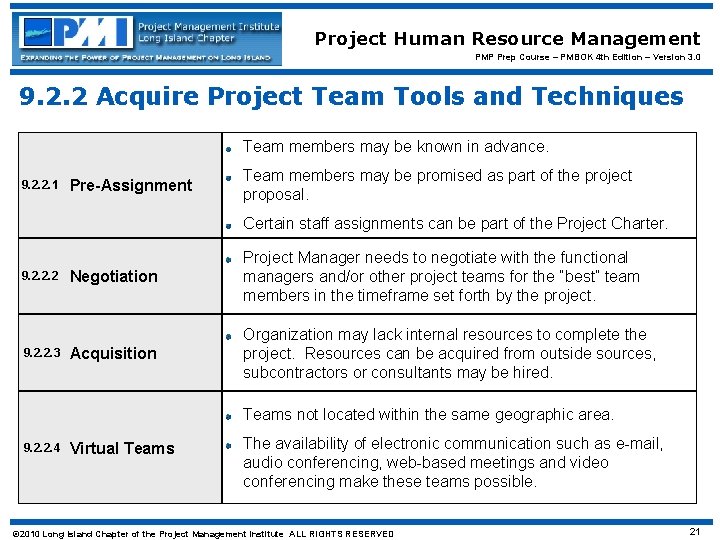
Project Human Resource Management PMP Prep Course – PMBOK 4 th Edition – Version 3. 0 9. 2. 2 Acquire Project Team Tools and Techniques Team members may be known in advance. 9. 2. 2. 1 Pre-Assignment Team members may be promised as part of the project proposal. Certain staff assignments can be part of the Project Charter. 9. 2. 2. 2 9. 2. 2. 3 Negotiation Project Manager needs to negotiate with the functional managers and/or other project teams for the “best” team members in the timeframe set forth by the project. Acquisition Organization may lack internal resources to complete the project. Resources can be acquired from outside sources, subcontractors or consultants may be hired. Teams not located within the same geographic area. 9. 2. 2. 4 Virtual Teams The availability of electronic communication such as e-mail, audio conferencing, web-based meetings and video conferencing make these teams possible. © 2010 Long Island Chapter of the Project Management Institute ALL RIGHTS RESERVED 21
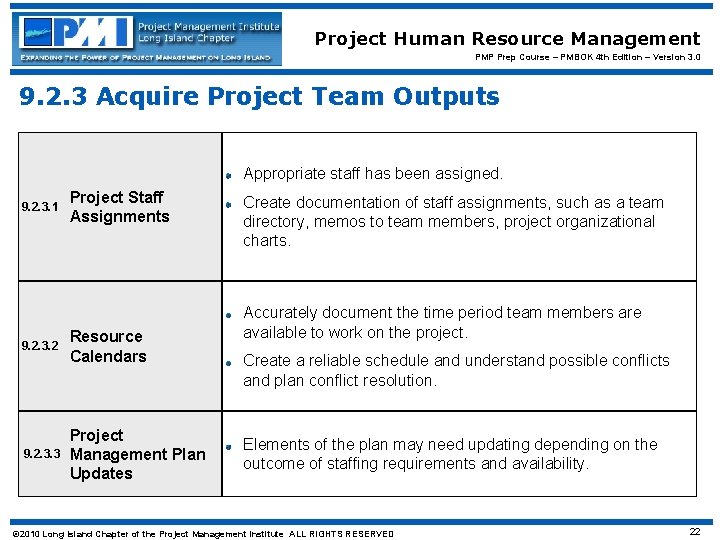
Project Human Resource Management PMP Prep Course – PMBOK 4 th Edition – Version 3. 0 9. 2. 3 Acquire Project Team Outputs Appropriate staff has been assigned. 9. 2. 3. 1 Project Staff Assignments 9. 2. 3. 2 Resource Calendars 9. 2. 3. 3 Project Management Plan Updates Create documentation of staff assignments, such as a team directory, memos to team members, project organizational charts. Accurately document the time period team members are available to work on the project. Create a reliable schedule and understand possible conflicts and plan conflict resolution. Elements of the plan may need updating depending on the outcome of staffing requirements and availability. © 2010 Long Island Chapter of the Project Management Institute ALL RIGHTS RESERVED 22
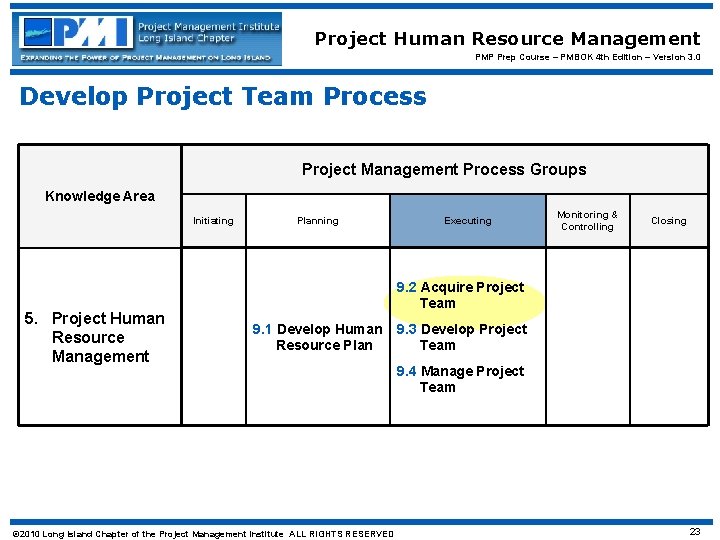
Project Human Resource Management PMP Prep Course – PMBOK 4 th Edition – Version 3. 0 Develop Project Team Process Project Management Process Groups Knowledge Area Initiating 5. Project Human Resource Management Planning Executing Monitoring & Controlling Closing 9. 2 Acquire Project Team 9. 1 Develop Human Resource Plan © 2010 Long Island Chapter of the Project Management Institute ALL RIGHTS RESERVED 9. 3 Develop Project Team 9. 4 Manage Project Team 23
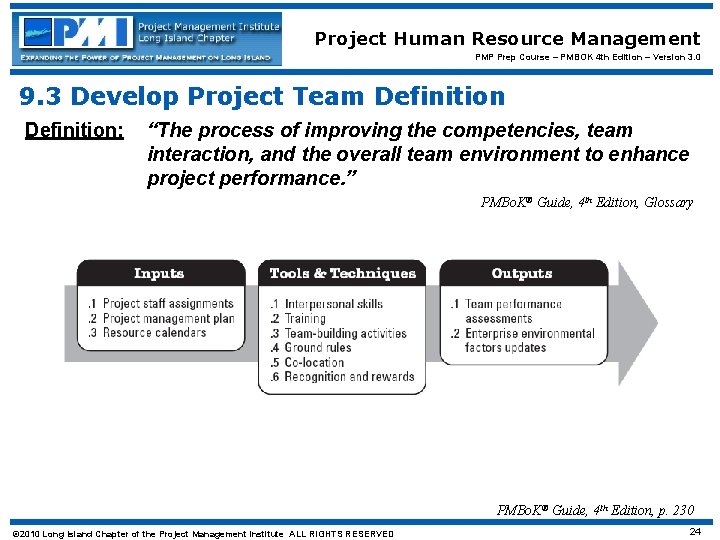
Project Human Resource Management PMP Prep Course – PMBOK 4 th Edition – Version 3. 0 9. 3 Develop Project Team Definition: “The process of improving the competencies, team interaction, and the overall team environment to enhance project performance. ” PMBo. K® Guide, 4 th Edition, Glossary PMBo. K® Guide, 4 th Edition, p. 230 © 2010 Long Island Chapter of the Project Management Institute ALL RIGHTS RESERVED 24
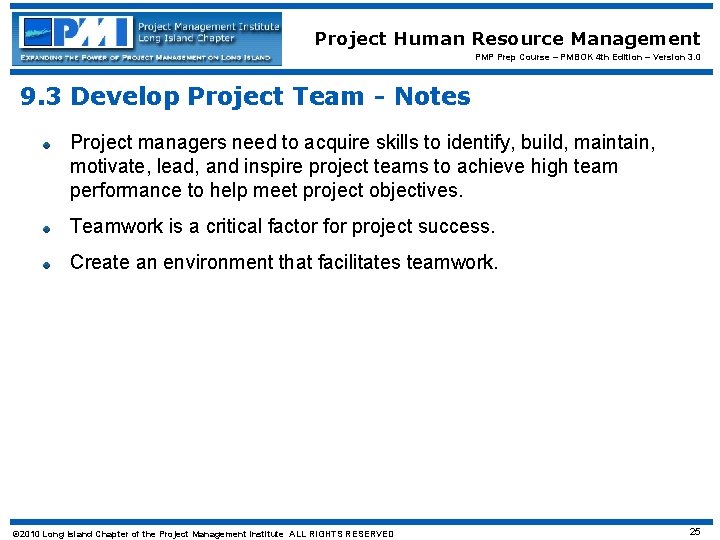
Project Human Resource Management PMP Prep Course – PMBOK 4 th Edition – Version 3. 0 9. 3 Develop Project Team - Notes Project managers need to acquire skills to identify, build, maintain, motivate, lead, and inspire project teams to achieve high team performance to help meet project objectives. Teamwork is a critical factor for project success. Create an environment that facilitates teamwork. © 2010 Long Island Chapter of the Project Management Institute ALL RIGHTS RESERVED 25
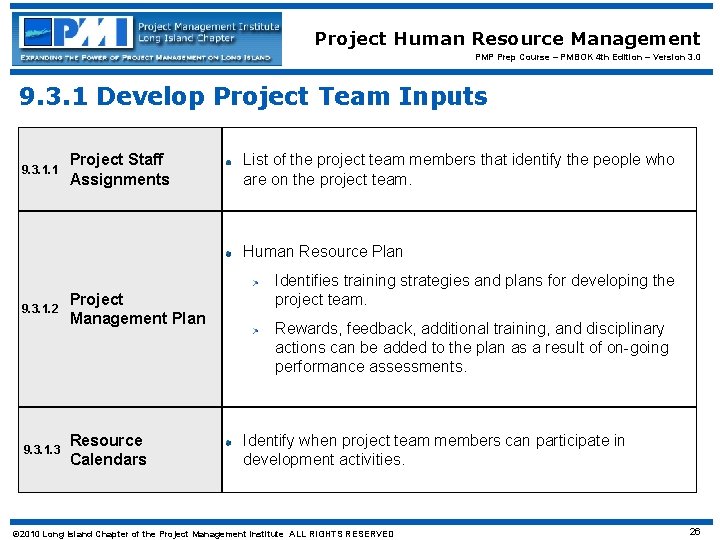
Project Human Resource Management PMP Prep Course – PMBOK 4 th Edition – Version 3. 0 9. 3. 1 Develop Project Team Inputs 9. 3. 1. 1 Project Staff Assignments List of the project team members that identify the people who are on the project team. Human Resource Plan 9. 3. 1. 2 9. 3. 1. 3 Project Management Plan Resource Calendars Identifies training strategies and plans for developing the project team. Rewards, feedback, additional training, and disciplinary actions can be added to the plan as a result of on-going performance assessments. Identify when project team members can participate in development activities. © 2010 Long Island Chapter of the Project Management Institute ALL RIGHTS RESERVED 26
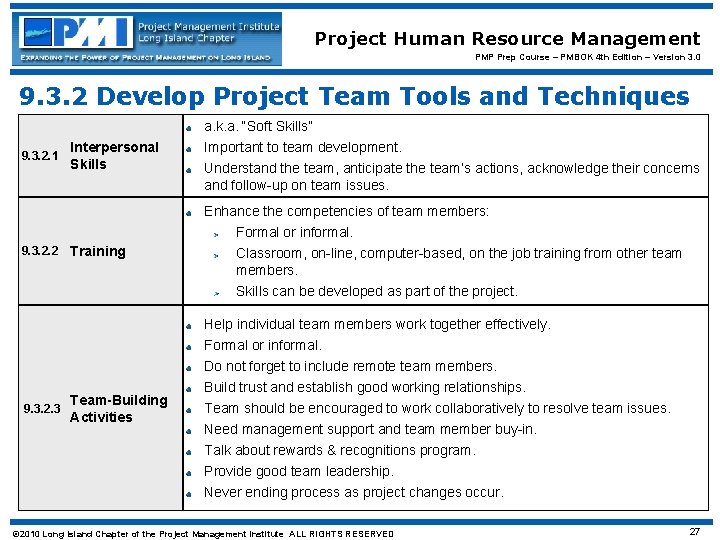
Project Human Resource Management PMP Prep Course – PMBOK 4 th Edition – Version 3. 0 9. 3. 2 Develop Project Team Tools and Techniques a. k. a. “Soft Skills” 9. 3. 2. 1 Interpersonal Skills Important to team development. Understand the team, anticipate the team’s actions, acknowledge their concerns and follow-up on team issues. Enhance the competencies of team members: Formal or informal. 9. 3. 2. 2 Training Classroom, on-line, computer-based, on the job training from other team members. Skills can be developed as part of the project. Help individual team members work together effectively. Formal or informal. 9. 3. 2. 3 Team-Building Activities Do not forget to include remote team members. Build trust and establish good working relationships. Team should be encouraged to work collaboratively to resolve team issues. Need management support and team member buy-in. Talk about rewards & recognitions program. Provide good team leadership. Never ending process as project changes occur. © 2010 Long Island Chapter of the Project Management Institute ALL RIGHTS RESERVED 27
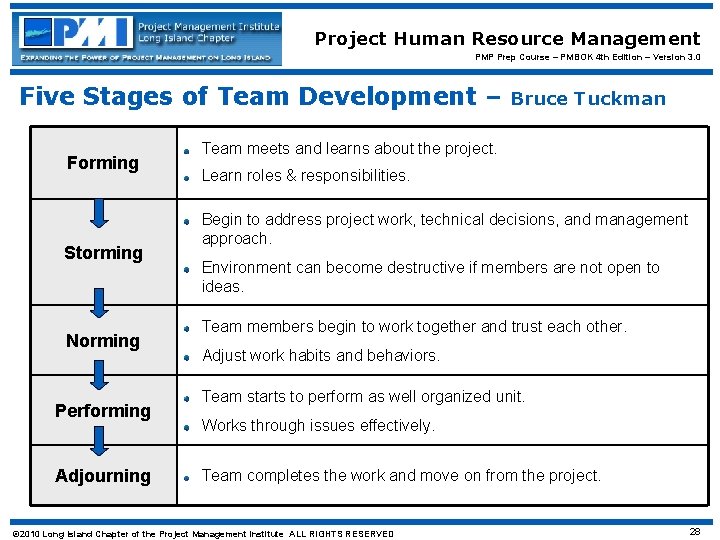
Project Human Resource Management PMP Prep Course – PMBOK 4 th Edition – Version 3. 0 Five Stages of Team Development – Forming Storming Norming Performing Adjourning Bruce Tuckman Team meets and learns about the project. Learn roles & responsibilities. Begin to address project work, technical decisions, and management approach. Environment can become destructive if members are not open to ideas. Team members begin to work together and trust each other. Adjust work habits and behaviors. Team starts to perform as well organized unit. Works through issues effectively. Team completes the work and move on from the project. © 2010 Long Island Chapter of the Project Management Institute ALL RIGHTS RESERVED 28
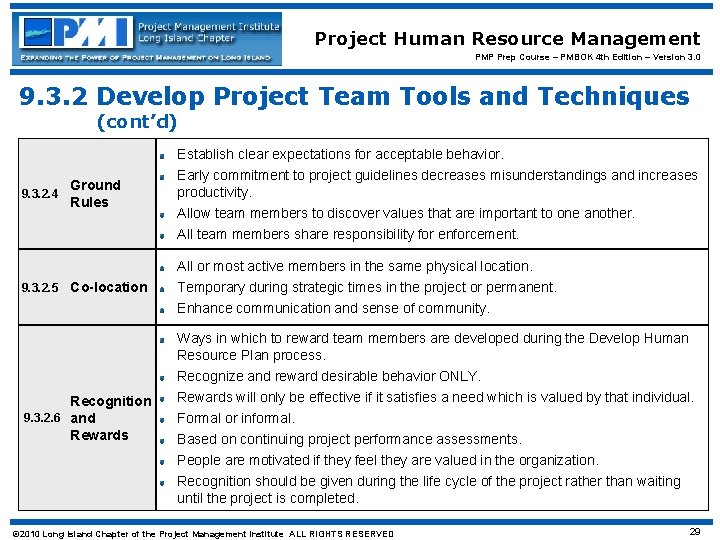
Project Human Resource Management PMP Prep Course – PMBOK 4 th Edition – Version 3. 0 9. 3. 2 Develop Project Team Tools and Techniques (cont’d) 9. 3. 2. 4 Ground Rules Establish clear expectations for acceptable behavior. Early commitment to project guidelines decreases misunderstandings and increases productivity. Allow team members to discover values that are important to one another. All team members share responsibility for enforcement. All or most active members in the same physical location. 9. 3. 2. 5 Co-location Temporary during strategic times in the project or permanent. Enhance communication and sense of community. Ways in which to reward team members are developed during the Develop Human Resource Plan process. Recognition 9. 3. 2. 6 and Rewards Recognize and reward desirable behavior ONLY. Rewards will only be effective if it satisfies a need which is valued by that individual. Formal or informal. Based on continuing project performance assessments. People are motivated if they feel they are valued in the organization. Recognition should be given during the life cycle of the project rather than waiting until the project is completed. © 2010 Long Island Chapter of the Project Management Institute ALL RIGHTS RESERVED 29
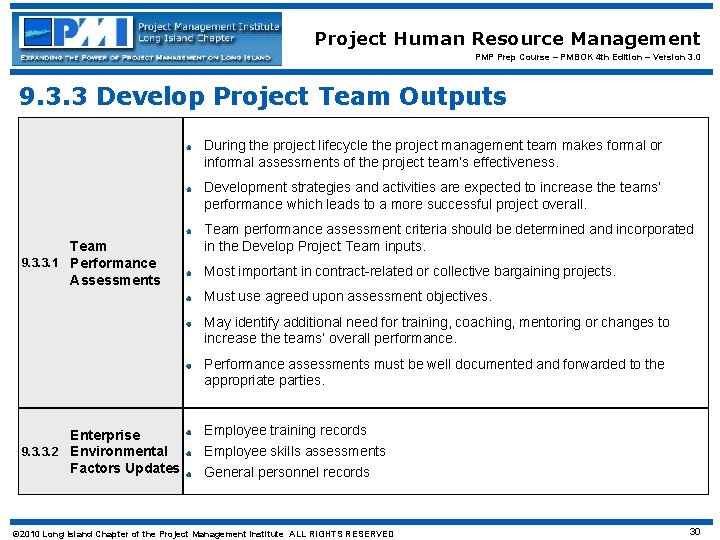
Project Human Resource Management PMP Prep Course – PMBOK 4 th Edition – Version 3. 0 9. 3. 3 Develop Project Team Outputs During the project lifecycle the project management team makes formal or informal assessments of the project team’s effectiveness. Development strategies and activities are expected to increase the teams’ performance which leads to a more successful project overall. Team 9. 3. 3. 1 Performance Assessments Team performance assessment criteria should be determined and incorporated in the Develop Project Team inputs. Most important in contract-related or collective bargaining projects. Must use agreed upon assessment objectives. May identify additional need for training, coaching, mentoring or changes to increase the teams’ overall performance. Performance assessments must be well documented and forwarded to the appropriate parties. Enterprise 9. 3. 3. 2 Environmental Factors Updates Employee training records Employee skills assessments General personnel records © 2010 Long Island Chapter of the Project Management Institute ALL RIGHTS RESERVED 30
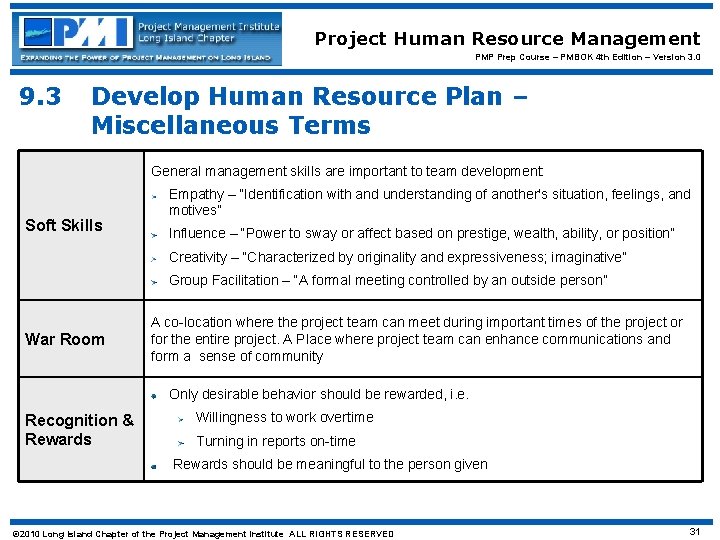
Project Human Resource Management PMP Prep Course – PMBOK 4 th Edition – Version 3. 0 9. 3 Develop Human Resource Plan – Miscellaneous Terms General management skills are important to team development: Soft Skills Empathy – “Identification with and understanding of another's situation, feelings, and motives” Influence – “Power to sway or affect based on prestige, wealth, ability, or position” Creativity – “Characterized by originality and expressiveness; imaginative” Group Facilitation – “A formal meeting controlled by an outside person” War Room A co-location where the project team can meet during important times of the project or for the entire project. A Place where project team can enhance communications and form a sense of community Only desirable behavior should be rewarded, i. e. Recognition & Rewards Willingness to work overtime Turning in reports on-time Rewards should be meaningful to the person given © 2010 Long Island Chapter of the Project Management Institute ALL RIGHTS RESERVED 31
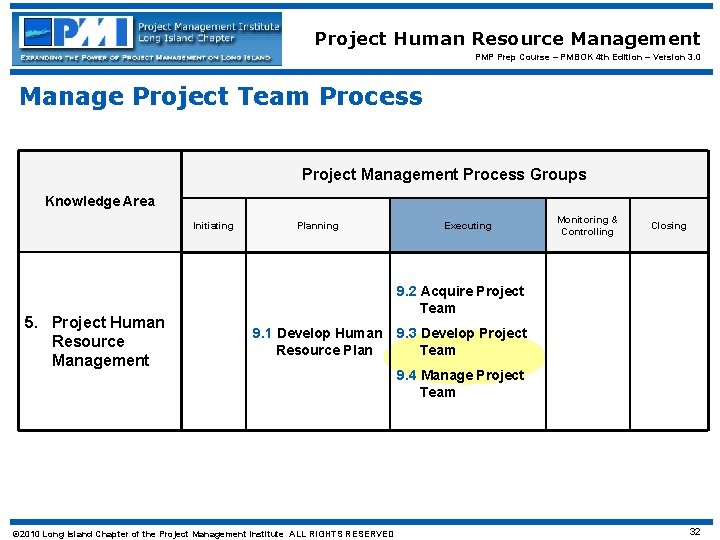
Project Human Resource Management PMP Prep Course – PMBOK 4 th Edition – Version 3. 0 Manage Project Team Process Project Management Process Groups Knowledge Area Initiating 5. Project Human Resource Management Planning Executing Monitoring & Controlling Closing 9. 2 Acquire Project Team 9. 1 Develop Human Resource Plan © 2010 Long Island Chapter of the Project Management Institute ALL RIGHTS RESERVED 9. 3 Develop Project Team 9. 4 Manage Project Team 32
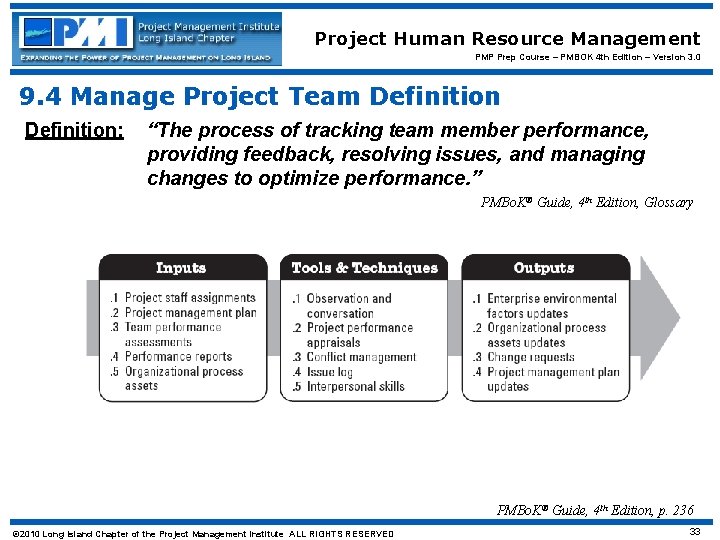
Project Human Resource Management PMP Prep Course – PMBOK 4 th Edition – Version 3. 0 9. 4 Manage Project Team Definition: “The process of tracking team member performance, providing feedback, resolving issues, and managing changes to optimize performance. ” PMBo. K® Guide, 4 th Edition, Glossary PMBo. K® Guide, 4 th Edition, p. 236 © 2010 Long Island Chapter of the Project Management Institute ALL RIGHTS RESERVED 33
Project Human Resource Management PMP Prep Course – PMBOK 4 th Edition – Version 3. 0 9. 4 Manage Project Team - Notes Managing the project team requires a variety of management skills to create high performance teams. Project Managers should provide challenging assignments to team members and provide recognition for high performance. © 2010 Long Island Chapter of the Project Management Institute ALL RIGHTS RESERVED 34
Project Human Resource Management PMP Prep Course – PMBOK 4 th Edition – Version 3. 0 9. 4. 1 Manage Project Team Inputs 9. 4. 1. 1 Project Staff Assignments Provides documentation which includes the list of project team members. Contains the Human Resource Plan to include: 9. 4. 1. 2 Project Management Plan Roles & Responsibilities Project Organization The staffing management plan 9. 4. 1. 3 Team Performance Assessments Formal or informal assessments of the team’s performance. © 2010 Long Island Chapter of the Project Management Institute ALL RIGHTS RESERVED 35
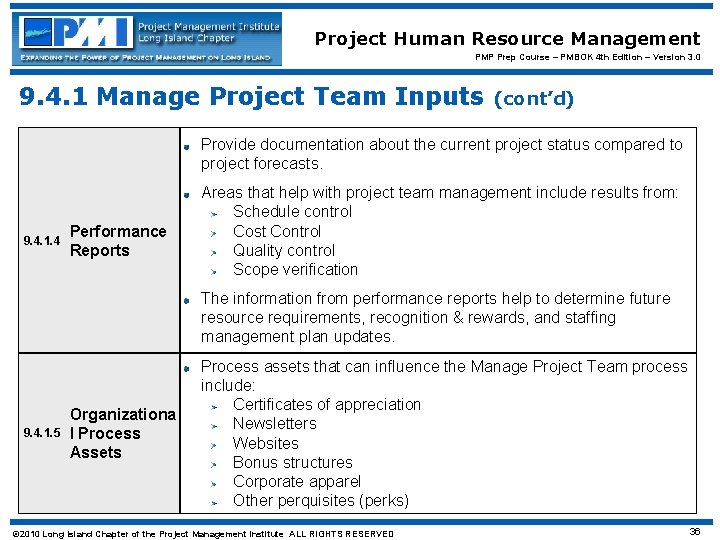
Project Human Resource Management PMP Prep Course – PMBOK 4 th Edition – Version 3. 0 9. 4. 1 Manage Project Team Inputs (cont’d) Provide documentation about the current project status compared to project forecasts. 9. 4. 1. 4 Performance Reports Areas that help with project team management include results from: Schedule control Cost Control Quality control Scope verification The information from performance reports help to determine future resource requirements, recognition & rewards, and staffing management plan updates. 9. 4. 1. 5 Organizationa l Process Assets Process assets that can influence the Manage Project Team process include: Certificates of appreciation Newsletters Websites Bonus structures Corporate apparel Other perquisites (perks) © 2010 Long Island Chapter of the Project Management Institute ALL RIGHTS RESERVED 36
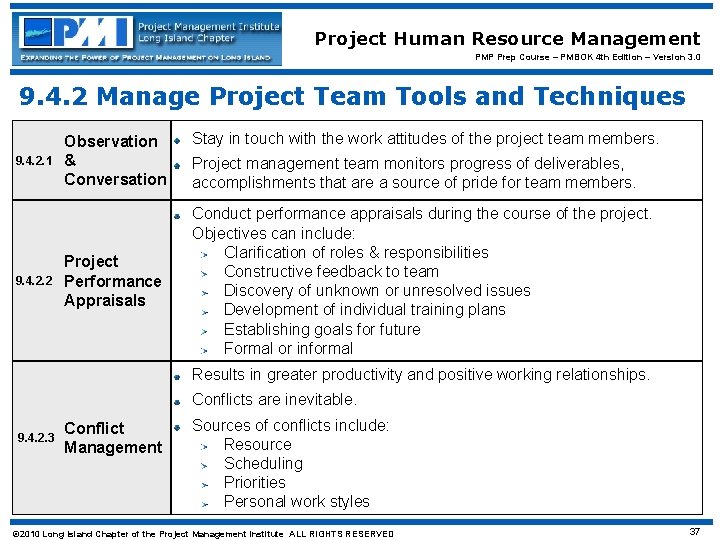
Project Human Resource Management PMP Prep Course – PMBOK 4 th Edition – Version 3. 0 9. 4. 2 Manage Project Team Tools and Techniques 9. 4. 2. 1 9. 4. 2. 2 Observation & Conversation Project Performance Appraisals Stay in touch with the work attitudes of the project team members. Project management team monitors progress of deliverables, accomplishments that are a source of pride for team members. Conduct performance appraisals during the course of the project. Objectives can include: Clarification of roles & responsibilities Constructive feedback to team Discovery of unknown or unresolved issues Development of individual training plans Establishing goals for future Formal or informal Results in greater productivity and positive working relationships. Conflicts are inevitable. 9. 4. 2. 3 Conflict Management Sources of conflicts include: Resource Scheduling Priorities Personal work styles © 2010 Long Island Chapter of the Project Management Institute ALL RIGHTS RESERVED 37
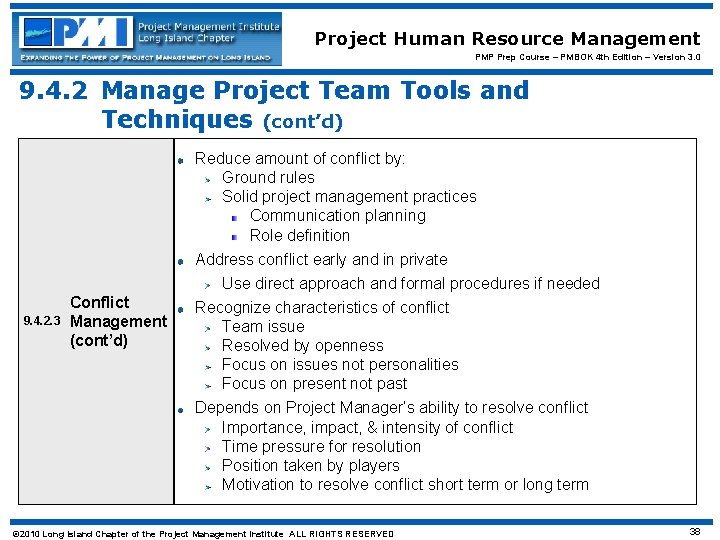
Project Human Resource Management PMP Prep Course – PMBOK 4 th Edition – Version 3. 0 9. 4. 2 Manage Project Team Tools and Techniques (cont’d) Reduce amount of conflict by: Ground rules Solid project management practices Communication planning Role definition Address conflict early and in private 9. 4. 2. 3 Conflict Management (cont’d) Use direct approach and formal procedures if needed Recognize characteristics of conflict Team issue Resolved by openness Focus on issues not personalities Focus on present not past Depends on Project Manager’s ability to resolve conflict Importance, impact, & intensity of conflict Time pressure for resolution Position taken by players Motivation to resolve conflict short term or long term © 2010 Long Island Chapter of the Project Management Institute ALL RIGHTS RESERVED 38
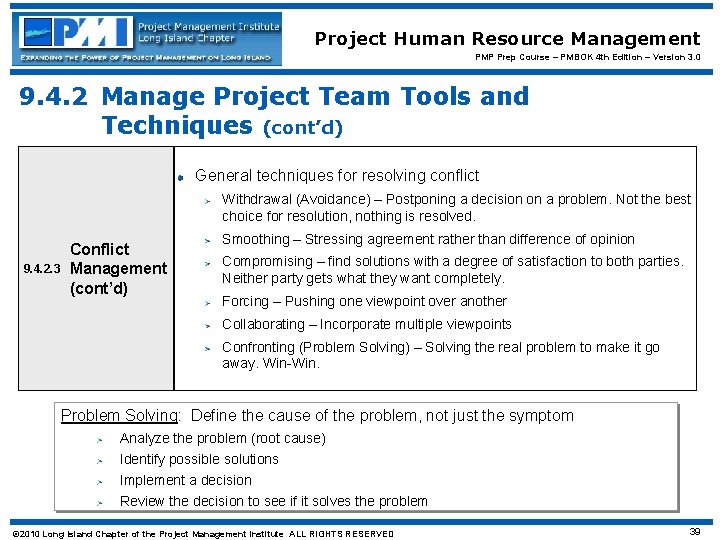
Project Human Resource Management PMP Prep Course – PMBOK 4 th Edition – Version 3. 0 9. 4. 2 Manage Project Team Tools and Techniques (cont’d) General techniques for resolving conflict Withdrawal (Avoidance) – Postponing a decision on a problem. Not the best choice for resolution, nothing is resolved. 9. 4. 2. 3 Conflict Management (cont’d) Smoothing – Stressing agreement rather than difference of opinion Compromising – find solutions with a degree of satisfaction to both parties. Neither party gets what they want completely. Forcing – Pushing one viewpoint over another Collaborating – Incorporate multiple viewpoints Confronting (Problem Solving) – Solving the real problem to make it go away. Win-Win. Problem Solving: Define the cause of the problem, not just the symptom Analyze the problem (root cause) Identify possible solutions Implement a decision Review the decision to see if it solves the problem © 2010 Long Island Chapter of the Project Management Institute ALL RIGHTS RESERVED 39
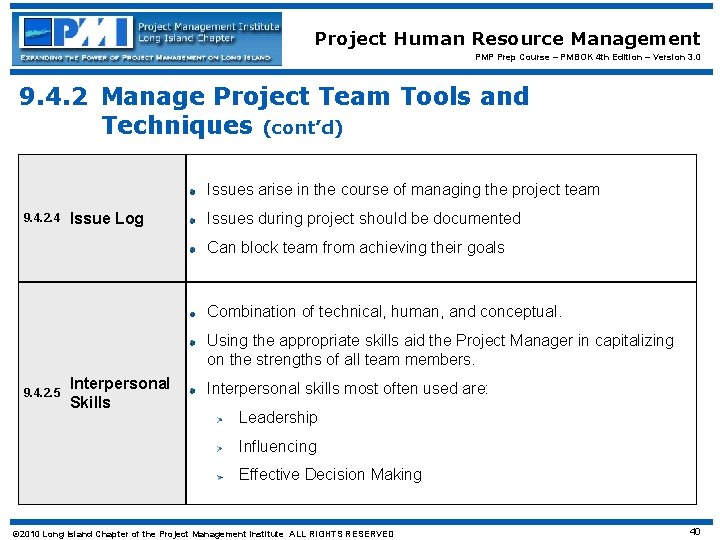
Project Human Resource Management PMP Prep Course – PMBOK 4 th Edition – Version 3. 0 9. 4. 2 Manage Project Team Tools and Techniques (cont’d) Issues arise in the course of managing the project team 9. 4. 2. 4 Issue Log Issues during project should be documented Can block team from achieving their goals Combination of technical, human, and conceptual. Using the appropriate skills aid the Project Manager in capitalizing on the strengths of all team members. 9. 4. 2. 5 Interpersonal Skills Interpersonal skills most often used are: Leadership Influencing Effective Decision Making © 2010 Long Island Chapter of the Project Management Institute ALL RIGHTS RESERVED 40
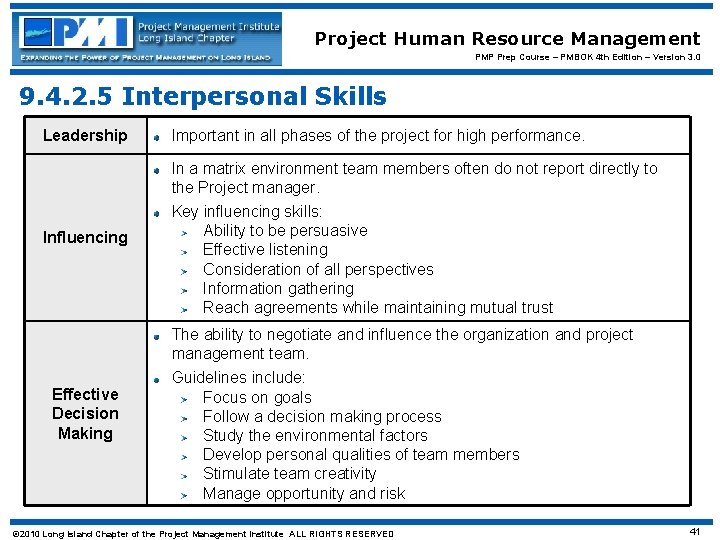
Project Human Resource Management PMP Prep Course – PMBOK 4 th Edition – Version 3. 0 9. 4. 2. 5 Interpersonal Skills Leadership Important in all phases of the project for high performance. In a matrix environment team members often do not report directly to the Project manager. Influencing Key influencing skills: Ability to be persuasive Effective listening Consideration of all perspectives Information gathering Reach agreements while maintaining mutual trust The ability to negotiate and influence the organization and project management team. Effective Decision Making Guidelines include: Focus on goals Follow a decision making process Study the environmental factors Develop personal qualities of team members Stimulate team creativity Manage opportunity and risk © 2010 Long Island Chapter of the Project Management Institute ALL RIGHTS RESERVED 41
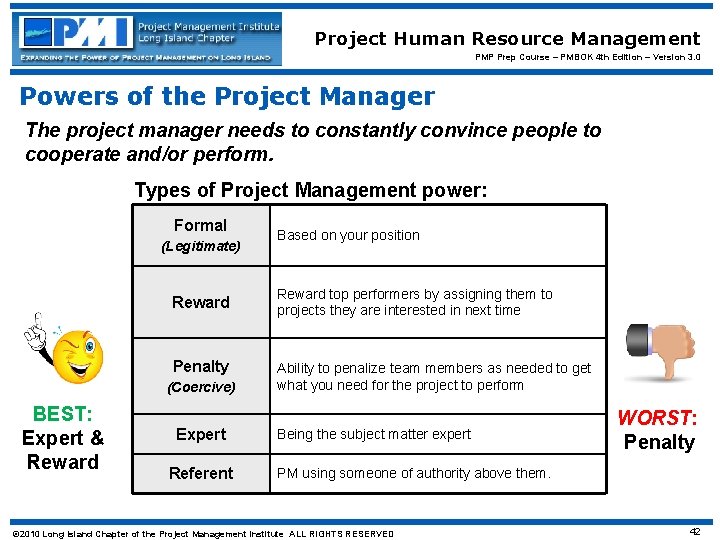
Project Human Resource Management PMP Prep Course – PMBOK 4 th Edition – Version 3. 0 Powers of the Project Manager The project manager needs to constantly convince people to cooperate and/or perform. Types of Project Management power: Formal (Legitimate) Reward Penalty (Coercive) BEST: Expert & Reward Expert Referent Based on your position Reward top performers by assigning them to projects they are interested in next time Ability to penalize team members as needed to get what you need for the project to perform Being the subject matter expert WORST: Penalty PM using someone of authority above them. © 2010 Long Island Chapter of the Project Management Institute ALL RIGHTS RESERVED 42
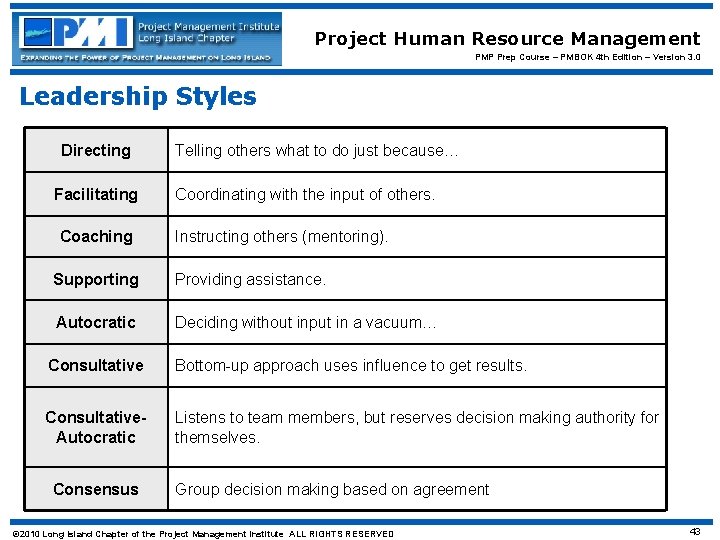
Project Human Resource Management PMP Prep Course – PMBOK 4 th Edition – Version 3. 0 Leadership Styles Directing Facilitating Coaching Telling others what to do just because… Coordinating with the input of others. Instructing others (mentoring). Supporting Providing assistance. Autocratic Deciding without input in a vacuum… Consultative Bottom-up approach uses influence to get results. Consultative. Autocratic Listens to team members, but reserves decision making authority for themselves. Consensus Group decision making based on agreement © 2010 Long Island Chapter of the Project Management Institute ALL RIGHTS RESERVED 43
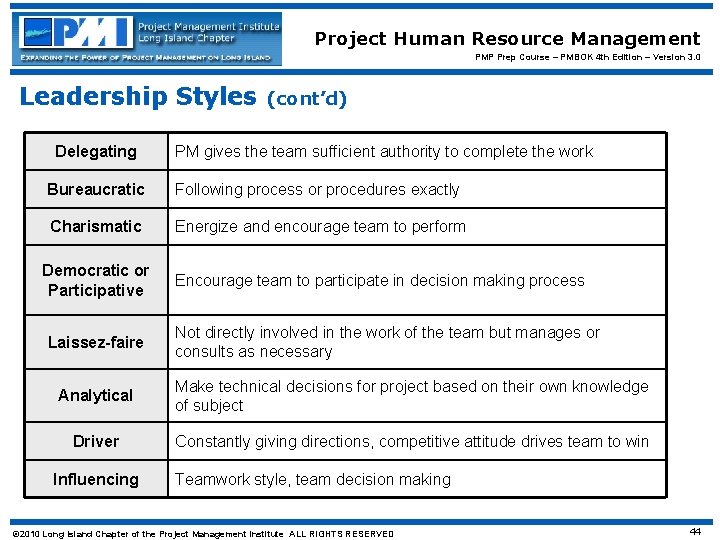
Project Human Resource Management PMP Prep Course – PMBOK 4 th Edition – Version 3. 0 Leadership Styles Delegating (cont’d) PM gives the team sufficient authority to complete the work Bureaucratic Following process or procedures exactly Charismatic Energize and encourage team to perform Democratic or Participative Laissez-faire Encourage team to participate in decision making process Not directly involved in the work of the team but manages or consults as necessary Analytical Make technical decisions for project based on their own knowledge of subject Driver Constantly giving directions, competitive attitude drives team to win Influencing Teamwork style, team decision making © 2010 Long Island Chapter of the Project Management Institute ALL RIGHTS RESERVED 44
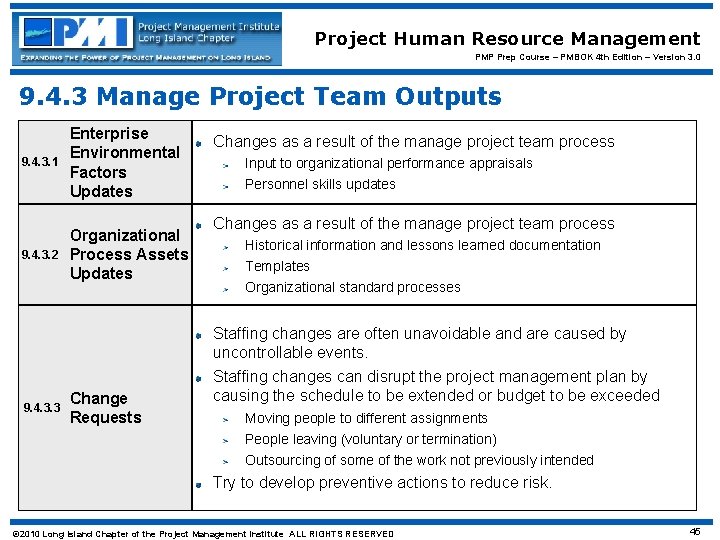
Project Human Resource Management PMP Prep Course – PMBOK 4 th Edition – Version 3. 0 9. 4. 3 Manage Project Team Outputs 9. 4. 3. 1 9. 4. 3. 2 9. 4. 3. 3 Enterprise Environmental Factors Updates Organizational Process Assets Updates Change Requests Changes as a result of the manage project team process Input to organizational performance appraisals Personnel skills updates Changes as a result of the manage project team process Historical information and lessons learned documentation Templates Organizational standard processes Staffing changes are often unavoidable and are caused by uncontrollable events. Staffing changes can disrupt the project management plan by causing the schedule to be extended or budget to be exceeded Moving people to different assignments People leaving (voluntary or termination) Outsourcing of some of the work not previously intended Try to develop preventive actions to reduce risk. © 2010 Long Island Chapter of the Project Management Institute ALL RIGHTS RESERVED 45
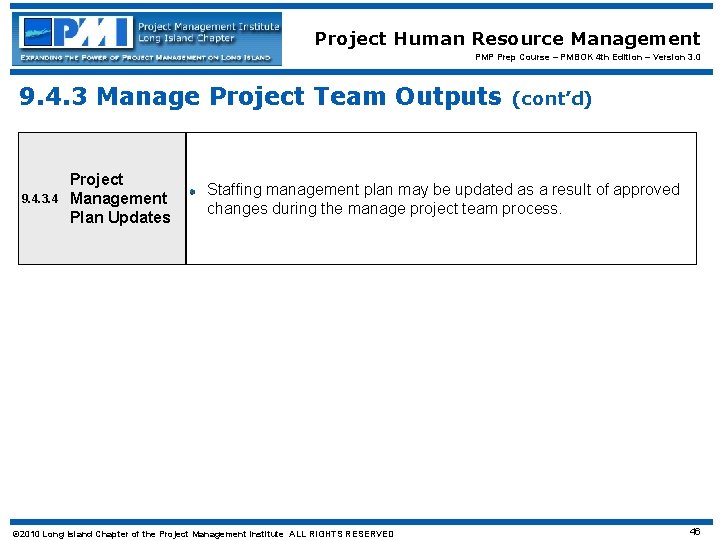
Project Human Resource Management PMP Prep Course – PMBOK 4 th Edition – Version 3. 0 9. 4. 3 Manage Project Team Outputs 9. 4. 3. 4 Project Management Plan Updates (cont’d) Staffing management plan may be updated as a result of approved changes during the manage project team process. © 2010 Long Island Chapter of the Project Management Institute ALL RIGHTS RESERVED 46
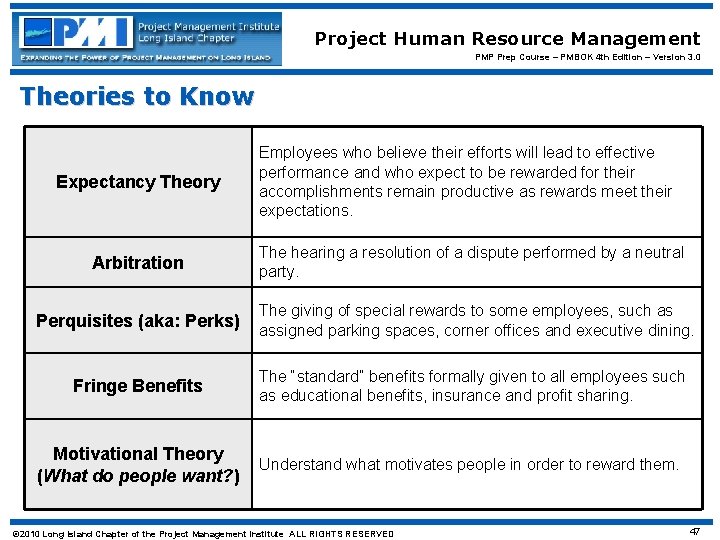
Project Human Resource Management PMP Prep Course – PMBOK 4 th Edition – Version 3. 0 Theories to Know Expectancy Theory Arbitration Employees who believe their efforts will lead to effective performance and who expect to be rewarded for their accomplishments remain productive as rewards meet their expectations. The hearing a resolution of a dispute performed by a neutral party. Perquisites (aka: Perks) The giving of special rewards to some employees, such as assigned parking spaces, corner offices and executive dining. Fringe Benefits The “standard” benefits formally given to all employees such as educational benefits, insurance and profit sharing. Motivational Theory (What do people want? ) Understand what motivates people in order to reward them. © 2010 Long Island Chapter of the Project Management Institute ALL RIGHTS RESERVED 47
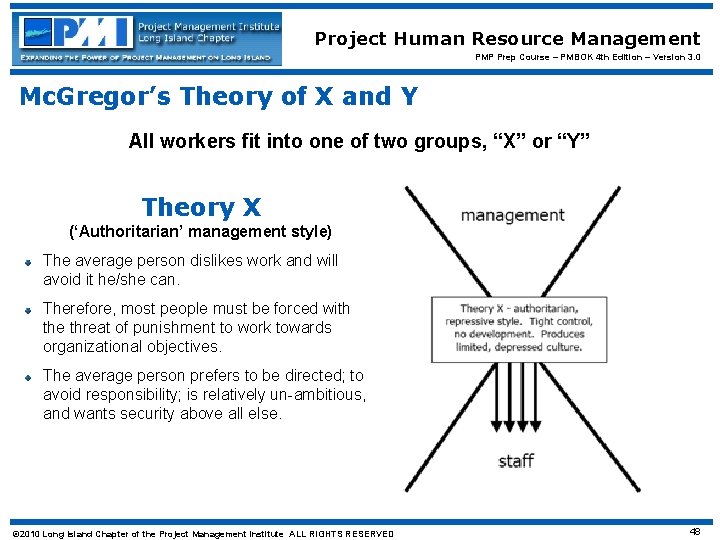
Project Human Resource Management PMP Prep Course – PMBOK 4 th Edition – Version 3. 0 Mc. Gregor’s Theory of X and Y All workers fit into one of two groups, “X” or “Y” Theory X (‘Authoritarian’ management style) The average person dislikes work and will avoid it he/she can. Therefore, most people must be forced with the threat of punishment to work towards organizational objectives. The average person prefers to be directed; to avoid responsibility; is relatively un-ambitious, and wants security above all else. © 2010 Long Island Chapter of the Project Management Institute ALL RIGHTS RESERVED 48
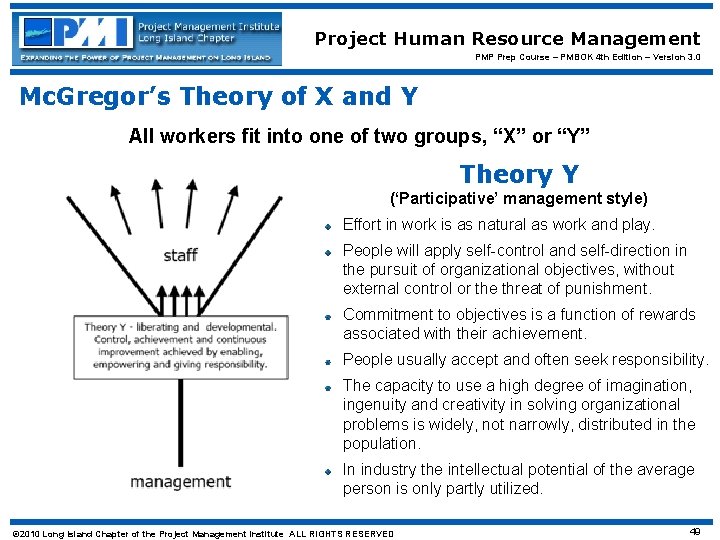
Project Human Resource Management PMP Prep Course – PMBOK 4 th Edition – Version 3. 0 Mc. Gregor’s Theory of X and Y All workers fit into one of two groups, “X” or “Y” Theory Y (‘Participative’ management style) Effort in work is as natural as work and play. People will apply self-control and self-direction in the pursuit of organizational objectives, without external control or the threat of punishment. Commitment to objectives is a function of rewards associated with their achievement. People usually accept and often seek responsibility. The capacity to use a high degree of imagination, ingenuity and creativity in solving organizational problems is widely, not narrowly, distributed in the population. In industry the intellectual potential of the average person is only partly utilized. © 2010 Long Island Chapter of the Project Management Institute ALL RIGHTS RESERVED 49
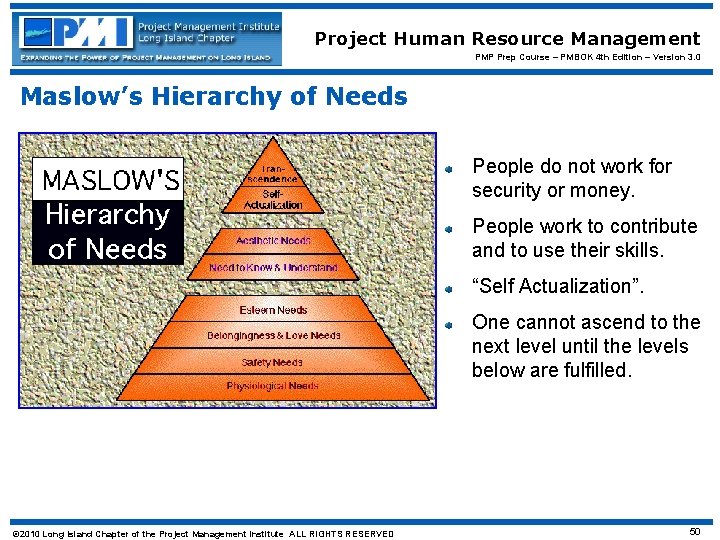
Project Human Resource Management PMP Prep Course – PMBOK 4 th Edition – Version 3. 0 Maslow’s Hierarchy of Needs People do not work for security or money. People work to contribute and to use their skills. “Self Actualization”. One cannot ascend to the next level until the levels below are fulfilled. © 2010 Long Island Chapter of the Project Management Institute ALL RIGHTS RESERVED 50
Project Human Resource Management PMP Prep Course – PMBOK 4 th Edition – Version 3. 0 Herzberg’s Theory Hygiene Factors and Motivating Agents Hygiene Factors Poor hygiene factors may destroy motivation, but improving them may not improve motivation Working conditions Salary Personal Life Relationships at work Security Status Motivating Agents Responsibility Self actualization Professional growth Recognition © 2010 Long Island Chapter of the Project Management Institute ALL RIGHTS RESERVED 51
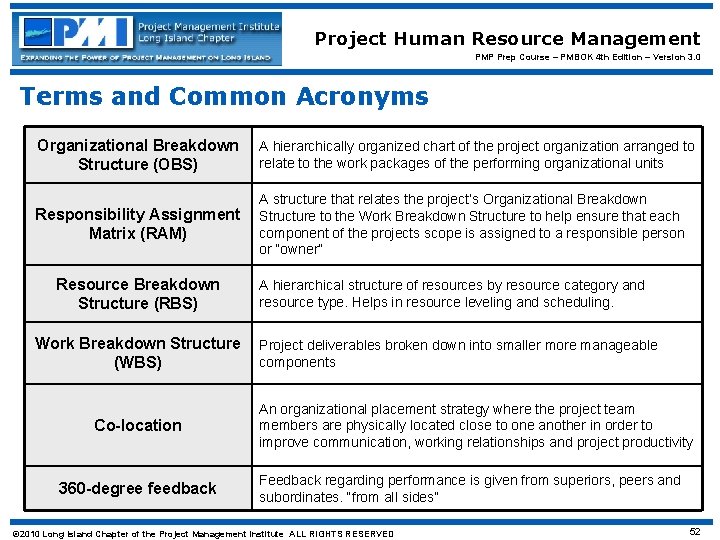
Project Human Resource Management PMP Prep Course – PMBOK 4 th Edition – Version 3. 0 Terms and Common Acronyms Organizational Breakdown Structure (OBS) A hierarchically organized chart of the project organization arranged to relate to the work packages of the performing organizational units Responsibility Assignment Matrix (RAM) A structure that relates the project’s Organizational Breakdown Structure to the Work Breakdown Structure to help ensure that each component of the projects scope is assigned to a responsible person or “owner” Resource Breakdown Structure (RBS) Work Breakdown Structure (WBS) Co-location 360 -degree feedback A hierarchical structure of resources by resource category and resource type. Helps in resource leveling and scheduling. Project deliverables broken down into smaller more manageable components An organizational placement strategy where the project team members are physically located close to one another in order to improve communication, working relationships and project productivity Feedback regarding performance is given from superiors, peers and subordinates. “from all sides” © 2010 Long Island Chapter of the Project Management Institute ALL RIGHTS RESERVED 52
Project Human Resource Management PMP Prep Course – PMBOK 4 th Edition – Version 3. 0 © 2010 Long Island Chapter of the Project Management Institute ALL RIGHTS RESERVED 53
Project Human Resource Management PMP Prep Course – PMBOK 4 th Edition – Version 3. 0 Good Luck!! © 2010 Long Island Chapter of the Project Management Institute ALL RIGHTS RESERVED
- Slides: 54