
Project Ghana Emergency Medicine Collaborative Document Title Stroke
Project: Ghana Emergency Medicine Collaborative Document Title: Stroke Management in the 21 st Century: What Do You Need to Know? Author(s): Rashmi Kothari (Michigan State University), MD 2012 License: Unless otherwise noted, this material is made available under the terms of the Creative Commons Attribution Share Alike-3. 0 License: http: //creativecommons. org/licenses/by-sa/3. 0/ We have reviewed this material in accordance with U. S. Copyright Law and have tried to maximize your ability to use, share, and adapt it. These lectures have been modified in the process of making a publicly shareable version. The citation key on the following slide provides information about how you may share and adapt this material. Copyright holders of content included in this material should contact open. michigan@umich. edu with any questions, corrections, or clarification regarding the use of content. For more information about how to cite these materials visit http: //open. umich. edu/privacy-and-terms-use. Any medical information in this material is intended to inform and educate and is not a tool for self-diagnosis or a replacement for medical evaluation, advice, diagnosis or treatment by a healthcare professional. Please speak to your physician if you have questions about your medical condition. Viewer discretion is advised: Some medical content is graphic and may not be suitable for all viewers. 1
Attribution Key for more information see: http: //open. umich. edu/wiki/Attribution. Policy Use + Share + Adapt { Content the copyright holder, author, or law permits you to use, share and adapt. } Public Domain – Government: Works that are produced by the U. S. Government. (17 USC § 105) Public Domain – Expired: Works that are no longer protected due to an expired copyright term. Public Domain – Self Dedicated: Works that a copyright holder has dedicated to the public domain. Creative Commons – Zero Waiver Creative Commons – Attribution License Creative Commons – Attribution Share Alike License Creative Commons – Attribution Noncommercial Share Alike License GNU – Free Documentation License Make Your Own Assessment { Content Open. Michigan believes can be used, shared, and adapted because it is ineligible for copyright. } Public Domain – Ineligible: Works that are ineligible for copyright protection in the U. S. (17 USC § 102(b)) *laws in your jurisdiction may differ { Content Open. Michigan has used under a Fair Use determination. } Fair Use: Use of works that is determined to be Fair consistent with the U. S. Copyright Act. (17 USC § 107) *laws in your jurisdiction may differ Our determination DOES NOT mean that all uses of this 3 rd-party content are Fair Uses and we DO NOT guarantee that your use of the content is Fair. 2 To use this content you should do your own independent analysis to determine whether or not your use will be Fair.
Why do we care about stroke? • Third leading cause of death • Leading cause of adult disability • 20 -30% mortality 3
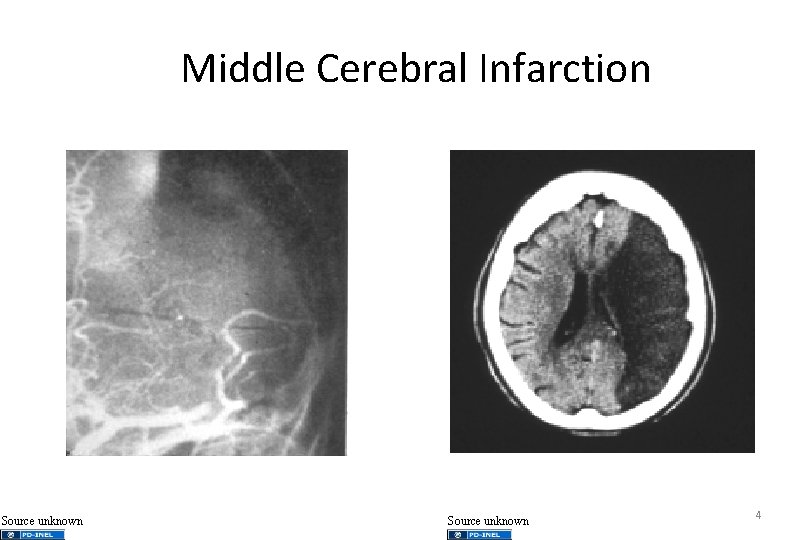
Middle Cerebral Infarction Source unknown 4
Tissue-Plasminogen Activator in Acute Ischemic Stroke • • • Double-blinded Placebo controlled 0. 9 mg/kg 624 patients Treated within 3 hours – 1/2 within 90 minutes – 1/2 within 91 -180 minutes • 4 Outcome measures Reference: Tissue Plasminogen Activator for Acute Ischemic Stroke. The National Institute of Neurological Disorders and Stroke rt-PA Stroke Study Group 5 N Engl J Med 1995; 333: 1581 -1588. http: //www. nejm. org/doi/full/10. 1056/NEJM 199512143332401.
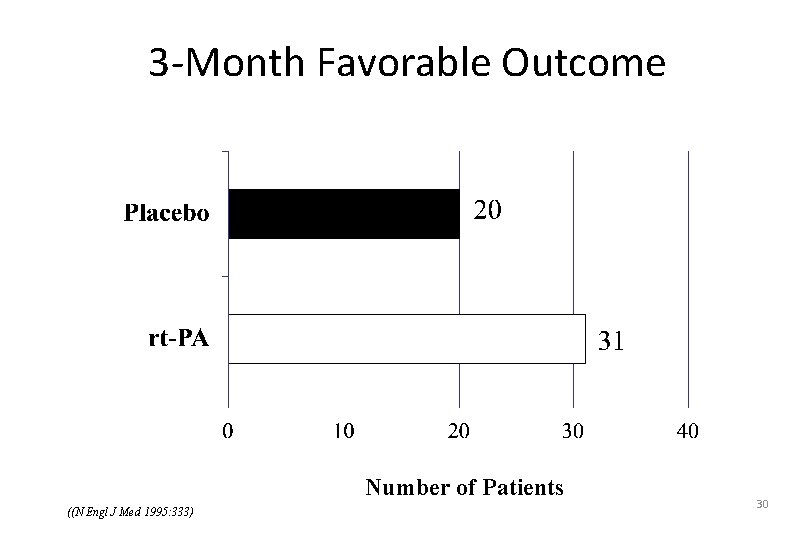
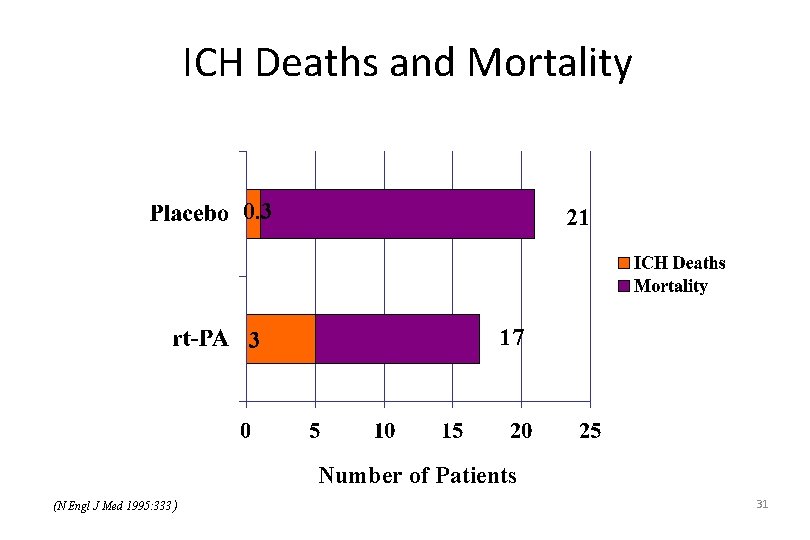
NINDS rt-PA Stroke Trial Results • 30% more likely to have favorable 3 -month outcome – 1. 9 (1. 2 -2. 9)=Odds Ratio (0 -90 minutes) – 1. 7 (1. 3 -2. 9)=Odds Ratio (91 -180) minutes) • Significantly higher intracerebral hemorrhage rate – 0. 6% Placebo – 6. 4% rt-PA • No difference in mortality – 21% Placebo – 17% rt-PA 6
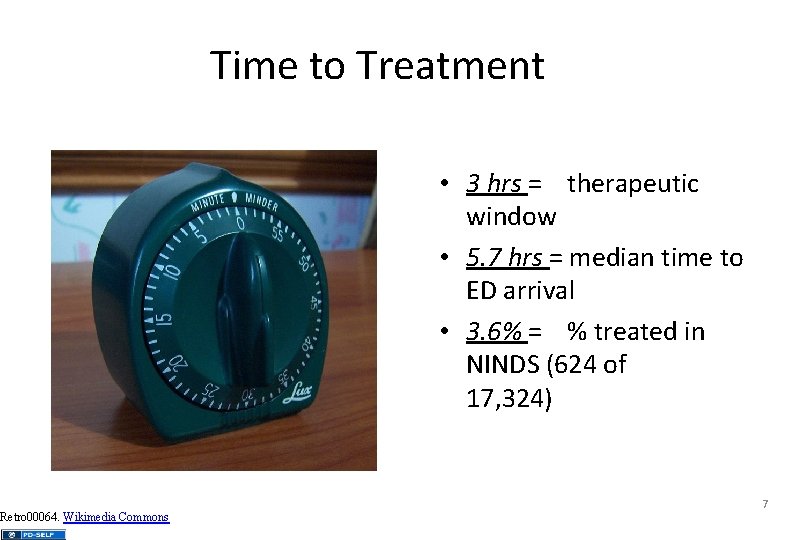
Time to Treatment • 3 hrs = therapeutic window • 5. 7 hrs = median time to ED arrival • 3. 6% = % treated in NINDS (624 of 17, 324) Retro 00064. Wikimedia Commons 7
Jmkim dot com, Wikimedia Commons 8
Stroke Chain of Survival & Recovery • • Detection: Early Recognition Dispatch: Early EMS Activation Delivery: Transport & Management Door: ED Triage Data: ED Evaluation & Management Decision: Specific Therapies Drug: Thrombolytic & Neuroprotective Therapy 9
Detection • What are Signs & Symptoms? – 43% general public didn’t know any – 39% of acute stroke patients didn’t know any • What are Risk Factors? – 32% general public didn’t know any – 43% of acute stroke patients didn’t know any Pancioli JAMA 1998; 279 Kothari Stroke 1997; 28 10
What do you need to know about stroke? • Signs & Symptoms – one-sided extremity weakness – one-sided numbness – difficulty speaking – visual problems • Risk Factors – hypertension – diabetes mellitus – smoking – heart disease – prior strokes – older age – race (African-Americans) 11
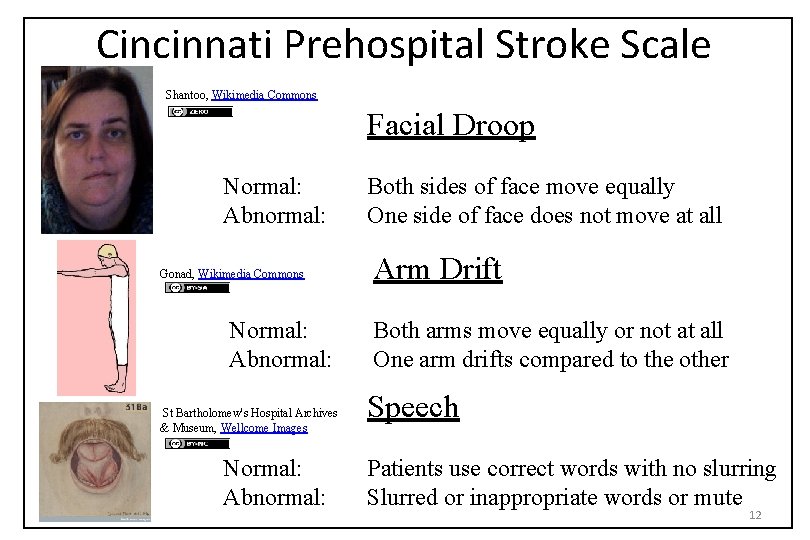
Cincinnati Prehospital Stroke Scale Shantoo, Wikimedia Commons Facial Droop Normal: Abnormal: Gonad, Wikimedia Commons Normal: Abnormal: St Bartholomew's Hospital Archives & Museum, Wellcome Images Normal: Abnormal: Both sides of face move equally One side of face does not move at all Arm Drift Both arms move equally or not at all One arm drifts compared to the other Speech Patients use correct words with no slurring Slurred or inappropriate words or mute 12
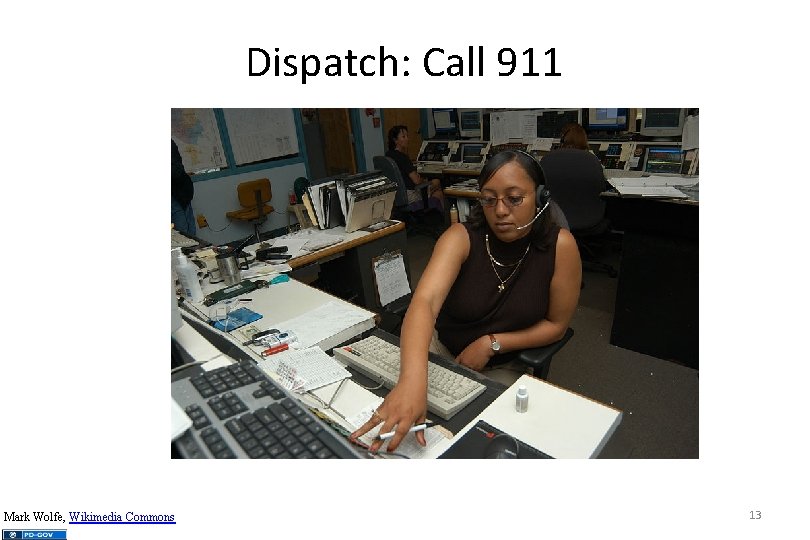
Dispatch: Call 911 Mark Wolfe, Wikimedia Commons 13
General Publics’ Perception of What to do in Case of a Stroke • 90% would seek medical attention – 43% call 911 immediately – 26% call their family doctor – 11% go straight to the ED NSA/Gallop Poll 1996 14
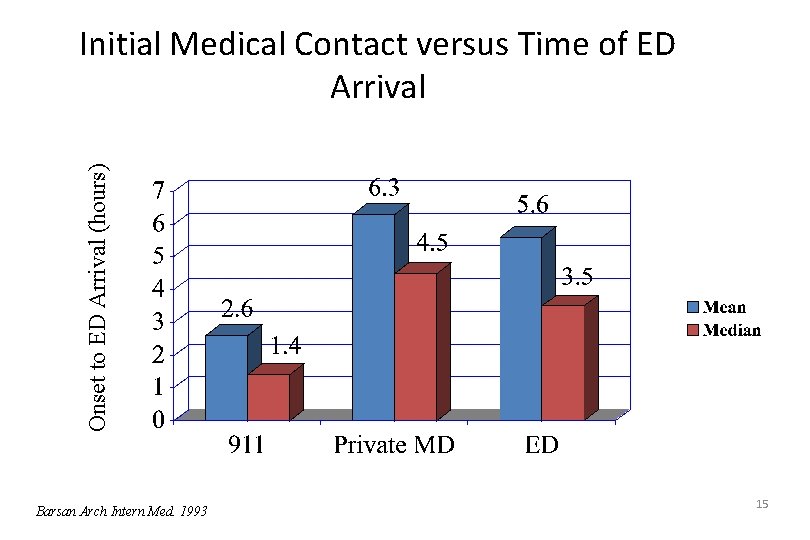
Onset to ED Arrival (hours) Initial Medical Contact versus Time of ED Arrival Barsan Arch Intern Med. 1993 15
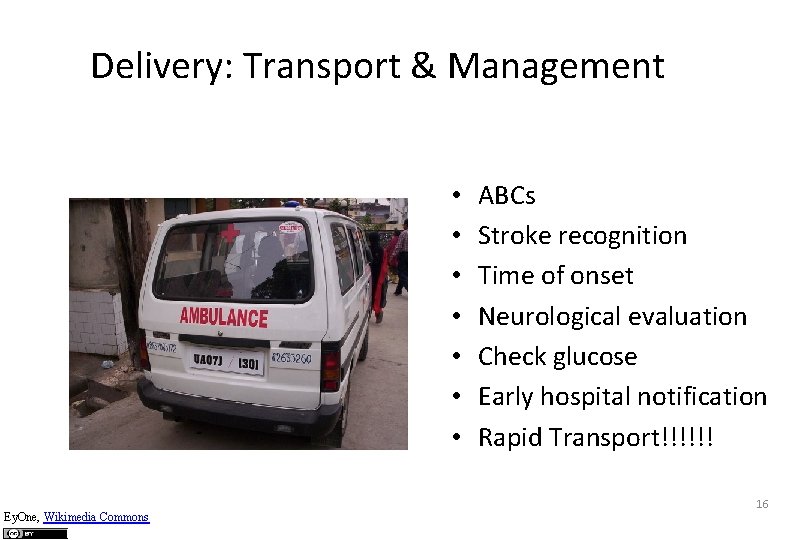
Delivery: Transport & Management • • Ey. One, Wikimedia Commons ABCs Stroke recognition Time of onset Neurological evaluation Check glucose Early hospital notification Rapid Transport!!!!!! 16
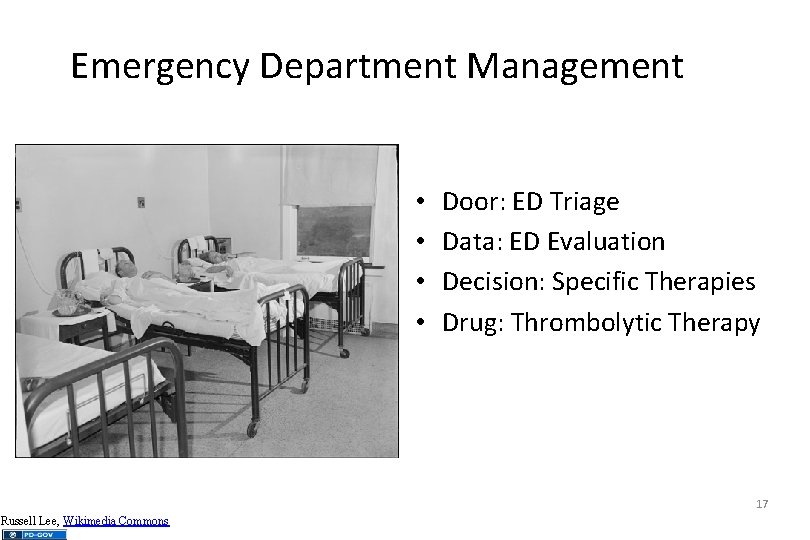
Emergency Department Management • • Door: ED Triage Data: ED Evaluation Decision: Specific Therapies Drug: Thrombolytic Therapy 17 Russell Lee, Wikimedia Commons
Shantoo, Wikimedia Commons Triage 18
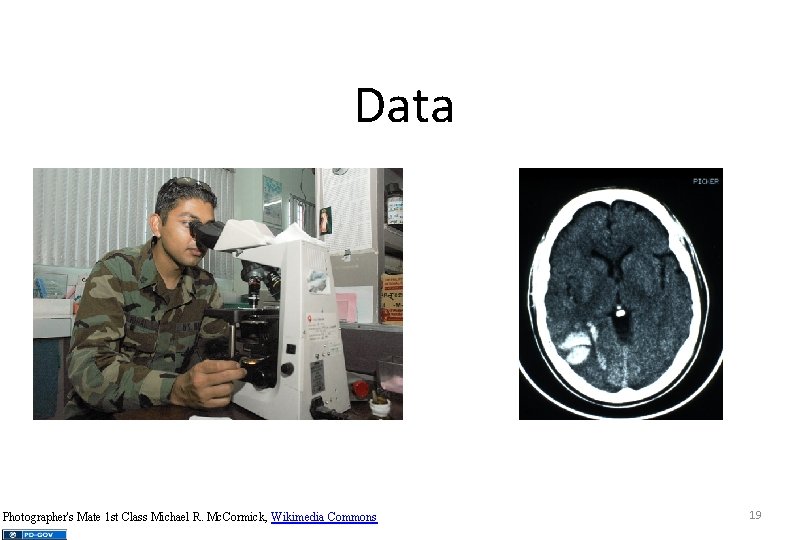
Data Photographer's Mate 1 st Class Michael R. Mc. Cormick, Wikimedia Commons 19
Decision (Who Should I Treat? ) • Inclusion Criteria • Exclusion Criteria 20
Inclusion Criteria • Clinical Presentation of Ischemic Stroke • Onset within 3 hours 21
Exclusion Criteria • • Onset >3 hours BP>185/110 Hemorrhage on CT Seizure at onset Surgery 14 days Trauma 3 months Stroke 3 months Minimal or resolving symptoms • • GI/GU bleed 21 days Prior ICH or SAH Recent MI On Coumadin PT>1. 5 On heparin PTT>21 Platelets <100, 000 Glucose >400 22
Drug (How Do You Treat? ) • Pre-Treatment – glucose, NIHSS, CT, Consent • Dosing • Monitoring 23
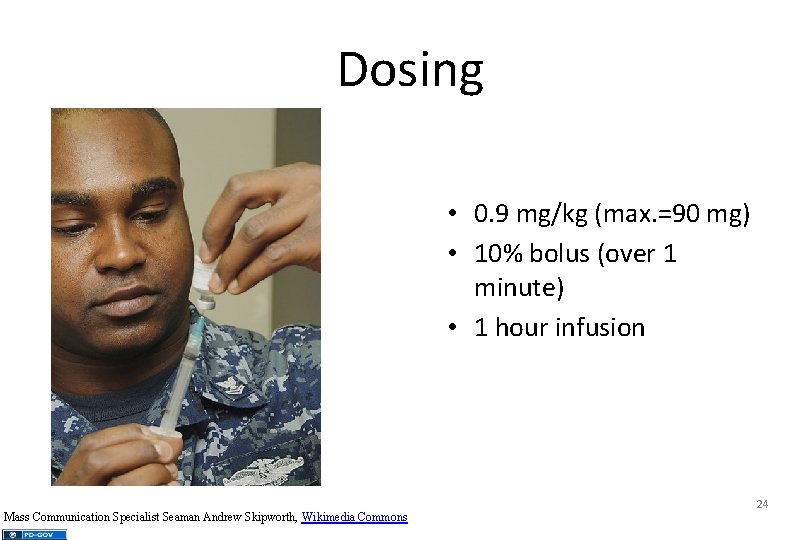
Dosing • 0. 9 mg/kg (max. =90 mg) • 10% bolus (over 1 minute) • 1 hour infusion Mass Communication Specialist Seaman Andrew Skipworth, Wikimedia Commons 24
Patient Monitoring • ICU admission (24 hours) • Neuro checks – Q 15 minute X 6 hours – Q 1 hour X 18 hours • BP checks 25
Blood Pressure Management • Non-Thrombolytic Candidates • Thrombolytic Candidates – pre-treatment (185/110 mm. Hg) – during & post-treatment 26
BP Management • Non-Thrombolytic Candidate – Don’t Treat!!! • Pre-Thrombolysis – Be Gentle!!! • During & Post-Thrombolysis – Be Aggressive!!! 27
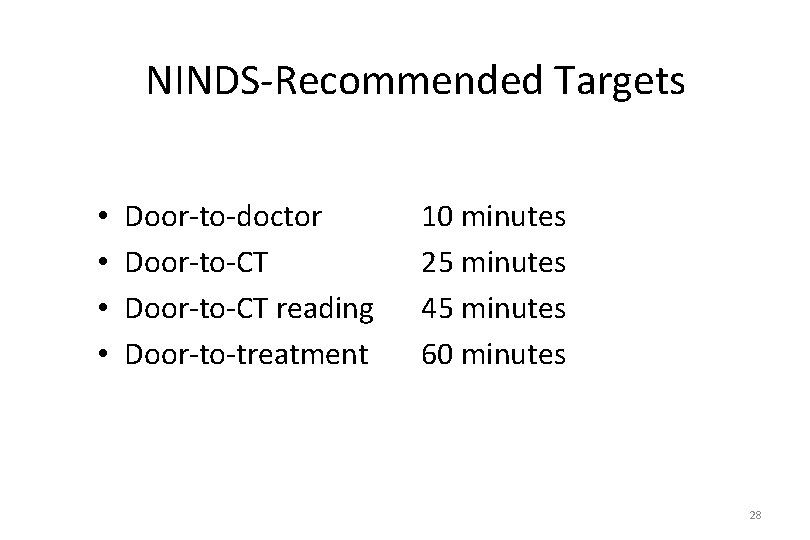
NINDS-Recommended Targets • • Door-to-doctor Door-to-CT reading Door-to-treatment 10 minutes 25 minutes 45 minutes 60 minutes 28
Stroke Chain of Survival & Recovery • • Detection: Early Recognition Dispatch: Early EMS Activation Delivery: Transport & Management Door: ED Triage Data: ED Evaluation & Management Decision: Specific Therapies Drug: Thrombolytic & Neuroprotective Therapy 29
3 -Month Favorable Outcome Number of Patients ((N Engl J Med 1995: 333) 30
ICH Deaths and Mortality 0. 3 3 21 17 Number of Patients (N Engl J Med 1995: 333) 31
Baseline NIHSS and ICH in the NINDS Trial Percentage of t-PA Patients with Symptomatic ICH (Broderick, Stroke 1997) 32
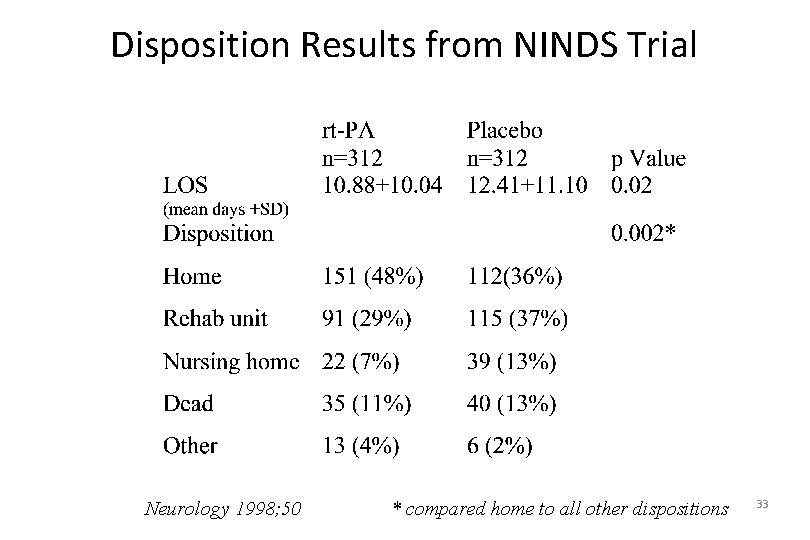
Disposition Results from NINDS Trial Neurology 1998; 50 * compared home to all other dispositions 33
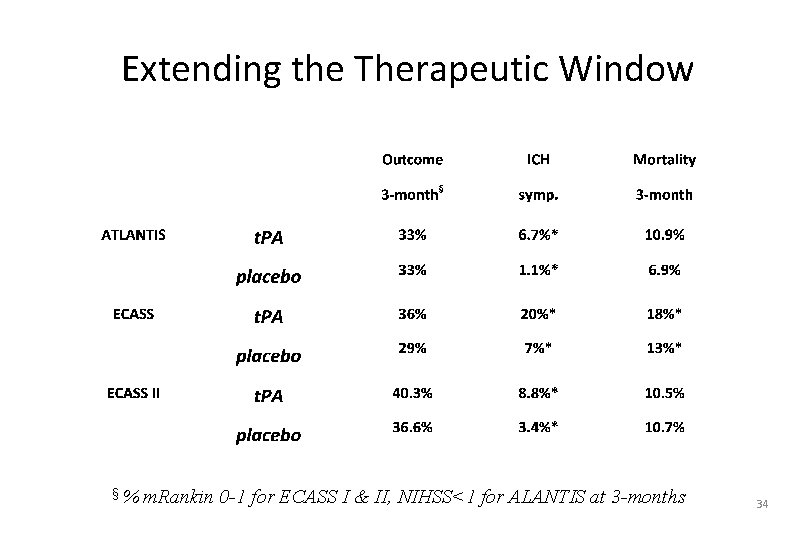
Extending the Therapeutic Window §% m. Rankin 0 -1 for ECASS I & II, NIHSS<1 for ALANTIS at 3 -months 34
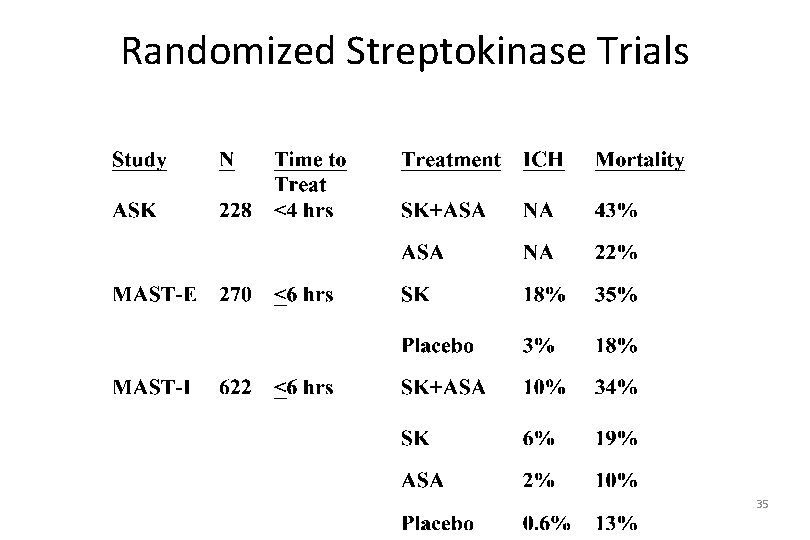
Randomized Streptokinase Trials 35
- Slides: 35