
Project Ghana Emergency Medicine Collaborative Document Title Hemostasis
Project: Ghana Emergency Medicine Collaborative Document Title: Hemostasis: Platelet and Coagulation Disorders Author(s): Joseph H. Hartmann (University of Michigan), DO 2012 License: Unless otherwise noted, this material is made available under the terms of the Creative Commons Attribution Share Alike-3. 0 License: http: //creativecommons. org/licenses/by-sa/3. 0/ We have reviewed this material in accordance with U. S. Copyright Law and have tried to maximize your ability to use, share, and adapt it. These lectures have been modified in the process of making a publicly shareable version. The citation key on the following slide provides information about how you may share and adapt this material. Copyright holders of content included in this material should contact open. michigan@umich. edu with any questions, corrections, or clarification regarding the use of content. For more information about how to cite these materials visit http: //open. umich. edu/privacy-and-terms-use. Any medical information in this material is intended to inform and educate and is not a tool for self-diagnosis or a replacement for medical evaluation, advice, diagnosis or treatment by a healthcare professional. Please speak to your physician if you have questions about your medical condition. Viewer discretion is advised: Some medical content is graphic and may not be suitable for all viewers. 1
Attribution Key for more information see: http: //open. umich. edu/wiki/Attribution. Policy Use + Share + Adapt { Content the copyright holder, author, or law permits you to use, share and adapt. } Public Domain – Government: Works that are produced by the U. S. Government. (17 USC § 105) Public Domain – Expired: Works that are no longer protected due to an expired copyright term. Public Domain – Self Dedicated: Works that a copyright holder has dedicated to the public domain. Creative Commons – Zero Waiver Creative Commons – Attribution License Creative Commons – Attribution Share Alike License Creative Commons – Attribution Noncommercial Share Alike License GNU – Free Documentation License Make Your Own Assessment { Content Open. Michigan believes can be used, shared, and adapted because it is ineligible for copyright. } Public Domain – Ineligible: Works that are ineligible for copyright protection in the U. S. (17 USC § 102(b)) *laws in your jurisdiction may differ { Content Open. Michigan has used under a Fair Use determination. } Fair Use: Use of works that is determined to be Fair consistent with the U. S. Copyright Act. (17 USC § 107) *laws in your jurisdiction may differ Our determination DOES NOT mean that all uses of this 3 rd-party content are Fair Uses and we DO NOT guarantee that your use of the content is Fair. To use this content you should do your own independent analysis to determine whether or not your use will be Fair. 2
Hemostasis: Platelet and Coagulation Disorders Joseph Hartmann D. O. 3
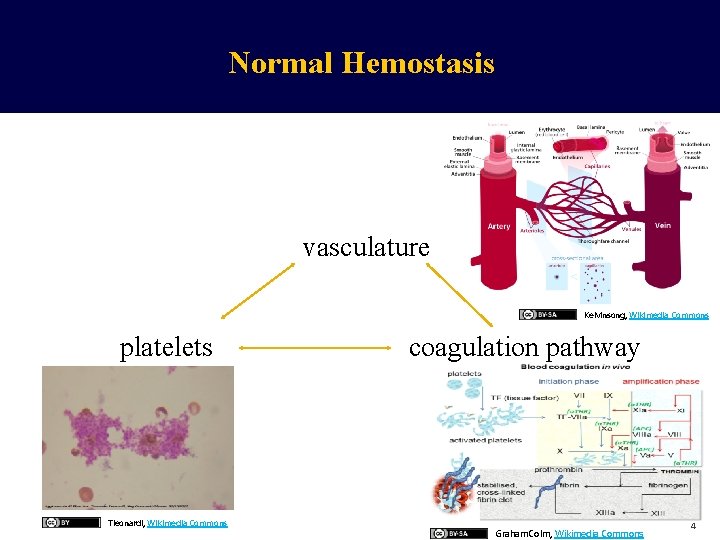
Normal Hemostasis vasculature Kelvinsong, Wikimedia Commons platelets Tleonardi, Wikimedia Commons coagulation pathway Graham. Colm, Wikimedia Commons 4
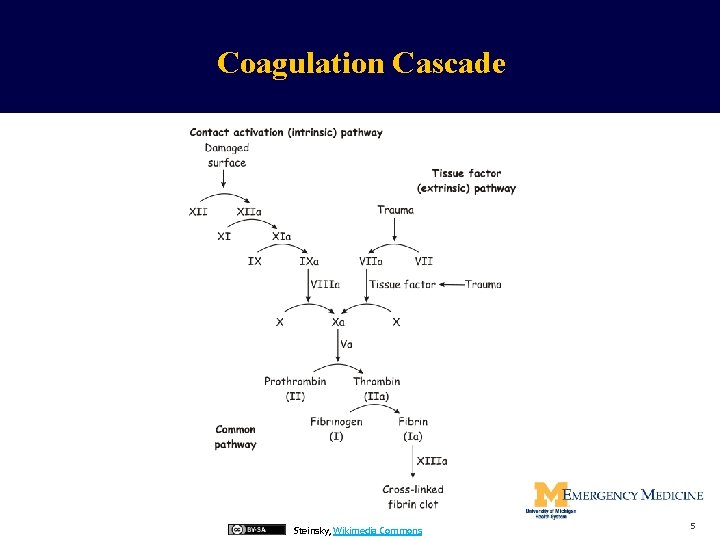
Coagulation Cascade Steinsky, Wikimedia Commons 5
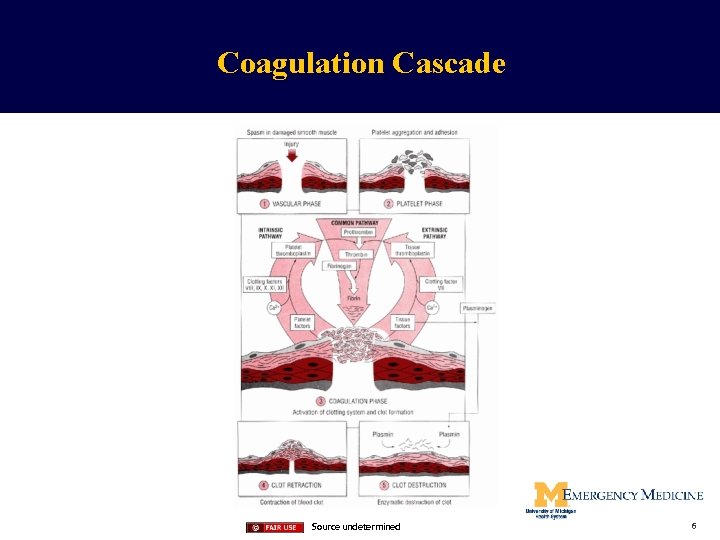
Coagulation Cascade Source undetermined 6
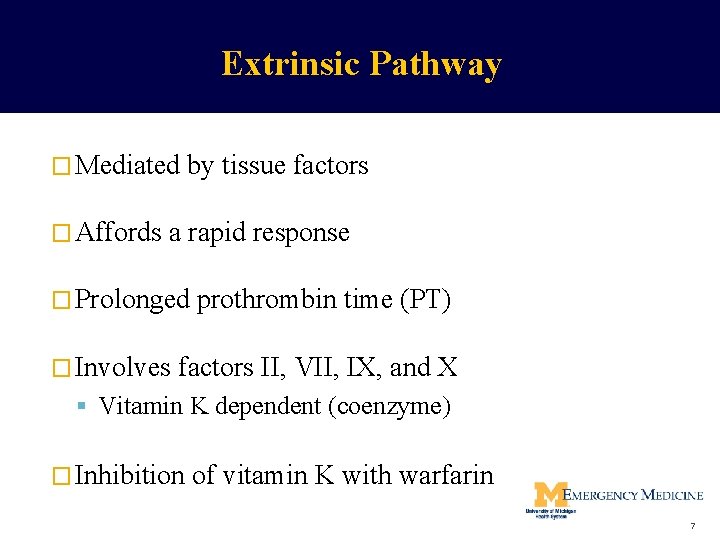
Extrinsic Pathway � Mediated � Affords by tissue factors a rapid response � Prolonged � Involves prothrombin time (PT) factors II, VII, IX, and X Vitamin K dependent (coenzyme) � Inhibition of vitamin K with warfarin 7
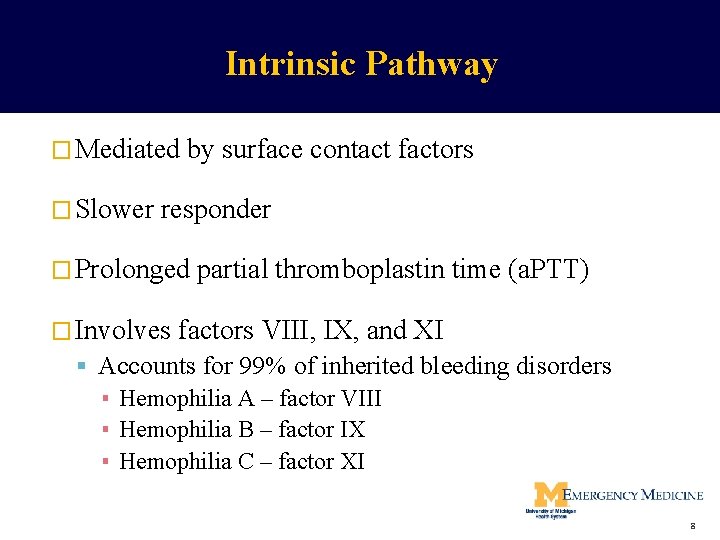
Intrinsic Pathway � Mediated � Slower by surface contact factors responder � Prolonged � Involves partial thromboplastin time (a. PTT) factors VIII, IX, and XI Accounts for 99% of inherited bleeding disorders ▪ Hemophilia A – factor VIII ▪ Hemophilia B – factor IX ▪ Hemophilia C – factor XI 8
Common Pathway � Prolonged PT and a. PTT � Thrombin and fibrinogen form insoluble clot 9

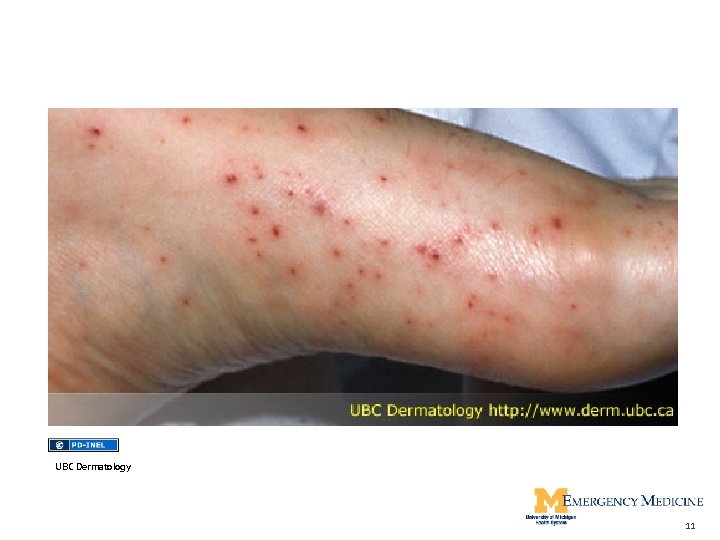
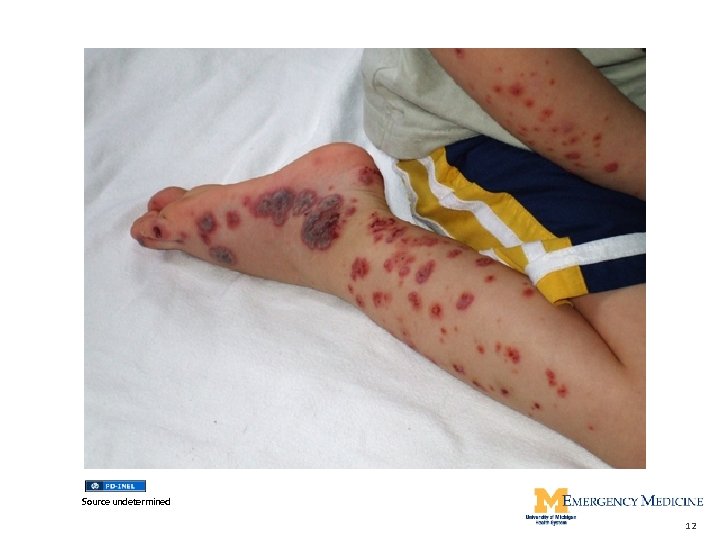
Platelet Disorders � Thrombocytopenia = platelet count < 100, 000 cu mm � Platelet count < 50, 000 variable risk � Platelet count < 20, 000 transfusion appropriate � Platelet count < 10, 000 spontaneous hemorrhage � Platelet dysfunction = mucus membrane bleeding Epistaxis Gingival Vaginal bleeding Petechiae, purpura 10
UBC Dermatology 11
Source undetermined 12
Platelet Disorders � Immune (Idiopathic) Thrombocytopenic Purpura (ITP) � Thrombotic Thrombocytopenic Purpura (TTP) � Hemolytic-Uremic � Heparin Syndrome (HUS) –Induced Thrombocytopenia (HIT) � Drug-Induced Inactivation of Platelets 13
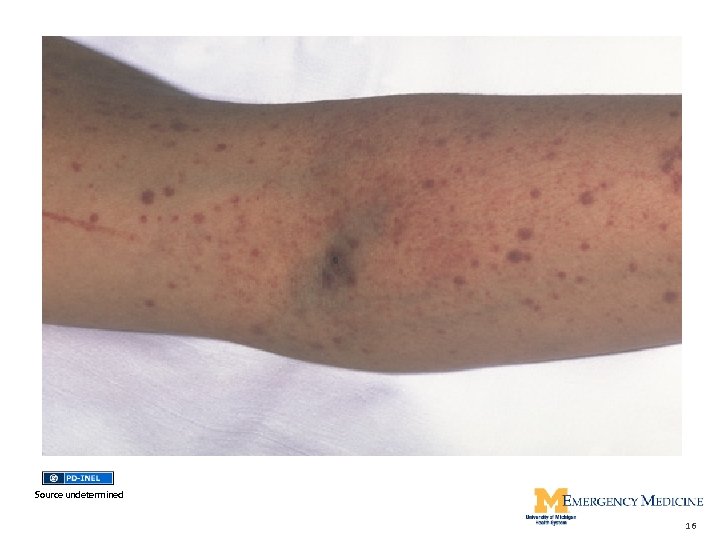
Immune Thrombocytopenic Purpura � Acquired autoimmune disorder Thrombocytopenia with normal bone marrow � Acute form Children 2 -6 yrs. old Associated with prior viral illness (<3 wk) Resolution > 1 -2 months, often quite longer Spontaneous resolution in 90% 14
Immune Thrombocytopenic Purpura � Chronic form Adults: women > men or women < men Associated with autoimmune disorder (SLE, HIV) Resolution is rare Thrombocytopenia < 20, 000 Mucosal bleeding 15
Source undetermined 16
Immune Thrombocytopenic Purpura � Management Do not transfuse platelets Steroids Splenectomy Immunoglobulin therapy Plasmapheresis 17
Thrombotic Thrombocytopenic Purpura � Thrombocytopenia � Classic + microangiopathic hemolytic anemia pentad - Fever, anemia, thrombocytopenia, renal failure, neurologic symptoms � Associations – Autoimmune – AIDS, lupus, scleroderma, Sjogren Pregnancy Rx – cyclosporine, tacrolimus, quinidine 18
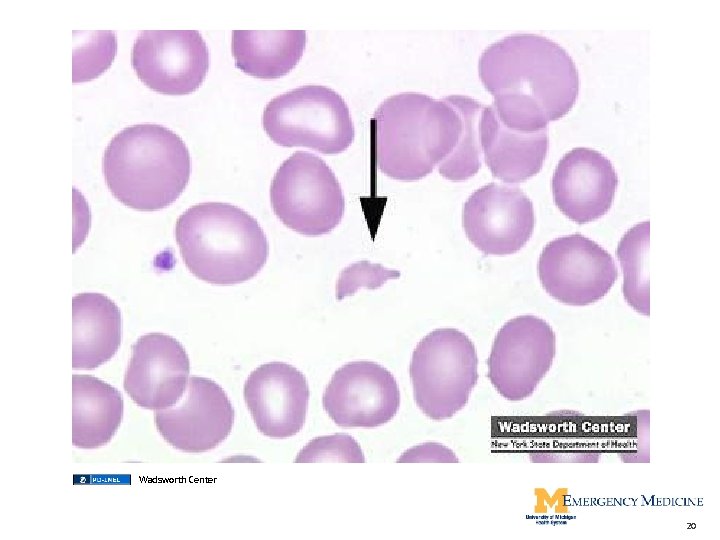
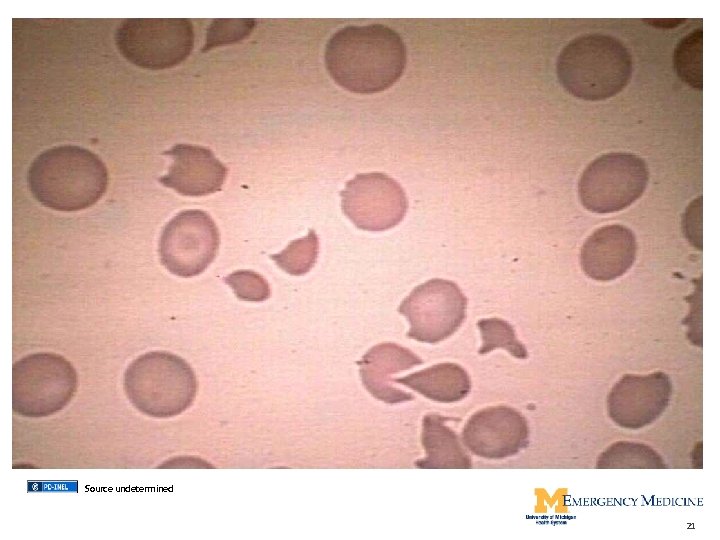
Thrombotic Thrombocytopenic Purpura � Laboratory findings Schistocytes (helmet cells) ▪ Intravascular hemolysis – peripheral smear Platelets < 20, 000 Increased reticulocyte count Increased indirect bilirubin Increased LDH Decreased haptoglobin � Tx: urgent hematology consult, plasmapheresis, steroids 19
Wadsworth Center 20
Source undetermined 21
Hemolytic-Uremic Syndrome � Thrombocytopenia + microangiopathic hemolytic anemia + acute renal failure � Primarily in children 6 mo – 4 yr Most common cause of acute renal failure in children � Associations – E. coli H 7: 0157 Shiga-like toxin 22
Hemolytic-Uremic Syndrome � Presentation – bloody diarrhea and seizure Pentad of TTP – neurologic symptoms more pronounced HUS – renal dysfunction more pronounced � Laboratory findings SCHISTOCYTES TTP lab findings Worse renal function parameters, i. e. renal failure 23
Hemolytic-Uremic Syndrome � Treatment Supportive, dialysis (? ), do not administer antibiotics. Schistocytes + child = HUS Schistocytes + adult = TTP Schistocytes + neurologic dysfunction = TTP Schistocytes + renal dysfunction = HUS 24
Heparin-Induced Thrombocytopenia � Type I Platelet count rarely < 100, 000 Occurs within first few days Benign – not associated with thrombosis Platelet count normalizes regardless of heparin use / disuse 25
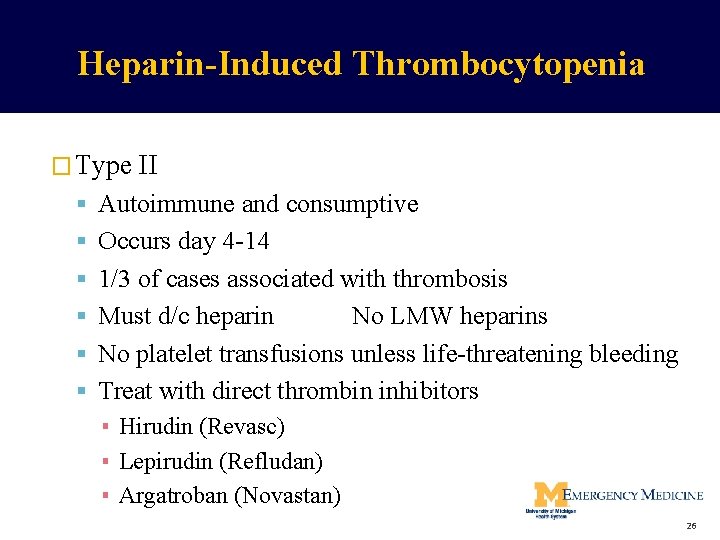
Heparin-Induced Thrombocytopenia � Type II Autoimmune and consumptive Occurs day 4 -14 1/3 of cases associated with thrombosis Must d/c heparin No LMW heparins No platelet transfusions unless life-threatening bleeding Treat with direct thrombin inhibitors ▪ Hirudin (Revasc) ▪ Lepirudin (Refludan) ▪ Argatroban (Novastan) 26
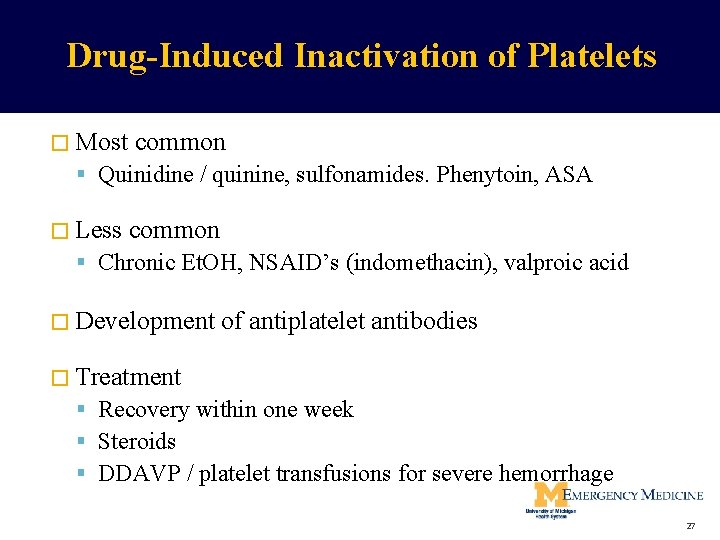
Drug-Induced Inactivation of Platelets � Most common Quinidine / quinine, sulfonamides. Phenytoin, ASA � Less common Chronic Et. OH, NSAID’s (indomethacin), valproic acid � Development of antiplatelet antibodies � Treatment Recovery within one week Steroids DDAVP / platelet transfusions for severe hemorrhage 27
Coagulation Disorders � Hemophilia A (classic hemophilia) � Hemophilia B (Christmas disease) � Disseminated � von Intravascular Coagulation Willibrand’s Disease � Medication toxicity 28
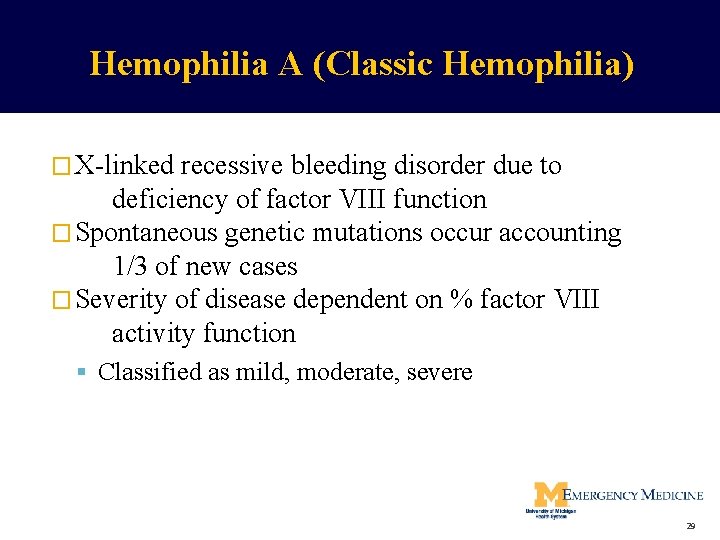
Hemophilia A (Classic Hemophilia) � X-linked recessive bleeding disorder due to deficiency of factor VIII function � Spontaneous genetic mutations occur accounting 1/3 of new cases � Severity of disease dependent on % factor VIII activity function Classified as mild, moderate, severe 29
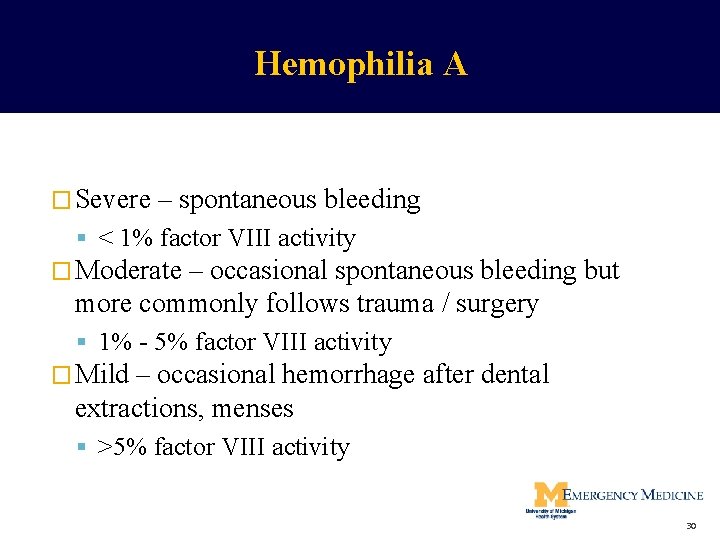
Hemophilia A � Severe – spontaneous bleeding < 1% factor VIII activity � Moderate – occasional spontaneous bleeding but more commonly follows trauma / surgery 1% - 5% factor VIII activity � Mild – occasional hemorrhage after dental extractions, menses >5% factor VIII activity 30
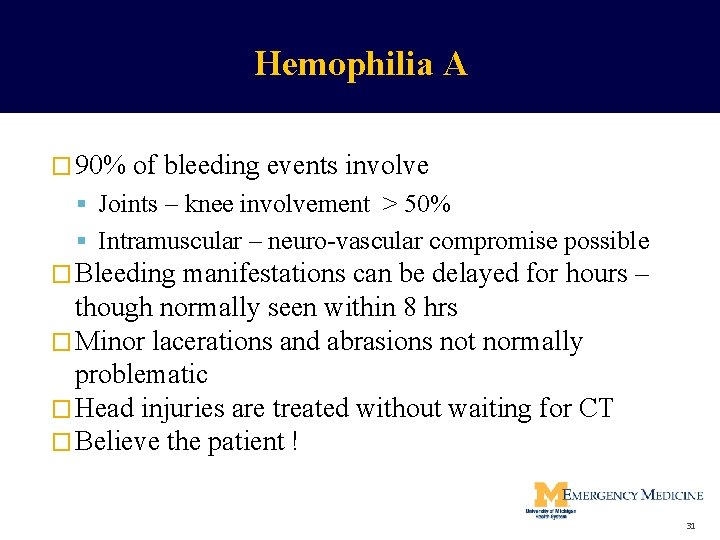
Hemophilia A � 90% of bleeding events involve Joints – knee involvement > 50% Intramuscular – neuro-vascular compromise possible � Bleeding manifestations can be delayed for hours – though normally seen within 8 hrs � Minor lacerations and abrasions not normally problematic � Head injuries are treated without waiting for CT � Believe the patient ! 31
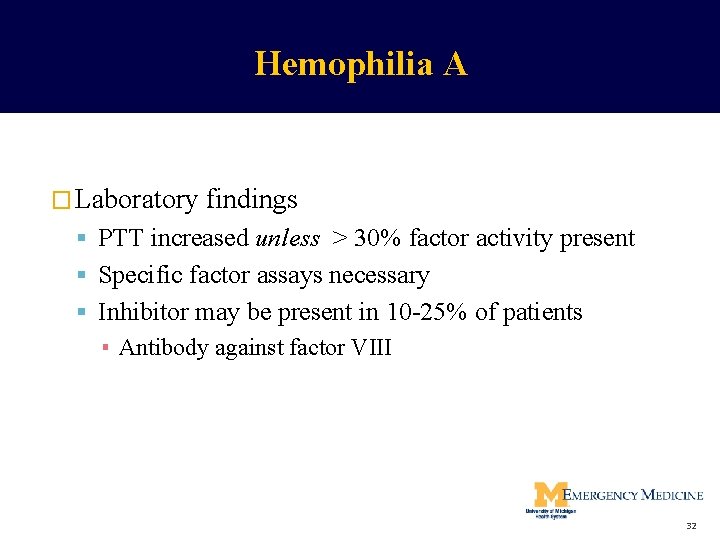
Hemophilia A � Laboratory findings PTT increased unless > 30% factor activity present Specific factor assays necessary Inhibitor may be present in 10 -25% of patients ▪ Antibody against factor VIII 32
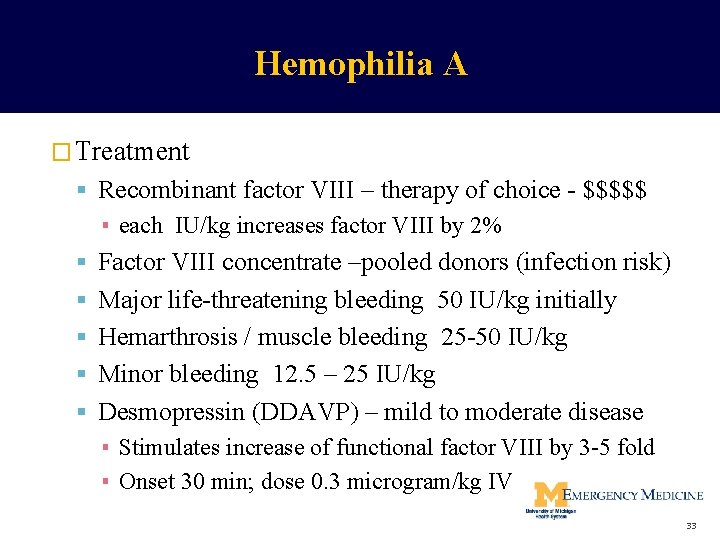
Hemophilia A � Treatment Recombinant factor VIII – therapy of choice - $$$$$ ▪ each IU/kg increases factor VIII by 2% Factor VIII concentrate –pooled donors (infection risk) Major life-threatening bleeding 50 IU/kg initially Hemarthrosis / muscle bleeding 25 -50 IU/kg Minor bleeding 12. 5 – 25 IU/kg Desmopressin (DDAVP) – mild to moderate disease ▪ Stimulates increase of functional factor VIII by 3 -5 fold ▪ Onset 30 min; dose 0. 3 microgram/kg IV 33
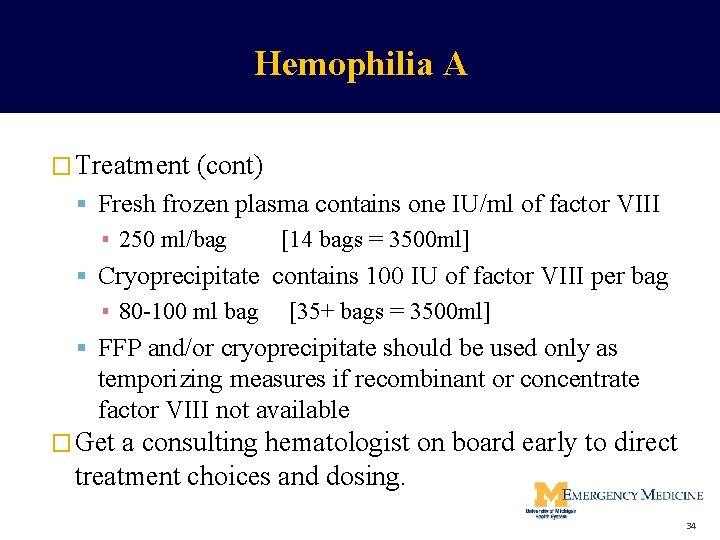
Hemophilia A � Treatment (cont) Fresh frozen plasma contains one IU/ml of factor VIII ▪ 250 ml/bag [14 bags = 3500 ml] Cryoprecipitate contains 100 IU of factor VIII per bag ▪ 80 -100 ml bag [35+ bags = 3500 ml] FFP and/or cryoprecipitate should be used only as temporizing measures if recombinant or concentrate factor VIII not available � Get a consulting hematologist on board early to direct treatment choices and dosing. 34
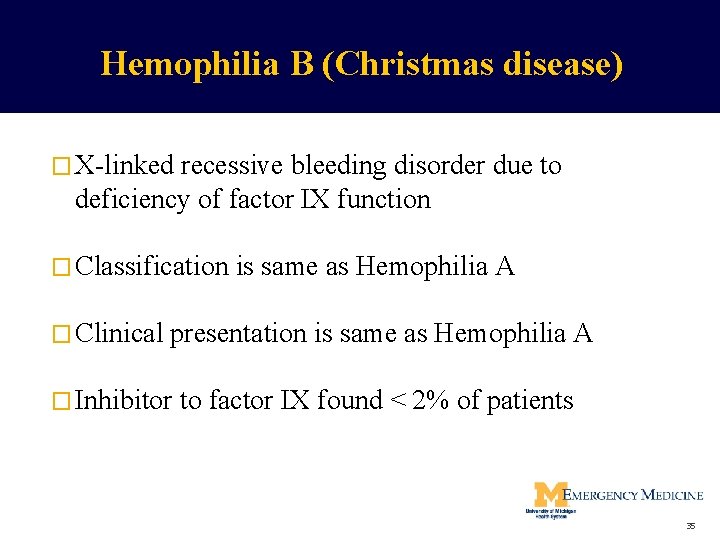
Hemophilia B (Christmas disease) � X-linked recessive bleeding disorder due to deficiency of factor IX function � Classification � Clinical is same as Hemophilia A presentation is same as Hemophilia A � Inhibitor to factor IX found < 2% of patients 35
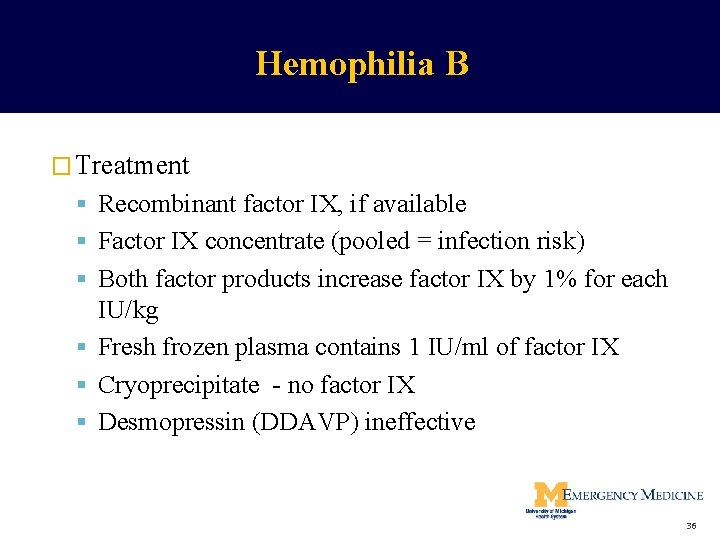
Hemophilia B � Treatment Recombinant factor IX, if available Factor IX concentrate (pooled = infection risk) Both factor products increase factor IX by 1% for each IU/kg Fresh frozen plasma contains 1 IU/ml of factor IX Cryoprecipitate - no factor IX Desmopressin (DDAVP) ineffective 36
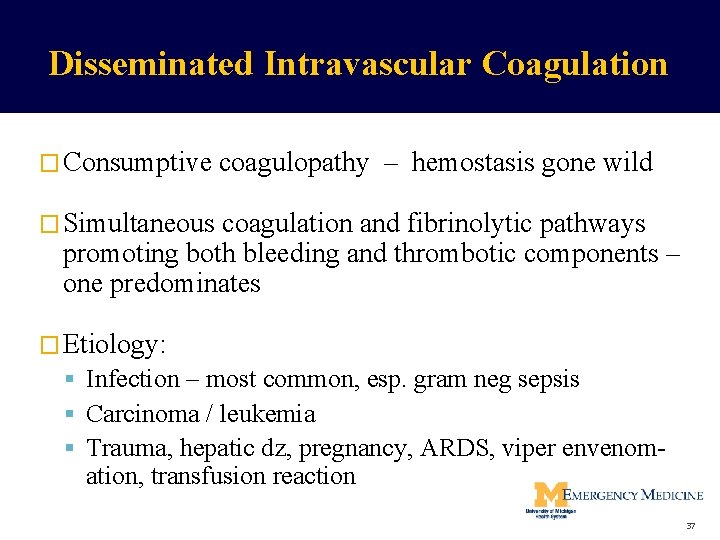
Disseminated Intravascular Coagulation � Consumptive coagulopathy – hemostasis gone wild � Simultaneous coagulation and fibrinolytic pathways promoting both bleeding and thrombotic components – one predominates � Etiology: Infection – most common, esp. gram neg sepsis Carcinoma / leukemia Trauma, hepatic dz, pregnancy, ARDS, viper envenom- ation, transfusion reaction 37
Disseminated Intravascular Coagulation � Laboratory – PT elevated, PTT often elevated Decreased platelets, fibrinogen Increased fibrin split products and d-dimer (more specific, less sensitive) Fragmented RBC’s anemia 38
Disseminated Intravascular Coagulation � Treatment Supportive aggressive resuscitation ▪ IV fluids and RBC transfusion Fresh frozen plasma to replace coagulation factors ▪ Two units at a time Cryoprecipitate for fibrinogen replacement ▪ Ten bags Platelet transfusion Heparin if thrombosis predominates ▪ Ca, leukemia, pregnancy-related Activated protein C, if septic shock 39
von Willibrand’s Disease � Most common inherited bleeding disorder � von Willibrand’s factor (v. WF) facilitates platelet adhesion to each other and to damaged endothelium Also, a carrier protein for factor VIII � Three forms of clinical presentation � Laboratory – usually normal PT and PTT; bleeding time prolonged; v. WF activity low 40
von Willibrand’s Disease � Type I Mild form = 80% of patients Mucosal bleeding – decrease in v. WF (quantitative) � Type II Mild form =10% of patients Mucosal bleeding – dysfunctional v. WF (qualitaitve) � Type III Severe form =10% of patients Bleeding episodes resemble hemophilias – no detectable v. WF 41
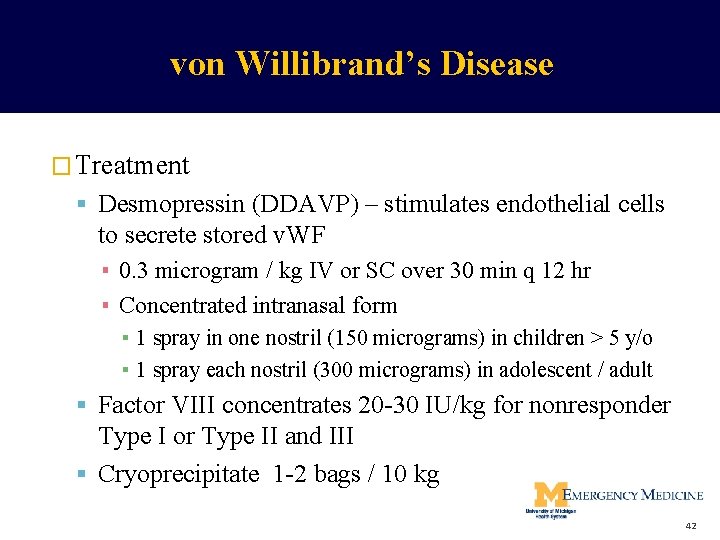
von Willibrand’s Disease � Treatment Desmopressin (DDAVP) – stimulates endothelial cells to secrete stored v. WF ▪ 0. 3 microgram / kg IV or SC over 30 min q 12 hr ▪ Concentrated intranasal form ▪ 1 spray in one nostril (150 micrograms) in children > 5 y/o ▪ 1 spray each nostril (300 micrograms) in adolescent / adult Factor VIII concentrates 20 -30 IU/kg for nonresponder Type I or Type II and III Cryoprecipitate 1 -2 bags / 10 kg 42
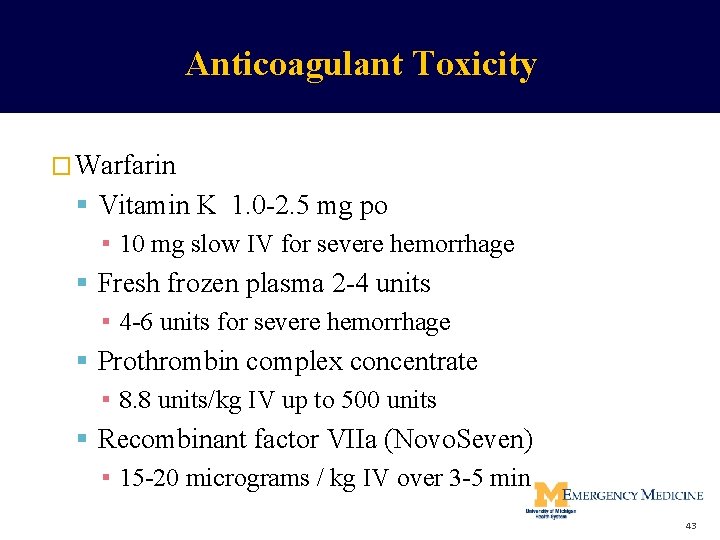
Anticoagulant Toxicity � Warfarin Vitamin K 1. 0 -2. 5 mg po ▪ 10 mg slow IV for severe hemorrhage Fresh frozen plasma 2 -4 units ▪ 4 -6 units for severe hemorrhage Prothrombin complex concentrate ▪ 8. 8 units/kg IV up to 500 units Recombinant factor VIIa (Novo. Seven) ▪ 15 -20 micrograms / kg IV over 3 -5 min 43
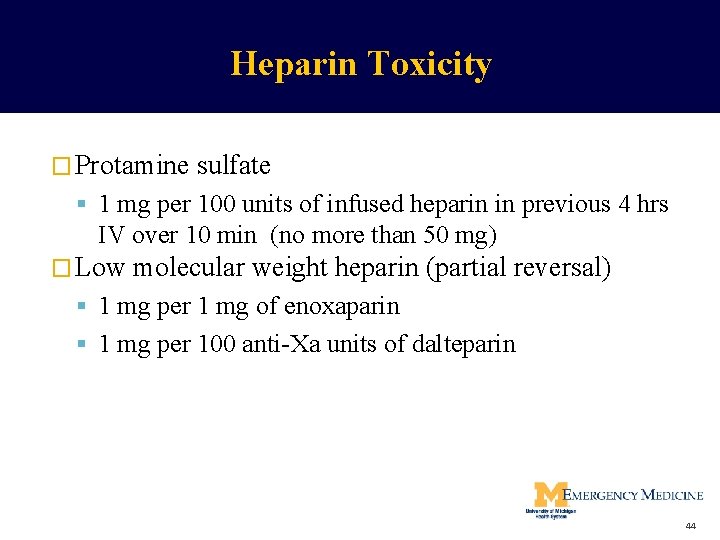
Heparin Toxicity � Protamine sulfate 1 mg per 100 units of infused heparin in previous 4 hrs IV over 10 min (no more than 50 mg) � Low molecular weight heparin (partial reversal) 1 mg per 1 mg of enoxaparin 1 mg per 100 anti-Xa units of dalteparin 44
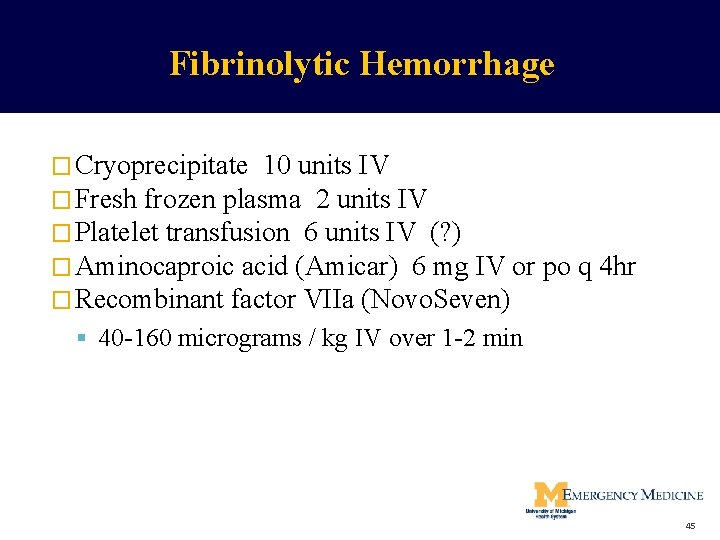
Fibrinolytic Hemorrhage � Cryoprecipitate 10 units IV � Fresh frozen plasma 2 units IV � Platelet transfusion 6 units IV (? ) � Aminocaproic acid (Amicar) 6 mg IV or � Recombinant factor VIIa (Novo. Seven) po q 4 hr 40 -160 micrograms / kg IV over 1 -2 min 45
Bleeding in Hepatic Failure � Vitamin K 10 mg SC or IV � Fresh frozen plasma 10 -25 � Platelet transfusion � Desmopressin (DDAVP) ml / kg 0. 3 microgram / kg SC or 0. 3 microgram / kg in 50 ml NS IVPB over 30 min � Cryoprecipitate if fibrinogen levels < 100 mg/dl 46
Bleeding in Renal Failure � Hemodialysis provides transient benefit to platelet function for 24 – 48 hrs � Desmopressin (DDAVP) 0. 3 micrograms / kg in 50 ml NS IVPB over 30 min � Platelet transfusion � Cryoprecipitate 47
Drug Inactivation of Platelets � ASA, NSAID’s, clopidogrel (Plavix), ticlopidine (Ticlid) All inhibit platelet aggregation � Discontinue agent � Platelet transfusion � Desmopressin (DDAVP) 0. 3 micrograms / kg in 50 ml NS IVPB over 30 min 48
- Slides: 48