
Project Ghana Emergency Medicine Collaborative Document Title Crush
Project: Ghana Emergency Medicine Collaborative Document Title: Crush Injury and Crush Syndrome Author(s): Jim Holliman (Uniformed Services University), MD 2012 License: Unless otherwise noted, this material is made available under the terms of the Creative Commons Attribution Share Alike-3. 0 License: http: //creativecommons. org/licenses/by-sa/3. 0/ We have reviewed this material in accordance with U. S. Copyright Law and have tried to maximize your ability to use, share, and adapt it. These lectures have been modified in the process of making a publicly shareable version. The citation key on the following slide provides information about how you may share and adapt this material. Copyright holders of content included in this material should contact open. michigan@umich. edu with any questions, corrections, or clarification regarding the use of content. For more information about how to cite these materials visit http: //open. umich. edu/privacy-and-terms-use. Any medical information in this material is intended to inform and educate and is not a tool for self-diagnosis or a replacement for medical evaluation, advice, diagnosis or treatment by a healthcare professional. Please speak to your physician if you have questions about your medical condition. Viewer discretion is advised: Some medical content is graphic and may not be suitable for all viewers. 1

2
Crush Injury and Crush Syndrome Jim Holliman, M. D. , F. A. C. E. P. Program Manager Afghanistan Healthcare Sector Reconstruction Project Center for Disaster and Humanitarian Assistance Medicine Professor of Military and Emergency Medicine Uniformed Services University Bethesda, Maryland, U. S. A. 3
Crush Injury and Crush Syndrome Lecture Outline ŸEpidemiology ŸPathophysiology ŸTreatment ŸControversies in management ŸPrognosis 4
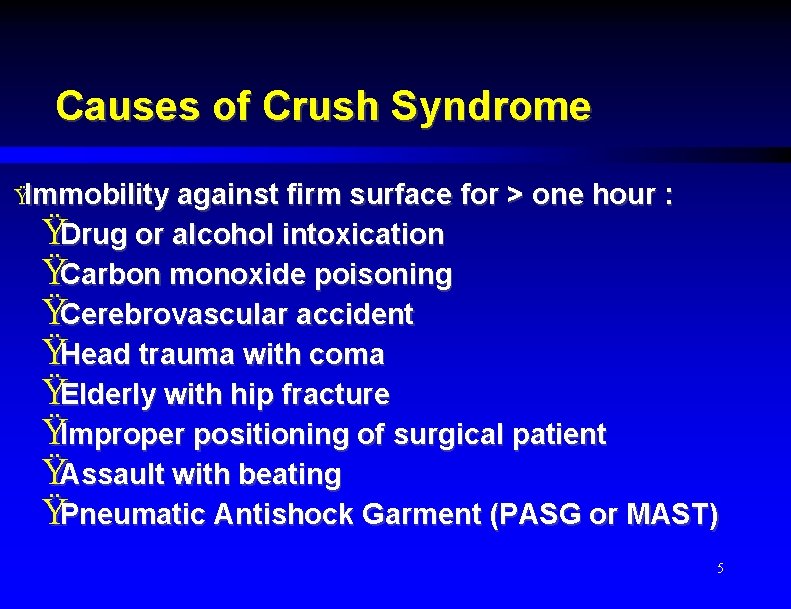
Causes of Crush Syndrome ŸImmobility against firm surface for > one hour : ŸDrug or alcohol intoxication ŸCarbon monoxide poisoning ŸCerebrovascular accident ŸHead trauma with coma ŸElderly with hip fracture ŸImproper positioning of surgical patient ŸAssault with beating ŸPneumatic Antishock Garment (PASG or MAST) 5
Causes of Mass Casualties with Crush Syndrome ŸBuilding collapse ŸEarthquakes ŸLandslides ŸBombings ŸConstruction accidents ŸHeavy snow on roof ŸMine or trench collapse 6
Crush Syndrome Official Definitions ŸFrom recent consensus meeting : Ÿ"A crush injury is a direct injury resulting from crush. Crush syndrome is the systemic manifestation of muscle cell damage resulting from pressure or crushing. " ŸBetter (mine) : ŸCrush syndrome is the clinical condition caused by compression of muscle with subsequent rhabdomyolysis which can then cause the complications of electrolyte disturbances, fluid sequestration, & myoglobinuria. ŸAnother : Ÿ"A form of traumatic rhabdomyolysis that occurs after prolonged continuous pressure & is characterized by systemic involvement". 7
Historical Reports of Crush Syndrome ŸOld Testament Book of Numbers ŸDeaths from illness involving muscle pain & weakness (rhabdomyolysis) ƒ Due to eating quail which had consumed hemlock seeds ŸLarrey (Napoleon's army surgeon) in 1812 described limb gangrene in carbon monoxide victims ŸBywaters & Beal in 1941 reported 5 patients from the London Blitz who died of renal failure ŸLater reports (both clinical & animal studies) by Bywaters identified myoglobinuria as the cause for the renal failure 8
Major Mass Casualty Events with Reports of Crush Syndrome ŸEarthquakes : ŸTangshan, China 1976 ŸArmenia 1988 ŸIran 1990 and 2003 ŸNorthridge, California 1994 ŸKobe, Japan 1995 ("Hanshin-Awaji") ŸTurkey 1992 (Izmit, "Marmara" 1999) ŸTerrorist bombings : ŸIsrael ŸLebanon ŸSaudi Arabia 9
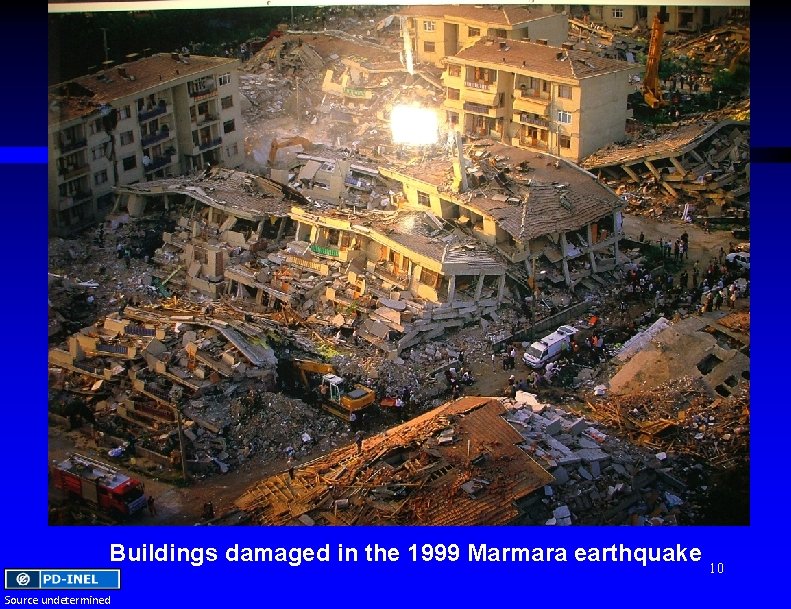
Buildings damaged in the 1999 Marmara earthquake Source undetermined 10
Incidence of Crush Syndrome in Mass Casualty Events Ÿ 10 to 60 % of survivors extricated from collapsed buildings ŸUp to half may develop renal failure ƒ At least half of these require dialysis ŸTypically about 20 % of injured are hospitalized, and 5 to 20 % of these have crush injury, and 0. 5 to 1 % end up needing dialysis ŸIncidence less in quakes where most residences are adobe or one story (Central America for example) 11
Pathophysiology of Crush Syndrome ŸNot usually directly due to ischemia ŸMain cause is stretch of the muscle sarcolemma ŸSarcolemma permeability increases ŸInflux of sodium, water, & extracellular calcium into the sarcoplasm ƒ Results in cellular swelling, increased intracellular calcium, disrupted cellular function & respiration, decreased ATP production, & subsequent myocytic death ŸMuscle swelling can then cause early or even days delayed compartment syndrome 12
Systemic Sequelae of Crush Injury ŸResult from death of muscle cells and leak of intracellular metabolites into the systemic circulation ("reperfusion injury" ŸSuperoxide anions (free radicals) then cause further membrane injury ŸMay not manifest until just after entrapped part of body is extricated 13
Metabolic Derangements from Crush Syndrome ŸHypovolemia (fluid sequestration in damaged muscle) ŸHyperkalemia ŸHypocalcemia (due to calcium deposition in muscle) ŸHyperphosphatemia ŸMetabolic acidosis ŸMyoglobinemia / myoglobinuria 14
Effects of Myoglobinuria in Crush Syndrome ŸMyoglobin can precipitate (particularly with hypovolemia and acidosis) and directly obstruct renal tubular flow ŸMyoglobin is also directly toxic to the renal tubular cells 15
Renal Toxicity of Myoglobin ŸBywaters' studies showed acid urine is required for myoglobin to cause renal injury ŸAt p. H < 5. 6, myoglobin dissociates into its 2 components : ŸGlobin (shown nontoxic if infused) ŸFerrihemate (probably the toxic component) 16
Other Clinical Syndromes with Similar Effects as Crush Syndrome ŸTumor lysis syndrome ŸHeatstroke ŸExertional rhabdomyolysis ŸHigh voltage (> 1000 volts) electrical injury 17
Field Rescue Considerations for Patients with Crush Syndrome ŸApply facemask to protect from dust inhalation ŸOxygen (if no risk of fire at the scene) ŸIf building unstable, then equipment stabilization may be needed before medical treatment can be given ŸStart IV normal saline early if possible ŸVentilate well near gas or diesel powered generators to avoid CO poisoning 18
Hyperkalemia in Crush Syndrome ŸCan occur soon after extrication ŸCan be quickly fatal ŸMay occur before manifestations of renal failure ŸMay occur without obvious signs of compartment syndrome ŸMay require emergent prehospital treatment 19
Emergent Treatment of Hyperkalemia from Crush Syndrome ŸNormal saline IV fluid bolus ŸIV Na. HCO 3 50 to 100 meq ŸAerosolized albuterol (2. 5 mg in 3 cc) ŸLess effective or practical : ŸIV dextrose (25 grams) & insulin (5 units IV) ŸPO or PR kayexalate ŸNote that IV calcium is controversial (as it may just worsen intramuscular hypercalcemia) ŸEmergent hemodialysis may be needed 20
Main Treatment for Crush Syndrome : IV Fluid Resuscitation ŸNormal saline (0. 9 %) preferred Ÿ(lactated Ringers contains 4 meq / liter of potassium, & so may worsen hyperkalemia, & also has calcium) ŸIf started early, may prevent later development of renal failure ŸBest if IV fluids can be started even prior to extrication 21
Recommended IV Fluid Infusion Rates for Crush Syndrome Ÿ 1 to 1. 5 liters per hour for young adults Ÿ 20 cc per kg per hour for children Ÿ 10 cc per kg per hour for elderly ŸInsert foley catheter as early as possible ŸTarget urine output should be > 50 cc per hour for adults, and > 2 cc per kg per hour for children ŸSome references advocate 150 to 200 cc per hour target in early phase 22
Use of IV Bicarbonate for Crush Syndrome ŸGoal is to have alkaline urine (check with p. H paper) ŸCan bolus supplement the normal saline with 50 meq (1 amp) doses ŸUp to 300 meq per 24 hours may be needed ŸOr add 3 amps (150 meq) to one liter D 5 W and infuse as first or second IV bolus 23
Use of Mannitol for Crush Syndrome ŸMay help eliminate myoglobin from the kidney & prevent renal failure ŸMay be useful to initiate diuresis in a patient who has adequate normal saline on board but whose urine output is still < 2 cc per kg per hour, or if adequate urine output is still not achieved 4 hours after treatment started 24
Mannitol Dosage for Crush Syndrome ŸMannitol 20 % solution 0. 25 grams per kg IV over 10 to 30 minutes ŸDiuresis should start in 15 to 30 minutes ŸIf urine output thereafter drops again, hypovolemia should be assumed, and only after aggressive rehydration should a second dose of mannitol be given ŸMaximum dose : 2 grams per kg per day (or 200 grams per day) 25
Contraindications to Mannitol ŸEstablished anuric renal failure ŸSevere congestive heart failure ŸThese patients may require pressors such as dopamine in order to tolerate the fluid load required for treatment, or may need early dialysis 26
Other Advantages of Mannitol for Treating Crush Syndrome ŸMay scavenge free radicals in muscle thus limiting necrosis ŸPositive inotropic effect on the heart ŸMost important : may help decompress compartment syndrome by mobilizing fluid from damaged muscle (thereby preventing need for fasciotomy) 27
Compartment Syndrome in Crush Injury ŸNormal muscle compartment pressure is < 15 mm Hg ŸPressure > 30 mm Hg produces muscle ischemia, so fasciotomy indicated if pressure is persistent above this ŸIrreversible muscle damage occurs after 6 hours, & irreversible nerve damage may occur after 4 hours of ischemia ŸPatients with higher diastolic pressure can tolerate higher tissue pressure without ischemia, so fasciotomy recommended when compartment pressure approaches 20 mm Hg below diastolic pressure ŸHowever, if patient is hypotensive, they can have significant ischemia at lower compartment pressures 28
When Should Fasciotomy be Done for Crush Injury ? ŸIn most reports of mass casualties from earthquakes, most of the fasciotomies were done more than 12 hours after the time of trauma ŸReviews of these cases showed high infection rates with increased mortality and amputations, and poor long term function ŸIsraeli experience has shown better results with not routinely performing delayed fasciotomies ŸSo fasciotomy would be indicated if the victim can be extricated and receive definitive medical care within 6 hours of injury, but not later ŸIf initial compartment pressures are normal, and delayed compartment syndrome develops, fasciotomy may be needed 29
Additional Treatments for Crush Injury ŸDon't forget oxygen suplementation (even if the patient is not hypoxemic, O 2 may help ischemic muscle) ŸDon't forget pain medications ŸAddress tetanus immunization status ŸAcetazolamide (250 mg PO tid) may help excrete bicarbonate in the urine ŸFurosemide may initiate diuresis but not favored since it makes acid urine 30
Diagnostic Testing in Patients with Crush Injury ŸEKG as early as possible to look for signs of hyperkalemia ŸHandheld fingerstick blood analyzer may be useful in the field to identify hyperkalemia early ŸRoutine labwork to obtain : ŸCBC, platelets, type and screen, electrolyte panel, BUN, creatinine, CPK, liver panel, urinalysis ŸOptional labwork : ABG, myoglobin, PTT ŸChest X-ray ŸOther radiographs, computed tomography, etc. to evaluate for other injuries 31
Monitoring the Crush Syndrome Patient ŸUrine output and urine p. H (hourly) ŸSerial electrolytes (particularly potassium) : every 6 hours initially ŸCPK, BUN, creatinine : every 8 to 12 hours ŸABG (if initially acidotic or on ventilator) : every 4 hours ŸMay need central IV line or Swan Ganz catheter for patients with cardiac or pulmonary disease ŸCompartment pressures : every 4 hours initially 32
Other Injuries in the Crush Syndrome Patient ŸHigh incidence of associated injuries ŸExtremity fractures and lacerations are most common ŸWith crush injury to trunk, can have internal abdominal injuries in addition to abdominal wall muscle compression injury ŸMay have "traumatic asphyxia" if chest compressed ŸDust inhalation common in concrete building collapse ŸFires common with earthquakes, so may have burns, smoke inhalation, and CO poisoning ŸHypothermia or hyperthermia 33
Mortality Related to Crush Syndrome ŸIn earthquakes, most of on scene deaths are due to direct head and trunk trauma ŸOf those extricated, mortality reports vary widely (zero to 60 %) ŸMortality increases with : ŸAge > 50, prior chronic illness ŸDuration of entrapment (almost no survivors after 5 days) 34
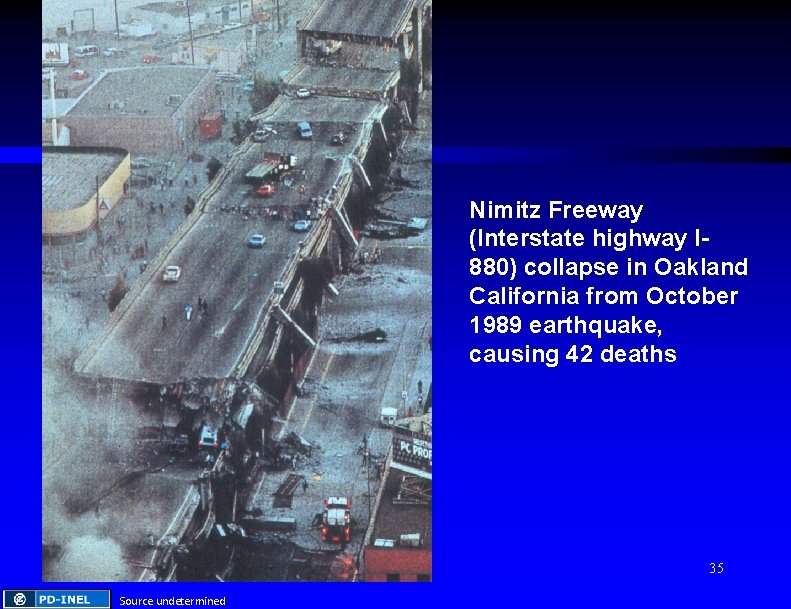
Nimitz Freeway (Interstate highway I 880) collapse in Oakland California from October 1989 earthquake, causing 42 deaths 35 Source undetermined
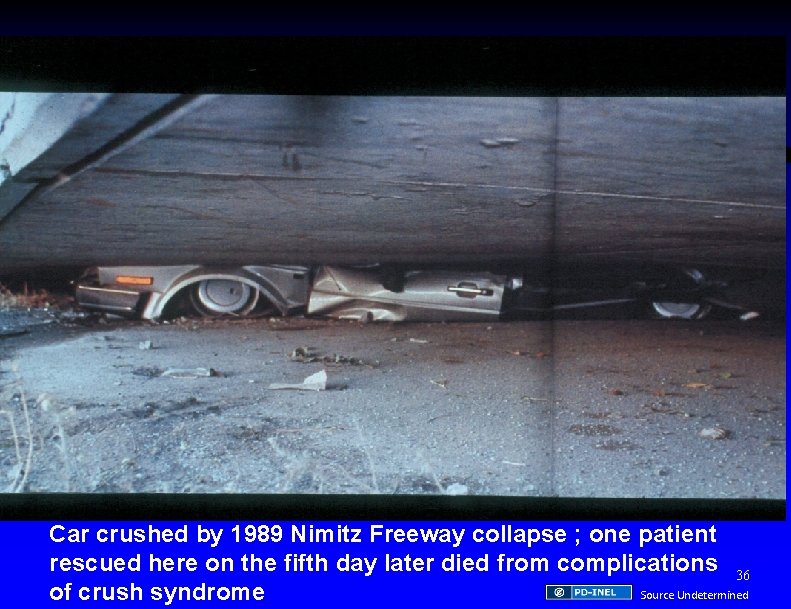
Car crushed by 1989 Nimitz Freeway collapse ; one patient rescued here on the fifth day later died from complications 36 Source Undetermined of crush syndrome
Prognosis Related to Crush Syndrome ŸMajor risk factors for renal failure : Ÿ 2 or more limbs crushed ŸInsufficient early IV fluid ŸDelayed in presentation to hospital ŸChildren at lesser risk to need dialysis Ÿ 50 % or more may have severe long term limb disability if fasciotomy done ŸPatients often need long term physical therapy and may need counseling 37
Disaster Planning Aspects Related to Crush Syndrome ŸNeed to have access to increased number of hemodialysis machines ŸThe Renal Disaster Relief Task Force of the International Society of Nephrology has been organized to bring multiple machines to a disaster region ŸPrehospital personnel need to be supplied with extra facemasks and respirators ŸPrehospital personnel will need access to large amounts of IV fluid and amps of bicarbonate 38
Crush Syndrome Lecture Summary ŸStart IV fluids prior to extrication if possible ŸAssess quickly for hyperkalemia and associated injuries ŸIf extrication > 6 hours after injury, do not perform fasciotomy for compartment syndrome ŸPerform careful monitoring after admission to hospital 39
- Slides: 39