
Project Ghana Emergency Medicine Collaborative Document Title Bursitis
Project: Ghana Emergency Medicine Collaborative Document Title: Bursitis, Tendonitis, Fibromyalgia, and RSD Author(s): Joe Lex, MD, 2013 (Temple University School of Medicine) License: Unless otherwise noted, this material is made available under the terms of the Creative Commons Attribution Share Alike-3. 0 License: http: //creativecommons. org/licenses/by-sa/3. 0/ We have reviewed this material in accordance with U. S. Copyright Law and have tried to maximize your ability to use, share, and adapt it. These lectures have been modified in the process of making a publicly shareable version. The citation key on the following slide provides information about how you may share and adapt this material. Copyright holders of content included in this material should contact open. michigan@umich. edu with any questions, corrections, or clarification regarding the use of content. For more information about how to cite these materials visit http: //open. umich. edu/privacy-and-terms-use. Any medical information in this material is intended to inform and educate and is not a tool for self-diagnosis or a replacement for medical evaluation, advice, diagnosis or treatment by a healthcare professional. Please speak to your physician if you have questions about your medical condition. Viewer discretion is advised: Some medical content is graphic and may not be suitable for all viewers. 1
Attribution Key for more information see: http: //open. umich. edu/wiki/Attribution. Policy Use + Share + Adapt { Content the copyright holder, author, or law permits you to use, share and adapt. } Public Domain – Government: Works that are produced by the U. S. Government. (17 USC § 105) Public Domain – Expired: Works that are no longer protected due to an expired copyright term. Public Domain – Self Dedicated: Works that a copyright holder has dedicated to the public domain. Creative Commons – Zero Waiver Creative Commons – Attribution License Creative Commons – Attribution Share Alike License Creative Commons – Attribution Noncommercial Share Alike License GNU – Free Documentation License Make Your Own Assessment { Content Open. Michigan believes can be used, shared, and adapted because it is ineligible for copyright. } Public Domain – Ineligible: Works that are ineligible for copyright protection in the U. S. (17 USC § 102(b)) *laws in your jurisdiction may differ { Content Open. Michigan has used under a Fair Use determination. } Fair Use: Use of works that is determined to be Fair consistent with the U. S. Copyright Act. (17 USC § 107) *laws in your jurisdiction may differ Our determination DOES NOT mean that all uses of this 3 rd-party content are Fair Uses and we DO NOT guarantee that your use of the content is Fair. 2 To use this content you should do your own independent analysis to determine whether or not your use will be Fair.
Bursitis, Tendonitis, Fibromyalgia, and RSD Joe Lex, MD, FAAEM Temple University School of Medicine Philadelphia, PA 3 Emergency Medicine
Objectives 1. Explain how bursitis and tendonitis are similar 2. Explain how bursitis and tendonitis differ from another 3. List phases in development and healing of bursitis and tendonitis 4 Emergency Medicine
Objectives 4. List common types of bursitis and tendonitis found at the: u Shoulder u. Hip u Elbow u. Knee u Wrist u. Ankle 5. List indications / contraindications for injection therapy of bursitis and tendonitis 5 Emergency Medicine
Objectives 6. Describe typical findings in a patient with fibromyalgia 7. Describe typical findings in a patient with reflex sympathetic dystrophy 6 Emergency Medicine
Sports u. Society more athletic u. Physical activity health benefits u. Overuse syndromes increase u 25% to 50% of participants will experience tendonitis or bursitis 7 Emergency Medicine
Workplace Musculoskeletal disorders from… …repetitive motions …localized contact stress …awkward positions …vibrations …forceful exertions u. Ergonomic design incidence 8 Emergency Medicine
Bursae u. Closed, round, flat sacs u. Lined by synovium u. May or may not communicate with synovial cavity u. Occur at areas of friction between skin and underlying ligaments / bone 9 Emergency Medicine
Bursae u. Permit lubricated movement over areas of potential impingement u. Many are nameless u~78 on each side of body u. New bursae may form anywhere from frequent irritation 10 Emergency Medicine
Bursitis Inflamed by… …chronic friction …trauma …crystal deposition …infection …systemic disease: rheumatoid arthritis, psoriatic arthritis, gout ankylosing spondylitis 11 Emergency Medicine

Bursitis u. Inflammation causes bursal synovial cells to thicken u. Excess fluid accumulates inside and around affected bursae Bemoeial (Wikipedia) 12 Emergency Medicine
Tendons u. Tendon sheaths composed of same synovial cells as bursae u. Inflamed in similar manner u. Tendonitis: inflammation of tendon only u. Tenosynovitis: inflammation of tendon plus its sheath 13 Emergency Medicine
Tendons u. Inflammatory changes involving sheath well documented u. Inflammatory lesions of tendon alone not well documented u. Distinction uncertain: terms tendonitis and tenosynovitis used interchangeably 14 Emergency Medicine
Tendons u. Most overuse syndromes are NOT inflammatory u. Biopsy: no inflammatory cells u. High glutamate concentrations u. NSAIDs / steroids: no advantage u. Tendon. ITIS a misnomer 15 Emergency Medicine
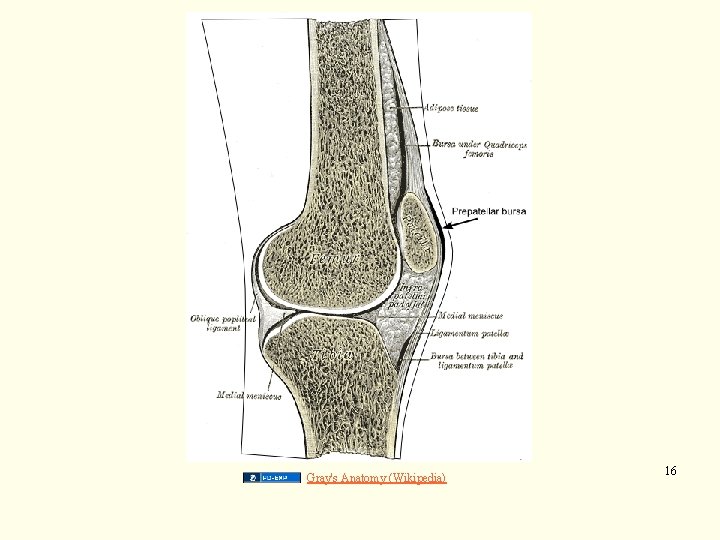
Gray's Anatomy (Wikipedia) 16
Bursitis / Tendonitis u. Most common causes: mechanical overload and repetitive microtrauma u. Most injuries multifactorial 17 Emergency Medicine
Bursitis / Tendonitis u. Intrinsic factors: malalignment, poor muscle flexibility, muscle weakness or imbalance u. Extrinsic factors: design of equipment or workplace and excessive duration, frequency, or intensity of activity 18 Emergency Medicine
Immediate Phase u. Release of chemotactic and vasoactive chemical mediators u. Vasodilation and cellular edema u PMNs perpetuate process u. Lasts 48 hours to 2 weeks u. Repetitive insults prolong inflammatory stage 19 Emergency Medicine
Healing Phase u. Classic inflammatory signs: pain, warmth, erythema, swelling u. Healing goes through proliferative and maturation u 6 to 12 weeks: organization and collagen cross-linking mature to preinjury strength 20 Emergency Medicine
History u. Changes in sports activity, work activities, or workplace u. Cause not always found u. Pregnancy, quinolone therapy, connective tissue disorders, systemic illness 21 Emergency Medicine
History u. Most common complaint: PAIN u. Acute or chronic u. Frequently more severe after periods of rest u. May resolve quickly after initial movement only to become throbbing pain after exercise 22 Emergency Medicine
Articular vs. Periarticular In joint capsule u Joint pain / warmth / swelling u Worse with active & passive movement u All parts of joint involved Periarticular u Pain not uniform across joint u Pain only certain movements u Pain character & radiation vary 23 Emergency Medicine
Physical Exam u. Careful palpation u. Range of motion u. Heat, warmth, redness 24 Emergency Medicine
Lab Studies u. Screening tests: CBC, CRP, ESR u. Chronic rheumatic disease: mild anemia u. Rheumatoid factor, antinuclear antibody, antistreptolysin O titers, and Lyme serologies for follow-up u. Serum uric acid: not helpful 25 Emergency Medicine
Synovial Fluid u. Especially crystalline, suppurative etiology u. Appearance, cell count and diff, crystal analysis, Gram’s stain – Positive Gram’s: diagnostic – Negative Gram’s: cannot rule out 26 Emergency Medicine
Management u. Rest u. Pain relief: meds, heat, cold u. No advantage to NSAIDs u. Exceptions: olecranon bursitis and prepatellar bursitis have a moderate risk of being infected (Staphylococcus aureus) 27 Emergency Medicine
Management u. Shoulder: immobilize few days – Risk of adhesive capsulitis u. Lateral epicondylitis: forearm brace u. Olecranon bursitis: compression dressing 28 Emergency Medicine
Management u. De Quervain’s: splint wrist and thumb in 20 o dorsiflexion u. Achilles tendonitis: heel lift or splint in slight plantar flexion 29 Emergency Medicine
Local Injection 30 Emergency Medicine
Local Injection u. Lidocaine or steroid injection can overcome refractory pain u. Steroids universally given, often with great success u. No good prospective data to support or refute therapeutic benefit 31 Emergency Medicine
Local Injection u. Short course of oral steroid may produce statistically similar results u. Primary goal of steroid injection: relieve pain so patient can participate in physical rehab 32 Emergency Medicine
Local Injection u. Adjunct to other modalities: pain control, PT, exercise, OT, relative rest, immobilization u. Additional pain control: NSAIDs, acupuncture, ultrasound, ice, heat, electrical nerve stimulation 33 Emergency Medicine
Local Injection u. Analgesics + exercise: better results than exercise alone u. Eliminate provoking factors u. Avoid repeat steroid injection unless good prior response u. Wait at least 6 weeks between injections in same site 34 Emergency Medicine
Indications Diagnosis u. Obtain fluid for analysis u. Eliminate referred pain Therapy u. Give pain relief u. Deliver therapeutic agents 35 Emergency Medicine
Contraindication: Absolute u. Bacteremia u. Infectious arthritis u. Periarticular cellulitis u. Adjacent osteomyelitis u. Significant bleeding disorder u. Hypersensitivity to steroid u. Osteochondral fracture 36 Emergency Medicine
Contraindication: Relative u Violation of skin integrity u Chronic local infection u Anticoagulant use u Poorly controlled diabetes u Internal joint derangement u Hemarthrosis u Preexisting tendon injury u Partial tendon rupture 37 Emergency Medicine
Preparations u. Local anesthetic u. Hydrocortisone / corticosteroid u. Rapid anti-inflammatory effect u. Categorized by solubility and relative potency u. High solubility short duration – Absorbed, dispersed more rapidly 38 Emergency Medicine
Preparations u. Triamcinolone hexacetonide: least soluble, longest duration – Potential for subcutaneous atrophy – Intra-articular injections only u. Methylprednisolone acetate (Depo. Medrol®): reasonable first choice for most ED indications 39 Emergency Medicine
Dosage u. Large bursa: subacromial, olecranon, trochanteric: 40 – 60 mg methylprednisolone u. Medium or wrist, knee, heel ganglion: 10 – 20 mg u. Tendon sheath: de Quervain, flexor tenosynovitis: 5 – 15 mg 40 Emergency Medicine
Site Preparation u. Use careful aseptic technique u. Mark landmarks with skin pencil, tincture of iodine, or thimerosal (Merthiolate®) (sterile Q-tip) u. Clean point of entry: povidoneiodine (Betadine®) and alcohol u. Do not need sterile drapes 41 Emergency Medicine
Technique u. Make skin wheal: 1% lidocaine or 0. 25% bupivacaine OR… …use topical vapocoolant: e. g. , Fluori-Methane® u. Use Z-tract technique: limits risk of soft tissue fistula u. Agitate syringe prior to injection: steroid can precipitate or layer 42 Emergency Medicine
Complications: Acute u. Reaction to anesthetic: rare – Treat as in standard textbooks u. Accidental IV injection u. Vagal reaction: have patient flat u. Nerve injury: pain, paresthesias u. Post injection flare: starts in hours, gone in days (~2%) 43 Emergency Medicine
Complications: Delayed u. Localized subcutaneous or cutaneous atrophy at injection site u. Small depression in skin with depigmentation, transparency, and occasional telangiectasia – Evident in 6 weeks to 3 months – Usually resolve within 6 months – Can be permanent 44 Emergency Medicine
Complications: Delayed u. Tendon rupture: low risk (<1%) u. Dose-related u. Related to direct tendon injection? u. Limit injections to no more than once every 3 to 4 months u. Avoid major stress-bearing tendons: Achilles, patellar 45 Emergency Medicine
Complications: Delayed u. Systemic absorption slower than with oral steroids u. Can suppress hypopituitaryadrenal axis for 2 to 7 days u. Can exacerbate hyperglycemia in diabetes u. Abnormal uterine bleeding reported 46 Emergency Medicine

Some specific entities… 47 Emergency Medicine
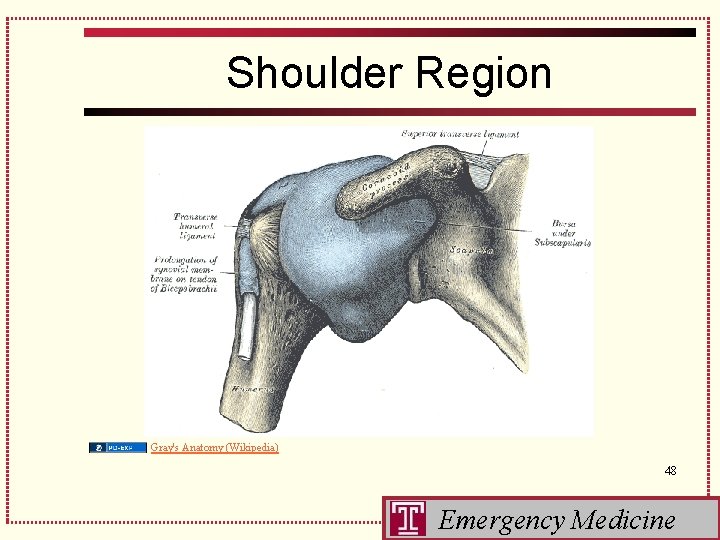
Shoulder Region Gray's Anatomy (Wikipedia) 48 Emergency Medicine
Shoulder Region “Bursitis of the shoulder” • Supraspinatus tendon and subdeltoid bursa “Bicipital tendonitis” • Tendon of long head of biceps 49 Emergency Medicine
Bicipital Tendonitis u. Risk: repeatedly flex elbow against resistance: weightlifter, swimmer u. Tendon goes through bicipital (intertubercular) groove u. Pain with elbow at 90° flexion, arm internally / externally rotated 50 Emergency Medicine
Bicipital Tendonitis u. Range of motion: normal or restricted u. Strength: normal u. Tenderness: bicipital groove u. Pain: elevate shoulder, reach hip pocket, pull a back zipper 51 Emergency Medicine
Bicipital Tendonitis u. Lipman test: "rolling" bicipital tendon produces localized tenderness u. Yergason test: pain along bicipital groove when patient attempts supination of forearm against resistance, holding elbow flexed at 90° against side of body 52 Emergency Medicine
Calcific Tendonitis Supraspinatus Tendonitis Subacromial Bursitis u. Calcific (calcareous) tendonitis: hydroxyapatite deposits in one or more rotator cuff tendons – Commonly supraspinatus u. Sometimes rupture into adjacent subacromial bursa u. Acute deltoid pain, tenderness 53 Emergency Medicine
Calcific Tendonitis 54
Calcific Tendonitis Supraspinatus Tendonitis Subacromial Bursitis u. Clinically similar: difficult to differentiate u. Rotator cuff: teres minor, supraspinatus, infraspinatus, subscapularis – Insert as conjoined tendon into greater tuberosity of humerus 55 Emergency Medicine
Calcific Tendonitis Supraspinatus Tendonitis Subacromial Bursitis Jobe’s sign, AKA “empty can test” u. Abduct arm to 90 o in the scapular plane, then internally rotate arms to thumbs pointed downward u. Place downward force on arms: weakness or pain if supraspinatus 56 Emergency Medicine
Calcific Tendonitis Supraspinatus Tendonitis Subacromial Bursitis u. Other tests: Neer, Hawkins u. Passively abduct arm to 90°, then passively lower arm to 0° and ask patient to actively abduct arm to 30° 57 Emergency Medicine
Calcific Tendonitis Supraspinatus Tendonitis Subacromial Bursitis u. If can abduct to 30° but no further, suspect deltoid u. If cannot get to 30°, but if placed at 30° can actively abduct arm further, suspect supraspinatus u. If uses hip to propel arm from 0° to beyond 30°, suspect supraspinatus 58 Emergency Medicine
Calcific Tendonitis Supraspinatus Tendonitis Subacromial Bursitis u. Subacromial bursa: superior and lateral to supraspinatus tendon u. Tendon and bursa in space between acromion process and head of humerus u. Prone to impingement 59 Emergency Medicine
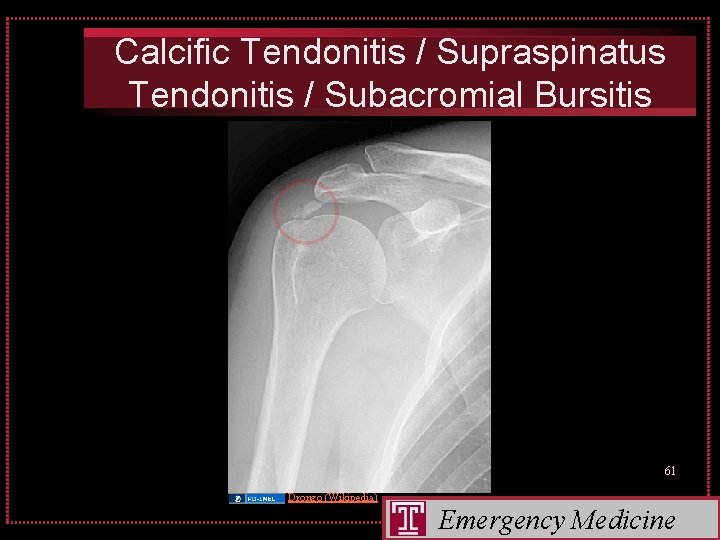
Calcific Tendonitis / Supraspinatus Tendonitis / Subacromial Bursitis u. Patient holds arm protectively against chest wall u. May be incapacitating u. All ROM disturbed, but internal rotation markedly limited u. Diffuse perihumeral tenderness u. X-ray: hazy shadow 60 Emergency Medicine
Calcific Tendonitis / Supraspinatus Tendonitis / Subacromial Bursitis 61 Drongo (Wikipedia) Emergency Medicine
Rotator Cuff Tear Nucleus Communications (Wikimedia Commons) 62 Emergency Medicine
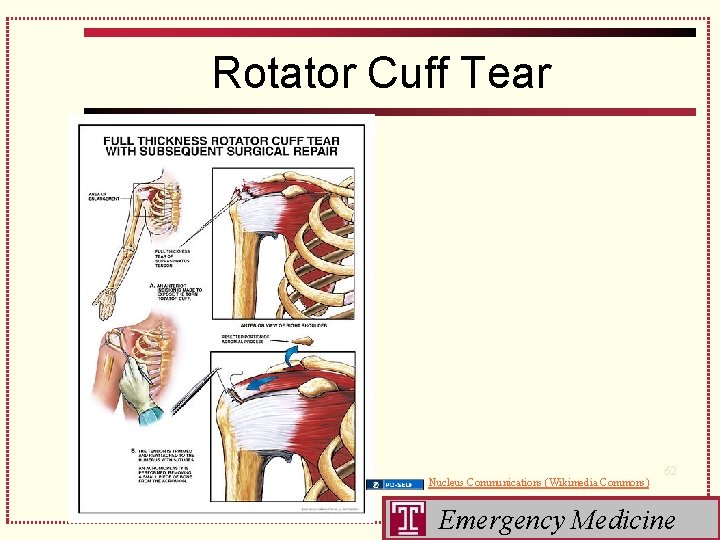
Rotator Cuff Tear u. Drop arm test: arm passively abducted at 90 o, patient asked to maintain dropped arm represents large rotator cuff tear u. Shrug sign: attempt to abduct arm results in shrug only 63 Emergency Medicine
Elbow and Wrist • “Student’s elbow” Olecranon bursa • “Tennis Elbow” Extendor tendons posteriorly at ischial tuberosity • De Quervain’s tenosynovitis Tendons of extensor pollicis brevis and abductor pollicis longus • “Acute tendonitis of the wrist” Flexor carpi ulnaris and other wrist flexor tendons 64 Emergency Medicine
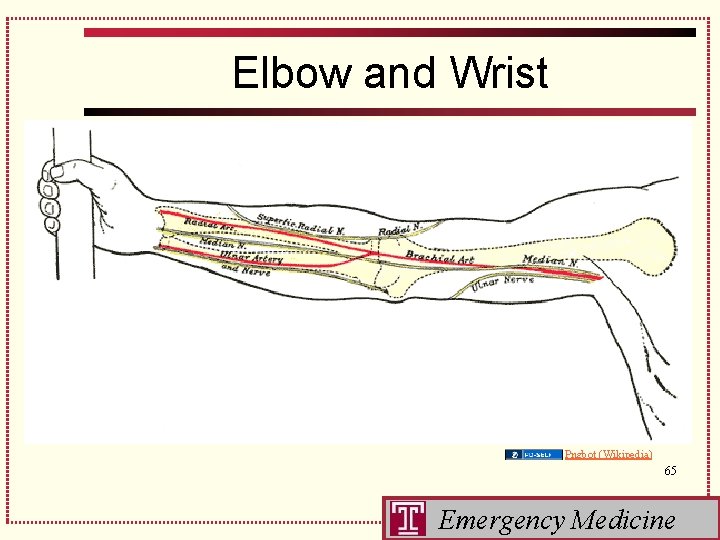
Elbow and Wrist Pngbot (Wikipedia) 65 Emergency Medicine
Lateral Epicondylitis u. Pain at insertion of extensor carpi radialis and extensor digitorum muscles u. Radiohumeral bursitis: tender over radiohumeral groove u. Tennis elbow: tender over lateral epicondyle 66 Emergency Medicine
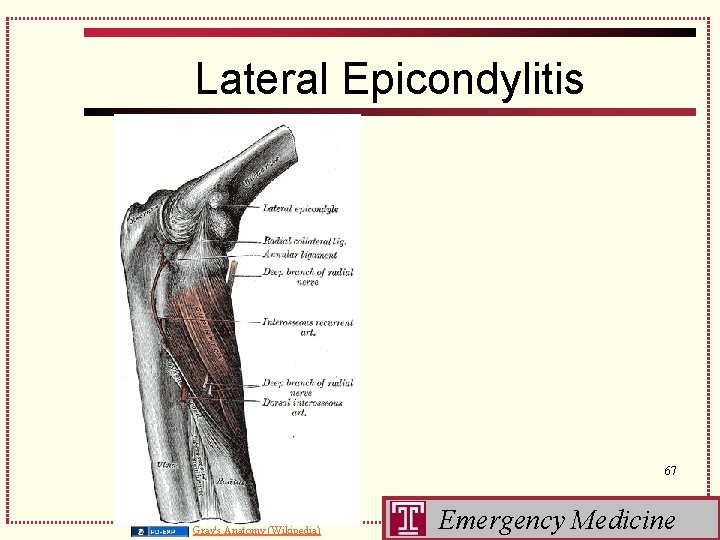
Lateral Epicondylitis 67 Gray's Anatomy (Wikipedia) Emergency Medicine
Lateral Epicondylitis u. History repetitive overhead motion: golfing, gardening, using tools u. Worse when middle finger extended against resistance with wrist and the elbow in extension u. Worse when wrist extended against resistance 68 Emergency Medicine
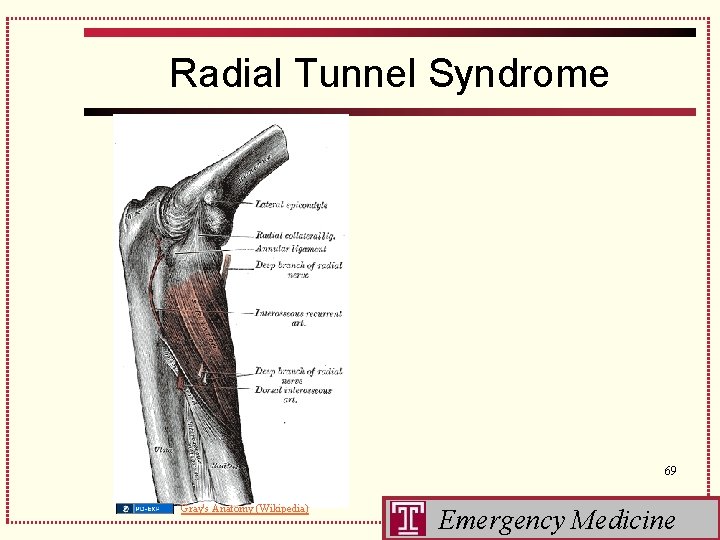
Radial Tunnel Syndrome 69 Gray's Anatomy (Wikipedia) Emergency Medicine
Medial Epicondylitis u“Golfer's elbow” or “pitcher’s elbow” similar u. Much less common u. Worse when wrist flexed against resistance u. Tender medial epicondyle 70 Emergency Medicine
Cubital Tunnel Syndrome u. Ulnar nerve passes through cubital tunnel just behind ulnar elbow u. Numbness and pain small and ring fingers u. Initial treatment: rest, splint 71 Emergency Medicine
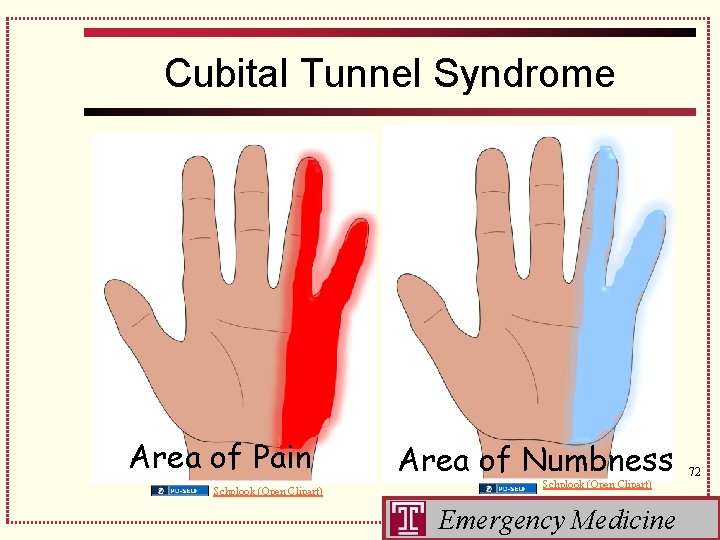
Cubital Tunnel Syndrome Area of Pain Schplook (Open Clipart) Area of Numbness Schplook (Open Clipart) Emergency Medicine 72
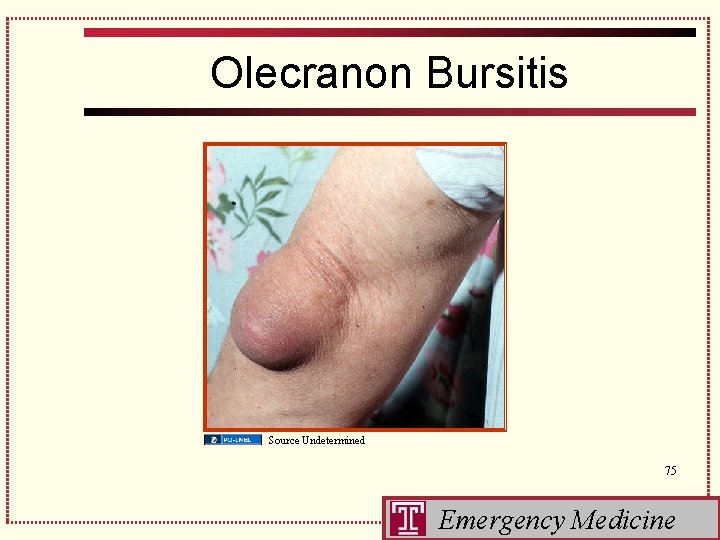
Olecranon Bursitis u“Student's” or “barfly elbow” u. Most frequent site of septic bursitis u. Aseptic: motion at elbow joint complete and painless u. Septic: all motion usually painful 73 Emergency Medicine
Olecranon Bursitis Aseptic olecranon bursitis u. Cosmetically bothersome, usually resolves spontaneously u. If bothersome, aspiration and steroid injection speed resolution u. Oral NSAID after steroid injection does not affect outcome 74 Emergency Medicine
Olecranon Bursitis Source Undetermined 75 Emergency Medicine
Septic Olecranon Bursitis u. Most common septic bursitis: olecranon and prepatellar u 2 o to acute trauma / skin breakage u. Impossible to differentiate acute gouty olecranon bursitis from septic bursitis without laboratory analysis 76 Emergency Medicine
77 Arcadian (Wikimedia Commons)
Ganglion Cysts u. Swelling on dorsal wrist u~60% of wrist and hand soft tissue tumors u. Etiology obscure u. Lined with mesothelium or synovium u. Arise from tendon sheaths or near joint capsule 78 Emergency Medicine
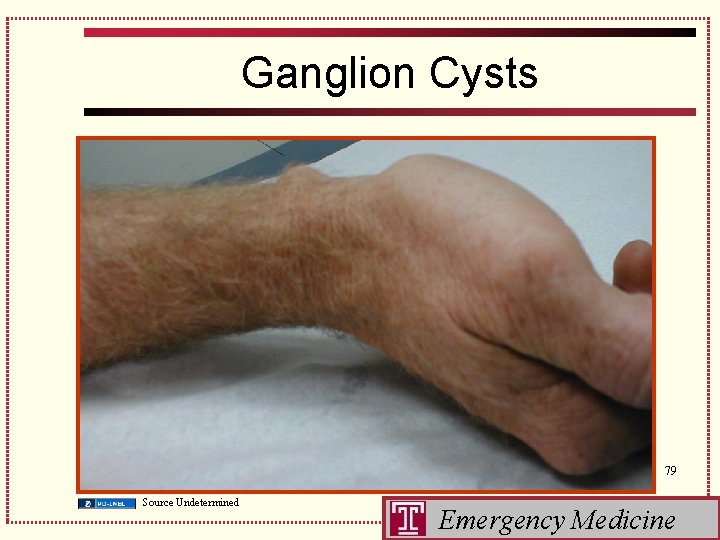
Ganglion Cysts 79 Source Undetermined Emergency Medicine
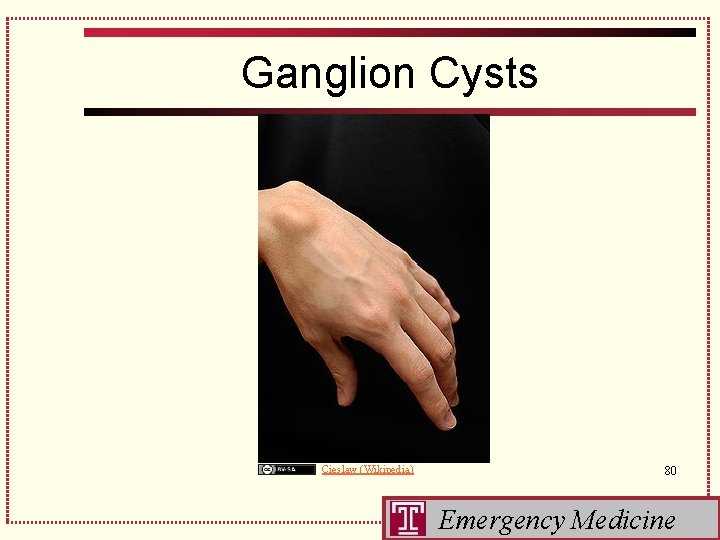
Ganglion Cysts Cieslaw (Wikipedia) 80 Emergency Medicine
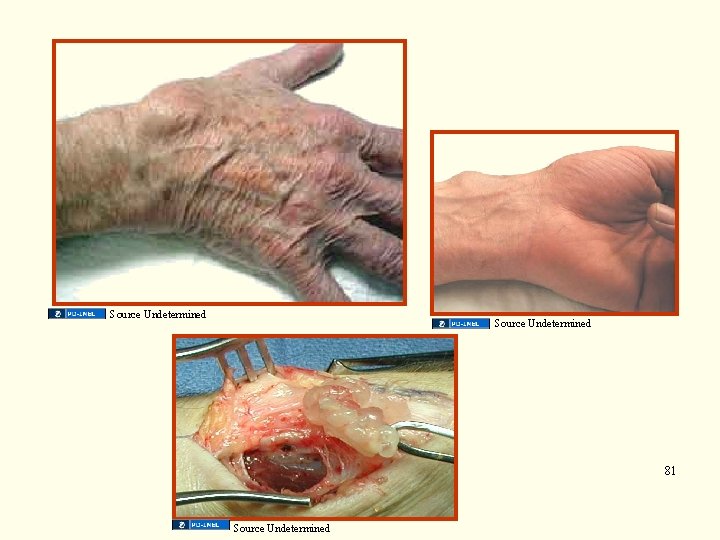
Source Undetermined 81 Source Undetermined
Carpal Tunnel Syndrome u. Median nerve compression in fibroosseous tunnel of wrist u. Pain at wrist that sometimes radiates upward into forearm u. Associated with tingling and paresthesias of palmar side of index and middle fingers and radial half of the ring finger 82 Emergency Medicine
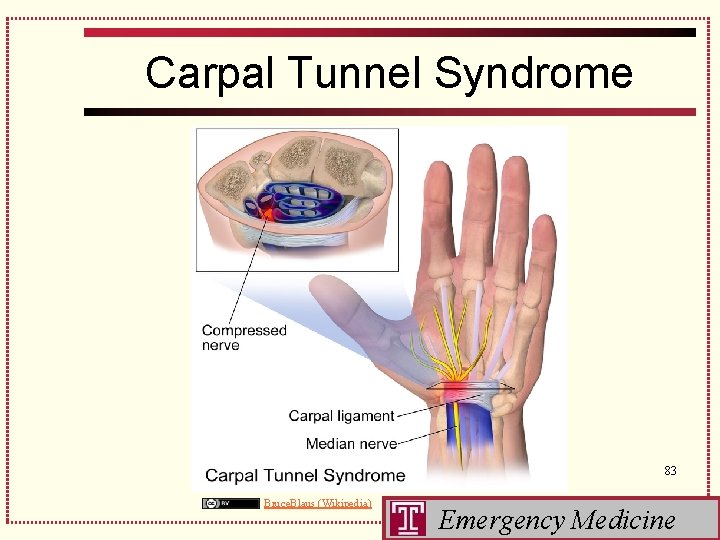
Carpal Tunnel Syndrome 83 Bruce. Blaus (Wikipedia) Emergency Medicine
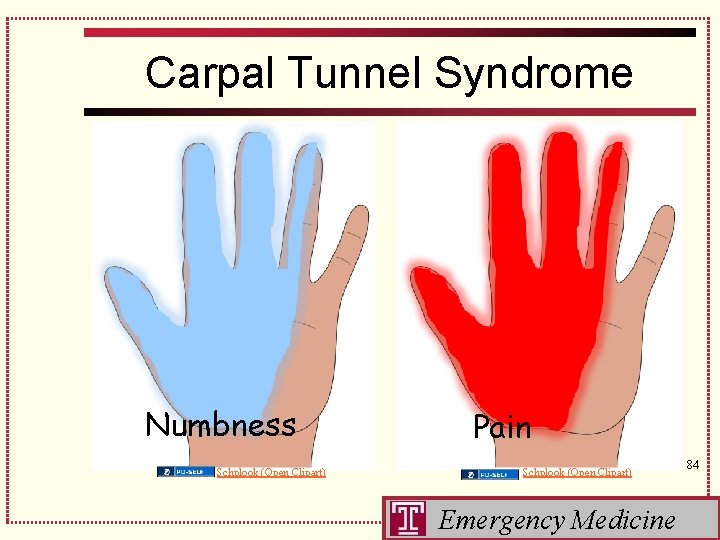
Carpal Tunnel Syndrome Numbness Schplook (Open Clipart) Pain Schplook (Open Clipart) Emergency Medicine 84
Carpal Tunnel Syndrome u. Patient wakes during night with burning or aching pain, numbness, and tingling u. Positive Tinel sign: reproduce tingling and paresthesias by tapping over median nerve at volar crease of wrist 85 Emergency Medicine
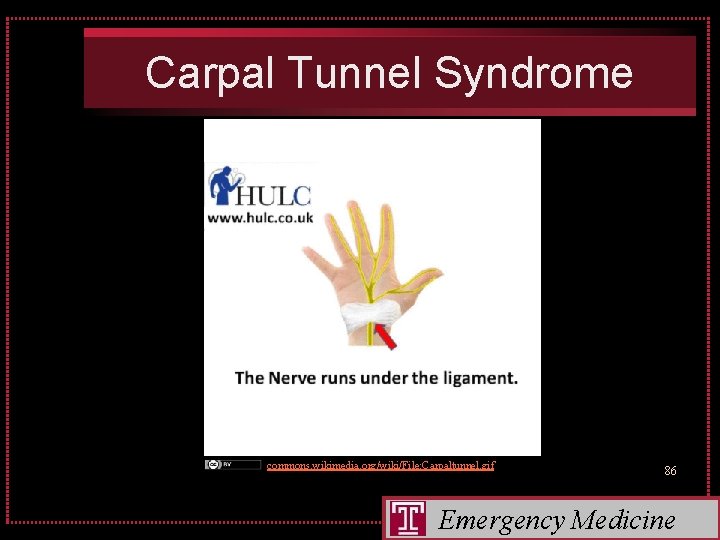
Carpal Tunnel Syndrome commons. wikimedia. org/wiki/File: Carpaltunnel. gif 86 Emergency Medicine
Carpal Tunnel Syndrome u. Positive Phalen test: flexed wrists held against each other for several minutes in effort to provoke symptoms in median nerve distribution 87 Emergency Medicine
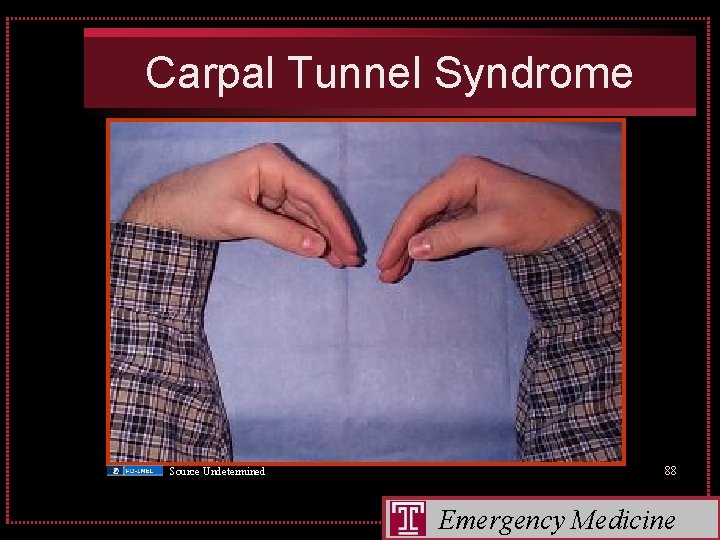
Carpal Tunnel Syndrome Source Undetermined 88 Emergency Medicine
Carpal Tunnel Syndrome u. May be idiopathic u. Known causes: rheumatoid arthritis pregnancy, diabetes, hypothyroidism, acromegaly 89 Emergency Medicine
Carpal Tunnel Syndrome u. Insert needle just radial or ulnar to palmaris longus and proximal to distal wrist crease u. Ulnar preferred: avoids nerve u. Direct needle at 60° to skin surface, point toward tip of middle finger 90 Emergency Medicine
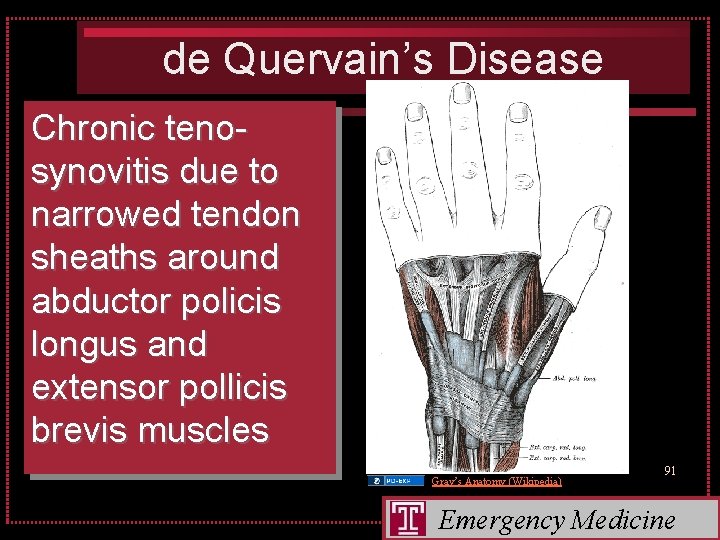
de Quervain’s Disease Chronic tenosynovitis due to narrowed tendon sheaths around abductor policis longus and extensor pollicis brevis muscles Gray’s Anatomy (Wikipedia) 91 Emergency Medicine
de Quervain’s Disease u 1 st dorsal compartment u. Radial border of anatomic snuffbox u 1 st compartment may cross over 2 nd compartment (ECRL/B) proximal to extensor retinaculum u. Steroid injections relieve most symptoms 92 Emergency Medicine
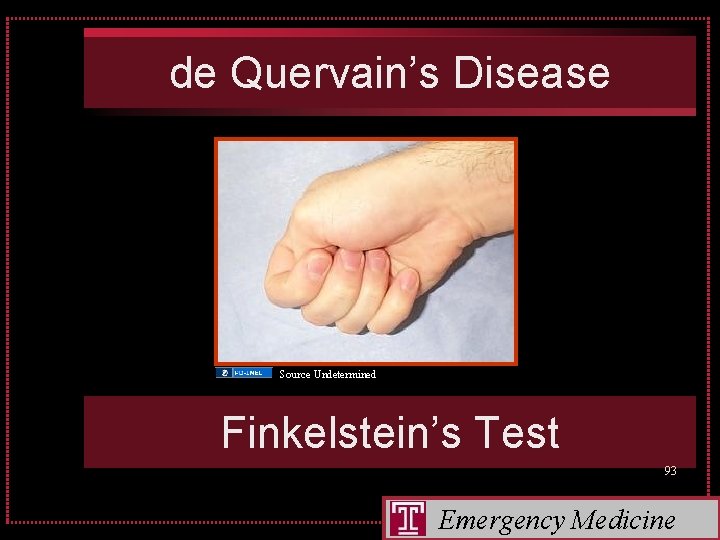
de Quervain’s Disease Source Undetermined Finkelstein’s Test 93 Emergency Medicine
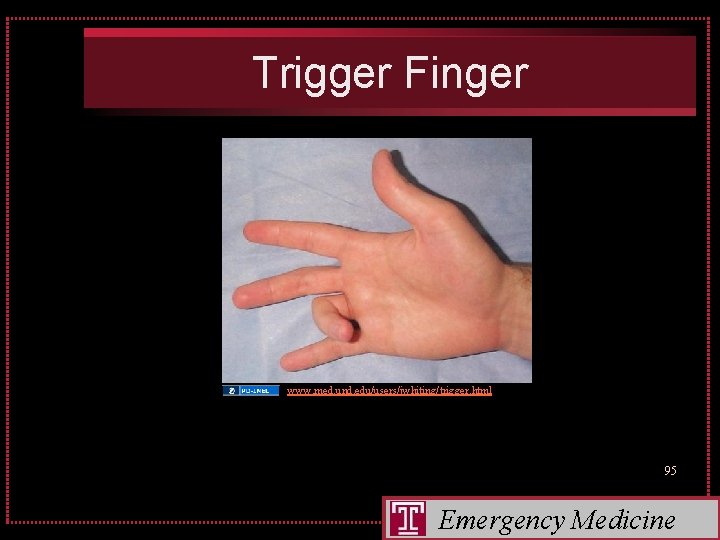
Trigger Finger u. Digital flexor tenosynovitis u. Stenosed tendon sheath – Palmar surface over MC head u. Intermittent tendon “catch” u“Locks” on awakening u. Most frequent: ring and middle 94 Emergency Medicine
Trigger Finger www. med. und. edu/users/jwhiting/trigger. html 95 Emergency Medicine
Trigger Finger u. Tendon sheath walls lined with synovial cells u. Tendon unable to glide within sheath u. Initial treatment: splint, moist heat, NSAID u. Steroid for recalcitrant cases 96 Emergency Medicine
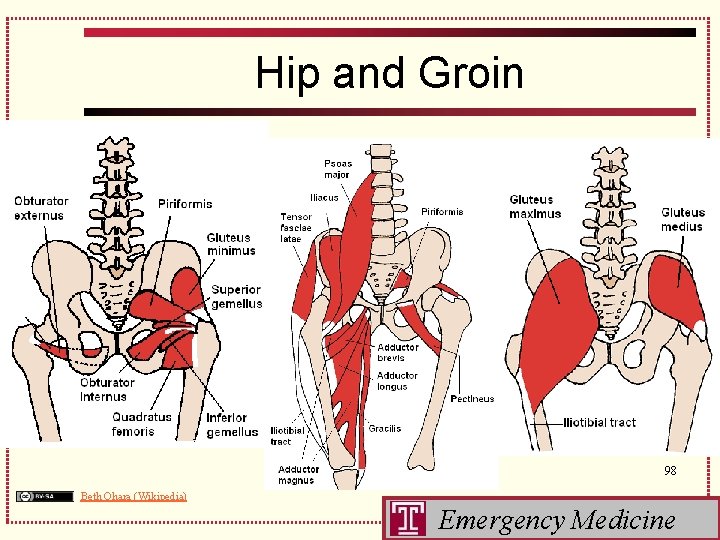
Hip and Groin • “ischial bursitis” Located medial to the sciatic nerve • “trochanteric bursitis” Gluteus medius and minimus tendons • “iliopectineal bursitis” Located lateral to femoral vessels 97 Emergency Medicine
Hip and Groin 98 Beth Ohara (Wikipedia) Emergency Medicine
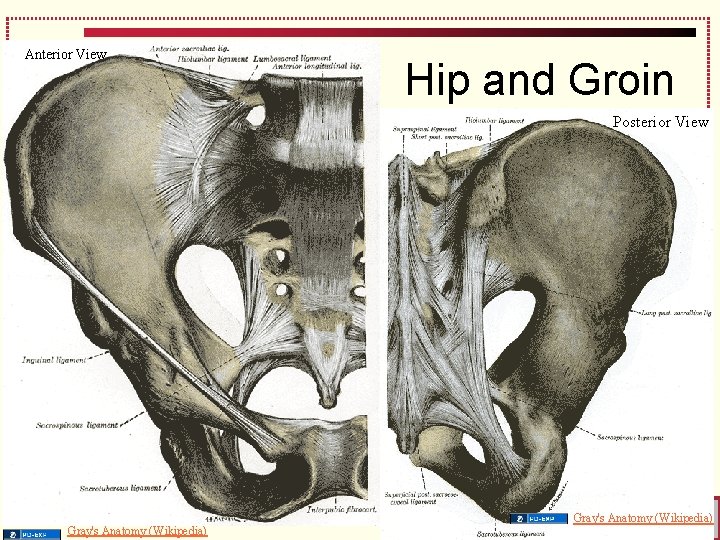
Anterior View Hip and Groin Posterior View 99 Gray's Anatomy (Wikipedia) Emergency Medicine
Trochanteric Bursitis u. Second leading cause of lateral hip pain after osteoarthritis u. Discrete tenderness to deep palpation u. Principal bursa between gluteus maximus and posterolateral prominence of greater trochanter 100 Emergency Medicine
Trochanteric Bursitis u. Pain usually chronic u. Pathology in hip abductors u. May radiate down thigh, lateral or posterior u. Worse with lying on side, stepping from curb, descending steps 101 Emergency Medicine
Trochanteric Bursitis u. Patrick fabere sign (flexion, abduction, external rotation, and extension) may be negative u. Passive ROM relatively painless u. Active abduction when lying on opposite side pain u. Sharp external rotation pain 102 Emergency Medicine
Ischiogluteal Bursitis u. Weaver's bottom / tailor’s seat: pain center of buttock radiating down back of leg u. Often mistaken for back strain, herniated disk u. Pain worse with sitting on hard surface, bending forward, standing on tiptoe 103 Emergency Medicine
Ischiogluteal Bursitis u. Tenderness over ischial tuberosity u. Ischiogluteal bursa adjacent to ischial tuberosity, overlies sciatic / posterior femoral cutaneous nerves 104 Emergency Medicine
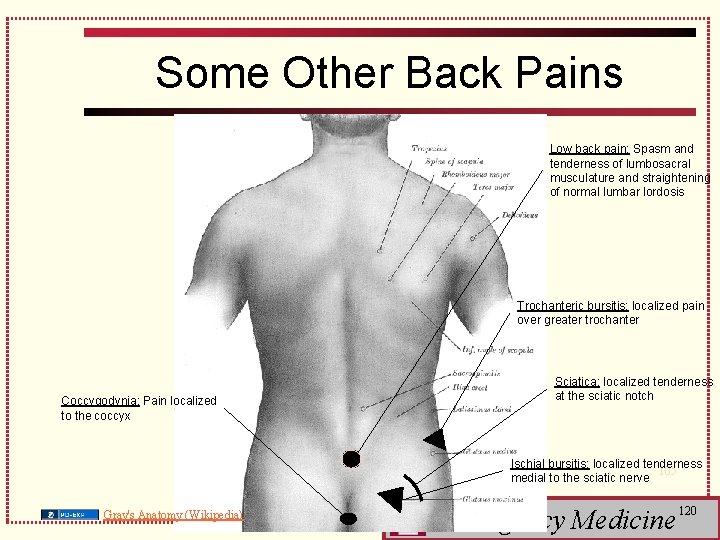
Some Other Back Pains Low back pain: Spasm and tenderness of lumbosacral musculature and straightening of normal lumbar lordosis Trochanteric bursitis: localized pain over greater trochanter Coccygodynia: Pain localized to the coccyx Sciatica: localized tenderness at the sciatic notch Ischial bursitis: localized tenderness 105 medial to the sciatic nerve Gray's Anatomy (Wikipedia) Emergency Medicine 120
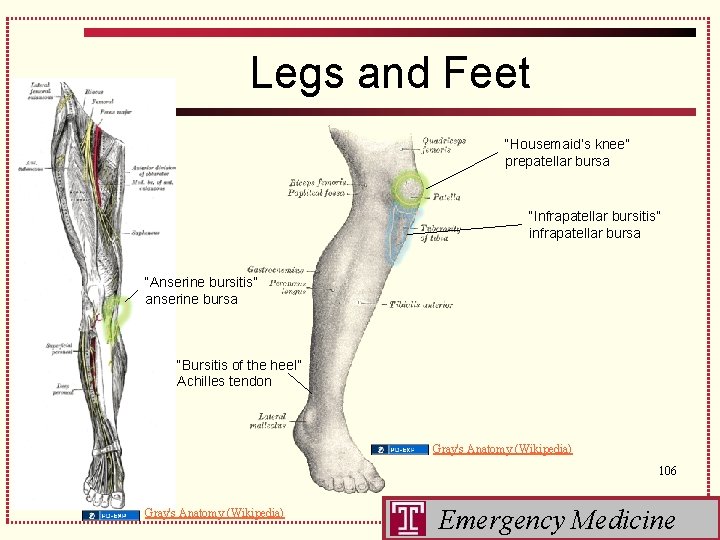
Legs and Feet “Housemaid’s knee” prepatellar bursa “Infrapatellar bursitis” infrapatellar bursa “Anserine bursitis” anserine bursa “Bursitis of the heel” Achilles tendon Gray's Anatomy (Wikipedia) 106 Gray's Anatomy (Wikipedia) Emergency Medicine
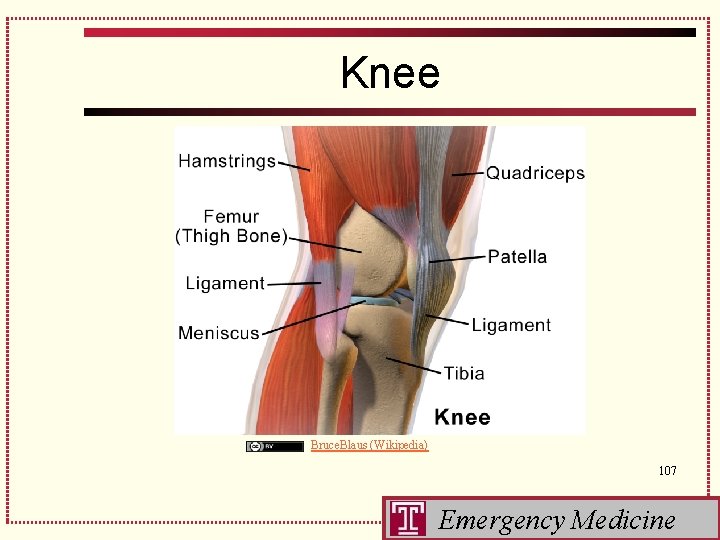
Knee Bruce. Blaus (Wikipedia) 107 Emergency Medicine
Prepatellar Bursitis u. Housemaid’s knee / nun’s knee: swelling with effusion of superficial bursa over lower pole of patella u. Passive motion fully preserved u. Pain mild except during extreme knee flexion or direct pressure 108 Emergency Medicine
Prepatellar Bursitis u. Pressure from repetitive kneeling on a firm surface: rug cutter's knee u. Rarely direct trauma u. Second most common site for septic bursitis 109 Emergency Medicine
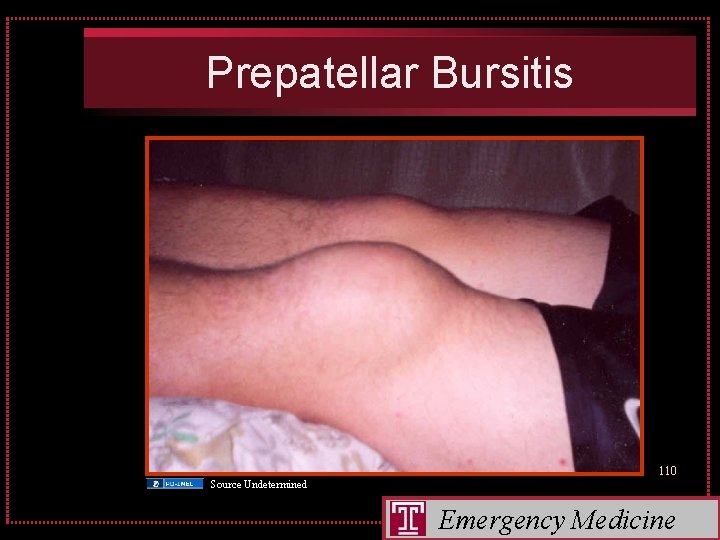
Prepatellar Bursitis 110 Source Undetermined Emergency Medicine
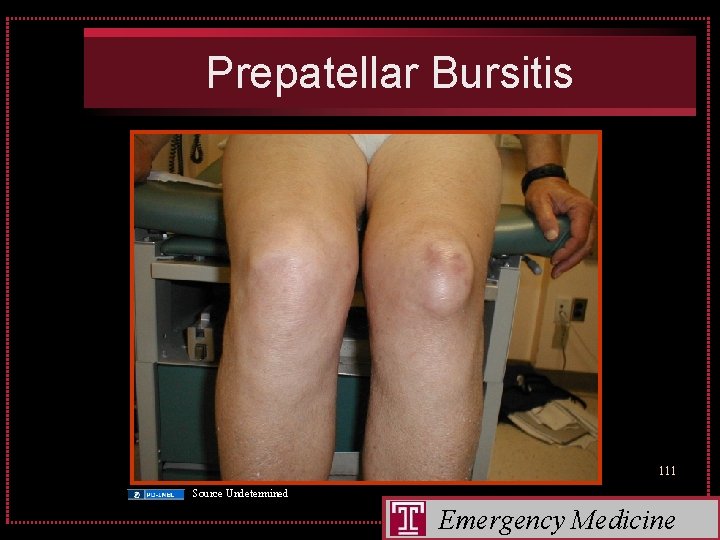
Prepatellar Bursitis 111 Source Undetermined Emergency Medicine
Baker’s Cyst u. Pseudothrombophlebitis syndrome u. Herniated fluid-filled sacs of articular synovial membrane that extend into popliteal fossa u. Causes: trauma, rheumatoid arthritis, gout, osteoarthritis u. Pain worse with active knee flexion 112 Emergency Medicine
Baker’s Cyst u. Can mimic deep venous thrombosis u. Ultrasound eseential u. Many resolve over weeks u. May require surgery u. Steroid injections not performed: risk of neurovascular injury 113 Emergency Medicine
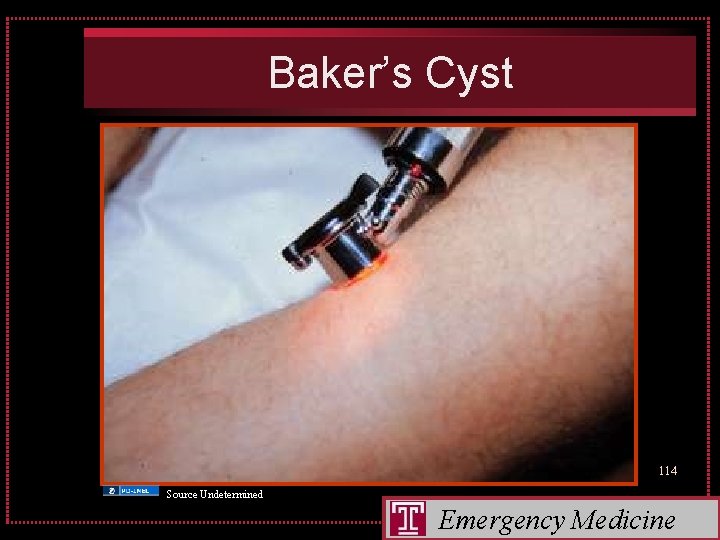
Baker’s Cyst 114 Source Undetermined Emergency Medicine
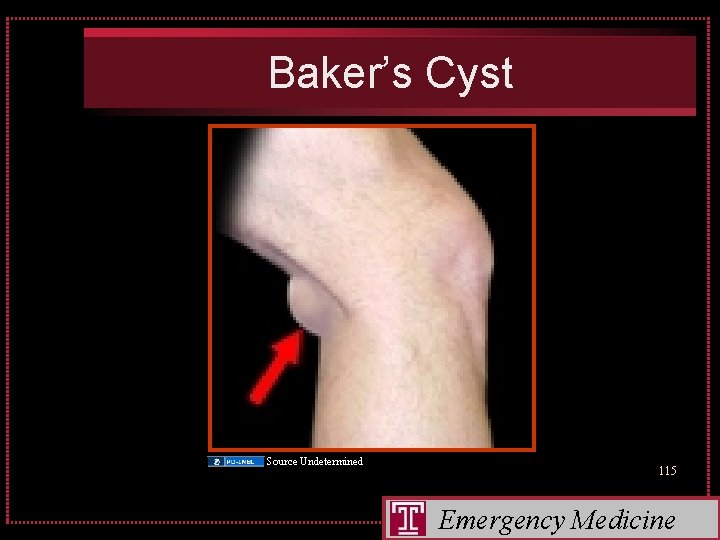
Baker’s Cyst Source Undetermined 115 Emergency Medicine
Anserine Bursitis u. Cavalryman's disease / pes bursitis / goosefoot bursitis: obese women with large thighs, athletes who run u. Anteromedial knee, inferior to joint line at insertion of sartorius, semitendinous, and gracilis tendon 116 Emergency Medicine
Anserine Bursitis u. Abrupt knee pain, local tenderness 4 to 5 cm below medial aspect of tibial plateau u. Knee flexion exacerbates 117 Emergency Medicine
Iliotibial Band Syndrome u. Lateral knee pain u. Cyclists, dancers, distance runners, football players u. Pain worse climbing stairs u. Tenderness when patient supine, knee flexed to 90 o 118 Emergency Medicine
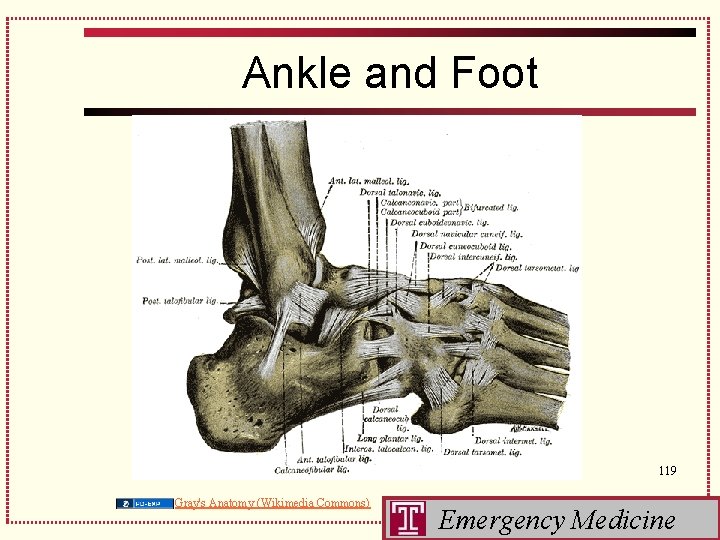
Ankle and Foot 119 Gray's Anatomy (Wikimedia Commons) Emergency Medicine
Peroneal Tendonitis u. Peroneal tendons cross behind lateral malleolus u. Running, jumping, sprain u. Holding foot up and out against downward pressure causes pain 120 Emergency Medicine
Peroneal Tendon Rupture u. Torn retinaculum u. Have patient dorsiflex and plantar flex with foot in inversion u. Feel for “snapping” behind lateral malleolus 121 Emergency Medicine
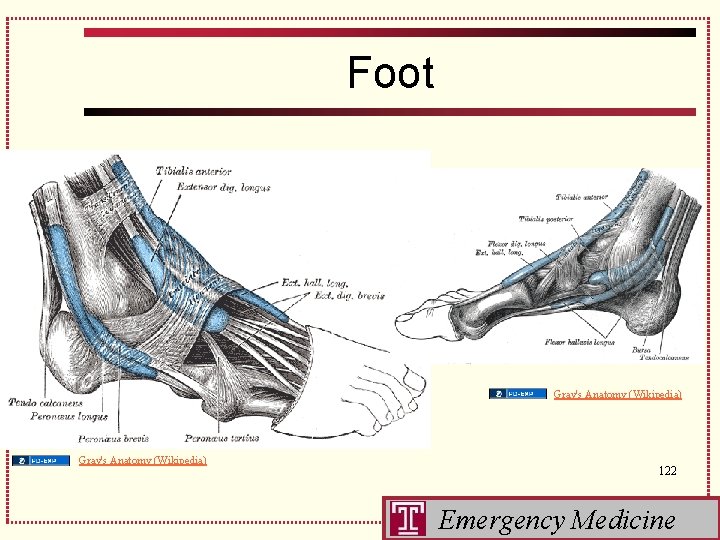
Foot Gray's Anatomy (Wikipedia) 122 Emergency Medicine
Retrocalcaneal Bursitis u. Ankle overuse: excessive walking, running, or jumping u. Heel pain: especially with walking, running, palpation u. Haglund disease: bony ridge on posterosuperior calcaneus u. Treatment: open heels (clogs), bare feet, sandals, or heel lift 123 Emergency Medicine
Plantar Fasciitis u. Policeman's heel / soldier's heel: associated with heel spurs u. Degenerated plantar fascial band at origin on medial calcaneous u. Heel pain worse in morning and after long periods of rest u. May be relieved with activity 124 Emergency Medicine
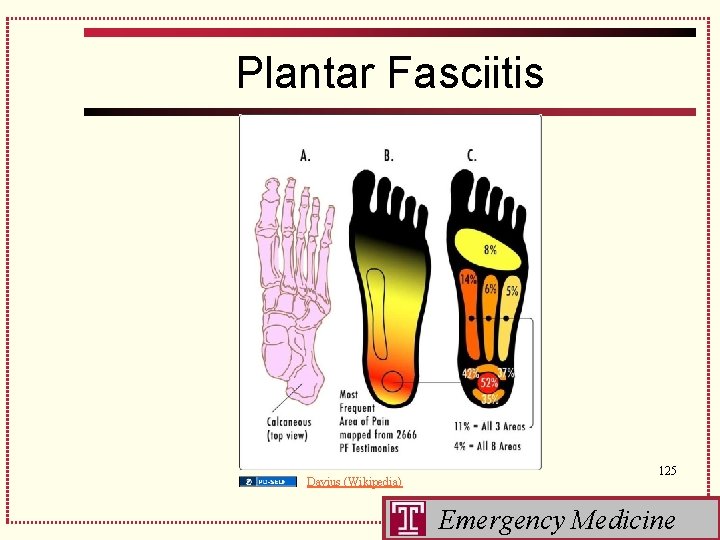
Plantar Fasciitis Davius (Wikipedia) 125 Emergency Medicine
Plantar Fasciitis u. Microtears in fascia from overuse? u. Eliminate precipitators, rest, strength and stretching exercises, arch supports, and night splints u. Sometimes need steroid injection u. Risk of plantar fascia rupture and fat pad atrophy 126 Emergency Medicine
Tarsal Tunnel Syndrome u. Between medial malleolus and flexor retinaculum u. Vague pain in sole of foot: burning or tingling u. Worse with activity, especially standing, walking for long periods u. Tender along course of nerve 127 Emergency Medicine
Tarsal Tunnel Syndrome u. Between medial malleolus and flexor retinaculum u. Vague pain in sole of foot: burning or tingling u. Worse with activity, especially standing, walking for long periods u. Tender along course of nerve 128 Emergency Medicine
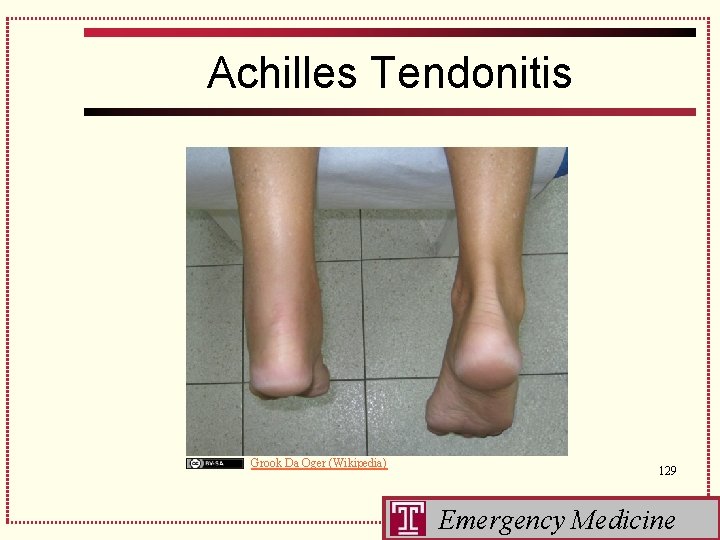
Achilles Tendonitis Grook Da Oger (Wikipedia) 129 Emergency Medicine
Fibromyalgia Sav vas (Wikimedia Commons) 130 Emergency Medicine
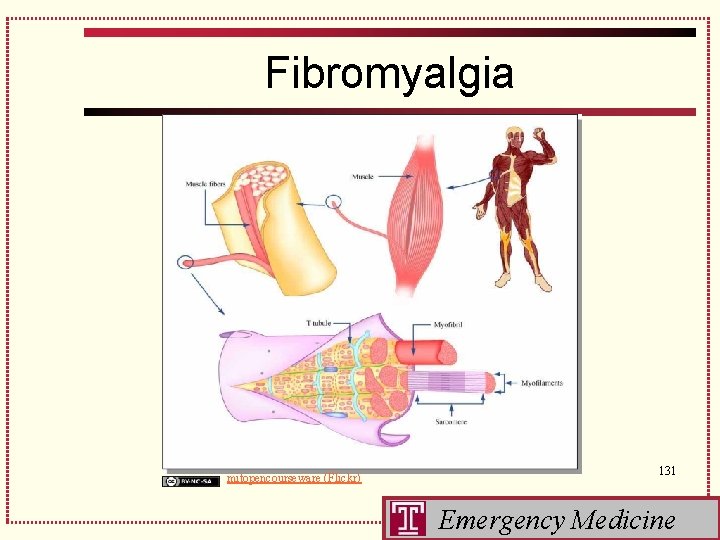
Fibromyalgia mitopencourseware (Flickr) 131 Emergency Medicine
132 Google
133 Amazon Emergency Medicine
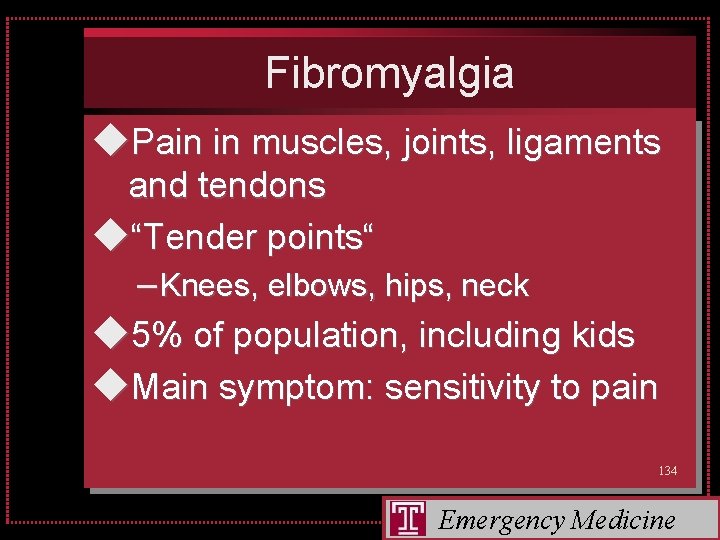
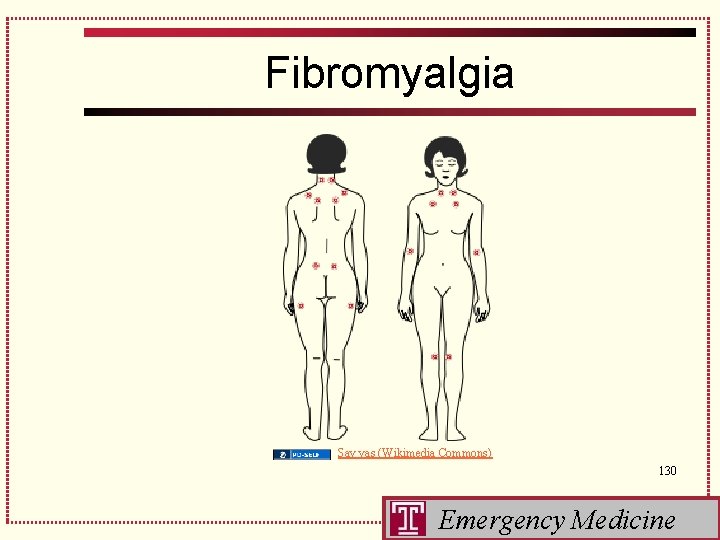
Fibromyalgia u. Pain in muscles, joints, ligaments and tendons u“Tender points“ – Knees, elbows, hips, neck u 5% of population, including kids u. Main symptom: sensitivity to pain 134 Emergency Medicine
Fibromyalgia u. Pain: chronic, deep or burning, migratory, intermittent u. Fatigue, poor sleep u. Numbness or tingling u“Poor blood flow” u. Sensitivity to odors, bright lights, loud noises, medicines 135 Emergency Medicine
Fibromyalgia u. Jaw pain u. Dry eyes u. Difficulty focusing u. Dizziness u. Balance problems u. Chest pain u. Rapid or irregular heartbeat 136 Emergency Medicine
Fibromyalgia u. Shortness of breath u. Difficulty swallowing u. Heartburn u. Gas u. Cramping abdominal pain u. Alternating diarrhea & constipation u. Frequent urination 137 Emergency Medicine
Fibromyalgia u. Pain in bladder area u. Urgency u. Pelvic pain u. Painful menstrual periods u. Painful sexual intercourse u. Depression u. Anxiety 138 Emergency Medicine
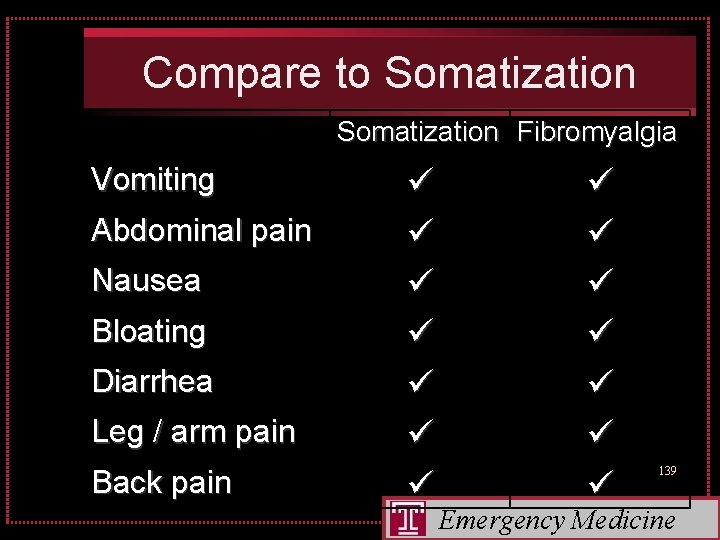
Compare to Somatization Fibromyalgia Vomiting Abdominal pain Nausea Bloating Diarrhea Leg / arm pain Back pain 139 Emergency Medicine
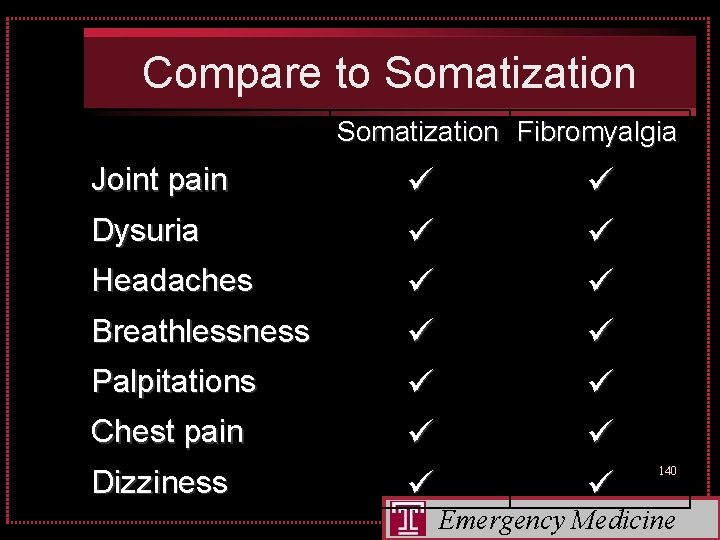
Compare to Somatization Fibromyalgia Joint pain Dysuria Headaches Breathlessness Palpitations Chest pain Dizziness 140 Emergency Medicine
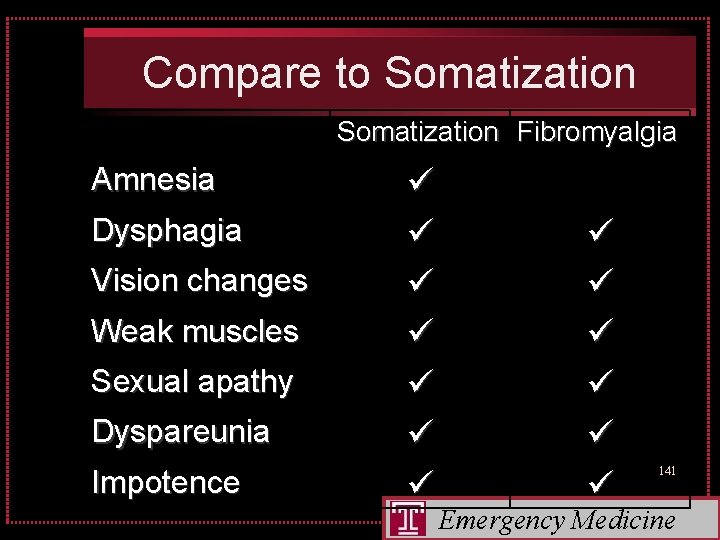
Compare to Somatization Fibromyalgia Amnesia Dysphagia Vision changes Weak muscles Sexual apathy Dyspareunia Impotence 141 Emergency Medicine
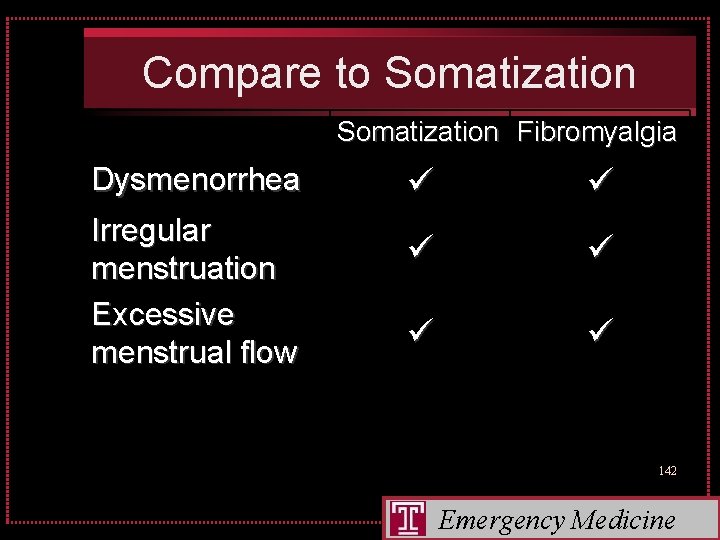
Compare to Somatization Fibromyalgia Dysmenorrhea Irregular menstruation Excessive menstrual flow 142 Emergency Medicine
Fibromyalgia u. Treatment 143 Emergency Medicine
Reflex Sympathetic Dystrophy u. Causalgia u. Shoulder-hand syndrome u. Sudeck's atrophy u. Post-traumatic pain syndrome u. Complex regional pain syndrome type I and type II u. Sympathetically maintained pain 144 Emergency Medicine
Reflex Sympathetic Dystrophy u. Distal extremity pain, tenderness u. Bone demineralization, trophic skin changes, vasomotor instability u. Precipitating event in 2/3: injury, stroke, MI, local trauma, fracture u. Associated with emotional liability, depression, anxiety 145 Emergency Medicine
Reflex Sympathetic Dystrophy u. Treatments: medication, physical therapy, sympathetic nerve blocks, psychological support – Possible sympathectomy or dorsal column stimulator u. Pain Clinic with coordinated plan may be helpful 146 Emergency Medicine
- Slides: 146