
Project Early Awareness Howard University Cancer Center Background
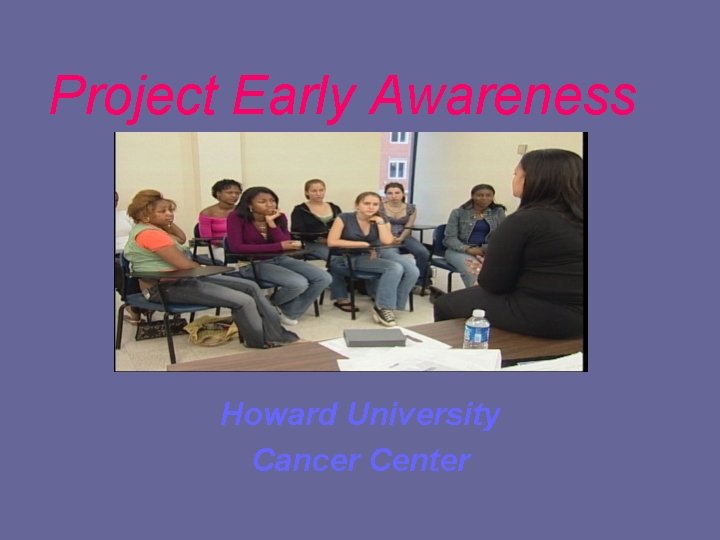
Project Early Awareness Howard University Cancer Center
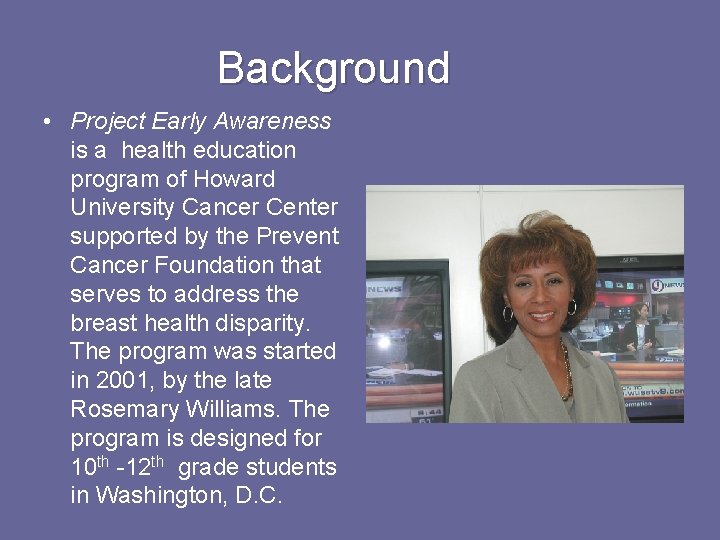
Background • Project Early Awareness is a health education program of Howard University Cancer Center supported by the Prevent Cancer Foundation that serves to address the breast health disparity. The program was started in 2001, by the late Rosemary Williams. The program is designed for 10 th -12 th grade students in Washington, D. C.
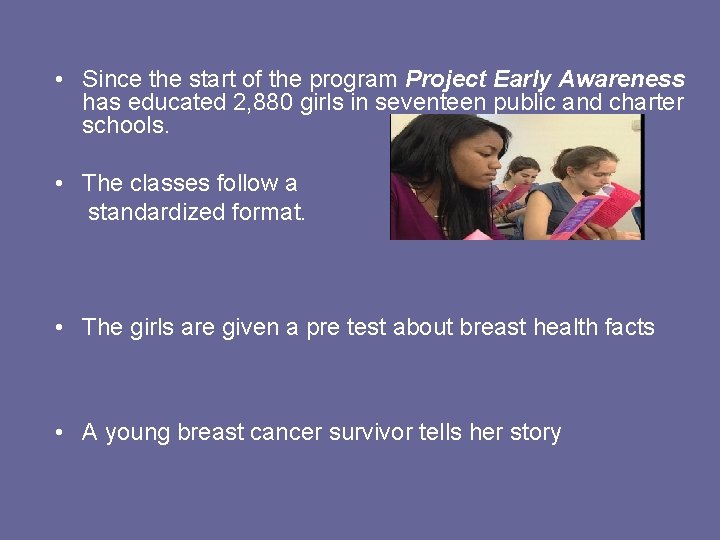
• Since the start of the program Project Early Awareness has educated 2, 880 girls in seventeen public and charter schools. • The classes follow a standardized format. • The girls are given a pre test about breast health facts • A young breast cancer survivor tells her story
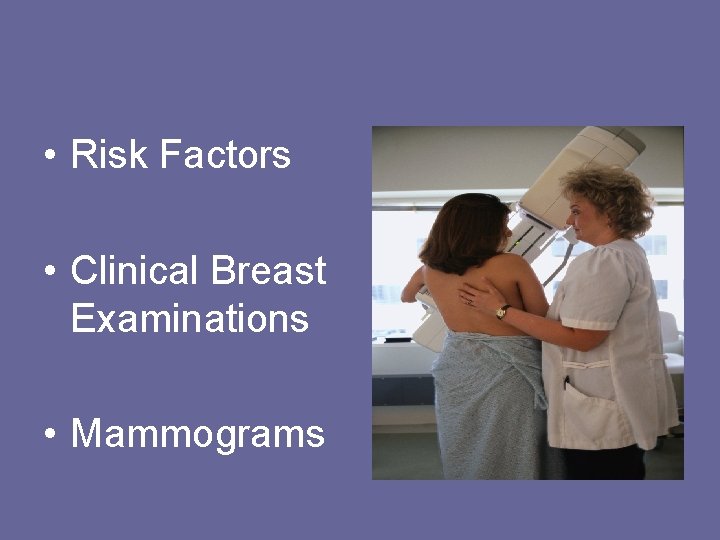
• Risk Factors • Clinical Breast Examinations • Mammograms

A video demonstrating a breast self examination is shown Breast models are used to practice the technique.
• • • Myths Exercise Smoking Alcohol Post-test questionnaire along with evaluations are distributed Examples of Post –Test Questions: • I am sure of the steps to follow doing a breast self examination • I know how to perform breast self examinations • I am confident I can perform breast self examinations
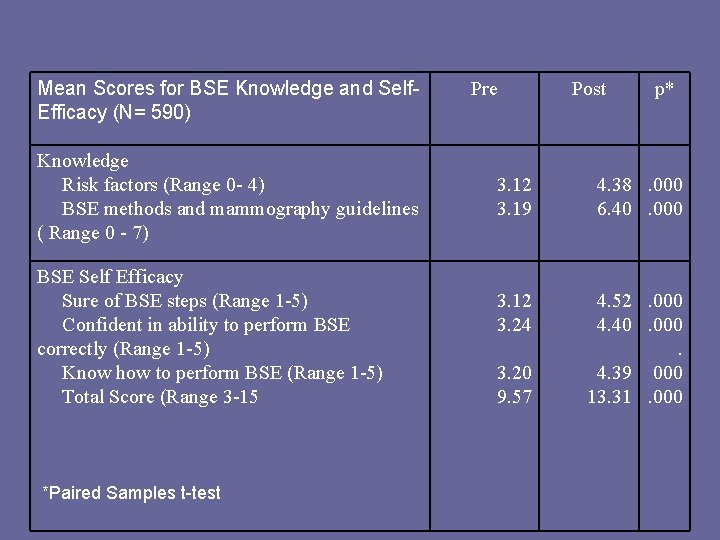
Mean Scores for BSE Knowledge and Self. Efficacy (N= 590) Knowledge Risk factors (Range 0 - 4) BSE methods and mammography guidelines ( Range 0 - 7) BSE Self Efficacy Sure of BSE steps (Range 1 -5) Confident in ability to perform BSE correctly (Range 1 -5) Know how to perform BSE (Range 1 -5) Total Score (Range 3 -15 *Paired Samples t-test Pre Post p* 3. 12 3. 19 4. 38. 000 6. 40. 000 3. 12 3. 24 4. 52. 000 4. 40. 000. 4. 39 000 13. 31. 000 3. 20 9. 57
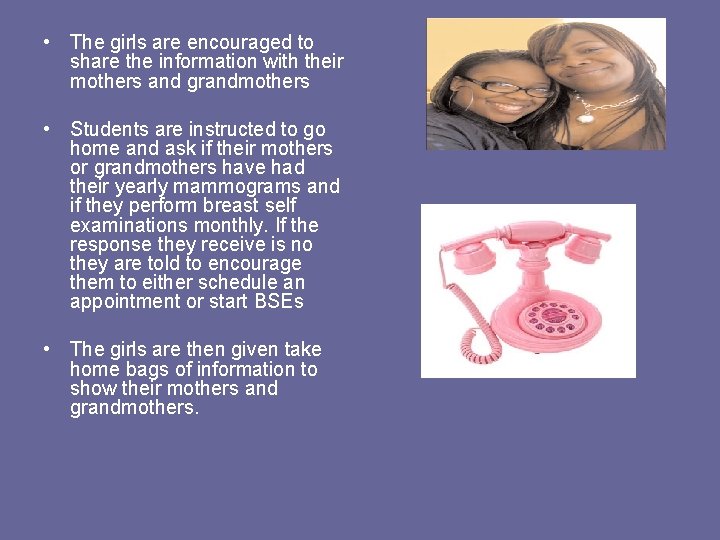
• The girls are encouraged to share the information with their mothers and grandmothers • Students are instructed to go home and ask if their mothers or grandmothers have had their yearly mammograms and if they perform breast self examinations monthly. If the response they receive is no they are told to encourage them to either schedule an appointment or start BSEs • The girls are then given take home bags of information to show their mothers and grandmothers.
• Since 2003, 1, 273 boys have been educated through the Project Early Awareness Program. • Topics: • Testicular Cancer • Breast Cancer • Lung Cancer • Smoking Cessation • Prostate Cancer

Prostate Cancer • Leading cancer diagnosed among men in the United States • Leading cause of male cancer-related deaths • Mortality rates for prostate cancer are much lower than the incidence rates— survival for men with prostate cancer is generally quite high • 218, 890 new cases / 27, 050 deaths in 2007. • It is a slow moving cancer http: //www. cancer. org/downloads/STT/CAFF 2006 PWSecured. pdf
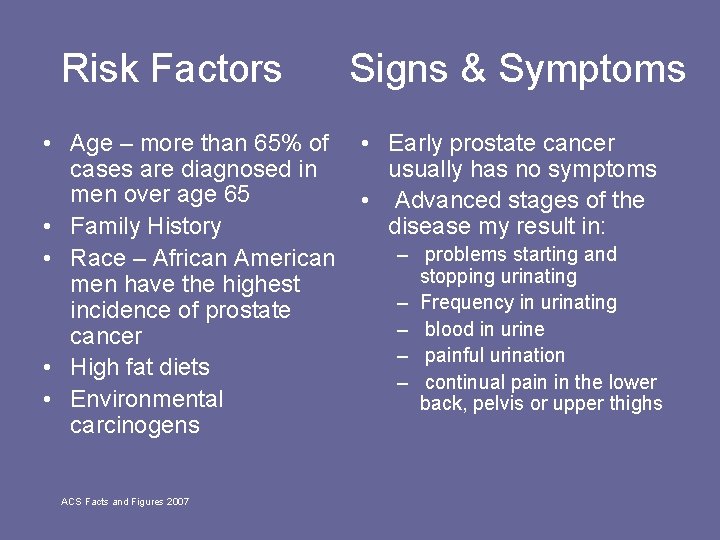
Risk Factors • Age – more than 65% of cases are diagnosed in men over age 65 • Family History • Race – African American men have the highest incidence of prostate cancer • High fat diets • Environmental carcinogens ACS Facts and Figures 2007 Signs & Symptoms • Early prostate cancer usually has no symptoms • Advanced stages of the disease my result in: – problems starting and stopping urinating – Frequency in urinating – blood in urine – painful urination – continual pain in the lower back, pelvis or upper thighs

Early Detection • Our best defense • The earlier prostate cancer is detected, the better the chance of effective treatment • Long term survival is good for cancer confined to the prostate • Once a tumor has spread outside of the prostate gland, it is much more difficult to treat • Regular Screening – Digital Rectal Exam – Prostate Specific Antigen (PSA) http: //www. cancer. org/downloads/STT/CAFF 2006 PWSecured. pdf

PSA • Elevated PSA doesn’t always mean cancer is present—it serves as a red flag • Other conditions associated with an elevated PSA – BPH (benign enlargement of prostate) – UTI (urinary tract infection) – Prostatitis (infection/inflammation of prostate) http: //www. cancer. org/downloads/STT/CAFF 2006 PWSecured. pdf
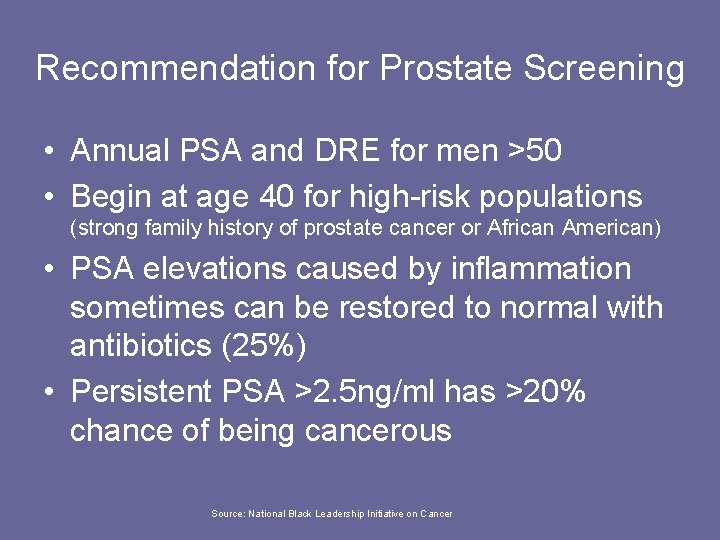
Recommendation for Prostate Screening • Annual PSA and DRE for men >50 • Begin at age 40 for high-risk populations (strong family history of prostate cancer or African American) • PSA elevations caused by inflammation sometimes can be restored to normal with antibiotics (25%) • Persistent PSA >2. 5 ng/ml has >20% chance of being cancerous Source: National Black Leadership Initiative on Cancer
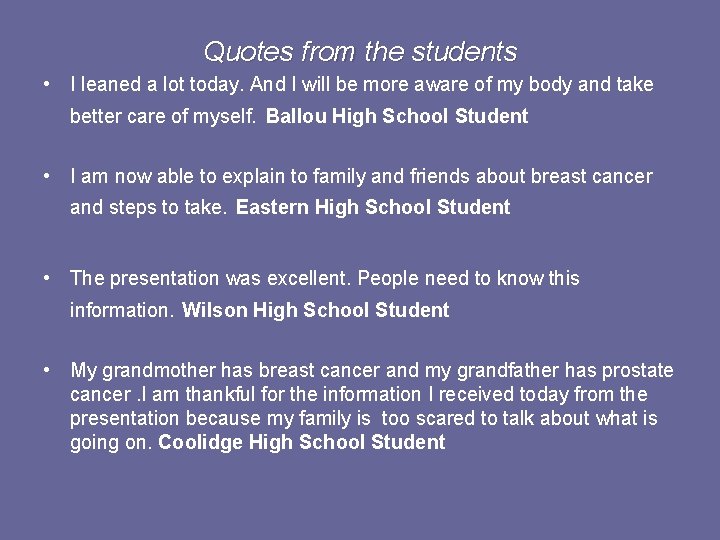
Quotes from the students • I leaned a lot today. And I will be more aware of my body and take better care of myself. Ballou High School Student • I am now able to explain to family and friends about breast cancer and steps to take. Eastern High School Student • The presentation was excellent. People need to know this information. Wilson High School Student • My grandmother has breast cancer and my grandfather has prostate cancer. I am thankful for the information I received today from the presentation because my family is too scared to talk about what is going on. Coolidge High School Student
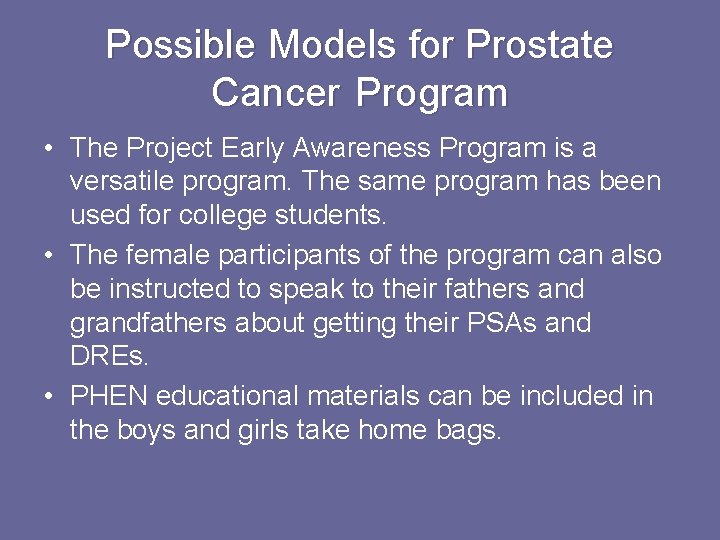
Possible Models for Prostate Cancer Program • The Project Early Awareness Program is a versatile program. The same program has been used for college students. • The female participants of the program can also be instructed to speak to their fathers and grandfathers about getting their PSAs and DREs. • PHEN educational materials can be included in the boys and girls take home bags.
Possible Models for Prostate Cancer Program • A questionnaire about prostate health can be added to the take home bags. • An incentive such as a gift card to a grocery store or for gas can be mailed once the questionnaire has been completed

Prostate Health Practices/Prostate Screening Evaluation Form • • • Before your son or daughter gave you the Project Early Awareness take home bag, had the two of you had a discussion about prostate health? Yes______ No______ After you received the take home bag, did you begin to think more about your prostate health? Yes______ No______ Have you ever been diagnosed with prostate cancer? Yes______ No______ Do you have a father, brother, son who has had a prostate cancer diagnosis? Yes______ No______ Unknown______ Do you have an uncle, grandfather, cousin or any other biological (blood) relative who has had a prostate cancer diagnosis? Yes______ No______ Unknown______ How old are you? Age______
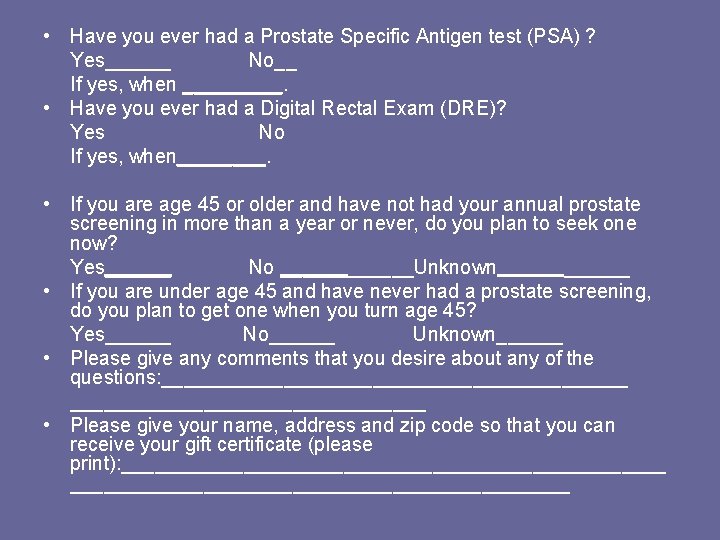
• Have you ever had a Prostate Specific Antigen test (PSA) ? Yes______ No__ If yes, when _____. • Have you ever had a Digital Rectal Exam (DRE)? Yes No If yes, when____. • If you are age 45 or older and have not had your annual prostate screening in more than a year or never, do you plan to seek one now? Yes______ No ______Unknown ______ • If you are under age 45 and have never had a prostate screening, do you plan to get one when you turn age 45? Yes______ No______ Unknown______ • Please give any comments that you desire about any of the questions: _____________________ • Please give your name, address and zip code so that you can receive your gift certificate (please print): _________________________

Thank you
- Slides: 20