
Project Cost Range Project Management Breakout Paul Derwent
Project Cost Range Project Management Breakout Paul Derwent PIP-II DOE Independent Project Review 12 -14 December 2017 In partnership with: India/DAE Italy/INFN UK/STFC France/CEA/Irfu, CNRS/IN 2 P 3
Paul Derwent • Role in project: – Deputy Project Manager • Relevant Experience – Scientist , Ph. D 1990 University of Chicago – 20+ years in Accelerator Division • Antiproton source: design, fabrication, installation, commissioning of Accumulator stacktail stochastic cooling system, achieved record accumulation rates • Department Head: Recycler (2006 -2009), PIP-II (2014 -present) • Associate Project Manager for Accelerator & Nu. MI Upgrades, NOv. A CD-4 2014 (2009 -2014) • Deputy Project Manager 2 12/12/17 Paul Derwent | Cost Range
Cost Estimate Process • FY 16/17: $32 M • WBS Definition – Dictionary & Work Scope • Basis of Estimate – Labor and M&S resources necessary to perform the work scope – Reasoning behind the estimate – Estimate uncertainty • Resource Loaded Schedule – Labor rates, Overheads, Escalation • Estimate to Complete: 3 12/12/17 Paul Derwent | Cost Range $513 M
Cost Estimate Process: Contingency • Estimate Uncertainty from the Basis of Estimates • Risk Uncertainty from the Risk Analysis • Project Definition/Design Maturity from Expert Analysis 4 12/12/17 Paul Derwent | Cost Range
Estimate Uncertainty • Defined in PIP-II docdb #345 – Categories • M&S: 8 levels • Labor: 8 levels • Civil: 5 levels – OPSS Procedure as of March 2017 • Procedure_12. PM-005 • Cost Estimating Contingency Tables • Specified at L 5 in WBS in the BOE process 5 12/12/17 Paul Derwent | Cost Range
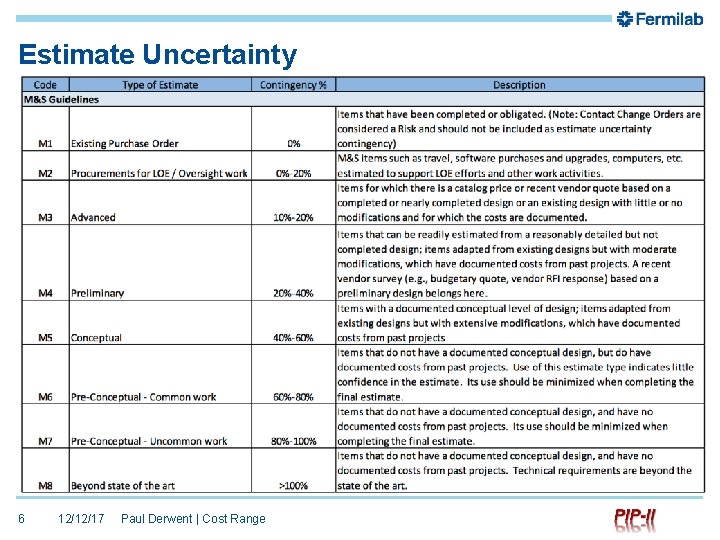
Estimate Uncertainty 6 12/12/17 Paul Derwent | Cost Range
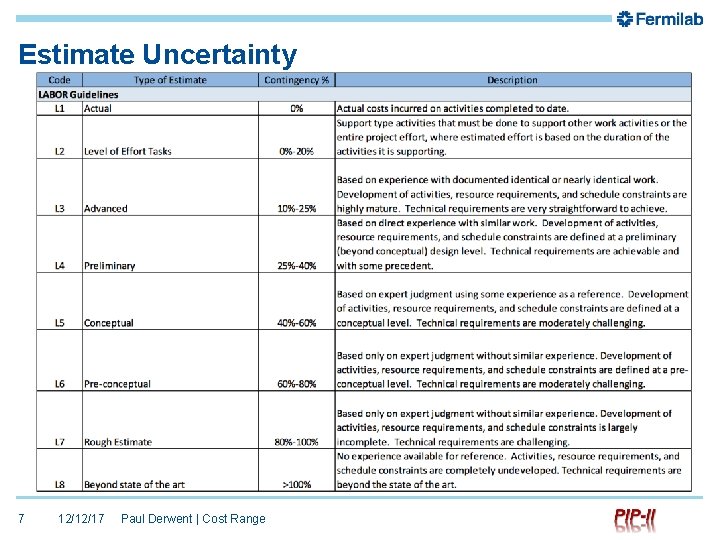
Estimate Uncertainty 7 12/12/17 Paul Derwent | Cost Range
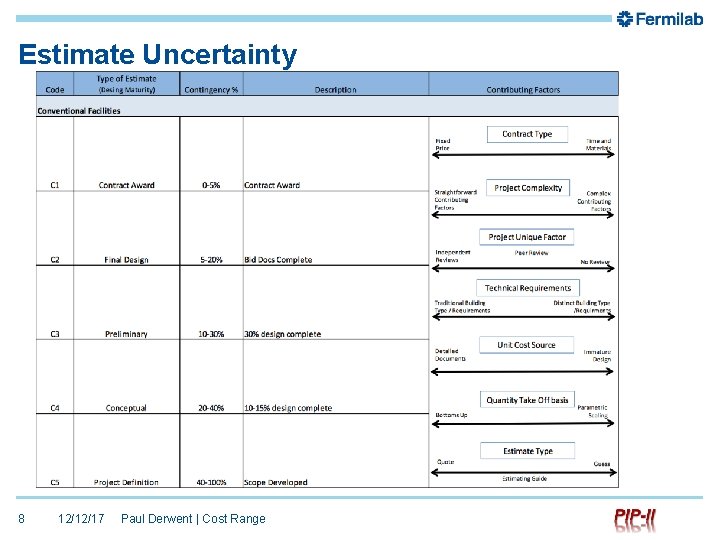
Estimate Uncertainty 8 12/12/17 Paul Derwent | Cost Range
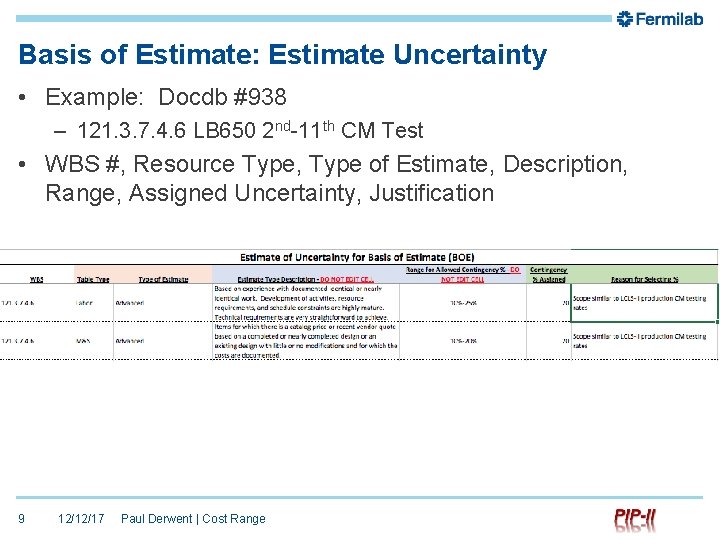
Basis of Estimate: Estimate Uncertainty • Example: Docdb #938 – 121. 3. 7. 4. 6 LB 650 2 nd-11 th CM Test • WBS #, Resource Type, Type of Estimate, Description, Range, Assigned Uncertainty, Justification 9 12/12/17 Paul Derwent | Cost Range
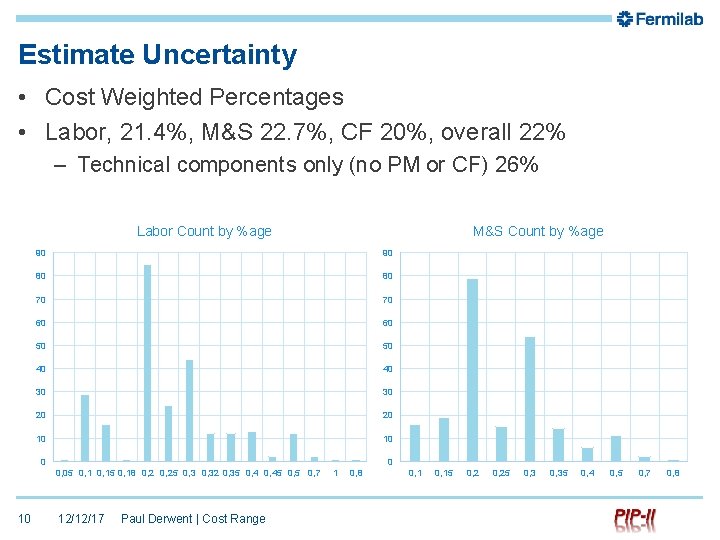
Estimate Uncertainty • Cost Weighted Percentages • Labor, 21. 4%, M&S 22. 7%, CF 20%, overall 22% – Technical components only (no PM or CF) 26% Labor Count by %age M&S Count by %age 90 90 80 80 70 70 60 60 50 50 40 40 30 30 20 20 10 10 0 0 0, 05 0, 15 0, 18 0, 25 0, 32 0, 35 0, 45 0, 7 10 12/12/17 Paul Derwent | Cost Range 1 0, 8 0, 15 0, 25 0, 35 0, 4 0, 5 0, 7 0, 8
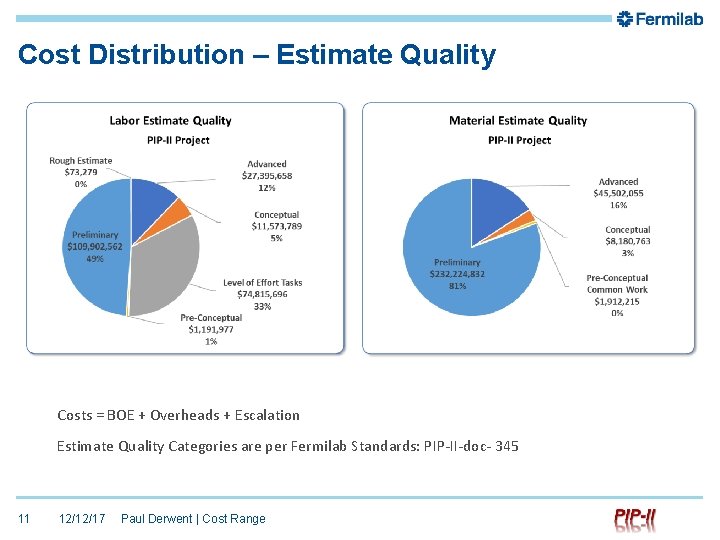
Cost Distribution – Estimate Quality Costs = BOE + Overheads + Escalation Estimate Quality Categories are per Fermilab Standards: PIP-II-doc- 345 11 12/12/17 Paul Derwent | Cost Range
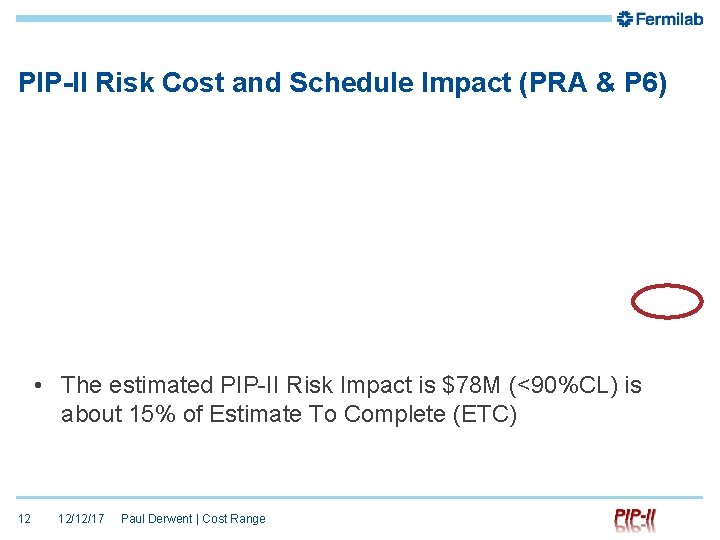
PIP-II Risk Cost and Schedule Impact (PRA & P 6) • The estimated PIP-II Risk Impact is $78 M (<90%CL) is about 15% of Estimate To Complete (ETC) 12 12/12/17 Paul Derwent | Cost Range
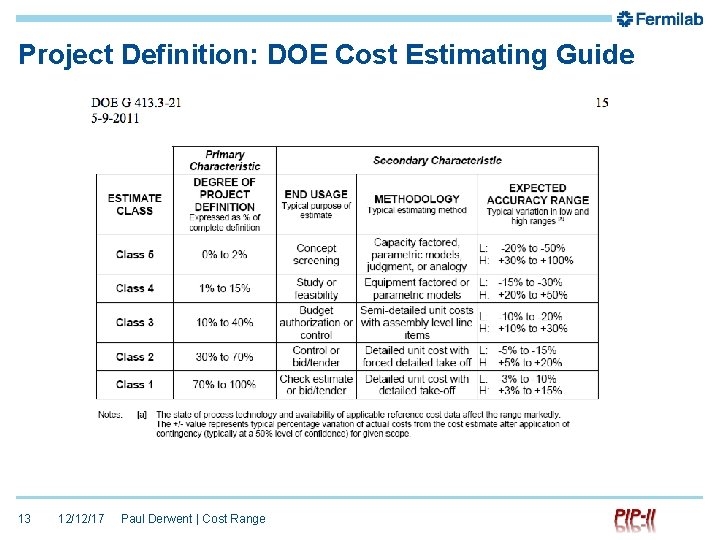
Project Definition: DOE Cost Estimating Guide 13 12/12/17 Paul Derwent | Cost Range
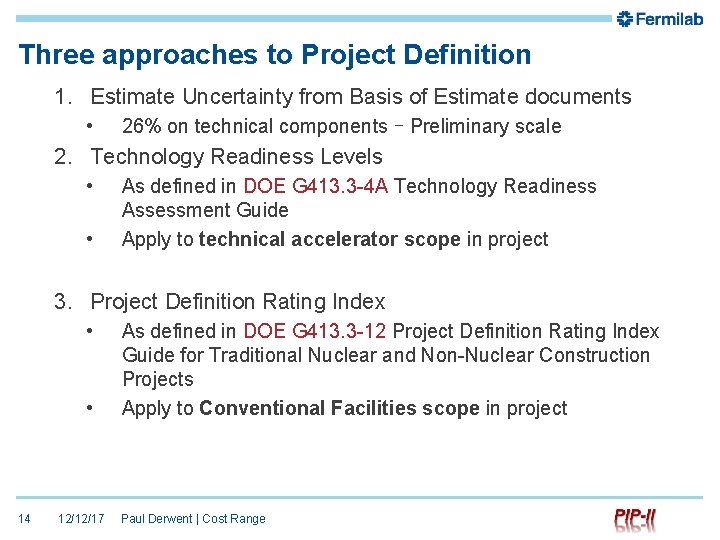
Three approaches to Project Definition 1. Estimate Uncertainty from Basis of Estimate documents • 26% on technical components – Preliminary scale 2. Technology Readiness Levels • • As defined in DOE G 413. 3 -4 A Technology Readiness Assessment Guide Apply to technical accelerator scope in project 3. Project Definition Rating Index • • 14 12/12/17 As defined in DOE G 413. 3 -12 Project Definition Rating Index Guide for Traditional Nuclear and Non-Nuclear Construction Projects Apply to Conventional Facilities scope in project Paul Derwent | Cost Range
Design Maturity : Technical Accelerator Scope • Technological Readiness Level – Scale 1 -9 – Defined in DOE G 413. 3 -4 A Technology Readiness Assessment Guide • Project Engineers assessed TRLs at WBS L 4 – Pip 2 -docdb #1251 contains summary spreadsheet 15 12/12/17 Paul Derwent | Cost Range
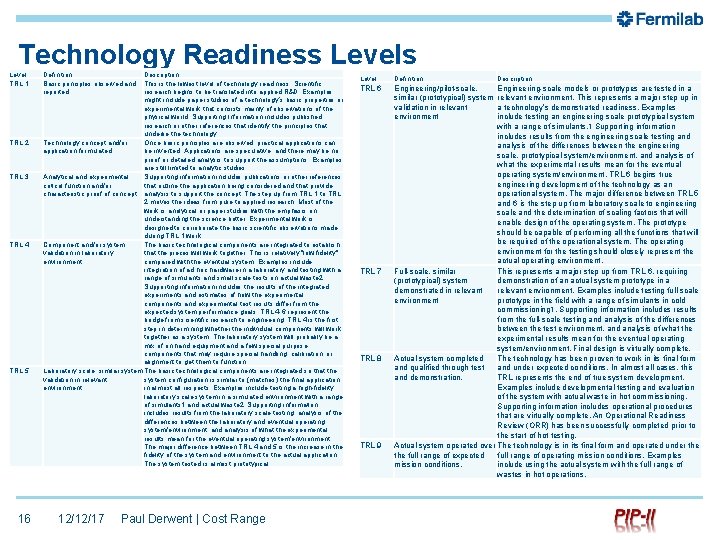
Technology Readiness Level TRL 1 TRL 2 TRL 3 TRL 4 TRL 5 16 Definition Basic principles observed and reported Description This is the lowest level of technology readiness. Scientific research begins to be translated into applied R&D. Examples might include paper studies of a technology’s basic properties or experimental work that consists mainly of observations of the physical world. Supporting Information includes published research or other references that identify the principles that underlie the technology. Technology concept and/or Once basic principles are observed, practical applications can application formulated be invented. Applications are speculative, and there may be no proof or detailed analysis to support the assumptions. Examples are still limited to analytic studies. Analytical and experimental Supporting information includes publications or other references critical function and/or that outline the application being considered and that provide characteristic proof of concept analysis to support the concept. The step up from TRL 1 to TRL 2 moves the ideas from pure to applied research. Most of the work is analytical or paper studies with the emphasis on understanding the science better. Experimental work is designed to corroborate the basic scientific observations made during TRL 1 work. Component and/or system The basic technological components are integrated to establish validation in laboratory that the pieces will work together. This is relatively "low fidelity" environment compared with the eventual system. Examples include integration of ad hoc hardware in a laboratory and testing with a range of simulants and small scale tests on actual waste 2. Supporting information includes the results of the integrated experiments and estimates of how the experimental components and experimental test results differ from the expected system performance goals. TRL 4 -6 represent the bridge from scientific research to engineering. TRL 4 is the first step in determining whether the individual components will work together as a system. The laboratory system will probably be a mix of on hand equipment and a few special purpose components that may require special handling, calibration, or alignment to get them to function. Laboratory scale, similar system The basic technological components are integrated so that the validation in relevant system configuration is similar to (matches) the final application environment in almost all respects. Examples include testing a high-fidelity, laboratory scale system in a simulated environment with a range of simulants 1 and actual waste 2. Supporting information includes results from the laboratory scale testing, analysis of the differences between the laboratory and eventual operating system/environment, and analysis of what the experimental results mean for the eventual operating system/environment. The major difference between TRL 4 and 5 is the increase in the fidelity of the system and environment to the actual application. The system tested is almost prototypical. 12/12/17 Paul Derwent | Cost Range Level Definition TRL 6 Engineering/pilot-scale, similar (prototypical) system validation in relevant environment TRL 7 TRL 8 TRL 9 Description Engineering-scale models or prototypes are tested in a relevant environment. This represents a major step up in a technology’s demonstrated readiness. Examples include testing an engineering scale prototypical system with a range of simulants. 1 Supporting information includes results from the engineering scale testing and analysis of the differences between the engineering scale, prototypical system/environment, and analysis of what the experimental results mean for the eventual operating system/environment. TRL 6 begins true engineering development of the technology as an operational system. The major difference between TRL 5 and 6 is the step up from laboratory scale to engineering scale and the determination of scaling factors that will enable design of the operating system. The prototype should be capable of performing all the functions that will be required of the operational system. The operating environment for the testing should closely represent the actual operating environment. Full-scale, similar This represents a major step up from TRL 6, requiring (prototypical) system demonstration of an actual system prototype in a demonstrated in relevant environment. Examples include testing full-scale environment prototype in the field with a range of simulants in cold commissioning 1. Supporting information includes results from the full-scale testing and analysis of the differences between the test environment, and analysis of what the experimental results mean for the eventual operating system/environment. Final design is virtually complete. Actual system completed The technology has been proven to work in its final form and qualified through test and under expected conditions. In almost all cases, this and demonstration. TRL represents the end of true system development. Examples include developmental testing and evaluation of the system with actual waste in hot commissioning. Supporting information includes operational procedures that are virtually complete. An Operational Readiness Review (ORR) has been successfully completed prior to the start of hot testing. Actual system operated over The technology is in its final form and operated under the full range of expected full range of operating mission conditions. Examples mission conditions. include using the actual system with the full range of wastes in hot operations.
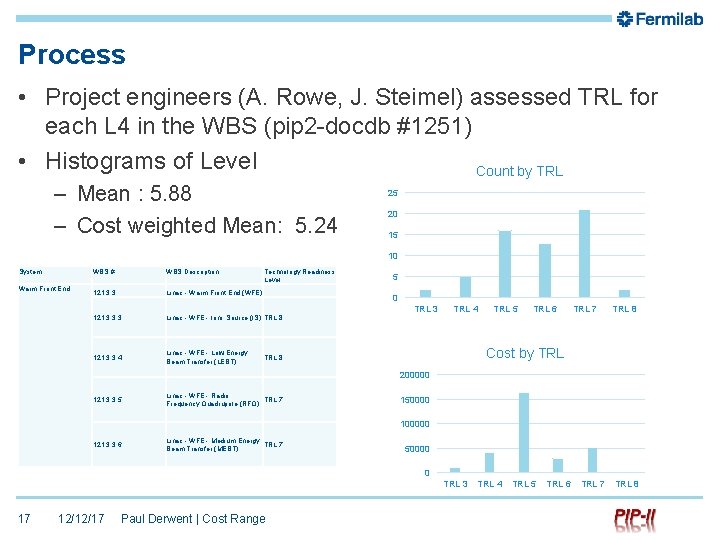
Process • Project engineers (A. Rowe, J. Steimel) assessed TRL for each L 4 in the WBS (pip 2 -docdb #1251) • Histograms of Level Count by TRL – Mean : 5. 88 – Cost weighted Mean: 5. 24 25 20 15 10 System Warm Front End WBS # WBS Description Technology Readiness Level 121. 3. 3 Linac - Warm Front End (WFE) 121. 3. 3. 3 Linac - WFE - Ions Source (IS) TRL 8 121. 3. 3. 4 Linac - WFE - Low Energy Beam Transfer (LEBT) 5 0 TRL 3 TRL 4 TRL 5 TRL 6 TRL 7 TRL 8 Cost by TRL 8 200000 121. 3. 3. 5 Linac - WFE - Radio TRL 7 Frequency Quadrupole (RFQ) 150000 100000 121. 3. 3. 6 Linac - WFE - Medium Energy TRL 7 Beam Transfer (MEBT) 50000 0 TRL 3 17 12/12/17 Paul Derwent | Cost Range TRL 4 TRL 5 TRL 6 TRL 7 TRL 8
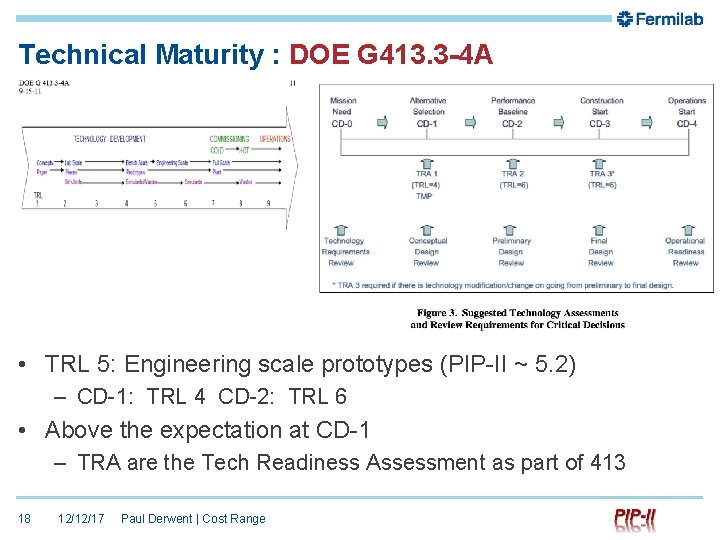
Technical Maturity : DOE G 413. 3 -4 A • TRL 5: Engineering scale prototypes (PIP-II ~ 5. 5) – CD-1: TRL 4 CD-2: TRL 6 • Above the expectation at CD-1 – TRA are the Tech Readiness Assessment as part of 413 • TRL 5: Engineering scale prototypes (PIP-II ~ 5. 2) – CD-1: TRL 4 CD-2: TRL 6 • Above the expectation at CD-1 – TRA are the Tech Readiness Assessment as part of 413 18 12/12/17 Paul Derwent | Cost Range
Design Maturity : Conventional Facilities • Project Definition Rating Index – Spreadsheet with levels for each Critical Decision • DOE G 413. 3 -12 PDRI Guide for Traditional Nuclear and Non. Nuclear Construction Projects • Associate PM for CF filled out spreadsheet – Pip 2 -docdb #1230 – Will utilize the tool as ongoing process 19 12/12/17 Paul Derwent | Cost Range
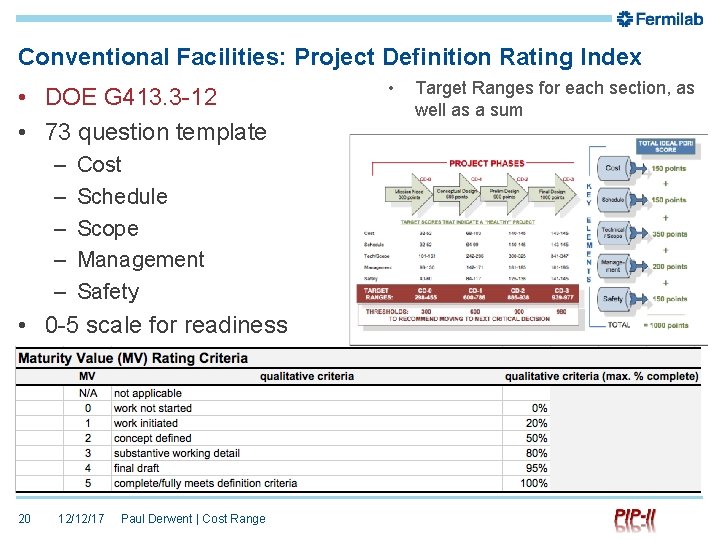
Conventional Facilities: Project Definition Rating Index • DOE G 413. 3 -12 • 73 question template – – – Cost Schedule Scope Management Safety • 0 -5 scale for readiness 20 12/12/17 Paul Derwent | Cost Range • Target Ranges for each section, as well as a sum
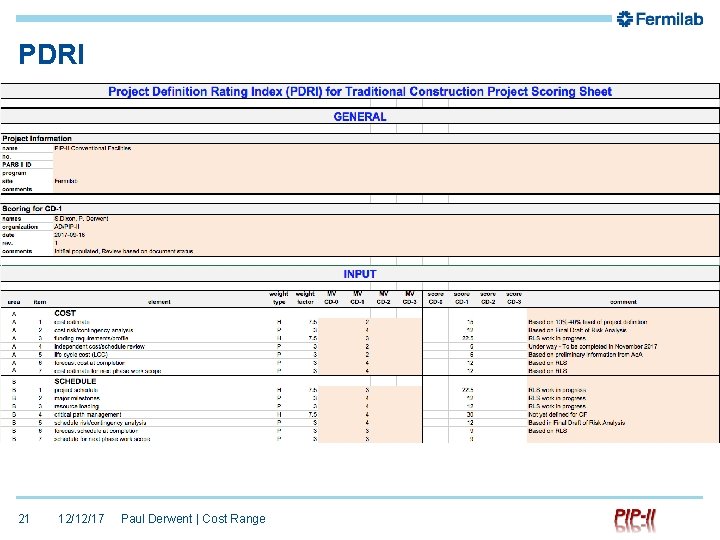
PDRI 21 12/12/17 Paul Derwent | Cost Range
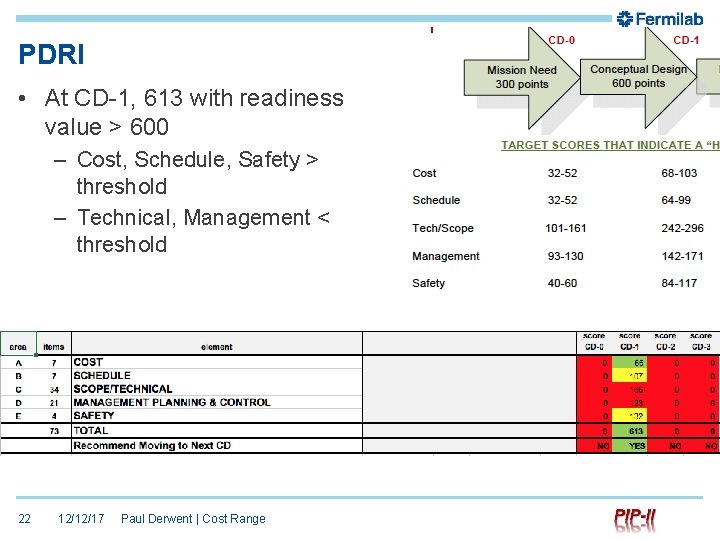
PDRI • At CD-1, 613 with readiness value > 600 – Cost, Schedule, Safety > threshold – Technical, Management < threshold 22 12/12/17 Paul Derwent | Cost Range
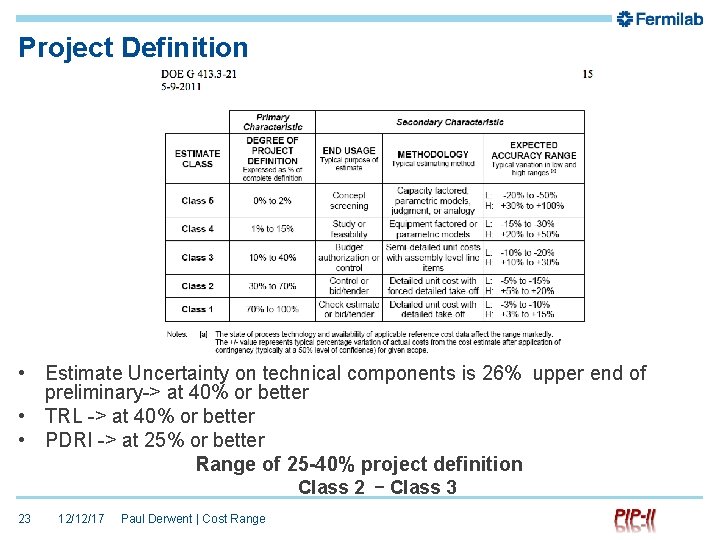
Project Definition • Estimate Uncertainty on technical components is 26% upper end of preliminary-> at 40% or better • TRL -> at 40% or better • PDRI -> at 25% or better Range of 25 -40% project definition Class 2 – Class 3 23 12/12/17 Paul Derwent | Cost Range
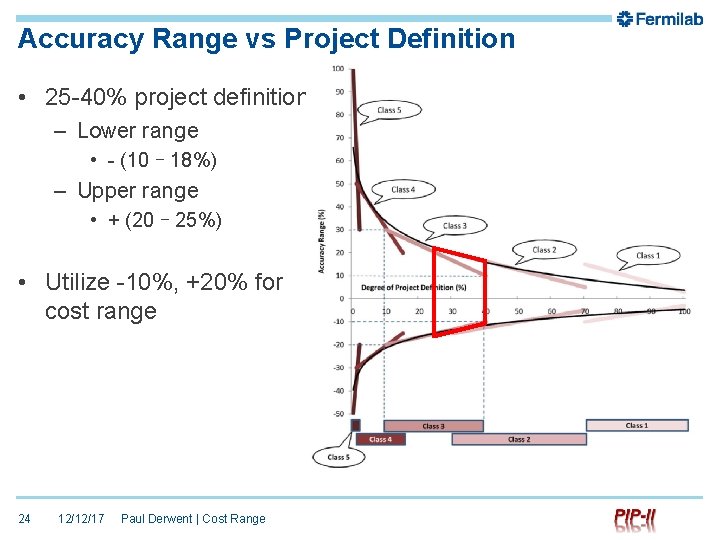
Accuracy Range vs Project Definition • 25 -40% project definition – Lower range • - (10 – 18%) – Upper range • + (20 – 25%) • Utilize -10%, +20% for cost range 24 12/12/17 Paul Derwent | Cost Range
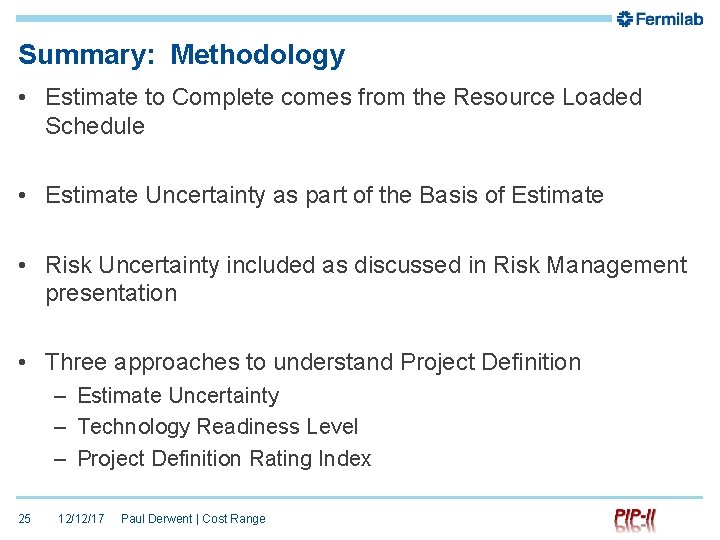
Summary: Methodology • Estimate to Complete comes from the Resource Loaded Schedule • Estimate Uncertainty as part of the Basis of Estimate • Risk Uncertainty included as discussed in Risk Management presentation • Three approaches to understand Project Definition – Estimate Uncertainty – Technology Readiness Level – Project Definition Rating Index 25 12/12/17 Paul Derwent | Cost Range
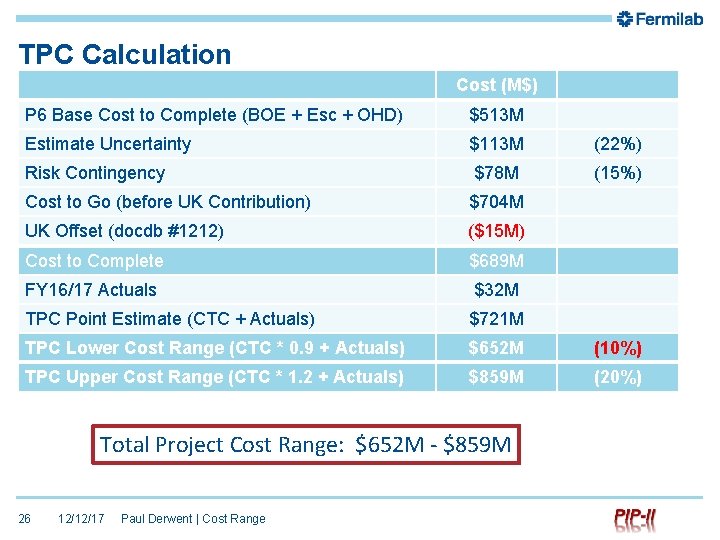
TPC Calculation Cost (M$) P 6 Base Cost to Complete (BOE + Esc + OHD) $513 M Estimate Uncertainty $113 M (22%) Risk Contingency $78 M (15%) Cost to Go (before UK Contribution) $704 M UK Offset (docdb #1212) ($15 M) Cost to Complete $689 M FY 16/17 Actuals $32 M TPC Point Estimate (CTC + Actuals) $721 M TPC Lower Cost Range (CTC * 0. 9 + Actuals) $652 M (10%) TPC Upper Cost Range (CTC * 1. 2 + Actuals) $859 M (20%) Total Project Cost Range: $652 M - $859 M 26 12/12/17 Paul Derwent | Cost Range
END 27 12/12/17 Paul Derwent | Cost Range
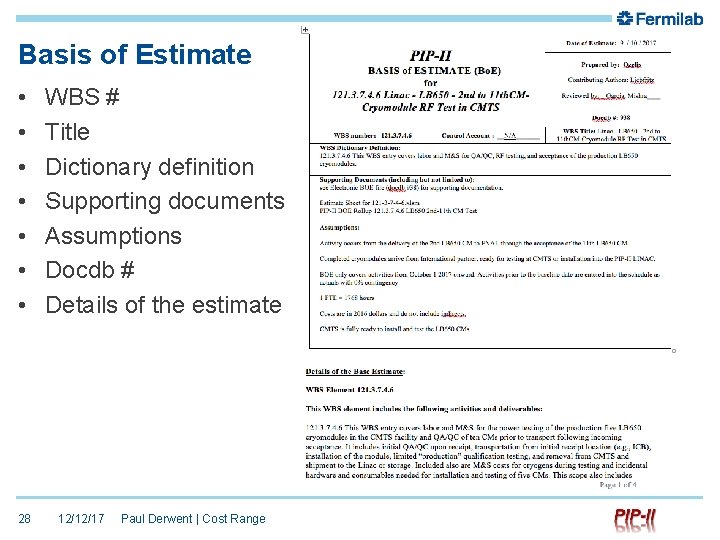
Basis of Estimate • • 28 WBS # Title Dictionary definition Supporting documents Assumptions Docdb # Details of the estimate 12/12/17 Paul Derwent | Cost Range
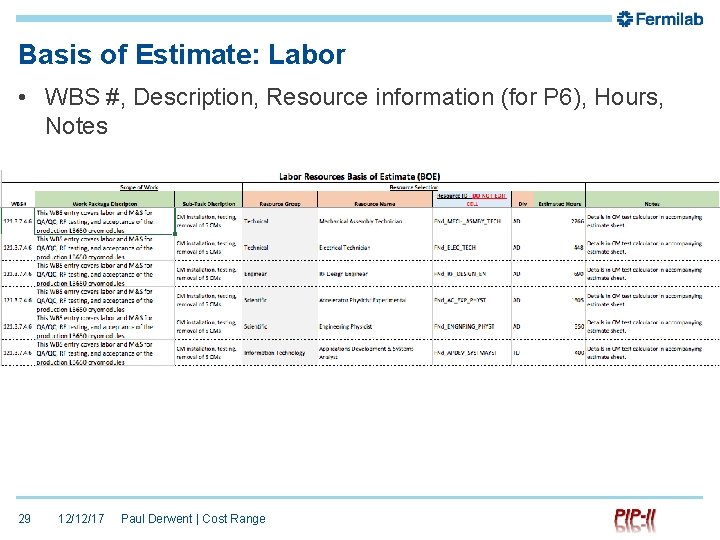
Basis of Estimate: Labor • WBS #, Description, Resource information (for P 6), Hours, Notes 29 12/12/17 Paul Derwent | Cost Range
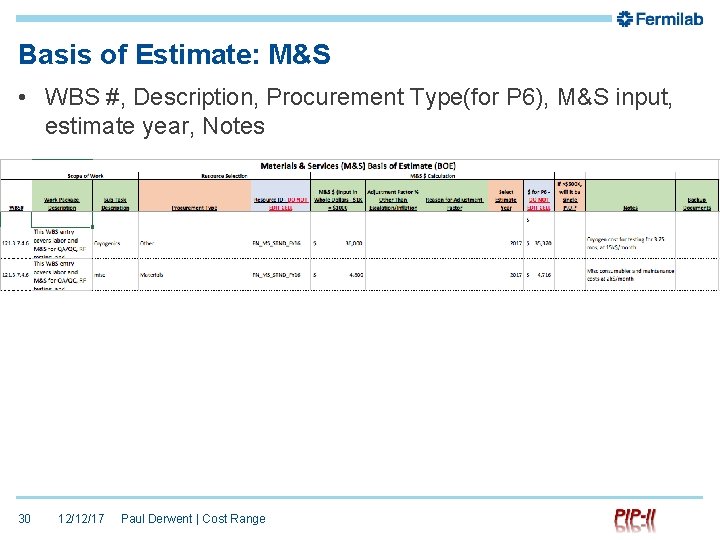
Basis of Estimate: M&S • WBS #, Description, Procurement Type(for P 6), M&S input, estimate year, Notes 30 12/12/17 Paul Derwent | Cost Range
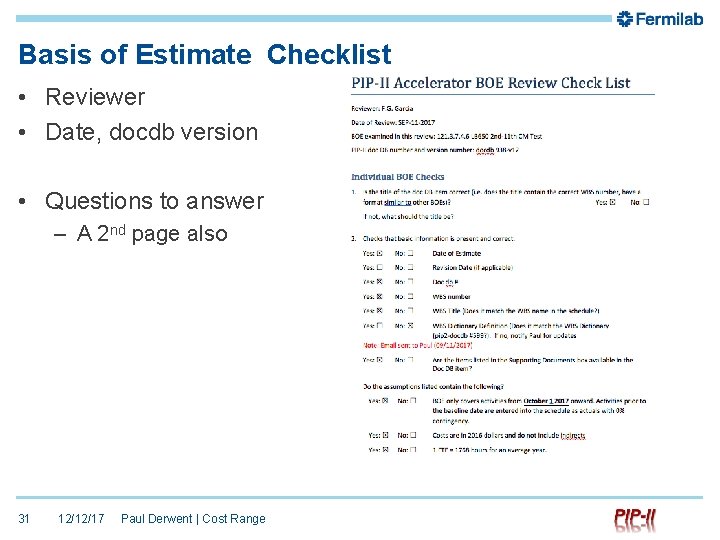
Basis of Estimate Checklist • Reviewer • Date, docdb version • Questions to answer – A 2 nd page also 31 12/12/17 Paul Derwent | Cost Range
- Slides: 31