
Project Control Introduction Project control is a process
- Slides: 21
Project Control
Introduction §Project control is a process which is concerned with making sure that plans are kept to and taking appropriate actions when performance is falling behind plan. §According to Project Management Body of Knowledge, project control is defined as a project management function that involves comparing actual performance with planned performance and taking appropriate corrective action that will yield the desired outcome in the project when significant differences exist.
Functions of Project Control §It ensures regular monitoring of performance. §It motivates the project personnel to strive for achieving project objectives. §Provides the information about the various activities of the project to the team members. §Assisting the process of project planning/ control sessions. §Formulating the project schedule and work breakdown structure. §Managing the critical path to ensure schedules are being met. §Estimating the cost involved in the project. §Tracking and analysing project costs. §Managing the process of issue, risk and change control.
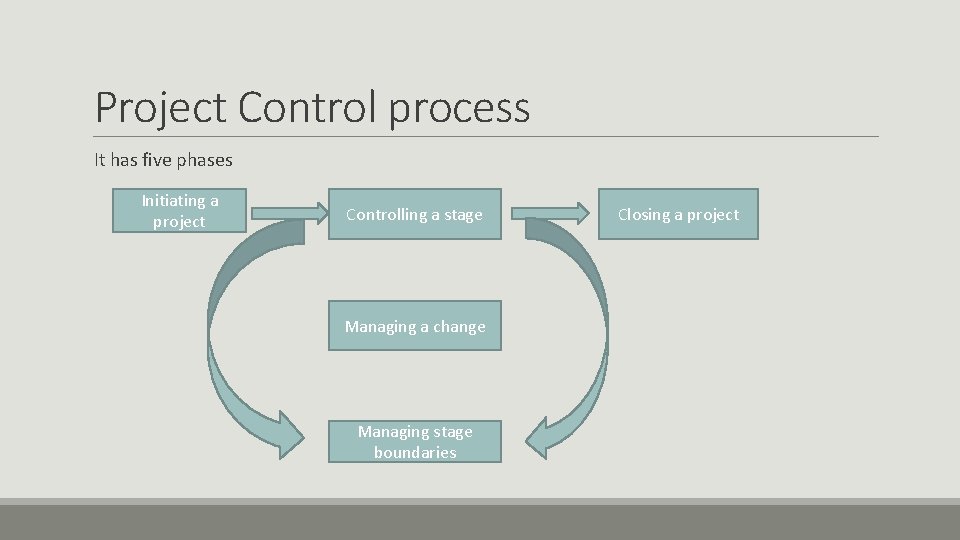
Project Control process It has five phases Initiating a project Controlling a stage Managing a change Managing stage boundaries Closing a project
1. Initiating a project The primary task of project manager is to ensure that the scope of the project should be decided before starting the initial stage. It is a critical stage and basically comprises of three main activities. §Accepting the project brief: It ensures that the documentation which is required to start the project should be in complete form and must be within acceptable standards. §Preparation for the first stage: The documentation which was done at earlier stage should be at proper place so that no delay in process can take place. §Seeking authority to succeed: Once the department is done with documentation, a team of personnel’s is required to initiate the project.
2. Controlling a stage In this step it is ensured that the project should be planned on day to day basis which includes delivering the products, monitoring the progress, managing all the risk and risky tasks, managing documents, managing contracts and assessing and reporting progress.
3. Managing state boundaries It is a mid way approach which not only reviews the current stage but also confirms that it is completed as per specifications and proper planning has been done for the next stage.
4. Managing change In this phase the ongoing changes of the project are properly managed and controlled in a systematic manner. Changes can take place at any moment of time and from any side but the things to be kept in mind are §Changes should be captured at early stages and must be assessed properly. §Changes should be accepted or not should always depend upon the time and circumstances. If the changes are within the tolerance limits then they should be accepted and if not the alternative approach should be there.
4. Closing the project This is the last stage which ensures that the project should be properly closed and all the residual issues are handed over in to business as usual. No delay in any kind of activity should be there.
Reasons for ineffective control of project 1. Problem of Human Resources 2. Poor control system § 3. Poor communication § 4. Resource mismanagement § 5. Inadequate planning, assumptions, risks or resources § 6. Ineffective quality control § 7. Use of unproven technology/ method § 8. Supply chain failures § 9. Managing multiple projects at once
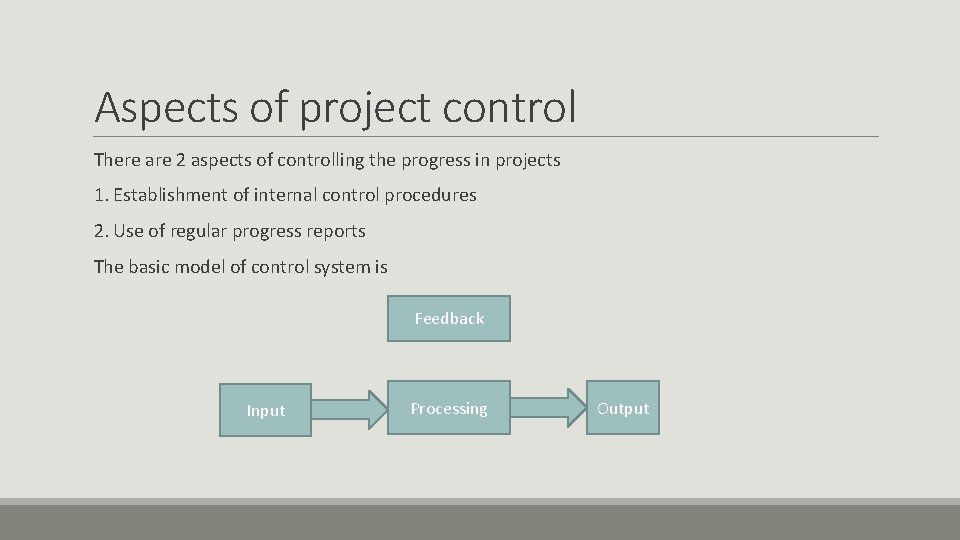
Aspects of project control There are 2 aspects of controlling the progress in projects 1. Establishment of internal control procedures 2. Use of regular progress reports The basic model of control system is Feedback Input Processing Output
Parameters of control Following parameters of the project are required to be regularly reviewed and controlled 1. Objective of the project 2. Sanctioned cost 3. Scheduled data of commissioning 4. Techno- economics Apart from this to effectively control the work, there are several things that must be done §Establish baselines §Monitor status §Forecasts §Variance §analysis
§Alternatives §Assessment of remedy §Responsibility for controlling §Team spirit §Scope of monitoring §Trained personnel §Time interval §Project control with respect to schedule, cost and quality is so important to project success that it must be supported by the entire project staff. Project control may be achieved by fostering a consciousness of cost, schedule and quantity through the project, visible, emphasizing their importance at every opportunity.
Progress control §The purpose of project control is to examine the progress on all key dimensions of the project, to determine whether or not project goals are likely to be met as documented in the project development plan. §In progress control of a project, cost is not only the factor that should be kept under consideration. But management must be able to control other aspects such as man hours, material requirements and time taken. The lapses of time, budget are still acceptable as long as they are within limits §The purpose of project control is to track all major project variables such as cost, time, scope and quality, and ensure that the team is making satisfactory progress to project goals.
Performance control It starts with identification of performance parameters such as output, raw materials, consumption and power consumption per unit of production. It helps organizations understand how decision making processes or practices led to success or failure in the past and how that understanding can lead to future improvements. Effective performance management system include: §Clearly defined, actionable and measurable goals §Establishing baselines §Accurate, repeatable and verifiable data §Feedback system §Timely §Relate to mission outcome §Cost effective
Configuration management and change control It is the process of controlling and documenting change to a developing system. It allows large teams to work together in a stable environment while still providing the flexibility required for creative work. Configuration management has three major purposes: §Identify the configuration of the product at various points of time. §Systematically control changes to the configuration. §Maintain the integrity and tractability of the configuration through the product life cycle. The process of change control is to identify, evaluate, priority and control changes to the project. When project is underway then the changes has to be made if there is any request from any project member or stakeholder.
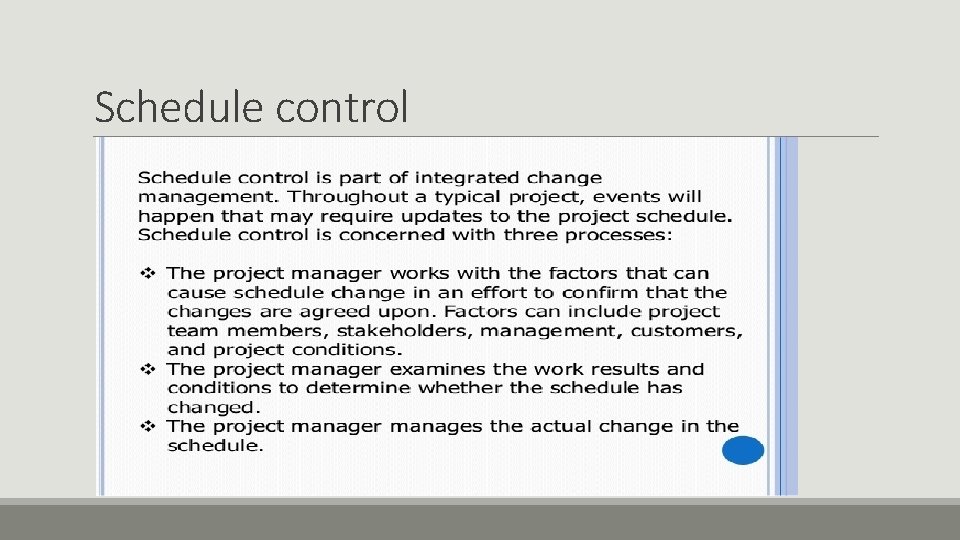
Schedule control
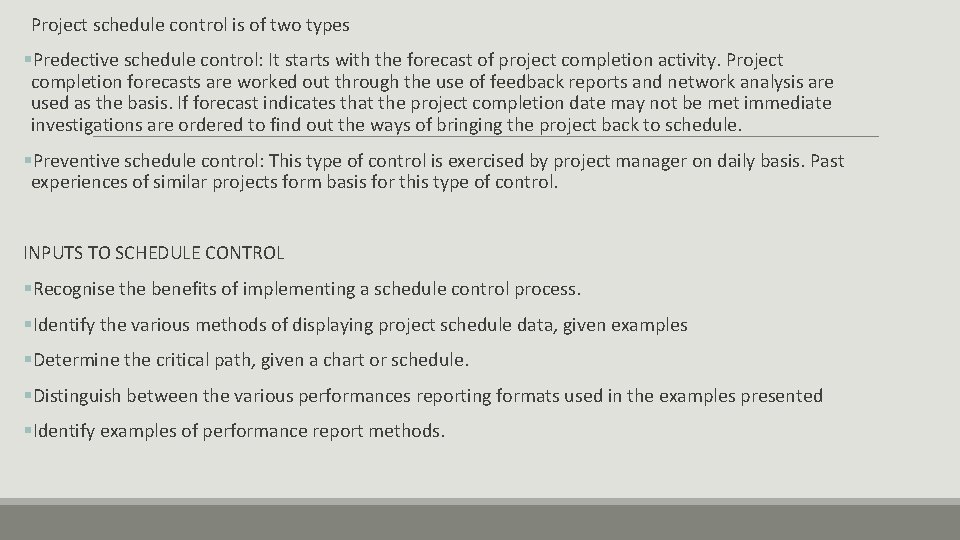
Project schedule control is of two types §Predective schedule control: It starts with the forecast of project completion activity. Project completion forecasts are worked out through the use of feedback reports and network analysis are used as the basis. If forecast indicates that the project completion date may not be met immediate investigations are ordered to find out the ways of bringing the project back to schedule. §Preventive schedule control: This type of control is exercised by project manager on daily basis. Past experiences of similar projects form basis for this type of control. INPUTS TO SCHEDULE CONTROL §Recognise the benefits of implementing a schedule control process. §Identify the various methods of displaying project schedule data, given examples §Determine the critical path, given a chart or schedule. §Distinguish between the various performances reporting formats used in the examples presented §Identify examples of performance report methods.
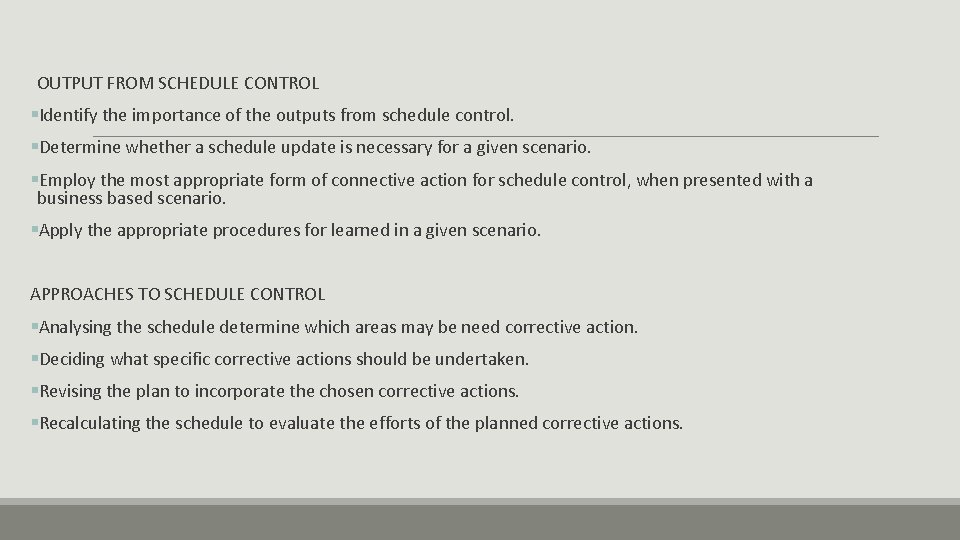
OUTPUT FROM SCHEDULE CONTROL §Identify the importance of the outputs from schedule control. §Determine whether a schedule update is necessary for a given scenario. §Employ the most appropriate form of connective action for schedule control, when presented with a business based scenario. §Apply the appropriate procedures for learned in a given scenario. APPROACHES TO SCHEDULE CONTROL §Analysing the schedule determine which areas may be need corrective action. §Deciding what specific corrective actions should be undertaken. §Revising the plan to incorporate the chosen corrective actions. §Recalculating the schedule to evaluate the efforts of the planned corrective actions.
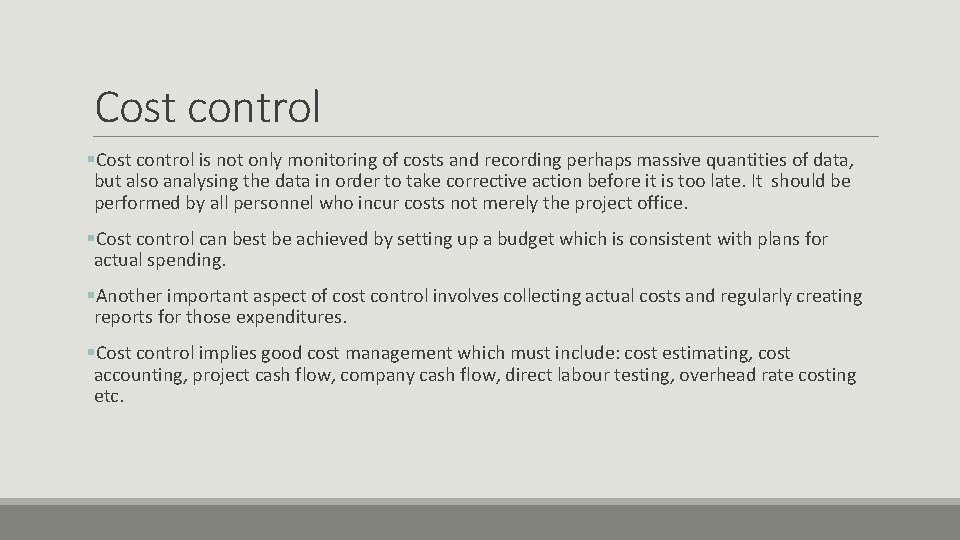
Cost control §Cost control is not only monitoring of costs and recording perhaps massive quantities of data, but also analysing the data in order to take corrective action before it is too late. It should be performed by all personnel who incur costs not merely the project office. §Cost control can best be achieved by setting up a budget which is consistent with plans for actual spending. §Another important aspect of cost control involves collecting actual costs and regularly creating reports for those expenditures. §Cost control implies good cost management which must include: cost estimating, cost accounting, project cash flow, company cash flow, direct labour testing, overhead rate costing etc.
§Effective cost control depend on various factors: cost for casting, realistic estimates, maintain contingencies, pricing the project, working capital management. §Cost control problems: poor estimating techniques, inadequate work breakdown structure, no management policy on reporting and control practices, unforeseen technical problems, poor comparison of actual and planned costs, schedule delays, inadequate formal planning, management reducing budgets etc.