
Project Communications Management PMP Prep Course PMBOK 4
Project Communications Management PMP Prep Course – PMBOK 4 th Edition – Version 2. 0 PMP Study Group Communications Management © 2010 Long Island Chapter of the Project Management Institute ALL RIGHTS RESERVED
Project Communications Management PMP Prep Course – PMBOK 4 th Edition – Version 2. 0 Project Communications Management Definition Project Communications Management includes the processes required to ensure timely and appropriate generation, collection, distribution, storage, retrieval, and ultimate disposition of project information. PMBo. K® Guide, 4 th Edition, Glossary © 2010 Long Island Chapter of the Project Management Institute ALL RIGHTS RESERVED 2
Project Communications Management PMP Prep Course – PMBOK 4 th Edition – Version 2. 0 General Key Notes Project Manager Role: Communications Management • • • Employ a proactive, structured approach to ensure proper stakeholder communication needs are addressed. Approach should support overall goal of maximizing probability of project success (i. e. keep the project momentum continuing forward. ) Note: PM’s spend over 90 percent of their time communicating. © 2010 Long Island Chapter of the Project Management Institute ALL RIGHTS RESERVED 3
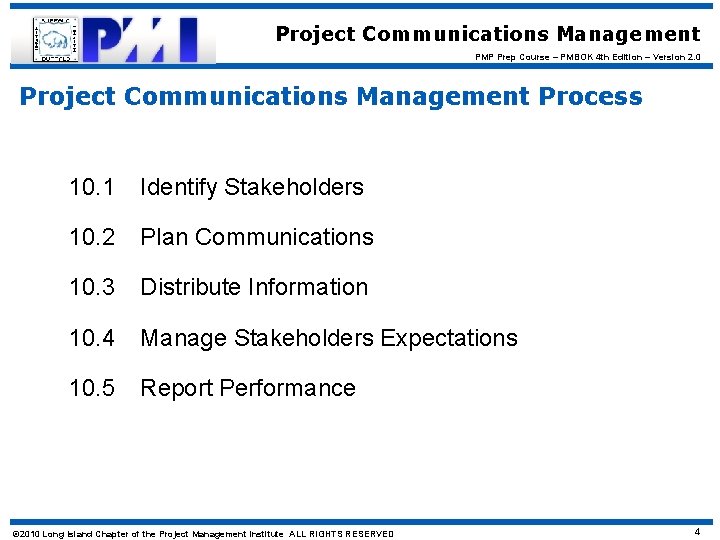
Project Communications Management PMP Prep Course – PMBOK 4 th Edition – Version 2. 0 Project Communications Management Process 10. 1 Identify Stakeholders 10. 2 Plan Communications 10. 3 Distribute Information 10. 4 Manage Stakeholders Expectations 10. 5 Report Performance © 2010 Long Island Chapter of the Project Management Institute ALL RIGHTS RESERVED 4
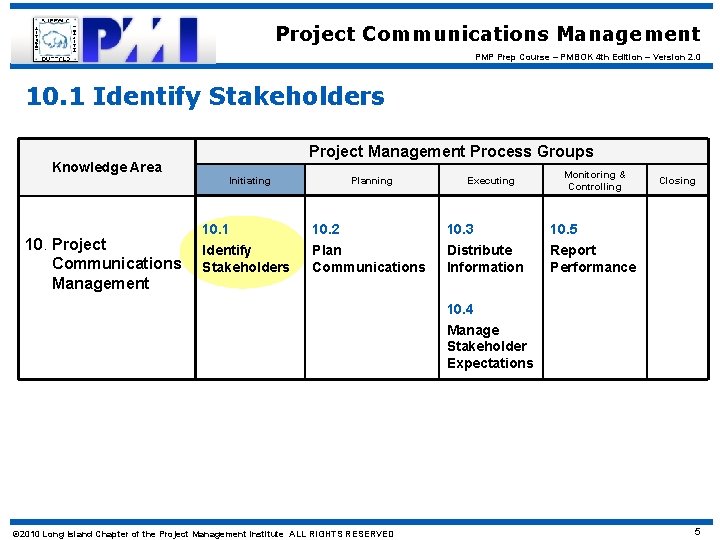
Project Communications Management PMP Prep Course – PMBOK 4 th Edition – Version 2. 0 10. 1 Identify Stakeholders Knowledge Area 10. Project Communications Management Project Management Process Groups Initiating Planning Executing Monitoring & Controlling 10. 1 10. 2 10. 3 10. 5 Identify Stakeholders Plan Communications Distribute Information Report Performance Closing 10. 4 Manage Stakeholder Expectations © 2010 Long Island Chapter of the Project Management Institute ALL RIGHTS RESERVED 5
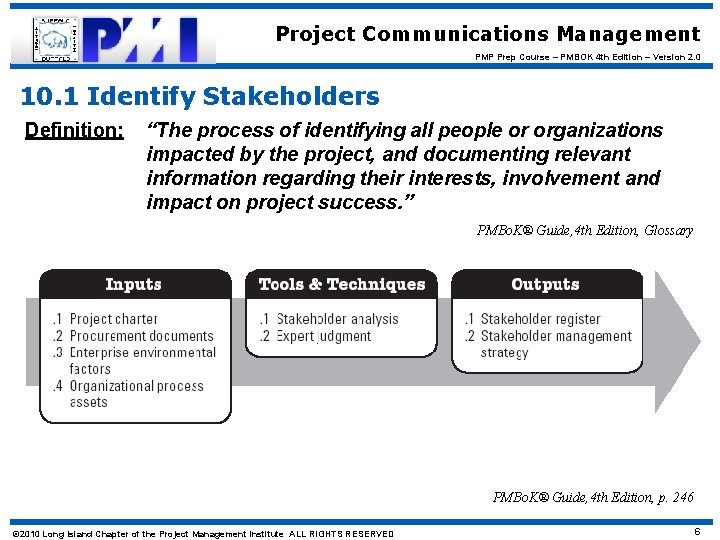
Project Communications Management PMP Prep Course – PMBOK 4 th Edition – Version 2. 0 10. 1 Identify Stakeholders Definition: “The process of identifying all people or organizations impacted by the project, and documenting relevant information regarding their interests, involvement and impact on project success. ” PMBo. K® Guide, 4 th Edition, Glossary PMBo. K® Guide, 4 th Edition, p. 246 © 2010 Long Island Chapter of the Project Management Institute ALL RIGHTS RESERVED 6
Project Communications Management PMP Prep Course – PMBOK 4 th Edition – Version 2. 0 Who are Project Stakeholders? Ø “Person or organization actively involved in the project or whose interest may be positively or negatively affected by execution or completion of project”. PMBo. K® Guide, 4 th Edition, Glossary Ø Can be categorized by: ü ü ü Influence = active involvement Power = authority Interest = level of concern Impact = ability to affect changes Salience = power, urgency, and legitimacy Study Tip - For stakeholder identification questions, look for the most inclusive listing/response. © 2010 Long Island Chapter of the Project Management Institute ALL RIGHTS RESERVED 7
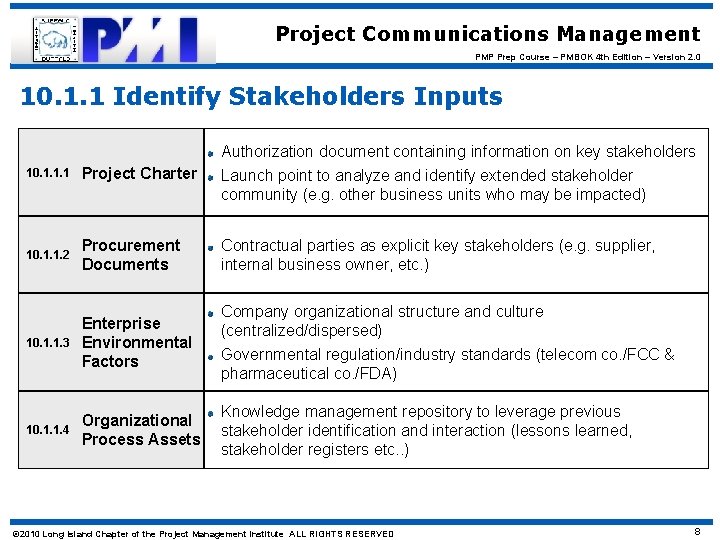
Project Communications Management PMP Prep Course – PMBOK 4 th Edition – Version 2. 0 10. 1. 1 Identify Stakeholders Inputs 10. 1. 1. 1 Project Charter Authorization document containing information on key stakeholders Launch point to analyze and identify extended stakeholder community (e. g. other business units who may be impacted) 10. 1. 1. 2 Procurement Documents Contractual parties as explicit key stakeholders (e. g. supplier, internal business owner, etc. ) 10. 1. 1. 3 Enterprise Environmental Factors 10. 1. 1. 4 Organizational Process Assets Company organizational structure and culture (centralized/dispersed) Governmental regulation/industry standards (telecom co. /FCC & pharmaceutical co. /FDA) Knowledge management repository to leverage previous stakeholder identification and interaction (lessons learned, stakeholder registers etc. . ) © 2010 Long Island Chapter of the Project Management Institute ALL RIGHTS RESERVED 8
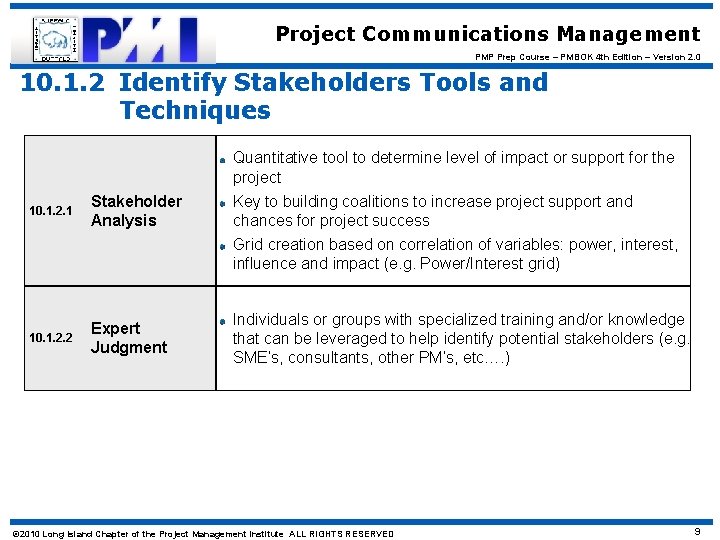
Project Communications Management PMP Prep Course – PMBOK 4 th Edition – Version 2. 0 10. 1. 2 Identify Stakeholders Tools and Techniques Quantitative tool to determine level of impact or support for the project 10. 1. 2. 1 Stakeholder Analysis Key to building coalitions to increase project support and chances for project success Grid creation based on correlation of variables: power, interest, influence and impact (e. g. Power/Interest grid) 10. 1. 2. 2 Expert Judgment Individuals or groups with specialized training and/or knowledge that can be leveraged to help identify potential stakeholders (e. g. SME’s, consultants, other PM’s, etc…. ) © 2010 Long Island Chapter of the Project Management Institute ALL RIGHTS RESERVED 9
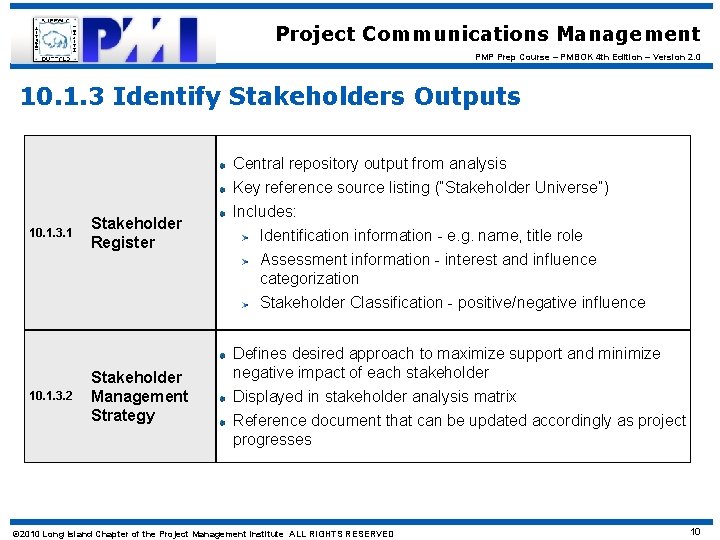
Project Communications Management PMP Prep Course – PMBOK 4 th Edition – Version 2. 0 10. 1. 3 Identify Stakeholders Outputs Central repository output from analysis Key reference source listing (“Stakeholder Universe”) 10. 1. 3. 1 10. 1. 3. 2 Stakeholder Register Stakeholder Management Strategy Includes: Identification information - e. g. name, title role Assessment information - interest and influence categorization Stakeholder Classification - positive/negative influence Defines desired approach to maximize support and minimize negative impact of each stakeholder Displayed in stakeholder analysis matrix Reference document that can be updated accordingly as project progresses © 2010 Long Island Chapter of the Project Management Institute ALL RIGHTS RESERVED 10
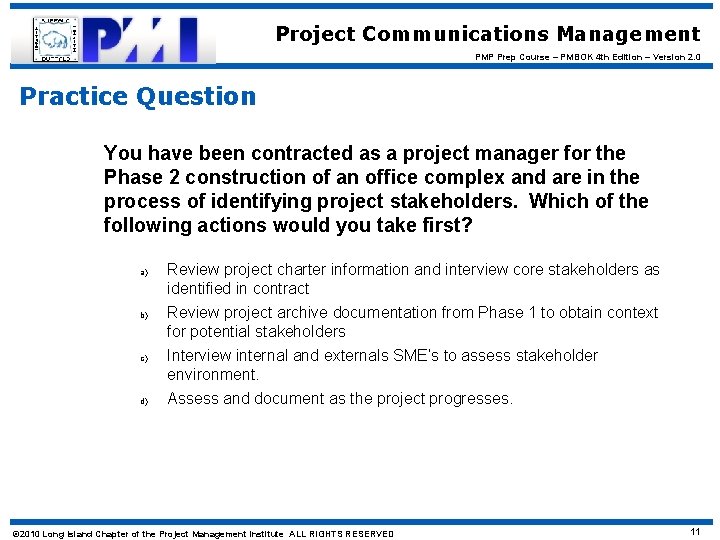
Project Communications Management PMP Prep Course – PMBOK 4 th Edition – Version 2. 0 Practice Question You have been contracted as a project manager for the Phase 2 construction of an office complex and are in the process of identifying project stakeholders. Which of the following actions would you take first? a) b) c) d) Review project charter information and interview core stakeholders as identified in contract Review project archive documentation from Phase 1 to obtain context for potential stakeholders Interview internal and externals SME’s to assess stakeholder environment. Assess and document as the project progresses. © 2010 Long Island Chapter of the Project Management Institute ALL RIGHTS RESERVED 11
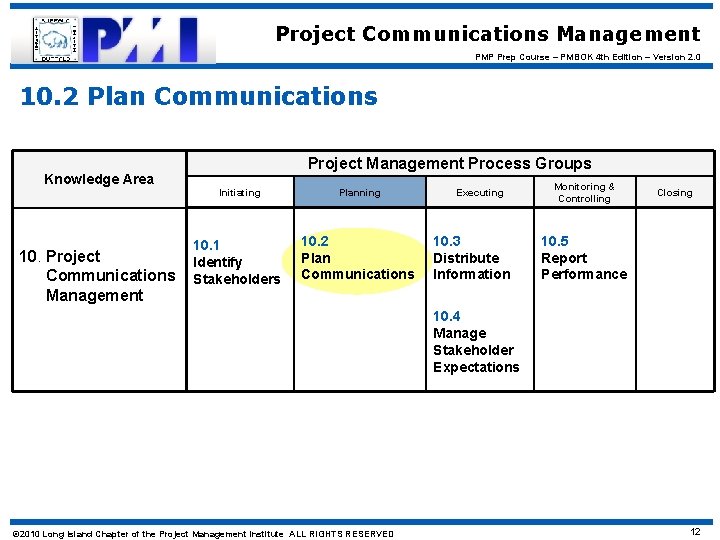
Project Communications Management PMP Prep Course – PMBOK 4 th Edition – Version 2. 0 10. 2 Plan Communications Knowledge Area 10. Project Communications Management Project Management Process Groups Initiating Planning 10. 1 Identify Stakeholders 10. 2 Plan Communications Executing 10. 3 Distribute Information Monitoring & Controlling Closing 10. 5 Report Performance 10. 4 Manage Stakeholder Expectations © 2010 Long Island Chapter of the Project Management Institute ALL RIGHTS RESERVED 12
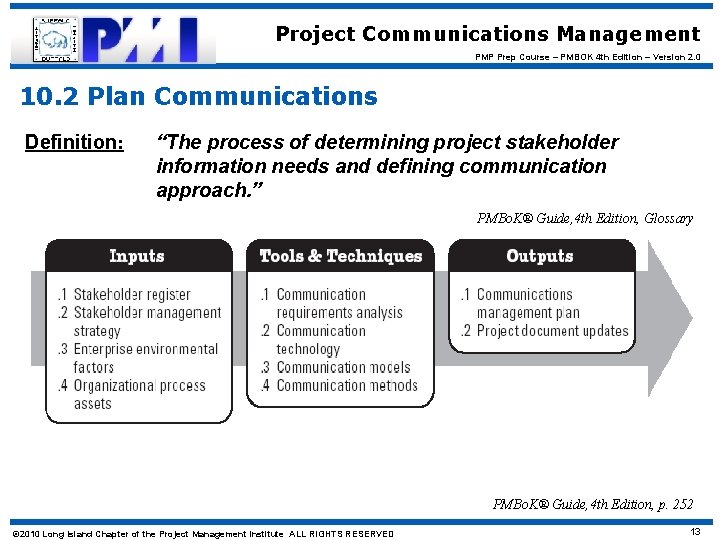
Project Communications Management PMP Prep Course – PMBOK 4 th Edition – Version 2. 0 10. 2 Plan Communications Definition: “The process of determining project stakeholder information needs and defining communication approach. ” PMBo. K® Guide, 4 th Edition, Glossary PMBo. K® Guide, 4 th Edition, p. 252 © 2010 Long Island Chapter of the Project Management Institute ALL RIGHTS RESERVED 13
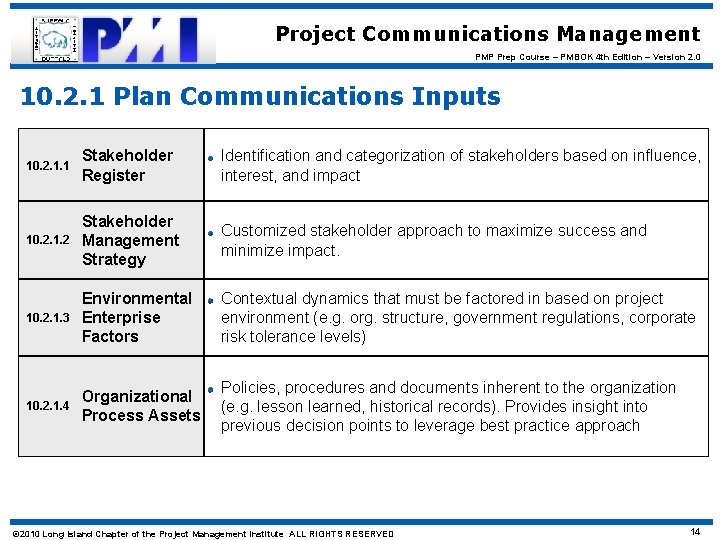
Project Communications Management PMP Prep Course – PMBOK 4 th Edition – Version 2. 0 10. 2. 1 Plan Communications Inputs 10. 2. 1. 1 Stakeholder Register Identification and categorization of stakeholders based on influence, interest, and impact 10. 2. 1. 2 Stakeholder Management Strategy Customized stakeholder approach to maximize success and minimize impact. 10. 2. 1. 3 Environmental Enterprise Factors Contextual dynamics that must be factored in based on project environment (e. g. org. structure, government regulations, corporate risk tolerance levels) 10. 2. 1. 4 Organizational Process Assets Policies, procedures and documents inherent to the organization (e. g. lesson learned, historical records). Provides insight into previous decision points to leverage best practice approach © 2010 Long Island Chapter of the Project Management Institute ALL RIGHTS RESERVED 14
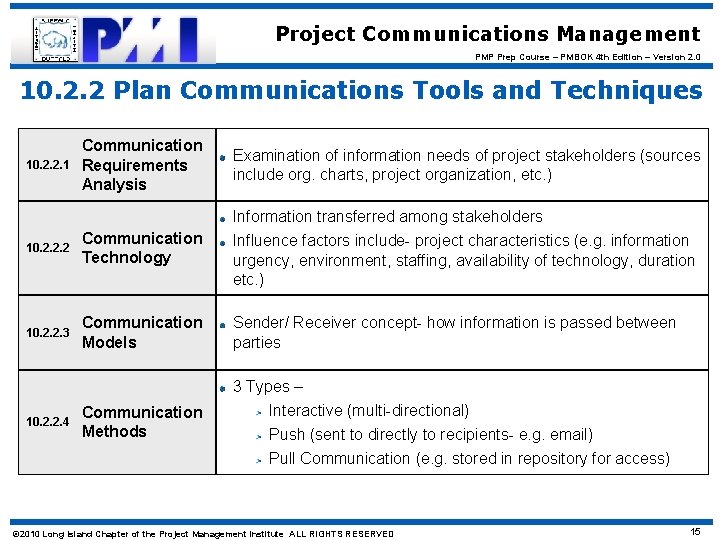
Project Communications Management PMP Prep Course – PMBOK 4 th Edition – Version 2. 0 10. 2. 2 Plan Communications Tools and Techniques Communication Requirements Analysis Examination of information needs of project stakeholders (sources include org. charts, project organization, etc. ) 10. 2. 2. 2 Communication Technology Information transferred among stakeholders Influence factors include- project characteristics (e. g. information urgency, environment, staffing, availability of technology, duration etc. ) 10. 2. 2. 3 Communication Models Sender/ Receiver concept- how information is passed between parties Communication Methods 3 Types – Interactive (multi-directional) Push (sent to directly to recipients- e. g. email) 10. 2. 2. 1 10. 2. 2. 4 Pull Communication (e. g. stored in repository for access) © 2010 Long Island Chapter of the Project Management Institute ALL RIGHTS RESERVED 15
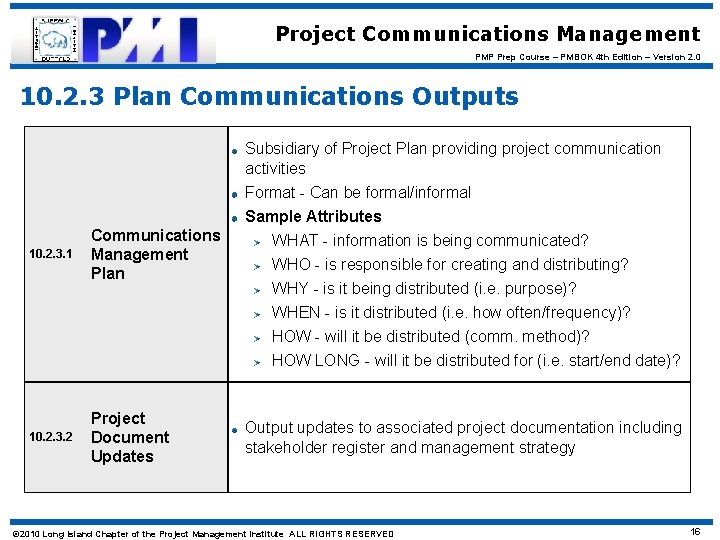
Project Communications Management PMP Prep Course – PMBOK 4 th Edition – Version 2. 0 10. 2. 3 Plan Communications Outputs Subsidiary of Project Plan providing project communication activities Format - Can be formal/informal Sample Attributes 10. 2. 3. 1 Communications Management Plan 10. 2. 3. 2 Project Document Updates WHAT - information is being communicated? WHO - is responsible for creating and distributing? WHY - is it being distributed (i. e. purpose)? WHEN - is it distributed (i. e. how often/frequency)? HOW - will it be distributed (comm. method)? HOW LONG - will it be distributed for (i. e. start/end date)? Output updates to associated project documentation including stakeholder register and management strategy © 2010 Long Island Chapter of the Project Management Institute ALL RIGHTS RESERVED 16
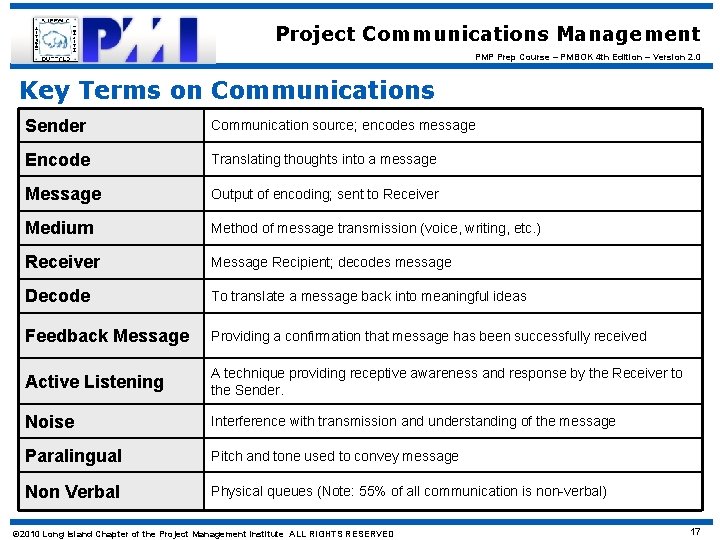
Project Communications Management PMP Prep Course – PMBOK 4 th Edition – Version 2. 0 Key Terms on Communications Sender Communication source; encodes message Encode Translating thoughts into a message Message Output of encoding; sent to Receiver Medium Method of message transmission (voice, writing, etc. ) Receiver Message Recipient; decodes message Decode To translate a message back into meaningful ideas Feedback Message Providing a confirmation that message has been successfully received Active Listening A technique providing receptive awareness and response by the Receiver to the Sender. Noise Interference with transmission and understanding of the message Paralingual Pitch and tone used to convey message Non Verbal Physical queues (Note: 55% of all communication is non-verbal) © 2010 Long Island Chapter of the Project Management Institute ALL RIGHTS RESERVED 17
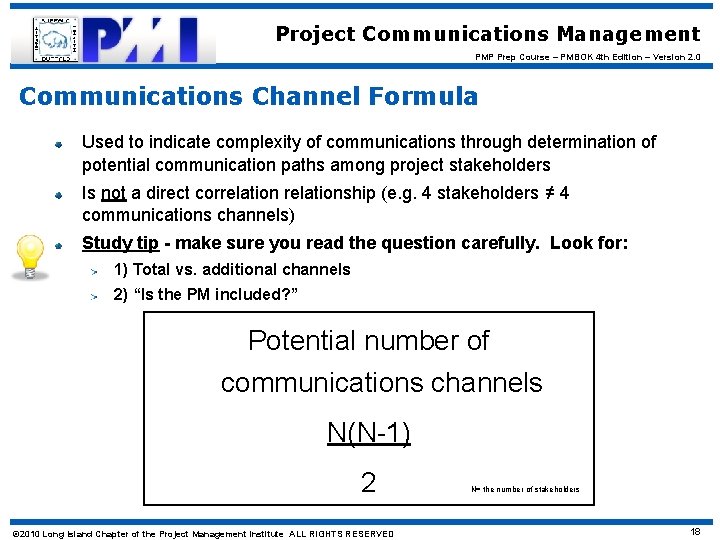
Project Communications Management PMP Prep Course – PMBOK 4 th Edition – Version 2. 0 Communications Channel Formula Used to indicate complexity of communications through determination of potential communication paths among project stakeholders Is not a direct correlationship (e. g. 4 stakeholders ≠ 4 communications channels) Study tip - make sure you read the question carefully. Look for: 1) Total vs. additional channels 2) “Is the PM included? ” Potential number of communications channels N(N-1) 2 © 2010 Long Island Chapter of the Project Management Institute ALL RIGHTS RESERVED N= the number of stakeholders 18
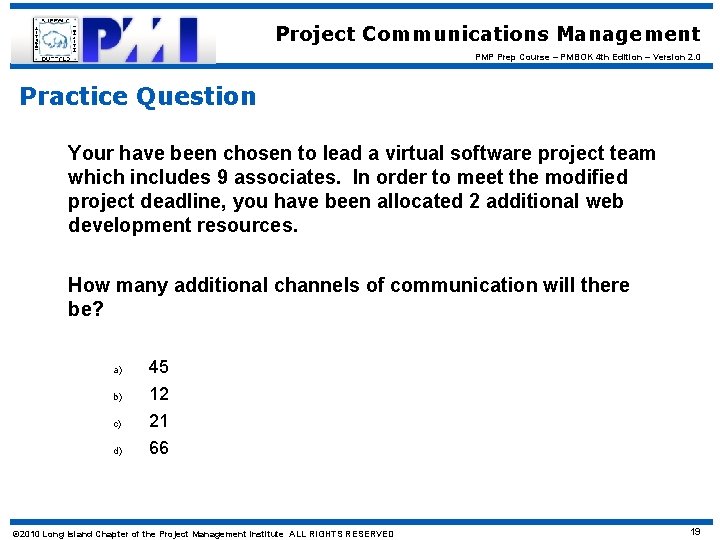
Project Communications Management PMP Prep Course – PMBOK 4 th Edition – Version 2. 0 Practice Question Your have been chosen to lead a virtual software project team which includes 9 associates. In order to meet the modified project deadline, you have been allocated 2 additional web development resources. How many additional channels of communication will there be? a) b) c) d) 45 12 21 66 © 2010 Long Island Chapter of the Project Management Institute ALL RIGHTS RESERVED 19
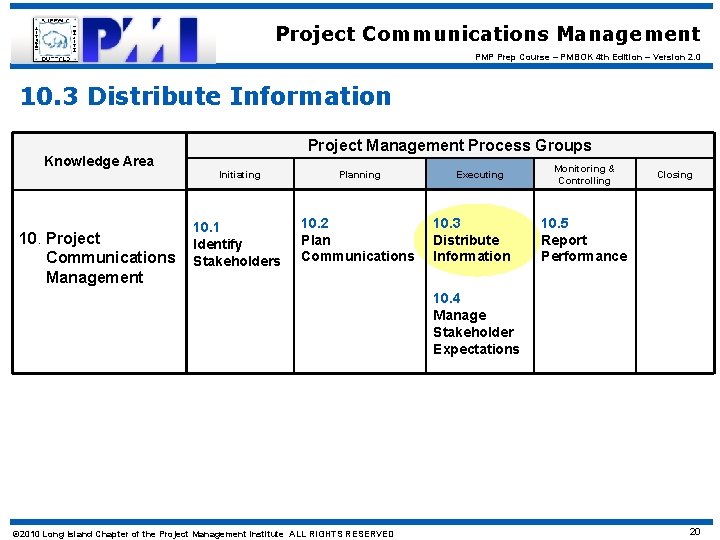
Project Communications Management PMP Prep Course – PMBOK 4 th Edition – Version 2. 0 10. 3 Distribute Information Knowledge Area 10. Project Communications Management Project Management Process Groups Initiating Planning 10. 1 Identify Stakeholders 10. 2 Plan Communications Executing 10. 3 Distribute Information Monitoring & Controlling Closing 10. 5 Report Performance 10. 4 Manage Stakeholder Expectations © 2010 Long Island Chapter of the Project Management Institute ALL RIGHTS RESERVED 20
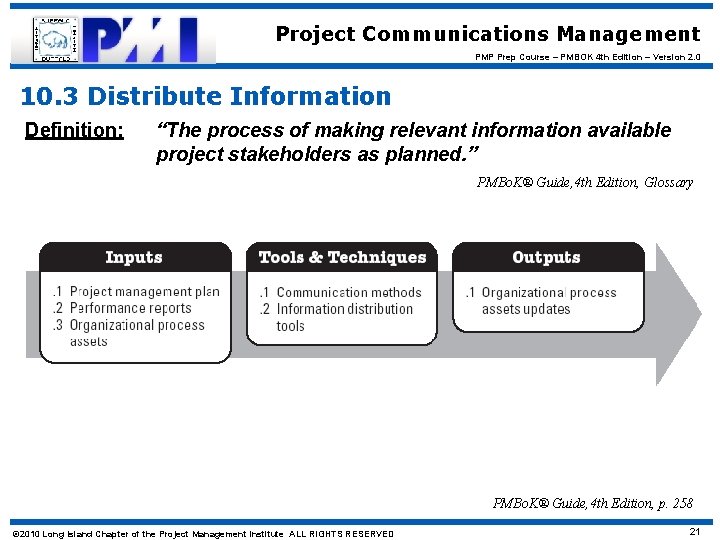
Project Communications Management PMP Prep Course – PMBOK 4 th Edition – Version 2. 0 10. 3 Distribute Information Definition: “The process of making relevant information available project stakeholders as planned. ” PMBo. K® Guide, 4 th Edition, Glossary PMBo. K® Guide, 4 th Edition, p. 258 © 2010 Long Island Chapter of the Project Management Institute ALL RIGHTS RESERVED 21
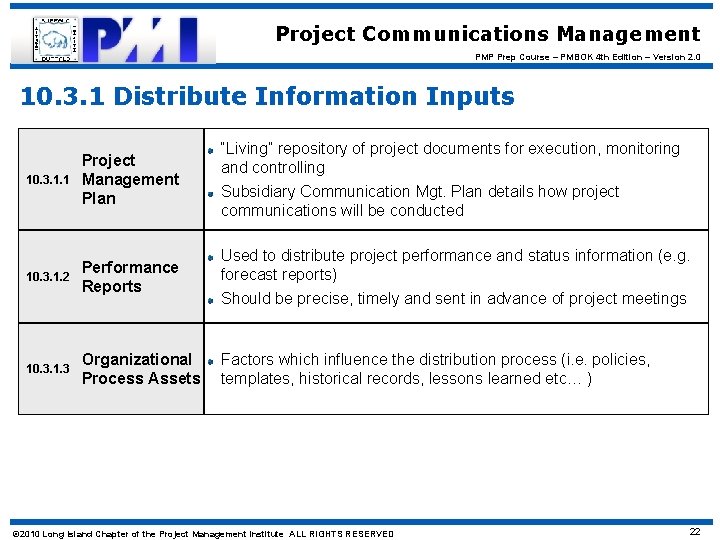
Project Communications Management PMP Prep Course – PMBOK 4 th Edition – Version 2. 0 10. 3. 1 Distribute Information Inputs 10. 3. 1. 1 Project Management Plan 10. 3. 1. 2 Performance Reports 10. 3. 1. 3 Organizational Process Assets “Living” repository of project documents for execution, monitoring and controlling Subsidiary Communication Mgt. Plan details how project communications will be conducted Used to distribute project performance and status information (e. g. forecast reports) Should be precise, timely and sent in advance of project meetings Factors which influence the distribution process (i. e. policies, templates, historical records, lessons learned etc… ) © 2010 Long Island Chapter of the Project Management Institute ALL RIGHTS RESERVED 22
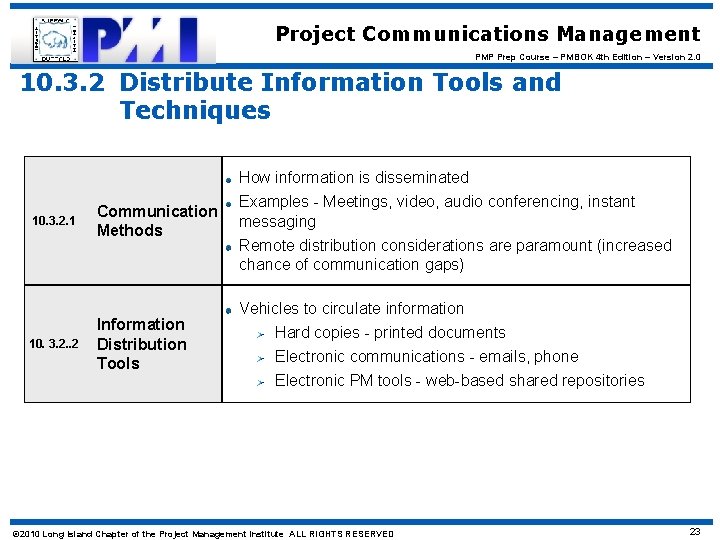
Project Communications Management PMP Prep Course – PMBOK 4 th Edition – Version 2. 0 10. 3. 2 Distribute Information Tools and Techniques 10. 3. 2. 1 10. 3. 2. . 2 Communication Methods Information Distribution Tools How information is disseminated Examples - Meetings, video, audio conferencing, instant messaging Remote distribution considerations are paramount (increased chance of communication gaps) Vehicles to circulate information Hard copies - printed documents Electronic communications - emails, phone Electronic PM tools - web-based shared repositories © 2010 Long Island Chapter of the Project Management Institute ALL RIGHTS RESERVED 23
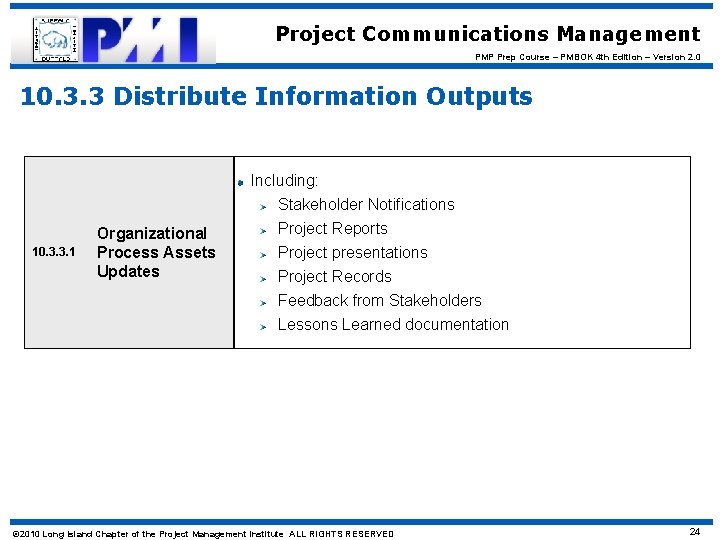
Project Communications Management PMP Prep Course – PMBOK 4 th Edition – Version 2. 0 10. 3. 3 Distribute Information Outputs 10. 3. 3. 1 Organizational Process Assets Updates Including: Stakeholder Notifications Project Reports Project presentations Project Records Feedback from Stakeholders Lessons Learned documentation © 2010 Long Island Chapter of the Project Management Institute ALL RIGHTS RESERVED 24
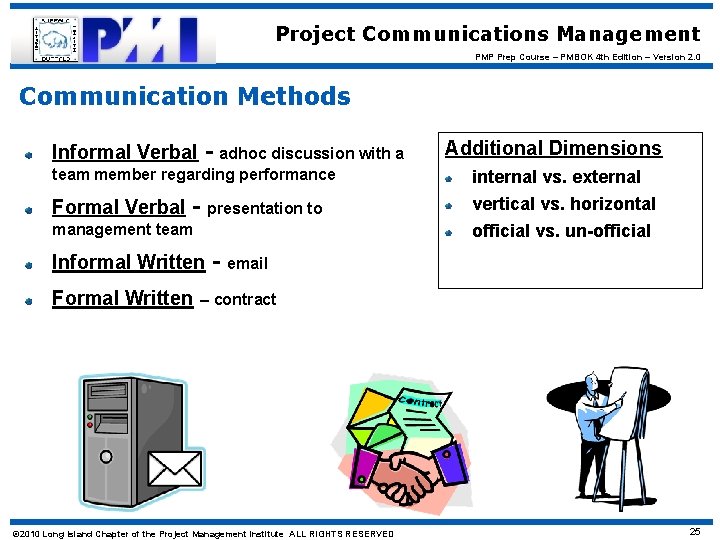
Project Communications Management PMP Prep Course – PMBOK 4 th Edition – Version 2. 0 Communication Methods Informal Verbal - adhoc discussion with a team member regarding performance Formal Verbal - presentation to internal vs. external vertical vs. horizontal official vs. un-official management team Informal Written Formal Written Additional Dimensions - email – contract © 2010 Long Island Chapter of the Project Management Institute ALL RIGHTS RESERVED 25
Project Communications Management PMP Prep Course – PMBOK 4 th Edition – Version 2. 0 Practice Question As a result of the Distribute Information process, all of the following organizational process assets can be updated except _____. a) b) c) d) Lessons learned documentation Project Charter Project Presentations Stakeholder Notifications © 2010 Long Island Chapter of the Project Management Institute ALL RIGHTS RESERVED 26
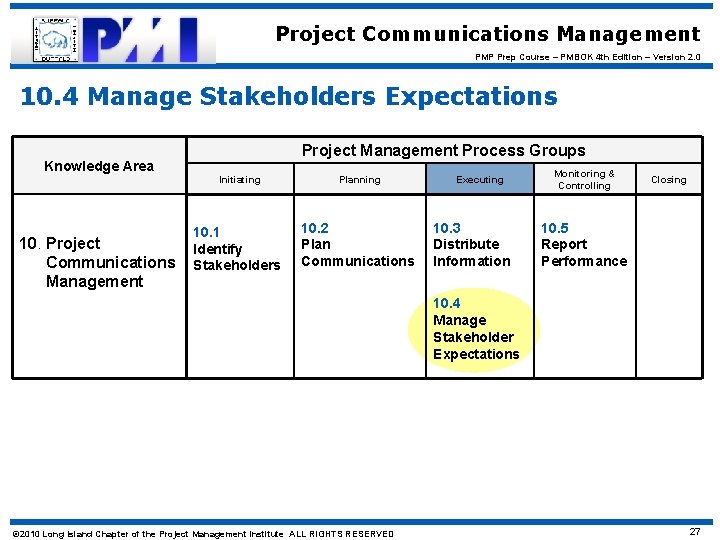
Project Communications Management PMP Prep Course – PMBOK 4 th Edition – Version 2. 0 10. 4 Manage Stakeholders Expectations Knowledge Area 10. Project Communications Management Project Management Process Groups Initiating Planning 10. 1 Identify Stakeholders 10. 2 Plan Communications Executing 10. 3 Distribute Information Monitoring & Controlling Closing 10. 5 Report Performance 10. 4 Manage Stakeholder Expectations © 2010 Long Island Chapter of the Project Management Institute ALL RIGHTS RESERVED 27
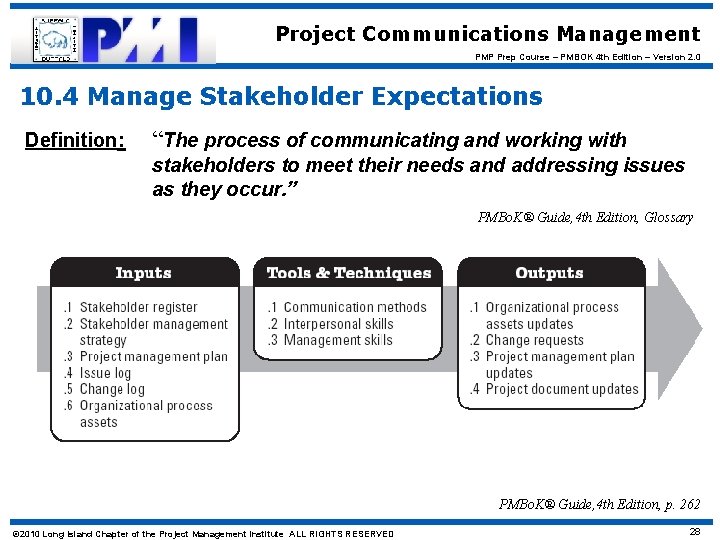
Project Communications Management PMP Prep Course – PMBOK 4 th Edition – Version 2. 0 10. 4 Manage Stakeholder Expectations Definition: “The process of communicating and working with stakeholders to meet their needs and addressing issues as they occur. ” PMBo. K® Guide, 4 th Edition, Glossary PMBo. K® Guide, 4 th Edition, p. 262 © 2010 Long Island Chapter of the Project Management Institute ALL RIGHTS RESERVED 28
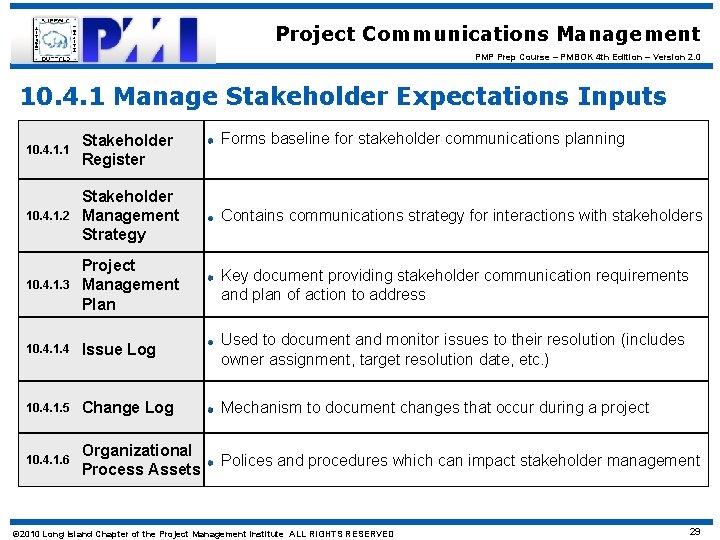
Project Communications Management PMP Prep Course – PMBOK 4 th Edition – Version 2. 0 10. 4. 1 Manage Stakeholder Expectations Inputs Forms baseline for stakeholder communications planning 10. 4. 1. 1 Stakeholder Register 10. 4. 1. 2 Stakeholder Management Strategy Contains communications strategy for interactions with stakeholders 10. 4. 1. 3 Project Management Plan Key document providing stakeholder communication requirements and plan of action to address 10. 4. 1. 4 Issue Log Used to document and monitor issues to their resolution (includes owner assignment, target resolution date, etc. ) 10. 4. 1. 5 Change Log Mechanism to document changes that occur during a project 10. 4. 1. 6 Organizational Process Assets Polices and procedures which can impact stakeholder management © 2010 Long Island Chapter of the Project Management Institute ALL RIGHTS RESERVED 29
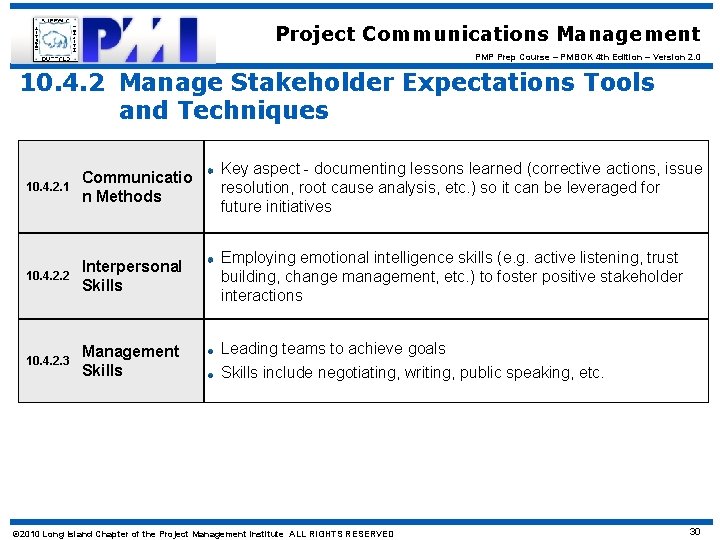
Project Communications Management PMP Prep Course – PMBOK 4 th Edition – Version 2. 0 10. 4. 2 Manage Stakeholder Expectations Tools and Techniques 10. 4. 2. 1 Communicatio n Methods Key aspect - documenting lessons learned (corrective actions, issue resolution, root cause analysis, etc. ) so it can be leveraged for future initiatives 10. 4. 2. 2 Interpersonal Skills Employing emotional intelligence skills (e. g. active listening, trust building, change management, etc. ) to foster positive stakeholder interactions 10. 4. 2. 3 Management Skills Leading teams to achieve goals Skills include negotiating, writing, public speaking, etc. © 2010 Long Island Chapter of the Project Management Institute ALL RIGHTS RESERVED 30
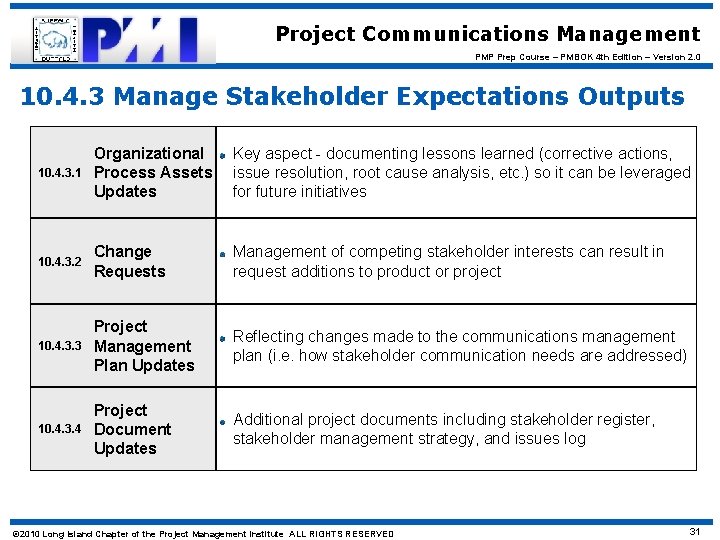
Project Communications Management PMP Prep Course – PMBOK 4 th Edition – Version 2. 0 10. 4. 3 Manage Stakeholder Expectations Outputs 10. 4. 3. 1 Organizational Process Assets Updates Key aspect - documenting lessons learned (corrective actions, issue resolution, root cause analysis, etc. ) so it can be leveraged for future initiatives 10. 4. 3. 2 Change Requests Management of competing stakeholder interests can result in request additions to product or project 10. 4. 3. 3 Project Management Plan Updates Reflecting changes made to the communications management plan (i. e. how stakeholder communication needs are addressed) 10. 4. 3. 4 Project Document Updates Additional project documents including stakeholder register, stakeholder management strategy, and issues log © 2010 Long Island Chapter of the Project Management Institute ALL RIGHTS RESERVED 31
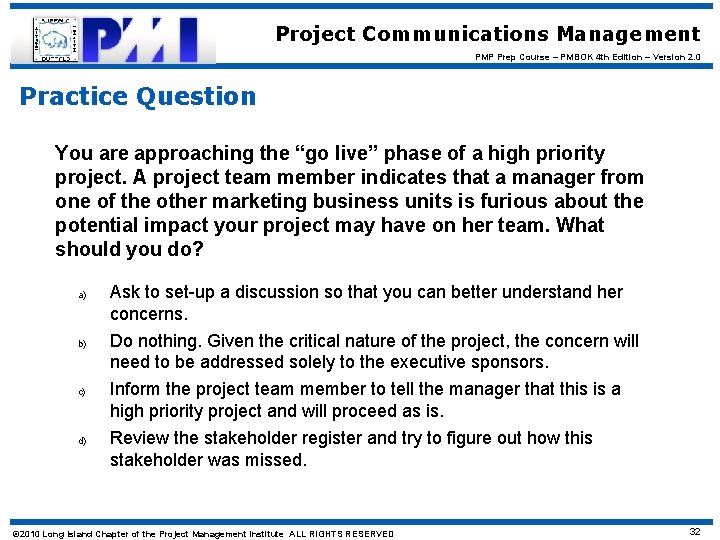
Project Communications Management PMP Prep Course – PMBOK 4 th Edition – Version 2. 0 Practice Question You are approaching the “go live” phase of a high priority project. A project team member indicates that a manager from one of the other marketing business units is furious about the potential impact your project may have on her team. What should you do? a) b) c) d) Ask to set-up a discussion so that you can better understand her concerns. Do nothing. Given the critical nature of the project, the concern will need to be addressed solely to the executive sponsors. Inform the project team member to tell the manager that this is a high priority project and will proceed as is. Review the stakeholder register and try to figure out how this stakeholder was missed. © 2010 Long Island Chapter of the Project Management Institute ALL RIGHTS RESERVED 32
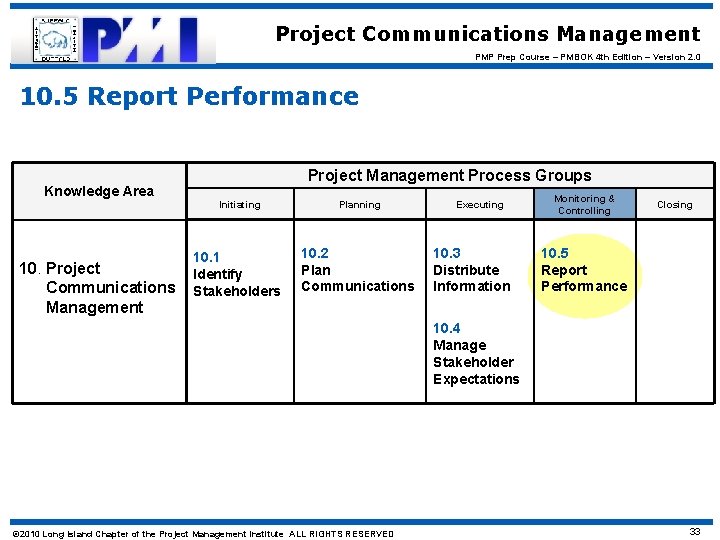
Project Communications Management PMP Prep Course – PMBOK 4 th Edition – Version 2. 0 10. 5 Report Performance Knowledge Area 10. Project Communications Management Project Management Process Groups Initiating Planning 10. 1 Identify Stakeholders 10. 2 Plan Communications Executing 10. 3 Distribute Information Monitoring & Controlling Closing 10. 5 Report Performance 10. 4 Manage Stakeholder Expectations © 2010 Long Island Chapter of the Project Management Institute ALL RIGHTS RESERVED 33
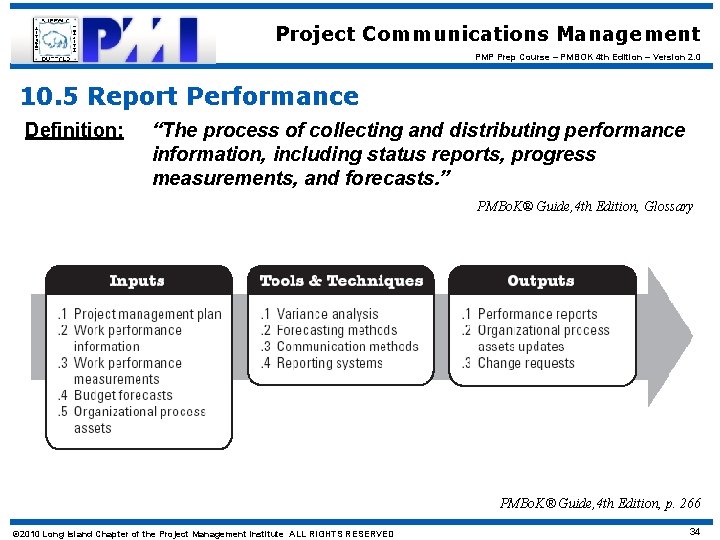
Project Communications Management PMP Prep Course – PMBOK 4 th Edition – Version 2. 0 10. 5 Report Performance Definition: “The process of collecting and distributing performance information, including status reports, progress measurements, and forecasts. ” PMBo. K® Guide, 4 th Edition, Glossary PMBo. K® Guide, 4 th Edition, p. 266 © 2010 Long Island Chapter of the Project Management Institute ALL RIGHTS RESERVED 34
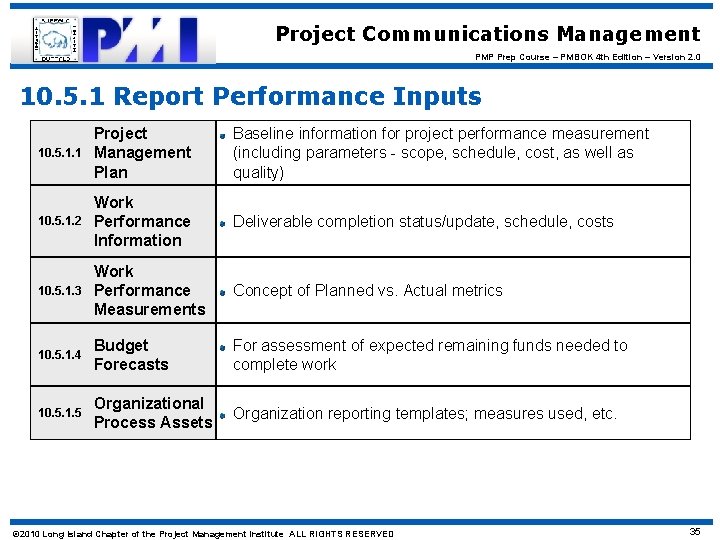
Project Communications Management PMP Prep Course – PMBOK 4 th Edition – Version 2. 0 10. 5. 1 Report Performance Inputs 10. 5. 1. 1 Project Management Plan Baseline information for project performance measurement (including parameters - scope, schedule, cost, as well as quality) 10. 5. 1. 2 Work Performance Information Deliverable completion status/update, schedule, costs 10. 5. 1. 3 Work Performance Measurements Concept of Planned vs. Actual metrics 10. 5. 1. 4 Budget Forecasts For assessment of expected remaining funds needed to complete work 10. 5. 1. 5 Organizational Process Assets Organization reporting templates; measures used, etc. © 2010 Long Island Chapter of the Project Management Institute ALL RIGHTS RESERVED 35
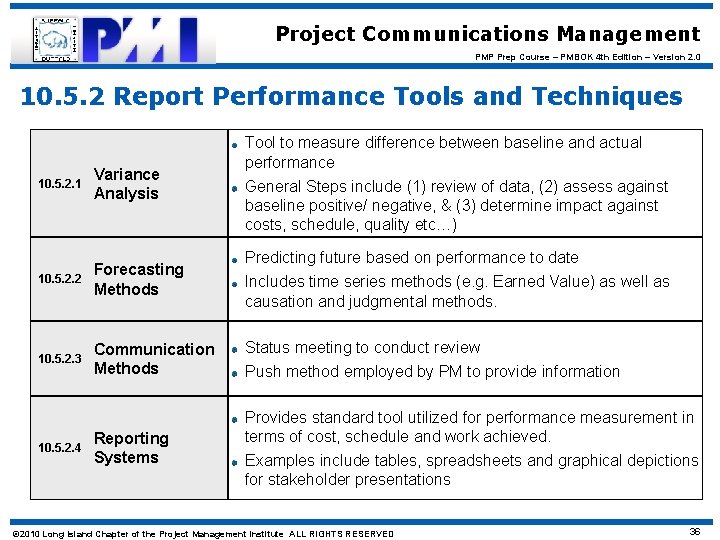
Project Communications Management PMP Prep Course – PMBOK 4 th Edition – Version 2. 0 10. 5. 2 Report Performance Tools and Techniques Tool to measure difference between baseline and actual performance 10. 5. 2. 1 Variance Analysis 10. 5. 2. 2 Forecasting Methods Predicting future based on performance to date Includes time series methods (e. g. Earned Value) as well as causation and judgmental methods. 10. 5. 2. 3 Communication Methods Status meeting to conduct review Push method employed by PM to provide information 10. 5. 2. 4 Reporting Systems General Steps include (1) review of data, (2) assess against baseline positive/ negative, & (3) determine impact against costs, schedule, quality etc…) Provides standard tool utilized for performance measurement in terms of cost, schedule and work achieved. Examples include tables, spreadsheets and graphical depictions for stakeholder presentations © 2010 Long Island Chapter of the Project Management Institute ALL RIGHTS RESERVED 36
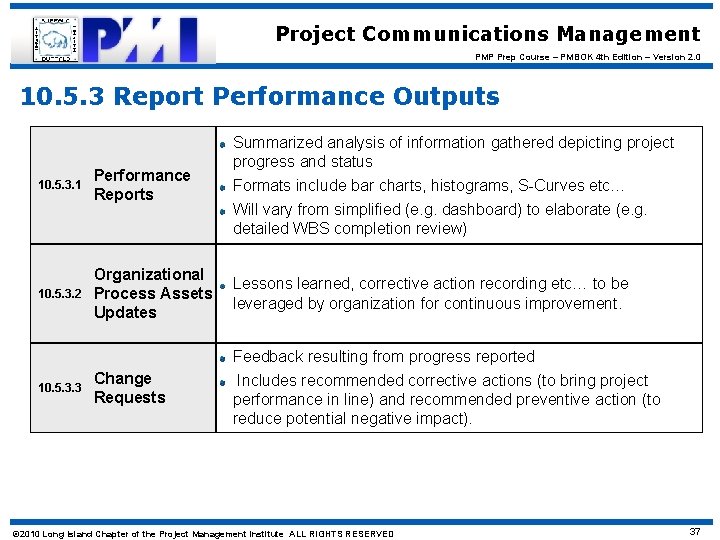
Project Communications Management PMP Prep Course – PMBOK 4 th Edition – Version 2. 0 10. 5. 3 Report Performance Outputs 10. 5. 3. 1 10. 5. 3. 2 10. 5. 3. 3 Performance Reports Summarized analysis of information gathered depicting project progress and status Formats include bar charts, histograms, S-Curves etc… Will vary from simplified (e. g. dashboard) to elaborate (e. g. detailed WBS completion review) Organizational Process Assets Updates Lessons learned, corrective action recording etc… to be leveraged by organization for continuous improvement. Change Requests Feedback resulting from progress reported Includes recommended corrective actions (to bring project performance in line) and recommended preventive action (to reduce potential negative impact). © 2010 Long Island Chapter of the Project Management Institute ALL RIGHTS RESERVED 37
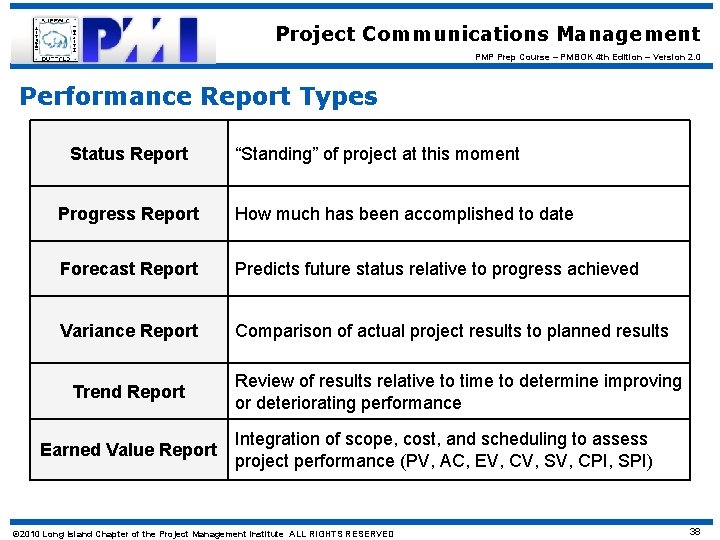
Project Communications Management PMP Prep Course – PMBOK 4 th Edition – Version 2. 0 Performance Report Types Status Report “Standing” of project at this moment Progress Report How much has been accomplished to date Forecast Report Predicts future status relative to progress achieved Variance Report Comparison of actual project results to planned results Trend Report Earned Value Report Review of results relative to time to determine improving or deteriorating performance Integration of scope, cost, and scheduling to assess project performance (PV, AC, EV, CV, SV, CPI, SPI) © 2010 Long Island Chapter of the Project Management Institute ALL RIGHTS RESERVED 38
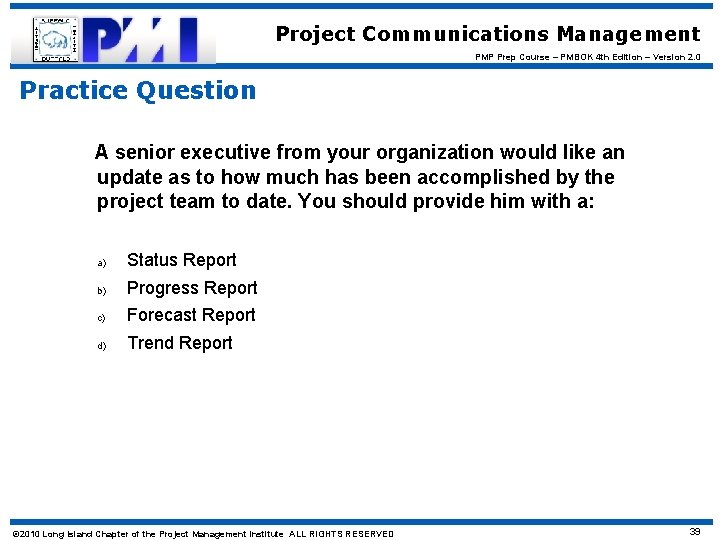
Project Communications Management PMP Prep Course – PMBOK 4 th Edition – Version 2. 0 Practice Question A senior executive from your organization would like an update as to how much has been accomplished by the project team to date. You should provide him with a: a) Status Report b) Progress Report c) Forecast Report d) Trend Report © 2010 Long Island Chapter of the Project Management Institute ALL RIGHTS RESERVED 39
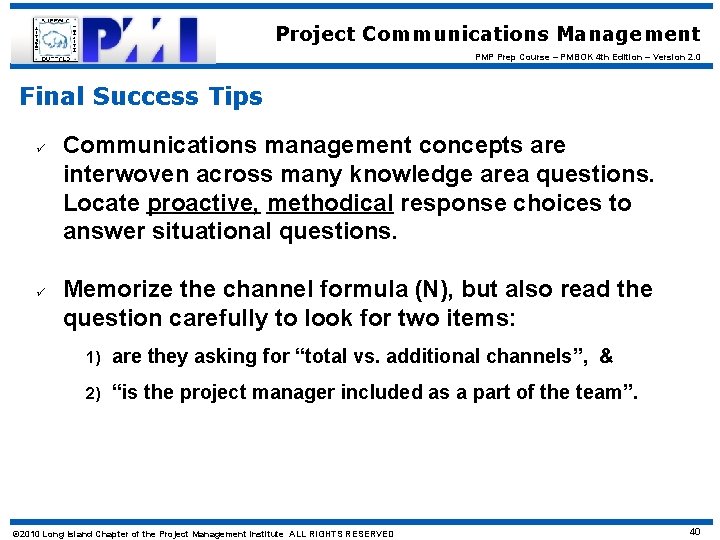
Project Communications Management PMP Prep Course – PMBOK 4 th Edition – Version 2. 0 Final Success Tips ü ü Communications management concepts are interwoven across many knowledge area questions. Locate proactive, methodical response choices to answer situational questions. Memorize the channel formula (N), but also read the question carefully to look for two items: 1) are they asking for “total vs. additional channels”, & 2) “is the project manager included as a part of the team”. © 2010 Long Island Chapter of the Project Management Institute ALL RIGHTS RESERVED 40
Project Communications Management PMP Prep Course – PMBOK 4 th Edition – Version 2. 0 Good Luck!! © 2010 Long Island Chapter of the Project Management Institute ALL RIGHTS RESERVED
- Slides: 41