
Project Communications Management Includes processes required to ensure
- Slides: 9
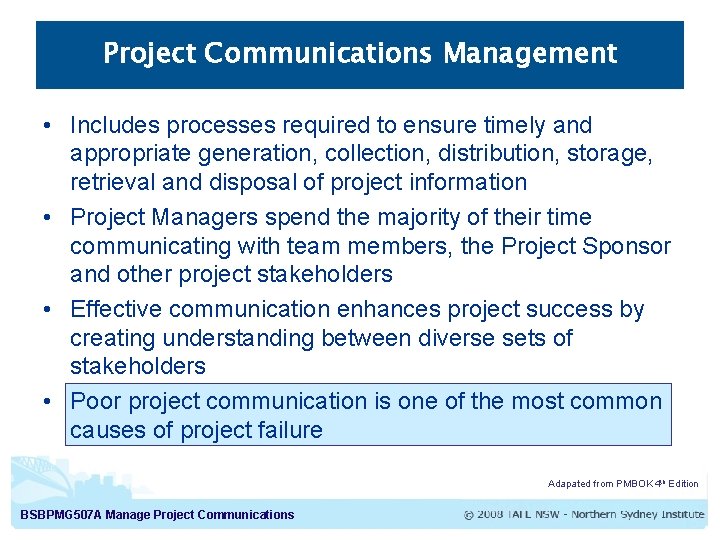
Project Communications Management • Includes processes required to ensure timely and appropriate generation, collection, distribution, storage, retrieval and disposal of project information • Project Managers spend the majority of their time communicating with team members, the Project Sponsor and other project stakeholders • Effective communication enhances project success by creating understanding between diverse sets of stakeholders • Poor project communication is one of the most common causes of project failure Adapated from PMBOK 4 th Edition BSBPMG 507 A Manage Project Communications
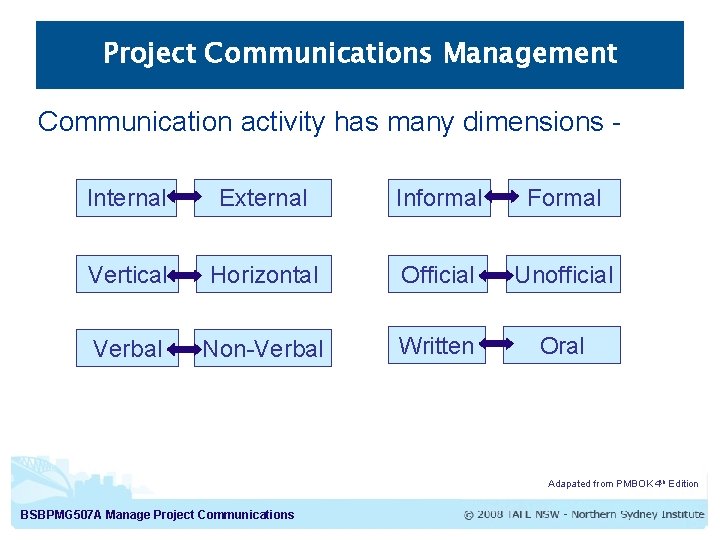
Project Communications Management Communication activity has many dimensions Internal External Informal Formal Vertical Horizontal Official Unofficial Verbal Non-Verbal Written Oral Adapated from PMBOK 4 th Edition BSBPMG 507 A Manage Project Communications
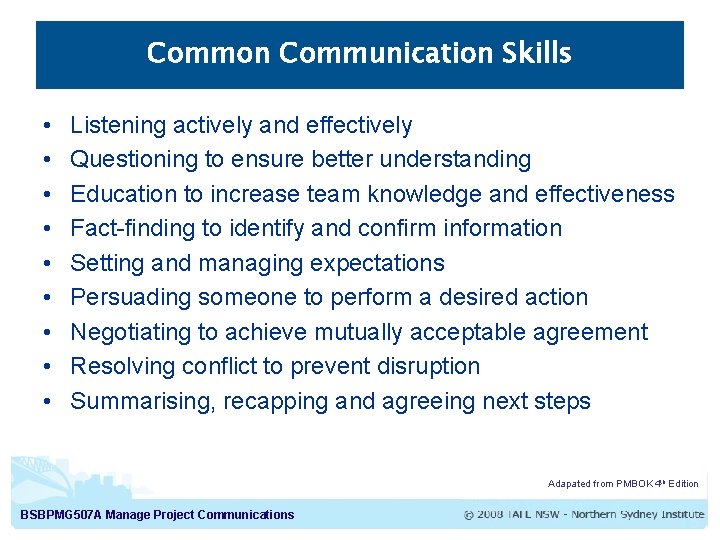
Common Communication Skills • • • Listening actively and effectively Questioning to ensure better understanding Education to increase team knowledge and effectiveness Fact-finding to identify and confirm information Setting and managing expectations Persuading someone to perform a desired action Negotiating to achieve mutually acceptable agreement Resolving conflict to prevent disruption Summarising, recapping and agreeing next steps Adapated from PMBOK 4 th Edition BSBPMG 507 A Manage Project Communications
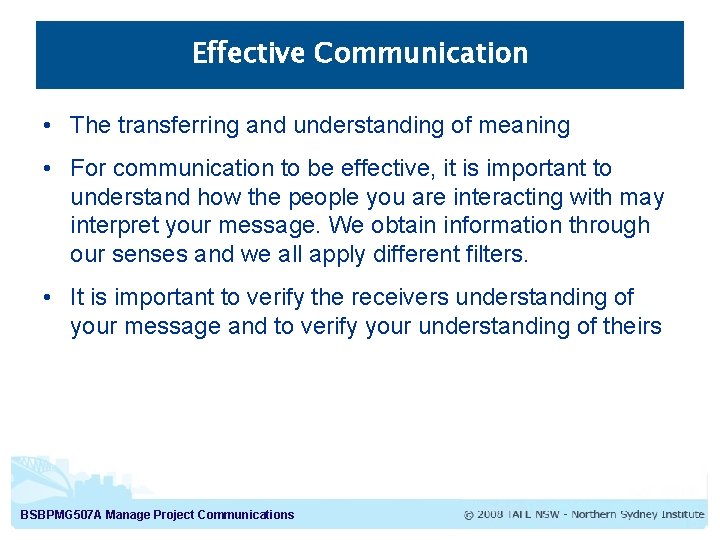
Effective Communication • The transferring and understanding of meaning • For communication to be effective, it is important to understand how the people you are interacting with may interpret your message. We obtain information through our senses and we all apply different filters. • It is important to verify the receivers understanding of your message and to verify your understanding of theirs BSBPMG 507 A Manage Project Communications
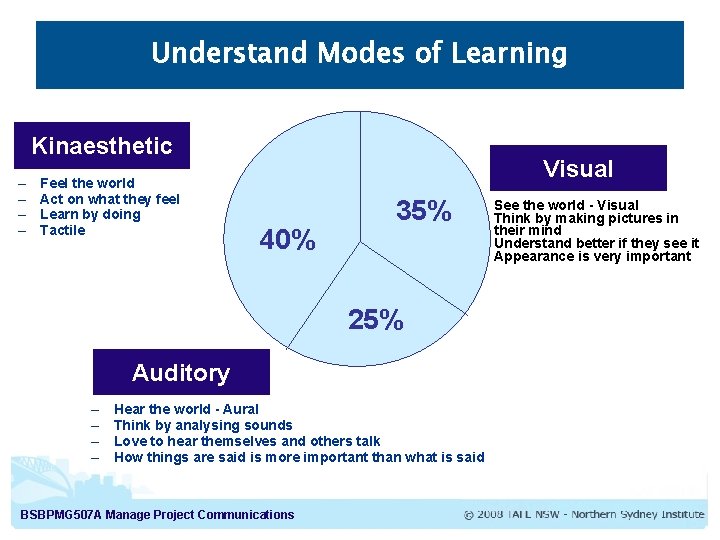
Understand Modes of Learning Kinaesthetic – – Feel the world Act on what they feel Learn by doing Tactile Visual 40% 35% 25% Auditory – – Hear the world - Aural Think by analysing sounds Love to hear themselves and others talk How things are said is more important than what is said BSBPMG 507 A Manage Project Communications See the world - Visual Think by making pictures in their mind Understand better if they see it Appearance is very important
Preferences for Communication • Modes of learning affect preferences for communication • Being aware of the modes will make your communication more successful • Cater for all three modes when planning and developing communication • Most people are a combination of two of the three modes – the most common are ü Kinaesthetic/Auditory and ü Kinaesthetic/Visual BSBPMG 507 A Manage Project Communications
Communication Broken Down • Content - 7% of the meaning from the content of the spoken message • Vocal - 38% of the meaning from the tone of voice, timbre, tempo, volume, pitch etc • Non Verbal – 55% of the meaning from body language, posture, gesture, breathing, skin colour etc • All three need to be congruent to convey the intended message Source: Mehrabian, A & Ferris, R, 1967. “ Inference of attitudes from non-verbal communication in two channels”, The Journal of Counselling Psychology, pp 248 - 252 BSBPMG 507 A Manage Project Communications
Active Listening • Active listening is an intent to "listen for meaning", in which the listener checks with the speaker to see that a statement has been correctly received • The process of attending carefully to what a speaker is saying, involving such techniques as accurately paraphrasing the speaker's remarks • a skill in which the listeners demonstrate that they understand what the speaker is saying both verbally and nonverbally BSBPMG 507 A Manage Project Communications
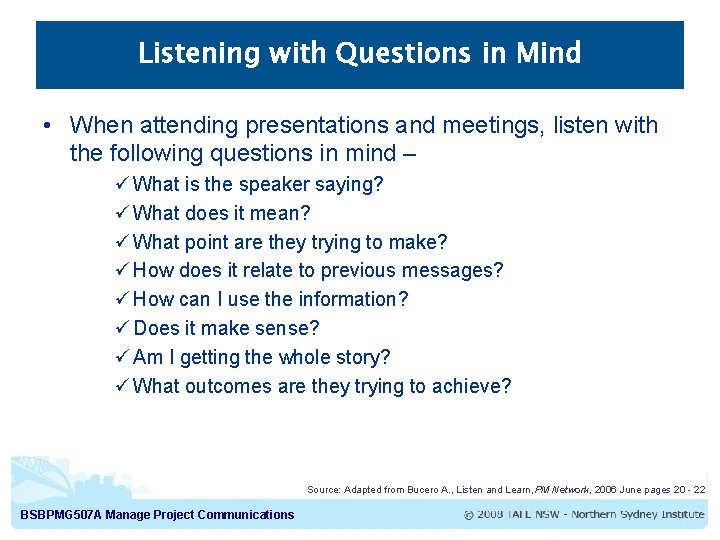
Listening with Questions in Mind • When attending presentations and meetings, listen with the following questions in mind – ü What is the speaker saying? ü What does it mean? ü What point are they trying to make? ü How does it relate to previous messages? ü How can I use the information? ü Does it make sense? ü Am I getting the whole story? ü What outcomes are they trying to achieve? Source: Adapted from Bucero A. , Listen and Learn, PM Network, 2006 June pages 20 - 22 BSBPMG 507 A Manage Project Communications