
Project Code RMW 29 BSAC Industrial Advisory Board
Project Code RMW 29 BSAC Industrial Advisory Board Meeting, 8 March 2005 Electric Power Demand Response Sensing X. Yang, J. Foster, J. Black, V. Gowrish, and Prof. R. M. White Part of the Demand Response (DR) Project funded by the California Energy Commission (CEC) UCB collaborators: BSAC (White), CBE (Arens), Mech. Eng. (Wright, Auslander), BWRC (Rabaey), CS (Culler) © 2005 University of California Prepublication Data Spring 2005
Demand Response Project Problem: electric power crisis of 2000 / 2001 – Supply shortages led to high prices in California electricity market – Market vulnerable to manipulation due to inelastic demand Solution: Demand Response – Enable consumer Demand to Respond to shortages in electricity supply – Technology to enable California households to modify their energy use during periods of peak demand, short supply, and high cost system elements include inexpensive wireless revenue metering, plus electricity use and thermal/humidity monitoring and control inside houses based on knowledge of present and short-range future weather conditions and electric power costs system responds automatically to time- and location-dependent price Utilities already allow large customers to save money by curtailing energy use at periods and contingency signals to reduce/shift loads of peak demand, but the California Energy Commission wants to be able to offer this approach to all California households (which requires leaps in technology to make system affordable enough) © 2005 University of California Prepublication Data Spring 2005
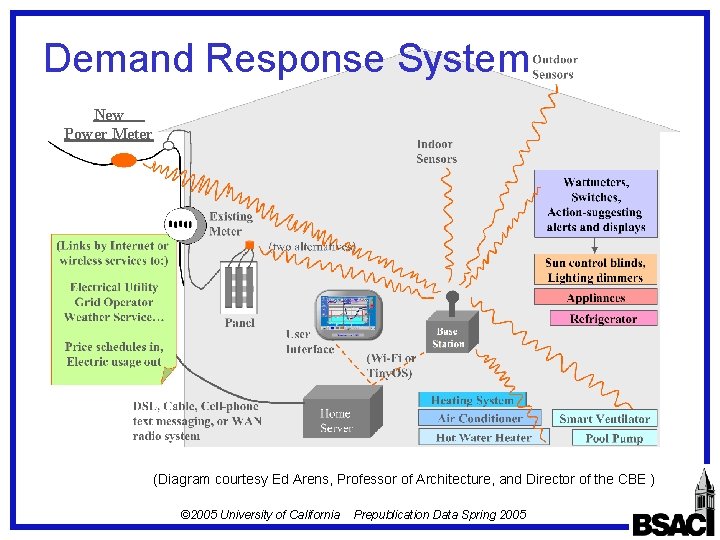
Demand Response System New Power Meter (Diagram courtesy Ed Arens, Professor of Architecture, and Director of the CBE ) © 2005 University of California Prepublication Data Spring 2005
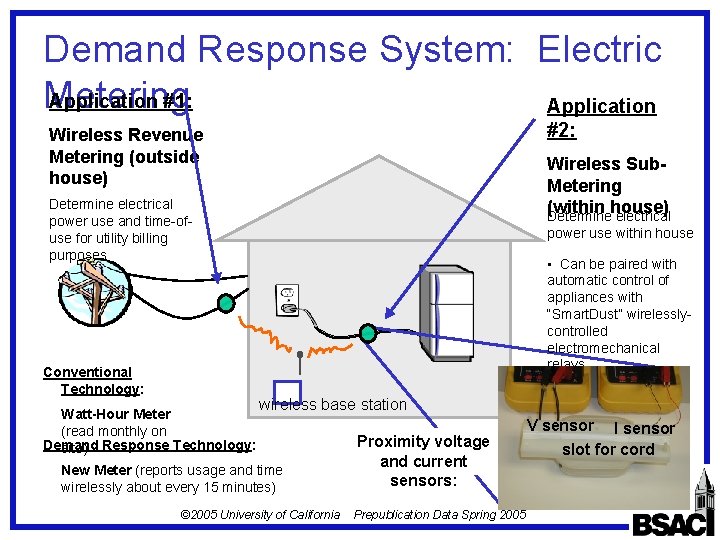
Demand Response System: Electric Metering Application #1: Application #2: Wireless Revenue Metering (outside house) Wireless Sub. Metering (within house) Determine electrical power use and time-ofuse for utility billing purposes Conventional Technology: Watt-Hour Meter (read monthly on Demand site) Response Technology: power use within house • Can be paired with automatic control of appliances with “Smart. Dust” wirelesslycontrolled electromechanical relays wireless base station New Meter (reports usage and time wirelessly about every 15 minutes) © 2005 University of California Proximity voltage and current sensors: Prepublication Data Spring 2005 V sensor I sensor slot for cord
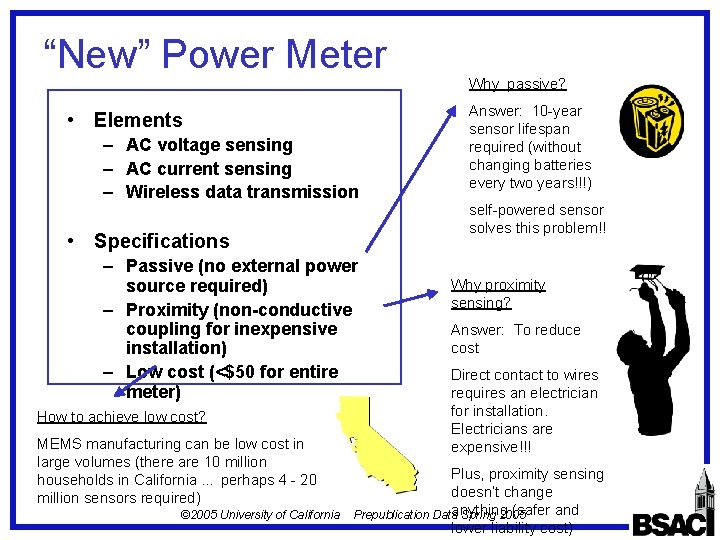
“New” Power Meter • Elements – AC voltage sensing – AC current sensing – Wireless data transmission • Specifications – Passive (no external power source required) – Proximity (non-conductive coupling for inexpensive installation) – Low cost (<$50 for entire meter) How to achieve low cost? MEMS manufacturing can be low cost in large volumes (there are 10 million households in California … perhaps 4 - 20 million sensors required) © 2005 University of California Why passive? Answer: 10 -year sensor lifespan required (without changing batteries every two years!!!) self-powered sensor solves this problem!! Why proximity sensing? Answer: To reduce cost Direct contact to wires requires an electrician for installation. Electricians are expensive!!! Plus, proximity sensing doesn’t change anything (safer and Prepublication Data Spring 2005 lower liability cost)
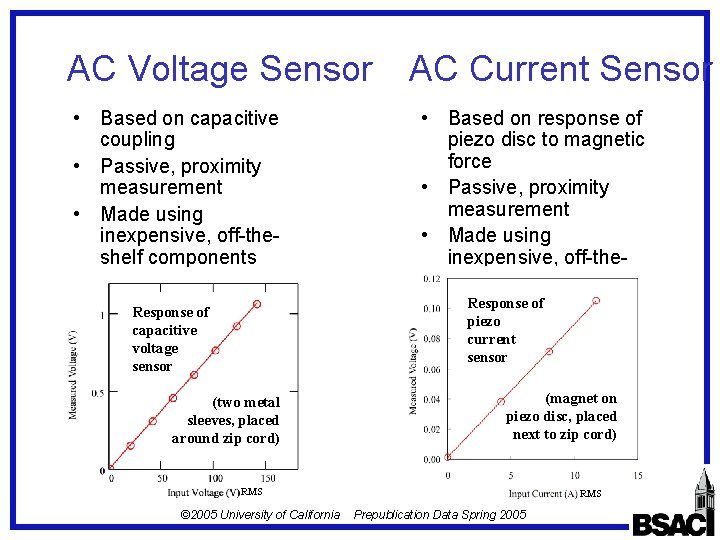
AC Voltage Sensor • Based on capacitive coupling • Passive, proximity measurement • Made using inexpensive, off-theshelf components AC Current Sensor • Based on response of piezo disc to magnetic force • Passive, proximity measurement • Made using inexpensive, off-theshelf components Response of piezo current sensor Response of capacitive voltage sensor (two metal sleeves, placed around zip cord) (magnet on piezo disc, placed next to zip cord) RMS © 2005 University of California RMS Prepublication Data Spring 2005
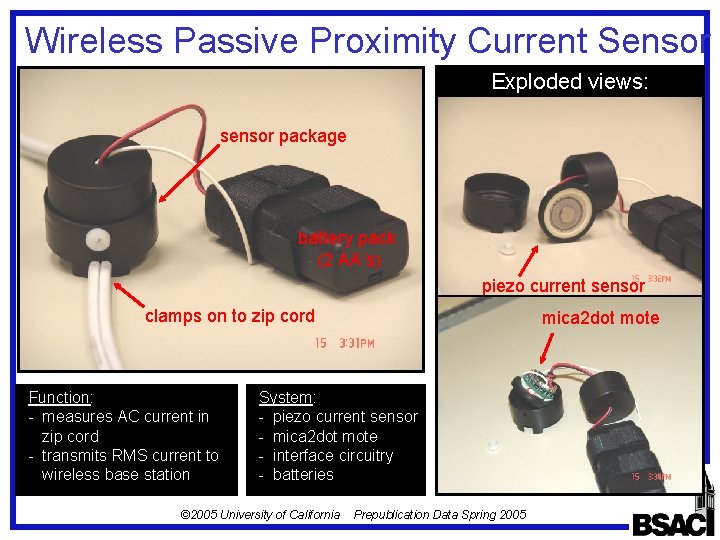
Wireless Passive Proximity Current Sensor Exploded views: sensor package battery pack (2 AA’s) piezo current sensor clamps on to zip cord Function: - measures AC current in zip cord - transmits RMS current to wireless base station mica 2 dot mote System: - piezo current sensor - mica 2 dot mote - interface circuitry - batteries © 2005 University of California Prepublication Data Spring 2005
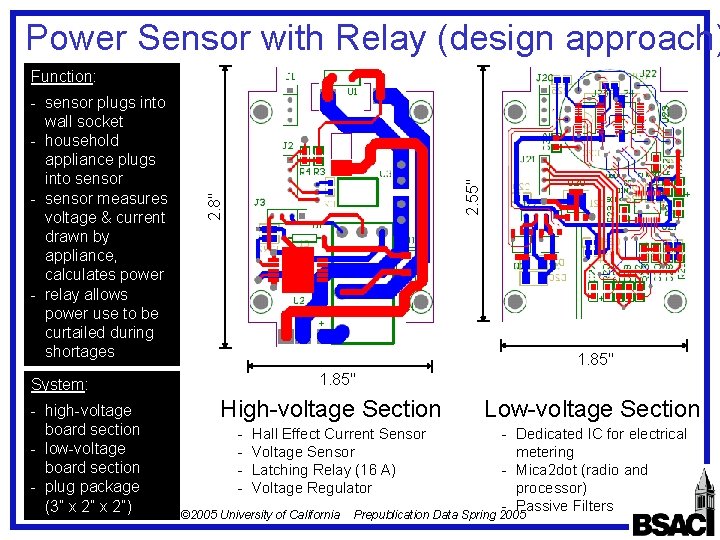
Power Sensor with Relay (design approach) 2. 8" - sensor plugs into wall socket - household appliance plugs into sensor - sensor measures voltage & current drawn by appliance, calculates power - relay allows power use to be curtailed during shortages 2. 55" Function: 1. 85" System: - high-voltage board section - low-voltage board section - plug package (3” x 2”) High-voltage Section - Hall Effect Current Sensor Voltage Sensor Latching Relay (16 A) Voltage Regulator © 2005 University of California Low-voltage Section - Dedicated IC for electrical metering - Mica 2 dot (radio and processor) - Passive Filters Prepublication Data Spring 2005
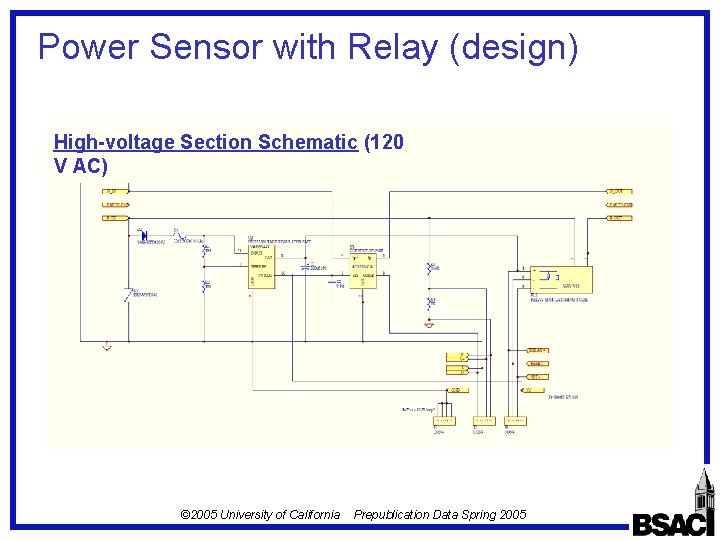
Power Sensor with Relay (design) High-voltage Section Schematic (120 V AC) © 2005 University of California Prepublication Data Spring 2005
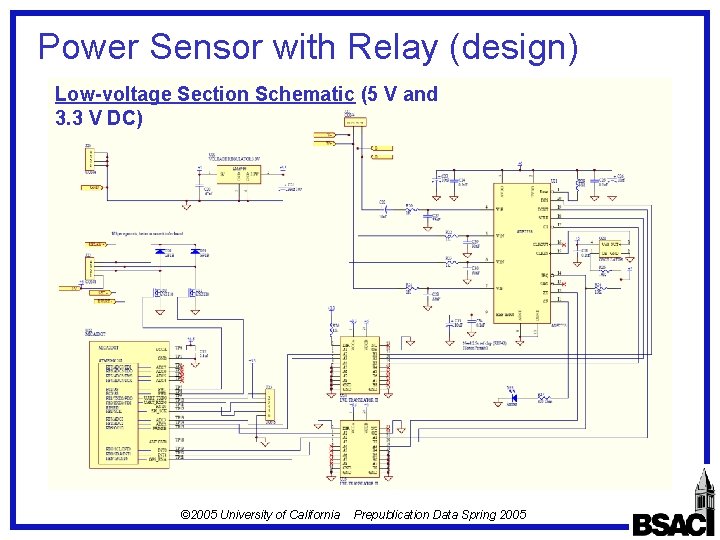
Power Sensor with Relay (design) Low-voltage Section Schematic (5 V and 3. 3 V DC) © 2005 University of California Prepublication Data Spring 2005
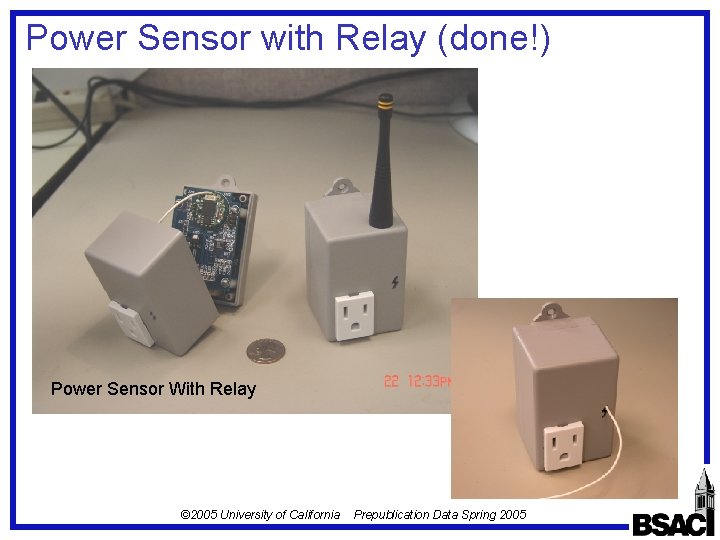
Power Sensor with Relay (done!) Power Sensor With Relay © 2005 University of California Prepublication Data Spring 2005
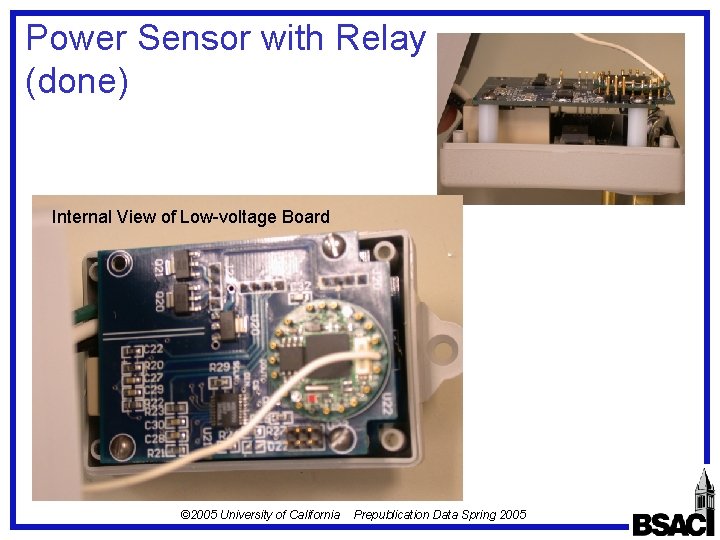
Power Sensor with Relay (done) Internal View of Low-voltage Board © 2005 University of California Prepublication Data Spring 2005
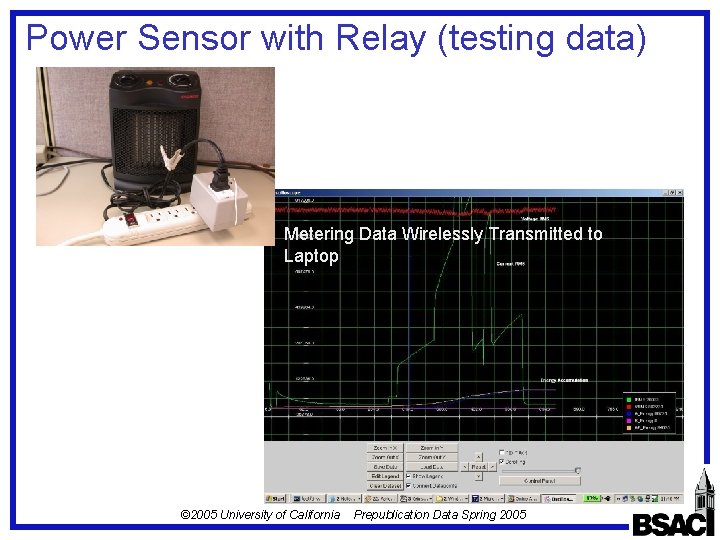
Power Sensor with Relay (testing data) Metering Data Wirelessly Transmitted to Laptop © 2005 University of California Prepublication Data Spring 2005
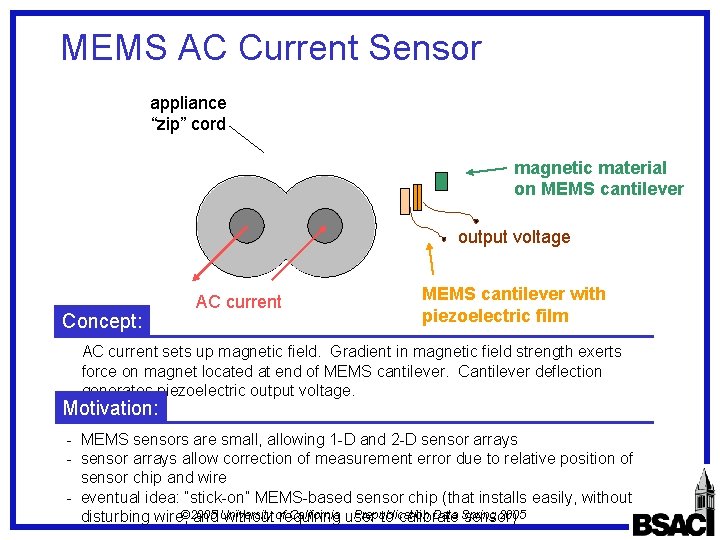
MEMS AC Current Sensor appliance “zip” cord magnetic material on MEMS cantilever output voltage Concept: AC current MEMS cantilever with piezoelectric film AC current sets up magnetic field. Gradient in magnetic field strength exerts force on magnet located at end of MEMS cantilever. Cantilever deflection generates piezoelectric output voltage. Motivation: - MEMS sensors are small, allowing 1 -D and 2 -D sensor arrays - sensor arrays allow correction of measurement error due to relative position of sensor chip and wire - eventual idea: “stick-on” MEMS-based sensor chip (that installs easily, without California user Prepublication Data Spring 2005 disturbing wire, © 2005 and. University without ofrequiring to calibrate sensor)
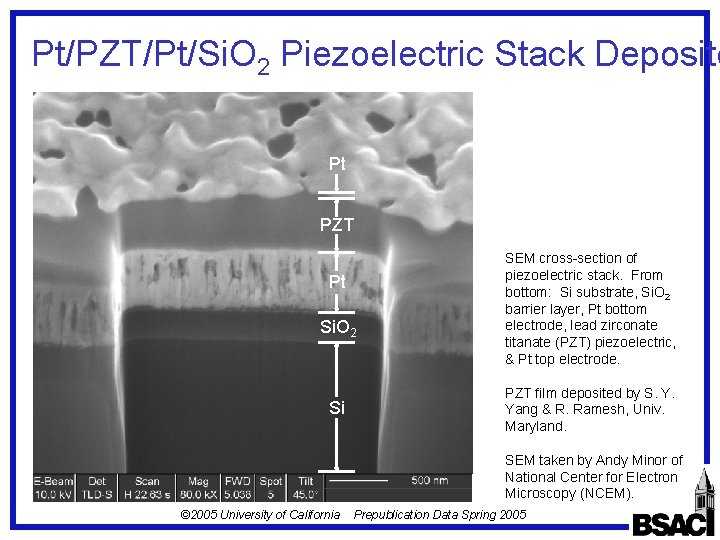
Pt/PZT/Pt/Si. O 2 Piezoelectric Stack Deposite Pt PZT Pt Si. O 2 Si SEM cross-section of piezoelectric stack. From bottom: Si substrate, Si. O 2 barrier layer, Pt bottom electrode, lead zirconate titanate (PZT) piezoelectric, & Pt top electrode. PZT film deposited by S. Y. Yang & R. Ramesh, Univ. Maryland. SEM taken by Andy Minor of National Center for Electron Microscopy (NCEM). © 2005 University of California Prepublication Data Spring 2005
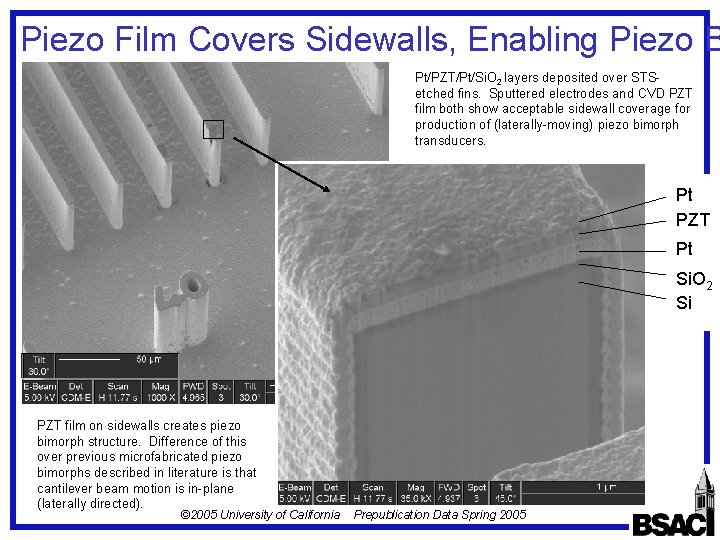
Piezo Film Covers Sidewalls, Enabling Piezo B Pt/PZT/Pt/Si. O 2 layers deposited over STSetched fins. Sputtered electrodes and CVD PZT film both show acceptable sidewall coverage for production of (laterally-moving) piezo bimorph transducers. Pt PZT Pt Si. O 2 Si PZT film on sidewalls creates piezo bimorph structure. Difference of this over previous microfabricated piezo bimorphs described in literature is that cantilever beam motion is in-plane (laterally directed). © 2005 University of California Prepublication Data Spring 2005
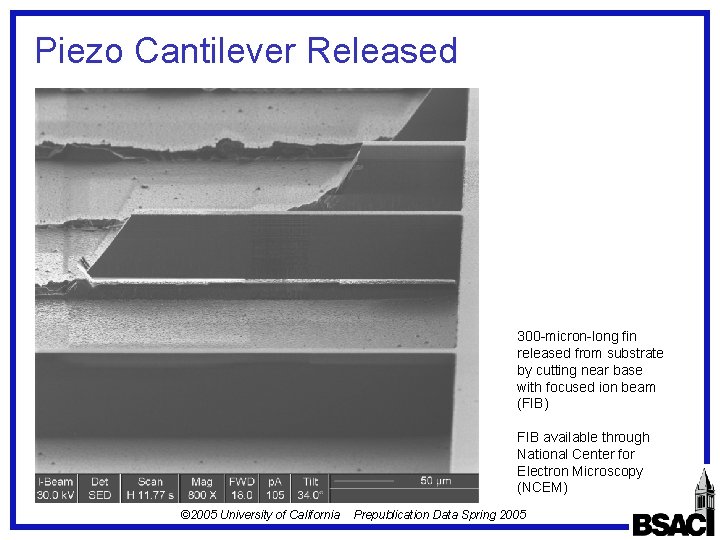
Piezo Cantilever Released 300 -micron-long fin released from substrate by cutting near base with focused ion beam (FIB) FIB available through National Center for Electron Microscopy (NCEM) © 2005 University of California Prepublication Data Spring 2005
Summary • Demonstrated off-the-shelf passive proximity current sensor – sensor clips on standard household zip cord, measured RMS AC current wirelessly transmitted to base station • Demonstrated off-the-shelf power sensor with relay – sensor measures electrical power consumption of household appliances, relay allows power use to be curtailed during shortages • Fabrication of MEMS current sensor – deposited electrode and piezoelectric films, released cantilever using FIB cut, measured recovery of plasma damage by annealing • What’s next for COTS wireless sensors: – continue ongoing collaboration with students in Prof. Culler’s group on a Telos platform power sensor with relay and triac • What’s next for MEMS sensors: – setup next generation MEMS chip (will have greater performance), evaluate 3 -D lithography to replace FIB cut © 2005 University of California Prepublication Data Spring 2005 procedures
- Slides: 18