
Project COACH Evaluation Model 2012 2013 Developed by
Project COACH Evaluation Model 2012 -2013 Developed by Hamilton County Department of Education and Educator Software Solutions; based on the work of Kim Marshall - Rethinking Teacher Supervision and Evaluation

Table of Contents • • • Project COACH Overview Mini Observation Process Summative Process Project COACH in Review Project COACH Rubric Project COACH - HCDE / ESS (2012 -2013)
How Did We Get Here? Origin of Project COACH • TN Framework of Evaluation became obsolete after 2010 -2011 • Excitement generated via Kim Marshall PD – Rethinking Teacher Supervision and Evaluation at 2010 Hamilton County Administrator Winter Retreat • Project COACH, centered around mini-observations and detailed rubrics, was piloted in Hamilton County during the 2010 -2011 school year. • Project COACH approved by TNSDOE for use as alternative model for the 2011 -2012 school year Project COACH - HCDE / ESS (2012 -2013)
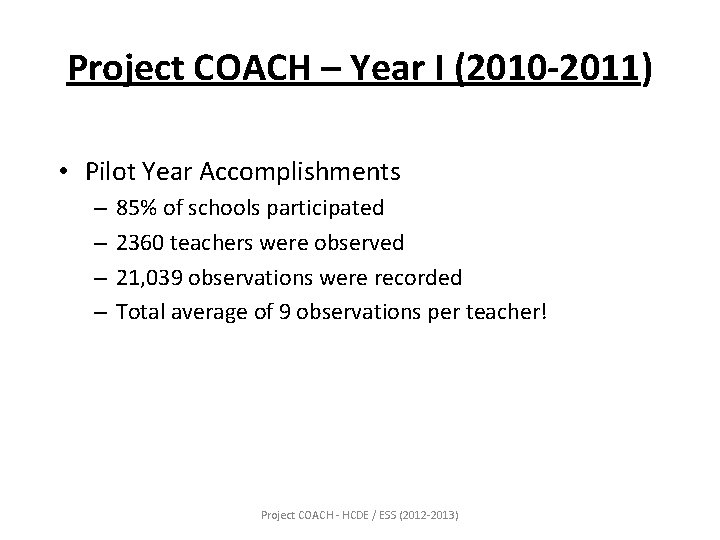
Project COACH – Year I (2010 -2011) • Pilot Year Accomplishments – – 85% of schools participated 2360 teachers were observed 21, 039 observations were recorded Total average of 9 observations per teacher! Project COACH - HCDE / ESS (2012 -2013)
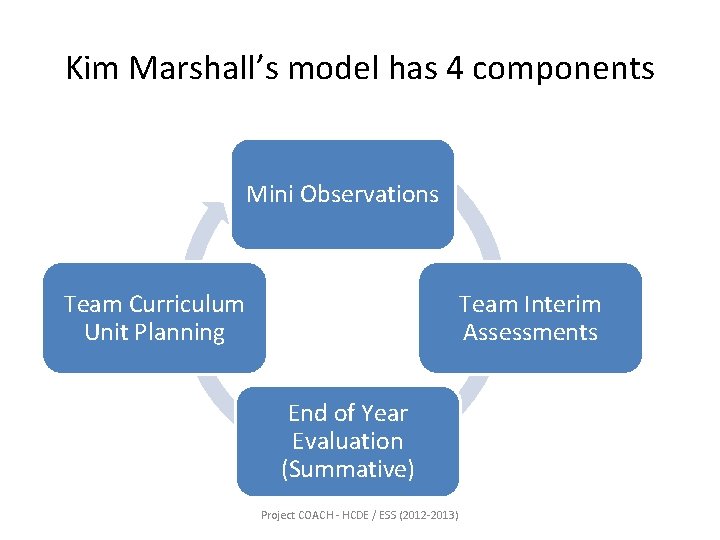
Kim Marshall’s model has 4 components Mini Observations Team Curriculum Unit Planning Team Interim Assessments End of Year Evaluation (Summative) Project COACH - HCDE / ESS (2012 -2013)
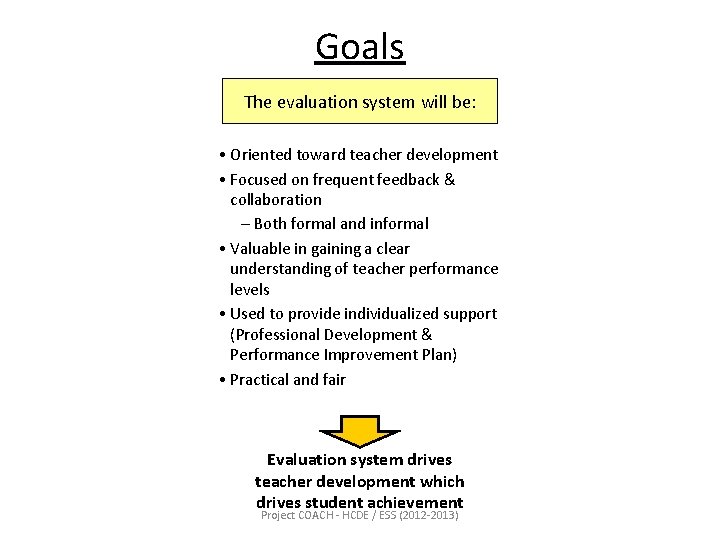
Goals The evaluation system will be: • Oriented toward teacher development • Focused on frequent feedback & collaboration – Both formal and informal • Valuable in gaining a clear understanding of teacher performance levels • Used to provide individualized support (Professional Development & Performance Improvement Plan) • Practical and fair Evaluation system drives teacher development which drives student achievement Project COACH - HCDE / ESS (2012 -2013)
Table of Contents • • • Project COACH Overview Mini Observation Process Summative Process Project COACH in Review Project COACH Rubric Project COACH - HCDE / ESS (2012 -2013)
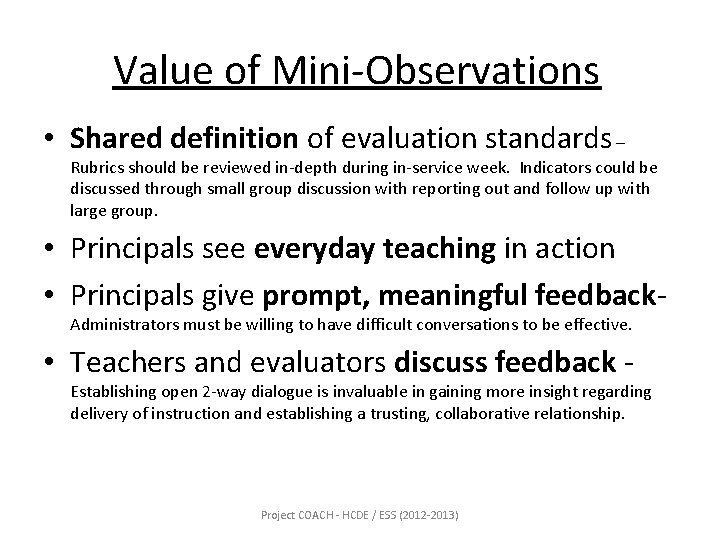
Value of Mini-Observations • Shared definition of evaluation standards – Rubrics should be reviewed in-depth during in-service week. Indicators could be discussed through small group discussion with reporting out and follow up with large group. • Principals see everyday teaching in action • Principals give prompt, meaningful feedback. Administrators must be willing to have difficult conversations to be effective. • Teachers and evaluators discuss feedback - Establishing open 2 -way dialogue is invaluable in gaining more insight regarding delivery of instruction and establishing a trusting, collaborative relationship. Project COACH - HCDE / ESS (2012 -2013)
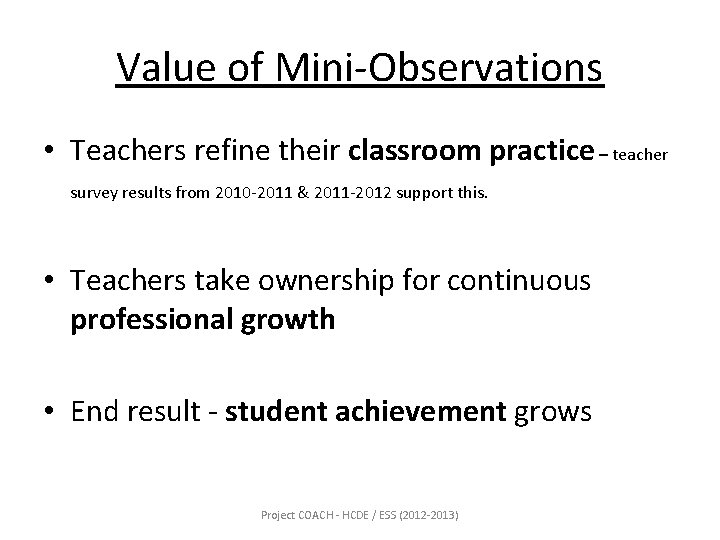
Value of Mini-Observations • Teachers refine their classroom practice – teacher survey results from 2010 -2011 & 2011 -2012 support this. • Teachers take ownership for continuous professional growth • End result - student achievement grows Project COACH - HCDE / ESS (2012 -2013)
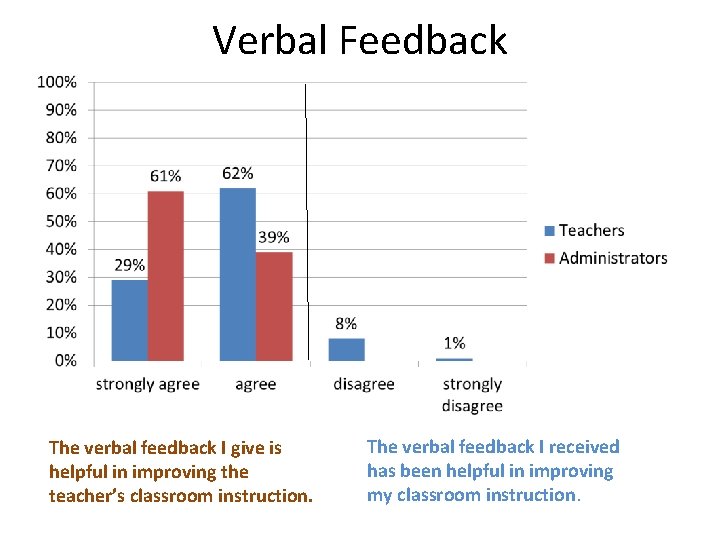
Verbal Feedback The verbal feedback I give is helpful in improving the teacher’s classroom instruction. The verbal feedback I received has been helpful in improving my classroom instruction.
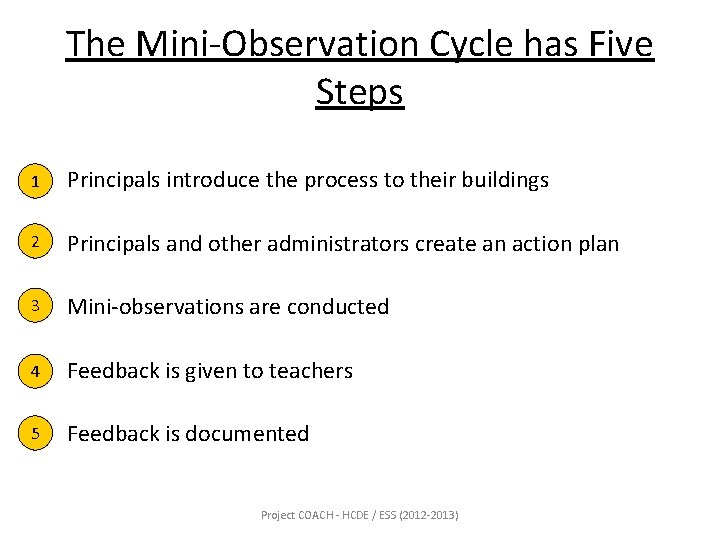
The Mini-Observation Cycle has Five Steps 11. Principals introduce the process to their buildings 22. Principals and other administrators create an action plan 33. Mini-observations are conducted 44. Feedback is given to teachers 55. Feedback is documented Project COACH - HCDE / ESS (2012 -2013)
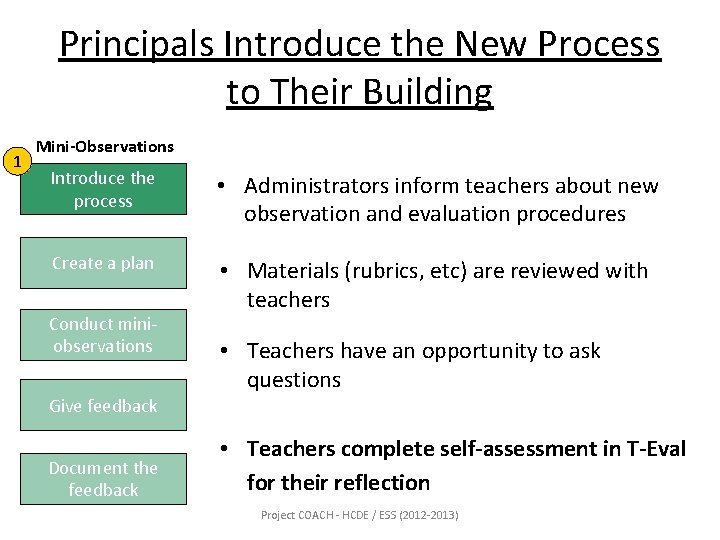
Principals Introduce the New Process to Their Building 1 Mini-Observations Introduce the process • Administrators inform teachers about new observation and evaluation procedures Create a plan • Materials (rubrics, etc) are reviewed with teachers Conduct miniobservations • Teachers have an opportunity to ask questions Give feedback Document the feedback • Teachers complete self-assessment in T-Eval for their reflection Project COACH - HCDE / ESS (2012 -2013)
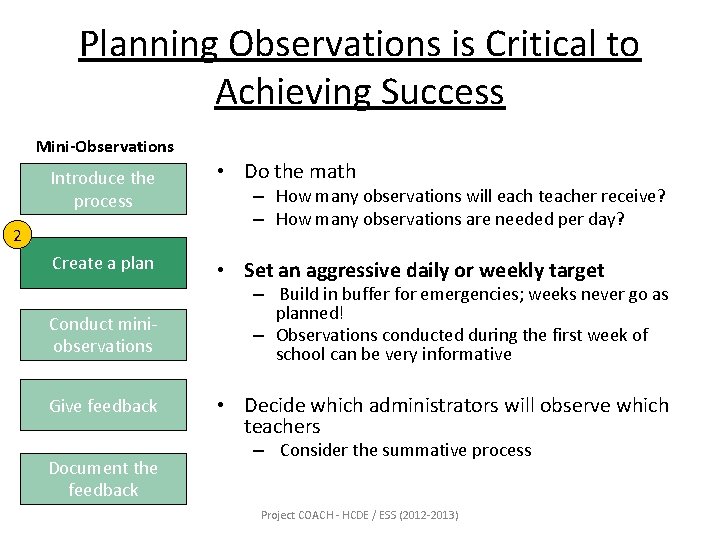
Planning Observations is Critical to Achieving Success Mini-Observations Introduce the process • Do the math Create a plan • Set an aggressive daily or weekly target 2 Conduct miniobservations Give feedback Document the feedback – How many observations will each teacher receive? – How many observations are needed per day? – Build in buffer for emergencies; weeks never go as planned! – Observations conducted during the first week of school can be very informative • Decide which administrators will observe which teachers – Consider the summative process Project COACH - HCDE / ESS (2012 -2013)
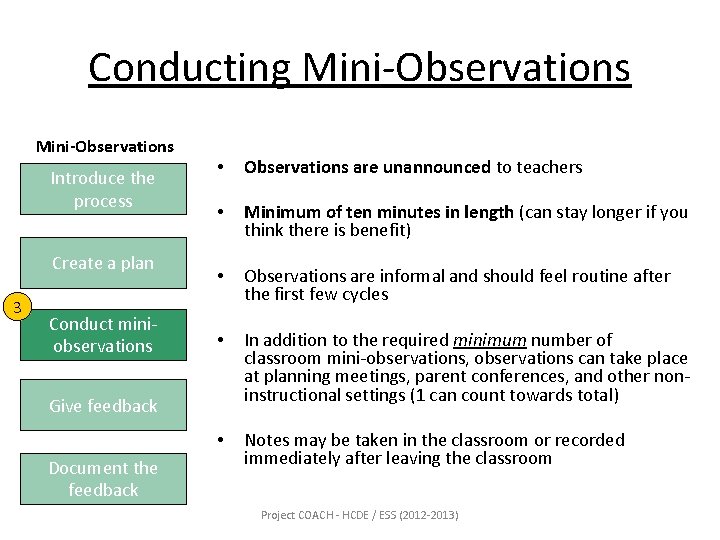
Conducting Mini-Observations Introduce the process Create a plan 3 Conduct miniobservations • Observations are unannounced to teachers • Minimum of ten minutes in length (can stay longer if you think there is benefit) • Observations are informal and should feel routine after the first few cycles • In addition to the required minimum number of classroom mini-observations, observations can take place at planning meetings, parent conferences, and other noninstructional settings (1 can count towards total) • Notes may be taken in the classroom or recorded immediately after leaving the classroom Give feedback Document the feedback Project COACH - HCDE / ESS (2012 -2013)
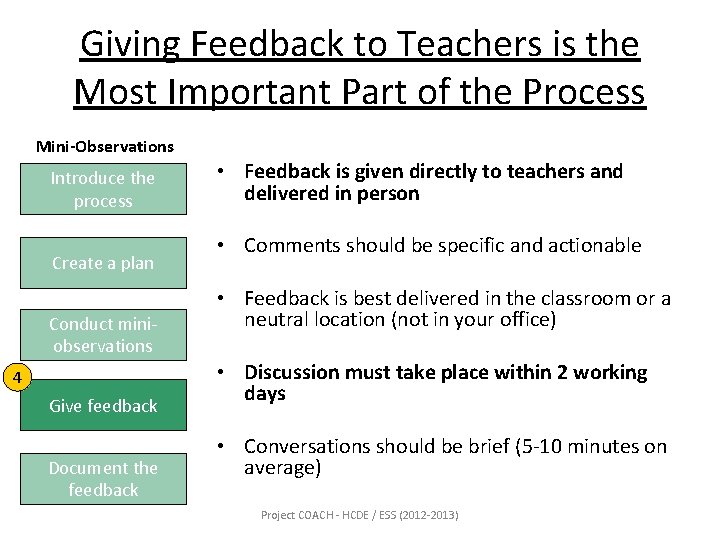
Giving Feedback to Teachers is the Most Important Part of the Process Mini-Observations Introduce the process Create a plan Conduct miniobservations 4 Give feedback Document the feedback • Feedback is given directly to teachers and delivered in person • Comments should be specific and actionable • Feedback is best delivered in the classroom or a neutral location (not in your office) • Discussion must take place within 2 working days • Conversations should be brief (5 -10 minutes on average) Project COACH - HCDE / ESS (2012 -2013)
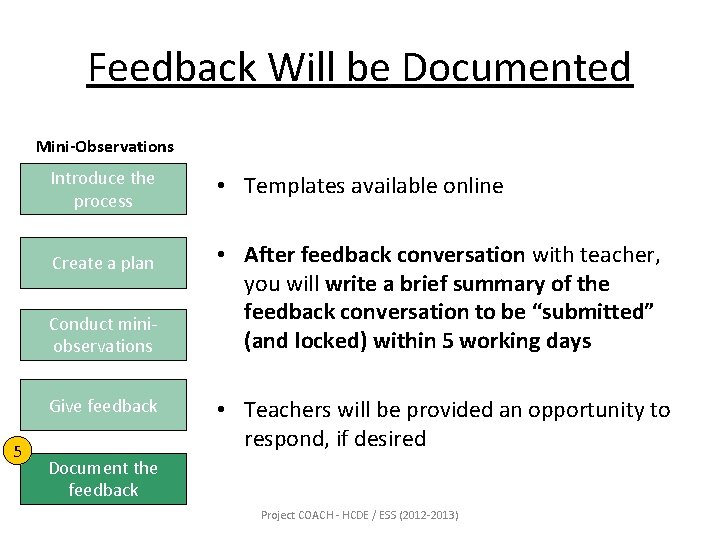
Feedback Will be Documented Mini-Observations Introduce the process Create a plan Conduct miniobservations Give feedback 5 • Templates available online • After feedback conversation with teacher, you will write a brief summary of the feedback conversation to be “submitted” (and locked) within 5 working days • Teachers will be provided an opportunity to respond, if desired Document the feedback Project COACH - HCDE / ESS (2012 -2013)
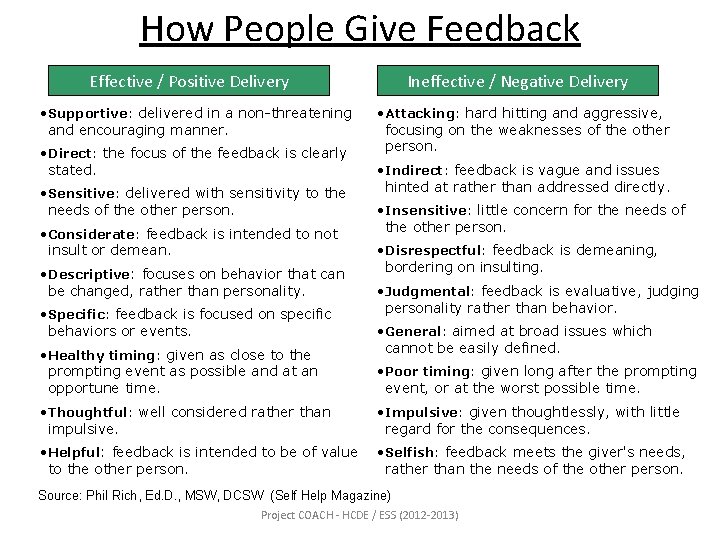
How People Give Feedback Effective / Positive Delivery • Supportive: delivered in a non-threatening and encouraging manner. • Direct: the focus of the feedback is clearly stated. • Sensitive: delivered with sensitivity to the needs of the other person. • Considerate: feedback is intended to not insult or demean. • Descriptive: focuses on behavior that can be changed, rather than personality. • Specific: feedback is focused on specific behaviors or events. • Healthy timing: given as close to the prompting event as possible and at an opportune time. Ineffective / Negative Delivery • Attacking: hard hitting and aggressive, focusing on the weaknesses of the other person. • Indirect: feedback is vague and issues hinted at rather than addressed directly. • Insensitive: little concern for the needs of the other person. • Disrespectful: feedback is demeaning, bordering on insulting. • Judgmental: feedback is evaluative, judging personality rather than behavior. • General: aimed at broad issues which cannot be easily defined. • Poor timing: given long after the prompting event, or at the worst possible time. • Thoughtful: well considered rather than impulsive. • Impulsive: given thoughtlessly, with little regard for the consequences. • Helpful: feedback is intended to be of value to the other person. • Selfish: feedback meets the giver's needs, rather than the needs of the other person. Source: Phil Rich, Ed. D. , MSW, DCSW (Self Help Magazine) Project COACH - HCDE / ESS (2012 -2013)
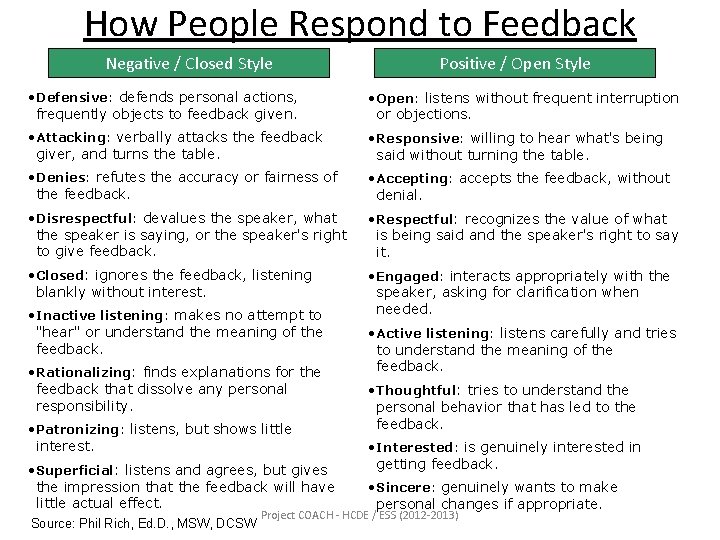
How People Respond to Feedback Negative / Closed Style Positive / Open Style • Defensive: defends personal actions, frequently objects to feedback given. • Open: listens without frequent interruption or objections. • Attacking: verbally attacks the feedback giver, and turns the table. • Responsive: willing to hear what's being said without turning the table. • Denies: refutes the accuracy or fairness of the feedback. • Accepting: accepts the feedback, without denial. • Disrespectful: devalues the speaker, what the speaker is saying, or the speaker's right to give feedback. • Respectful: recognizes the value of what is being said and the speaker's right to say it. • Closed: ignores the feedback, listening blankly without interest. • Engaged: interacts appropriately with the speaker, asking for clarification when needed. • Inactive listening: makes no attempt to "hear" or understand the meaning of the feedback. • Rationalizing: finds explanations for the feedback that dissolve any personal responsibility. • Patronizing: listens, but shows little interest. • Active listening: listens carefully and tries to understand the meaning of the feedback. • Thoughtful: tries to understand the personal behavior that has led to the feedback. • Interested: is genuinely interested in getting feedback. • Superficial: listens and agrees, but gives the impression that the feedback will have • Sincere: genuinely wants to make little actual effect. personal changes if appropriate. Project COACH - HCDE / ESS (2012 -2013) Source: Phil Rich, Ed. D. , MSW, DCSW
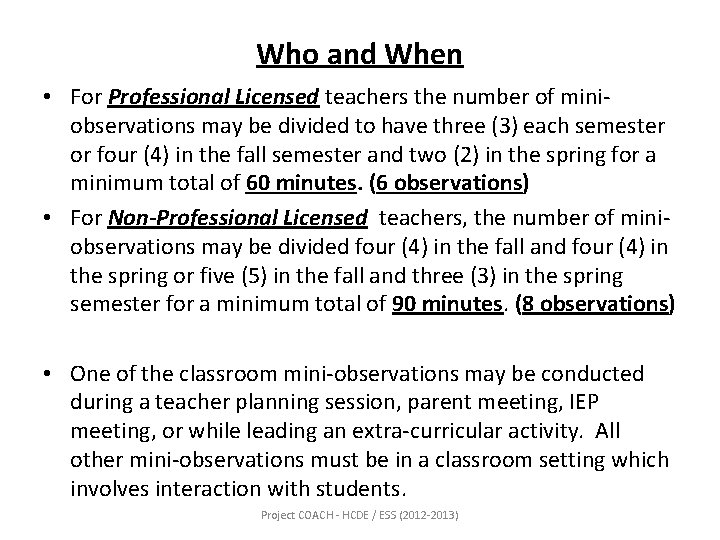
Who and When • For Professional Licensed teachers the number of miniobservations may be divided to have three (3) each semester or four (4) in the fall semester and two (2) in the spring for a minimum total of 60 minutes. (6 observations) • For Non-Professional Licensed teachers, the number of miniobservations may be divided four (4) in the fall and four (4) in the spring or five (5) in the fall and three (3) in the spring semester for a minimum total of 90 minutes. (8 observations) • One of the classroom mini-observations may be conducted during a teacher planning session, parent meeting, IEP meeting, or while leading an extra-curricular activity. All other mini-observations must be in a classroom setting which involves interaction with students. Project COACH - HCDE / ESS (2012 -2013)
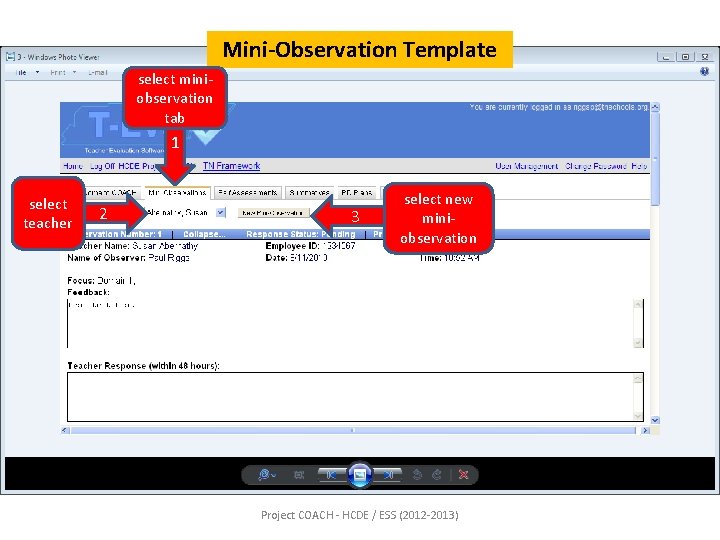
Mini-Observation Template select miniobservation tab 1 select teacher 2 3 select new miniobservation Project COACH - HCDE / ESS (2012 -2013)
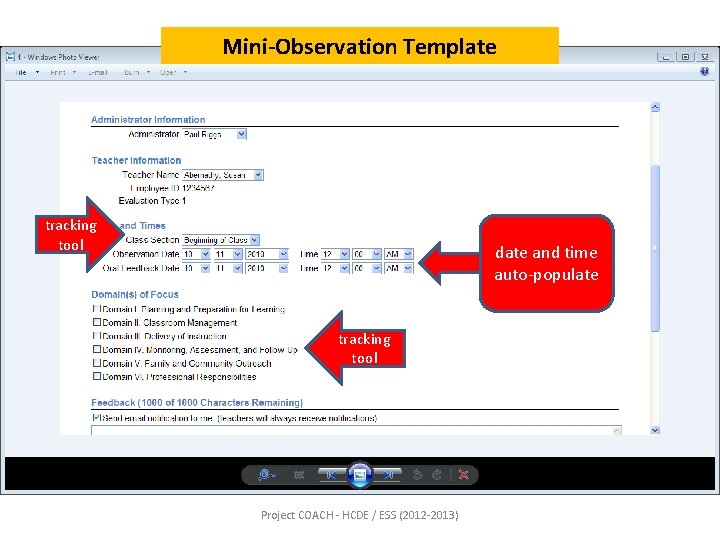
Mini-Observation Template tracking tool date and time auto-populate tracking tool Project COACH - HCDE / ESS (2012 -2013)
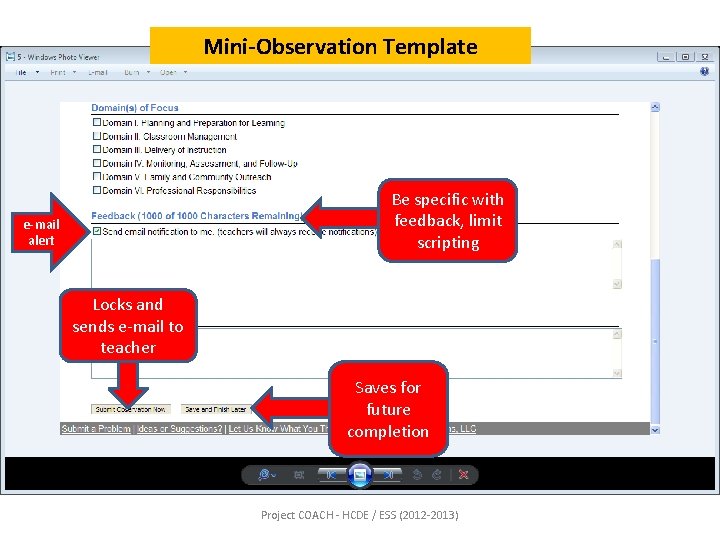
Mini-Observation Template Be specific with feedback, limit scripting e-mail alert Locks and sends e-mail to teacher Saves for future completion Project COACH - HCDE / ESS (2012 -2013)
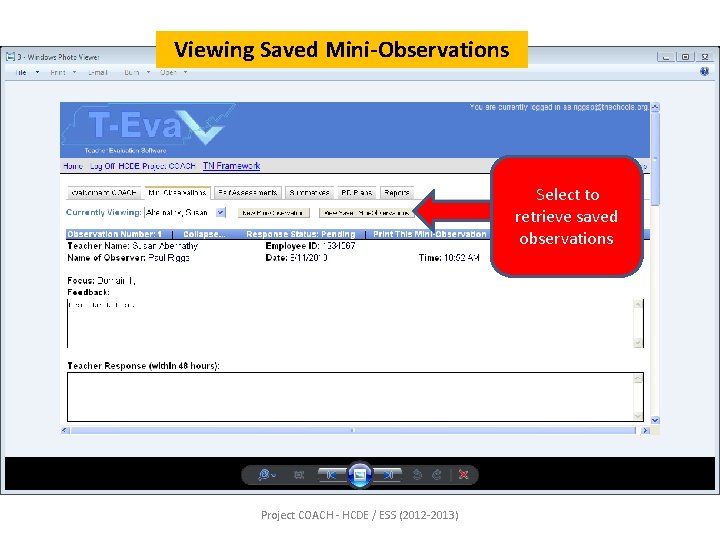
Viewing Saved Mini-Observations Select to retrieve saved observations Project COACH - HCDE / ESS (2012 -2013)
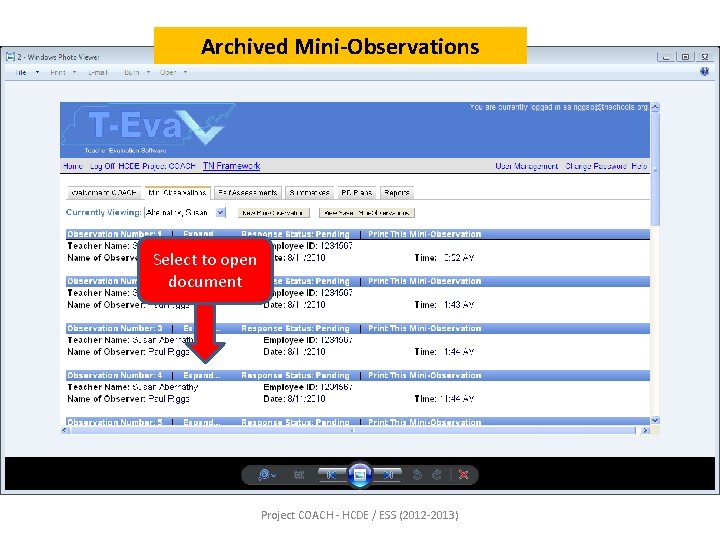
Archived Mini-Observations Select to open document Project COACH - HCDE / ESS (2012 -2013)
Table of Contents • • • Project COACH Overview Mini Observation Process Summative Process Project COACH in review Project COACH Rubric Project COACH - HCDE / ESS (2012 -2013)
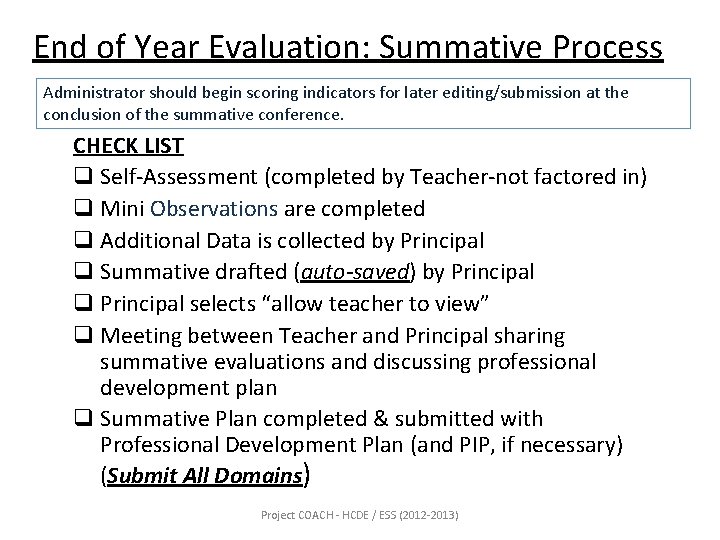
End of Year Evaluation: Summative Process Administrator should begin scoring indicators for later editing/submission at the conclusion of the summative conference. CHECK LIST q Self-Assessment (completed by Teacher-not factored in) q Mini Observations are completed q Additional Data is collected by Principal q Summative drafted (auto-saved) by Principal q Principal selects “allow teacher to view” q Meeting between Teacher and Principal sharing summative evaluations and discussing professional development plan q Summative Plan completed & submitted with Professional Development Plan (and PIP, if necessary) (Submit All Domains) Project COACH - HCDE / ESS (2012 -2013)
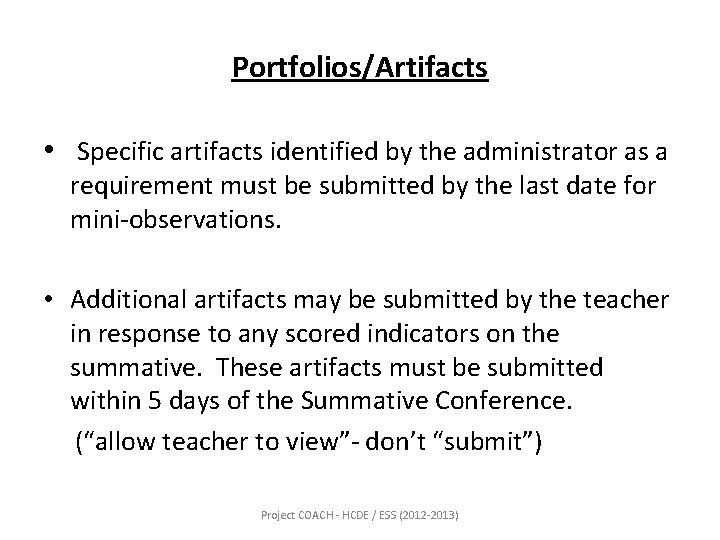
Portfolios/Artifacts • Specific artifacts identified by the administrator as a requirement must be submitted by the last date for mini-observations. • Additional artifacts may be submitted by the teacher in response to any scored indicators on the summative. These artifacts must be submitted within 5 days of the Summative Conference. (“allow teacher to view”- don’t “submit”) Project COACH - HCDE / ESS (2012 -2013)
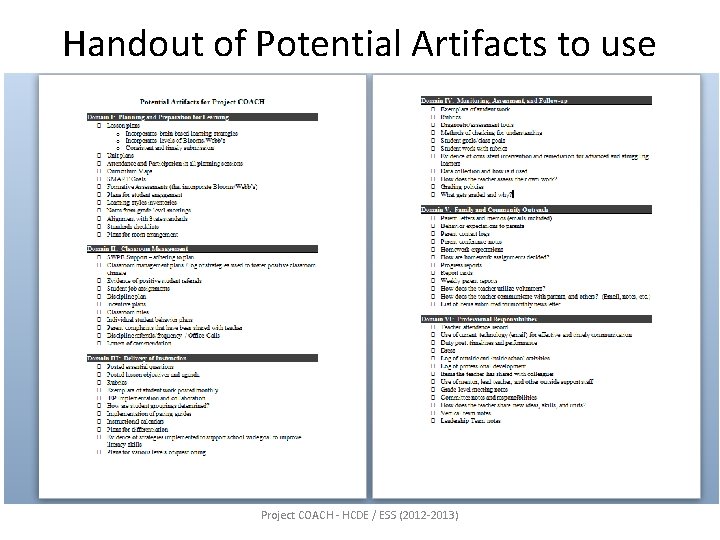
Handout of Potential Artifacts to use for Summatives Project COACH - HCDE / ESS (2012 -2013)
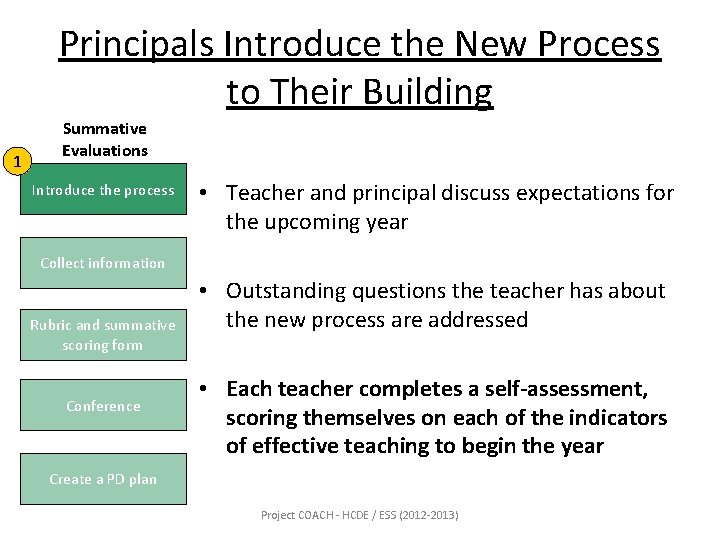
Principals Introduce the New Process to Their Building 1 Summative Evaluations Introduce the process • Teacher and principal discuss expectations for the upcoming year Collect information Rubric and summative scoring form Conference • Outstanding questions the teacher has about the new process are addressed • Each teacher completes a self-assessment, scoring themselves on each of the indicators of effective teaching to begin the year Create a PD plan Project COACH - HCDE / ESS (2012 -2013)
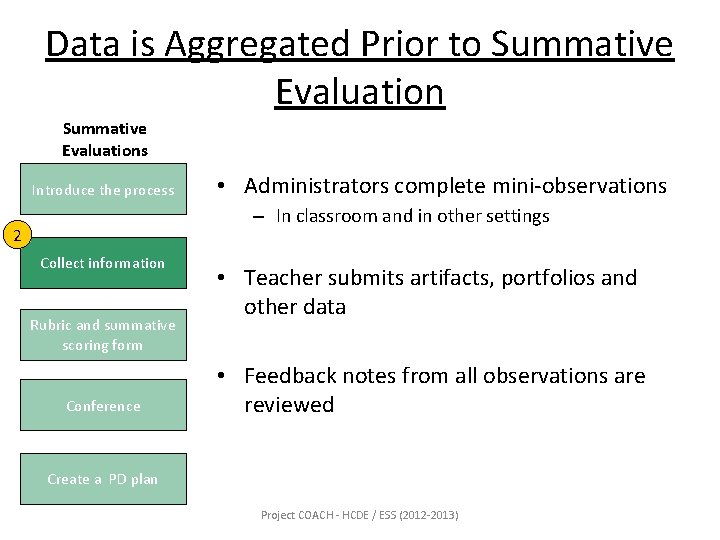
Data is Aggregated Prior to Summative Evaluations Introduce the process • Administrators complete mini-observations – In classroom and in other settings 2 Collect information Rubric and summative scoring form Conference • Teacher submits artifacts, portfolios and other data • Feedback notes from all observations are reviewed Create a PD plan Project COACH - HCDE / ESS (2012 -2013)
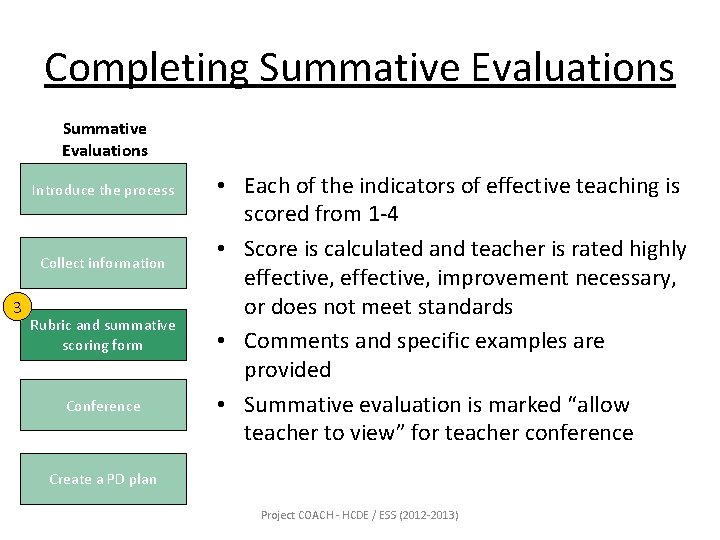
Completing Summative Evaluations Introduce the process Collect information 3 Rubric and summative scoring form Conference • Each of the indicators of effective teaching is scored from 1 -4 • Score is calculated and teacher is rated highly effective, improvement necessary, or does not meet standards • Comments and specific examples are provided • Summative evaluation is marked “allow teacher to view” for teacher conference Create a PD plan Project COACH - HCDE / ESS (2012 -2013)
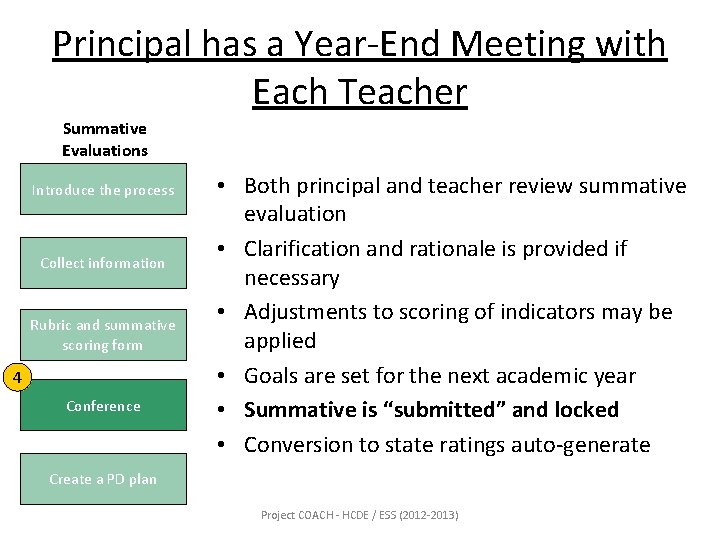
Principal has a Year-End Meeting with Each Teacher Summative Evaluations Introduce the process Collect information Rubric and summative scoring form 4 Conference • Both principal and teacher review summative evaluation • Clarification and rationale is provided if necessary • Adjustments to scoring of indicators may be applied • Goals are set for the next academic year • Summative is “submitted” and locked • Conversion to state ratings auto-generate Create a PD plan Project COACH - HCDE / ESS (2012 -2013)
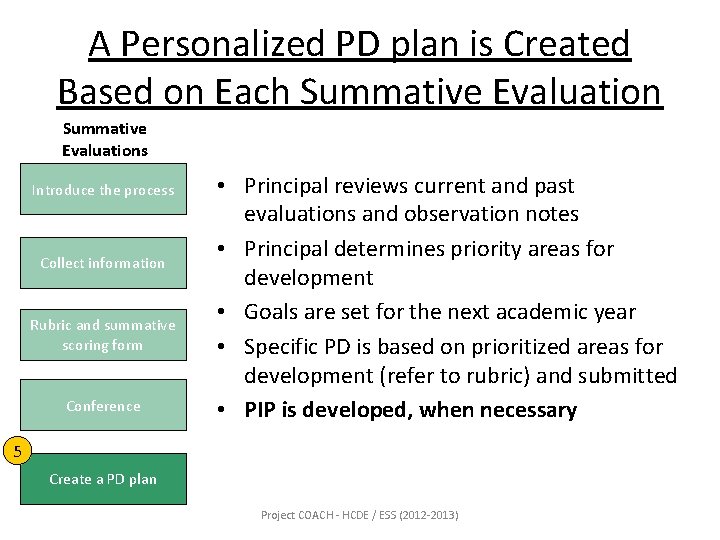
A Personalized PD plan is Created Based on Each Summative Evaluations Introduce the process Collect information Rubric and summative scoring form Conference • Principal reviews current and past evaluations and observation notes • Principal determines priority areas for development • Goals are set for the next academic year • Specific PD is based on prioritized areas for development (refer to rubric) and submitted • PIP is developed, when necessary 5 Create a PD plan Project COACH - HCDE / ESS (2012 -2013)
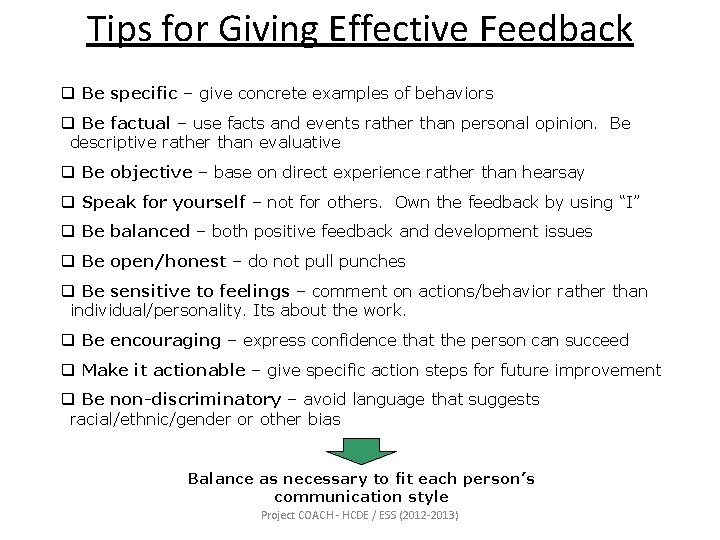
Tips for Giving Effective Feedback q Be specific – give concrete examples of behaviors q Be factual – use facts and events rather than personal opinion. Be descriptive rather than evaluative q Be objective – base on direct experience rather than hearsay q Speak for yourself – not for others. Own the feedback by using “I” q Be balanced – both positive feedback and development issues q Be open/honest – do not pull punches q Be sensitive to feelings – comment on actions/behavior rather than individual/personality. Its about the work. q Be encouraging – express confidence that the person can succeed q Make it actionable – give specific action steps for future improvement q Be non-discriminatory – avoid language that suggests racial/ethnic/gender or other bias Balance as necessary to fit each person’s communication style Project COACH - HCDE / ESS (2012 -2013)
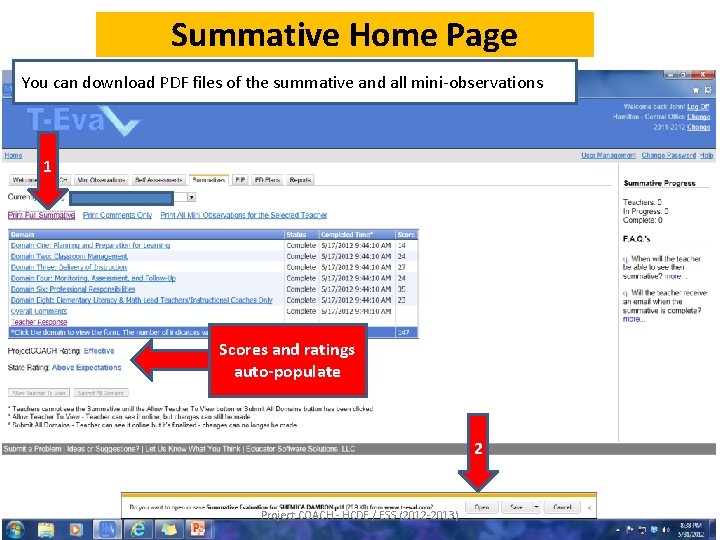
Summative Home Page You can download PDF files of the summative and all mini-observations 1 Scores and ratings auto-populate 2 Project COACH - HCDE / ESS (2012 -2013)
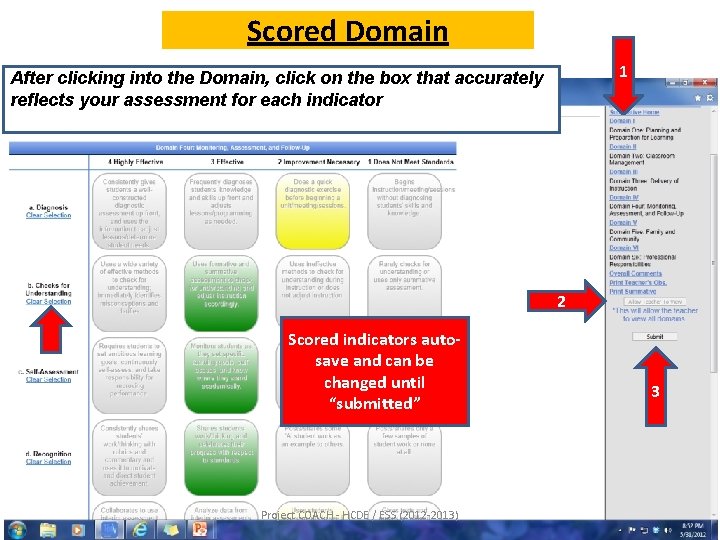
Scored Domain 1 After clicking into the Domain, click on the box that accurately reflects your assessment for each indicator 2 Scored indicators autosave and can be changed until “submitted” Project COACH - HCDE / ESS (2012 -2013) 3
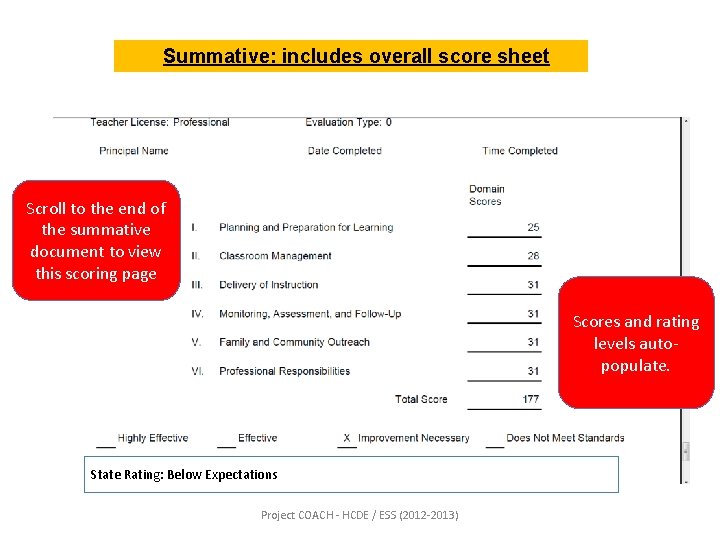
Summative: includes overall score sheet Scroll to the end of the summative document to view this scoring page Scores and rating levels autopopulate. State Rating: Below Expectations Project COACH - HCDE / ESS (2012 -2013)
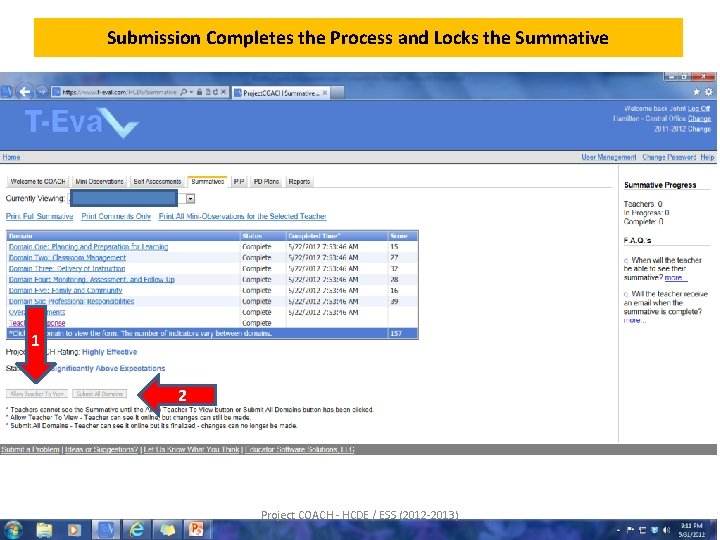
Submission Completes the Process and Locks the Summative 1 2 Project COACH - HCDE / ESS (2012 -2013)
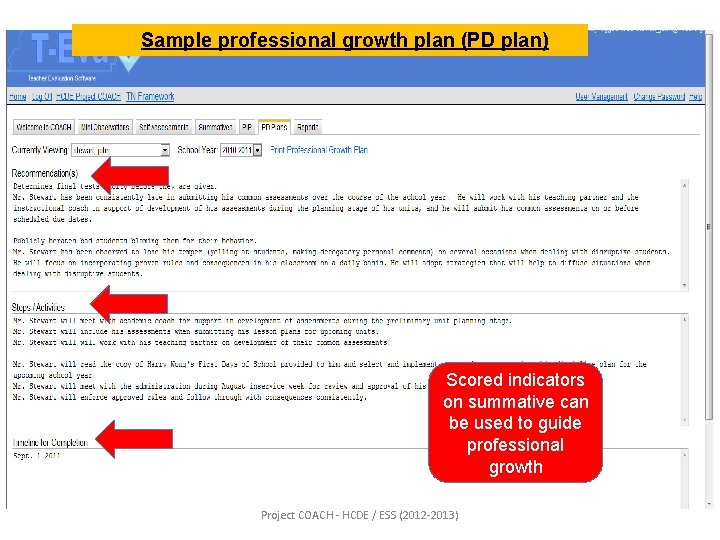
Sample professional growth plan (PD plan) Scored indicators on summative can be used to guide professional growth Project COACH - HCDE / ESS (2012 -2013)
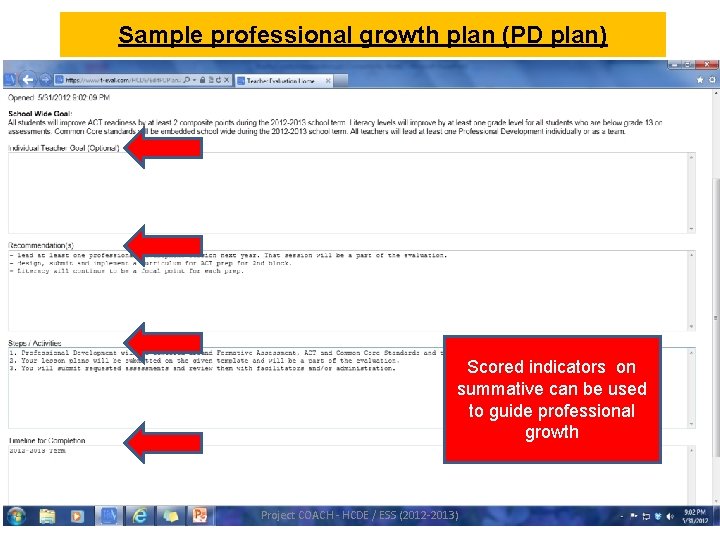
Sample professional growth plan (PD plan) Scored indicators on summative can be used to guide professional growth Project COACH - HCDE / ESS (2012 -2013)
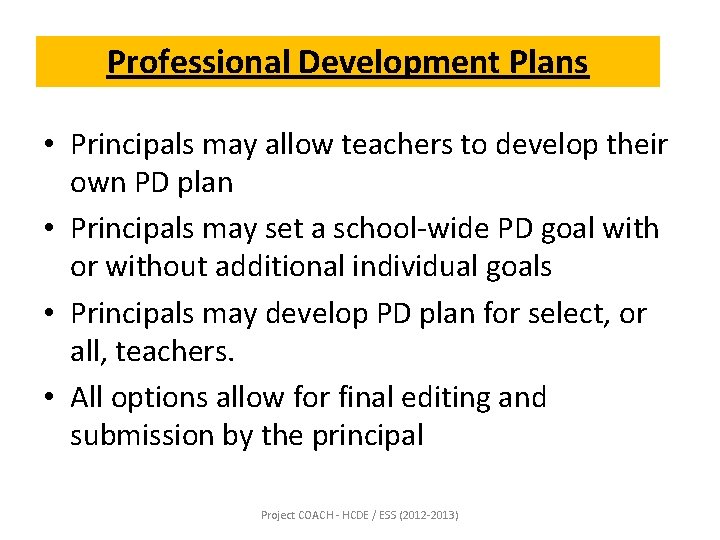
Professional Development Plans • Principals may allow teachers to develop their own PD plan • Principals may set a school-wide PD goal with or without additional individual goals • Principals may develop PD plan for select, or all, teachers. • All options allow for final editing and submission by the principal Project COACH - HCDE / ESS (2012 -2013)
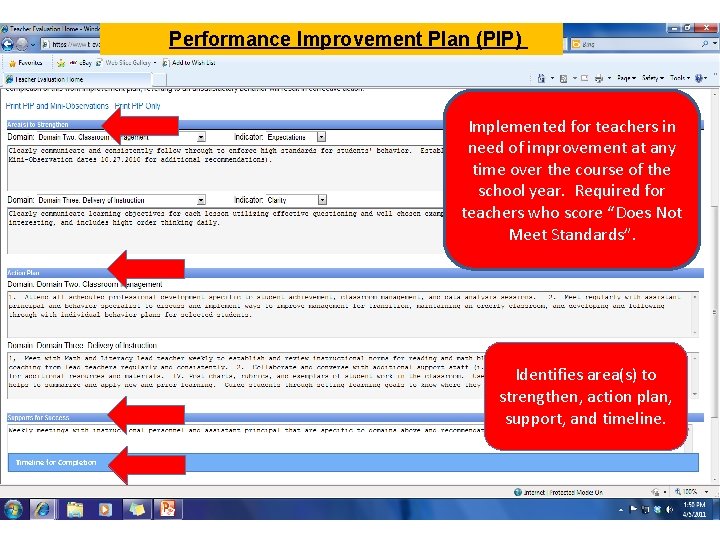
Performance Improvement Plan (PIP) Implemented for teachers in need of improvement at any time over the course of the school year. Required for teachers who score “Does Not Meet Standards”. Identifies area(s) to strengthen, action plan, support, and timeline. Timeline for Completion
PIP Guidelines • A Performance Improvement Plan (PIP): – Is to address teaching performance concerns that arise during Project Coach mini-observations – Should only be instituted after attempts at coaching are unsuccessful – Is a short term process and should ideally be six months or fewer in length – Progress should be reviewed monthly – Required for teachers scoring Does Not Meet Standards Project COACH - HCDE / ESS (2012 -2013)
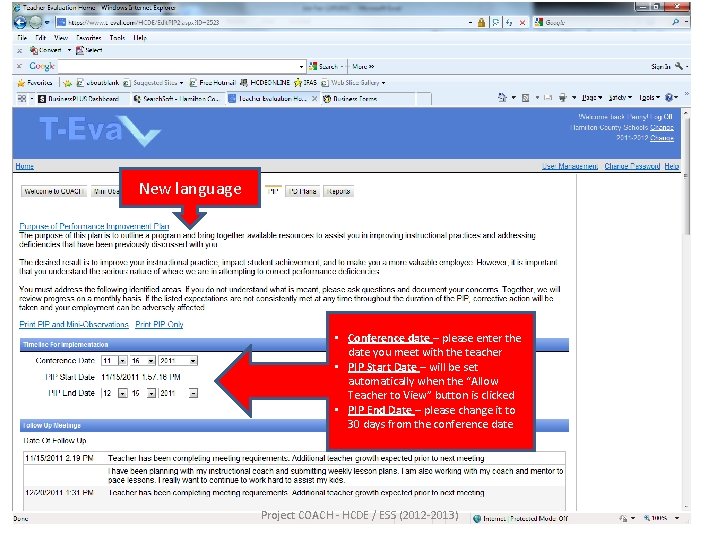
New language • Conference date – please enter the date you meet with the teacher • PIP Start Date – will be set automatically when the “Allow Teacher to View” button is clicked • PIP End Date – please change it to 30 days from the conference date Project COACH - HCDE / ESS (2012 -2013)
Prior to state submission, scores will be converted to the state’s 5 level rating system (State Requirement) Project COACH Teacher Rating Levels • 90% - 100% (Highly Effective) • 75% - 89% (Effective) • 60% - 74% (Improvement Necessary) • 59% and below (Does Not Meet Standards) Conversion Scale to State Rating Levels • 95% - 100% (Significantly Above Expectations) • 87% - 94% (Above Expectations) • 75% - 86% (Meets Expectations) • 60% - 74% (Below Expectations) • 59% and below (Significantly Below Expectations) The observation component is only 50% of the teacher evaluation process; the other 50% will come from student data and will be combined with the observation scores for the final overall teacher rating. Project COACH - HCDE / ESS (2012 -2013)
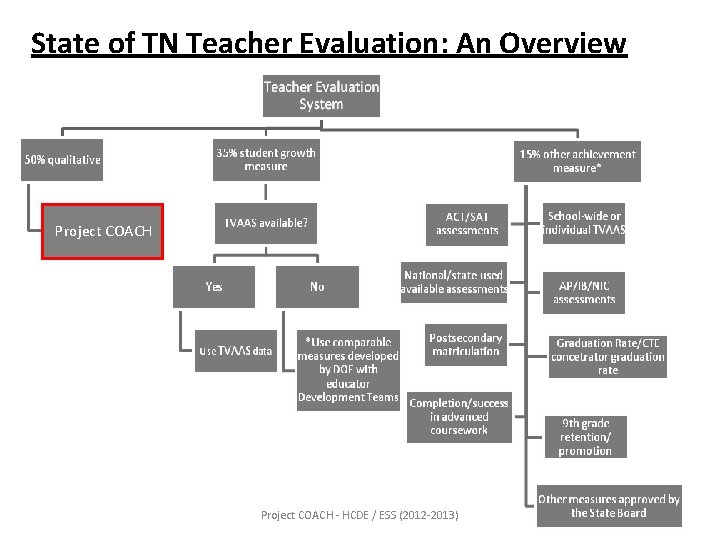
State of TN Teacher Evaluation: An Overview Project COACH - HCDE / ESS (2012 -2013)
Table of Contents • • • Project COACH Overview Mini Observation Process Summative Process Project COACH in Review Project COACH Rubric Project COACH - HCDE / ESS (2012 -2013)
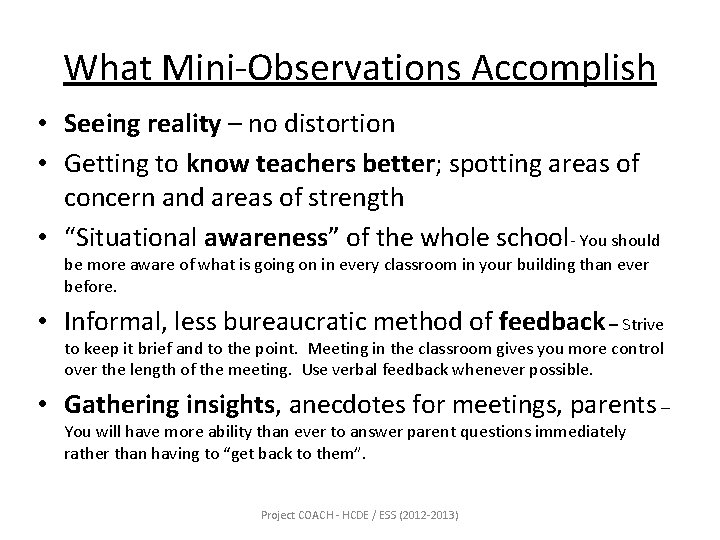
What Mini-Observations Accomplish • Seeing reality – no distortion • Getting to know teachers better; spotting areas of concern and areas of strength • “Situational awareness” of the whole school- You should be more aware of what is going on in every classroom in your building than ever before. • Informal, less bureaucratic method of feedback – Strive to keep it brief and to the point. Meeting in the classroom gives you more control over the length of the meeting. Use verbal feedback whenever possible. • Gathering insights, anecdotes for meetings, parents – You will have more ability than ever to answer parent questions immediately rather than having to “get back to them”. Project COACH - HCDE / ESS (2012 -2013)
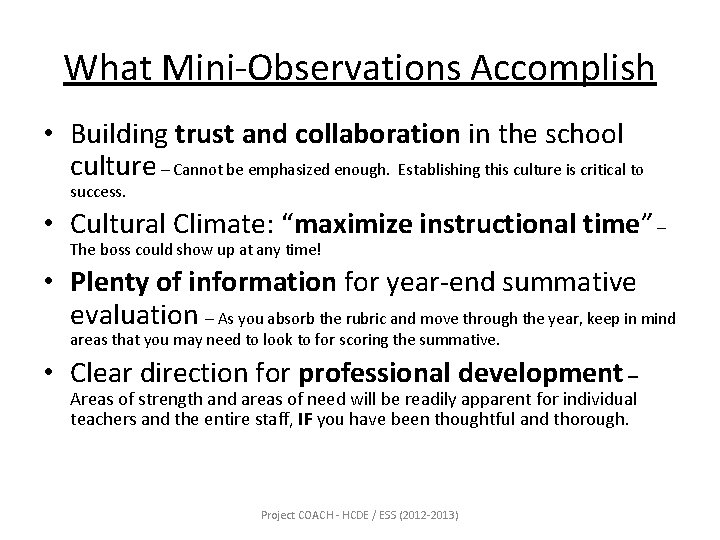
What Mini-Observations Accomplish • Building trust and collaboration in the school culture – Cannot be emphasized enough. Establishing this culture is critical to success. • Cultural Climate: “maximize instructional time” – The boss could show up at any time! • Plenty of information for year-end summative evaluation – As you absorb the rubric and move through the year, keep in mind areas that you may need to look to for scoring the summative. • Clear direction for professional development – Areas of strength and areas of need will be readily apparent for individual teachers and the entire staff, IF you have been thoughtful and thorough. Project COACH - HCDE / ESS (2012 -2013)
How Mini-Observations Can Fail • Not staying long enough to gather useful information • Making too few visits for a productive dialogue • Not having a system for capturing key insights • Not giving feedback in a way that will benefit teachers • State appeals process available based on use of inaccurate data or failure to follow process Project COACH - HCDE / ESS (2012 -2013)
Coaching Tips • Coaching is an ongoing process - day-to-day feedback is critical - Conversations revolving around instruction should become the norm between you and your staff. You will likely see it become more commonplace between staff members. • Feedback must be timely - not two weeks later • Schedule sufficient time - do not rush and try not to get interrupted – This must be a confidential conversation in a private setting. • Give feedback in person - avoid e-mail/voicemail for anything other than quick praise Project COACH - HCDE / ESS (2012 -2013)
More Coaching Tips • Choose an appropriate location - typically in private but do praise in public • Be professional - even if feedback is critical • Establish your message - Stay on topic. Remember, the goal is to have short and to the point conversations. • Determine how to deliver your message -Remind yourself of your own communication style -Think about the teacher’s temperament and most appropriate communication style for him/her Project COACH - HCDE / ESS (2012 -2013)
Talking points for Bringing it to Your Building • This model is about developing a shared understanding of what good teaching looks like • What would represent effective and highly effective for each indicator • In a 4 level rating system “Effective” is a good, strong score. There may not be a lot of 4’s, and there will be 2’s and 1’s • This model is primarily about development and collaboration • This model is our opportunity to take control of what our evaluation system will look like (rather than having it be state mandated) Project COACH - HCDE / ESS (2012 -2013)
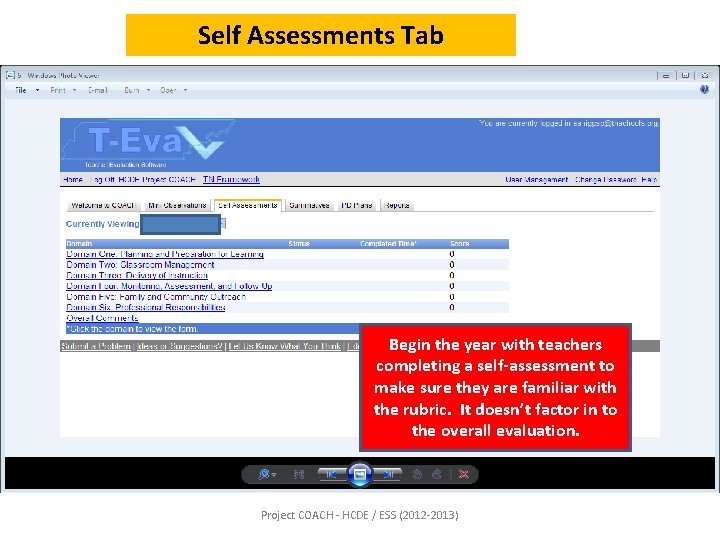
Self Assessments Tab Begin the year with teachers completing a self-assessment to make sure they are familiar with the rubric. It doesn’t factor in to the overall evaluation. Project COACH - HCDE / ESS (2012 -2013)
Project COACH Rubric • Six domains with a total of 40 indicators for certified classroom teachers – All are weighted evenly. • A variation of the core rubrics will be used for special groups: librarians, counselors, social workers, special ed lead teachers, psychologists, and instructional coaches. • Teachers will complete a self-assessment at the beginning of the evaluation cycle to insure knowledge of the rubric. • All indicators are scored to complete summative assessment to be scored only for the Summative, not a checklist for individual mini-observations. • Indicators guide professional growth – Administrators can see patterns for your most critical PD needs as well as areas of strength. Project COACH - HCDE / ESS (2012 -2013)
Review: Who and When • All certified staff • Minimum of 6 classroom instruction mini-observations on professional licensed staff; 10 minutes minimum for a total of 60 minutes • Minimum of 8 classroom instruction mini-observations on non-professional licensed staff; 10 minutes minimum for a total of 90 minutes • Minimum required observations conducted per semester - professional licensed - 4/2 or 3/3; non-professional licensed – 5/3 or 4/4 • One of the classroom mini-observations may be conducted during a teacher planning session, parent meeting, or while leading an extra-curricular activity. All other mini-observations must be in a classroom setting which involves interaction with students. • Additional information submitted by teacher via artifacts and/or portfolio • In addition to the classroom mini-observations; mini-observations of individual planning, team or parent meetings, etc. , may be conducted (student work, logs, letters, PD attendance, performances, etc. ) Project COACH - HCDE / ESS (2012 -2013)
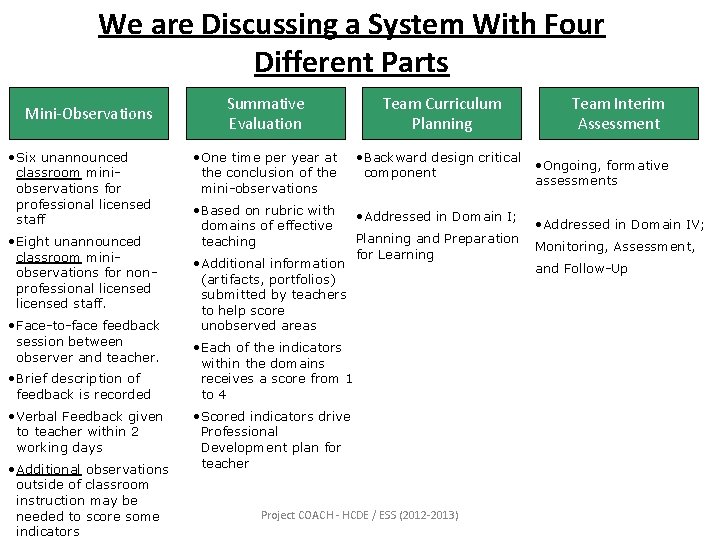
We are Discussing a System With Four Different Parts Mini-Observations • Six unannounced classroom miniobservations for professional licensed staff • Eight unannounced classroom miniobservations for nonprofessional licensed staff. • Face-to-face feedback session between observer and teacher. • Brief description of feedback is recorded • Verbal Feedback given to teacher within 2 working days • Additional observations outside of classroom instruction may be needed to score some indicators Summative Evaluation Team Curriculum Planning • One time per year at the conclusion of the mini-observations • Backward design critical component • Based on rubric with domains of effective teaching • Addressed in Domain I; • Additional information (artifacts, portfolios) submitted by teachers to help score unobserved areas Planning and Preparation for Learning • Each of the indicators within the domains receives a score from 1 to 4 • Scored indicators drive Professional Development plan for teacher Project COACH - HCDE / ESS (2012 -2013) Team Interim Assessment • Ongoing, formative assessments • Addressed in Domain IV; Monitoring, Assessment, and Follow-Up
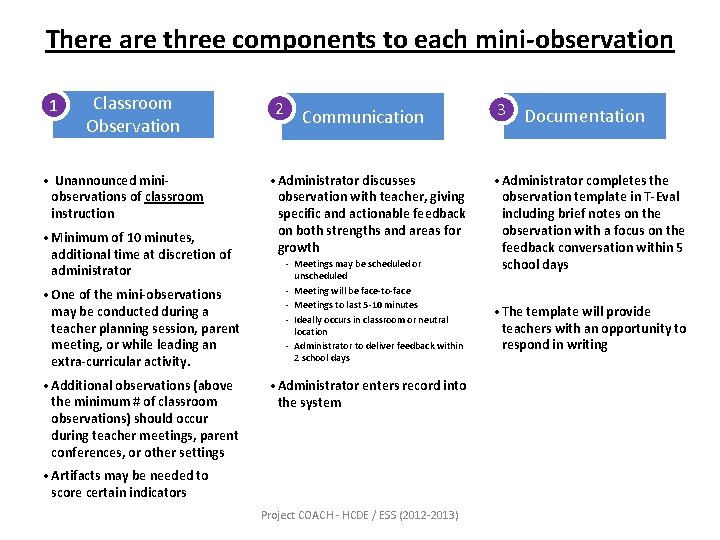
There are three components to each mini-observation 1 Classroom Observation • Unannounced miniobservations of classroom instruction • Minimum of 10 minutes, additional time at discretion of administrator • One of the mini-observations may be conducted during a teacher planning session, parent meeting, or while leading an extra-curricular activity. • Additional observations (above the minimum # of classroom observations) should occur during teacher meetings, parent conferences, or other settings 2 Communication • Administrator discusses observation with teacher, giving specific and actionable feedback on both strengths and areas for growth - Meetings may be scheduled or unscheduled - Meeting will be face-to-face - Meetings to last 5 -10 minutes - Ideally occurs in classroom or neutral location - Administrator to deliver feedback within 2 school days • Administrator enters record into the system • Artifacts may be needed to score certain indicators Project COACH - HCDE / ESS (2012 -2013) 3 Documentation • Administrator completes the observation template in T-Eval including brief notes on the observation with a focus on the feedback conversation within 5 school days • The template will provide teachers with an opportunity to respond in writing
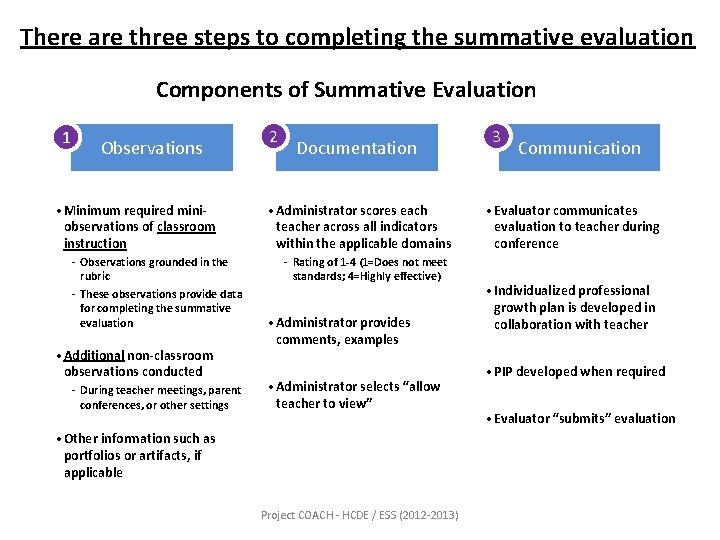
There are three steps to completing the summative evaluation Components of Summative Evaluation 1 Observations • Minimum required miniobservations of classroom instruction - Observations grounded in the rubric - These observations provide data for completing the summative evaluation • Additional non-classroom observations conducted - During teacher meetings, parent conferences, or other settings 2 Documentation • Administrator scores each teacher across all indicators within the applicable domains - Rating of 1 -4 (1=Does not meet standards; 4=Highly effective) • Administrator provides comments, examples • Administrator selects “allow teacher to view” • Other information such as portfolios or artifacts, if applicable Project COACH - HCDE / ESS (2012 -2013) 3 Communication • Evaluator communicates evaluation to teacher during conference • Individualized professional growth plan is developed in collaboration with teacher • PIP developed when required • Evaluator “submits” evaluation
Table of Contents • • • Project COACH Overview Mini Observation Process Summative Process Project COACH in Review Project COACH Rubric Project COACH - HCDE / ESS (2012 -2013)
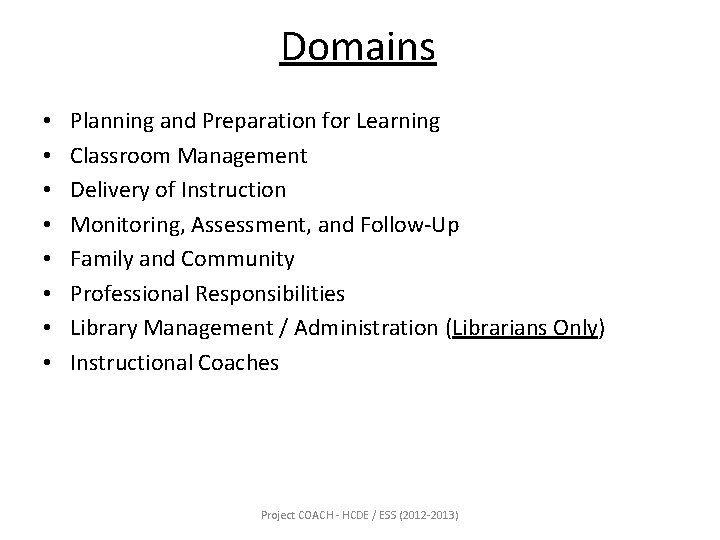
Domains • • Planning and Preparation for Learning Classroom Management Delivery of Instruction Monitoring, Assessment, and Follow-Up Family and Community Professional Responsibilities Library Management / Administration (Librarians Only) Instructional Coaches Project COACH - HCDE / ESS (2012 -2013)
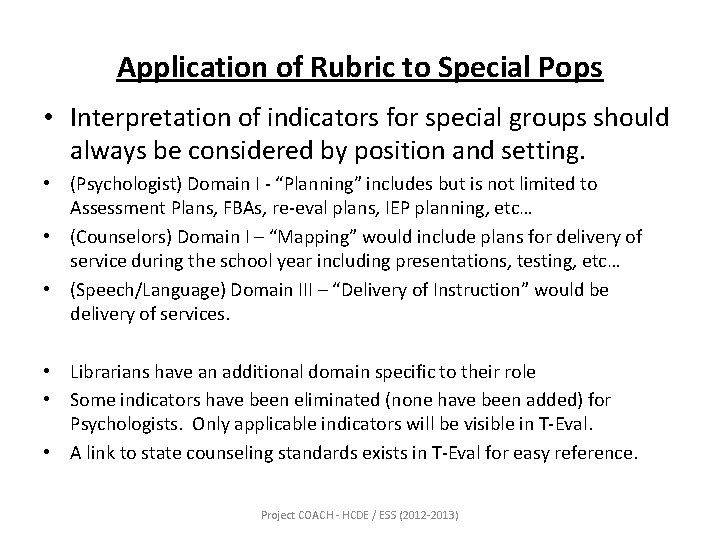
Application of Rubric to Special Pops • Interpretation of indicators for special groups should always be considered by position and setting. • (Psychologist) Domain I - “Planning” includes but is not limited to Assessment Plans, FBAs, re-eval plans, IEP planning, etc… • (Counselors) Domain I – “Mapping” would include plans for delivery of service during the school year including presentations, testing, etc… • (Speech/Language) Domain III – “Delivery of Instruction” would be delivery of services. • Librarians have an additional domain specific to their role • Some indicators have been eliminated (none have been added) for Psychologists. Only applicable indicators will be visible in T-Eval. • A link to state counseling standards exists in T-Eval for easy reference. Project COACH - HCDE / ESS (2012 -2013)
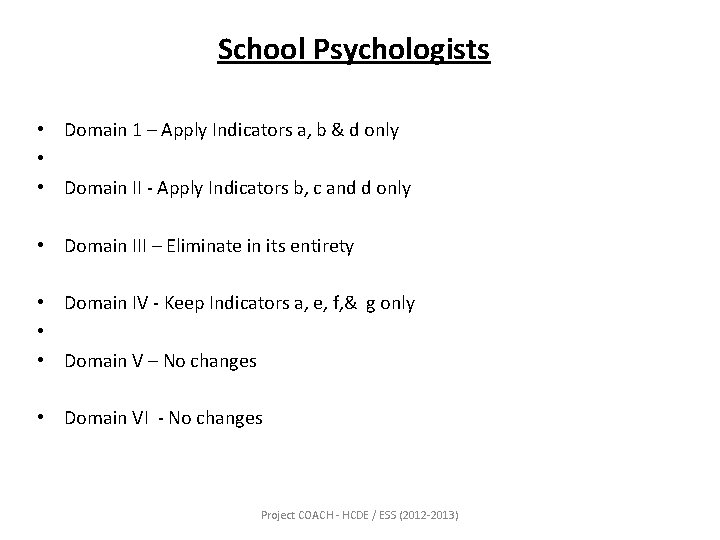
School Psychologists • Domain 1 – Apply Indicators a, b & d only • • Domain II - Apply Indicators b, c and d only • Domain III – Eliminate in its entirety • Domain IV - Keep Indicators a, e, f, & g only • • Domain V – No changes • Domain VI - No changes Project COACH - HCDE / ESS (2012 -2013)
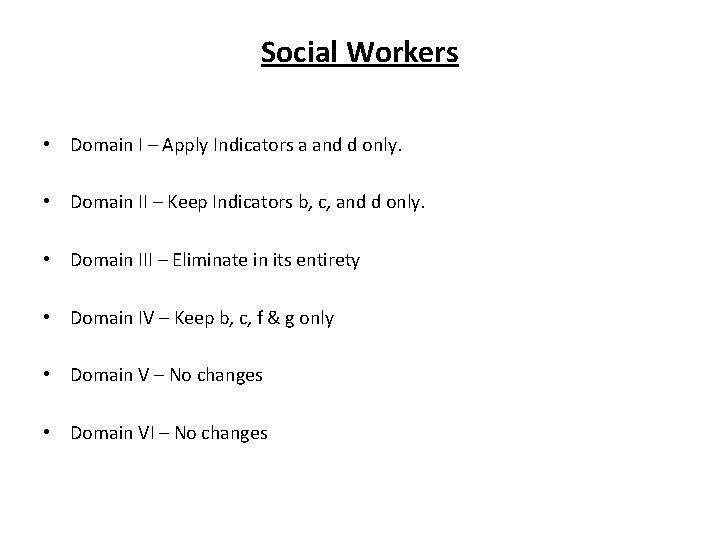
Social Workers • Domain I – Apply Indicators a and d only. • Domain II – Keep Indicators b, c, and d only. • Domain III – Eliminate in its entirety • Domain IV – Keep b, c, f & g only • Domain V – No changes • Domain VI – No changes
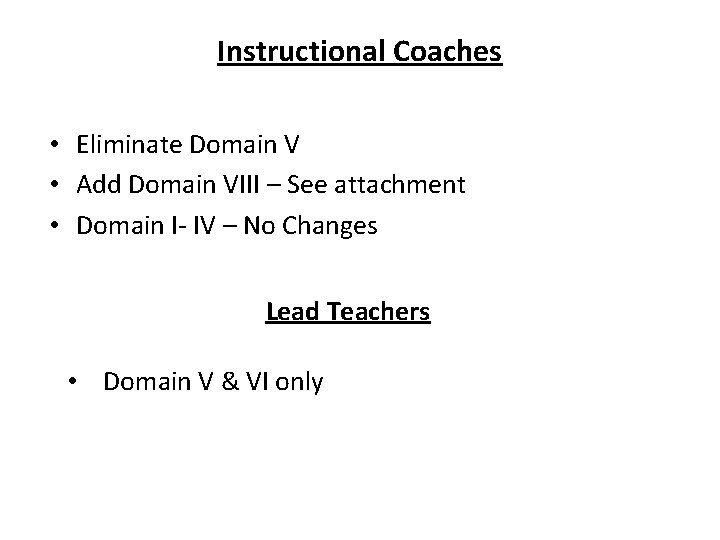
Instructional Coaches • Eliminate Domain V • Add Domain VIII – See attachment • Domain I- IV – No Changes Lead Teachers • Domain V & VI only
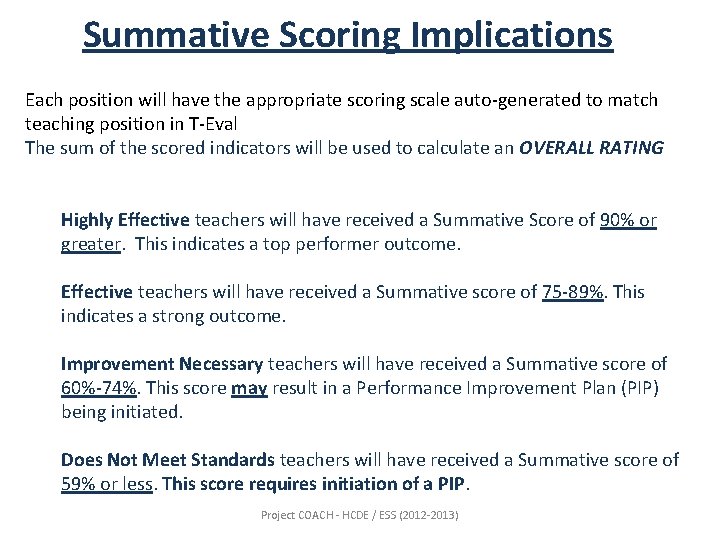
Summative Scoring Implications Each position will have the appropriate scoring scale auto-generated to match teaching position in T-Eval The sum of the scored indicators will be used to calculate an OVERALL RATING Highly Effective teachers will have received a Summative Score of 90% or greater. This indicates a top performer outcome. Effective teachers will have received a Summative score of 75 -89%. This indicates a strong outcome. Improvement Necessary teachers will have received a Summative score of 60%-74%. This score may result in a Performance Improvement Plan (PIP) being initiated. Does Not Meet Standards teachers will have received a Summative score of 59% or less. This score requires initiation of a PIP. Project COACH - HCDE / ESS (2012 -2013)
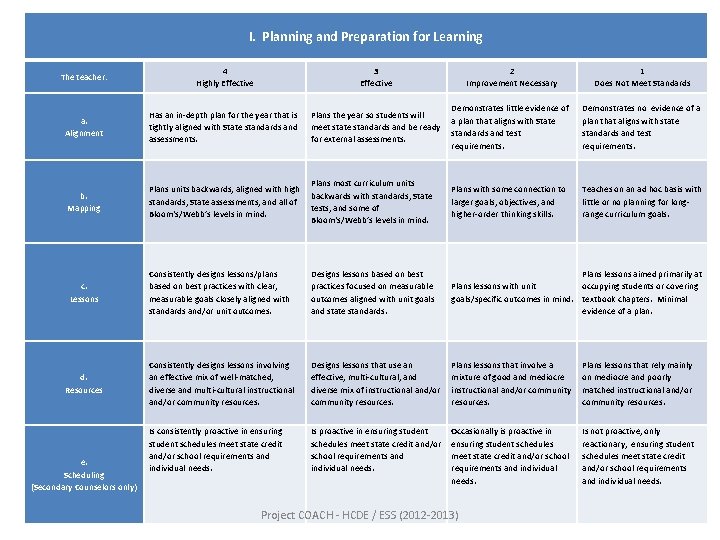
I. Planning and Preparation for Learning The teacher: 4 Highly Effective 3 Effective 2 Improvement Necessary 1 Does Not Meet Standards a. Alignment Has an in-depth plan for the year that is tightly aligned with State standards and assessments. Plans the year so students will meet state standards and be ready for external assessments. Demonstrates little evidence of a plan that aligns with State standards and test requirements. Demonstrates no evidence of a plan that aligns with state standards and test requirements. b. Mapping Plans units backwards, aligned with high standards, State assessments, and all of Bloom's/Webb’s levels in mind. Plans most curriculum units backwards with standards, State tests, and some of Bloom's/Webb’s levels in mind. Plans with some connection to larger goals, objectives, and higher-order thinking skills. Teaches on an ad hoc basis with little or no planning for longrange curriculum goals. c. Lessons Consistently designs lessons/plans based on best practices with clear, measurable goals closely aligned with standards and/or unit outcomes. Designs lessons based on best practices focused on measurable outcomes aligned with unit goals and state standards. Plans lessons aimed primarily at Plans lessons with unit occupying students or covering goals/specific outcomes in mind. textbook chapters. Minimal evidence of a plan. d. Resources Consistently designs lessons involving an effective mix of well-matched, diverse and multi-cultural instructional and/or community resources. Designs lessons that use an effective, multi-cultural, and diverse mix of instructional and/or community resources. Plans lessons that involve a mixture of good and mediocre instructional and/or community resources. Plans lessons that rely mainly on mediocre and poorly matched instructional and/or community resources. Is consistently proactive in ensuring student schedules meet state credit and/or school requirements and individual needs. Is proactive in ensuring student schedules meet state credit and/or school requirements and individual needs. Occasionally is proactive in ensuring student schedules meet state credit and/or school requirements and individual needs. Is not proactive, only reactionary, ensuring student schedules meet state credit and/or school requirements and individual needs. e. Scheduling (Secondary Counselors only) Project COACH - HCDE / ESS (2012 -2013)
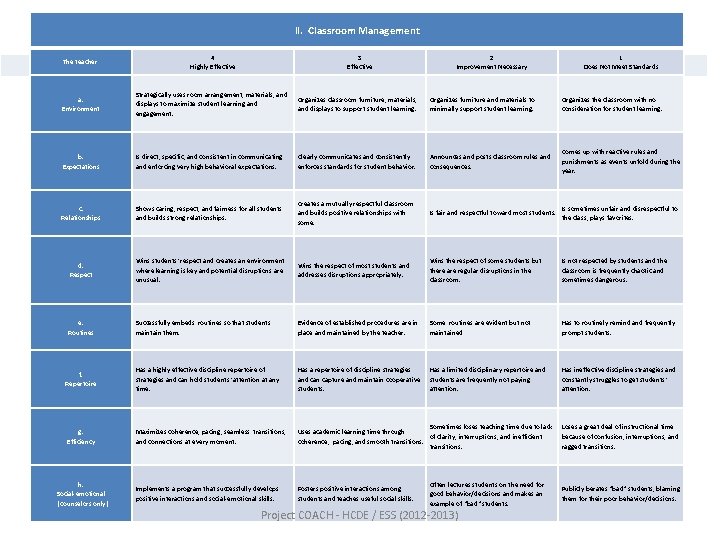
II. Classroom Management The teacher: 4 Highly Effective a. Environment Strategically uses room arrangement, materials, and displays to maximize student learning and engagement. Organizes classroom furniture, materials, and displays to support student learning. Organizes furniture and materials to minimally support student learning. Organizes the classroom with no consideration for student learning. b. Expectations Is direct, specific, and consistent in communicating and enforcing very high behavioral expectations. Clearly communicates and consistently enforces standards for student behavior. Announces and posts classroom rules and consequences. Comes up with reactive rules and punishments as events unfold during the year. c. Relationships Shows caring, respect, and fairness for all students and builds strong relationships. Creates a mutually respectful classroom and builds positive relationships with some. Is fair and respectful toward most students. Is sometimes unfair and disrespectful to the class; plays favorites. d. Respect Wins students' respect and creates an environment where learning is key and potential disruptions are unusual. Wins the respect of most students and addresses disruptions appropriately. Wins the respect of some students but there are regular disruptions in the classroom. Is not respected by students and the classroom is frequently chaotic and sometimes dangerous. e. Routines Successfully embeds routines so that students maintain them. Evidence of established procedures are in place and maintained by the teacher. Some routines are evident but not maintained Has to routinely remind and frequently prompt students. f. Repertoire Has a highly effective discipline repertoire of strategies and can hold students' attention at any time. Has a repertoire of discipline strategies and can capture and maintain cooperative students. Has a limited disciplinary repertoire and students are frequently not paying attention. Has ineffective discipline strategies and constantly struggles to get students' attention. g. Efficiency Maximizes coherence, pacing, seamless transitions, and connections at every moment. Sometimes loses teaching time due to lack Uses academic learning time through of clarity, interruptions, and inefficient coherence, pacing, and smooth transitions. Implements a program that successfully develops positive interactions and social-emotional skills. Fosters positive interactions among students and teaches useful social skills. h. Social-emotional (Counselors only) 3 Effective 2 Improvement Necessary Often lectures students on the need for good behavior/decisions and makes an example of "bad" students. Project COACH - HCDE / ESS (2012 -2013) 1 Does Not Meet Standards Loses a great deal of instructional time because of confusion, interruptions, and ragged transitions. Publicly berates "bad" students, blaming them for their poor behavior/decisions.
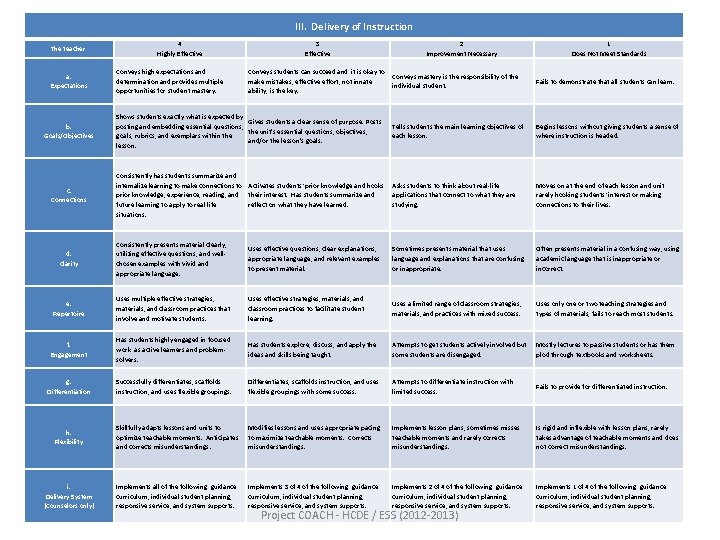
III. Delivery of Instruction The teacher: a. Expectations 4 Highly Effective Conveys high expectations and determination and provides multiple opportunities for student mastery. 3 Effective Conveys students can succeed and it is okay to make mistakes; effective effort, not innate ability, is the key. 2 Improvement Necessary 1 Does Not Meet Standards Conveys mastery is the responsibility of the individual student. Fails to demonstrate that all students can learn. b. Goals/Objectives Shows students exactly what is expected by Gives students a clear sense of purpose. Posts posting and embedding essential questions, the unit’s essential questions, objectives, goals, rubrics, and exemplars within the and/or the lesson’s goals. lesson. Tells students the main learning objectives of each lesson. Begins lessons without giving students a sense of where instruction is headed. c. Connections Consistently has students summarize and internalize learning to make connections to Activates students' prior knowledge and hooks prior knowledge, experience, reading, and their interest. Has students summarize and future learning to apply to real life reflect on what they have learned. situations. Asks students to think about real-life applications that connect to what they are studying. Moves on at the end of each lesson and unit rarely hooking students' interest or making connections to their lives. d. Clarity Consistently presents material clearly, utilizing effective questions, and wellchosen examples with vivid and appropriate language. Uses effective questions, clear explanations, appropriate language, and relevant examples to present material. Sometimes presents material that uses language and explanations that are confusing or inappropriate. Often presents material in a confusing way, using academic language that is inappropriate or incorrect. e. Repertoire Uses multiple effective strategies, materials, and classroom practices that involve and motivate students. Uses effective strategies, materials, and classroom practices to facilitate student learning. Uses a limited range of classroom strategies, materials, and practices with mixed success. Uses only one or two teaching strategies and types of materials; fails to reach most students. f. Engagement Has students highly engaged in focused work as active learners and problemsolvers. Has students explore, discuss, and apply the ideas and skills being taught. Attempts to get students actively involved but some students are disengaged. Mostly lectures to passive students or has them plod through textbooks and worksheets. g. Differentiation Successfully differentiates, scaffolds instruction, and uses flexible groupings. Differentiates, scaffolds instruction, and uses flexible groupings with some success. Attempts to differentiate instruction with limited success. Fails to provide for differentiated instruction. h. Flexibility Skillfully adapts lessons and units to optimize teachable moments. Anticipates and corrects misunderstandings. Modifies lessons and uses appropriate pacing to maximize teachable moments. Corrects misunderstandings. Implements lesson plans, sometimes misses teachable moments and rarely corrects misunderstandings. Is rigid and inflexible with lesson plans, rarely takes advantage of teachable moments and does not correct misunderstandings. i. Delivery System (Counselors only) Implements all of the following: guidance curriculum, individual student planning, responsive service, and system supports. Implements 3 of 4 of the following: guidance curriculum, individual student planning, responsive service, and system supports. Implements 2 of 4 of the following: guidance curriculum, individual student planning, responsive service, and system supports. Implements 1 of 4 of the following: guidance curriculum, individual student planning, responsive service, and system supports. Project COACH - HCDE / ESS (2012 -2013)
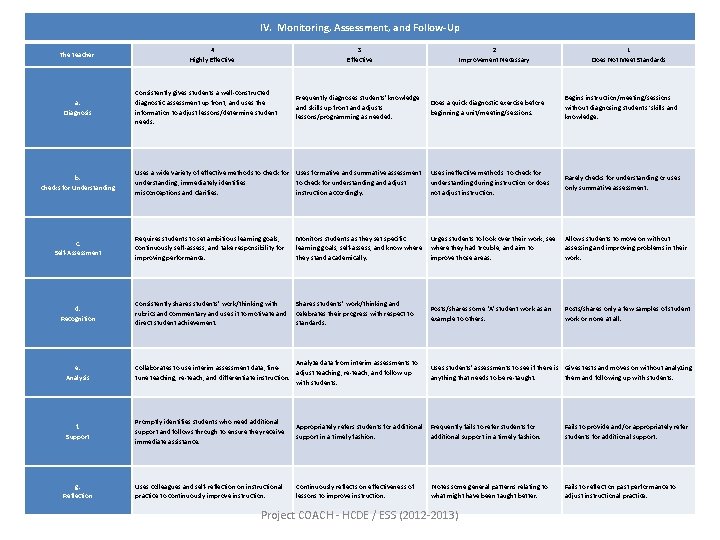
IV. Monitoring, Assessment, and Follow-Up The teacher: 4 Highly Effective 3 Effective Consistently gives students a well-constructed diagnostic assessment up front, and uses the information to adjust lessons/determine student needs. 1 Does Not Meet Standards Does a quick diagnostic exercise before beginning a unit/meeting/sessions. Begins instruction/meeting/sessions without diagnosing students' skills and knowledge. Uses a wide variety of effective methods to check for Uses formative and summative assessment understanding; immediately identifies to check for understanding and adjust misconceptions and clarifies. instruction accordingly. Uses ineffective methods to check for understanding during instruction or does not adjust instruction. Rarely checks for understanding or uses only summative assessment. c. Self-Assessment Requires students to set ambitious learning goals, continuously self-assess, and take responsibility for improving performance. Monitors students as they set specific learning goals, self-assess, and know where they stand academically. Urges students to look over their work, see where they had trouble, and aim to improve those areas. Allows students to move on without assessing and improving problems in their work. d. Recognition Consistently shares students’ work/thinking with rubrics and commentary and uses it to motivate and direct student achievement. Shares students’ work/thinking and celebrates their progress with respect to standards. Posts/shares some ‘A’ student work as an example to others. Posts/shares only a few samples of student work or none at all. a. Diagnosis b. Checks for Understanding Frequently diagnoses students’ knowledge and skills up front and adjusts lessons/programming as needed. 2 Improvement Necessary e. Analysis Analyze data from interim assessments to Collaborates to use interim assessment data, fineadjust teaching, re-teach, and follow up tune teaching, re-teach, and differentiate instruction. with students. Uses students’ assessments to see if there is Gives tests and moves on without analyzing anything that needs to be re-taught. them and following up with students. f. Support Promptly identifies students who need additional support and follows through to ensure they receive immediate assistance. Appropriately refers students for additional support in a timely fashion. Frequently fails to refer students for additional support in a timely fashion. Fails to provide and/or appropriately refer students for additional support. g. Reflection Uses colleagues and self-reflection on instructional practice to continuously improve instruction. Continuously reflects on effectiveness of lessons to improve instruction. Notes some general patterns relating to what might have been taught better. Fails to reflect on past performance to adjust instructional practice. Project COACH - HCDE / ESS (2012 -2013)
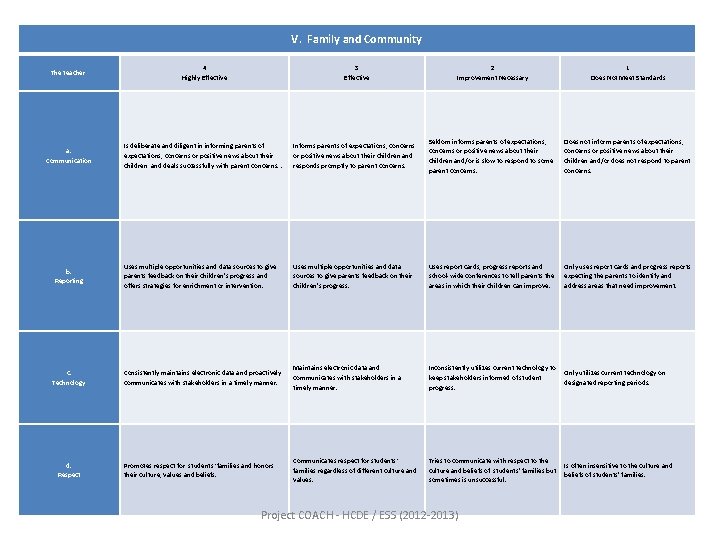
V. Family and Community The teacher: 4 Highly Effective a. Communication Is deliberate and diligent in informing parents of expectations, concerns or positive news about their children and deals successfully with parent concerns. . b. Reporting c. Technology d. Respect 3 Effective 2 Improvement Necessary 1 Does Not Meet Standards Informs parents of expectations, concerns or positive news about their children and responds promptly to parent concerns. Seldom informs parents of expectations, concerns or positive news about their children and/or is slow to respond to some parent concerns. Does not inform parents of expectations, concerns or positive news about their children and/or does not respond to parent concerns. Uses multiple opportunities and data sources to give parents feedback on their children’s progress and offers strategies for enrichment or intervention. Uses multiple opportunities and data sources to give parents feedback on their children’s progress. Uses report cards, progress reports and school-wide conferences to tell parents the areas in which their children can improve. Only uses report cards and progress reports expecting the parents to identify and address areas that need improvement. Consistently maintains electronic data and proactively communicates with stakeholders in a timely manner. Maintains electronic data and communicates with stakeholders in a timely manner. Inconsistently utilizes current technology to keep stakeholders informed of student progress. Only utilizes current technology on designated reporting periods. Promotes respect for students' families and honors their culture, values and beliefs. Communicates respect for students' families regardless of different culture and values. Tries to communicate with respect to the culture and beliefs of students’ families but sometimes is unsuccessful. Is often insensitive to the culture and beliefs of students’ families. Project COACH - HCDE / ESS (2012 -2013)
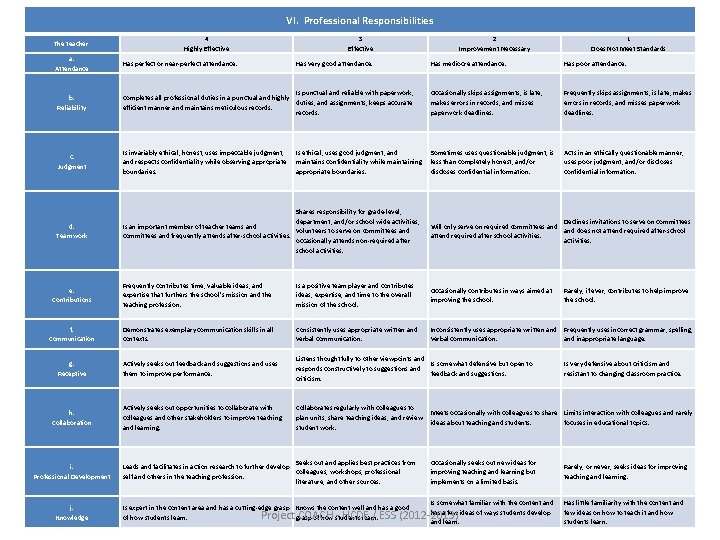
VI. Professional Responsibilities The teacher: a. Attendance 4 Highly Effective 3 Effective Has perfect or near-perfect attendance. Has very good attendance. 2 Improvement Necessary 1 Does Not Meet Standards Has mediocre attendance. Has poor attendance. b. Reliability Is punctual and reliable with paperwork, Completes all professional duties in a punctual and highly duties, and assignments; keeps accurate efficient manner and maintains meticulous records. Occasionally skips assignments, is late, makes errors in records, and misses paperwork deadlines. Frequently skips assignments, is late, makes errors in records, and misses paperwork deadlines. c. Judgment Is invariably ethical, honest, uses impeccable judgment, and respects confidentiality while observing appropriate boundaries. Sometimes uses questionable judgment, is less than completely honest, and/or discloses confidential information. Acts in an ethically questionable manner, uses poor judgment, and/or discloses confidential information. d. Teamwork Shares responsibility for grade-level, department, and/or school wide activities; Is an important member of teacher teams and volunteers to serve on committees and frequently attends after-school activities. occasionally attends non-required after school activities. Declines invitations to serve on committees Will only serve on required committees and does not attend required after-school attend required after school activities. e. Contributions Frequently contributes time, valuable ideas, and expertise that furthers the school’s mission and the teaching profession. Is a positive team player and contributes ideas, expertise, and time to the overall mission of the school. Occasionally contributes in ways aimed at improving the school. f. Communication Demonstrates exemplary communication skills in all contexts. Consistently uses appropriate written and verbal communication. Inconsistently uses appropriate written and Frequently uses incorrect grammar, spelling, verbal communication. and inappropriate language. g. Receptive Actively seeks out feedback and suggestions and uses them to improve performance. Listens thoughtfully to other viewpoints and Is somewhat defensive but open to responds constructively to suggestions and feedback and suggestions. criticism. h. Collaboration Actively seeks out opportunities to collaborate with colleagues and other stakeholders to improve teaching and learning. Collaborates regularly with colleagues to plan units, share teaching ideas, and review student work. i. Professional Development j. Knowledge Is ethical, uses good judgment, and maintains confidentiality while maintaining appropriate boundaries. Seeks out and applies best practices from Leads and facilitates in action research to further develop colleagues, workshops, professional self and others in the teaching profession. literature, and other sources. Is expert in the content area and has a cutting-edge grasp Knows the content well and has a good of how students learn. grasp of how students learn. Rarely, if ever, contributes to help improve the school. Is very defensive about criticism and resistant to changing classroom practice. Meets occasionally with colleagues to share Limits interaction with colleagues and rarely ideas about teaching and students. focuses in educational topics. Occasionally seeks out new ideas for improving teaching and learning but implements on a limited basis. Is somewhat familiar with the content and has a few ideas of ways students develop Project COACH - HCDE / ESS (2012 -2013) and learn. Rarely, or never, seeks ideas for improving teaching and learning. Has little familiarity with the content and few ideas on how to teach it and how students learn.
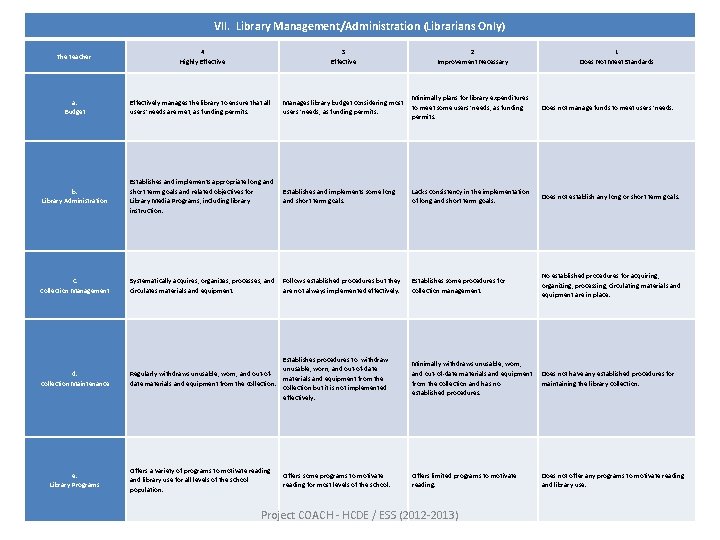
VII. Library Management/Administration (Librarians Only) The teacher: 4 Highly Effective 3 Effective 2 Improvement Necessary 1 Does Not Meet Standards a. Budget Effectively manages the library to ensure that all users' needs are met, as funding permits. Manages library budget considering most users' needs, as funding permits. Minimally plans for library expenditures to meet some users' needs, as funding permits. Does not manage funds to meet users' needs. b. Library Administration Establishes and implements appropriate long and short term goals and related objectives for Library Media Programs, including library instruction. Establishes and implements some long and short term goals. Lacks consistency in the implementation of long and short term goals. Does not establish any long or short term goals. c. Collection Management Systematically acquires, organizes, processes, and circulates materials and equipment. Follows established procedures but they are not always implemented effectively. Establishes some procedures for collection management. No established procedures for acquiring, organizing, processing, circulating materials and equipment are in place. d. Collection Maintenance Establishes procedures to withdraw unusable, worn, and out-of-date Regularly withdraws unusable, worn, and out-ofmaterials and equipment from the date materials and equipment from the collection but it is not implemented effectively. Minimally withdraws unusable, worn, and out-of-date materials and equipment from the collection and has no established procedures. Does not have any established procedures for maintaining the library collection. Offers a variety of programs to motivate reading and library use for all levels of the school population. Offers limited programs to motivate reading. Does not offer any programs to motivate reading and library use. e. Library Programs Offers some programs to motivate reading for most levels of the school. Project COACH - HCDE / ESS (2012 -2013)
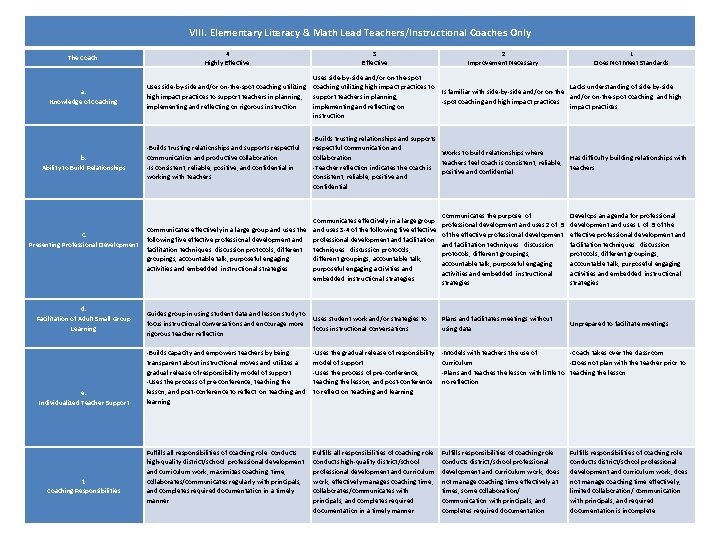
VIII. Elementary Literacy & Math Lead Teachers/Instructional Coaches Only The Coach: 4 Highly Effective 3 Effective a. Knowledge of Coaching Uses side-by-side and/or on-the-spot coaching utilizing high impact practices to support teachers in planning, implementing and reflecting on rigorous instruction Uses side-by-side and/or on-the-spot coaching utilizing high impact practices to support teachers in planning, implementing and reflecting on instruction -Builds trusting relationships and supports respectful communication and productive collaboration -Is consistent, reliable, positive, and confidential in working with teachers -Builds trusting relationships and supports respectful communication and Works to build relationships where collaboration teachers feel coach is consistent, reliable, -Teacher reflection indicates the coach is positive and confidential consistent, reliable, positive and confidential Has difficulty building relationships with teachers Communicates effectively in a large group and uses the and uses 3 -4 of the following five effective professional development and facilitation techniques: discussion protocols, different techniques: discussion protocols, groupings, accountable talk, purposeful engaging different groupings, accountable talk, activities and embedded instructional strategies purposeful engaging activities and embedded instructional strategies Communicates the purpose of professional development and uses 2 of 5 of the effective professional development and facilitation techniques: discussion protocols, different groupings, accountable talk, purposeful engaging activities and embedded instructional strategies Develops an agenda for professional development and uses 1 of 5 of the effective professional development and facilitation techniques: discussion protocols, different groupings, accountable talk, purposeful engaging activities and embedded instructional strategies Guides group in using student data and lesson study to focus instructional conversations and encourage more rigorous teacher reflection Uses student work and/or strategies to focus instructional conversations Plans and facilitates meetings without using data Unprepared to facilitate meetings -Builds capacity and empowers teachers by being transparent about instructional moves and utilizes a gradual release of responsibility model of support -Uses the process of pre-conference, teaching the lesson, and post-conference to reflect on teaching and learning -Uses the gradual release of responsibility model of support -Uses the process of pre-conference, teaching the lesson, and post-conference to reflect on teaching and learning -Models with teachers the use of -Coach takes over the classroom curriculum -Does not plan with the teacher prior to -Plans and teaches the lesson with little to teaching the lesson no reflection Fulfills all responsibilities of coaching role: conducts high-quality district/school professional development and curriculum work, maximizes coaching time, collaborates/communicates regularly with principals, and completes required documentation in a timely manner Fulfills all responsibilities of coaching role: conducts high-quality district/school professional development and curriculum work, effectively manages coaching time, collaborates/communicates with principals, and completes required documentation in a timely manner Fulfills responsibilities of coaching role: conducts district/school professional development and curriculum work, does not manage coaching time effectively at times, some collaboration/ communication with principals, and completes required documentation b. Ability to Build Relationships c. Presenting Professional Development d. Facilitation of Adult Small Group Learning e. Individualized Teacher Support f. Coaching Responsibilities 2 Improvement Necessary 1 Does Not Meet Standards Lacks understanding of side-by-side Is familiar with side-by-side and/or on-the-spot coaching and high impact practices Fulfills responsibilities of coaching role: conducts district/school professional development and curriculum work, does not manage coaching time effectively, limited collaboration/ communication with principals, and required documentation is incomplete
- Slides: 74