
PROJECT CHARTER Welcome and Induction Phase 2 and
- Slides: 1
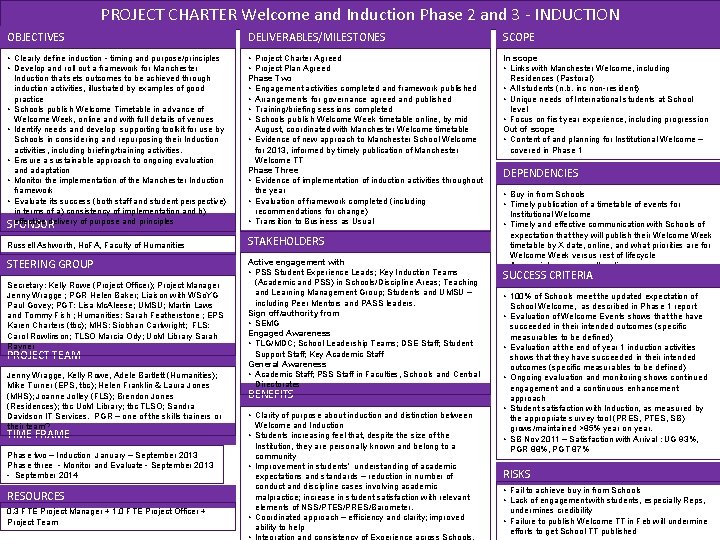
PROJECT CHARTER Welcome and Induction Phase 2 and 3 - INDUCTION OBJECTIVES DELIVERABLES/MILESTONES SCOPE • Clearly define induction - timing and purpose/principles • Develop and roll out a framework for Manchester • Project Charter Agreed • Project Plan Agreed Induction that sets outcomes to be achieved through induction activities, illustrated by examples of good practice • Schools publish Welcome Timetable in advance of Welcome Week, online and with full details of venues • Identify needs and develop supporting toolkit for use by Schools in considering and repurposing their Induction activities, including briefing/training activities. • Ensure a sustainable approach to ongoing evaluation and adaptation • Monitor the implementation of the Manchester Induction framework • Evaluate its success (both staff and student perspective) in terms of a) consistency of implementation and b) effective delivery of purpose and principles SPONSOR Phase Two • Engagement activities completed and framework published • Arrangements for governance agreed and published • Training/briefing sessions completed • Schools publish Welcome Week timetable online, by mid August, coordinated with Manchester Welcome timetable • Evidence of new approach to Manchester School Welcome for 2013, informed by timely publication of Manchester Welcome TT Phase Three • Evidence of implementation of induction activities throughout the year • Evaluation of framework completed (including recommendations for change) • Transition to Business as Usual In scope • Links with Manchester Welcome, including Residences (Pastoral) • All students (n. b. inc non-resident) • Unique needs of International students at School level • Focus on first year experience, including progression Out of scope • Content of and planning for Institutional Welcome – covered in Phase 1 Russell Ashworth, Ho. FA, Faculty of Humanities STAKEHOLDERS STEERING GROUP Secretary: Kelly Rowe (Project Officer); Project Manager Jenny Wragge ; PGR Helen Baker; Liaison with WSo. YG Paul Govey; PGT: Lisa Mc. Aleese; UMSU; Martin Laws and Tommy Fish ; Humanities: Sarah Featherstone ; EPS Karen Charters (tbc); MHS: Siobhan Cartwright; FLS: Carol Rowlinson; TLSO Marcia Ody; Uo. M Library Sarah Rayner PROJECT TEAM Jenny Wragge, Kelly Rowe, Adele Bartlett (Humanities); Mike Turner (EPS, tbc); Helen Franklin & Laura Jones (MHS); Joanne Jolley (FLS); Brendon Jones (Residences); tbc Uo. M Library; tbc TLSO; Sandra Davidson IT Services. PGR – one of the skills trainers or their team? TIME FRAME Phase two – Induction January – September 2013 Phase three - Monitor and Evaluate - September 2013 - September 2014 RESOURCES 0. 3 FTE Project Manager + 1. 0 FTE Project Officer + Project Team Active engagement with • PSS Student Experience Leads; Key Induction Teams (Academic and PSS) in Schools/Discipline Areas; Teaching and Learning Management Group; Students and UMSU – including Peer Mentors and PASS leaders. Sign off/authority from • SEMG Engaged Awareness • TLG/MDC; School Leadership Teams; DSE Staff; Student Support Staff; Key Academic Staff General Awareness • Academic Staff; PSS Staff in Faculties, Schools and Central Directorates DEPENDENCIES • Buy in from Schools • Timely publication of a timetable of events for Institutional Welcome • Timely and effective communication with Schools of expectation that they will publish their Welcome Week timetable by X date, online, and what priorities are for Welcome Week versus rest of lifecycle • Appropriate resource allocation SUCCESS CRITERIA • 100% of Schools meet the updated expectation of School Welcome, as described in Phase 1 report • Evaluation of Welcome Events shows that the have • • BENEFITS • Clarity of purpose about induction and distinction between • Welcome and Induction • Students increasing feel that, despite the size of the Institution, they are personally known and belong to a community • Improvement in students’ understanding of academic expectations and standards – reduction in number of conduct and discipline cases involving academic malpractice; increase in student satisfaction with relevant elements of NSS/PTES/PRES/Barometer. • Coordinated approach – efficiency and clarity; improved ability to help • succeeded in their intended outcomes (specific measurables to be defined) Evaluation at the end of year 1 induction activities shows that they have succeeded in their intended outcomes (specific measurables to be defined) Ongoing evaluation and monitoring shows continued engagement and a continuous enhancement approach Student satisfaction with Induction, as measured by the appropriate survey tool (PRES, PTES, SB) grows/maintained >85% year on year. SB Nov 2011 – Satisfaction with Arrival : UG 93%, PGR 88%, PGT 87% RISKS • Fail to achieve buy in from Schools • Lack of engagement with students, especially Reps, undermines credibility • Failure to publish Welcome TT in Feb will undermine efforts to get School TT published