
Project Cash Flow Analysis Lecture No 27 Professor

- Slides: 32
Project Cash Flow Analysis Lecture No. 27 Professor C. S. Park Fundamentals of Engineering Economics Copyright © 2005 1
Elements of Investment Decision • • • Identification of Investment Opportunities Generation of Cash Flows Measures of Investment Worth Our focus in this Project Selection chapter is to develop the format Project Implementation of after-tax cash flow statements. Project-Control/Post-Audit 2
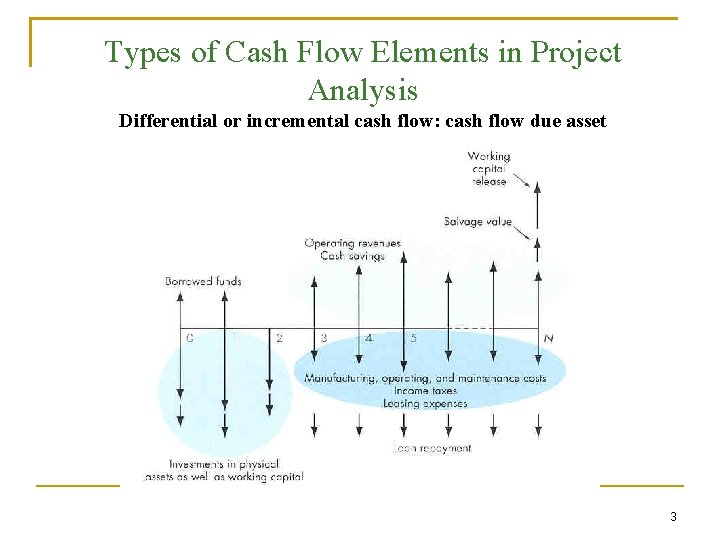
Types of Cash Flow Elements in Project Analysis Differential or incremental cash flow: cash flow due asset 3
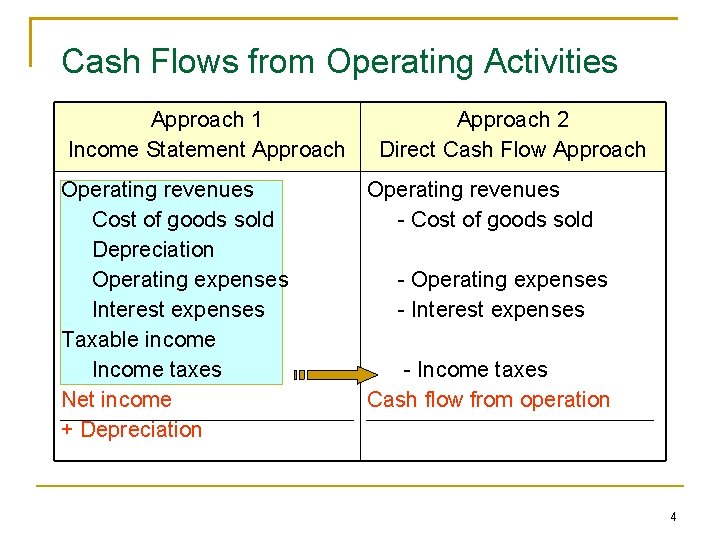
Cash Flows from Operating Activities Approach 1 Income Statement Approach Operating revenues Cost of goods sold Depreciation Operating expenses Interest expenses Taxable income Income taxes Net income + Depreciation Approach 2 Direct Cash Flow Approach Operating revenues - Cost of goods sold - Operating expenses - Interest expenses - Income taxes Cash flow from operation 4
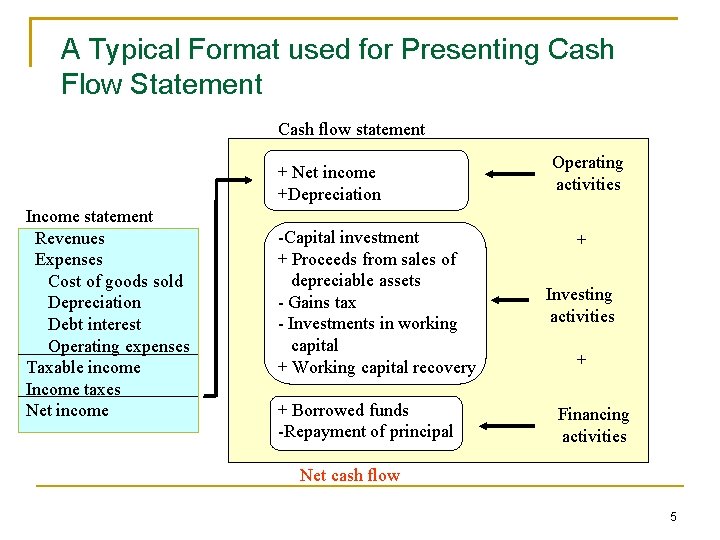
A Typical Format used for Presenting Cash Flow Statement Cash flow statement + Net income +Depreciation Income statement Revenues Expenses Cost of goods sold Depreciation Debt interest Operating expenses Taxable income Income taxes Net income -Capital investment + Proceeds from sales of depreciable assets - Gains tax - Investments in working capital + Working capital recovery + Borrowed funds -Repayment of principal Operating activities + Investing activities + Financing activities Net cash flow 5
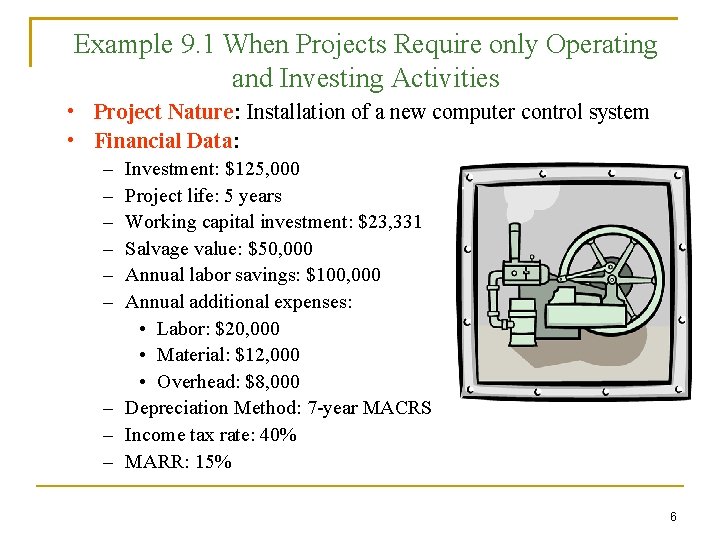
Example 9. 1 When Projects Require only Operating and Investing Activities • Project Nature: Installation of a new computer control system • Financial Data: – – – Investment: $125, 000 Project life: 5 years Working capital investment: $23, 331 Salvage value: $50, 000 Annual labor savings: $100, 000 Annual additional expenses: • Labor: $20, 000 • Material: $12, 000 • Overhead: $8, 000 – Depreciation Method: 7 -year MACRS – Income tax rate: 40% – MARR: 15% 6
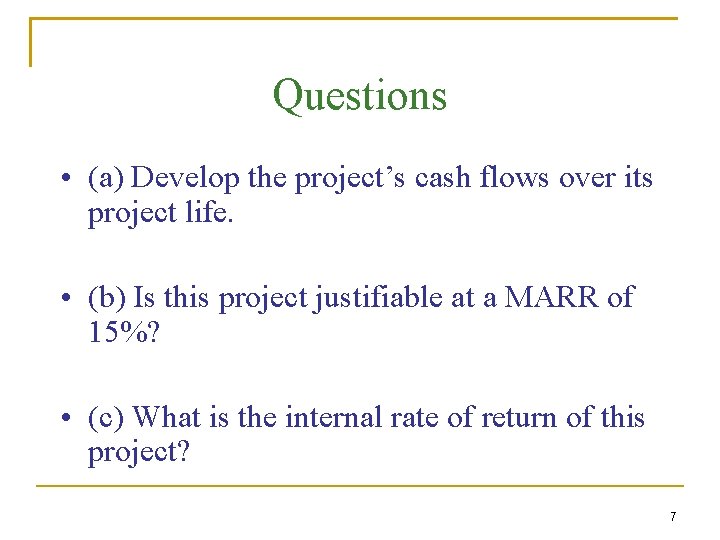
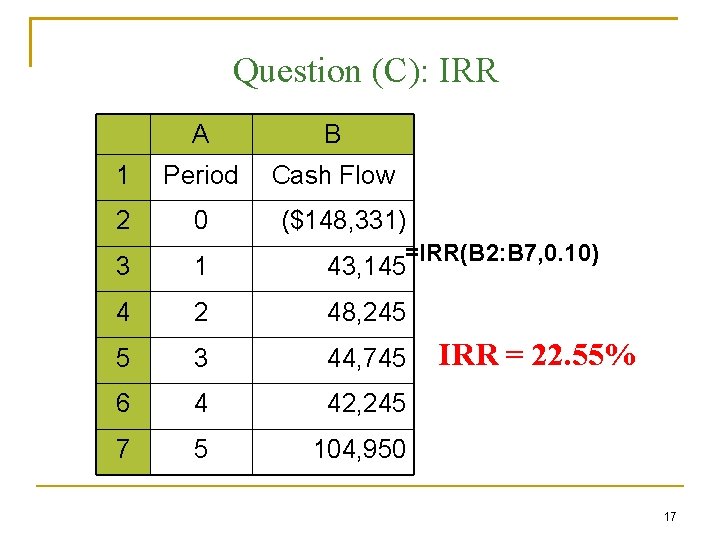
Questions • (a) Develop the project’s cash flows over its project life. • (b) Is this project justifiable at a MARR of 15%? • (c) What is the internal rate of return of this project? 7
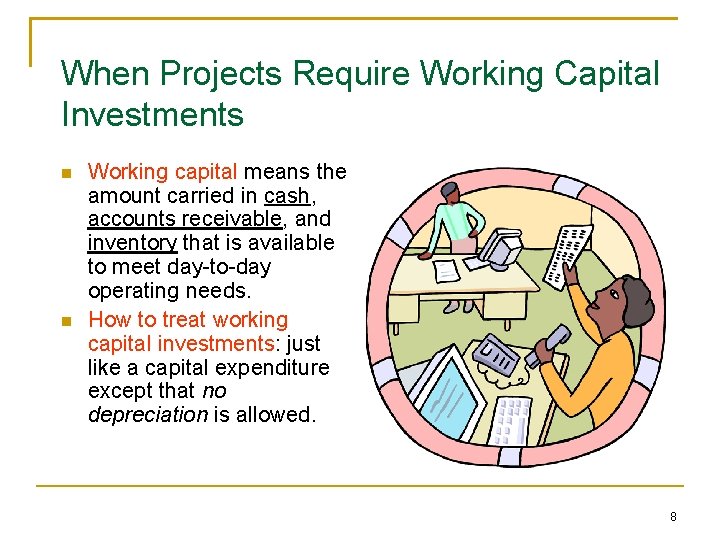
When Projects Require Working Capital Investments Working capital means the amount carried in cash, accounts receivable, and inventory that is available to meet day-to-day operating needs. How to treat working capital investments: just like a capital expenditure except that no depreciation is allowed. 8
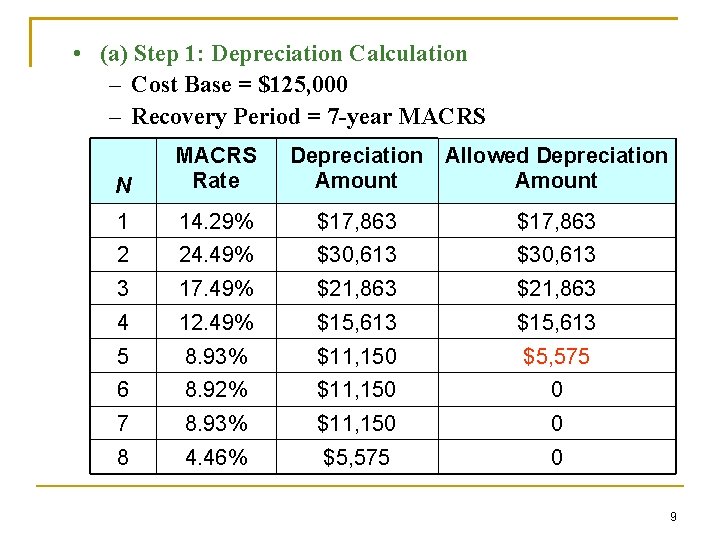
• (a) Step 1: Depreciation Calculation – Cost Base = $125, 000 – Recovery Period = 7 -year MACRS N MACRS Rate Depreciation Allowed Depreciation Amount 1 14. 29% $17, 863 2 24. 49% $30, 613 3 17. 49% $21, 863 4 12. 49% $15, 613 5 8. 93% $11, 150 $5, 575 6 8. 92% $11, 150 0 7 8. 93% $11, 150 0 8 4. 46% $5, 575 0 9
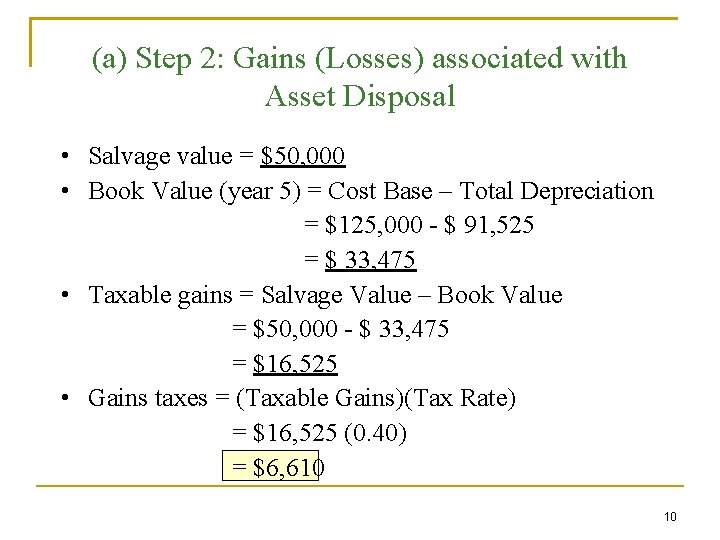
(a) Step 2: Gains (Losses) associated with Asset Disposal • Salvage value = $50, 000 • Book Value (year 5) = Cost Base – Total Depreciation = $125, 000 - $ 91, 525 = $ 33, 475 • Taxable gains = Salvage Value – Book Value = $50, 000 - $ 33, 475 = $16, 525 • Gains taxes = (Taxable Gains)(Tax Rate) = $16, 525 (0. 40) = $6, 610 10
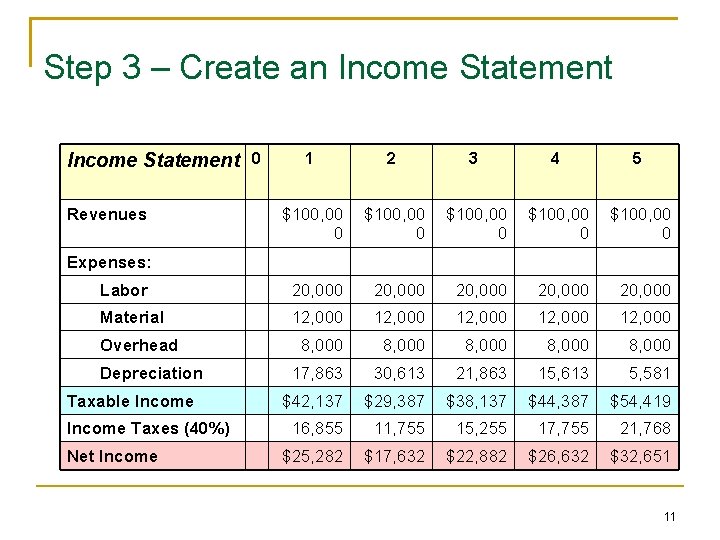
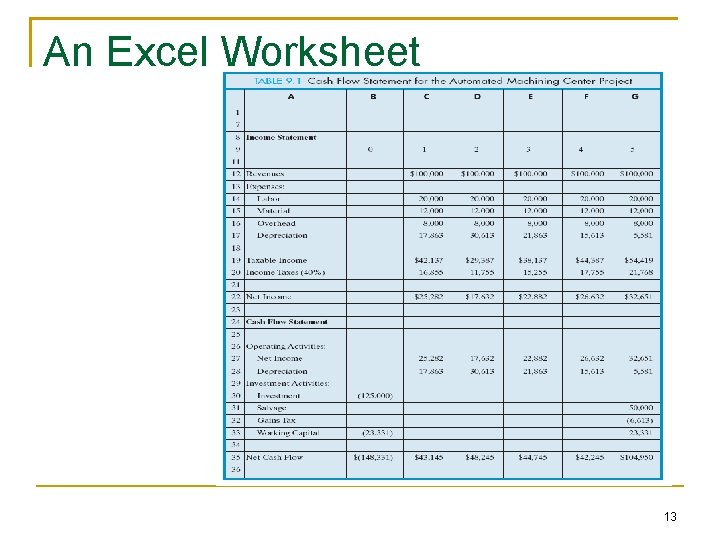
Step 3 – Create an Income Statement 0 1 2 3 4 5 $100, 00 0 $100, 00 0 Labor 20, 000 20, 000 Material 12, 000 12, 000 8, 000 8, 000 17, 863 30, 613 21, 863 15, 613 5, 581 $42, 137 $29, 387 $38, 137 $44, 387 $54, 419 16, 855 11, 755 15, 255 17, 755 21, 768 $25, 282 $17, 632 $22, 882 $26, 632 $32, 651 Revenues Expenses: Overhead Depreciation Taxable Income Taxes (40%) Net Income 11
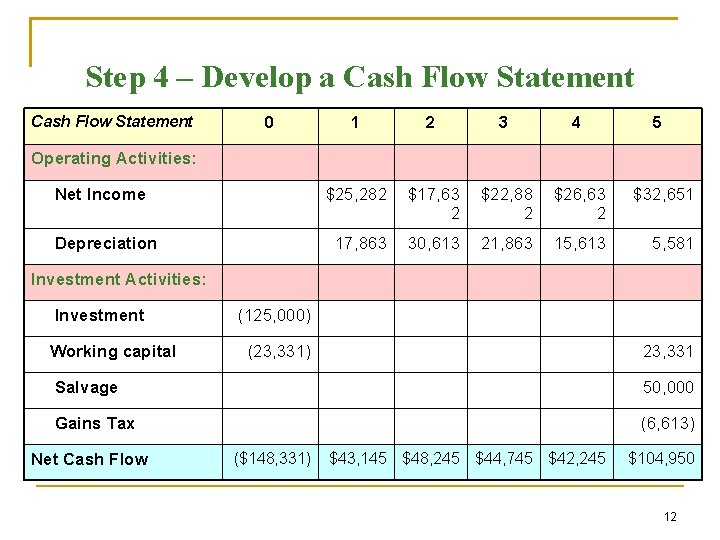
Step 4 – Develop a Cash Flow Statement 0 1 2 3 4 5 $25, 282 $17, 63 2 $22, 88 2 $26, 63 2 $32, 651 17, 863 30, 613 21, 863 15, 613 5, 581 Operating Activities: Net Income Depreciation Investment Activities: Investment Working capital (125, 000) (23, 331) 23, 331 Salvage 50, 000 Gains Tax (6, 613) Net Cash Flow ($148, 331) $43, 145 $48, 245 $44, 745 $42, 245 $104, 950 12
An Excel Worksheet 13
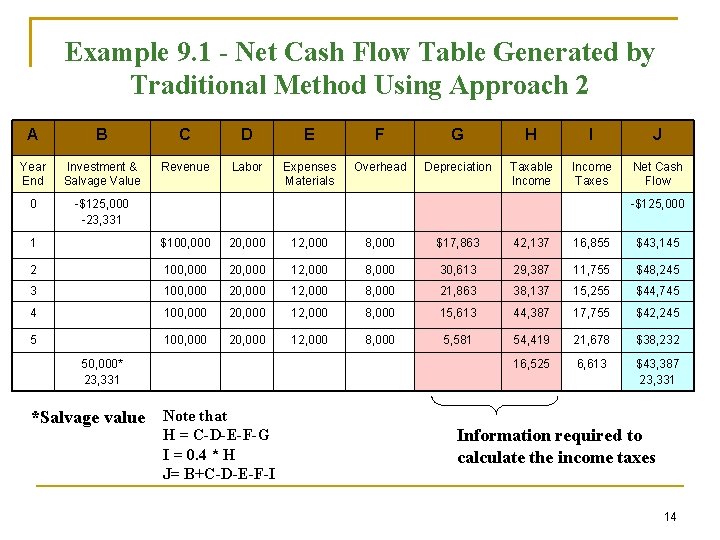
Example 9. 1 - Net Cash Flow Table Generated by Traditional Method Using Approach 2 A B C D E F G H I J Year End Investment & Salvage Value Revenue Labor Expenses Materials Overhead Depreciation Taxable Income Taxes Net Cash Flow 0 -$125, 000 -23, 331 -$125, 000 1 $100, 000 20, 000 12, 000 8, 000 $17, 863 42, 137 16, 855 $43, 145 2 100, 000 20, 000 12, 000 8, 000 30, 613 29, 387 11, 755 $48, 245 3 100, 000 20, 000 12, 000 8, 000 21, 863 38, 137 15, 255 $44, 745 4 100, 000 20, 000 12, 000 8, 000 15, 613 44, 387 17, 755 $42, 245 5 100, 000 20, 000 12, 000 8, 000 5, 581 54, 419 21, 678 $38, 232 16, 525 6, 613 $43, 387 23, 331 50, 000* 23, 331 *Salvage value Note that H = C-D-E-F-G I = 0. 4 * H J= B+C-D-E-F-I Information required to calculate the income taxes 14
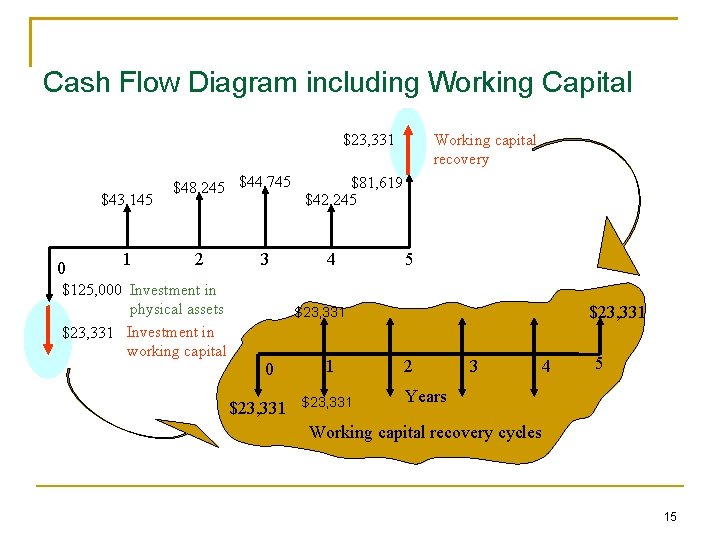
Cash Flow Diagram including Working Capital $23, 331 $43, 145 0 1 $48, 245 $44, 745 2 $125, 000 Investment in physical assets $23, 331 Investment in working capital 3 Working capital recovery $81, 619 $42, 245 4 5 $23, 331 0 $23, 331 1 $23, 331 2 3 4 5 Years Working capital recovery cycles 15
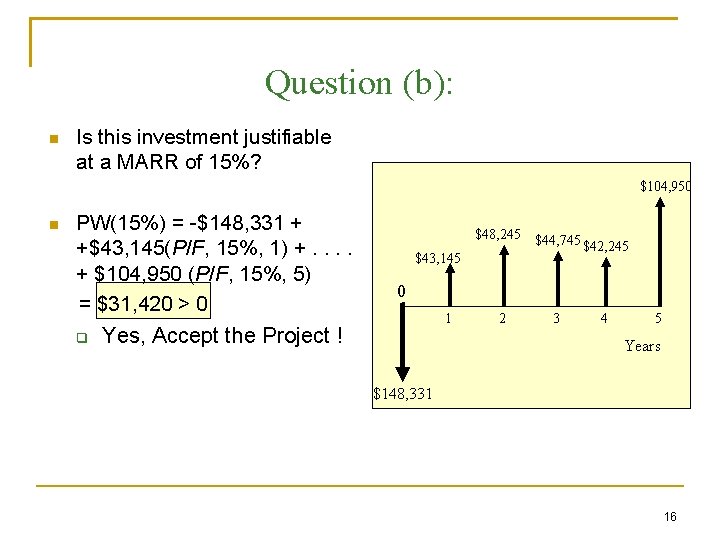
Question (b): Is this investment justifiable at a MARR of 15%? $104, 950 PW(15%) = -$148, 331 + +$43, 145(P/F, 15%, 1) +. . + $104, 950 (P/F, 15%, 5) = $31, 420 > 0 $48, 245 $43, 145 $44, 745 $42, 245 0 1 Yes, Accept the Project ! 2 3 4 5 Years $148, 331 16
Question (C): IRR A B 1 Period Cash Flow 2 0 ($148, 331) 3 1 43, 145 4 2 48, 245 5 3 44, 745 6 4 42, 245 7 5 104, 950 =IRR(B 2: B 7, 0. 10) IRR = 22. 55% 17
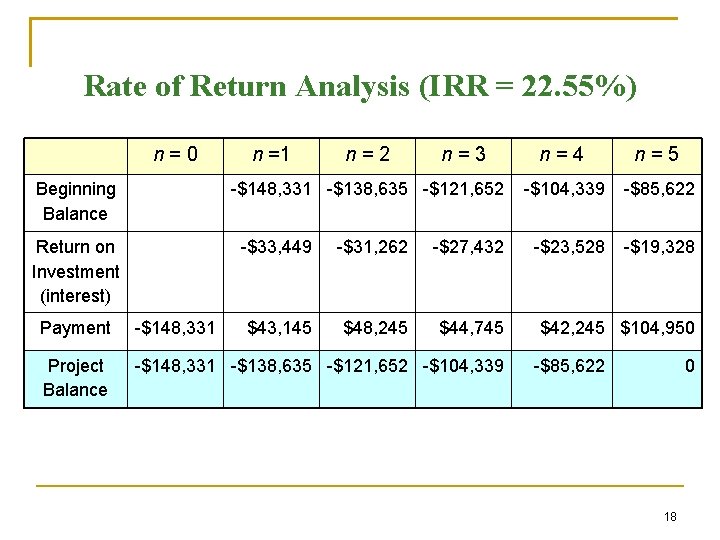
Rate of Return Analysis (IRR = 22. 55%) n=0 Beginning Balance n =1 n=2 n=3 -$148, 331 -$138, 635 -$121, 652 Return on Investment (interest) -$33, 449 -$31, 262 -$27, 432 $43, 145 $48, 245 $44, 745 Payment -$148, 331 Project Balance -$148, 331 -$138, 635 -$121, 652 -$104, 339 n=4 n=5 -$104, 339 -$85, 622 -$23, 528 -$19, 328 $42, 245 $104, 950 -$85, 622 0 18
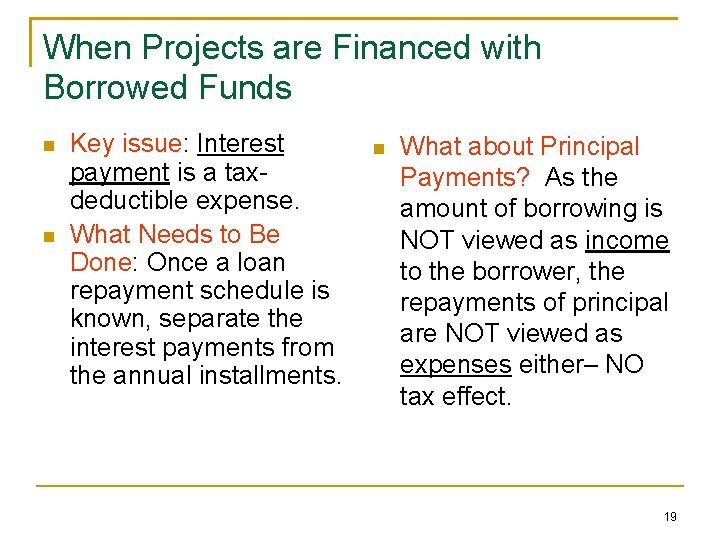
When Projects are Financed with Borrowed Funds Key issue: Interest payment is a taxdeductible expense. What Needs to Be Done: Once a loan repayment schedule is known, separate the interest payments from the annual installments. What about Principal Payments? As the amount of borrowing is NOT viewed as income to the borrower, the repayments of principal are NOT viewed as expenses either– NO tax effect. 19
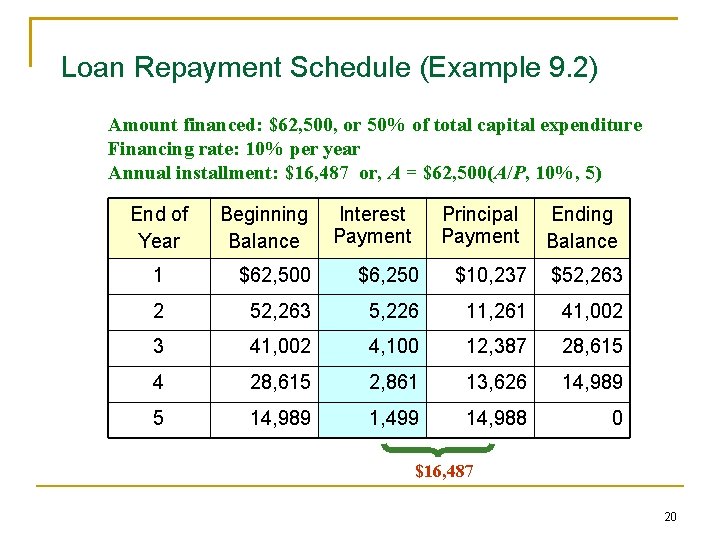
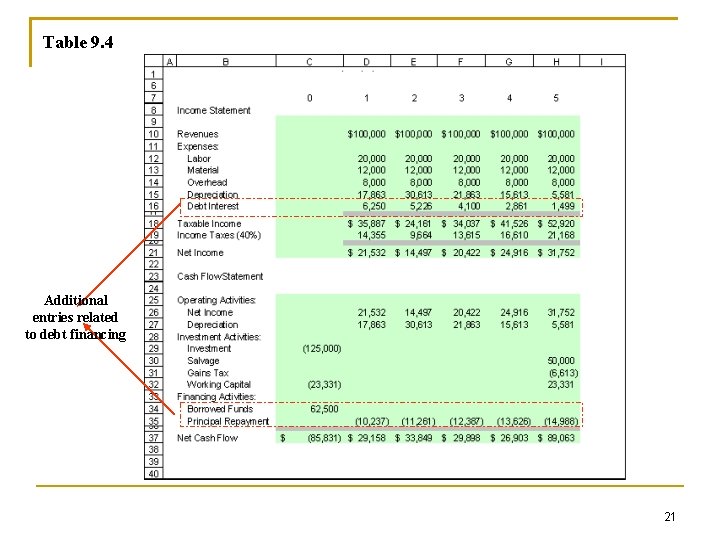
Loan Repayment Schedule (Example 9. 2) Amount financed: $62, 500, or 50% of total capital expenditure Financing rate: 10% per year Annual installment: $16, 487 or, A = $62, 500(A/P, 10%, 5) End of Year Beginning Balance Interest Payment Principal Payment Ending Balance 1 $62, 500 $6, 250 $10, 237 $52, 263 2 52, 263 5, 226 11, 261 41, 002 3 41, 002 4, 100 12, 387 28, 615 4 28, 615 2, 861 13, 626 14, 989 5 14, 989 1, 499 14, 988 0 $16, 487 20
Table 9. 4 Additional entries related to debt financing 21
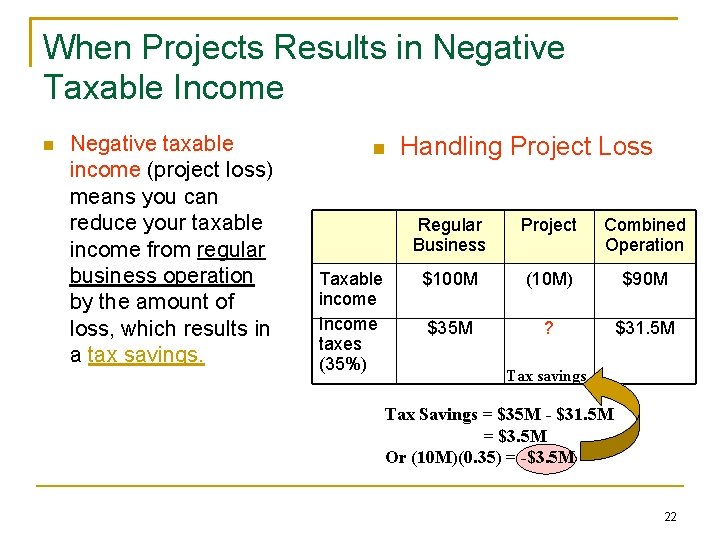
When Projects Results in Negative Taxable Income Negative taxable income (project loss) means you can reduce your taxable income from regular business operation by the amount of loss, which results in a tax savings. Taxable income Income taxes (35%) Handling Project Loss Regular Business Project Combined Operation $100 M (10 M) $90 M $35 M ? $31. 5 M Tax savings Tax Savings = $35 M - $31. 5 M = $3. 5 M Or (10 M)(0. 35) = -$3. 5 M 22
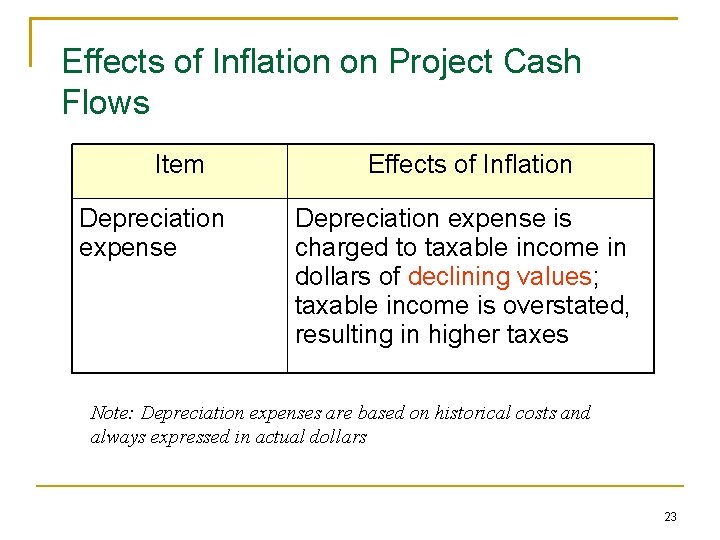
Effects of Inflation on Project Cash Flows Item Depreciation expense Effects of Inflation Depreciation expense is charged to taxable income in dollars of declining values; taxable income is overstated, resulting in higher taxes Note: Depreciation expenses are based on historical costs and always expressed in actual dollars 23
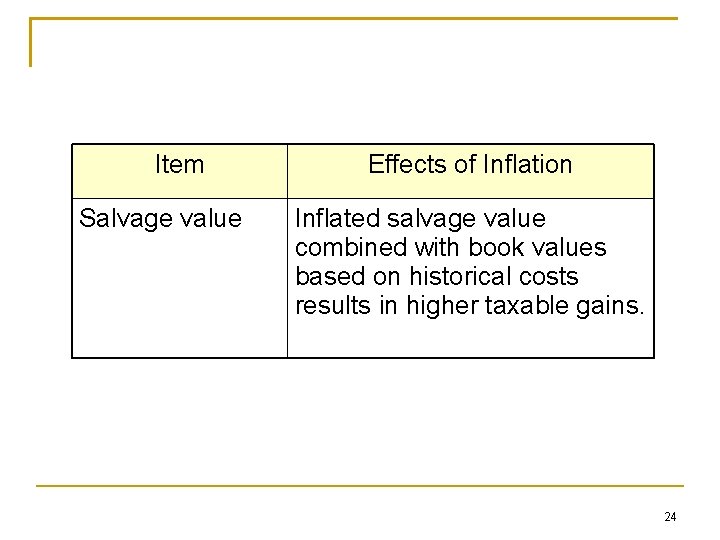
Item Salvage value Effects of Inflation Inflated salvage value combined with book values based on historical costs results in higher taxable gains. 24
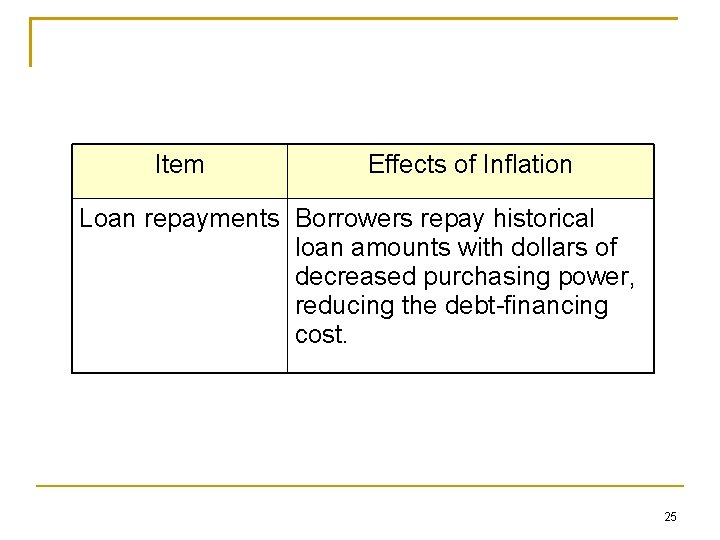
Item Effects of Inflation Loan repayments Borrowers repay historical loan amounts with dollars of decreased purchasing power, reducing the debt-financing cost. 25
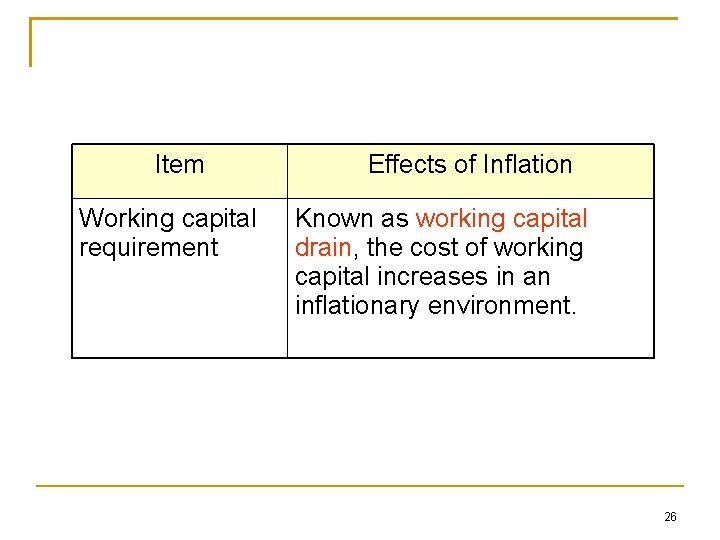
Item Working capital requirement Effects of Inflation Known as working capital drain, the cost of working capital increases in an inflationary environment. 26
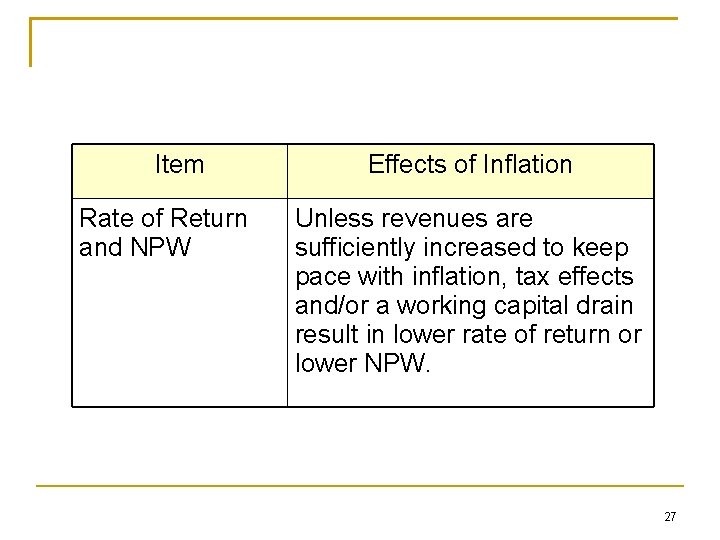
Item Rate of Return and NPW Effects of Inflation Unless revenues are sufficiently increased to keep pace with inflation, tax effects and/or a working capital drain result in lower rate of return or lower NPW. 27
28
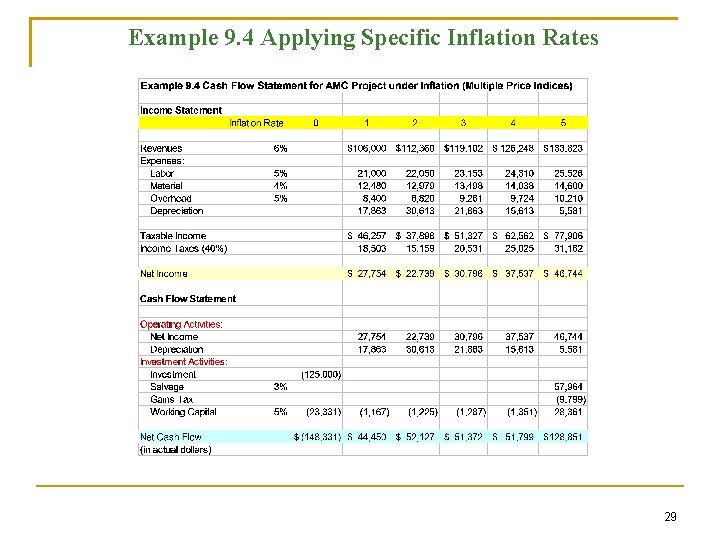
Example 9. 4 Applying Specific Inflation Rates 29
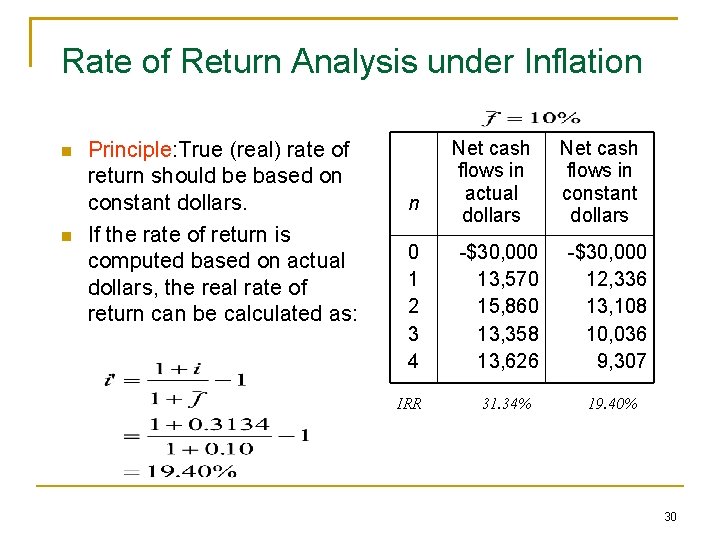
Rate of Return Analysis under Inflation Principle: True (real) rate of return should be based on constant dollars. If the rate of return is computed based on actual dollars, the real rate of return can be calculated as: n 0 1 2 3 4 IRR Net cash flows in actual dollars -$30, 000 13, 570 15, 860 13, 358 13, 626 31. 34% Net cash flows in constant dollars -$30, 000 12, 336 13, 108 10, 036 9, 307 19. 40% 30
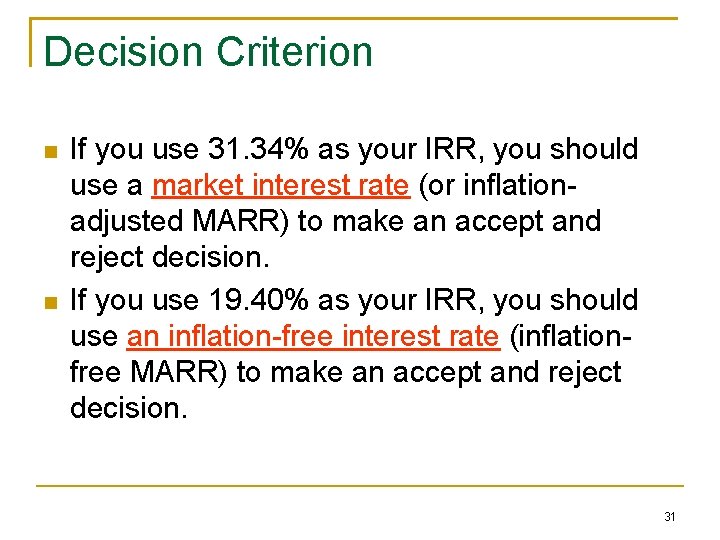
Decision Criterion If you use 31. 34% as your IRR, you should use a market interest rate (or inflationadjusted MARR) to make an accept and reject decision. If you use 19. 40% as your IRR, you should use an inflation-free interest rate (inflationfree MARR) to make an accept and reject decision. 31
32