
Project Business Case Methodology Project Initiation and Planning
Project Business Case Methodology Project Initiation and Planning -1 -
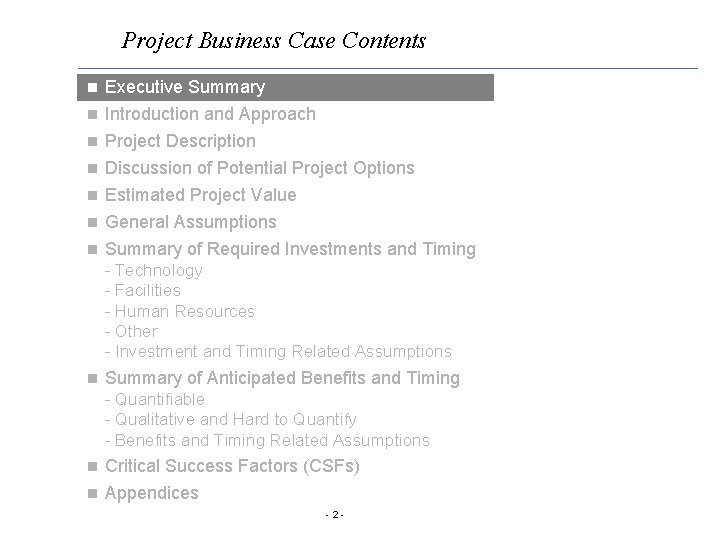
Project Business Case Contents n Executive Summary Introduction and Approach n Project Description n n Discussion of Potential Project Options Estimated Project Value n General Assumptions n Summary of Required Investments and Timing n - Technology - Facilities - Human Resources - Other - Investment and Timing Related Assumptions n Summary of Anticipated Benefits and Timing - Quantifiable - Qualitative and Hard to Quantify - Benefits and Timing Related Assumptions Critical Success Factors (CSFs) n Appendices n -2 -
Project Business Case Executive Summary Defined n The executive summary is meant to provide a brief overview of the contents of the business case n Try to keep the executive summary between 2 -3 pages n The big headline items should be pulled to the front of the documentation, i. e. , don’t make readers search for the key points and data -3 -
Project Business Case Executive Summary Elements n Abbreviated introduction n Listing of options n Recommendation and Clear rationale and justification for the project n Estimated value of the recommended option u How much u How soon u High level assumptions (how sure) n Critical Success Factors n Established qualitative and quantitative baselines -4 -
Project Business Case Contents n Executive Summary Introduction and Approach n Project Description n n Discussion of Potential Project Options Estimated Project Value n General Assumptions n Summary of Required Investments and Timing n - Technology - Facilities - Human Resources - Other - Investment and Timing Related Assumptions n Summary of Anticipated Benefits and Timing - Quantifiable - Qualitative and Hard to Quantify - Benefits and Timing Related Assumptions Critical Success Factors (CSFs) n Appendices n -5 -
Project Business Case Introduction n Project Rationale u Briefly discuss the reasons the project is being proposed u Briefly describe the current state environment that created the strategic imperative, business reason, or other fact-based rationale u High level financial rationale buckets are: Cost avoidance and expense reduction Ø Growth (premium and/or fee for services) Ø Capital optimization Ø u Project rationale should track closely with, and correlate to, Project Charter scope descriptions of goals and objectives, performance criteria, and technology impacts u Examples: Ø Ø Ø Ø Desire for sales people to focus on high profile accounts Competitive pressures Increase in efficiency and effectiveness of customer contacts Improve customer retention Increase employee loyalty Tight labor market Loss reduction -6 -
Project Business Case Introduction (Continued) n Discuss Team Composition and Mission u It may be important to note that the team was cross-functional and explain u In some cases it will be appropriate to name the team members and their areas individually u Discuss what the team was empowered to do, the timing for delivery of results, and the target audience(s) u Examples: Cross-functional team formed in order to define project and build a business case Ø A discussion of the alternatives and recommendation would be presented to the Interim Program Management Team (IPMT) Ø -7 -
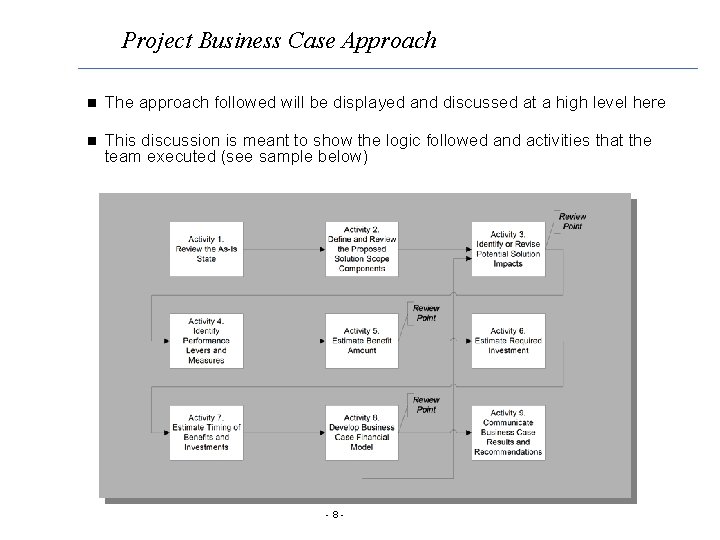
Project Business Case Approach n The approach followed will be displayed and discussed at a high level here n This discussion is meant to show the logic followed and activities that the team executed (see sample below) -8 -
Project Business Case Contents n Executive Summary Introduction and Approach n Project Description n n Discussion of Potential Project Options Estimated Project Value n General Assumptions n Summary of Required Investments and Timing n - Technology - Facilities - Human Resources - Other - Investment and Timing Related Assumptions n Summary of Anticipated Benefits and Timing - Quantifiable - Qualitative and Hard to Quantify - Benefits and Timing Related Assumptions Critical Success Factors (CSFs) n Appendices n -9 -
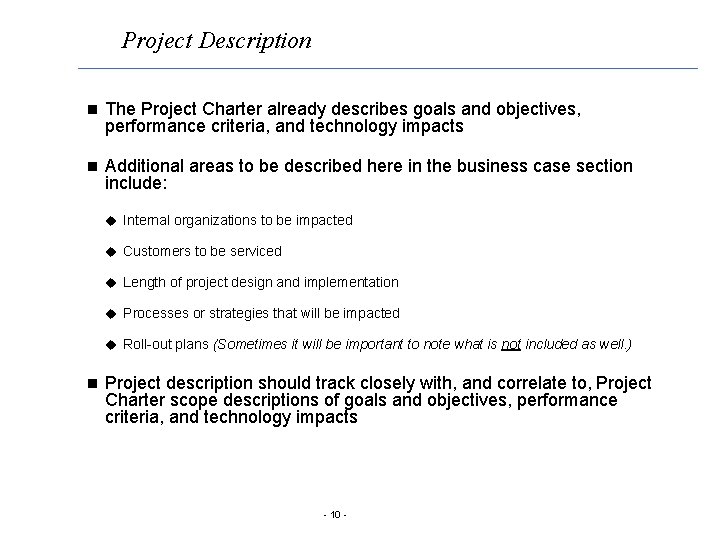
Project Description n The Project Charter already describes goals and objectives, performance criteria, and technology impacts n Additional areas to be described here in the business case section include: u Internal organizations to be impacted u Customers to be serviced u Length of project design and implementation u Processes or strategies that will be impacted u Roll-out plans (Sometimes it will be important to note what is not included as well. ) n Project description should track closely with, and correlate to, Project Charter scope descriptions of goals and objectives, performance criteria, and technology impacts - 10 -
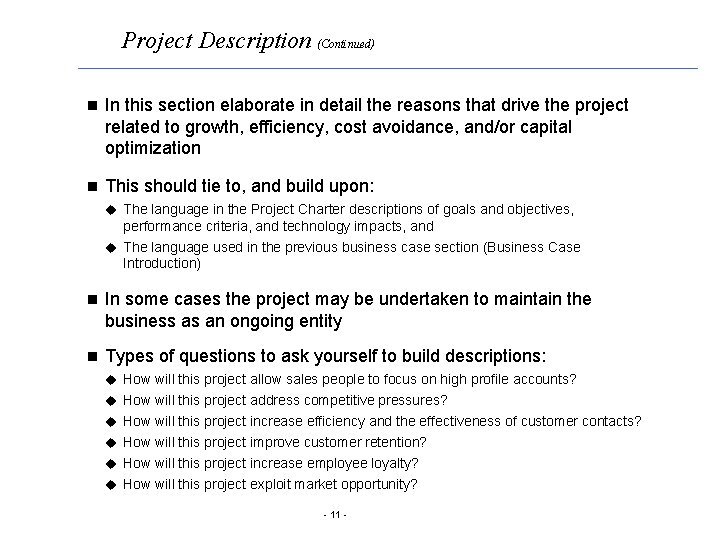
Project Description (Continued) n In this section elaborate in detail the reasons that drive the project related to growth, efficiency, cost avoidance, and/or capital optimization n This should tie to, and build upon: u The language in the Project Charter descriptions of goals and objectives, performance criteria, and technology impacts, and u The language used in the previous business case section (Business Case Introduction) n In some cases the project may be undertaken to maintain the business as an ongoing entity n Types of questions to ask yourself to build descriptions: u How will this project allow sales people to focus on high profile accounts? u How will this project address competitive pressures? u How will this project increase efficiency and the effectiveness of customer contacts? u How will this project improve customer retention? u How will this project increase employee loyalty? u How will this project exploit market opportunity? - 11 -
Project Business Case Contents n Executive Summary Introduction and Approach n Project Description n n Discussion of Potential Project Options Estimated Project Value n General Assumptions n Summary of Required Investments and Timing n - Technology - Facilities - Human Resources - Other - Investment and Timing Related Assumptions n Summary of Anticipated Benefits and Timing - Quantifiable - Qualitative and Hard to Quantify - Benefits and Timing Related Assumptions Critical Success Factors (CSFs) n Appendices n - 12 -
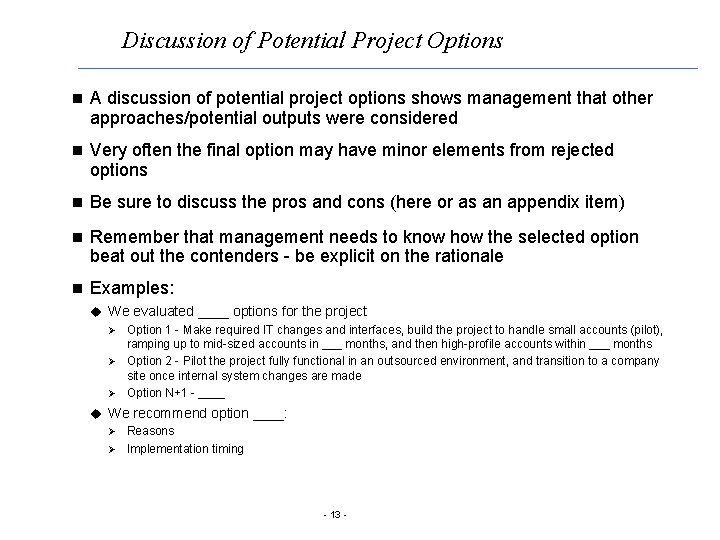
Discussion of Potential Project Options n A discussion of potential project options shows management that other approaches/potential outputs were considered n Very often the final option may have minor elements from rejected options n Be sure to discuss the pros and cons (here or as an appendix item) n Remember that management needs to know how the selected option beat out the contenders - be explicit on the rationale n Examples: u We evaluated ____ options for the project Option 1 - Make required IT changes and interfaces, build the project to handle small accounts (pilot), ramping up to mid-sized accounts in ___ months, and then high-profile accounts within ___ months Ø Option 2 - Pilot the project fully functional in an outsourced environment, and transition to a company site once internal system changes are made Ø Option N+1 - ____ Ø u We recommend option ____: Reasons Ø Implementation timing Ø - 13 -
Project Business Case Contents n Executive Summary Introduction and Approach n Project Description n n Discussion of Potential Project Options Estimated Project Value n General Assumptions n Summary of Required Investments and Timing n - Technology - Facilities - Human Resources - Other - Investment and Timing Related Assumptions n Summary of Anticipated Benefits and Timing - Quantifiable - Qualitative and Hard to Quantify - Benefits and Timing Related Assumptions Critical Success Factors (CSFs) n Appendices n - 14 -
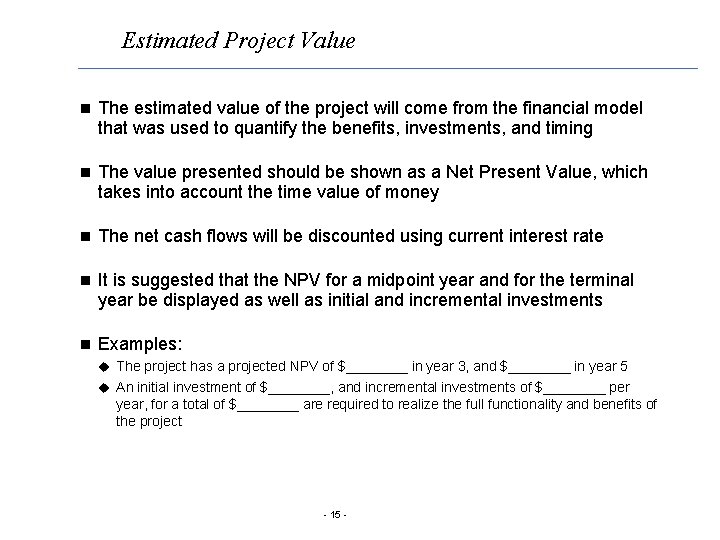
Estimated Project Value n The estimated value of the project will come from the financial model that was used to quantify the benefits, investments, and timing n The value presented should be shown as a Net Present Value, which takes into account the time value of money n The net cash flows will be discounted using current interest rate n It is suggested that the NPV for a midpoint year and for the terminal year be displayed as well as initial and incremental investments n Examples: u The project has a projected NPV of $____ in year 3, and $____ in year 5 u An initial investment of $____, and incremental investments of $____ per year, for a total of $____ are required to realize the full functionality and benefits of the project - 15 -
Project Business Case Contents n Executive Summary Introduction and Approach n Project Description n n Discussion of Potential Project Options Estimated Project Value n General Assumptions n Summary of Required Investments and Timing n - Technology - Facilities - Human Resources - Other - Investment and Timing Related Assumptions n Summary of Anticipated Benefits and Timing - Quantifiable - Qualitative and Hard to Quantify - Benefits and Timing Related Assumptions Critical Success Factors (CSFs) n Appendices n - 16 -
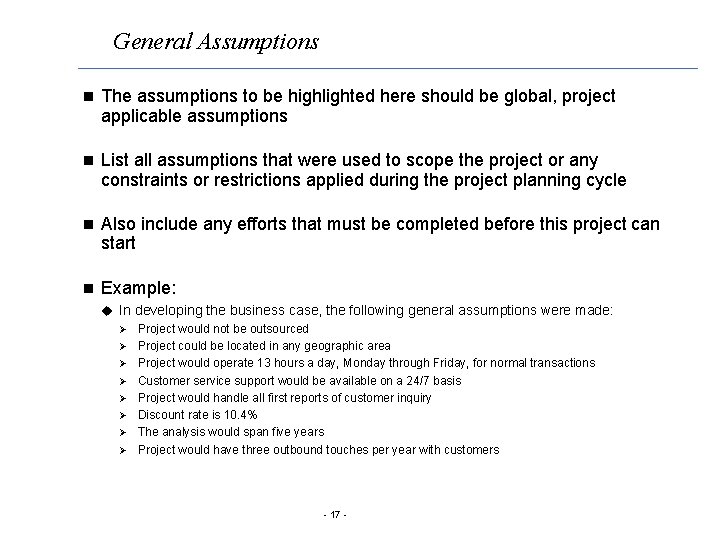
General Assumptions n The assumptions to be highlighted here should be global, project applicable assumptions n List all assumptions that were used to scope the project or any constraints or restrictions applied during the project planning cycle n Also include any efforts that must be completed before this project can start n Example: u In developing the business case, the following general assumptions were made: Ø Ø Ø Ø Project would not be outsourced Project could be located in any geographic area Project would operate 13 hours a day, Monday through Friday, for normal transactions Customer service support would be available on a 24/7 basis Project would handle all first reports of customer inquiry Discount rate is 10. 4% The analysis would span five years Project would have three outbound touches per year with customers - 17 -
Project Business Case Contents n Executive Summary Introduction and Approach n Project Description n n Discussion of Potential Project Options Estimated Project Value n General Assumptions n Summary of Required Investments and Timing n - Technology - Facilities - Human Resources - Other - Investment and Timing Related Assumptions n Summary of Anticipated Benefits and Timing - Quantifiable - Qualitative and Hard to Quantify - Benefits and Timing Related Assumptions Critical Success Factors (CSFs) n Appendices n - 18 -
Summary of Required Investments and Timing n This series of slides is used to highlight the investments needed to design and implement the solution in various categories (technology, facilities, human resources, and so on) n A brief description of each element will be useful here with the details treated as an appendix item - 19 -
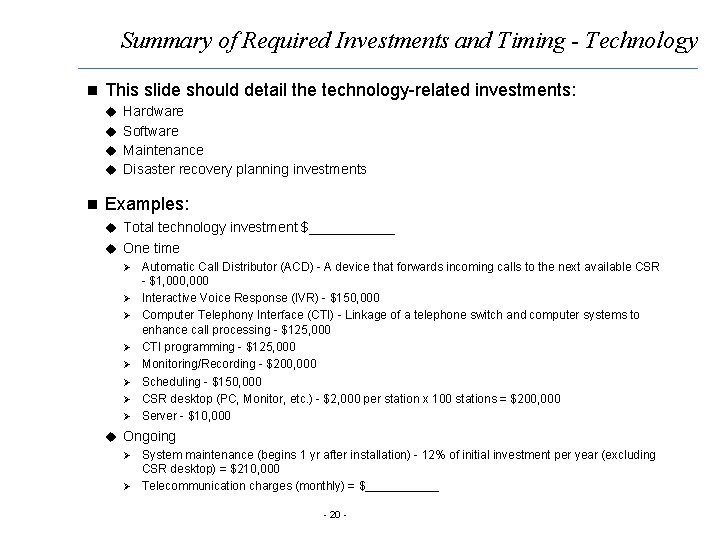
Summary of Required Investments and Timing - Technology n This slide should detail the technology-related investments: u Hardware u Software u Maintenance u Disaster recovery planning investments n Examples: u Total technology investment $______ u One time Ø Ø Ø Ø Automatic Call Distributor (ACD) - A device that forwards incoming calls to the next available CSR - $1, 000 Interactive Voice Response (IVR) - $150, 000 Computer Telephony Interface (CTI) - Linkage of a telephone switch and computer systems to enhance call processing - $125, 000 CTI programming - $125, 000 Monitoring/Recording - $200, 000 Scheduling - $150, 000 CSR desktop (PC, Monitor, etc. ) - $2, 000 per station x 100 stations = $200, 000 Server - $10, 000 u Ongoing System maintenance (begins 1 yr after installation) - 12% of initial investment per year (excluding CSR desktop) = $210, 000 Ø Telecommunication charges (monthly) = $______ Ø - 20 -
Summary of Required Investments and Timing - Facilities n This slide should detail the facilities-related investments such as: u Building lease u Required infrastructure (such as phone line design, utilities prep, LAN cable blueprint) u Furniture u Other overhead n Examples: u Total facilities investment $______ u One time Ø Ø Ø 5% down payment on building with space for 300 people (300 x 110 sqft x $83 per sq. ft. ) = $2, 739, 500 x. 05 down = $136, 950 System wiring = $_____ Continuous power supply/generator = $_____ Furniture = $_____ Other infrastructure = $_____ u Ongoing Ø Lease payment of $_____ per year for 10 years - 21 -
Summary of Required Investments and Timing - HR n This slide should detail the HR-related investments such as: u FTE (Full Time Equivalent) expansion or reduction related expenses, such as: Recruitment and hiring expenses if expansion Ø Severance and outplacement if reduction Ø u Relocation u Training and development u Travel u Salaries and fringe n Examples: u Total human resources investment $_____ u One time Initial reduction in workforce expenses $____ Ø Relocation expenses $____ Ø u Ongoing Salaries, bonuses and fringe - $____ (See Appendix 4 - Project Staffing Model) Ø Training - $____ Ø - 22 -
Summary of Required Investments and Timing - Other n This slide and space is meant to serve as a plug for any additional investments that are not slotted into the predefined categories in the preceding pages - 23 -
Summary of Required Investments and Timing - Assumptions n This slide should highlight the assumptions that are related to investment items and the associated time phasing n Discuss things such as: u When investments will be required u Any technology refreshes required (amount and intervals) u Facilities requirements u Givens around user population and skill sets n Examples: u We will roll out functionality as follows: Ø Ø Ø - 24 -
Project Business Case Contents n Executive Summary Introduction and Approach n Project Description n n Discussion of Potential Project Options Estimated Project Value n General Assumptions n Summary of Required Investments and Timing n - Technology - Facilities - Human Resources - Other - Investment and Timing Related Assumptions n Summary of Anticipated Benefits and Timing - Quantifiable - Qualitative and Hard to Quantify - Benefits and Timing Related Assumptions Critical Success Factors (CSFs) n Appendices n - 25 -
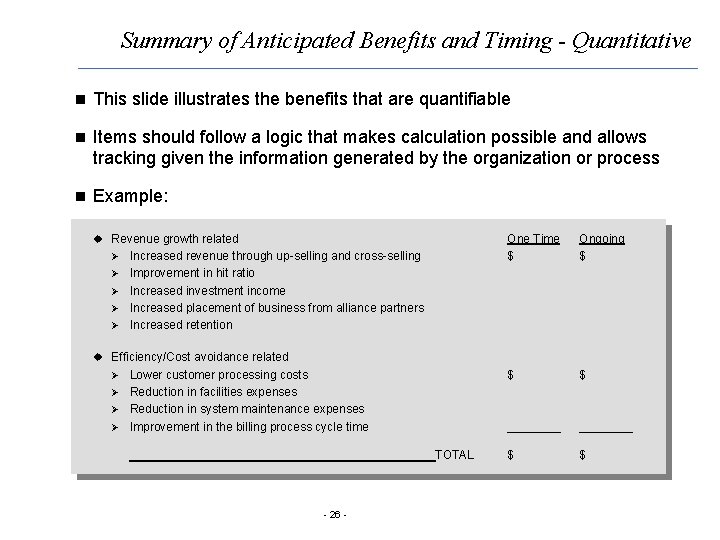
Summary of Anticipated Benefits and Timing - Quantitative n This slide illustrates the benefits that are quantifiable n Items should follow a logic that makes calculation possible and allows tracking given the information generated by the organization or process n Example: u Revenue growth related Ø Ø Ø Increased revenue through up-selling and cross-selling Improvement in hit ratio Increased investment income Increased placement of business from alliance partners Increased retention One Time $ Ongoing $ $ $ ________ $ $ u Efficiency/Cost avoidance related Lower customer processing costs Ø Reduction in facilities expenses Ø Reduction in system maintenance expenses Ø Improvement in the billing process cycle time Ø TOTAL - 26 -
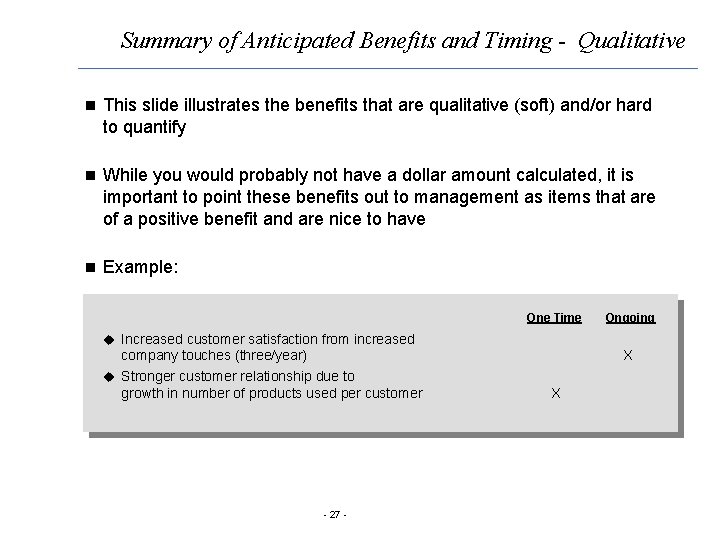
Summary of Anticipated Benefits and Timing - Qualitative n This slide illustrates the benefits that are qualitative (soft) and/or hard to quantify n While you would probably not have a dollar amount calculated, it is important to point these benefits out to management as items that are of a positive benefit and are nice to have n Example: One Time Ongoing u Increased customer satisfaction from increased company touches (three/year) u Stronger customer relationship due to growth in number of products used per customer - 27 - X X
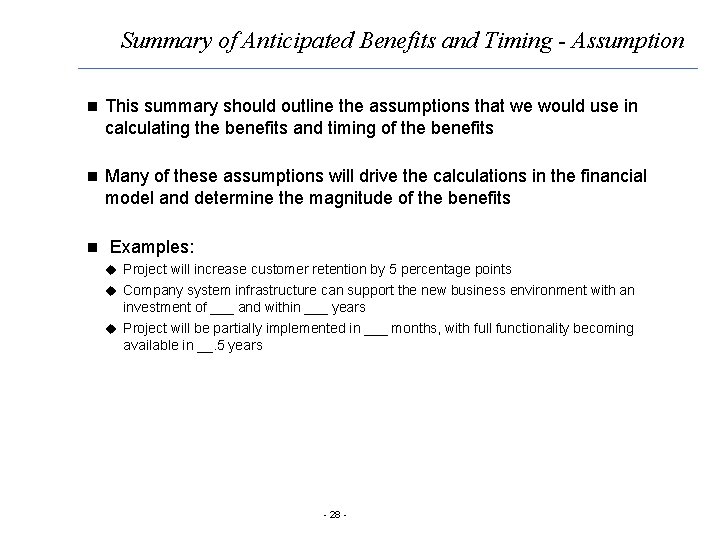
Summary of Anticipated Benefits and Timing - Assumption n This summary should outline the assumptions that we would use in calculating the benefits and timing of the benefits n Many of these assumptions will drive the calculations in the financial model and determine the magnitude of the benefits n Examples: u Project will increase customer retention by 5 percentage points u Company system infrastructure can support the new business environment with an investment of ___ and within ___ years u Project will be partially implemented in ___ months, with full functionality becoming available in __. 5 years - 28 -
Project Business Case Contents n Executive Summary Introduction and Approach n Project Description n n Discussion of Potential Project Options Estimated Project Value n General Assumptions n Summary of Required Investments and Timing n - Technology - Facilities - Human Resources - Other - Investment and Timing Related Assumptions n Summary of Anticipated Benefits and Timing - Quantifiable - Qualitative and Hard to Quantify - Benefits and Timing Related Assumptions Critical Success Factors (CSFs) n Appendices n - 29 -
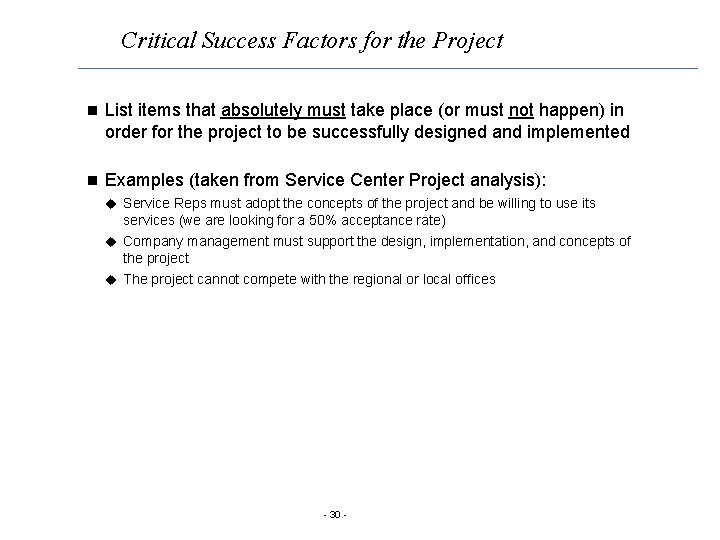
Critical Success Factors for the Project n List items that absolutely must take place (or must not happen) in order for the project to be successfully designed and implemented n Examples (taken from Service Center Project analysis): u Service Reps must adopt the concepts of the project and be willing to use its services (we are looking for a 50% acceptance rate) u Company management must support the design, implementation, and concepts of the project u The project cannot compete with the regional or local offices - 30 -
Project Business Case Contents n Executive Summary Introduction and Approach n Project Description n n Discussion of Potential Project Options Estimated Project Value n General Assumptions n Summary of Required Investments and Timing n - Technology - Facilities - Human Resources - Other - Investment and Timing Related Assumptions n Summary of Anticipated Benefits and Timing - Quantifiable - Qualitative and Hard to Quantify - Benefits and Timing Related Assumptions Critical Success Factors (CSFs) n Appendices n - 31 -
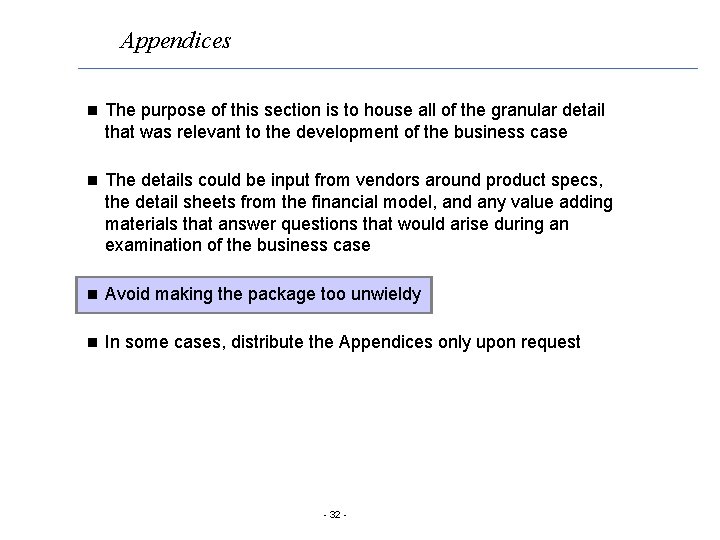
Appendices n The purpose of this section is to house all of the granular detail that was relevant to the development of the business case n The details could be input from vendors around product specs, the detail sheets from the financial model, and any value adding materials that answer questions that would arise during an examination of the business case n Avoid making the package too unwieldy n In some cases, distribute the Appendices only upon request - 32 -
Appendix 1. Detailed Financial Projections n The financial model would be inserted here n Some readers of the business desire to view the detailed calculations that would be part of the model, as well as the assumptions that drive the model n See separate financial model template and example - 33 -
Appendix 2. Technology Descriptions n Insert vendor descriptions and related materials here n This Appendix could be segmented into a logical breakdown like hardware, software, etc. - 34 -
Appendix 3. Description of Facilities n Insert any facilities detail materials here - 35 -
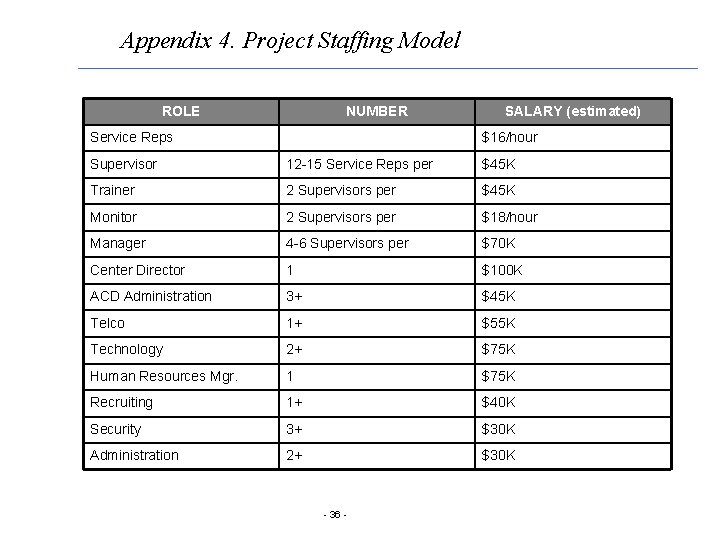
Appendix 4. Project Staffing Model ROLE NUMBER Service Reps SALARY (estimated) $16/hour Supervisor 12 -15 Service Reps per $45 K Trainer 2 Supervisors per $45 K Monitor 2 Supervisors per $18/hour Manager 4 -6 Supervisors per $70 K Center Director 1 $100 K ACD Administration 3+ $45 K Telco 1+ $55 K Technology 2+ $75 K Human Resources Mgr. 1 $75 K Recruiting 1+ $40 K Security 3+ $30 K Administration 2+ $30 K - 36 -
Appendix 5. Vendor Contracts n Insert any vendor detail materials here - 37 -
- Slides: 37