
Project Based Learning The Scientific Method Goals of
Project Based Learning & The Scientific Method
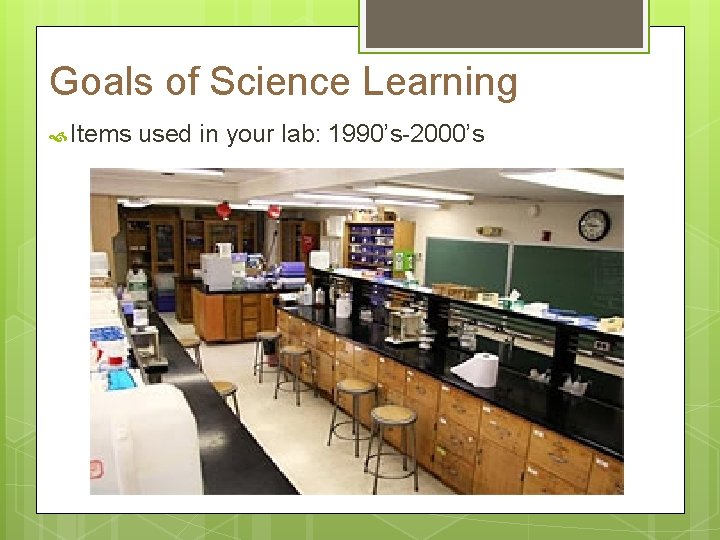
Goals of Science Learning Items used in your lab: 1990’s-2000’s
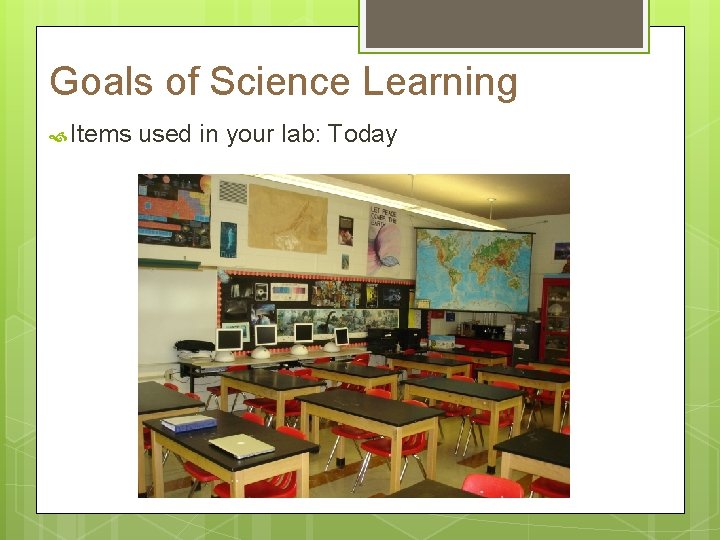
Goals of Science Learning Items used in your lab: Today
Thought Question #1 What are some of your goals that you have in science classrooms? How your are you going to implement more experiments in your science classrooms?
Science and YOUR classroom In the early grade levels it is important to emphasize active investigation Students in science should constantly be looking at ways to DO things rather than read things As grade level increases though, more science content is added and this investigation begins to decrease
Did You Know? K-1: students should spend 80% science time involved in investigations. 2 -3: students should spend 60% science time involved in investigations 4 -5: students should spend 50% science time involved in investigations 6 -8: there should be a greater focus on team activities and project activities
Engaged Learning Students are naturally curious. Engagement in science gets students to begin to observe world around them. Understanding of the scientific method leads students to further see the world in new ways.
Pros and Cons of Engaged Learning Benefits More hands on = more engaged students Way to get students to use their “endless energy” Gets students excited about science concepts Downfalls Where is the time? (later grades investigation time drops substantially) Set-up time is greater for teachers than a lecture Engaged activities can led to more disruptions in class

Reviewing Scientific Method
Thought Question #2 In your group discuss how you learned about the scientific method when you were in: 1) 2) 3) Elementary School Middle School/High School In a college level science class
The Scientific Method A process for trying to understand nature by observing nature and the way it behaves, and by conducting experiments to test our ideas. Key characteristics of the scientific method include Observation, formulation of Hypotheses, Experimentation, and formulation of Laws and Theories. 13
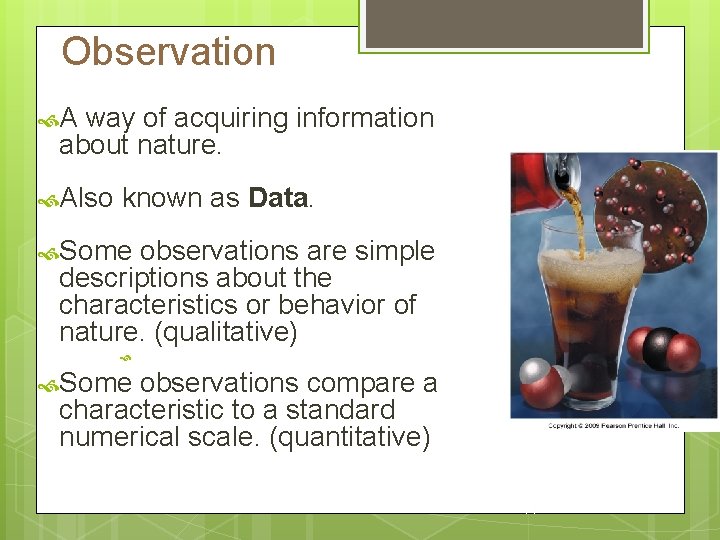
Observation A way of acquiring information about nature. Also known as Data. Some observations are simple descriptions about the characteristics or behavior of nature. (qualitative) Some observations compare a characteristic to a standard numerical scale. (quantitative) 14
Hypothesis A tentative interpretation or explanation of your observations. “The sweet taste of soda pop is due to the presence of sugar. ” A good hypothesis is one that can be tested to be proven wrong. Falsifiable. One test may invalidate your hypothesis. 15
Experiments Tests of hypotheses, laws, or theories. Can you think of a way to test whether the sweet taste of soda pop is due to the presence of sugar? Results either validate (confirm) or invalidate (deny) your ideas. Invalidate = Discard or Modify Many times experiments invalidate only parts of the hypothesis or theory, in which case the idea is modified. Validate ≠ Proof your idea will always hold 16
Laws Summary of observations that combines all past observations into one general statement. Law of Conservation of Mass— “In a chemical reaction matter is neither created nor destroyed. ” Allows So you to predict future observations. you can test the law with experiments. Unlike state laws, you cannot choose to violate a scientific law. 17
What’s the Difference Between an Observation and a Law? An observation tells you what happened in a single event. A law summarizes all the observations, effectively telling you what you will observe in future events. 18
Theories General explanation for the characteristics and behavior of nature. Models of nature. Dalton’s Can So Atomic Theory be used to predict future observations. they can be tested by experiments. 20
What’s the Difference Between a Hypothesis and a Theory? A hypothesis is an explanation of a single or small number of observations. A theory is an explanation that extends beyond individual observations to an understanding of the underlying causes for the way nature is or behaves. 21
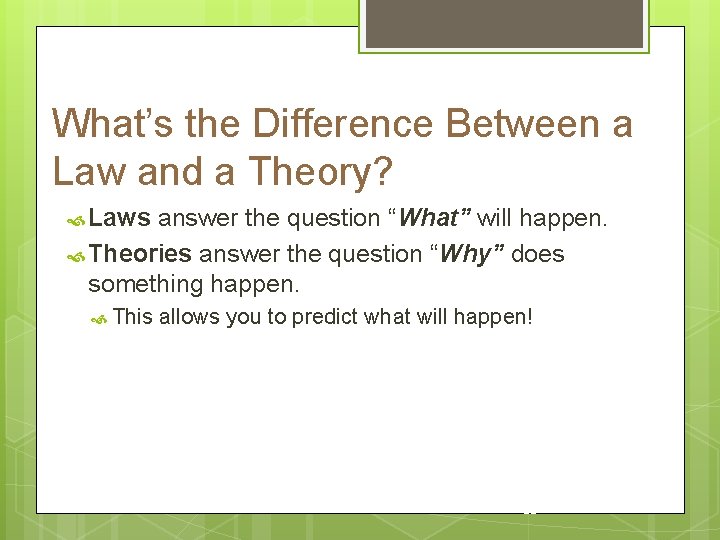
What’s the Difference Between a Law and a Theory? Laws answer the question “What” will happen. Theories answer the question “Why” does something happen. This allows you to predict what will happen! 22
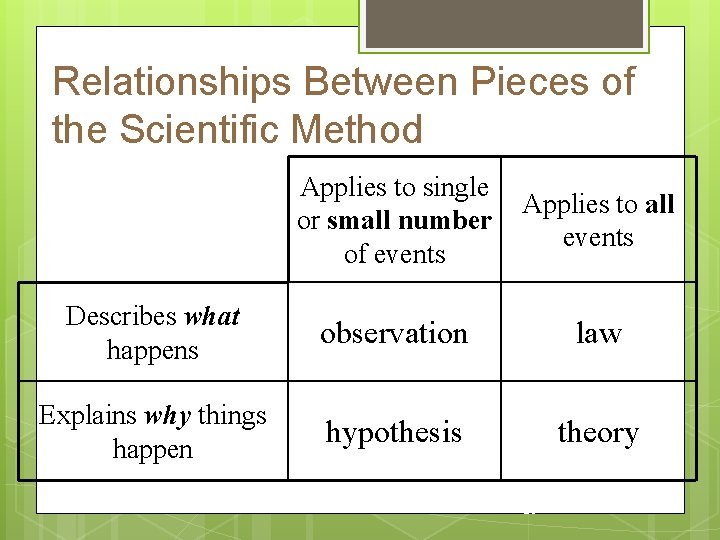
Relationships Between Pieces of the Scientific Method Applies to single or small number of events Applies to all events Describes what happens observation law Explains why things happen hypothesis theory 23
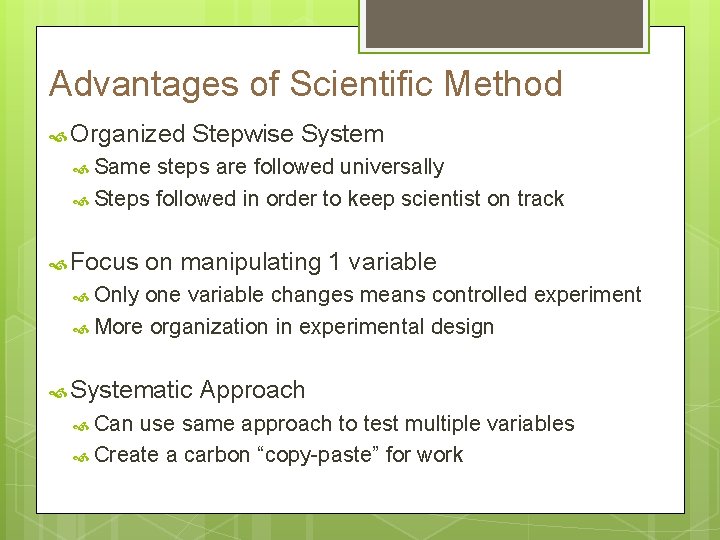
Advantages of Scientific Method Organized Stepwise System Same steps are followed universally Steps followed in order to keep scientist on track Focus on manipulating 1 variable Only one variable changes means controlled experiment More organization in experimental design Systematic Can Approach use same approach to test multiple variables Create a carbon “copy-paste” for work
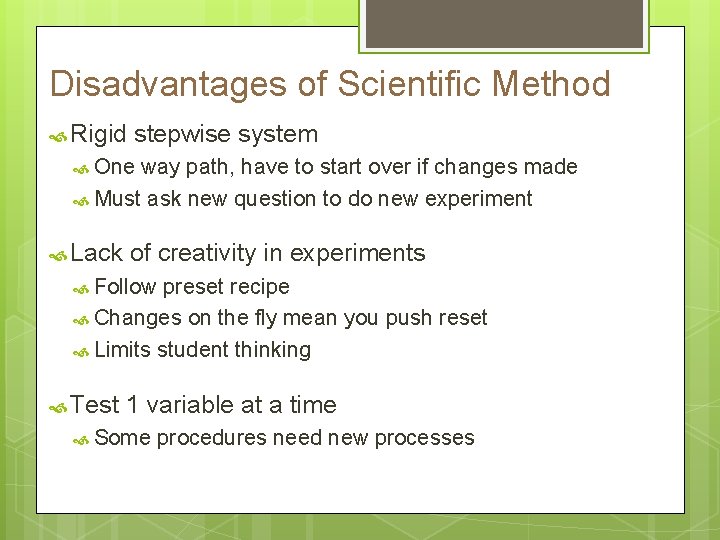
Disadvantages of Scientific Method Rigid stepwise system One way path, have to start over if changes made Must ask new question to do new experiment Lack of creativity in experiments Follow preset recipe Changes on the fly mean you push reset Limits student thinking Test 1 variable at a time Some procedures need new processes
Thought Question #3 Think about a project where you used the Scientific Method and discuss within your group. How If did that project go? it was successful what parts were successful If it was a struggle what was hard
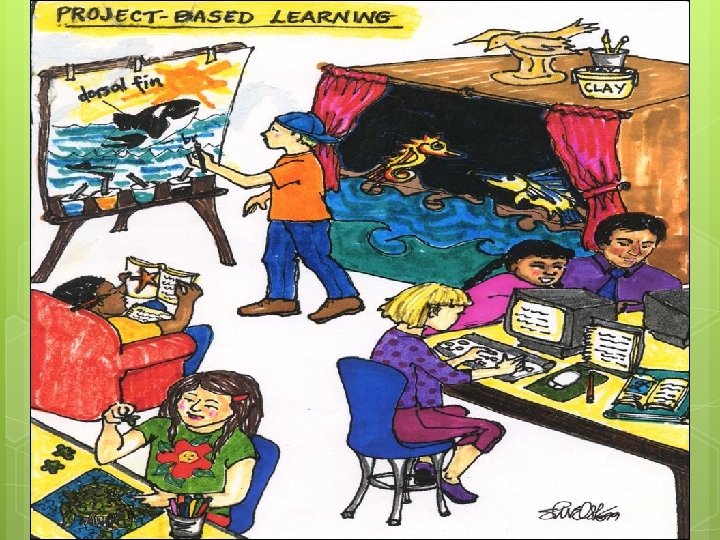
21 st Century Thinking Sometimes, the question is right there We don’t always have to ask a question We can survey a scenario and for an idea. Scenarios are often presented for us and we need to jump into them mid stream Can we do that with the scientific method? Not Always But what about project based learning?
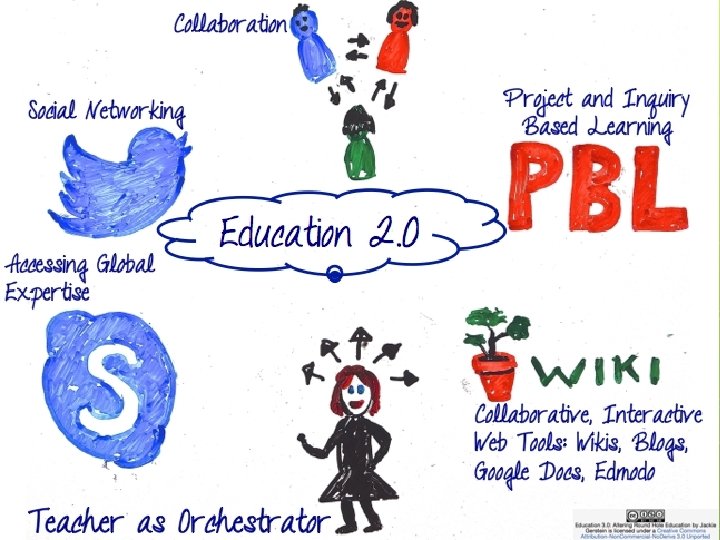
Project Based Learning What is PBL? “a method by which students gain knowledge and skills working over an extended period of time investigating and responding to a complex question, problem, scenario or challenge placed in their path. ”
PBL Essentials The 1) 2) 3) 4) 5) 6) 7) 8) following are PBL Essentials Significant Content 21 st Century Skills Going Deep The Driving Question Need to Know Voice and Choice Critique and Revision Public Audience
PBL Essentials Significant Content: learn knowledge and skills by doing rather than observing 21 st Century Skills: focus is on problem solving, working as a team, communication, creativity and critical thinking Going Deep: Students ask the questions, students look for the answers (take ownership) The Driving Question: what drives you? This question is the motivating factor of your work. Need to Know: The “why” part; why is this question important? What has been done before? How can we apply the driving question to society?
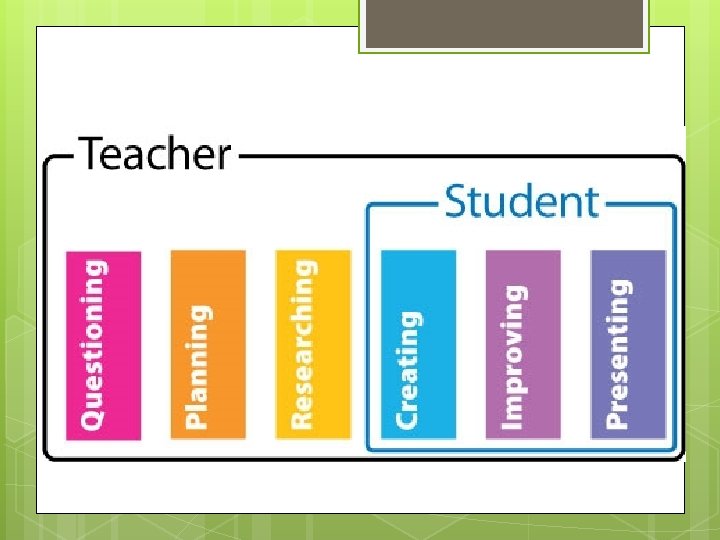
PBL Essentials Voice and Choice: you can make choices about how your project will work. You have the power to manipulate your work as you go Critique and Revision: teacher works as a mentor or coach on the side with you, advising the project as you go rather than telling you what the next step is. Public Audience: work is presented to audiences beyond the classroom (competitions, seminars, scientists, etc)
PBL in the Classroom A useful alternative to the scientific method Team-Based Emphasis A on 21 st century skills cross-disciplinary system
Project Based Learning PBL takes ownership of a task or assignment, rather than following a set of rigid steps PBLs train you to think about your academics as a whole, rather than compartmentalizing each subject as something individually PBLs prepare you for college and beyond: giving you skills that help land the best jobs
PBL Reading Read the following article I have just passed out and be ready to discuss the following topics with your group:
PBL Reading Questions 1) In what ways does project-based learning help make the classroom more engaging? 2) What are some ways your classrooms can help facilitate the learning environment? 3) Discuss 3 different media that can be used in the classroom besides a pencil/pen and paper 4) What are some of the advantages and disadvantages of using technology in the classroom? 5) Analyze this statement: the teacher plays the part of a facilitator. How can a teacher be a facilitator in project based learning for his or her students?
- Slides: 38