
Project analysis report of Solar Photovoltaic Roof Top








- Slides: 68
Project analysis report of Solar Photovoltaic Roof Top (offgrid) Standalone & Grid-Tie Prepared by: Ketan Kotak, Akshay Banodiya & Prakash Vaishnaw June 2015 Batch, Gujarat Institute of Solar Energy
2) Objectives of the Report 3) Methodology 4) Line Diagram of Solar PV System 5) Balance of System 6) Bill of Quantity 7) Installation and Commissioning 8) Operation and Maintenance 9) References PREPARED BY KETAN KOTAK, AKSHAY BANODIYA & PRAKASH VAISHNAW : GUJARAT INSTITUTE OF SOLAR ENERGY, AHMEDABAD CONTENTS 1) Introduction
In order to address the global challenges of energy security, climate change u d and sustainable development, there is a pressing need to accelerate the present o r Int deployment of Solar Photovoltaic technologies. Solar PV is a key technology option to realize the shift to a decarbonised energy supply and is projected to emerge as an attractive alternate electricity source which is abundant. According to the Ministry of power, 18. 5 million rural households are still to be electrified in India. 59 million households were electrified during 2001 – 2011, but most of them receive less than 6 hours of electricity per day. There are several villages in hilly and remote areas where extension of grid is neither technically feasible nor economically viable. By using offgrid renewable Solar photovoltaic technology, electrification of household could achieve significant deployment of Solar PV to sustain economic growth, to come out of the energy deficit situation and ensure that energy is available in every town & village, India must utilise its immense potential in solar energy. In this report, we tried to induce comprehensive analysis and estimation of standalone economical solar pv system under guidance of solar faculty Sohel Patel & Jwalant Mehta. Ketan Kotak, Akshay Banodiya & Prakash Vaishnaw : Gujarat Institute of Solar Energy (GISE), PREPARED BY KETAN KOTAK, AKSHAY BANODIYA & PRAKASH VAISHNAW : GUJARAT INSTITUTE OF SOLAR ENERGY, AHMEDABAD n o i ct
Application areas: Ø Hospitals Ø Educational institutions Ø Government offices Ø Commercial buildings Ø Petrol pumps Ø Construction companies Ø Water pumps Salient features of off-grid roof top system: Ø Low and optimum maintenance cost. Ø Stable supply of power increases the overall efficiency of electronic components Ø Can effectively manage usage of power based on requirements through smart electronics. Ø Batteries designed for longer life. Ø Minimum power loss with effectively designed DC cables and Junction boxes. PREPARED BY KETAN KOTAK, AKSHAY BANODIYA & PRAKASH VAISHNAW : GUJARAT INSTITUTE OF SOLAR ENERGY, AHMEDABAD Why off-grid roof top system: By using off-grid rooftop system the customer can have the following advantages. Ø Have access to power continuously all the time. Ø Not having any scheduled or unscheduled power cuts. Ø No dependency on diesel Ø The quality of this power is superior to the regular grid power. Ø Investment against increasing fuel and grid charges.
In this report, we examine the various factors contributing to the economically viable of solar power standalone (off-grid) system, such as usage of utility, power demand, design, Balance of system, Bill of quantity, Inverter Efficiency, solar panels and installation. THE OBJECTIVES OF THIS STUDY ARE SUMMARIZED BELOW: Ø To assess the load and power demand. Ø To analyse methodology of balance of system. Ø To evaluate bill of quantity. Ø To estimate the economical cost of standalone solar power system. Ø To improve feasibility of off-grid system installations & operations. Ø To recommend future steps in the field of solar roof top pv. PREPARED BY KETAN KOTAK, AKSHAY BANODIYA & PRAKASH VAISHNAW : GUJARAT INSTITUTE OF SOLAR ENERGY, AHMEDABAD OBJECTIVES OF THE REPORT Solar energy is becoming an important source of energy all over the World and specially in India. The off-grid solar PV system deployment in India has not yet become common and economical because of lack of demand, costly technology and less expertise professionals force.
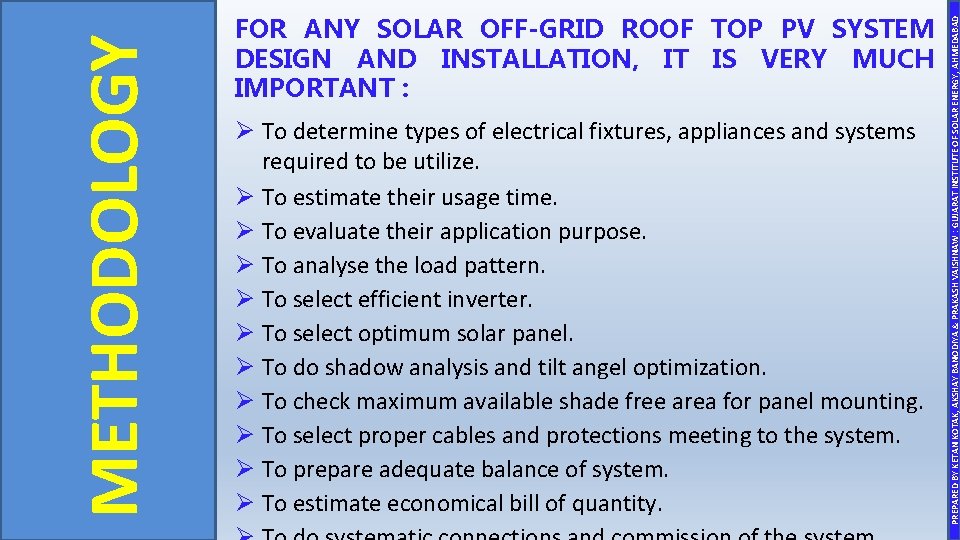
Ø To determine types of electrical fixtures, appliances and systems required to be utilize. Ø To estimate their usage time. Ø To evaluate their application purpose. Ø To analyse the load pattern. Ø To select efficient inverter. Ø To select optimum solar panel. Ø To do shadow analysis and tilt angel optimization. Ø To check maximum available shade free area for panel mounting. Ø To select proper cables and protections meeting to the system. Ø To prepare adequate balance of system. Ø To estimate economical bill of quantity. PREPARED BY KETAN KOTAK, AKSHAY BANODIYA & PRAKASH VAISHNAW : GUJARAT INSTITUTE OF SOLAR ENERGY, AHMEDABAD METHODOLOGY FOR ANY SOLAR OFF-GRID ROOF TOP PV SYSTEM DESIGN AND INSTALLATION, IT IS VERY MUCH IMPORTANT :
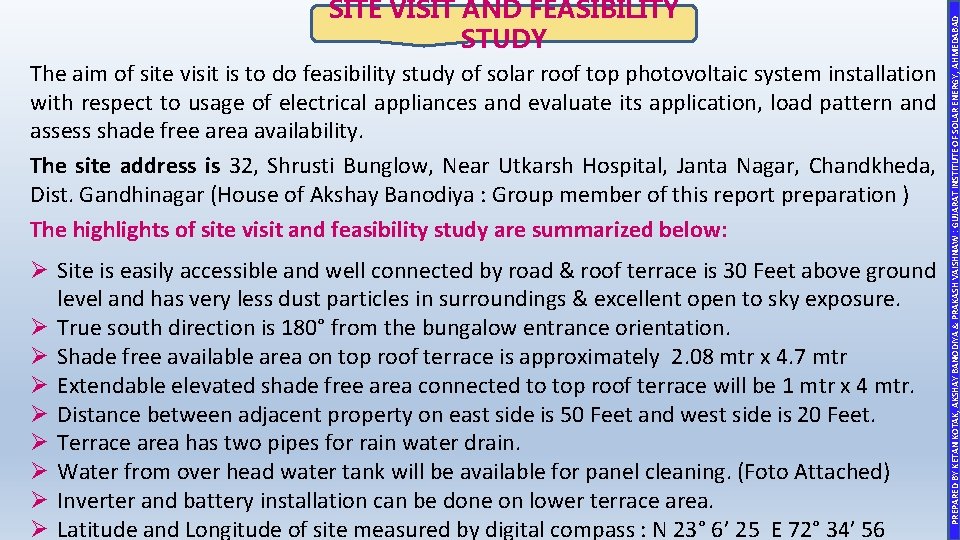
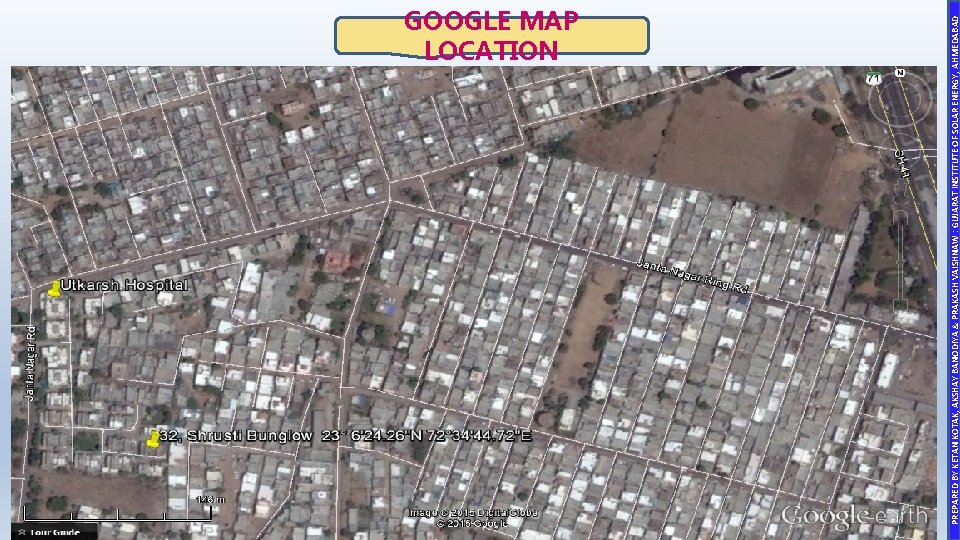
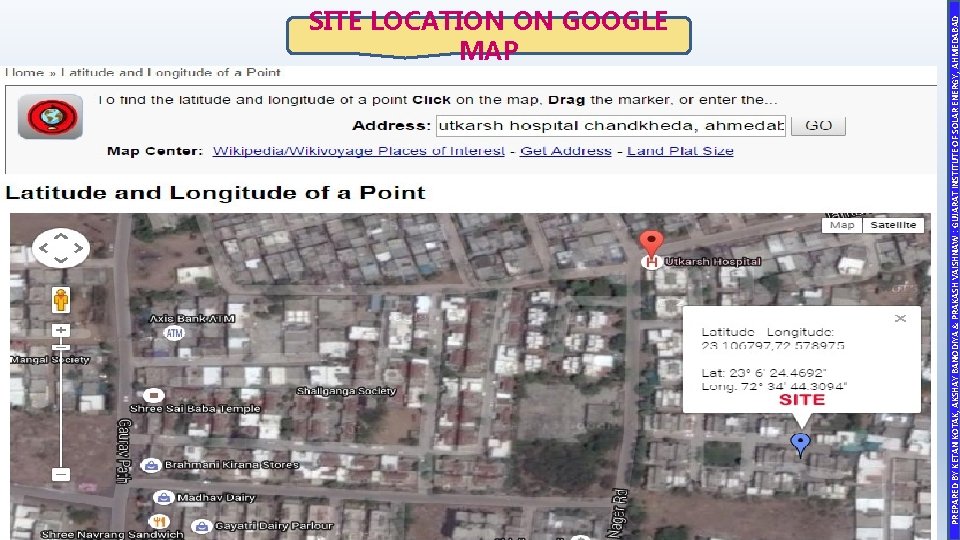
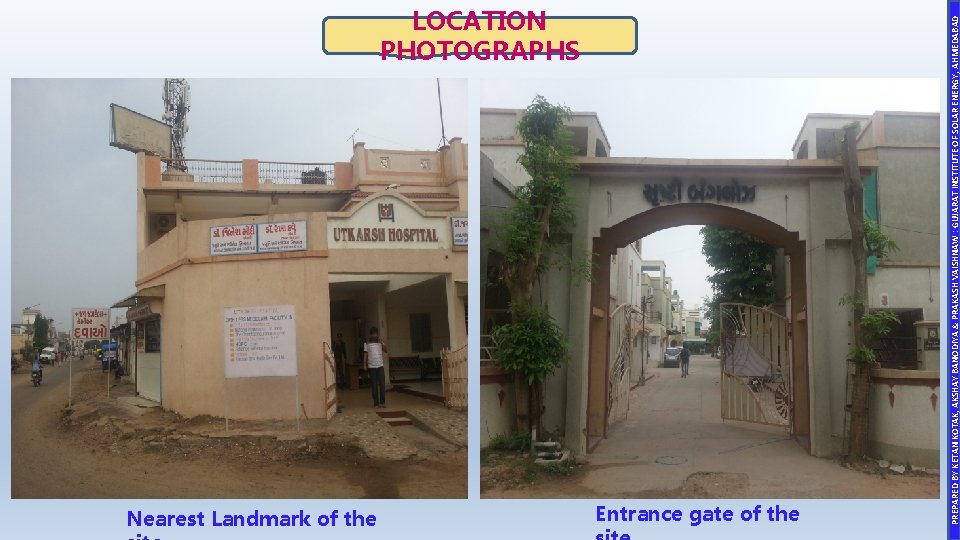
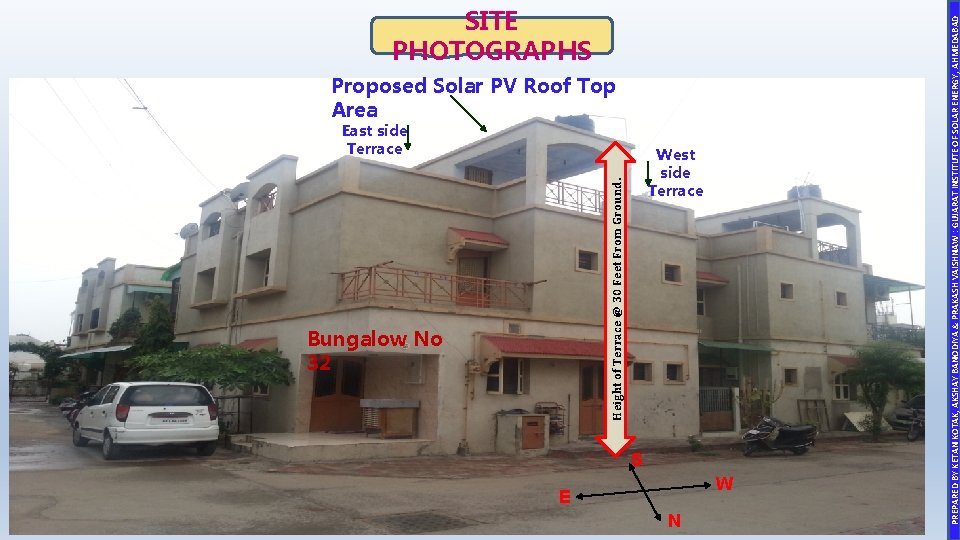
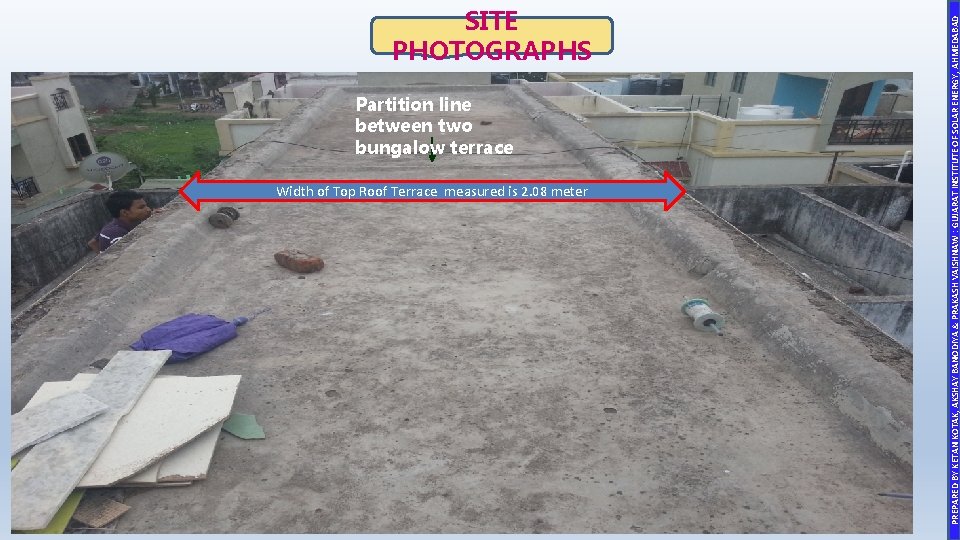
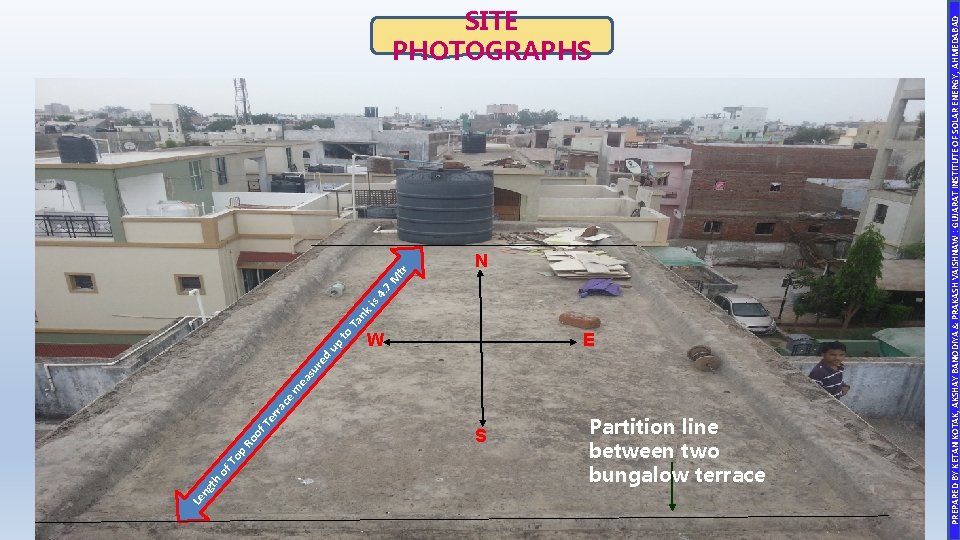
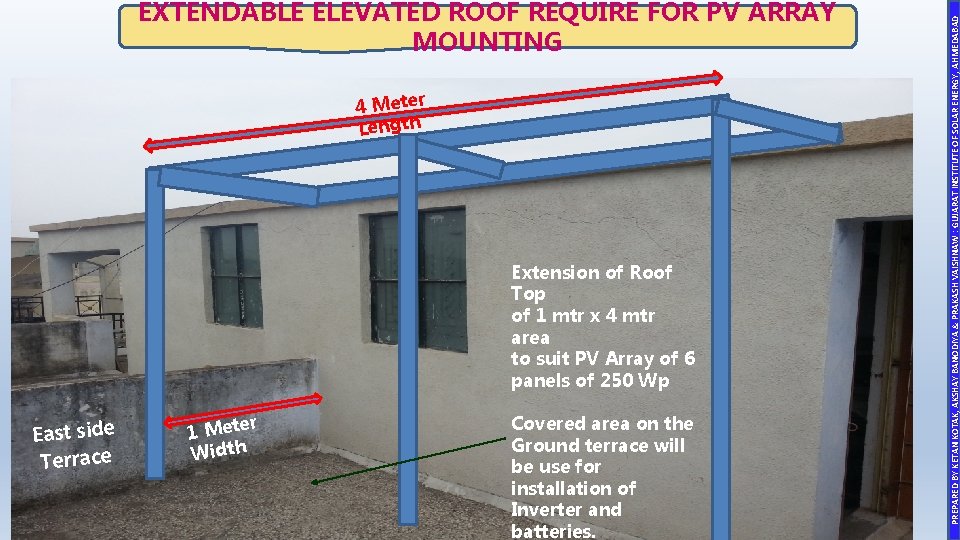
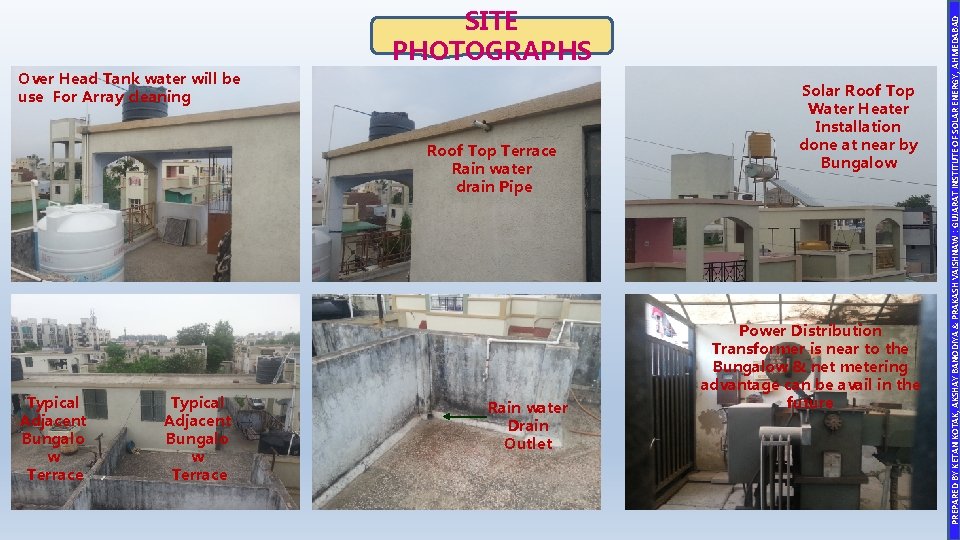
Ø Site is easily accessible and well connected by road & roof terrace is 30 Feet above ground level and has very less dust particles in surroundings & excellent open to sky exposure. Ø True south direction is 180° from the bungalow entrance orientation. Ø Shade free available area on top roof terrace is approximately 2. 08 mtr x 4. 7 mtr Ø Extendable elevated shade free area connected to top roof terrace will be 1 mtr x 4 mtr. Ø Distance between adjacent property on east side is 50 Feet and west side is 20 Feet. Ø Terrace area has two pipes for rain water drain. Ø Water from over head water tank will be available for panel cleaning. (Foto Attached) Ø Inverter and battery installation can be done on lower terrace area. Ø Latitude and Longitude of site measured by digital compass : N 23° 6’ 25 E 72° 34’ 56 PREPARED BY KETAN KOTAK, AKSHAY BANODIYA & PRAKASH VAISHNAW : GUJARAT INSTITUTE OF SOLAR ENERGY, AHMEDABAD SITE VISIT AND FEASIBILITY STUDY The aim of site visit is to do feasibility study of solar roof top photovoltaic system installation with respect to usage of electrical appliances and evaluate its application, load pattern and assess shade free area availability. The site address is 32, Shrusti Bunglow, Near Utkarsh Hospital, Janta Nagar, Chandkheda, Dist. Gandhinagar (House of Akshay Banodiya : Group member of this report preparation ) The highlights of site visit and feasibility study are summarized below:
PREPARED BY KETAN KOTAK, AKSHAY BANODIYA & PRAKASH VAISHNAW : GUJARAT INSTITUTE OF SOLAR ENERGY, AHMEDABAD GOOGLE MAP LOCATION
PREPARED BY KETAN KOTAK, AKSHAY BANODIYA & PRAKASH VAISHNAW : GUJARAT INSTITUTE OF SOLAR ENERGY, AHMEDABAD SITE LOCATION ON GOOGLE MAP
Nearest Landmark of the Entrance gate of the PREPARED BY KETAN KOTAK, AKSHAY BANODIYA & PRAKASH VAISHNAW : GUJARAT INSTITUTE OF SOLAR ENERGY, AHMEDABAD LOCATION PHOTOGRAPHS
Bungalow No 32 Height of Terrace @ 30 Feet From Ground. Proposed Solar PV Roof Top Area East side Terrace West side Terrace S E W N PREPARED BY KETAN KOTAK, AKSHAY BANODIYA & PRAKASH VAISHNAW : GUJARAT INSTITUTE OF SOLAR ENERGY, AHMEDABAD SITE PHOTOGRAPHS
Partition line between two bungalow terrace Width of Top Roof Terrace measured is 2. 08 meter PREPARED BY KETAN KOTAK, AKSHAY BANODIYA & PRAKASH VAISHNAW : GUJARAT INSTITUTE OF SOLAR ENERGY, AHMEDABAD SITE PHOTOGRAPHS
th ng of p To of Ro rra Te ce d re su ea m up to nk Ta is tr 7 M 4. N W E S Partition line between two bungalow terrace PREPARED BY KETAN KOTAK, AKSHAY BANODIYA & PRAKASH VAISHNAW : GUJARAT INSTITUTE OF SOLAR ENERGY, AHMEDABAD Le SITE PHOTOGRAPHS
4 Meter Length Extension of Roof Top of 1 mtr x 4 mtr area to suit PV Array of 6 panels of 250 Wp East side Terrace er 1 Met Width Covered area on the Ground terrace will be use for installation of Inverter and batteries. PREPARED BY KETAN KOTAK, AKSHAY BANODIYA & PRAKASH VAISHNAW : GUJARAT INSTITUTE OF SOLAR ENERGY, AHMEDABAD EXTENDABLE ELEVATED ROOF REQUIRE FOR PV ARRAY MOUNTING
Over Head Tank water will be use For Array cleaning Roof Top Terrace Rain water drain Pipe Typical Adjacent Bungalo w Terrace Rain water Drain Outlet Solar Roof Top Water Heater Installation done at near by Bungalow Power Distribution Transformer is near to the Bungalow & net metering advantage can be avail in the future PREPARED BY KETAN KOTAK, AKSHAY BANODIYA & PRAKASH VAISHNAW : GUJARAT INSTITUTE OF SOLAR ENERGY, AHMEDABAD SITE PHOTOGRAPHS
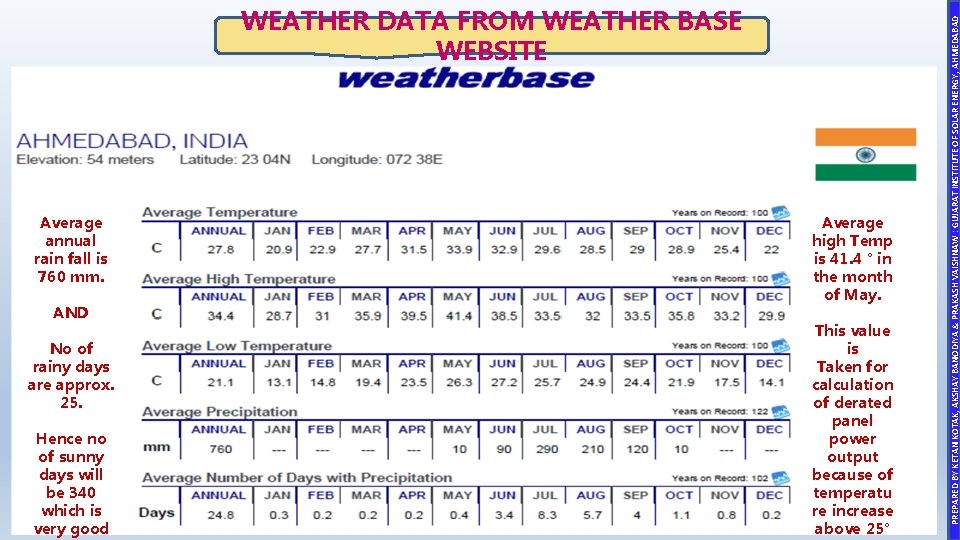
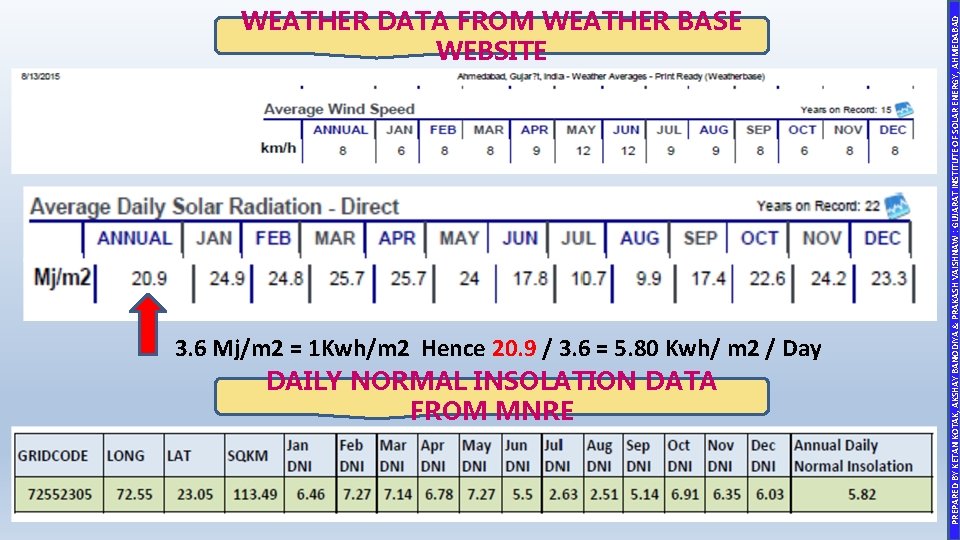
Average annual rain fall is 760 mm. AND No of rainy days are approx. 25. Hence no of sunny days will be 340 which is very good Average high Temp is 41. 4 ° in the month of May. This value is Taken for calculation of derated panel power output because of temperatu re increase above 25° PREPARED BY KETAN KOTAK, AKSHAY BANODIYA & PRAKASH VAISHNAW : GUJARAT INSTITUTE OF SOLAR ENERGY, AHMEDABAD WEATHER DATA FROM WEATHER BASE WEBSITE
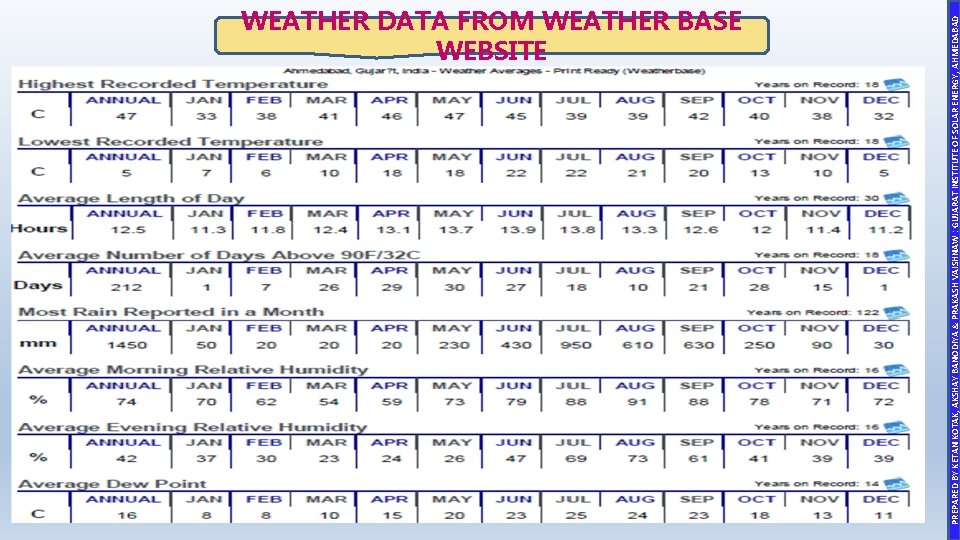
PREPARED BY KETAN KOTAK, AKSHAY BANODIYA & PRAKASH VAISHNAW : GUJARAT INSTITUTE OF SOLAR ENERGY, AHMEDABAD WEATHER DATA FROM WEATHER BASE WEBSITE
3. 6 Mj/m 2 = 1 Kwh/m 2 Hence 20. 9 / 3. 6 = 5. 80 Kwh/ m 2 / Day DAILY NORMAL INSOLATION DATA FROM MNRE PREPARED BY KETAN KOTAK, AKSHAY BANODIYA & PRAKASH VAISHNAW : GUJARAT INSTITUTE OF SOLAR ENERGY, AHMEDABAD WEATHER DATA FROM WEATHER BASE WEBSITE
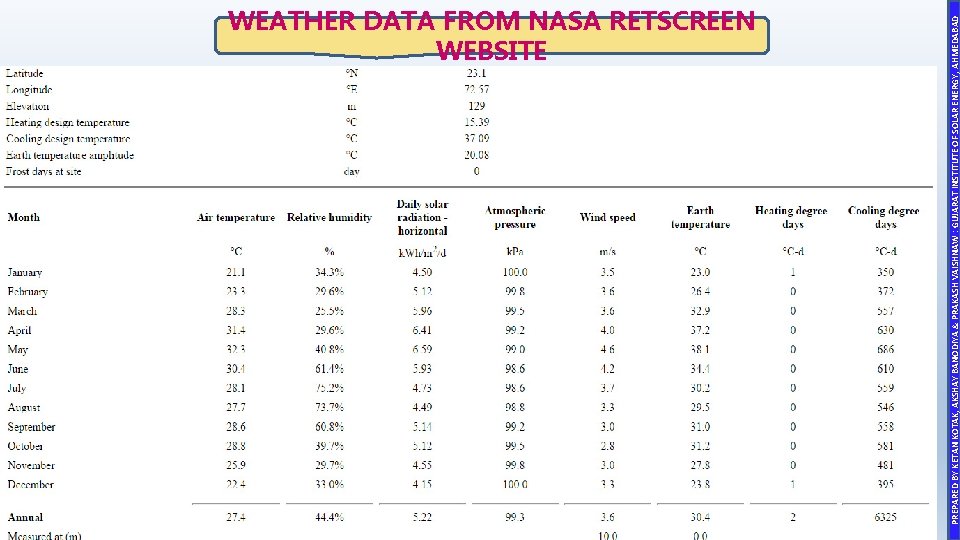
PREPARED BY KETAN KOTAK, AKSHAY BANODIYA & PRAKASH VAISHNAW : GUJARAT INSTITUTE OF SOLAR ENERGY, AHMEDABAD WEATHER DATA FROM NASA RETSCREEN WEBSITE
PREPARED BY KETAN KOTAK, AKSHAY BANODIYA & PRAKASH VAISHNAW : GUJARAT INSTITUTE OF SOLAR ENERGY, AHMEDABAD
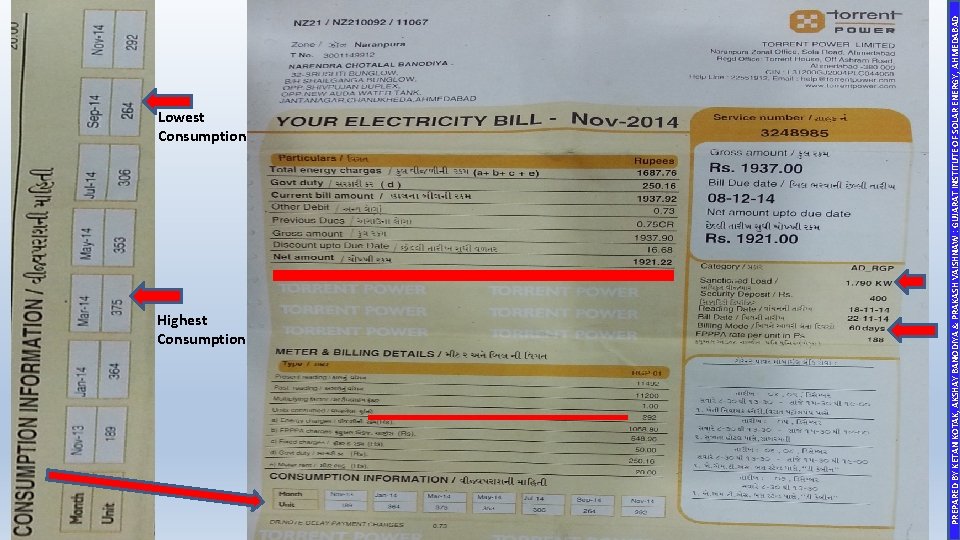
Highest Consumption PREPARED BY KETAN KOTAK, AKSHAY BANODIYA & PRAKASH VAISHNAW : GUJARAT INSTITUTE OF SOLAR ENERGY, AHMEDABAD Lowest Consumption
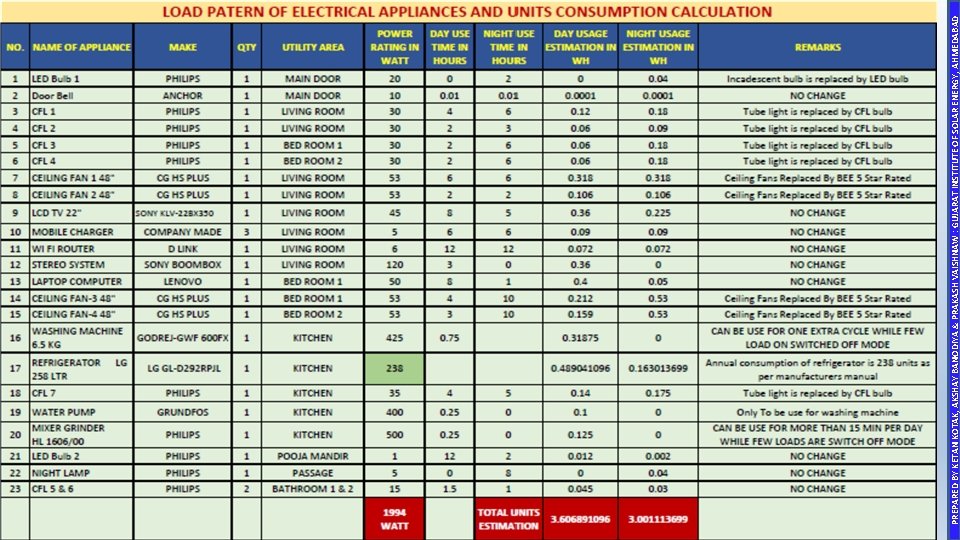
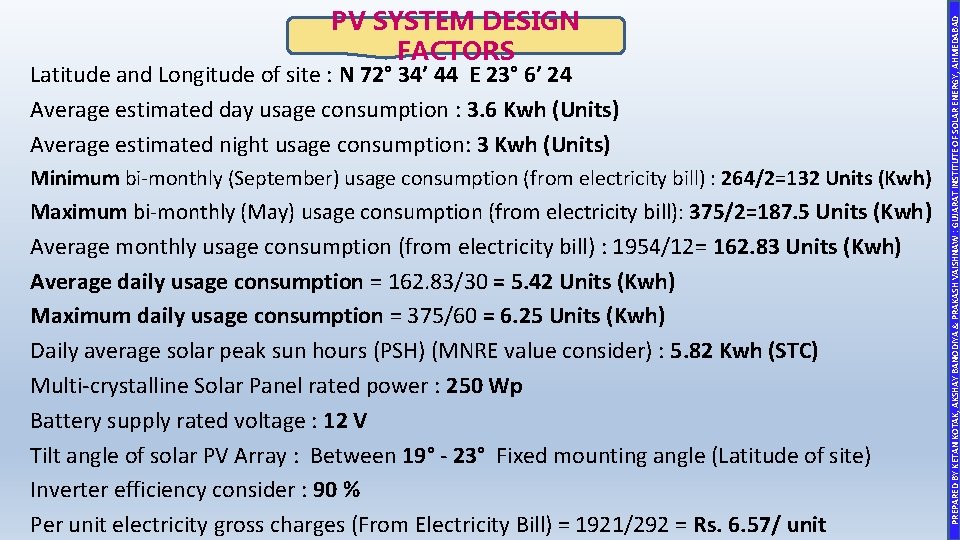
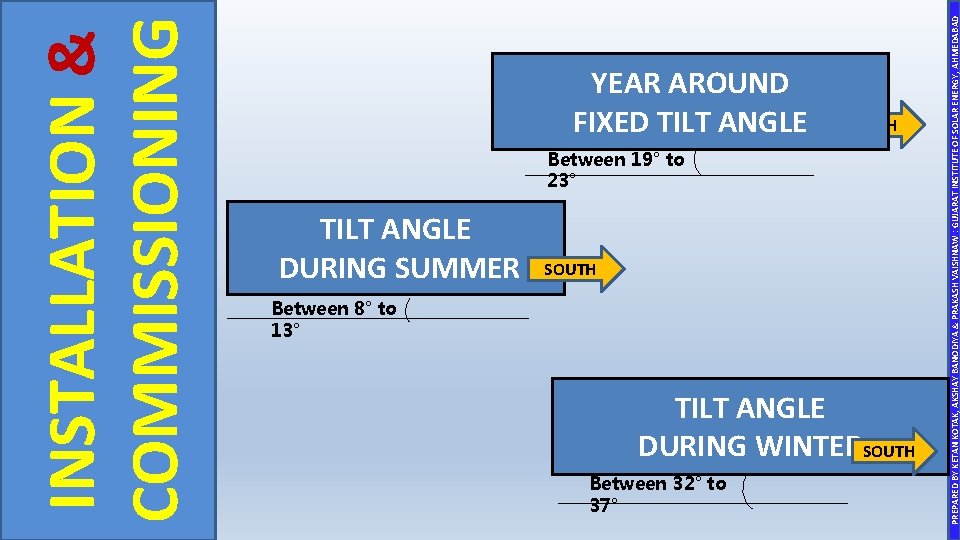
Minimum bi-monthly (September) usage consumption (from electricity bill) : 264/2=132 Units (Kwh) Maximum bi-monthly (May) usage consumption (from electricity bill): 375/2=187. 5 Units (Kwh) Average monthly usage consumption (from electricity bill) : 1954/12= 162. 83 Units (Kwh) Average daily usage consumption = 162. 83/30 = 5. 42 Units (Kwh) Maximum daily usage consumption = 375/60 = 6. 25 Units (Kwh) Daily average solar peak sun hours (PSH) (MNRE value consider) : 5. 82 Kwh (STC) Multi-crystalline Solar Panel rated power : 250 Wp Battery supply rated voltage : 12 V Tilt angle of solar PV Array : Between 19° - 23° Fixed mounting angle (Latitude of site) Inverter efficiency consider : 90 % Per unit electricity gross charges (From Electricity Bill) = 1921/292 = Rs. 6. 57/ unit PREPARED BY KETAN KOTAK, AKSHAY BANODIYA & PRAKASH VAISHNAW : GUJARAT INSTITUTE OF SOLAR ENERGY, AHMEDABAD PV SYSTEM DESIGN FACTORS Latitude and Longitude of site : N 72° 34’ 44 E 23° 6’ 24 Average estimated day usage consumption : 3. 6 Kwh (Units) Average estimated night usage consumption: 3 Kwh (Units)
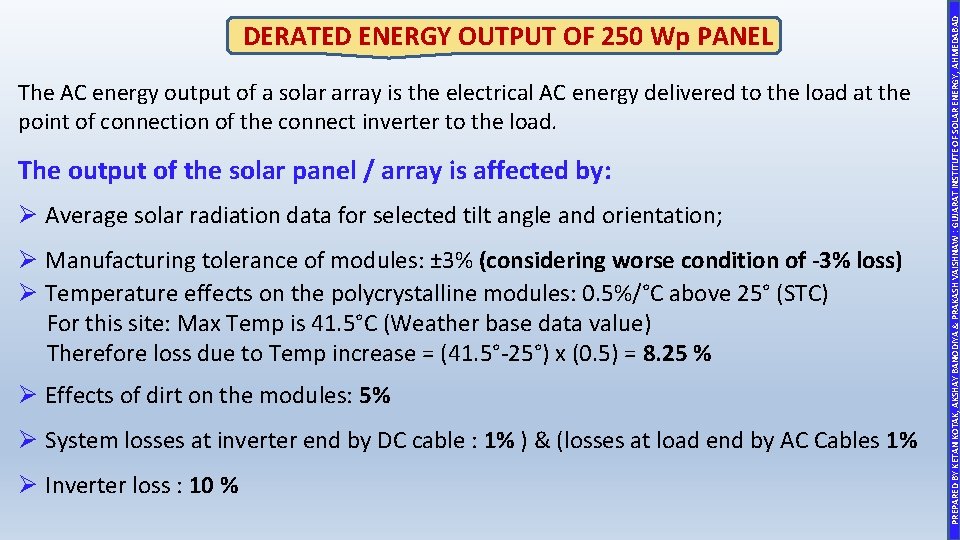
The AC energy output of a solar array is the electrical AC energy delivered to the load at the point of connection of the connect inverter to the load. The output of the solar panel / array is affected by: Ø Average solar radiation data for selected tilt angle and orientation; Ø Manufacturing tolerance of modules: ± 3% (considering worse condition of -3% loss) Ø Temperature effects on the polycrystalline modules: 0. 5%/°C above 25° (STC) For this site: Max Temp is 41. 5°C (Weather base data value) Therefore loss due to Temp increase = (41. 5°-25°) x (0. 5) = 8. 25 % Ø Effects of dirt on the modules: 5% Ø System losses at inverter end by DC cable : 1% ) & (losses at load end by AC Cables 1% Ø Inverter loss : 10 % PREPARED BY KETAN KOTAK, AKSHAY BANODIYA & PRAKASH VAISHNAW : GUJARAT INSTITUTE OF SOLAR ENERGY, AHMEDABAD DERATED ENERGY OUTPUT OF 250 Wp PANEL
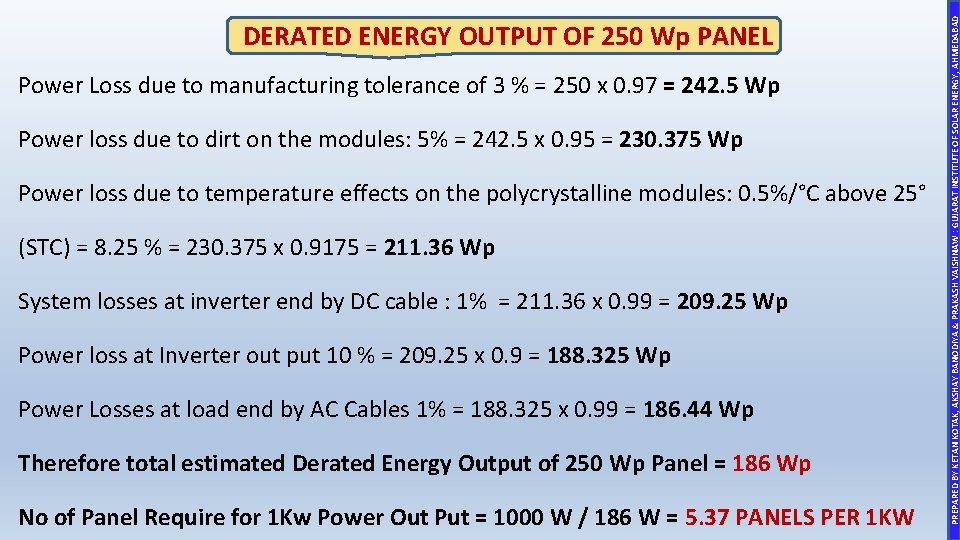
Power Loss due to manufacturing tolerance of 3 % = 250 x 0. 97 = 242. 5 Wp Power loss due to dirt on the modules: 5% = 242. 5 x 0. 95 = 230. 375 Wp Power loss due to temperature effects on the polycrystalline modules: 0. 5%/°C above 25° (STC) = 8. 25 % = 230. 375 x 0. 9175 = 211. 36 Wp System losses at inverter end by DC cable : 1% = 211. 36 x 0. 99 = 209. 25 Wp Power loss at Inverter out put 10 % = 209. 25 x 0. 9 = 188. 325 Wp Power Losses at load end by AC Cables 1% = 188. 325 x 0. 99 = 186. 44 Wp Therefore total estimated Derated Energy Output of 250 Wp Panel = 186 Wp No of Panel Require for 1 Kw Power Out Put = 1000 W / 186 W = 5. 37 PANELS PER 1 KW PREPARED BY KETAN KOTAK, AKSHAY BANODIYA & PRAKASH VAISHNAW : GUJARAT INSTITUTE OF SOLAR ENERGY, AHMEDABAD DERATED ENERGY OUTPUT OF 250 Wp PANEL
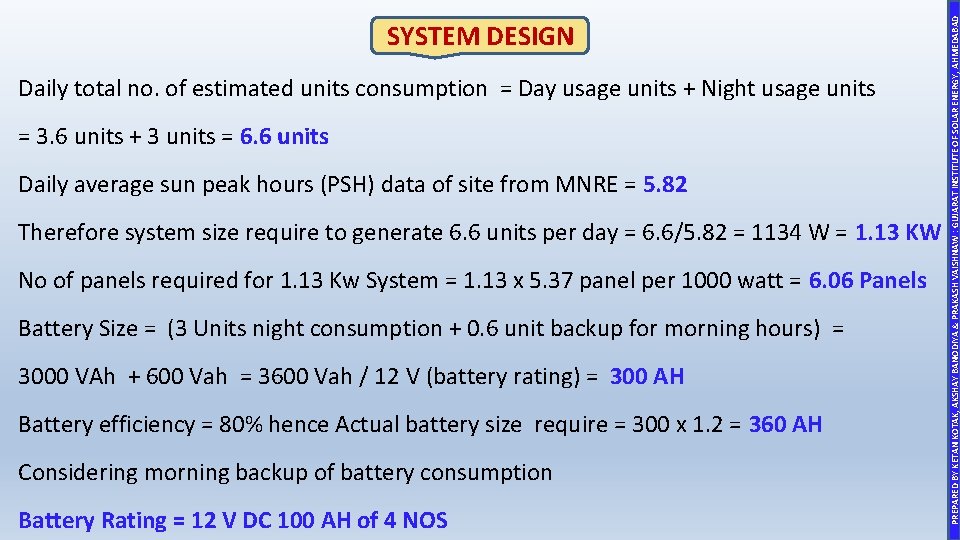
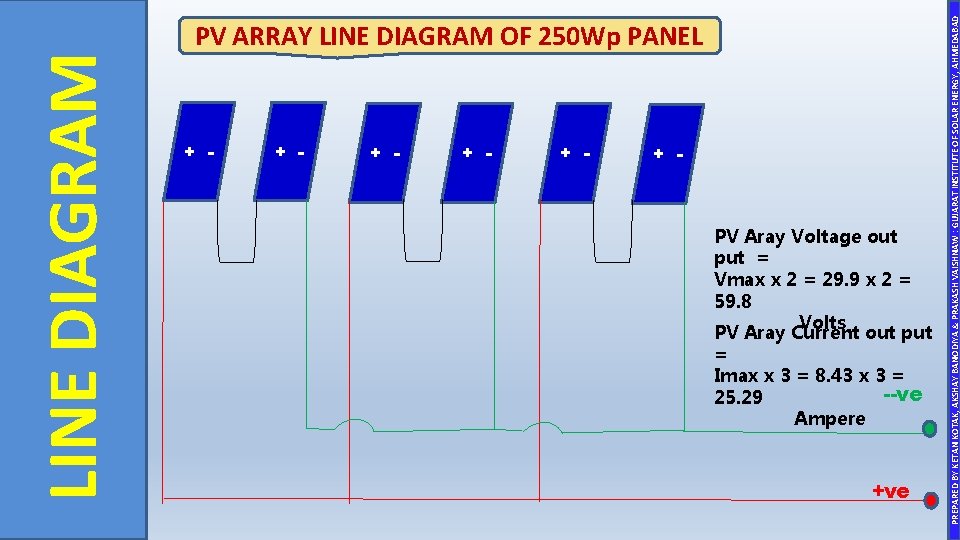
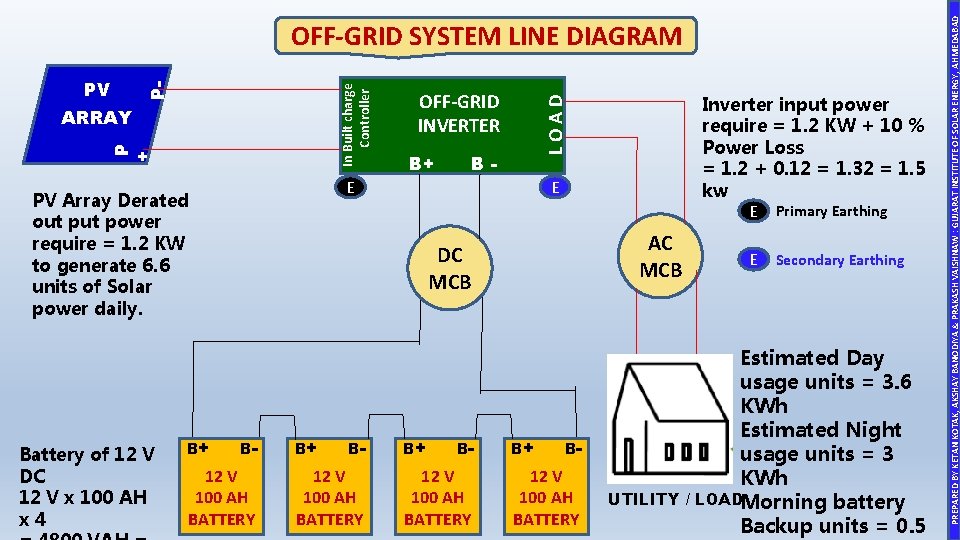
Daily total no. of estimated units consumption = Day usage units + Night usage units = 3. 6 units + 3 units = 6. 6 units Daily average sun peak hours (PSH) data of site from MNRE = 5. 82 Therefore system size require to generate 6. 6 units per day = 6. 6/5. 82 = 1134 W = 1. 13 KW No of panels required for 1. 13 Kw System = 1. 13 x 5. 37 panel per 1000 watt = 6. 06 Panels Battery Size = (3 Units night consumption + 0. 6 unit backup for morning hours) = 3000 VAh + 600 Vah = 3600 Vah / 12 V (battery rating) = 300 AH Battery efficiency = 80% hence Actual battery size require = 300 x 1. 2 = 360 AH Considering morning backup of battery consumption Battery Rating = 12 V DC 100 AH of 4 NOS PREPARED BY KETAN KOTAK, AKSHAY BANODIYA & PRAKASH VAISHNAW : GUJARAT INSTITUTE OF SOLAR ENERGY, AHMEDABAD SYSTEM DESIGN
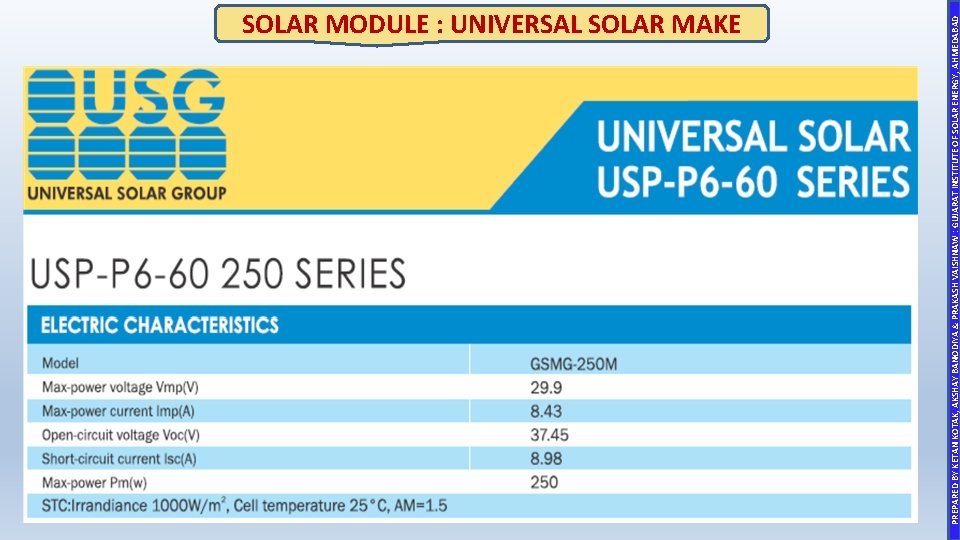
+ - + - + - PV Aray Voltage out put = Vmax x 2 = 29. 9 x 2 = 59. 8 Volts PV Aray Current out put = Imax x 3 = 8. 43 x 3 = --ve 25. 29 Ampere +ve PREPARED BY KETAN KOTAK, AKSHAY BANODIYA & PRAKASH VAISHNAW : GUJARAT INSTITUTE OF SOLAR ENERGY, AHMEDABAD LINE DIAGRAM PV ARRAY LINE DIAGRAM OF 250 Wp PANEL
B+ B+ B- E PV Array Derated out power require = 1. 2 KW to generate 6. 6 units of Solar power daily. Battery of 12 V DC 12 V x 100 AH x 4 OFF-GRID INVERTER E AC MCB DC MCB B- 12 V 100 AH BATTERY B+ B- 12 V 100 AH BATTERY Inverter input power require = 1. 2 KW + 10 % Power Loss = 1. 2 + 0. 12 = 1. 32 = 1. 5 kw E Primary Earthing B+ B- 12 V 100 AH BATTERY E Secondary Earthing Estimated Day usage units = 3. 6 KWh Estimated Night usage units = 3 KWh UTILITY / LOADMorning battery Backup units = 0. 5 PREPARED BY KETAN KOTAK, AKSHAY BANODIYA & PRAKASH VAISHNAW : GUJARAT INSTITUTE OF SOLAR ENERGY, AHMEDABAD P + ARRAY LOAD In Built charge Controller PV P- OFF-GRID SYSTEM LINE DIAGRAM
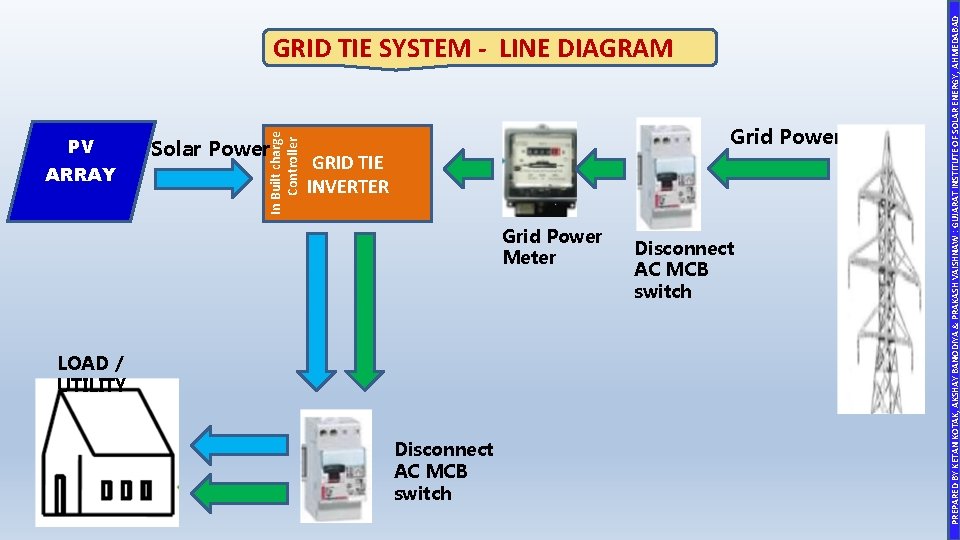
ARRAY Solar Power Grid Power GRID TIE INVERTER Grid Power Meter LOAD / UTILITY Disconnect AC MCB switch PREPARED BY KETAN KOTAK, AKSHAY BANODIYA & PRAKASH VAISHNAW : GUJARAT INSTITUTE OF SOLAR ENERGY, AHMEDABAD PV In Built charge Controller GRID TIE SYSTEM - LINE DIAGRAM
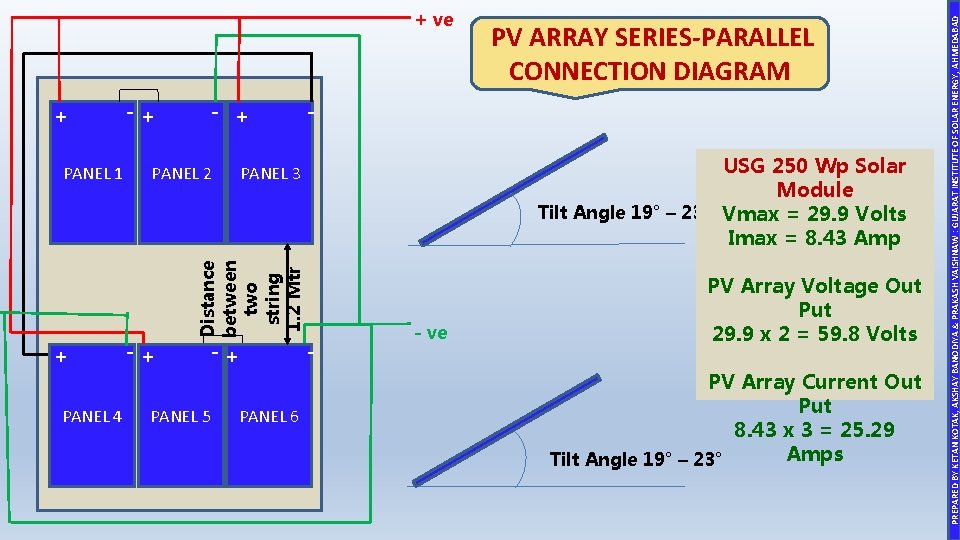
+ - + PANEL 2 - USG 250 Wp Solar Module Tilt Angle 19° – 23° Vmax = 29. 9 Volts Imax = 8. 43 Amp PANEL 3 Distance between two string 1. 2 Mtr PANEL 1 -+ + PANEL 4 -+ PANEL 5 -+ PANEL 6 PV ARRAY SERIES-PARALLEL CONNECTION DIAGRAM - - ve PV Array Voltage Out Put 29. 9 x 2 = 59. 8 Volts PV Array Current Out Put 8. 43 x 3 = 25. 29 Amps Tilt Angle 19° – 23° PREPARED BY KETAN KOTAK, AKSHAY BANODIYA & PRAKASH VAISHNAW : GUJARAT INSTITUTE OF SOLAR ENERGY, AHMEDABAD + ve
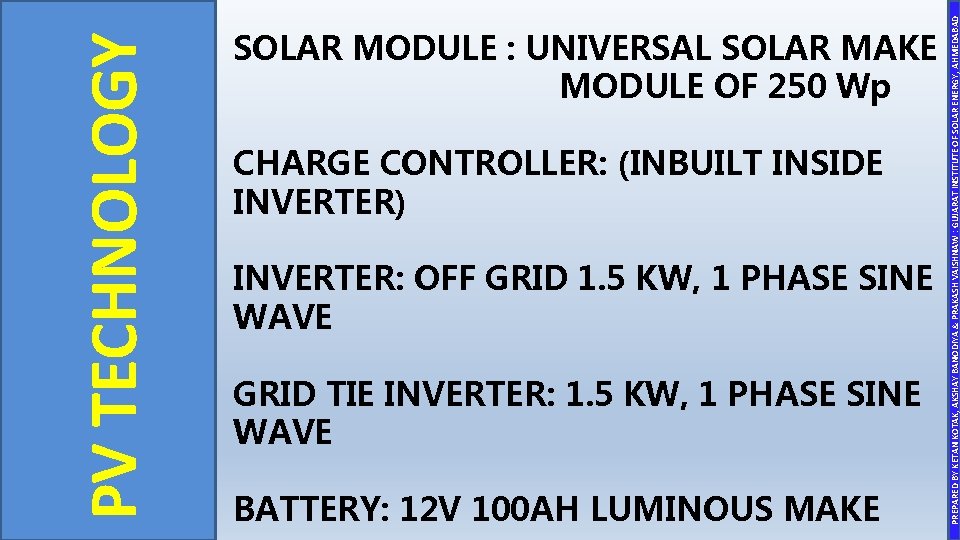
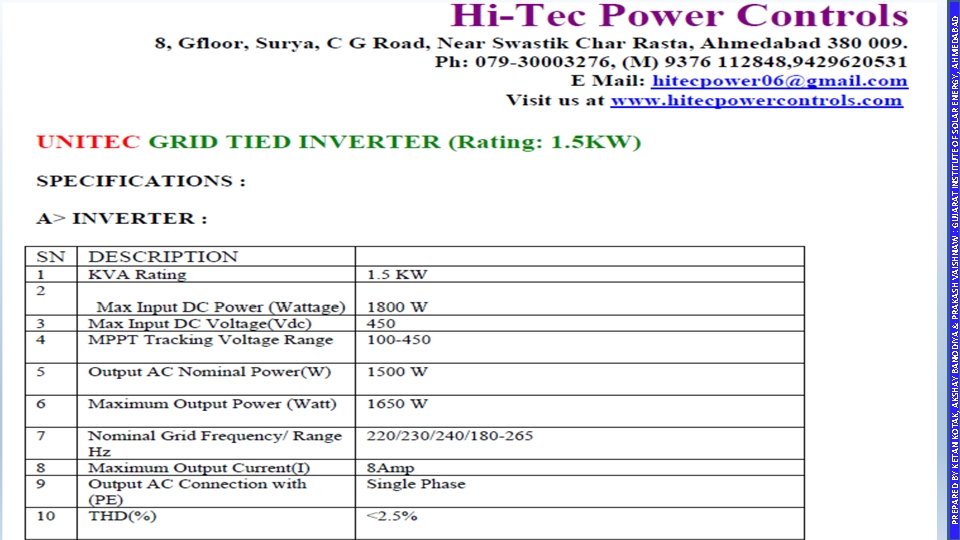
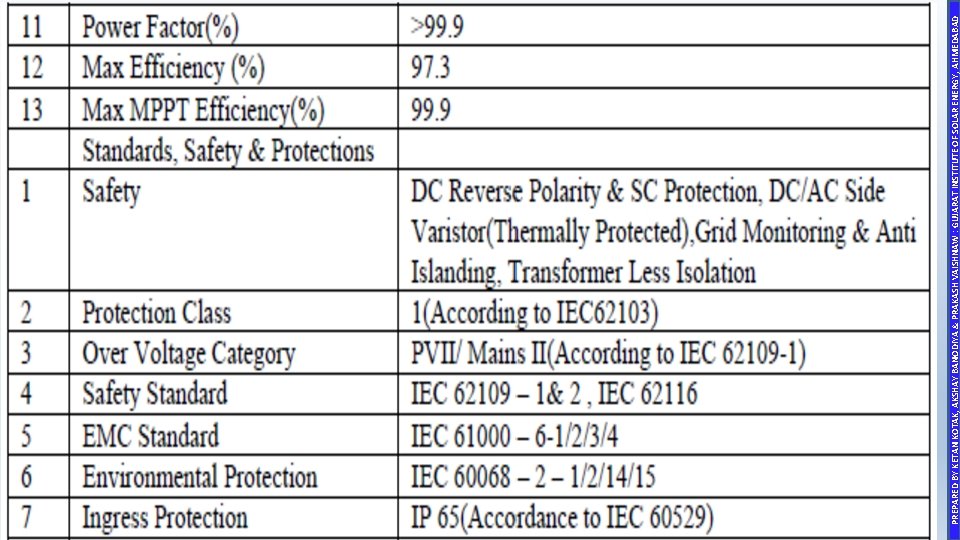
CHARGE CONTROLLER: (INBUILT INSIDE INVERTER) INVERTER: OFF GRID 1. 5 KW, 1 PHASE SINE WAVE GRID TIE INVERTER: 1. 5 KW, 1 PHASE SINE WAVE BATTERY: 12 V 100 AH LUMINOUS MAKE PREPARED BY KETAN KOTAK, AKSHAY BANODIYA & PRAKASH VAISHNAW : GUJARAT INSTITUTE OF SOLAR ENERGY, AHMEDABAD PV TECHNOLOGY SOLAR MODULE : UNIVERSAL SOLAR MAKE MODULE OF 250 Wp
PREPARED BY KETAN KOTAK, AKSHAY BANODIYA & PRAKASH VAISHNAW : GUJARAT INSTITUTE OF SOLAR ENERGY, AHMEDABAD MNRE STANDARDS for DESIGN
PREPARED BY KETAN KOTAK, AKSHAY BANODIYA & PRAKASH VAISHNAW : GUJARAT INSTITUTE OF SOLAR ENERGY, AHMEDABAD SOLAR MODULE : UNIVERSAL SOLAR MAKE
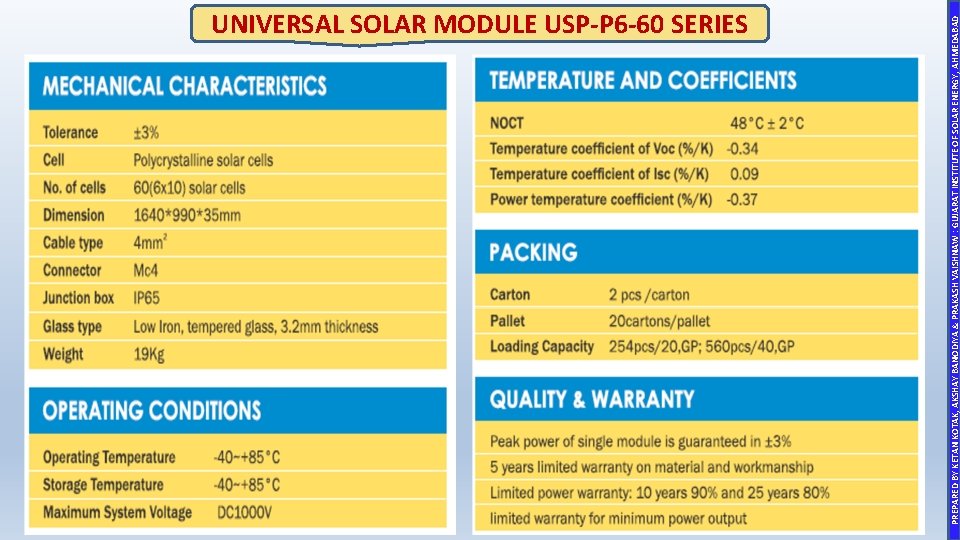
PREPARED BY KETAN KOTAK, AKSHAY BANODIYA & PRAKASH VAISHNAW : GUJARAT INSTITUTE OF SOLAR ENERGY, AHMEDABAD UNIVERSAL SOLAR MODULE USP-P 6 -60 SERIES
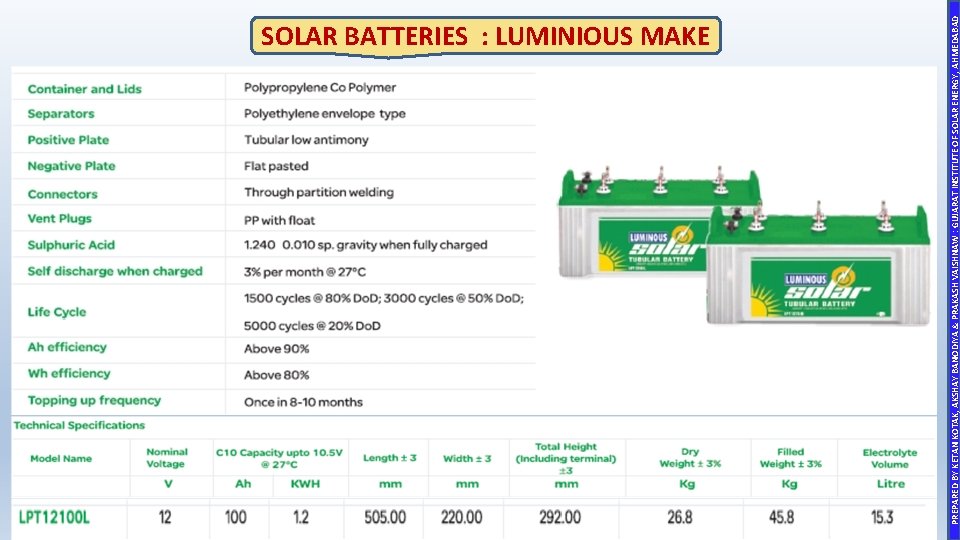
PREPARED BY KETAN KOTAK, AKSHAY BANODIYA & PRAKASH VAISHNAW : GUJARAT INSTITUTE OF SOLAR ENERGY, AHMEDABAD SOLAR BATTERIES : LUMINIOUS MAKE
PREPARED BY KETAN KOTAK, AKSHAY BANODIYA & PRAKASH VAISHNAW : GUJARAT INSTITUTE OF SOLAR ENERGY, AHMEDABAD
PREPARED BY KETAN KOTAK, AKSHAY BANODIYA & PRAKASH VAISHNAW : GUJARAT INSTITUTE OF SOLAR ENERGY, AHMEDABAD
PREPARED BY KETAN KOTAK, AKSHAY BANODIYA & PRAKASH VAISHNAW : GUJARAT INSTITUTE OF SOLAR ENERGY, AHMEDABAD
PREPARED BY KETAN KOTAK, AKSHAY BANODIYA & PRAKASH VAISHNAW : GUJARAT INSTITUTE OF SOLAR ENERGY, AHMEDABAD
PREPARED BY KETAN KOTAK, AKSHAY BANODIYA & PRAKASH VAISHNAW : GUJARAT INSTITUTE OF SOLAR ENERGY, AHMEDABAD
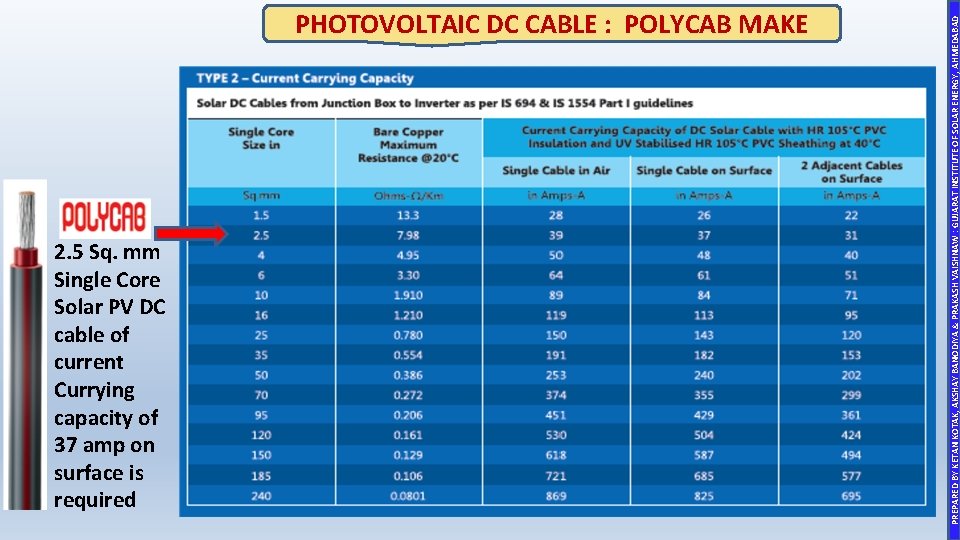
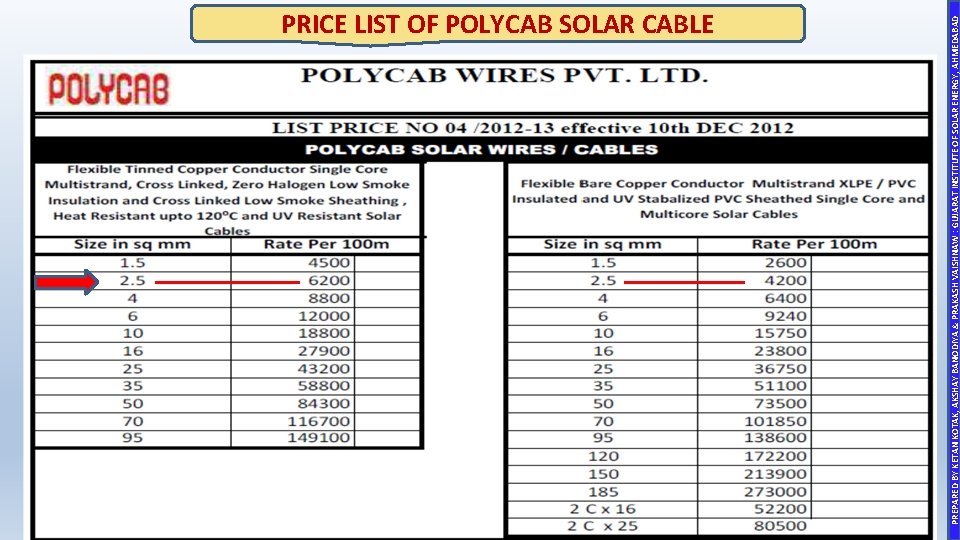
2. 5 Sq. mm Single Core Solar PV DC cable of current Currying capacity of 37 amp on surface is required PREPARED BY KETAN KOTAK, AKSHAY BANODIYA & PRAKASH VAISHNAW : GUJARAT INSTITUTE OF SOLAR ENERGY, AHMEDABAD PHOTOVOLTAIC DC CABLE : POLYCAB MAKE
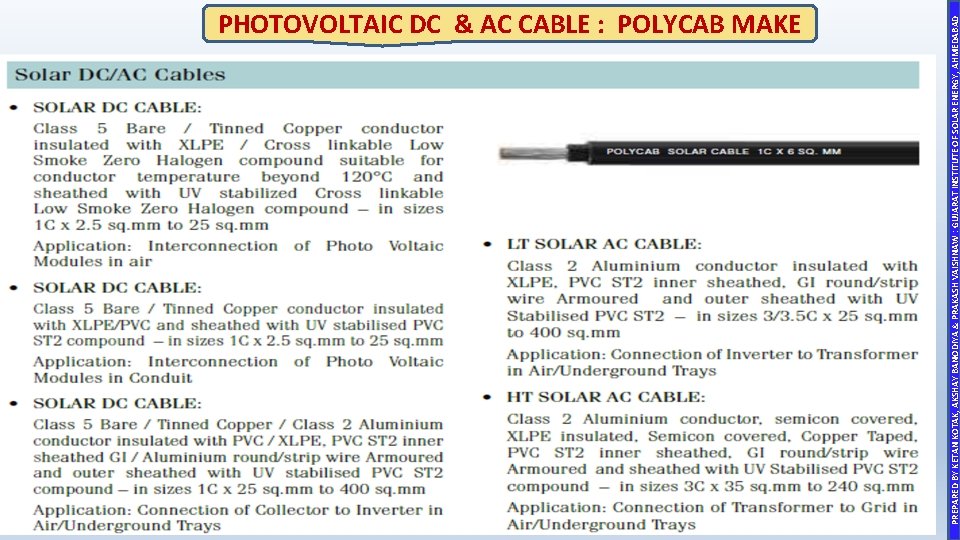
PREPARED BY KETAN KOTAK, AKSHAY BANODIYA & PRAKASH VAISHNAW : GUJARAT INSTITUTE OF SOLAR ENERGY, AHMEDABAD PHOTOVOLTAIC DC & AC CABLE : POLYCAB MAKE
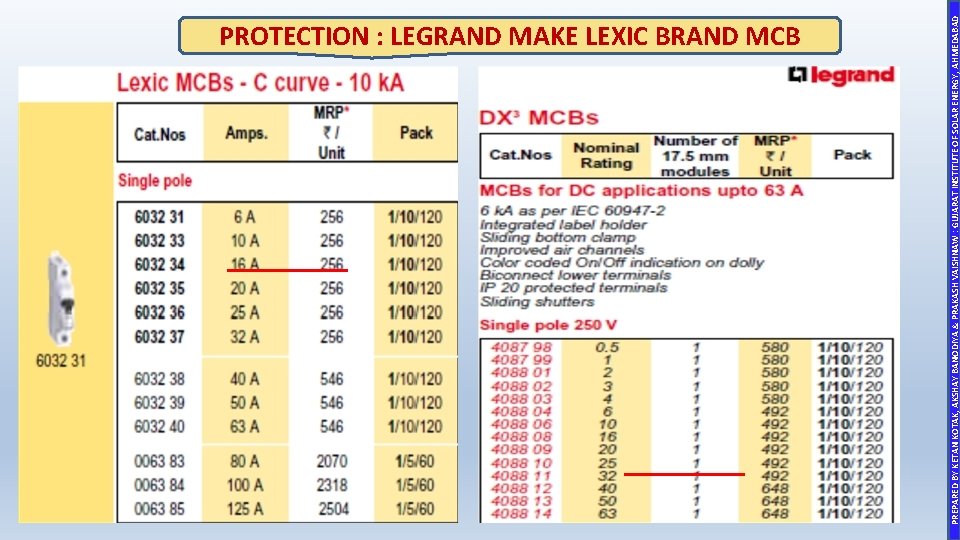
PREPARED BY KETAN KOTAK, AKSHAY BANODIYA & PRAKASH VAISHNAW : GUJARAT INSTITUTE OF SOLAR ENERGY, AHMEDABAD PROTECTION : LEGRAND MAKE LEXIC BRAND MCB
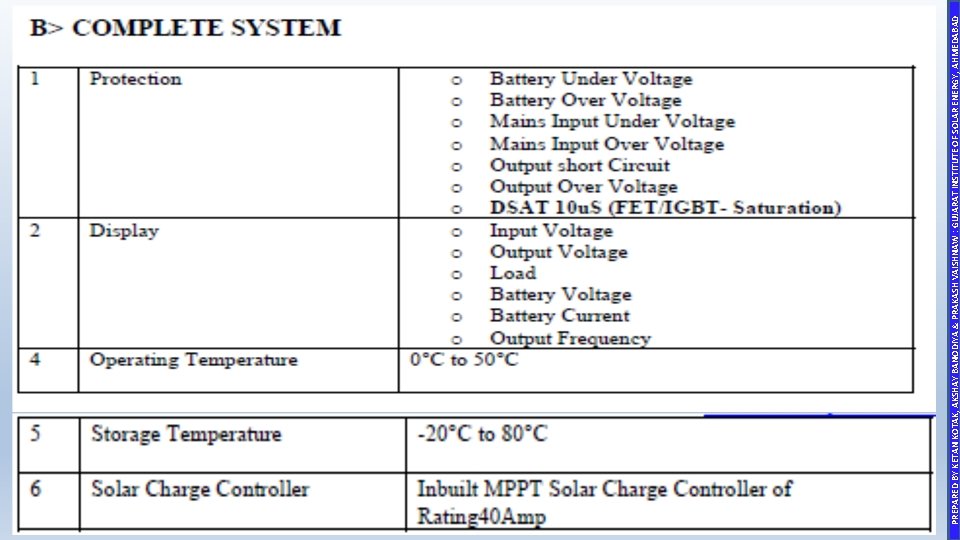
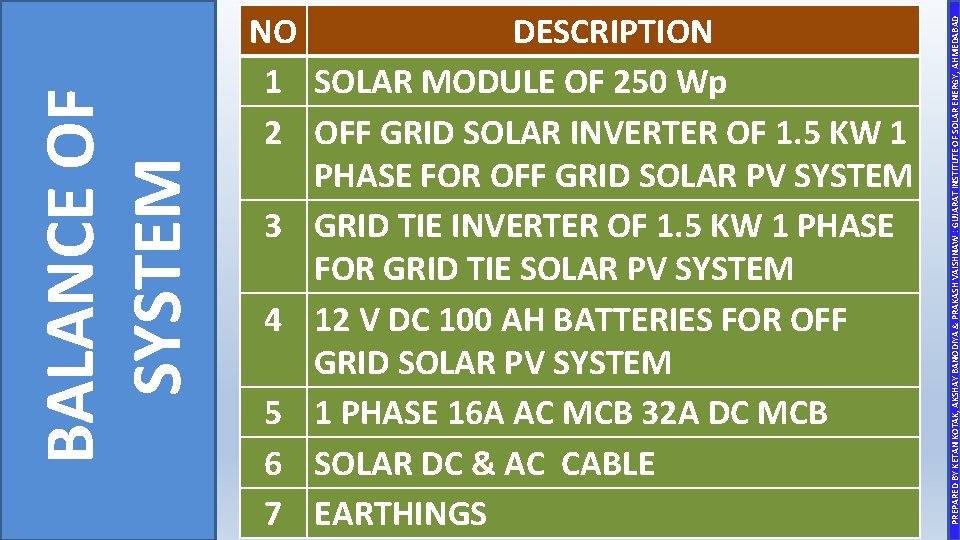
PREPARED BY KETAN KOTAK, AKSHAY BANODIYA & PRAKASH VAISHNAW : GUJARAT INSTITUTE OF SOLAR ENERGY, AHMEDABAD BALANCE OF SYSTEM NO DESCRIPTION 1 SOLAR MODULE OF 250 Wp 2 OFF GRID SOLAR INVERTER OF 1. 5 KW 1 PHASE FOR OFF GRID SOLAR PV SYSTEM 3 GRID TIE INVERTER OF 1. 5 KW 1 PHASE FOR GRID TIE SOLAR PV SYSTEM 4 12 V DC 100 AH BATTERIES FOR OFF GRID SOLAR PV SYSTEM 5 1 PHASE 16 A AC MCB 32 A DC MCB 6 SOLAR DC & AC CABLE 7 EARTHINGS
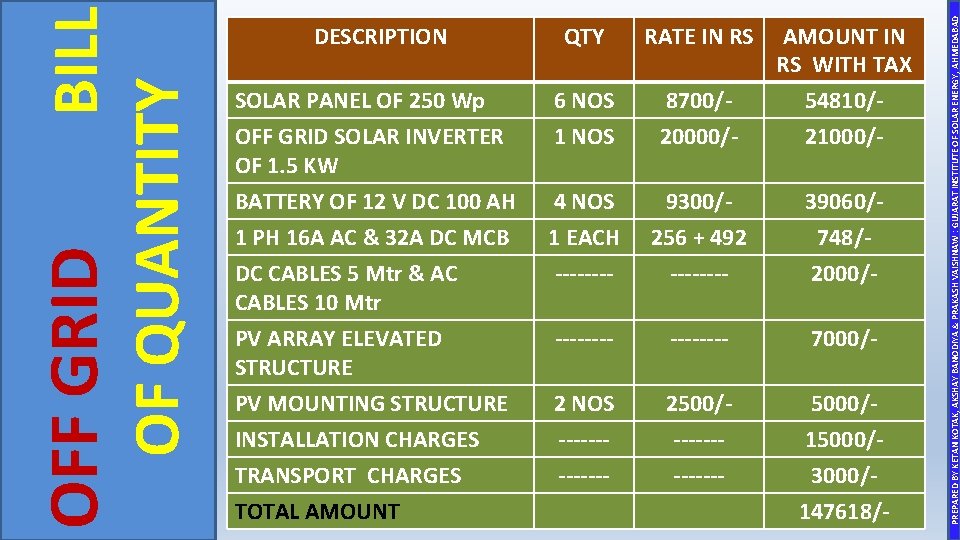
QTY RATE IN RS SOLAR PANEL OF 250 Wp 6 NOS 8700/- AMOUNT IN RS WITH TAX 54810/- OFF GRID SOLAR INVERTER OF 1. 5 KW BATTERY OF 12 V DC 100 AH 1 NOS 20000/- 21000/- 4 NOS 9300/- 39060/- 1 PH 16 A AC & 32 A DC MCB DC CABLES 5 Mtr & AC CABLES 10 Mtr PV ARRAY ELEVATED STRUCTURE 1 EACH ---- 256 + 492 ---- 748/2000/- -------- 7000/- PV MOUNTING STRUCTURE INSTALLATION CHARGES TRANSPORT CHARGES TOTAL AMOUNT 2 NOS ------- 2500/------- 5000/15000/3000/147618/- PREPARED BY KETAN KOTAK, AKSHAY BANODIYA & PRAKASH VAISHNAW : GUJARAT INSTITUTE OF SOLAR ENERGY, AHMEDABAD BILL OF QUANTITY OFF GRID DESCRIPTION
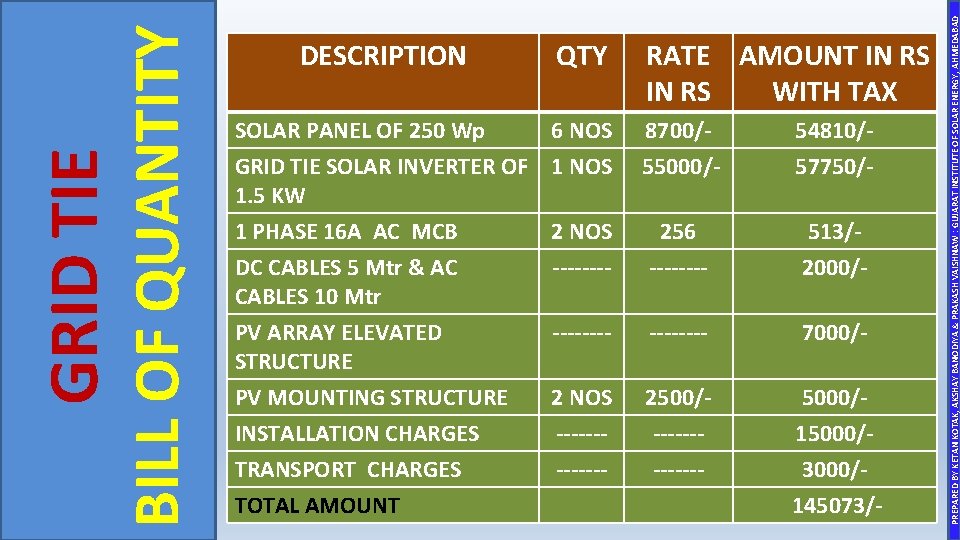
QTY RATE AMOUNT IN RS WITH TAX 6 NOS 8700/- 54810/- GRID TIE SOLAR INVERTER OF 1 NOS 1. 5 KW 55000/- 57750/- 1 PHASE 16 A AC MCB DC CABLES 5 Mtr & AC CABLES 10 Mtr PV ARRAY ELEVATED STRUCTURE 2 NOS ---- 256 ---- 513/2000/- -------- 7000/- PV MOUNTING STRUCTURE INSTALLATION CHARGES TRANSPORT CHARGES TOTAL AMOUNT 2 NOS ------- 2500/------- 5000/15000/3000/145073/- SOLAR PANEL OF 250 Wp PREPARED BY KETAN KOTAK, AKSHAY BANODIYA & PRAKASH VAISHNAW : GUJARAT INSTITUTE OF SOLAR ENERGY, AHMEDABAD BILL OF QUANTITY GRID TIE DESCRIPTION
PREPARED BY KETAN KOTAK, AKSHAY BANODIYA & PRAKASH VAISHNAW : GUJARAT INSTITUTE OF SOLAR ENERGY, AHMEDABAD PROFORMA INVOICE OF SOLAR MODULE AND BATTERIES
PREPARED BY KETAN KOTAK, AKSHAY BANODIYA & PRAKASH VAISHNAW : GUJARAT INSTITUTE OF SOLAR ENERGY, AHMEDABAD PROFORMA INVOICE OF OFF-GRID AND GRID TIE INVERTER
PREPARED BY KETAN KOTAK, AKSHAY BANODIYA & PRAKASH VAISHNAW : GUJARAT INSTITUTE OF SOLAR ENERGY, AHMEDABAD PRICE LIST OF POLYCAB SOLAR CABLE
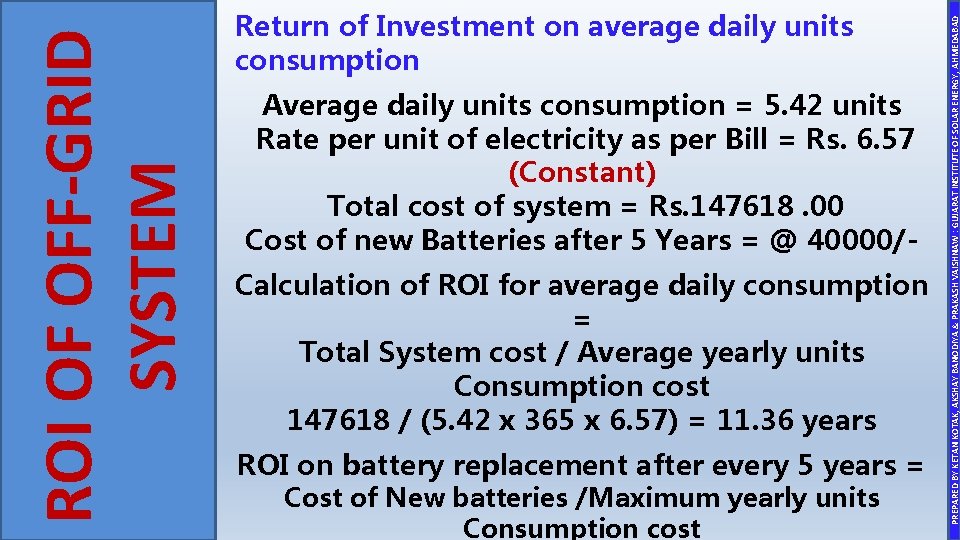
Average daily units consumption = 5. 42 units Rate per unit of electricity as per Bill = Rs. 6. 57 (Constant) Total cost of system = Rs. 147618. 00 Cost of new Batteries after 5 Years = @ 40000/Calculation of ROI for average daily consumption = Total System cost / Average yearly units Consumption cost 147618 / (5. 42 x 365 x 6. 57) = 11. 36 years ROI on battery replacement after every 5 years = Cost of New batteries /Maximum yearly units Consumption cost PREPARED BY KETAN KOTAK, AKSHAY BANODIYA & PRAKASH VAISHNAW : GUJARAT INSTITUTE OF SOLAR ENERGY, AHMEDABAD ROI OF OFF-GRID SYSTEM Return of Investment on average daily units consumption
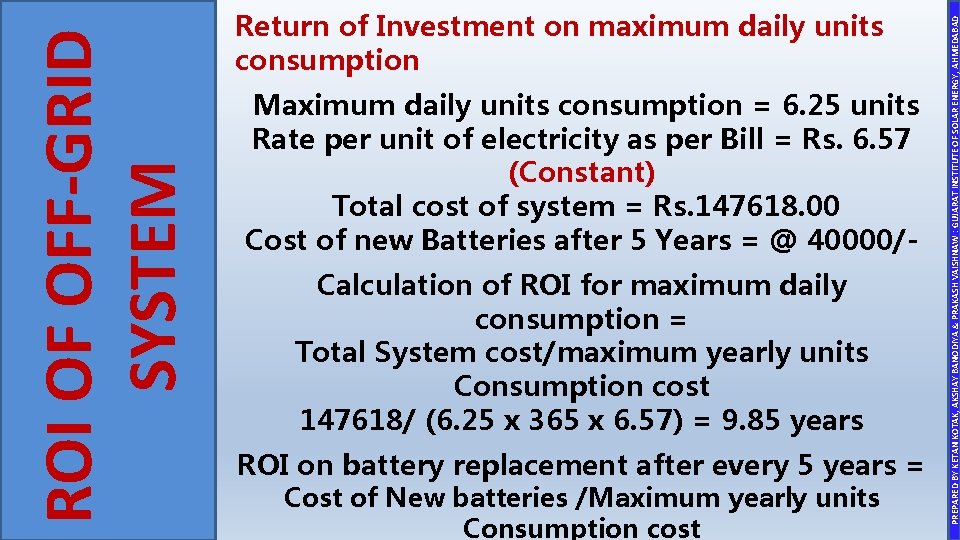
Maximum daily units consumption = 6. 25 units Rate per unit of electricity as per Bill = Rs. 6. 57 (Constant) Total cost of system = Rs. 147618. 00 Cost of new Batteries after 5 Years = @ 40000/Calculation of ROI for maximum daily consumption = Total System cost/maximum yearly units Consumption cost 147618/ (6. 25 x 365 x 6. 57) = 9. 85 years ROI on battery replacement after every 5 years = Cost of New batteries /Maximum yearly units Consumption cost PREPARED BY KETAN KOTAK, AKSHAY BANODIYA & PRAKASH VAISHNAW : GUJARAT INSTITUTE OF SOLAR ENERGY, AHMEDABAD ROI OF OFF-GRID SYSTEM Return of Investment on maximum daily units consumption
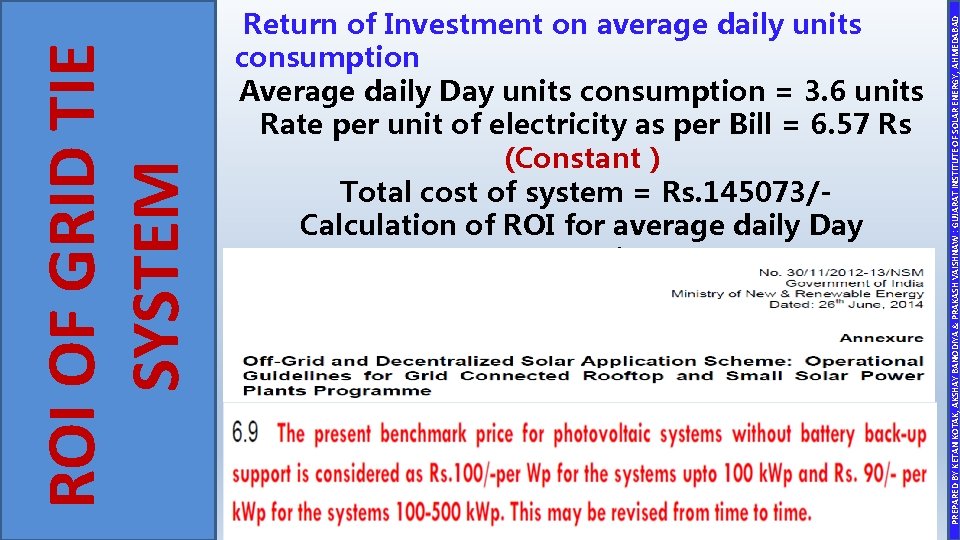
PREPARED BY KETAN KOTAK, AKSHAY BANODIYA & PRAKASH VAISHNAW : GUJARAT INSTITUTE OF SOLAR ENERGY, AHMEDABAD ROI OF GRID TIE SYSTEM Return of Investment on average daily units consumption Average daily Day units consumption = 3. 6 units Rate per unit of electricity as per Bill = 6. 57 Rs (Constant ) Total cost of system = Rs. 145073/Calculation of ROI for average daily Day consumption = Total System cost / Average yearly units Consumption cost 145388/ (3. 6 x 365 x 6. 57) = 16. 80 years
Ø The installation of Solar Power System involves the following major steps: Ø Civil Foundation Job Ø Assembly and fixing of support structure. Ø Mounting of Solar Modules on the Support Structure. Ø Installation of Battery Bank. Ø Interconnection of SPV panel in series & parallel configuration, Charge Control Unit and Junction Box Ø Connection of Battery Bank and Load Ø Earthing of Lightning Protection Unit. PREPARED BY KETAN KOTAK, AKSHAY BANODIYA & PRAKASH VAISHNAW : GUJARAT INSTITUTE OF SOLAR ENERGY, AHMEDABAD INSTALLATION & COMMISSIONING INSTALLATION GUIDELINES
While mounting the solar Modules, following points should be considered for getting maximum output from the solar modules: Ø Modules should be oriented south facing to receive maximum sunlight. . Ø The Modules produce more power at low temperature and full sun. Ø Tracking the Sun increases the amount of power from an array The Solar panels are generally installed in such a way that they can receive maximum direct sunlight without shade from any building/trees nearby falling on them at any part of the day. PREPARED BY KETAN KOTAK, AKSHAY BANODIYA & PRAKASH VAISHNAW : GUJARAT INSTITUTE OF SOLAR ENERGY, AHMEDABAD INSTALLATION & COMMISSIONING MOUNTING THE SOLAR MODULES
SOUTH Between 19° to 23° TILT ANGLE DURING SUMMER SOUTH Between 8° to 13° TILT ANGLE DURING WINTERSOUTH Between 32° to 37° PREPARED BY KETAN KOTAK, AKSHAY BANODIYA & PRAKASH VAISHNAW : GUJARAT INSTITUTE OF SOLAR ENERGY, AHMEDABAD INSTALLATION & COMMISSIONING YEAR AROUND FIXED TILT ANGLE
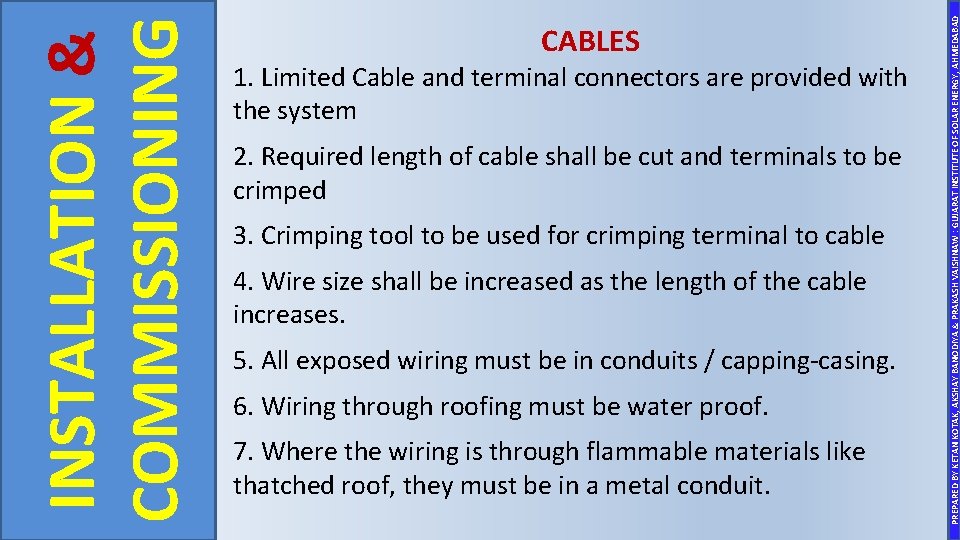
1. Limited Cable and terminal connectors are provided with the system 2. Required length of cable shall be cut and terminals to be crimped 3. Crimping tool to be used for crimping terminal to cable 4. Wire size shall be increased as the length of the cable increases. 5. All exposed wiring must be in conduits / capping-casing. 6. Wiring through roofing must be water proof. 7. Where the wiring is through flammable materials like thatched roof, they must be in a metal conduit. PREPARED BY KETAN KOTAK, AKSHAY BANODIYA & PRAKASH VAISHNAW : GUJARAT INSTITUTE OF SOLAR ENERGY, AHMEDABAD INSTALLATION & COMMISSIONING CABLES
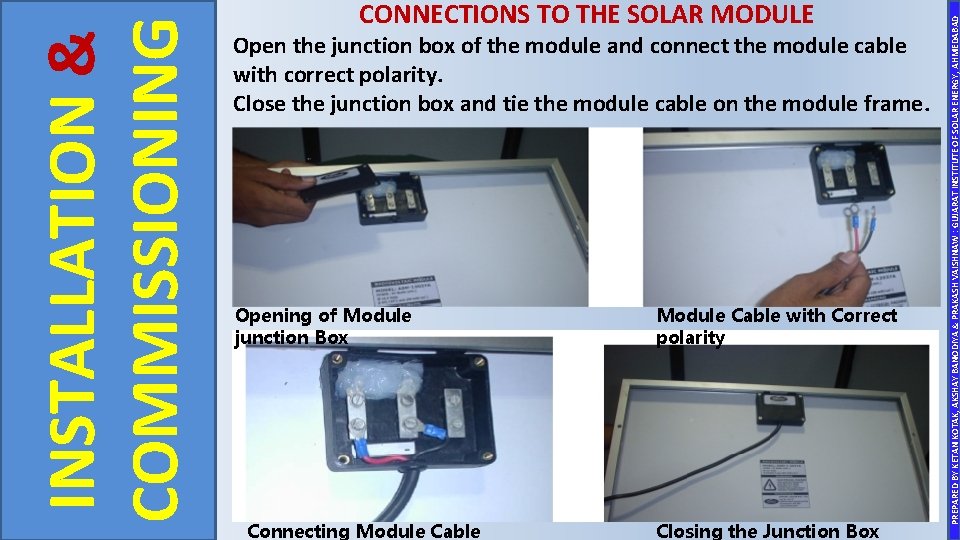
Open the junction box of the module and connect the module cable with correct polarity. Close the junction box and tie the module cable on the module frame. Opening of Module junction Box Connecting Module Cable with Correct polarity Closing the Junction Box PREPARED BY KETAN KOTAK, AKSHAY BANODIYA & PRAKASH VAISHNAW : GUJARAT INSTITUTE OF SOLAR ENERGY, AHMEDABAD INSTALLATION & COMMISSIONING CONNECTIONS TO THE SOLAR MODULE
Any obstruction (such as tree or building) should be avoided in East, West or South of the place of installation. The following is the criteria: (i) East or West: The distance between solar panel and obstruction should be more than double the height of obstruction. (ii) South: The distance should be more than half the height of obstruction. The support for the Solar panel need to be a robust one and should not be accessible to general public. It should be so installed that rainwater, bird dropping, leaves etc. do not accumulate and the top PREPARED BY KETAN KOTAK, AKSHAY BANODIYA & PRAKASH VAISHNAW : GUJARAT INSTITUTE OF SOLAR ENERGY, AHMEDABAD INSTALLATION & COMMISSIONING Solar panels should be installed South facing in the Northern hemisphere and North facing in the Southern hemisphere. Since India is in the Northern hemisphere, Solar panels will be installed always. South facing in our country. The directions North- South may be found with the help of Magnetic Compass.
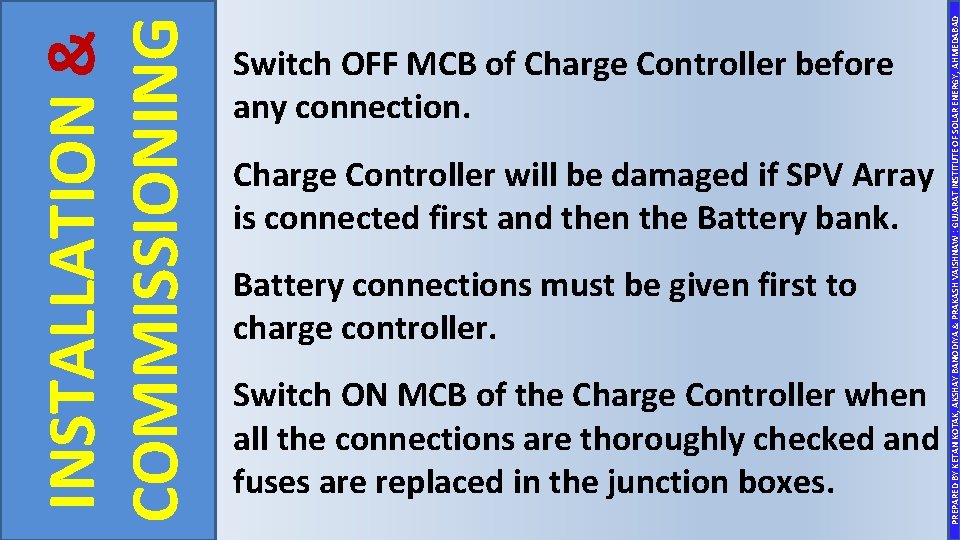
Charge Controller will be damaged if SPV Array is connected first and then the Battery bank. Battery connections must be given first to charge controller. Switch ON MCB of the Charge Controller when all the connections are thoroughly checked and fuses are replaced in the junction boxes. PREPARED BY KETAN KOTAK, AKSHAY BANODIYA & PRAKASH VAISHNAW : GUJARAT INSTITUTE OF SOLAR ENERGY, AHMEDABAD INSTALLATION & COMMISSIONING Switch OFF MCB of Charge Controller before any connection.
With Solar Panel Secondary battery maintenance becomes minimum. Still general periodical maintenance of battery should be carried out in usual manner and as per maintenance manual. For efficient working of SPV system certain precautions are to be observed as given below. PREPARED BY KETAN KOTAK, AKSHAY BANODIYA & PRAKASH VAISHNAW : GUJARAT INSTITUTE OF SOLAR ENERGY, AHMEDABAD OPERATION & MAINTENANCE Solar panels require virtually no maintenance. However the associated equipment such as batteries and charge controller are to be maintained. Once a fortnight the surface of the panels should be wiped clean with wet rag to remove dust, fallen leaves, bird dropping etc. Only water to be used and no other cleaning agent.
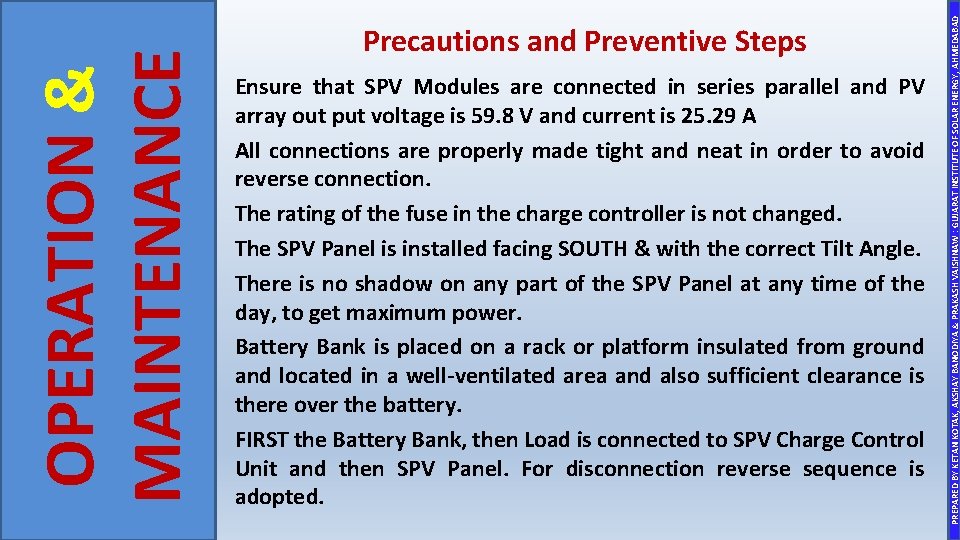
Ensure that SPV Modules are connected in series parallel and PV array out put voltage is 59. 8 V and current is 25. 29 A All connections are properly made tight and neat in order to avoid reverse connection. The rating of the fuse in the charge controller is not changed. The SPV Panel is installed facing SOUTH & with the correct Tilt Angle. There is no shadow on any part of the SPV Panel at any time of the day, to get maximum power. Battery Bank is placed on a rack or platform insulated from ground and located in a well-ventilated area and also sufficient clearance is there over the battery. FIRST the Battery Bank, then Load is connected to SPV Charge Control Unit and then SPV Panel. For disconnection reverse sequence is adopted. PREPARED BY KETAN KOTAK, AKSHAY BANODIYA & PRAKASH VAISHNAW : GUJARAT INSTITUTE OF SOLAR ENERGY, AHMEDABAD OPERATION & MAINTENANCE Precautions and Preventive Steps
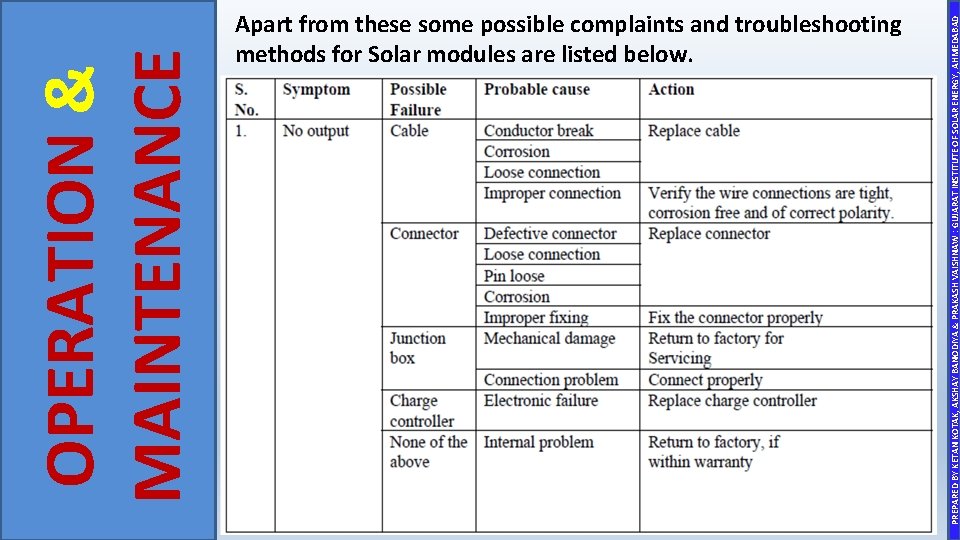
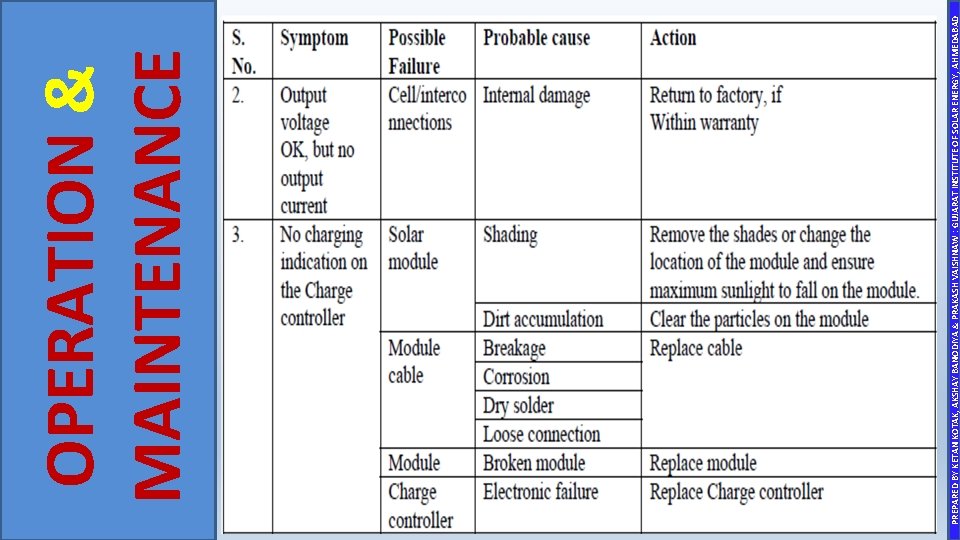
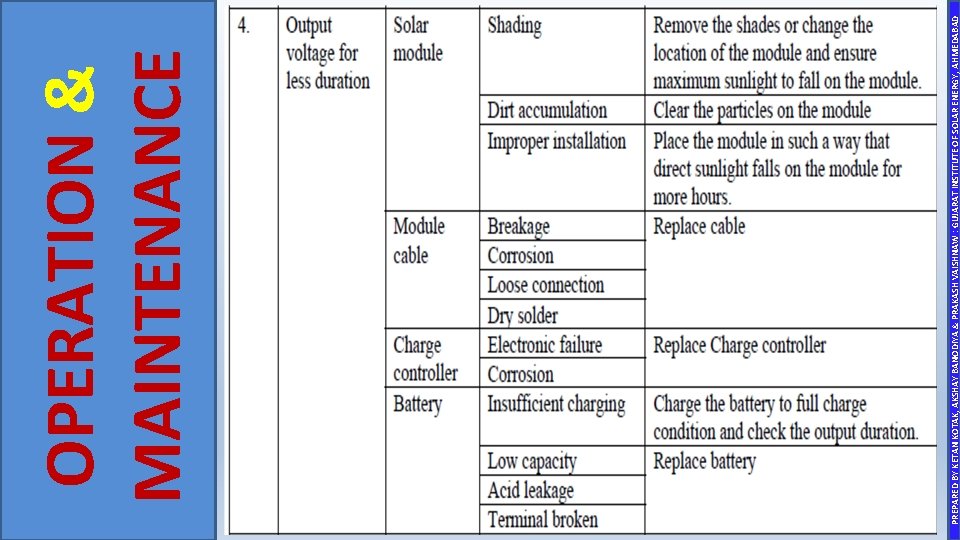
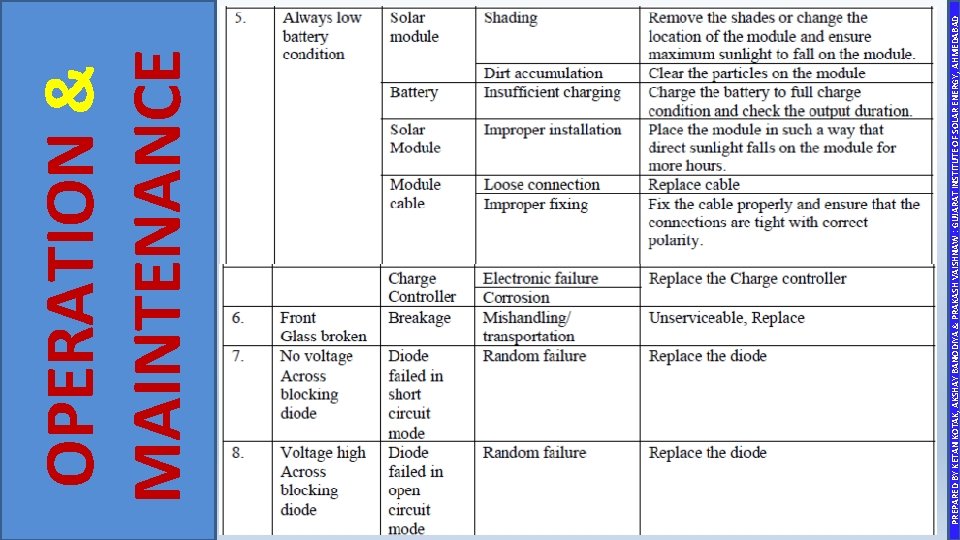
OPERATION & MAINTENANCE PREPARED BY KETAN KOTAK, AKSHAY BANODIYA & PRAKASH VAISHNAW : GUJARAT INSTITUTE OF SOLAR ENERGY, AHMEDABAD Apart from these some possible complaints and troubleshooting methods for Solar modules are listed below.
PREPARED BY KETAN KOTAK, AKSHAY BANODIYA & PRAKASH VAISHNAW : GUJARAT INSTITUTE OF SOLAR ENERGY, AHMEDABAD OPERATION & MAINTENANCE
PREPARED BY KETAN KOTAK, AKSHAY BANODIYA & PRAKASH VAISHNAW : GUJARAT INSTITUTE OF SOLAR ENERGY, AHMEDABAD OPERATION & MAINTENANCE
PREPARED BY KETAN KOTAK, AKSHAY BANODIYA & PRAKASH VAISHNAW : GUJARAT INSTITUTE OF SOLAR ENERGY, AHMEDABAD OPERATION & MAINTENANCE
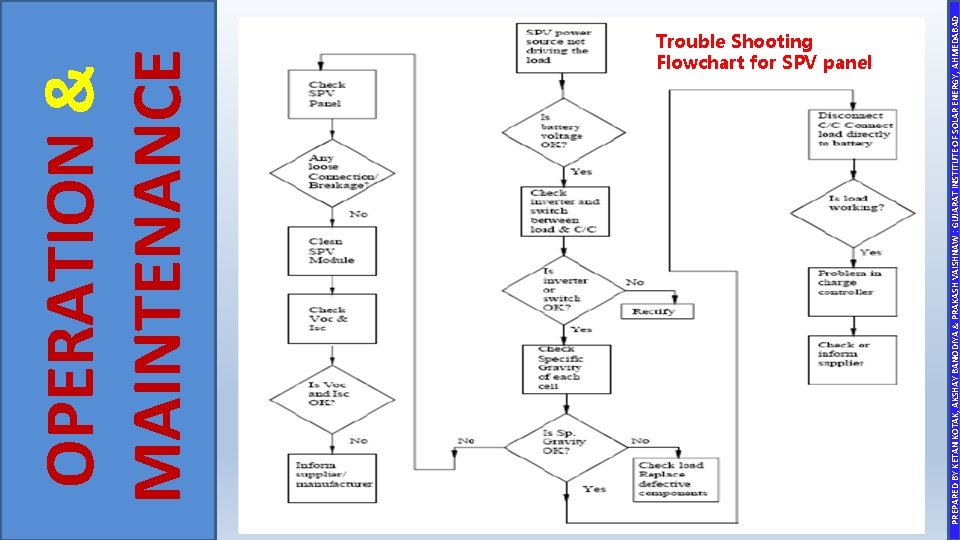
OPERATION & MAINTENANCE PREPARED BY KETAN KOTAK, AKSHAY BANODIYA & PRAKASH VAISHNAW : GUJARAT INSTITUTE OF SOLAR ENERGY, AHMEDABAD Trouble Shooting Flowchart for SPV panel
and Universities to be involved by state nodal agencies for study and field knowledge experience of installation, commissioning & PREPARED BY KETAN KOTAK, AKSHAY BANODIYA & PRAKASH VAISHNAW : GUJARAT INSTITUTE OF SOLAR ENERGY, AHMEDABAD FUTURE STEPS & RECOMMENDATIONS Students from Solar Training Institutes
Centre for Science and Environment 2) MNRE Off-Grid and Decentralized Solar Application Scheme: Operational Guidelines for Grid Connected Rooftop and Small Solar Power Plants Programme No. 30/11/2012 -13/NSM 3) Handbook on Installation and maintenance of Solar Panel CAMTECH/PROJ/HB-SP/2. 0 NOV 13 Govt. of India. 4) MNRE DNI weather Data. PREPARED BY KETAN KOTAK, AKSHAY BANODIYA & PRAKASH VAISHNAW : GUJARAT INSTITUTE OF SOLAR ENERGY, AHMEDABAD REFERENCES 1) State of Renewable Energy in India A Citizen’s Report,
KETAN KOTAK IGBC AP, D. M. E. & D. R. M. Mumbai PRAKASH VAISHNAW B. Tech. Electrical Engg. Pali, Rajasthan AKSHAY BANODIYA B. Com. Ahmedabad JUNE 2015 BATCH GUJARAT INSTITUTE OF SOLAR ENERGY SOLAR FACULTY : SOHEL PATEL AND JWALANT A. MEHTA