
Project Analysis Design Phases Why Analysis and Design







- Slides: 40
Project Analysis & Design Phases
Why Analysis and Design? Why are the analysis and design stages so important? n n n Determines the success or failure of a project. Discovers many issues that can pave the way for success. Prevents a company from developing a poor project and wasting resources and time.
Don’t let the word analysis n put you to sleep!
Thinking is a form of Creativity n To live a creative life, we must lose our fear of being wrong. Joseph Chilton Pearce
n Perhaps imagination is only intelligence having fun! George Scialabba
Aha Moments! n If at first the idea is not absurd, then there is no hope for it! Albert Einstein
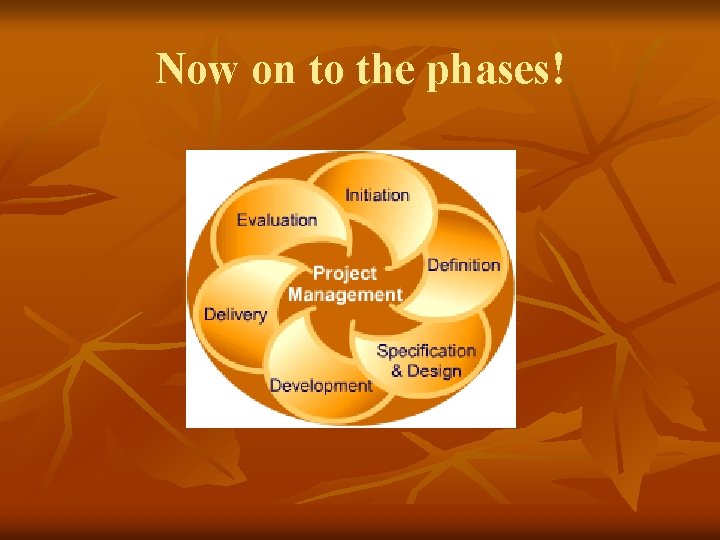
Now on to the phases!
FYI - What usually occurs first? n n n Request for a Proposal (RFP) from a potential client and your Proposal to the client. http: //www. tamingthebeast. net/articles/webdev elopmentproposal. htm Marketing and sales are an important part of this initial step.
Overview Of Analysis n n n Analyze whether the project is a worthwhile endeavor. Determine the website requirements for a successful site. Create a work plan to accomplish the project.
Experts use other terms: Some experts call the analysis and design phases: n Discovery –Understanding the target customers and their needs, and conceptualizing the business and customer goals for the website. n Exploration – Generating several rough initial website design, of which one or more will be chosen for further development n Refinement – polishing the navigation, layout, and flow of the selected design.
Ideas n It is better to have enough ideas for some of them to be wrong, than to be always right by having no ideas at all. Edward Bono
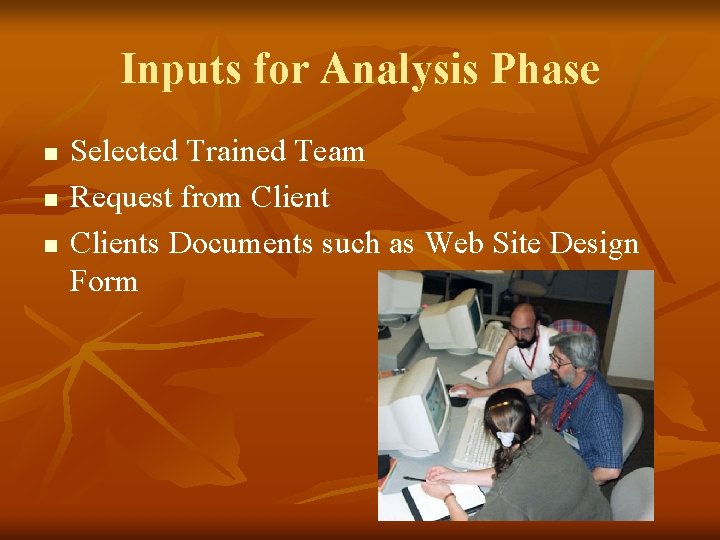
Inputs for Analysis Phase n n n Selected Trained Team Request from Clients Documents such as Web Site Design Form
Analysis n n n n Who is the customer? What does the project entails? Who will be the audience? What are the customer objectives? What are the audience objectives? Why is the project needed? What will this project help the client achieve?
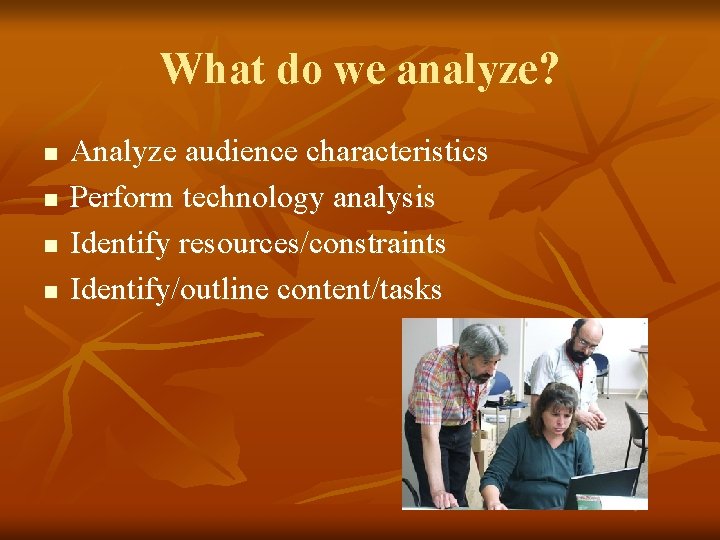
What do we analyze? n n Analyze audience characteristics Perform technology analysis Identify resources/constraints Identify/outline content/tasks
Gathering Information n n n n 1. Company/Client 2. Industry 3. Strategy/Marketing/Branding 4. Current Site 5. Competition 6. Audience 7. Products/Services 8. Other
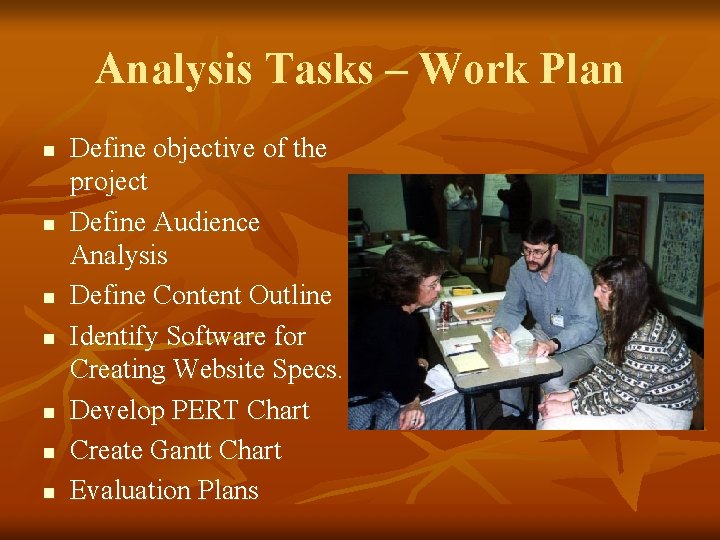
Analysis Tasks – Work Plan n n n Define objective of the project Define Audience Analysis Define Content Outline Identify Software for Creating Website Specs. Develop PERT Chart Create Gantt Chart Evaluation Plans
Determining Primary Objectives n n Objectives could be increase traffic, decrease calls for information, sell more products. Determine the primary objective—the most important reason for launching this site. n Make sure the client agrees. Then create the rest of your list, prioritizing your objectives into second and third levels of importance.
Audience/Desired Action n Describe a typical user coming to your site. How often is the user online and what does s/he generally use the web for? How old is the user and what does s/he do for a living?
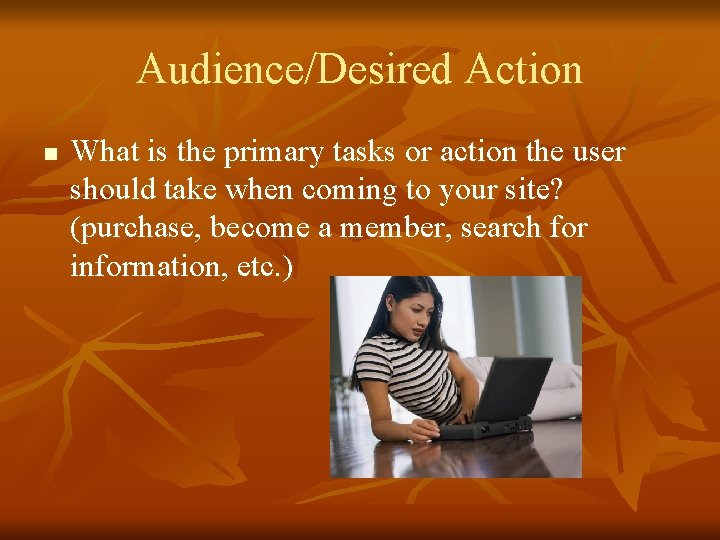
Audience/Desired Action n What is the primary tasks or action the user should take when coming to your site? (purchase, become a member, search for information, etc. )
Audience/Desired Action n n What are the key reasons why the target user chooses your company’s products and/or services? (cost, service, value, etc. ) How many people (as far as you can tell) access the site on a daily, weekly or monthly basis? How do you measure usage? Do you forecast usage to increase over the next year and by how much?
Technology n n What is your target platform and browser (if you know)? Are there specific technologies (Flash®, DHTML, Java. Script, Real Audio, etc. ) you would like to use in the site? If so, how will they enhance the user experience?
Technology (not needed now) n n n Will you have database functionality (dynamic content generation, search capabilities, personalization/log-in, etc. )? Will you have a need for secured transactions (ecommerce)? Will you require other specific programming needs (personalization, search capability)?
Reasons for Redesign n What are the main reasons you are redesigning your site? (New business model, outdated site, expanded services, different audience, etc. What are your primary online business objectives with the site redesign? (Increased sales, marketing/branding awareness, reduce customer service calls, etc. )
Content for Redesign n Describe visual elements or content which should be utilized from your current site or marketing materials (logo, color scheme, navigation, naming conventions, etc. ). How will the content of this site (along with functionality and navigation) expand or differ from your current site? Do you have an existing sitemap for the outgoing site structure?
Current Site n n n Do you feel your current site promotes a favorable user experience? Why not? What specific areas of your current site do you feel are successful? Why are they successful? What shortcomings exist with the current site and what three things would you change on the site today, if you could?
How Do You Schedule the Project? n n PERT CHARTS AND GANT CHARTS Most importantly, you can tweak and adjust these tasks and scheduling charts throughout the project.
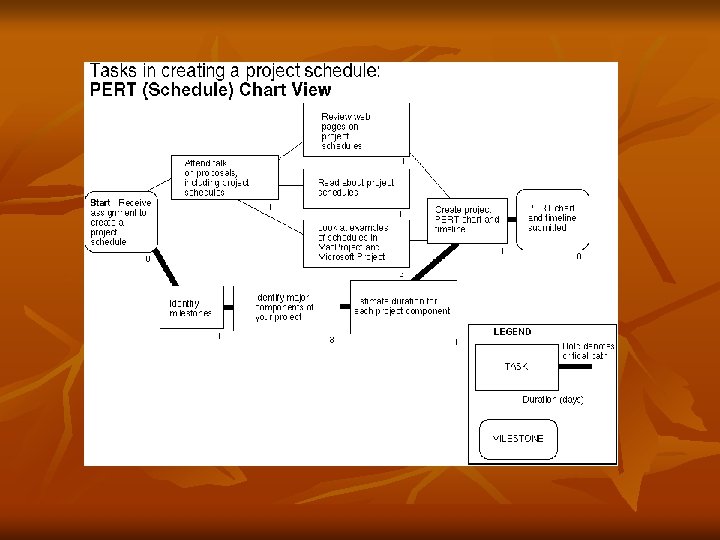
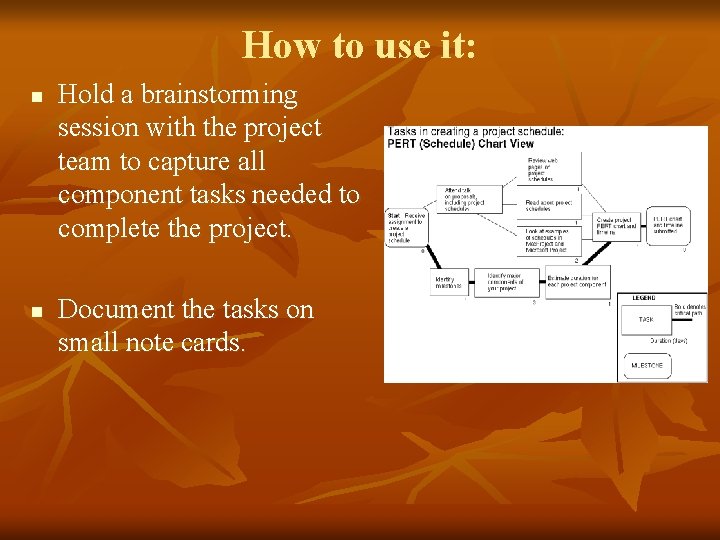
What are PERT Charts? n n PERT and Gantt Charts are fancy to-do lists! Microsoft Office calls a PERT Chart a Network Diagram – a sequence or logic diagram showing task dependencies. (one task depends on another one in order to be completed)
PERT Chart Shows you: n n n n What tasks must be carried out Where parallel activity can be performed The shortest time in which you can complete a project Resources needed to execute a project The sequence of activities, scheduling and timings involved Task priorities The most efficient way of shortening time on urgent projects.
How to use it: n n Hold a brainstorming session with the project team to capture all component tasks needed to complete the project. Document the tasks on small note cards.
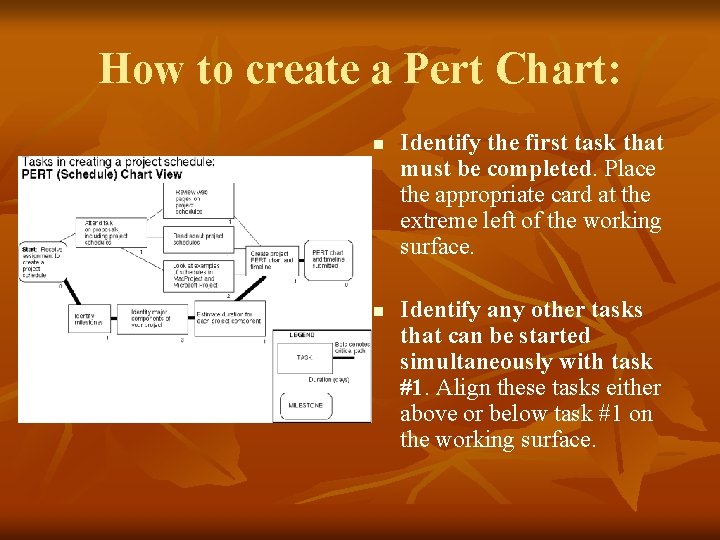
How to create a Pert Chart: n n Identify the first task that must be completed. Place the appropriate card at the extreme left of the working surface. Identify any other tasks that can be started simultaneously with task #1. Align these tasks either above or below task #1 on the working surface.
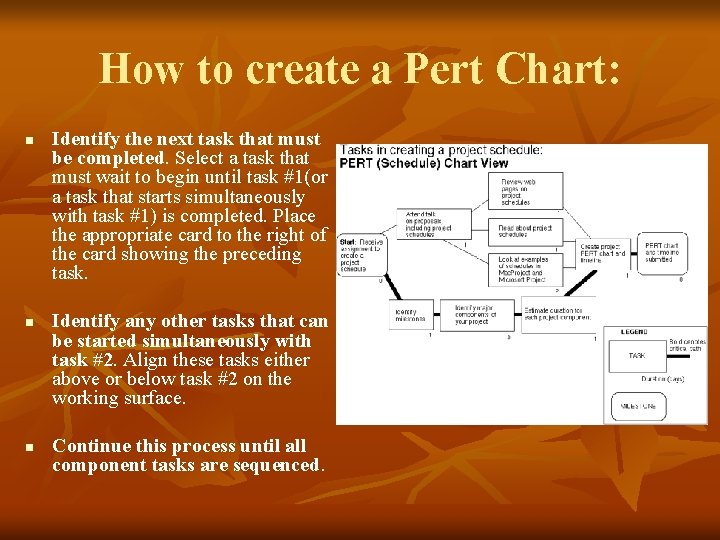
How to create a Pert Chart: n n n Identify the next task that must be completed. Select a task that must wait to begin until task #1(or a task that starts simultaneously with task #1) is completed. Place the appropriate card to the right of the card showing the preceding task. Identify any other tasks that can be started simultaneously with task #2. Align these tasks either above or below task #2 on the working surface. Continue this process until all component tasks are sequenced.
Don’t let the CHARTS n drive you mad!
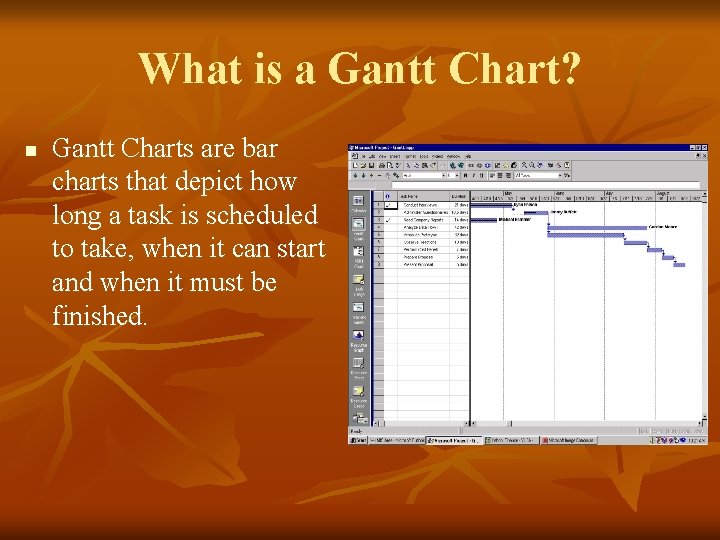
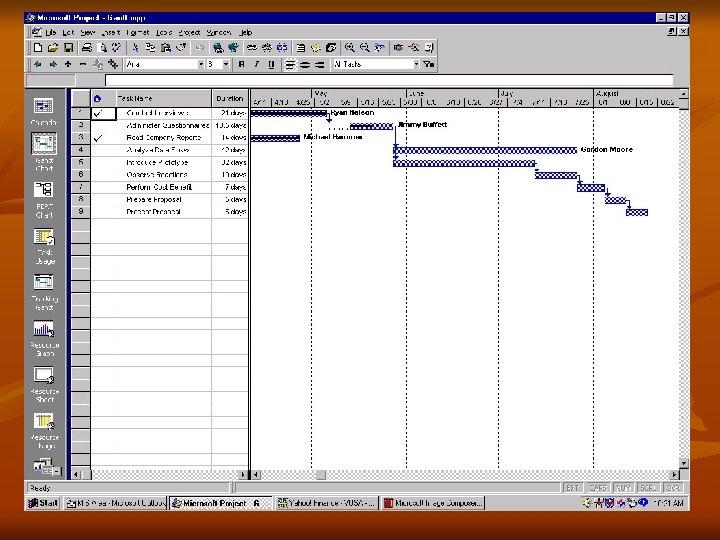
What is a Gantt Chart? n Gantt Charts are bar charts that depict how long a task is scheduled to take, when it can start and when it must be finished.
Gantt Chart shows you: n n n The overall sequence of tasks. Whether tasks are progressing on schedule and being completed on time. Measures the progress of individual tasks. Show what needs to be done and when. When the tasks are grouped by the team member, highlights each person's responsibilities.
Gantt Chart n n n When a project is under way, Gantt Charts help you to monitor whether the project is on schedule. If it is not, it allows you to pinpoint the remedial action necessary to put it back on schedule. You can also create a Gantt Chart in Excel.
Analysis Phase Complete n Formal agreement is then signed with the client
Output of Analysis Phase Analysis Design specification document – work plan that includes n Vision/treatment for solution n Goals and Objectives n Content such as photos, text, n audio, video n Pert Chart and Gantt Chart n Team Roles
Now to Discovery… n Working through the phases of analysis and design (or Discovery, Exploration & Refinement ) is a vitally important part of the web design and development.