
Project Alvarium Enabling Data Confidence Fabrics to Scale
Project Alvarium Enabling Data Confidence Fabrics to Scale Trust Across Heterogeneous Systems October 29, 2019
Project Alvarium at a glance › New LF project forming to focus on system-level trust and data confidence › Differentiated in its comprehensive view and in delivering data to applications with measurable confidence › Unifying, not reinventing trust insertion technologies › Relevant to all markets and solution stacks › Seeded by Dell Technologies code Project Mission: › Create the framework and open APIs that bind together existing open source and commercial value-add for trust insertion, develop confidence score algorithms › Collaborate with other LF projects and industry efforts (OSS, SDO) to unify existing and emerging trust insertion technologies and refine scoring algorithms 12/3/2020 2
What is a Data Confidence Fabric (DCF), or “trust fabric”? › A Data Confidence Fabric (DCF), or more generally-speaking trust fabric, is a virtual overlay that aids in the delivery of data from devices to applications with measurable trust characteristics. › A DCF is a loosely-coupled collection of various trust insertion technologies, bound together with an open framework › Example technologies include tools for silicon-based Root of Trust (Ro. T), open authentication and data ingestion APIs, metadata handling, immutable storage and blockchain/ledger › The Alvarium framework features open APIs and integrated algorithms to generate confidence scores for data based on the trust insertion technologies used and overall context › There is no single DCF, rather each entity/organization can build their own fabric with preferred technologies using the Alvarium framework › A trust fabric built with widely trusted ingredients will naturally produce the highest data confidence scores › Confidence scores normalize across systems of systems as data flows through intersecting trust fabrics › Key differentiation from other efforts focused on security, privacy and trust: › Holistic, system-level focus › Confidence scores to enable organizations to act with measured risk based on policy appropriate for the use case / context, working across heterogenous systems of systems 12/3/2020 3
Why we need to collaborate on a global trust fabric › Pervasive sharing and monetization of data, resources and services across heterogenous systems of systems spanning public and private boundaries › Can also include trusted sharing/exchange of data sets for training AI model › The common “zero trust” model isn’t scalable, access policy needs to be attached to trustworthy data › Consolidating workloads on common infrastructure in a trusted fashion › Enable sharing of data/services based on policy while protecting privacy and IP › Address common debates on data ownership › Meeting compliance requirements (e. g. GDPR) at scale › Enables organizations to trigger deletion of distributed data in place when a user requests to revokes privacy consent 12/3/2020 4
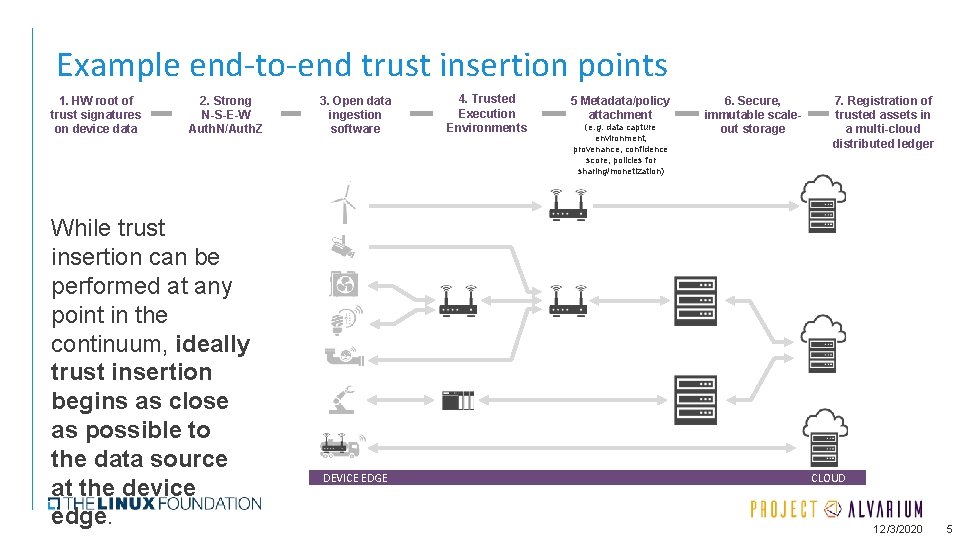
Example end-to-end trust insertion points 1. HW root of trust signatures on device data 2. Strong N-S-E-W Auth. N/Auth. Z While trust insertion can be performed at any point in the continuum, ideally trust insertion begins as close as possible to the data source at the device edge. 3. Open data ingestion software DEVICE EDGE 4. Trusted Execution Environments 5 Metadata/policy attachment (e. g. data capture environment, provenance, confidence score, policies for sharing/monetization) 6. Secure, immutable scaleout storage 7. Registration of trusted assets in a multi-cloud distributed ledger CLOUD 12/3/2020 5
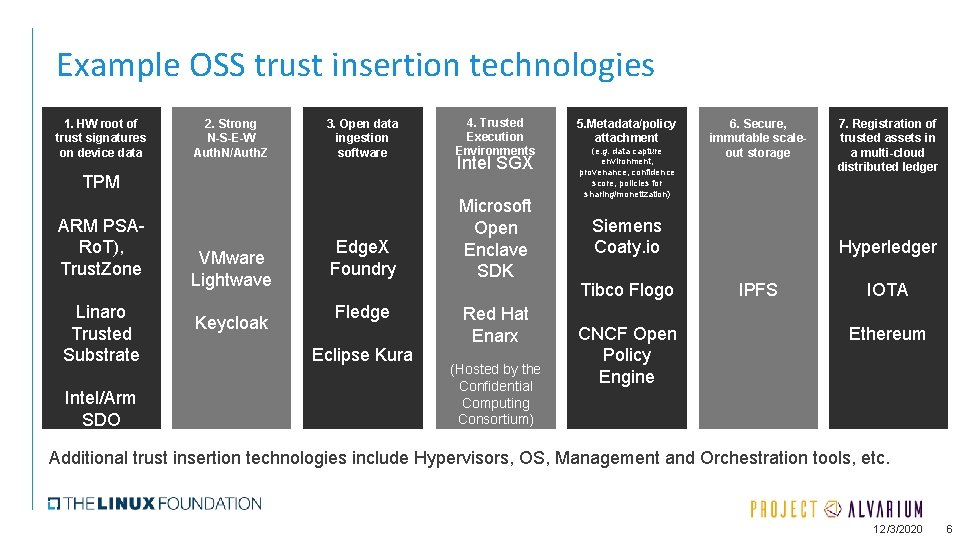
Example OSS trust insertion technologies 1. HW root of trust signatures on device data 2. Strong N-S-E-W Auth. N/Auth. Z 3. Open data ingestion software 4. Trusted Execution Environments 5. Metadata/policy attachment Edge. X Foundry Microsoft Open Enclave SDK Siemens Coaty. io TPM ARM PSARo. T), Trust. Zone Linaro Trusted Substrate Intel/Arm SDO VMware Lightwave Keycloak Fledge Eclipse Kura Intel SGX Red Hat Enarx (Hosted by the Confidential Computing Consortium) (e. g. data capture environment, provenance, confidence score, policies for sharing/monetization) Tibco Flogo CNCF Open Policy Engine 6. Secure, immutable scaleout storage 7. Registration of trusted assets in a multi-cloud distributed ledger Hyperledger IPFS IOTA Ethereum Additional trust insertion technologies include Hypervisors, OS, Management and Orchestration tools, etc. 12/3/2020 6
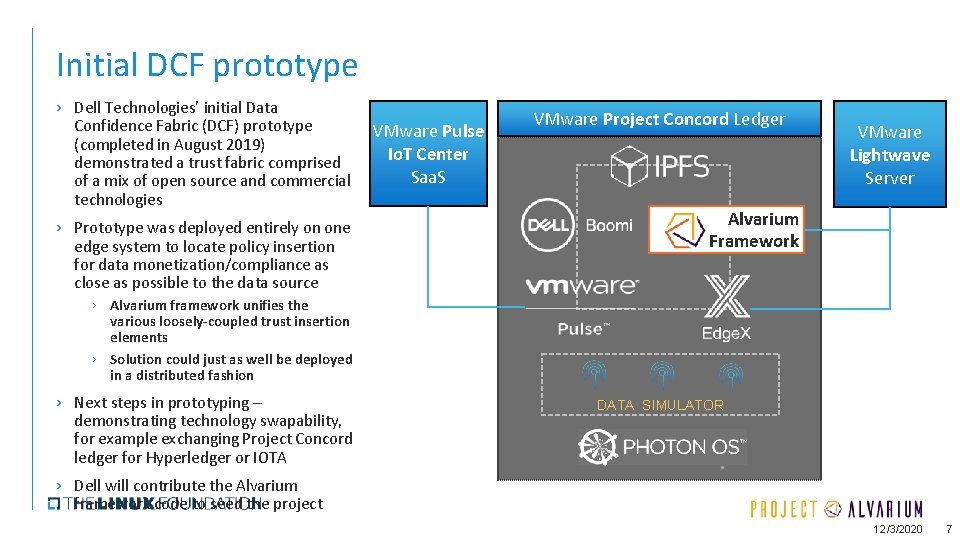
Initial DCF prototype › Dell Technologies’ initial Data Confidence Fabric (DCF) prototype (completed in August 2019) demonstrated a trust fabric comprised of a mix of open source and commercial technologies › Prototype was deployed entirely on one edge system to locate policy insertion for data monetization/compliance as close as possible to the data source VMware Pulse Io. T Center Saa. S VMware Project Concord Ledger VMware Lightwave Server Alvarium Framework › Alvarium framework unifies the various loosely-coupled trust insertion elements › Solution could just as well be deployed in a distributed fashion › Next steps in prototyping – demonstrating technology swapability, for example exchanging Project Concord ledger for Hyperledger or IOTA DATA SIMULATOR › Dell will contribute the Alvarium framework code to seed the project 12/3/2020 7
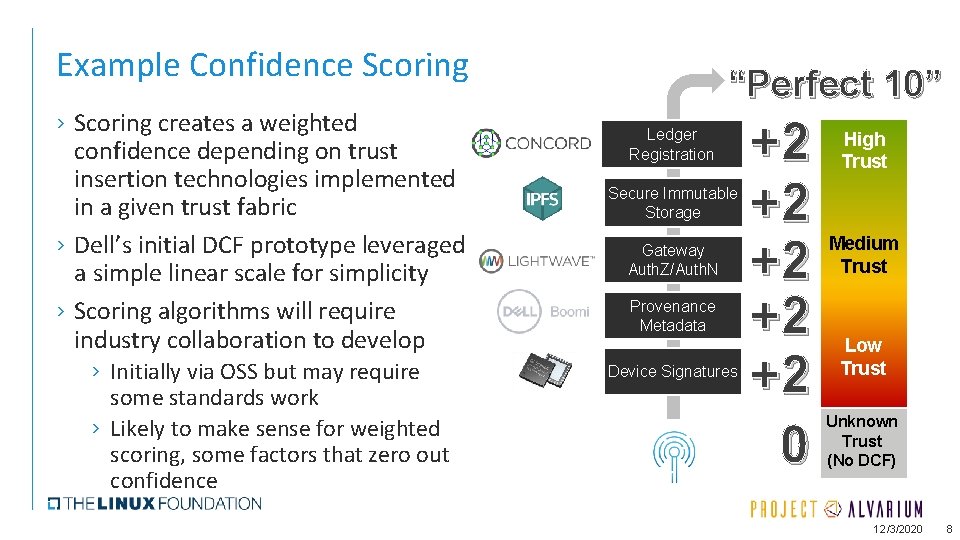
Example Confidence Scoring › Scoring creates a weighted confidence depending on trust insertion technologies implemented in a given trust fabric › Dell’s initial DCF prototype leveraged a simple linear scale for simplicity › Scoring algorithms will require industry collaboration to develop › Initially via OSS but may require some standards work › Likely to make sense for weighted scoring, some factors that zero out confidence “Perfect 10” Ledger Registration Secure Immutable Storage Gateway Auth. Z/Auth. N Provenance Metadata Device Signatures +2 +2 +2 0 High Trust Medium Trust Low Trust Unknown Trust (No DCF) 12/3/2020 8
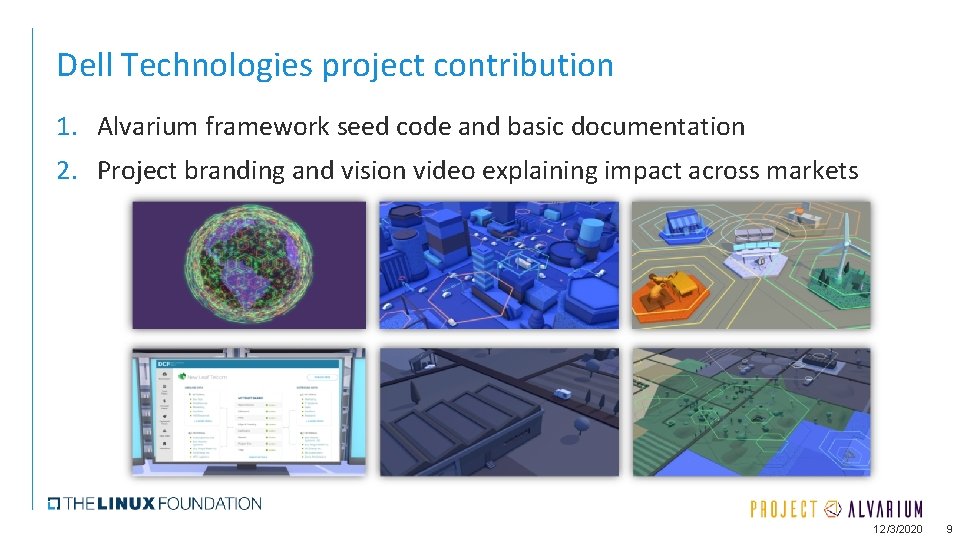
Dell Technologies project contribution 1. Alvarium framework seed code and basic documentation 2. Project branding and vision video explaining impact across markets 12/3/2020 9
Why ultimately form under LF Edge? › All data is created at the edge › Highest confidence achieved with trust insertion technologies applied as close to data source as possible › Project Alvarium will make ties to other key industry efforts, both inside of LF Edge, within the broader Linux Foundation (e. g. Confidential Computing Consortium, CNCF, LF Networking) and externally (e. g. IOTA, Linaro, TIo. TA) › Unifying, not reinventing trust insertion technologies 12/3/2020 10
Current Status & Next Steps › Continue onboarding collaborators, including links to other key industry projects, both within and external to the LF › Dell Technologies seed code to be donated in early 2020 12/3/2020 11
THANK YOU! The Linux Foundation Internal 12/3/2020 12
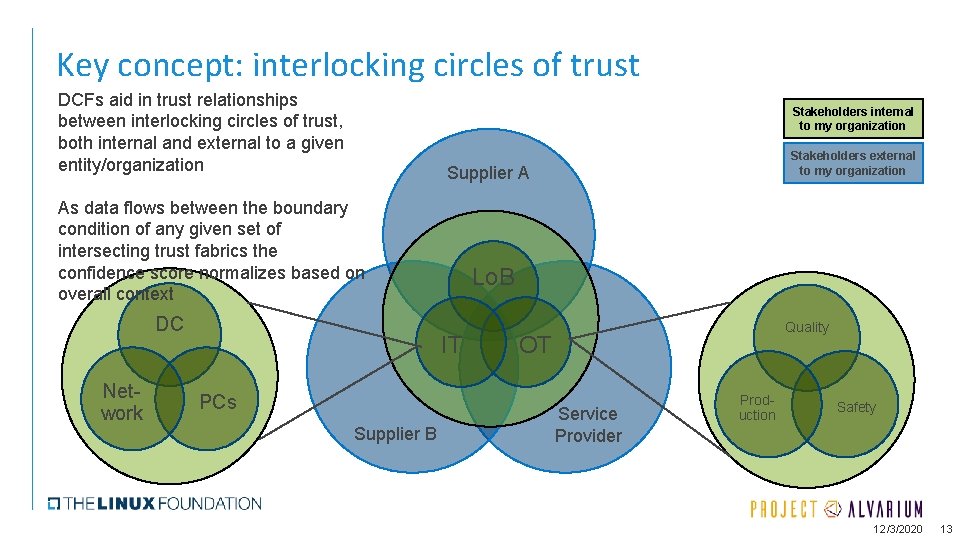
Key concept: interlocking circles of trust DCFs aid in trust relationships between interlocking circles of trust, both internal and external to a given entity/organization Stakeholders internal to my organization Supplier A As data flows between the boundary condition of any given set of intersecting trust fabrics the confidence score normalizes based on overall context DC Network Stakeholders external to my organization Lo. B IT PCs Supplier B Quality OT Service Provider Production Safety 12/3/2020 13
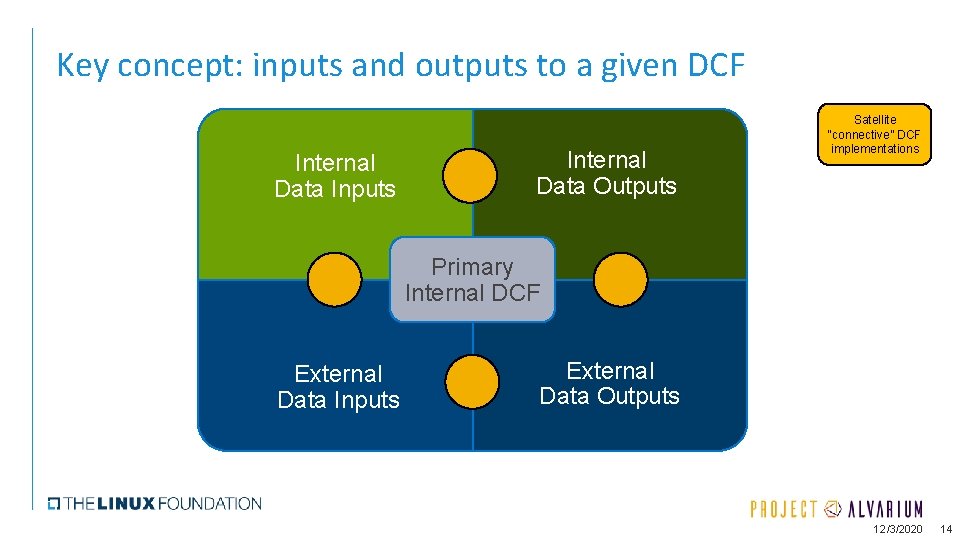
Key concept: inputs and outputs to a given DCF Internal Data Inputs Internal Data Outputs Satellite “connective” DCF implementations Primary Internal DCF External Data Inputs External Data Outputs 12/3/2020 14
- Slides: 14