
Project 9 Data Integration During Robotic UltrasoundGuided Surgery
Project 9 Data Integration During Robotic Ultrasound-Guided Surgery Paper Presentation by Andrew Wang Team Members Vineeta Khatuja, Tifany Yung Mentors Michael Choti MD MBA, Colin Lea, Theodoros Katsichtis, Russell Taylor Ph. D
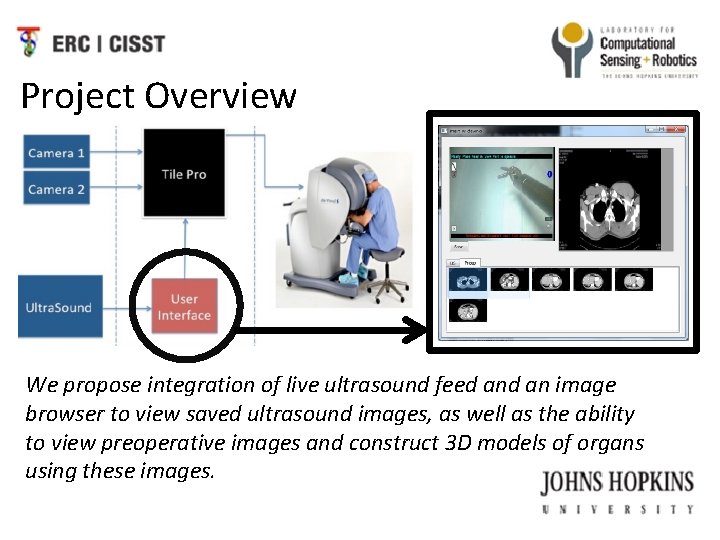
Project Overview We propose integration of live ultrasound feed an image browser to view saved ultrasound images, as well as the ability to view preoperative images and construct 3 D models of organs using these images.
Paper Selection “Robotic ultrasound probe for tumor identification in robotic partial nephrectomy: Initial series and outcomes. ” Bartosz F. Kaczmarek, S. S. , Firas Petros, Quoc-Dien Trinh, Navneet Mander, Roger Chen, Mani Menon, Craig G. Rogers (2012). “Maximizing Console Surgeon Independence during Robot-Assisted Renal Surgery by Using the Fourth Arm and Tile. Pro. ” Craig G. Rogers, M. R. L. , MD; Akshay Bhandari, MD; Louis Spencer Krane, MD; Daniel Eun, MD; Manish N. Patel, MD; Ronald Boris, MD; Alok Shrivastava, MD; Mani Menon, MD (2009).
Surgeon Autonomy • These papers documents methods and results of decreasing the surgeon’s reliance on technicians and external equipment. • Improving surgeon autonomy can increase both the efficiency and the efficacy of many robot-assisted surgeries.
Paper 1: Robotic Ultrasound Probe Intraoperative laparoscopic ultrasonography has already been shown to improve the efficacy of tumor excisions in partial nephrectomies. • While operating the da Vinci console, the surgeon would normally require an assistant to position the ultrasound probe. • The authors developed a modality and conducted a study to investigate the benefit to a surgeon who is provided the utility of intraoperative ultrasound probe control from the console independent of an assistant.
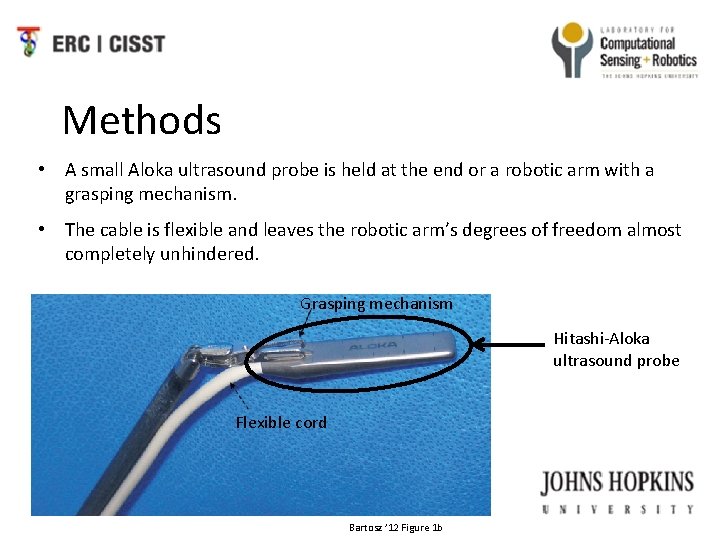
Methods • A small Aloka ultrasound probe is held at the end or a robotic arm with a grasping mechanism. • The cable is flexible and leaves the robotic arm’s degrees of freedom almost completely unhindered. Grasping mechanism Hitashi-Aloka ultrasound probe Flexible cord Bartosz ’ 12 Figure 1 b
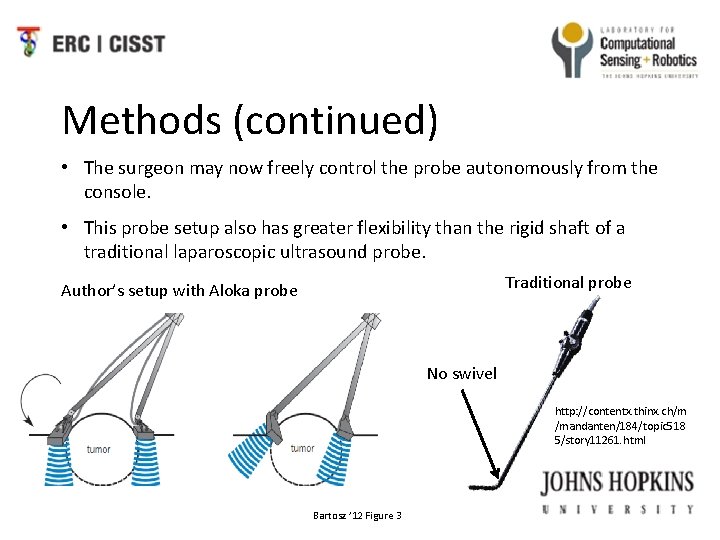
Methods (continued) • The surgeon may now freely control the probe autonomously from the console. • This probe setup also has greater flexibility than the rigid shaft of a traditional laparoscopic ultrasound probe. Traditional probe Author’s setup with Aloka probe No swivel http: //contentx. thinx. ch/m /mandanten/184/topic 518 5/story 11261. html Bartosz ’ 12 Figure 3
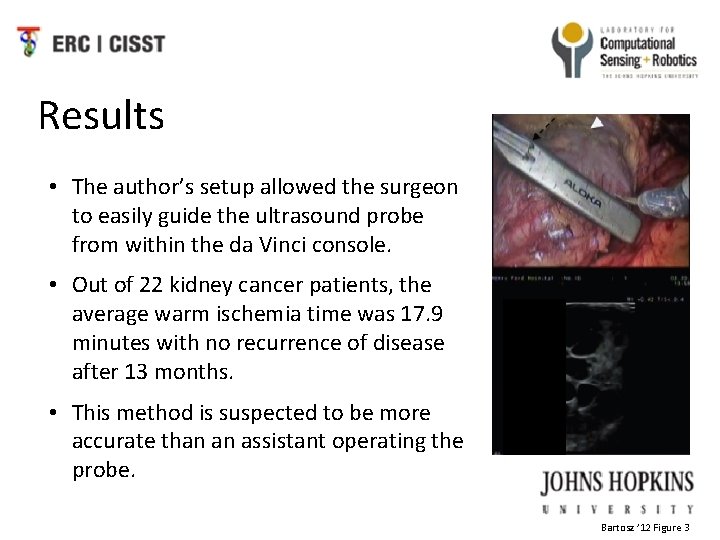
Results • The author’s setup allowed the surgeon to easily guide the ultrasound probe from within the da Vinci console. • Out of 22 kidney cancer patients, the average warm ischemia time was 17. 9 minutes with no recurrence of disease after 13 months. • This method is suspected to be more accurate than an assistant operating the probe. Bartosz ’ 12 Figure 3
Relevance • The authors devise a method which provides the surgeon with real-time feedback control of the surgery with ultrasonography. • Their interface uses an implementation of Tile. Pro similar to what we hope to develop. • The paper provides additional evidence of the benefits of surgeon autonomy.
Positive Aspects of this Work Implementation • The probe has much greater maneuverability (and potentially accuracy) with direct control by the surgeon. • The use of Tile. Pro was efficient and effective, allowing for real-time ultrasound feed with the capability of displaying pre-operative CT scans. Study • Conducted over 22 patients all of which received a 1 year follow up. • Patients were consecutive and performed by the same few surgeons.
Limitations of this Work Implementation • The surgeon still requires an assistant to take measurements of the real-time data, exposing and preparing tumor and many other tasks such as suturing. • The Tile. Pro setup is not space efficient and not well described. Study • Gives no frame of reference of performance with controls or statistics. • The authors note that the greatest limitation is their lack of an objective method to determine tumor identification precision.
Possible Future Work (authors) • The authors state that “the present report was not designed to determine whether a robotic probe offers improved outcomes beyond autonomy given the surgeon. ” • They recommend a much larger sample size with tests in procedures other than partial nephrectomy.
Paper 2: Surgeon Independence In order to improve the efficacy of ultrasound guided laparoscopies on the da Vinci surgical system in radical and partial nephrectomies, a fourth arm and Tile. Pro is used to improve surgeon autonomy. • The fourth arm allows for the surgeon to provide kidney retraction without need of an assistant. • The Tile. Pro implementation allows for efficient display and recall of preoperative data.
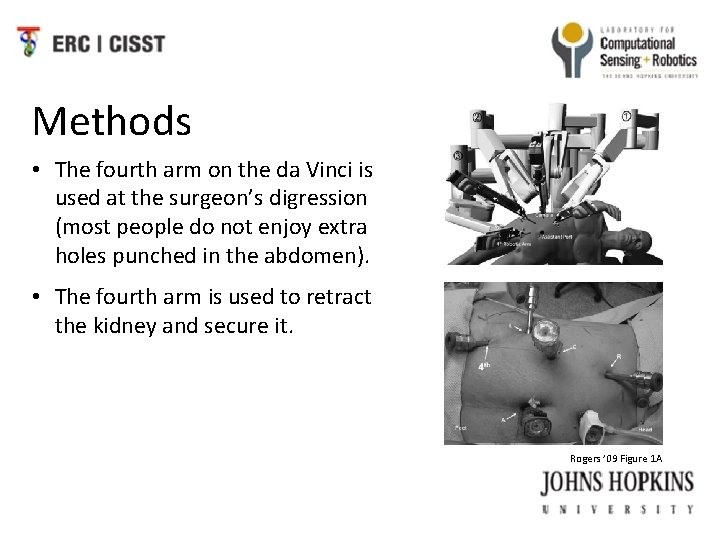
Methods • The fourth arm on the da Vinci is used at the surgeon’s digression (most people do not enjoy extra holes punched in the abdomen). • The fourth arm is used to retract the kidney and secure it. Rogers ’ 09 Figure 1 A
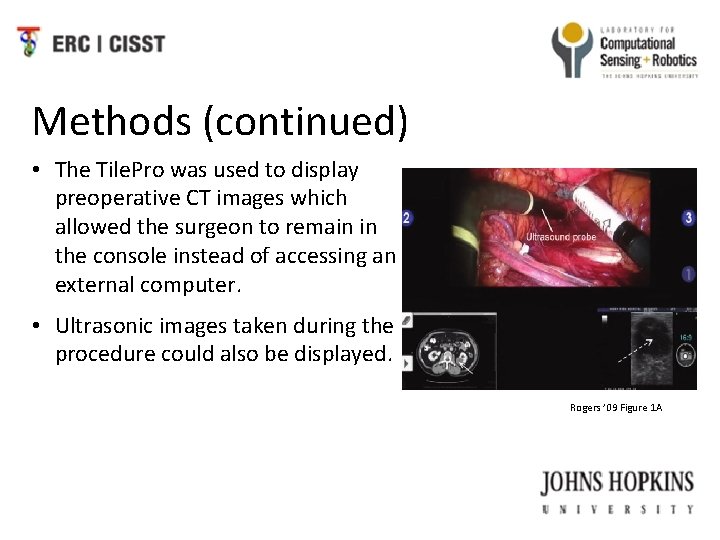
Methods (continued) • The Tile. Pro was used to display preoperative CT images which allowed the surgeon to remain in the console instead of accessing an external computer. • Ultrasonic images taken during the procedure could also be displayed. Rogers ’ 09 Figure 1 A
Results • The fourth arm was successful whenever the surgeon elected its use. • Unfortunately, its use was not possible when operating on some obese patients upon which the fourth arm was intended to help. • The Tile. Pro interface was successfully implemented to allow the surgeon to view preoperative data and access hospital data without leaving the console and with minimal dependence on assistance.
Relevance • The authors devise a method which improves surgeon autonomy by using a Tile. Pro implementation which allows the surgeon to remain in the console. • Their interface has some image saving and recall features similar to what we hope to develop. • The paper provides additional evidence of the benefits of surgeon autonomy.
Positive Aspects of this Work Implementation • The fourth arm allowed the surgeon to better stabilize the kidney which is important to complete the operation quickly and efficiently. • The use of Tile. Pro was clean, allowing image saving capabilities in addition to access to hospital databases. Study • Conducted on 90 patients over the course of about 2 years. • Data is well documented.
Limitations of this Work Implementation • The surgeon still requires an assistant to move the ultrasound probe, take measurements of the real-time data. • The authors note that the surgeon must request for preoperative data for an assistant to send to the console. • The Tile. Pro setup is not space efficient and not well documented. Study • The study yielded no statistically significant results in operative time, number of complications or morbidity. • The authors note that their usage of both the fourth arm and the Tile. Pro setup was subjective to the surgeon.
Possible Future Work (our project) • The authors state though useful, their Tile. Pro implementation was a bit difficult to use and required an assistant to load and scroll through images. • Our project will allow the surgeon to browse and save images independently within the console.
What we get from these papers • We can use the authors’ insight to better improve our Tile. Pro interface. • We can improve on the authors’ notion of surgeon autonomy with our implementation of Masters as Mice to increase surgeon utility. • Though we will not be developing our own ultrasound probe control, we can improve on the manner the surgeon receives the ultrasound feedback.

Thank You! Questions?
- Slides: 22