
PROJECT 11 Image Denoising for Electron Microscopy Team


- Slides: 14
PROJECT: 11 Image Denoising for Electron Microscopy Team: Ivana Pepic, University of Novi Sad Buda Bajić, University of Novi Sad Anindya Gupta, Tallinn Univ. of Technology Amit Suveer, Uppsala University
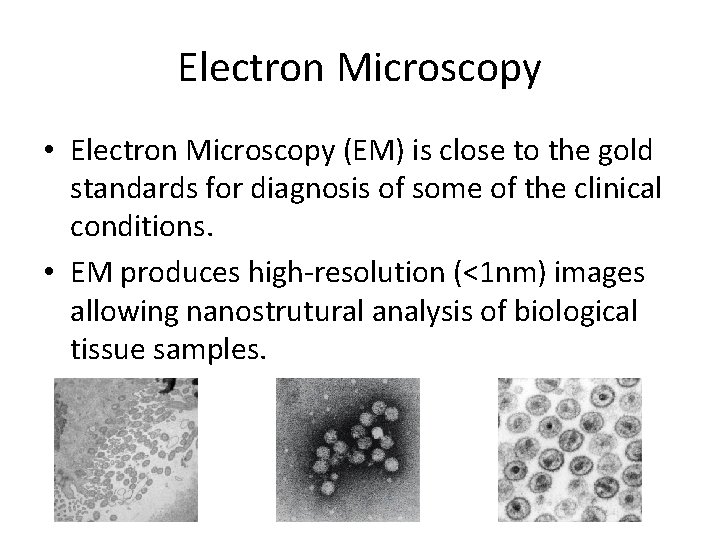
Electron Microscopy • Electron Microscopy (EM) is close to the gold standards for diagnosis of some of the clinical conditions. • EM produces high-resolution (<1 nm) images allowing nanostrutural analysis of biological tissue samples.
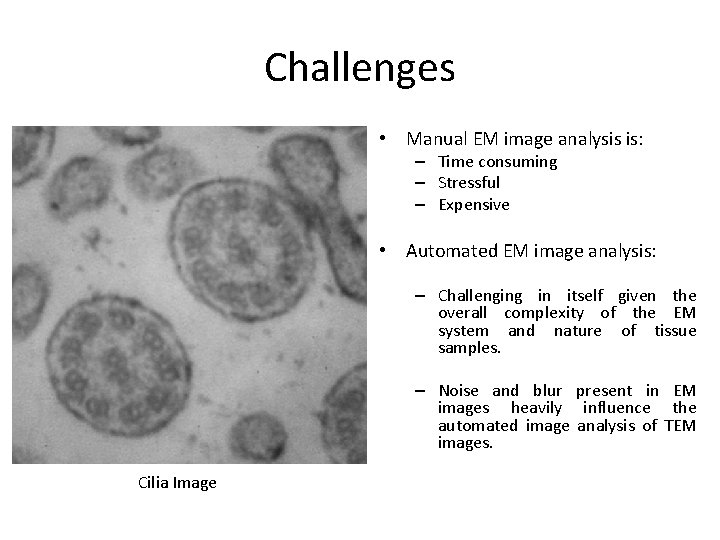
Challenges • Manual EM image analysis is: – Time consuming – Stressful – Expensive • Automated EM image analysis: – Challenging in itself given the overall complexity of the EM system and nature of tissue samples. – Noise and blur present in EM images heavily influence the automated image analysis of TEM images. Cilia Image
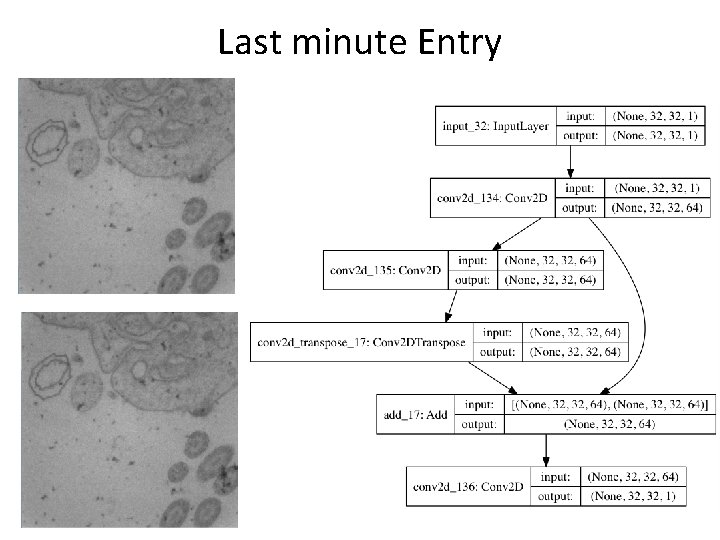
State of the art • Methods: – Sparse 3 D transform-domain celebrative filtering (BM 3 D) – Variance stabilization transform based • Variance stabilization is externally implemented • External variance stabilization in combination with BM 3 D • Variance stabilization is included in energy function – Machine / Deep learning based • Auto-encoders
Motivation
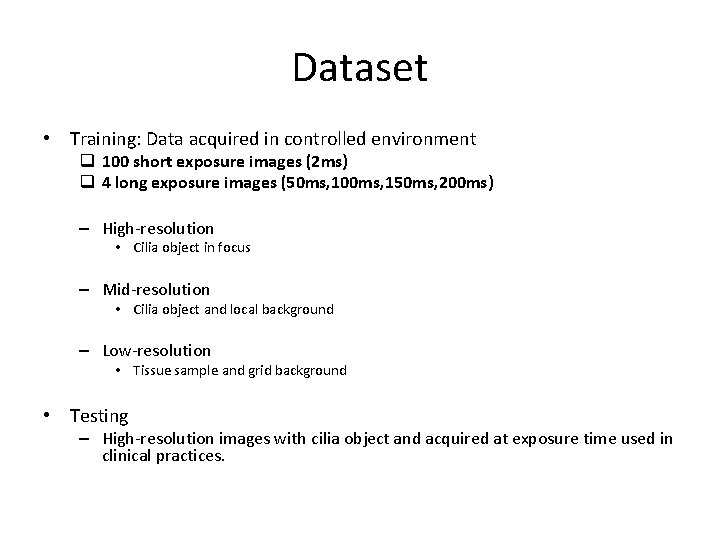
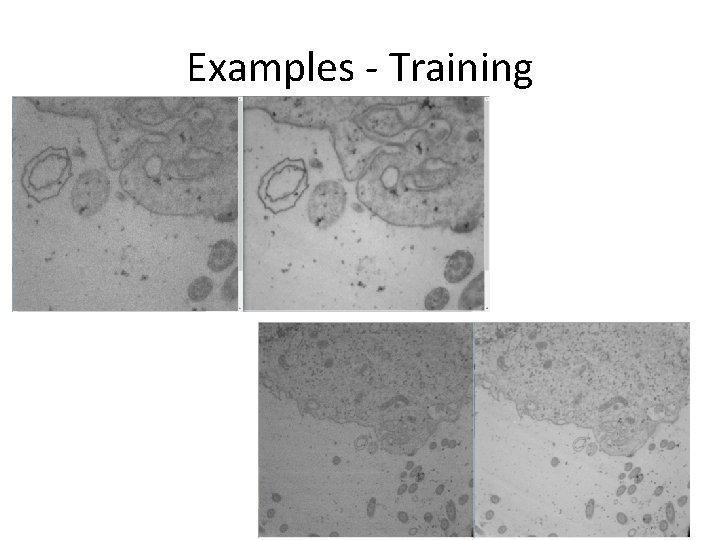
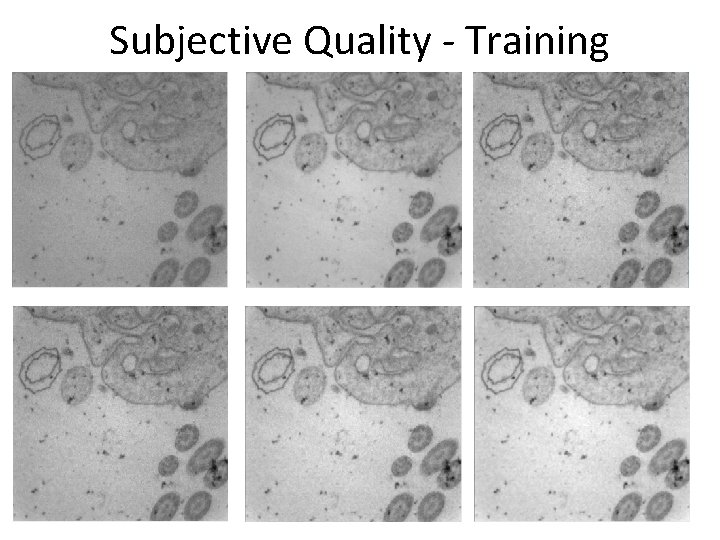
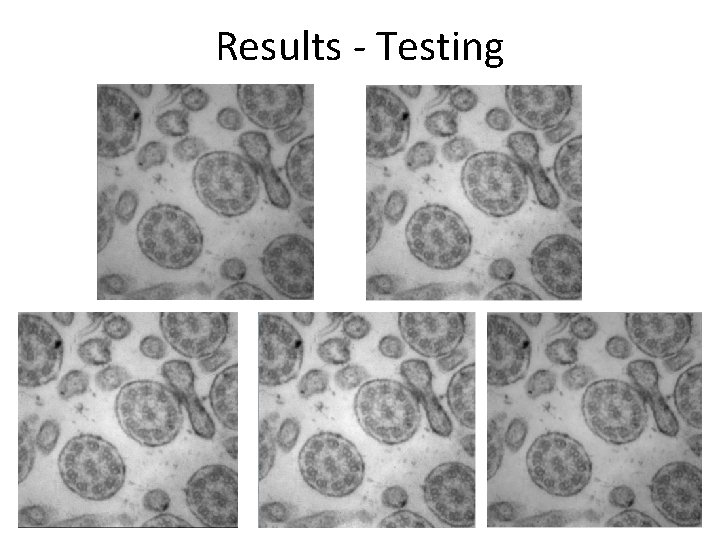
Dataset • Training: Data acquired in controlled environment q 100 short exposure images (2 ms) q 4 long exposure images (50 ms, 100 ms, 150 ms, 200 ms) – High-resolution • Cilia object in focus – Mid-resolution • Cilia object and local background – Low-resolution • Tissue sample and grid background • Testing – High-resolution images with cilia object and acquired at exposure time used in clinical practices.
Examples - Training
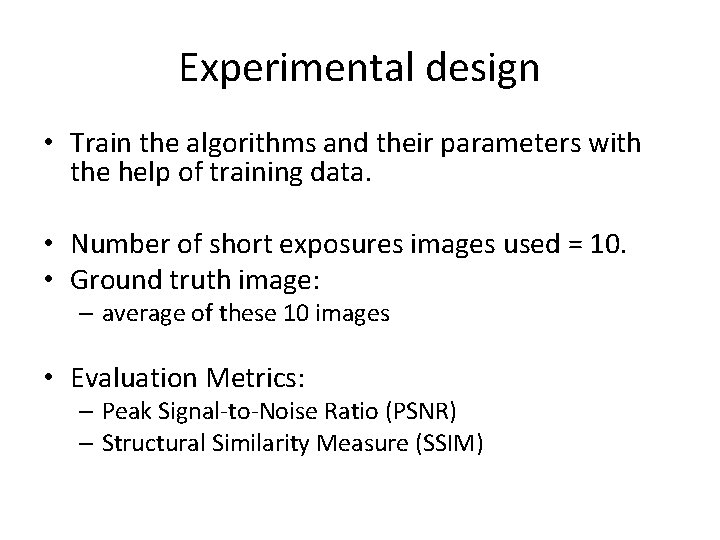
Experimental design • Train the algorithms and their parameters with the help of training data. • Number of short exposures images used = 10. • Ground truth image: – average of these 10 images • Evaluation Metrics: – Peak Signal-to-Noise Ratio (PSNR) – Structural Similarity Measure (SSIM)
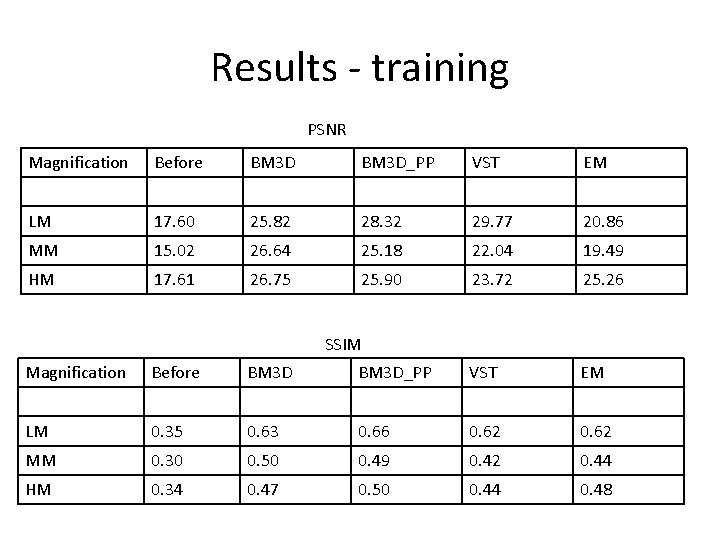
Results - training PSNR Magnification Before BM 3 D_PP VST EM LM 17. 60 25. 82 28. 32 29. 77 20. 86 MM 15. 02 26. 64 25. 18 22. 04 19. 49 HM 17. 61 26. 75 25. 90 23. 72 25. 26 SSIM Magnification Before BM 3 D_PP VST EM LM 0. 35 0. 63 0. 66 0. 62 MM 0. 30 0. 50 0. 49 0. 42 0. 44 HM 0. 34 0. 47 0. 50 0. 44 0. 48
Subjective Quality - Training
Results - Testing
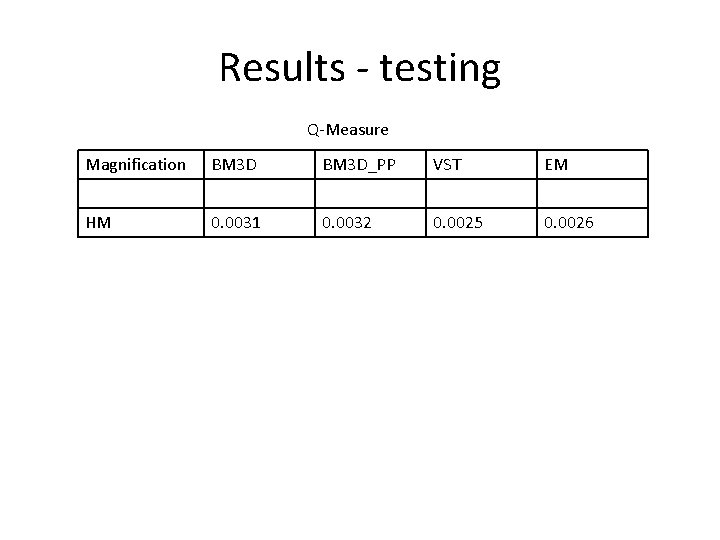
Results - testing Q-Measure Magnification BM 3 D_PP VST EM HM 0. 0031 0. 0032 0. 0025 0. 0026
Last minute Entry
THANK YOU!