
PROJECT 1 Voronoi Probability Maps for Seed Region
PROJECT 1: Voronoi Probability Maps for Seed Region Detection in Abdominal CT Images PROJECT 2: Kidney Seed Region Detection in Abdominal CT Images

Voronoi Probability Maps for Seed Region Detection in Abdominal CT Images By: Nicholas Cooper, Northern Kentucky University Maureen Kelly, Loyola University Chicago Jacob Furst, De. Paul University Daniela Raicu, De. Paul University REU Medical Informatics e. Xpericence (Med. IX) 2008 De. Paul University Northwestern University of Chicago Thursday, August 22, 2008 PROJECT 1
Topics of Discussion 1. 2. 3. 4. 5. 6. 7. 8. Project Goals Why Multiple Organs? Purpose for Radiologists Why Segment the Liver and Spleen Together? Challenging Aspects of Multi-Organ Segmentation Overcoming Challenges Methodology Results
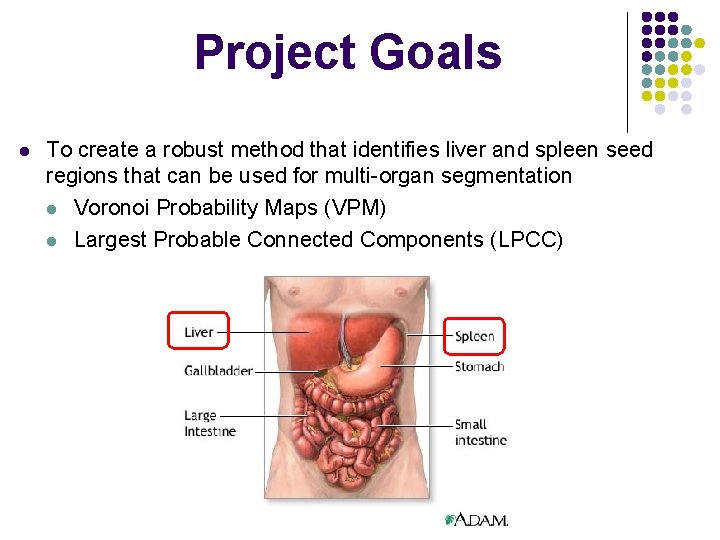
Project Goals l To create a robust method that identifies liver and spleen seed regions that can be used for multi-organ segmentation l Voronoi Probability Maps (VPM) l Largest Probable Connected Components (LPCC)
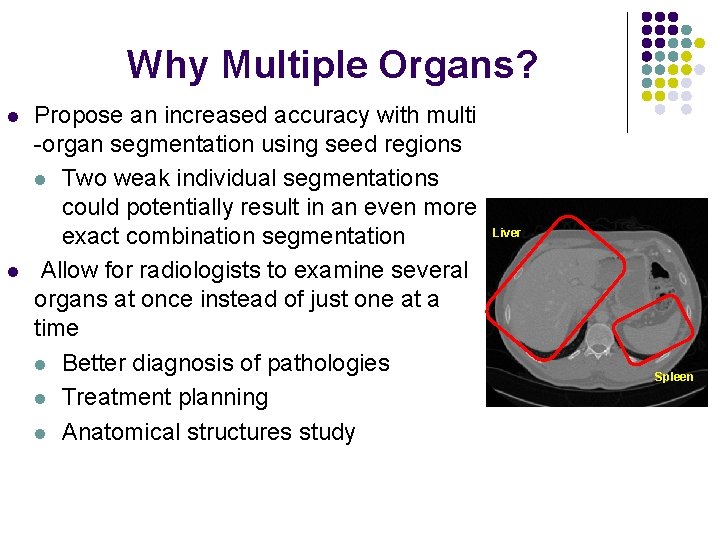
Why Multiple Organs? l l Propose an increased accuracy with multi -organ segmentation using seed regions l Two weak individual segmentations could potentially result in an even more exact combination segmentation Allow for radiologists to examine several organs at once instead of just one at a time l Better diagnosis of pathologies l Treatment planning l Anatomical structures study Liver Spleen
Purpose for Radiologists l l Check for diseases l Liver l Hepatitis (inflammation) l Cirrhosis (nodules formation) l Cancer l Spleen l Splenomegaly (enlargement) l Asplenia (abnormal function) Spread of a known disease/pathology Is a particular treatment is working for a patient? Show condition after a abdominal injury
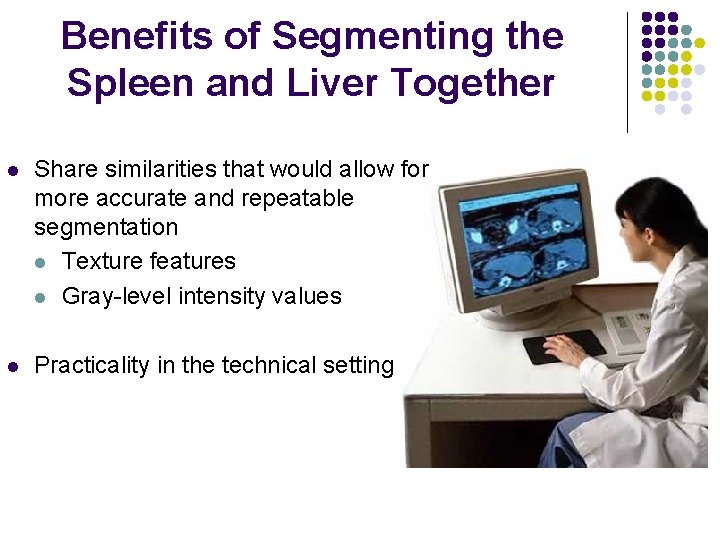
Benefits of Segmenting the Spleen and Liver Together l Share similarities that would allow for more accurate and repeatable segmentation l Texture features l Gray-level intensity values l Practicality in the technical setting
Challenges l l Spleen share similar texture features/properties to that of the liver Gray-level similarity of adjacent organs Variations in spleen and liver margins/shape Absence of the spleen Hey, where did the spleen go? ! Nick
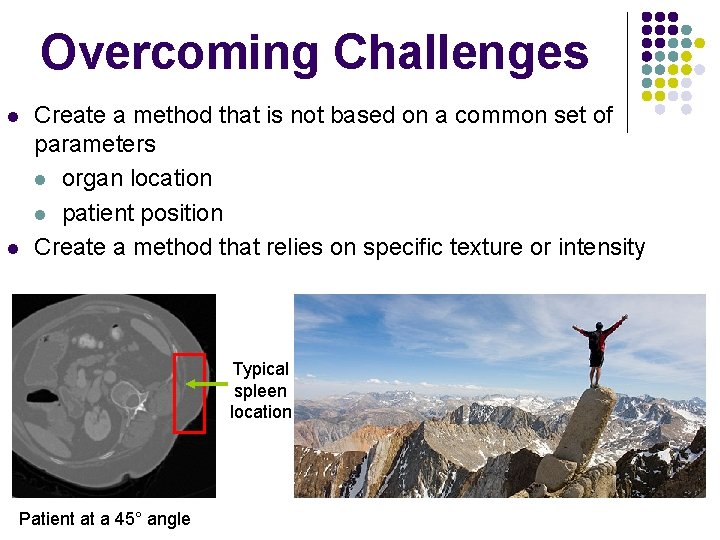
Overcoming Challenges l l Create a method that is not based on a common set of parameters l organ location l patient position Create a method that relies on specific texture or intensity Typical spleen location Patient at a 45° angle
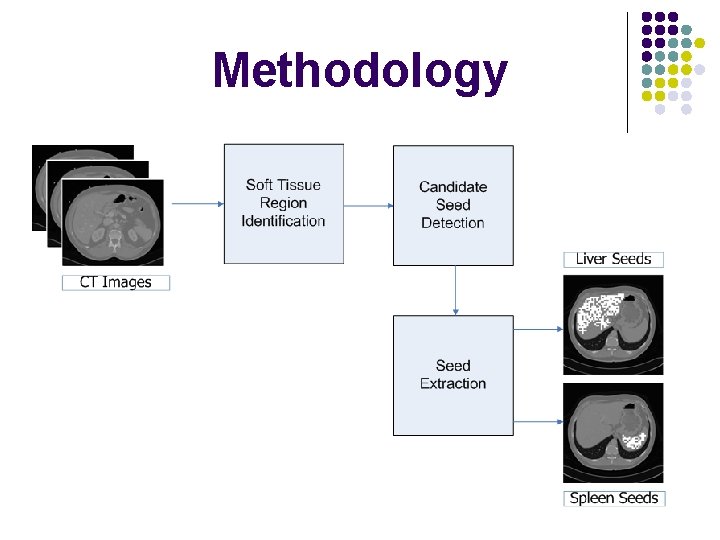
Methodology
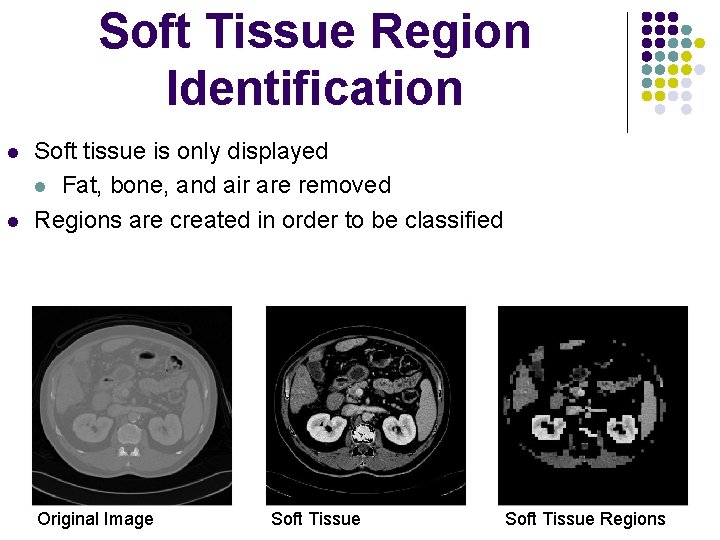
Soft Tissue Region Identification l l Soft tissue is only displayed l Fat, bone, and air are removed Regions are created in order to be classified Original Image Soft Tissue Regions
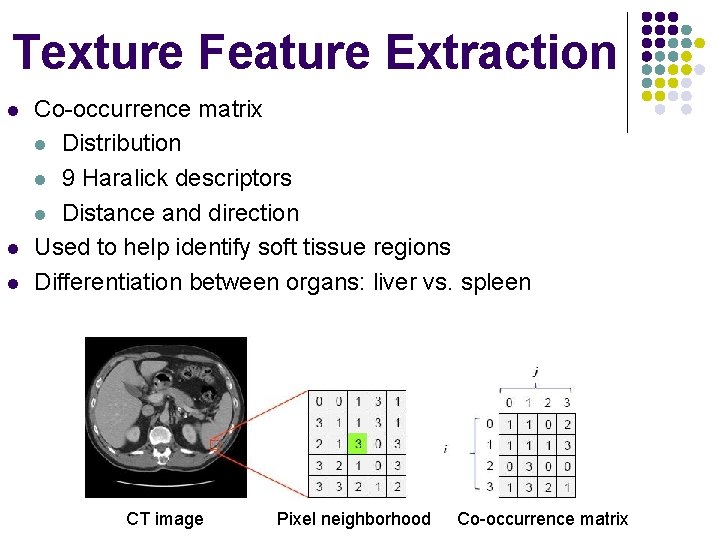
Texture Feature Extraction l l l Co-occurrence matrix l Distribution l 9 Haralick descriptors l Distance and direction Used to help identify soft tissue regions Differentiation between organs: liver vs. spleen CT image Pixel neighborhood Co-occurrence matrix
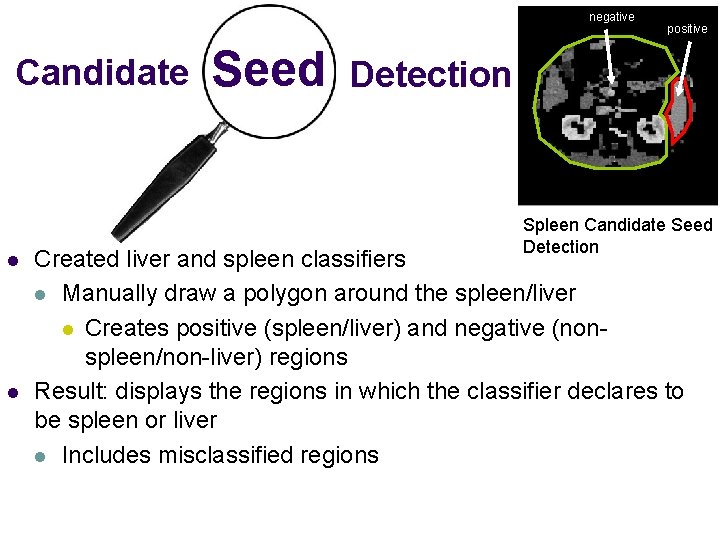
negative Candidate l l Seed positive Detection Spleen Candidate Seed Detection Created liver and spleen classifiers l Manually draw a polygon around the spleen/liver l Creates positive (spleen/liver) and negative (nonspleen/non-liver) regions Result: displays the regions in which the classifier declares to be spleen or liver l Includes misclassified regions
Seed Extraction l l Get specific organ regions l Spleen seed points are regions that ONLY contain the spleen, and same for liver. l Eliminate the misclassified regions Seeds that are extracted are used as initial points for expanding the spleen/liver regions to achieve the completely segmented organ
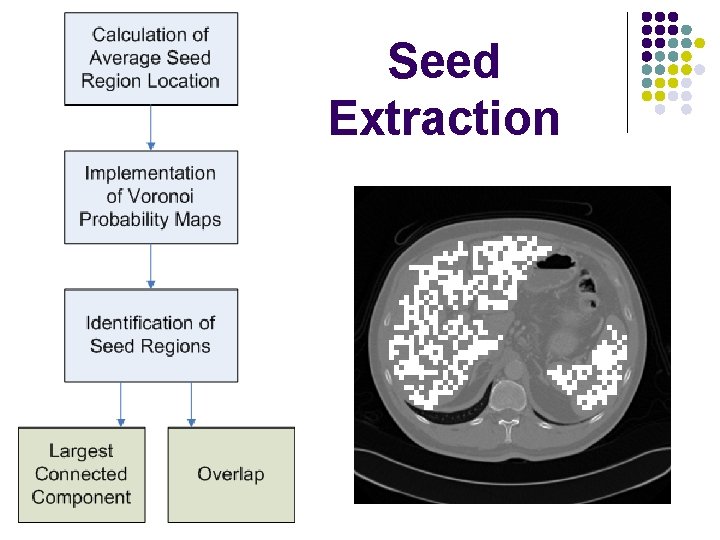
Seed Extraction

Calculation of Average Seed Region Location Finding average seed region location for both the liver and spleen Liver Candidate Seeds Average Seed Region Location Spleen Candidate Seeds

Implementation of Voronoi Probability Maps Create Voronoi probability map based on average seed region location Liver Candidate Seeds Voronoi Probability Map Spleen Candidate Seeds Probability becomes greater as the distance between seed region and bisector increases

Implementation of Voronoi Probability Maps Distance (d) between the bisector and the regions in the Voronoi region of the organ of interest is calculated, such that: d is then used to generate a probability, p, for each region: Once probability, p, is calculated, each connected component, C, is then given the value P such that:
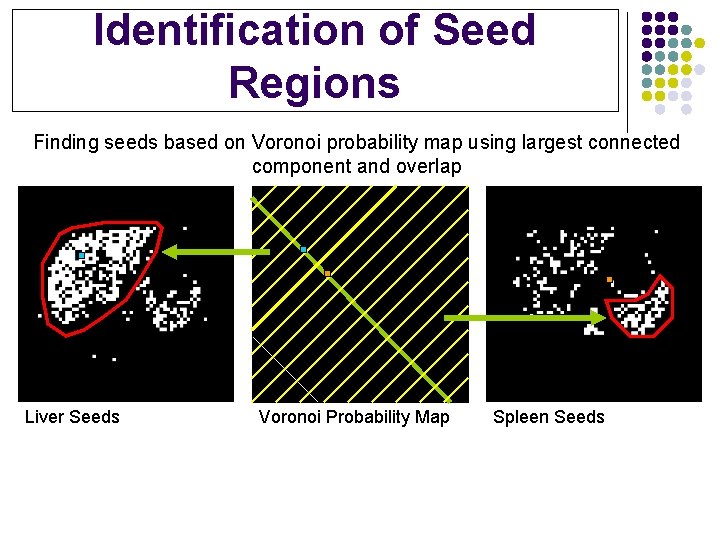
Identification of Seed Regions Finding seeds based on Voronoi probability map using largest connected component and overlap Liver Seeds Voronoi Probability Map Spleen Seeds
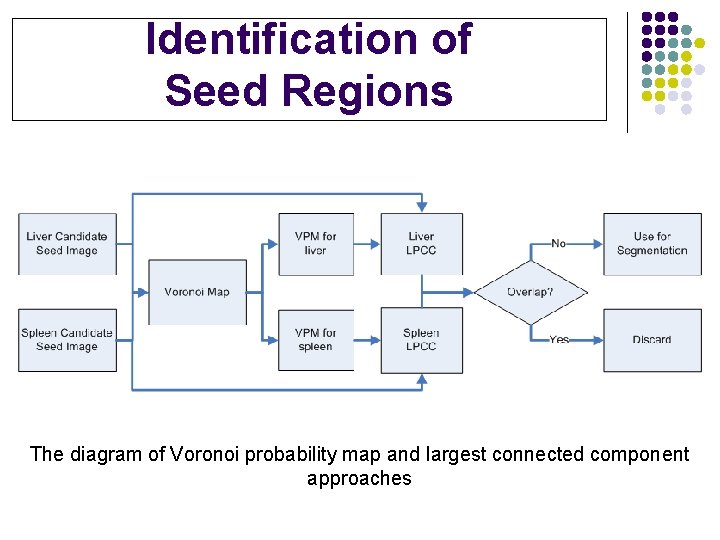
Identification of Seed Regions The diagram of Voronoi probability map and largest connected component approaches
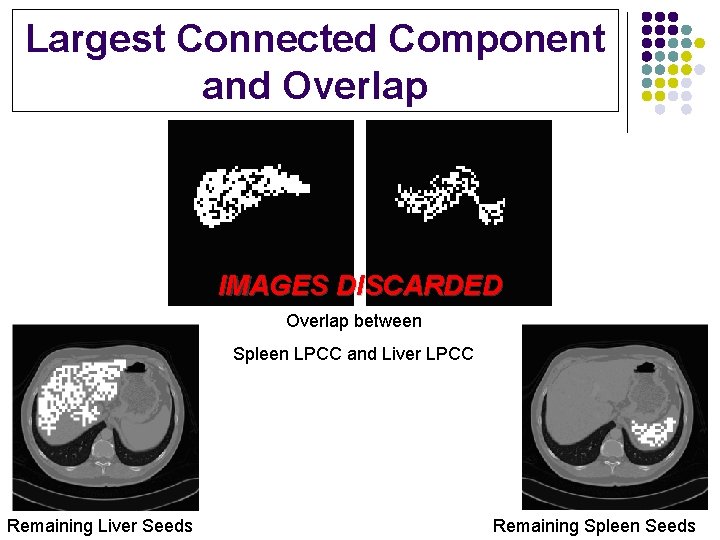
Largest Connected Component and Overlap IMAGES DISCARDED Overlap between Spleen LPCC and Liver LPCC Remaining Liver Seeds Remaining Spleen Seeds
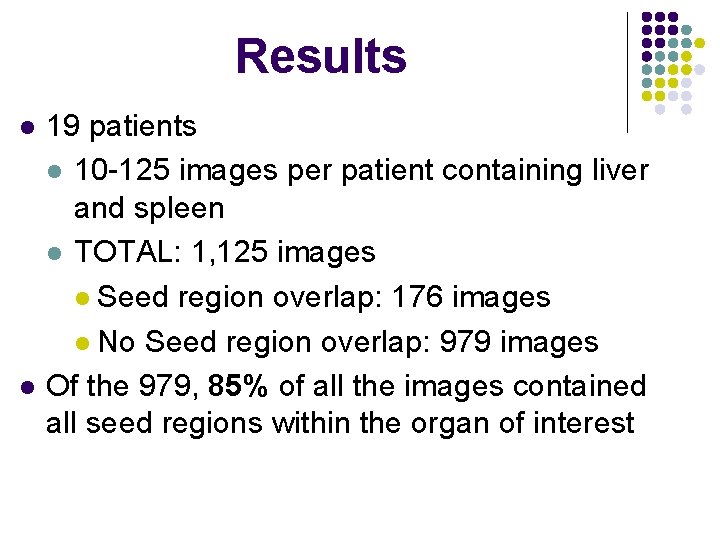
Results l l 19 patients l 10 -125 images per patient containing liver and spleen l TOTAL: 1, 125 images l Seed region overlap: 176 images l No Seed region overlap: 979 images Of the 979, 85% of all the images contained all seed regions within the organ of interest
Conclusion l l Results show that VPMs and LPCC was successful Succeeded in circumstances in which other methods failed l varying organ size l texture similarities l patient rotation Thanks to Reed’s mother!
Kidney Seed Region Detection in Abdominal CT Images PROJECT 2 By: Nicholas Cooper, Northern Kentucky University Maureen Kelly, Loyola University Chicago Jacob Furst, De. Paul University Daniela Raicu, De. Paul University REU Medical Informatics e. Xpericence (Med. IX) 2008 De. Paul University Northwestern University of Chicago Thursday, August 22, 2008
Topics of Discussion 1. 2. 3. 4. 5. 6. 7. 8. Project Goals Why Kidneys? Challenge: Why Not Use Previous Method? Overcoming Challenges Methodology Results Conclusion Future Work
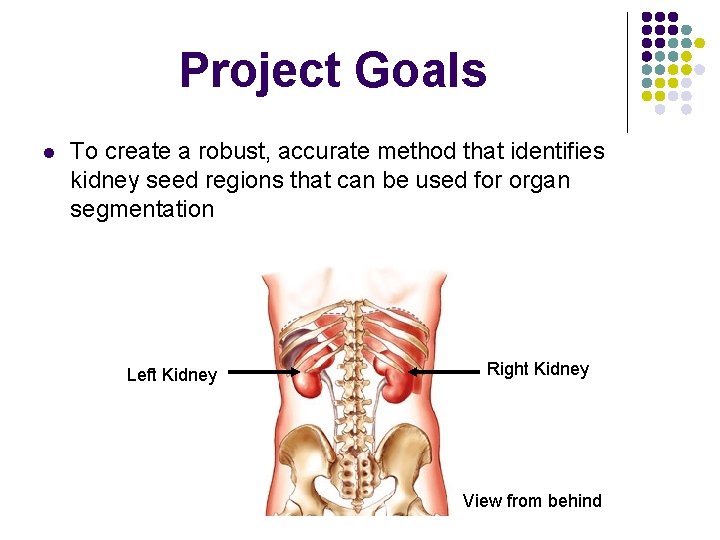
Project Goals l To create a robust, accurate method that identifies kidney seed regions that can be used for organ segmentation Left Kidney Right Kidney View from behind
Why Kidneys? l Detection, prevention, treatment l disease l l l One in nine Americans have chronic kidney disease (National Kidney Disease Foundation) Nephritis (inflammation) abdominal injury
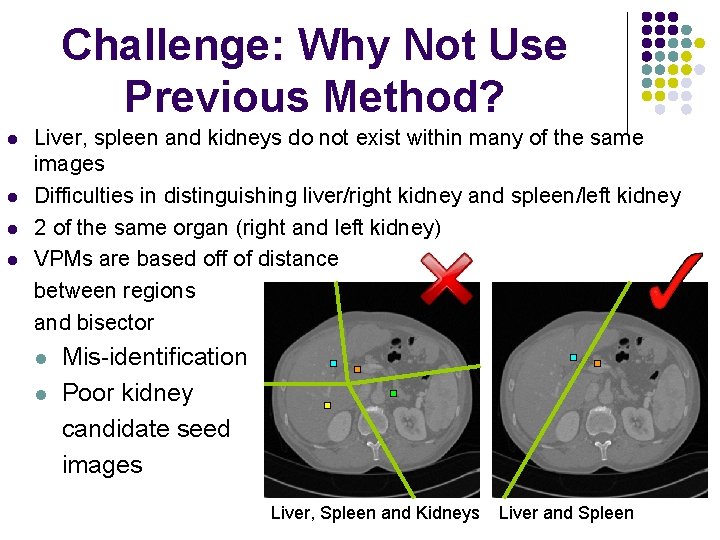
Challenge: Why Not Use Previous Method? l l Liver, spleen and kidneys do not exist within many of the same images Difficulties in distinguishing liver/right kidney and spleen/left kidney 2 of the same organ (right and left kidney) VPMs are based off of distance between regions and bisector l l Mis-identification Poor kidney candidate seed images Liver, Spleen and Kidneys Liver and Spleen
Overcoming Challenges l l l Use kidney’s high Hounsfield unit (HU) value to our advantage Use spine l Kidneys are located on either side of the spine Use revised probability map approach l Elliptical-shaped probability map (ESPM)
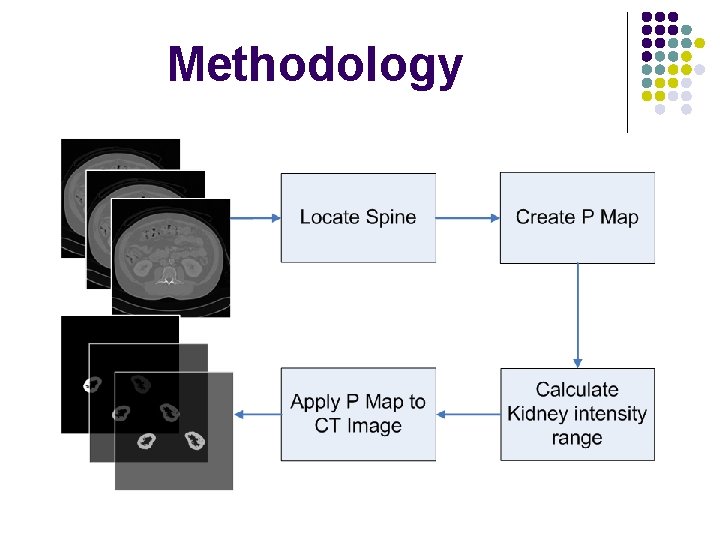
Methodology
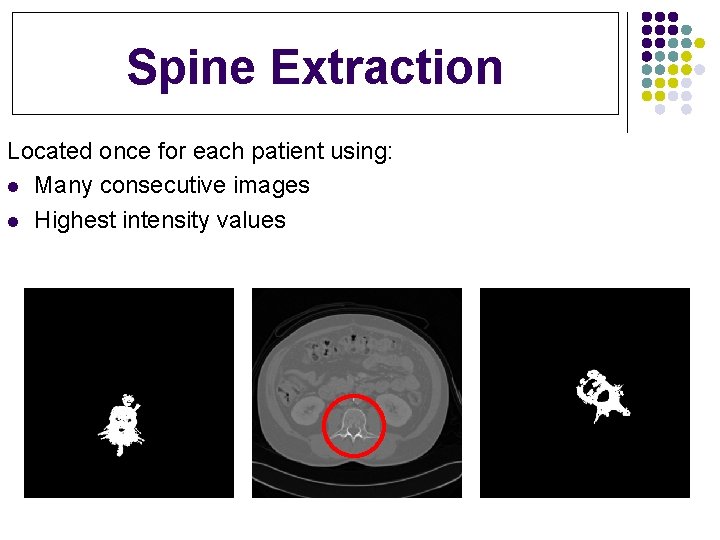
Spine Extraction Located once for each patient using: l Many consecutive images l Highest intensity values
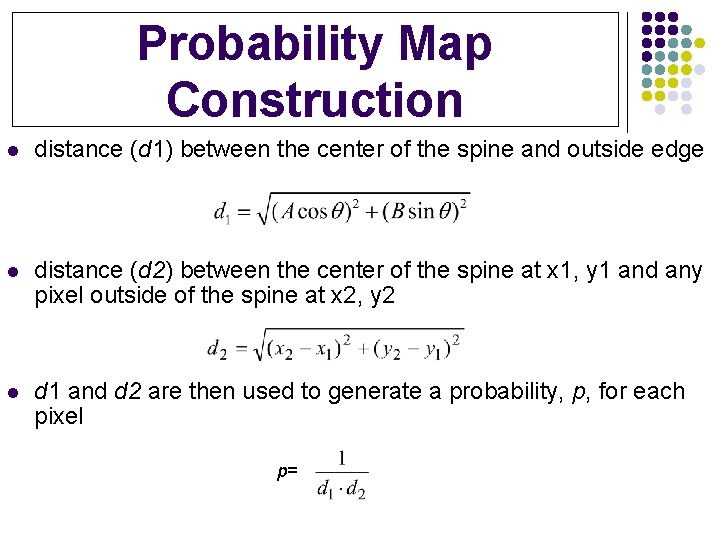
Probability Map Construction l distance (d 1) between the center of the spine and outside edge l distance (d 2) between the center of the spine at x 1, y 1 and any pixel outside of the spine at x 2, y 2 l d 1 and d 2 are then used to generate a probability, p, for each pixel p=
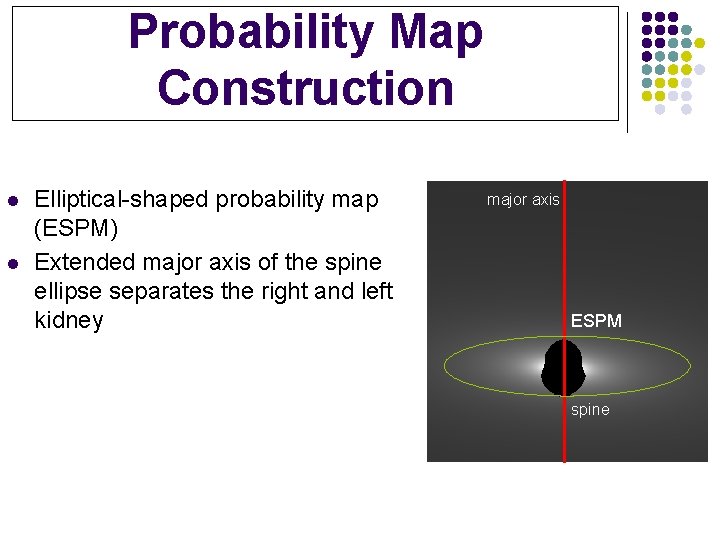
Probability Map Construction l l Elliptical-shaped probability map (ESPM) Extended major axis of the spine ellipse separates the right and left kidney major axis ESPM spine
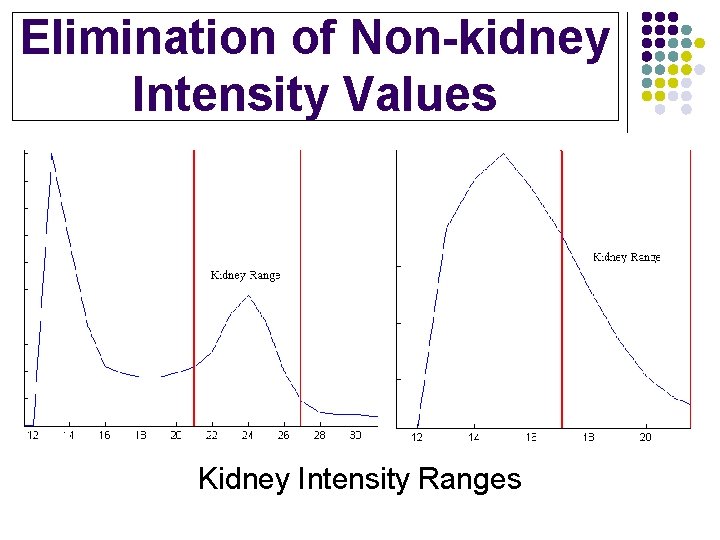
Elimination of Non-kidney Intensity Values Kidney Intensity Ranges
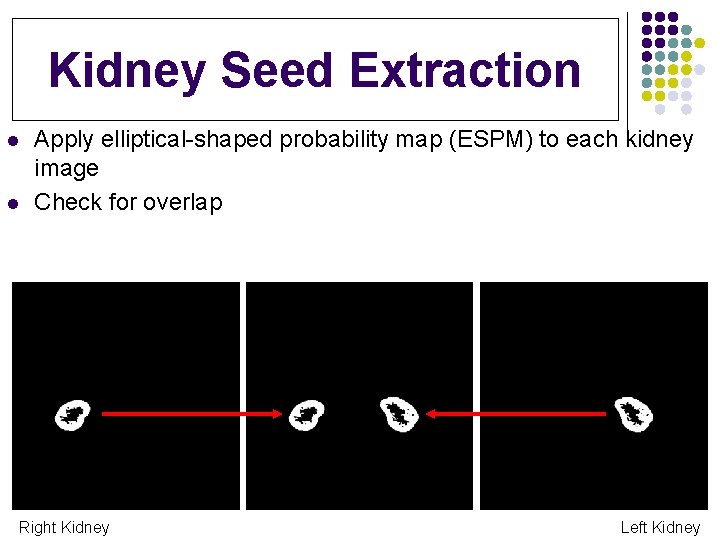
Kidney Seed Extraction l l Apply elliptical-shaped probability map (ESPM) to each kidney image Check for overlap Right Kidney Left Kidney
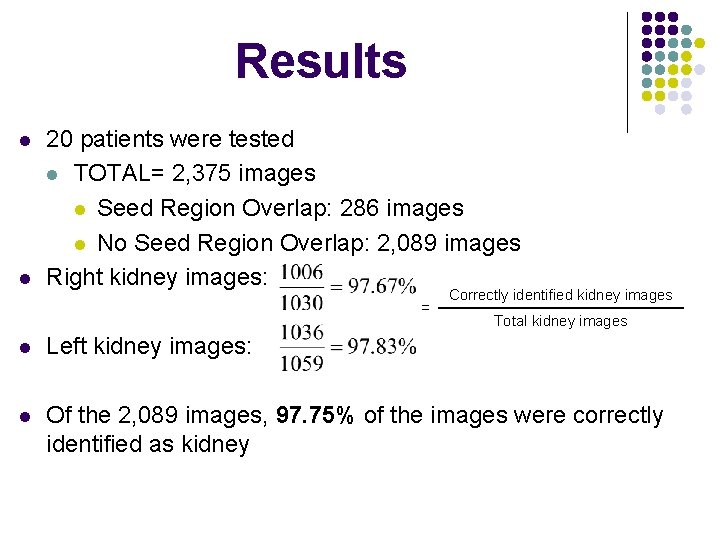
Results l l 20 patients were tested l TOTAL= 2, 375 images l Seed Region Overlap: 286 images l No Seed Region Overlap: 2, 089 images Right kidney images: = Correctly identified kidney images Total kidney images l Left kidney images: l Of the 2, 089 images, 97. 75% of the images were correctly identified as kidney
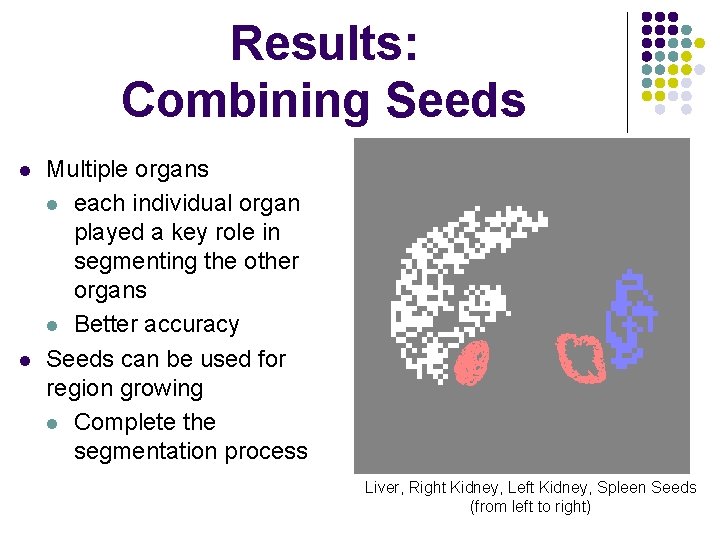
Results: Combining Seeds l l Multiple organs l each individual organ played a key role in segmenting the other organs l Better accuracy Seeds can be used for region growing l Complete the segmentation process Liver, Right Kidney, Left Kidney, Spleen Seeds (from left to right)
Conclusion l l Results prove that this method is very successful l Accurate l Reliable l Time-efficient Comparable results on other patient data sets?
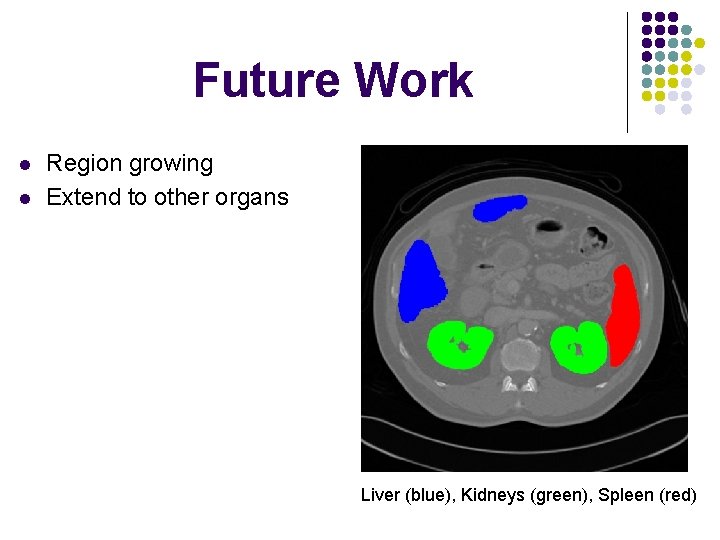
Future Work l l Region growing Extend to other organs Liver (blue), Kidneys (green), Spleen (red)

The End Any Questions? ? Thanks to Reed’s Mom again!
- Slides: 40